
Mexico Rail Asset Management Market (2025-2030)

The Mexico Rail Asset Management Market was valued at $87.3 Million in 2025 and projected to reach to $128.8 Million by 2030, representing a compound annual growth rate of 8.1%. Mexico's rail asset management market is positioned for sustained expansion through 2030, driven by government infrastructure investments and the private sector's commitment to digital transformation.


| Market Size in | USD 26.32 MN |
| Market Forecast in | |
| CAGR | |
| Forecast Period | |
| Units Considered | Value (USD MN) |
Mexico Rail Asset Management Market Trends and Insights
- This 8.1% compound annual growth rate reflects Mexico's increasing investment in modernizing its rail infrastructure and adopting digital asset management solutions.
- Mexico's rail sector is leveraging advanced technologies to optimize operational efficiency, reduce maintenance costs, and enhance safety across its expanding network. The expansion of Mexico's rail asset management market is driven by government initiatives to upgrade aging rail infrastructure and the growing adoption of IoT and predictive maintenance technologies.
- Mexico's freight and passenger rail operators are increasingly implementing comprehensive asset management systems to improve asset lifecycle visibility and reduce downtime.
- Between 2025 and 2030, Mexico is expected to see significant capital investments in rail modernization, positioning the country as a key growth market within Latin America's transportation technology sector..
Key Market Statistics
- CAGR (2025-2030) 8.1% CAGR
- Market Size, 2025 ~USD 87.3 Million
- Forecast, 2030 ~USD 128.8 Million
- Country Mexico
Mexico Rail Asset Management Market Overview
Market Valuation Growth :
Mexico's rail asset management market is valued at $87.3 million in 2025, with projections reaching $128.8 million by 2030, representing a strong 8.1% CAGR that outpaces the global average of 6.6%.
Infrastructure Modernization :
Mexico is significantly investing in rail infrastructure modernization, driving adoption of digital asset management solutions across freight and passenger rail networks to improve operational efficiency.
Technology Integration :
Mexican rail operators are increasingly implementing advanced technologies including IoT sensors, predictive maintenance systems, and cloud-based asset tracking to optimize fleet performance and reduce downtime.
Regional Economic Impact :
The growth in Mexico's rail asset management sector is supported by government initiatives to enhance logistics corridors and cross-border freight operations, particularly along major trade routes.
Mexico Rail Asset Management Market Dynamics
- The country's strategic geographic location as a trade hub between North America and Latin America creates significant demand for efficient rail asset management solutions.
- Operators are prioritizing predictive maintenance and real-time monitoring capabilities to reduce operational costs and improve service reliability.
- The convergence of aging infrastructure requiring modernization and increasing adoption of Industry 4.0 technologies presents substantial opportunities for solution providers.
- Mexico's rail sector is expected to continue leveraging advanced analytics and automation to enhance asset utilization and extend equipment lifespan..
Market Ecosystem
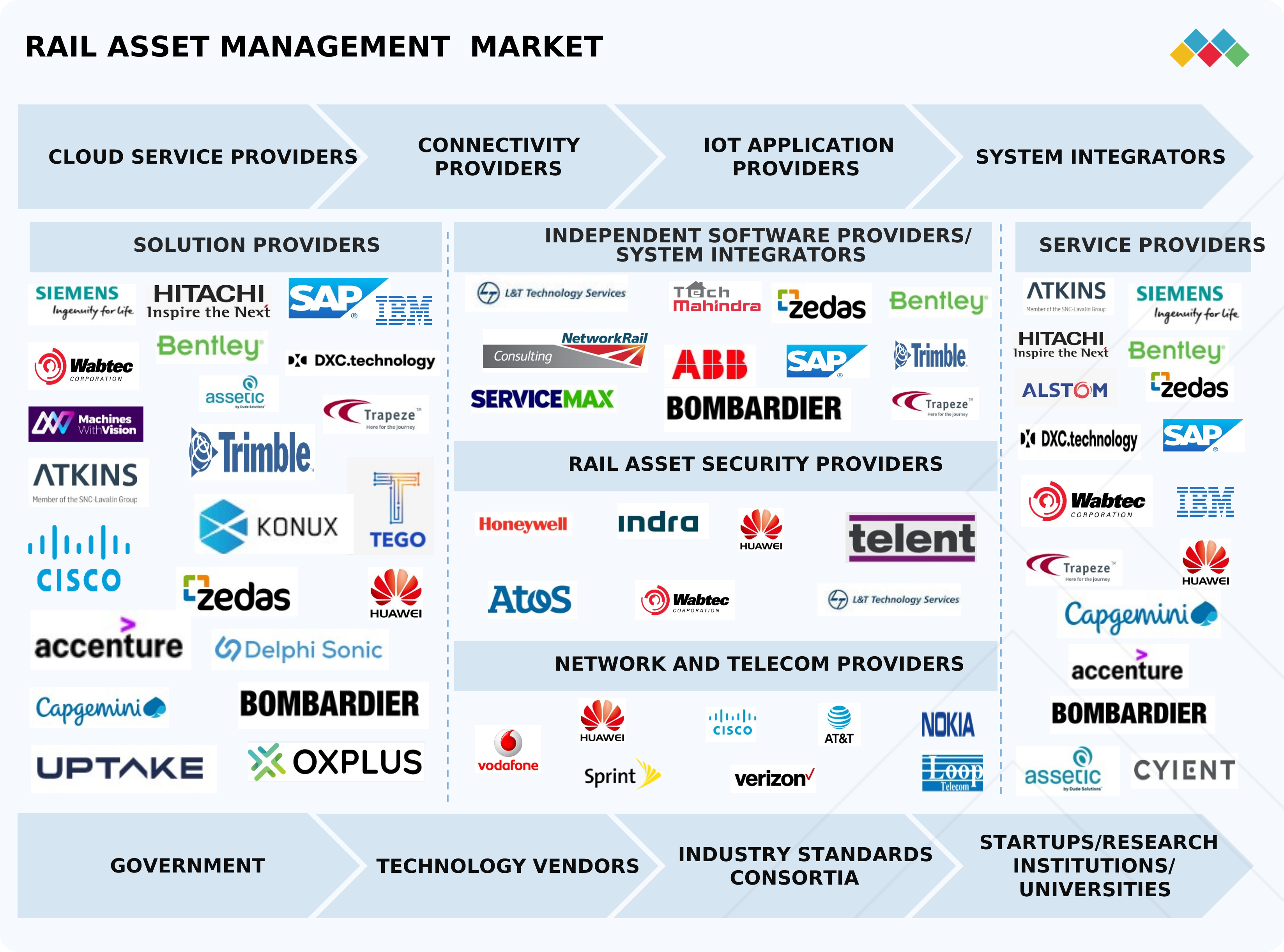
Rail asset management market: COMMERCIAL USE CASES ACROSS INDUSTRIES
| COMPANY | USE CASE DESCRIPTION | BENEFITS |
|---|---|---|
 |
Deployment of predictive maintenance platforms using IoT sensors and digital twins to monitor rolling stock health in real-time. | Minimizes downtime, reduces maintenance costs, extends asset lifecycle, and improves safety. |
 |
Implementation of integrated rail asset management systems combining data from rolling stock, signaling, and infrastructure for unified monitoring. | Enhances operational efficiency, provides better decision-making, and reduces operational risks. |
 |
Use of condition-based monitoring solutions for signaling systems and rolling stock to detect anomalies before failure occurs. | Increases reliability of services, improves punctuality, and reduces unexpected failures. |
 |
Leveraging AI-driven analytics and cloud-based asset management platforms (Maximo) for rail infrastructure and rolling stock. | Optimizes maintenance schedules, enables proactive asset management, and lowers operational expenses. |
 |
Deployment of railway performance management systems including fuel efficiency monitoring, asset tracking, and predictive analytics. | Improves energy efficiency, enhances fleet utilization, and supports sustainable rail operations. |
Logos and trademarks shown above are the property of their respective owners. Their use here is for informational and illustrative purposes only.
Related Ecosystem
Digitalization And Iot
- Sensors
- Remote Monitoring
- Supply Chain Management
- Passenger Information System (PIS)
- Platform as A Service (PaaS)
- International Business Machines Corporation
- Cisco Systems, Inc.
- MICROSOFT CORPORATION
- Oracle Corporation
- HUAWEI TECHNOLOGIES CO LTD
Software And Services
- Natural Language Processing (NLP)
- Machine Learning
- Supply Chain Management
- Predictive Analytics
- Image Sensors
- International Business Machines Corporation
- MICROSOFT CORPORATION
- Oracle Corporation
- SAP SE
- Amazon.com, Inc.
Key Takeaways
- Mexico's rail asset management market will grow from $87.3M (2025) to $128.8M (2030) at an 8.1% CAGR.
- Mexico is adopting predictive maintenance and IoT technologies to optimize rail asset performance and reduce operational costs.
- Government infrastructure modernization initiatives are accelerating digital transformation across Mexico's rail sector.
- Mexico represents a high-growth opportunity within Latin America's rail asset management landscape.
Rail Asset Management Market Report Scope
| Report Metric | Details |
|---|---|
| Base Year | 2025 |
| Fastest Growing Segment | MANAGED SERVICES (Service) |
| Forecast Period | 2025-2030 |
| Growth Rate | CAGR of 6.6% from 2025 to 2030 |
| Largest Segment | RAIL TRAFFIC MANAGEMENT (Solutions) |
| Market Size Base Year (Billions) | ~USD 12.78 (2025) |
| Revenue Forecast (Billions) | ~USD 17.59 (2030) |
| Segments Covered | Offering, Solution, Asset Performance Management Type, Service, Professional Service, Application, Type, Solutions, Component |
Mexico Rail Asset Management Market Report Segmentation
9 segment dimensions are covered across the global market.
By Offering
- Services
- Solutions
By Solution
- Analytics
- Apm
- Asset Planning & Scheduling
- Network Management
- Other Solutions
- Predictive Maintenance
- Remote Monitoring
- Route Optimization & Scheduling
- Security
- Workforce Management
By Asset Performance Management Type
- Condition Monitoring
- Predictive Maintenance
By Service
- Managed Services
- Professional Services
By Professional Service
- Consulting & Training
- Consulting And Training
- Support & Maintenance
- Support And Maintenance
- System Integration & Deployment
- System Integration And Deployment
By Application
- Asset Management
- Infrastructure
- Other Applications
- Pis
- Rail Operations Management
- Rolling Stock
- Subways
- Trains
By Type
- Alarm/Alert Systems
- Consulting
- Freight Management System
- Managed Services
- Passenger Information System
- Peds/Psds
- Professional Services
- Rail Analytics System
- Rail Asset Management And Maintenance Solutions
- Rail Communication And Networking System
- Rail Operation And Control Solutions
- Security And Safety Solutions
- Sensors
- Smart Ticketing System
- Support & Maintenance
- Support And Maintenance
- System Integration & Deployment
- System Integration And Deployment
- Training, Support, And Maintenance
- Video Surveillance Systems
By Solutions
- Asset Management
- Intelligent In-Train Solutions
- Other Solutions
- Rail Operations Management
- Rail Traffic Management
By Component
- Services
- Solutions
Target Audience
- Rail Operators & Fleet Managers : Mexican rail companies need market intelligence to benchmark their asset management capabilities, identify technology gaps, and plan digital transformation investments to remain competitive in the growing market.
- Technology Solution Providers : Software and hardware vendors targeting Mexico's rail sector require detailed market data to understand demand drivers, customer pain points, and growth opportunities for asset management solutions.
- Infrastructure Investment Firms : Private equity and infrastructure investors evaluating opportunities in Mexico's rail sector need market analysis to assess growth potential, identify acquisition targets, and structure investment theses.
- Government & Policy Makers : Mexican transportation authorities and government agencies use market research to inform infrastructure policy, funding allocation, and modernization initiatives aligned with sector growth trends.
- System Integrators & Consultants : Implementation partners and management consultants serving Mexico's rail industry require market insights to advise clients on technology adoption strategies and competitive positioning in the evolving landscape.
Reasons to Buy this Report
- Market-Specific Growth Data : Access detailed Mexico-focused market sizing, forecasts, and CAGR analysis that demonstrates the 8.1% growth opportunity, enabling informed investment and expansion decisions in this high-growth segment.
- Competitive Landscape Intelligence : Understand Mexico's unique competitive dynamics, local player strategies, and market consolidation trends specific to the country's rail asset management sector to identify partnership and acquisition opportunities.
- Infrastructure Investment Tracking : Monitor government and private sector rail modernization initiatives in Mexico, including funding announcements, project timelines, and technology adoption patterns to align sales and product strategies.
- Technology Adoption Insights : Gain visibility into Mexico-specific technology adoption rates for IoT, predictive maintenance, and cloud solutions in rail operations, helping vendors tailor offerings to local market needs and maturity levels.
- Strategic Market Entry Planning : Leverage Mexico-specific market data to develop targeted go-to-market strategies, identify key customer segments, and assess regulatory requirements for successful market penetration and revenue growth.
Frequently asked questions
What is the current size of Mexico's rail asset management market?
Mexico's rail asset management market is valued at $87.3 million in 2025 and is projected to reach $128.8 million by 2030.
What is the growth rate of Mexico's rail asset management market?
Mexico's rail asset management market is growing at a compound annual growth rate (CAGR) of 8.1% from 2025 to 2030.
What technologies are driving growth in Mexico's rail asset management market?
Mexico's rail asset management market is being driven by the adoption of IoT sensors, predictive maintenance platforms, cloud-based asset tracking systems, and advanced analytics solutions.
Which sectors in Mexico are investing in rail asset management solutions?
Mexico's freight rail operators, passenger rail services, and government transportation agencies are the primary investors in rail asset management technologies.
What factors are supporting Mexico's rail asset management market expansion?
Mexico's market expansion is supported by government infrastructure modernization programs, aging rail infrastructure requiring upgrades, and the need to improve operational efficiency and safety standards.
RESEARCH METHODOLOGY
The study involved four major activities in estimating the current size of the rail asset management market. Exhaustive secondary research was done to collect information on the logistics industry. The next step was to validate these findings, assumptions, and sizing with industry experts across the value chain using primary research. Both top-down and bottom-up approaches were employed to estimate the total market size. After that, the market breakup and data triangulation procedures were used to estimate the market size of the segments and sub-segments of the rail asset management market.
Secondary Research
In the secondary research process, various sources were referred to for identifying and collecting information for the study. The secondary sources included annual reports, press releases, and investor presentations of companies; white papers, journals, and certified publications; and articles from recognized authors, directories, and databases. The data was also collected from secondary sources, such as the OECD and the International Railway Journal, and information from the Railway Gazette International and the US DoT. Additionally, railway spending of various countries was extracted from their respective transportation associations, such as Société Nationale Des Chemins De Fer Français (SNCF), Taiwan Railways Administration (TRA), Passenger Rail Agency of South Africa (PRASA), European Rail Freight Association, and European Union (EU) Agency for Railways.
Primary Research
In the primary research process, various primary sources from both supply and demand sides were interviewed to obtain qualitative and quantitative information about the market. The primary sources from the supply side included various industry experts, such as Chief Experience Officers (CXOs), Vice Presidents (VPs), directors from business development, marketing, product development/innovation teams, related key executives from rail asset management solution vendors, system integrators, professional and Managed Service Providers (MSPs), industry associations, independent asset management and railway consultants, and key opinion leaders.
Primary interviews were conducted to gather insights, such as market statistics, data on revenue collected from the products and services, market breakups, market size estimations, market forecasting, and data triangulation. Furthermore, primary research helped in understanding the various trends related to technology, application, deployment mode, and region. Stakeholders from the demand side such as Chief Information Officers (CIOs), Chief Technology Officers (CTOs), Chief Strategy Officers (CSOs), and installation teams of governments/end users using rail asset management solutions were interviewed to understand the buyer’s perspective on suppliers, products, and service providers and their current usage of rail asset management solutions, which will affect the overall rail asset management market.
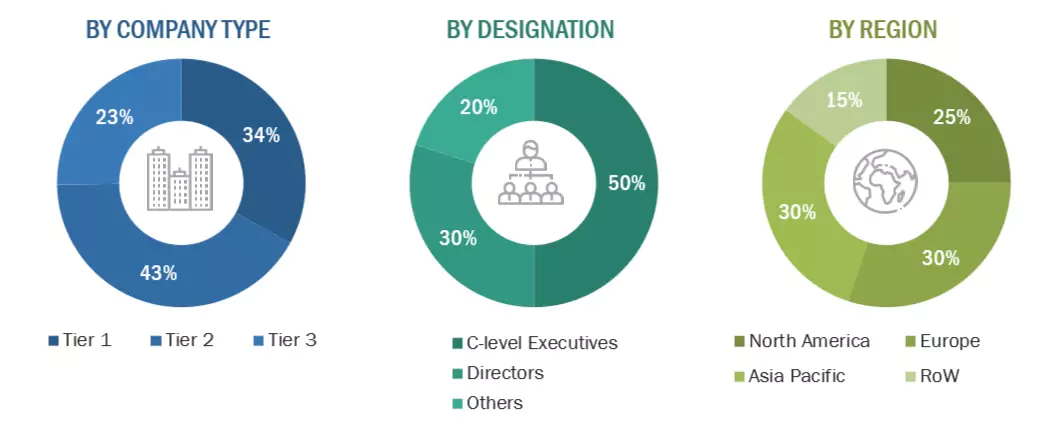
Note: Tier 1 companies have revenues over USD 1 billion; tier 2 companies have revenues ranging
from USD 500 million to USD 1 billion, and tier 3 companies have revenues ranging from USD 100 million to
USD 500 million
*Others include sales managers, marketing managers, and product managers.
**Rest of the World (RoW) includes MEA and Latin America.
Source: Industry Experts
To know about the assumptions considered for the study, download the pdf brochure
Market Size Estimation
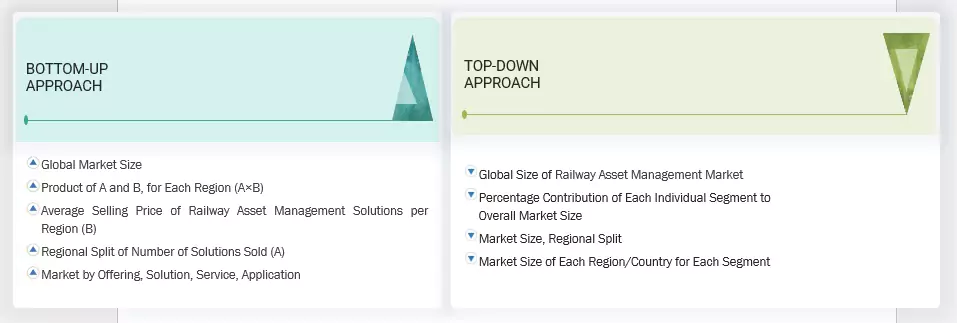
The top-down and bottom-up approaches were used to estimate and validate the size of the global rail asset management market and various other dependent submarkets in the overall market. An exhaustive list of all the vendors offering solutions and services in the rail asset management market was prepared while using the top-down approach. The market share for all the vendors in the market was estimated through annual reports, press releases, funding, investor presentations, paid databases, and primary interviews. Each vendor was evaluated based on its offering (solutions and services). The aggregate of all companies’ revenues was extrapolated to reach the overall market size.
Further, each subsegment was studied and analyzed for its global market size and regional penetration. The markets were triangulated through both primary and secondary research. The primary procedure included extensive interviews with industry leaders, such as Chief Executive Officers (CEOs), Vice Presidents (VPs), directors, and managers, for key insights.
Rail Asset Management Market : Top-Down and Bottom-Up Approach
Data Triangulation
After arriving at the overall market size using the market size estimation processes as explained above, the market was split into several segments and subsegments. The data triangulation and market breakup procedures were employed, wherever applicable, to complete the overall market engineering process and arrive at the exact statistics of each market segment and subsegment. The data was triangulated by studying various factors and trends from both the demand and supply sides.
Market Definition
The rail asset management system is a safe, reliable, substantial, and efficient approach to managing the entire rail infrastructure. It includes all the systems, procedures, methods, and tools that are used to optimize the performance, costs, and risks for the entire rail infrastructure lifecycle. The system helps reduce operational costs for rail infrastructure assets, such as signals, electrification systems, rail tracks, and rolling stocks. It further helps in ensuring top-notch performance, which elevates the reliability of the rail services. Rail asset management includes Asset Performance Management (APM), analytics, asset planning and scheduling, security, workforce management, and network management.
Stakeholders
- Rail Asset Management Vendors
- Network and System Integrators (SIs)
- Cloud Service Providers
- Rail Asset Management Infrastructure Providers
- Rail Asset Management Support Service Providers
- National Railway Governing Authorities/Regulators/Bodies
- Railway Operators and Agencies
- Value-added Resellers (VARs) and Distributors
Report Objectives
- To describe and forecast the size of the rail asset management market by offering, application, and region
- To describe and forecast the size of the market segments with respect to five main regions: North America, Europe, Asia Pacific (APAC), Latin America, and the Middle East & Africa (MEA)
- To provide detailed information regarding drivers, restraints, opportunities, and challenges influencing the growth of the rail asset management market
- To analyze micromarkets with respect to the individual growth trends, prospects, and contributions to the overall rail asset management market
- To analyze opportunities in the market for stakeholders by identifying the high-growth segments
- To profile key market players, including top vendors and startups, provide comparative analysis based on business overviews, regional presence, product offerings, business strategies, and key financials, and provide a detailed competitive landscape of the market
- To analyze competitive developments, such as mergers and acquisitions (M&A); new product launches and product enhancements; agreements, partnerships, and collaborations; expansions; and research and development (R&D) activities in the market
Available Customizations
With the given market data, MarketsandMarkets offers customizations as per the company’s specific needs. The following customization options are available for the report:
Country-wise information
- Analysis for additional countries (up to five)
Company Information
- Detailed analysis and profiling of additional market players (up to 5)
Get the Full Rail Asset Management Market Report
Full forecast, segment splits, and company analysis for all Rail Asset Management Market.
- Canada Rail Asset Management Market
- US Rail Asset Management Market
- UK Rail Asset Management Market
- China Rail Asset Management Market
- Nigeria Rail Asset Management Market
- Brazil Rail Asset Management Market
- France Rail Asset Management Market
- Germany Rail Asset Management Market
- Rest Of Europe Rail Asset Management Market
- India Rail Asset Management Market
- Japan Rail Asset Management Market
- Rest Of Asia Pacific Rail Asset Management Market
- Rest Of Latin America* Rail Asset Management Market
- South Africa Rail Asset Management Market
Need a Tailored Report?
Customize this report to your needs
Get 10% FREE Customization
Customize This Report
