
Brazil Rolling Stock Market (2025-2030)

The Brazil Rolling Stock Market was valued at $2201 Million in 2025 and projected to reach to $2699 Million by 2030, representing a compound annual growth rate of 3.0%. Brazil's rolling stock market is positioned for steady growth driven by sustained government commitment to infrastructure modernization and urban transit expansion.


| Market Size in | USD 26.32 MN |
| Market Forecast in | |
| CAGR | |
| Forecast Period | |
| Units Considered | Value (USD MN) |
Brazil Rolling Stock Market Trends and Insights
- Brazil's market expansion is driven by infrastructure modernization initiatives, increased urbanization, and government investments in rail and transit systems across the country.
- The steady growth trajectory reflects Brazil's commitment to enhancing transportation capacity and reducing congestion in major metropolitan areas. During the 2025–2030 forecast period, Brazil's rolling stock sector will benefit from rising demand for passenger and freight rail solutions.
- Brazil's strategic focus on sustainable mobility and the replacement of aging fleet assets will support market expansion.
- Key market participants are positioning themselves to capitalize on Brazil's infrastructure development programs and the country's emphasis on efficient, environmentally responsible transportation networks..
Key Market Statistics
- CAGR (2025-2030) 3.0% CAGR
- Market Size, 2025 ~USD 2201 Million
- Forecast, 2030 ~USD 2699 Million
- Country Brazil
Brazil Rolling Stock Market Overview
Market Size & Growth :
Brazil's rolling stock market is valued at USD 2,201 million in 2025, with projected growth to USD 2,699 million by 2030, representing a steady 3.0% CAGR.
Infrastructure Modernization :
Government-led rail and transit system upgrades across major Brazilian cities are driving demand for new rolling stock and fleet modernization initiatives.
Urbanization Trends :
Rapid urbanization in Brazil is increasing pressure on public transportation systems, spurring investments in metro, commuter rail, and light rail solutions.
Regional Performance :
Brazil's 3.0% CAGR trails the global market growth of 4.4%, indicating opportunities for accelerated expansion through strategic infrastructure investments.
Brazil Rolling Stock Market Dynamics
- Major metropolitan areas including São Paulo, Rio de Janeiro, and Brasília are investing in fleet renewal and capacity expansion to accommodate growing passenger demand.
- The market benefits from increasing urbanization rates and the need to modernize aging transit systems across the country. Looking ahead to 2030, Brazil's rolling stock sector will likely see continued momentum from public-private partnerships and federal funding allocations for rail infrastructure.
- However, growth rates remain moderate compared to global benchmarks, suggesting untapped potential for accelerated development.
- Strategic investments in suburban rail networks and metro extensions present significant opportunities for market participants..
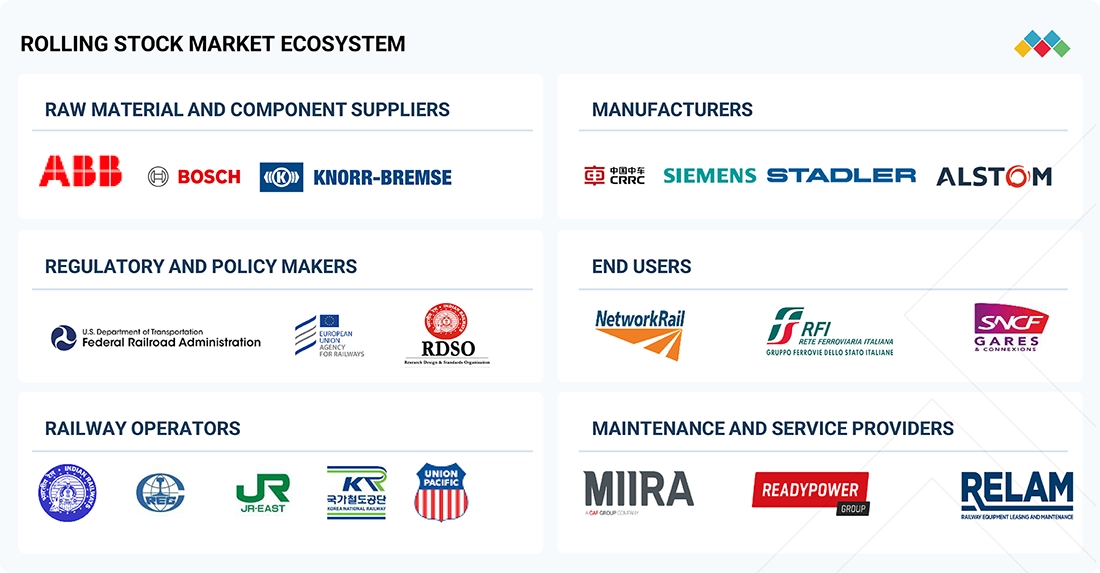
Market Ecosystem
ROLLING STOCK MARKET: COMMERCIAL USE CASES ACROSS INDUSTRIES
| COMPANY | USE CASE DESCRIPTION | BENEFITS |
|---|---|---|
 |
Operates freight trains to efficiently transport automotive parts and manufactured goods across multiple European countries | Reduces road congestion, lowers overall transport costs, and ensures the timely delivery of goods across long distances |
 |
Uses heavy-duty freight wagons to move large volumes of iron ore from remote mines to coastal ports for export | Enables high-volume bulk transport efficiently, reduces reliance on road transport, and supports large-scale mining operations |
 |
Operates electric multiple units (EMUs) to transport millions of daily commuters across the metropolitan area reliably | Provides fast, energy-efficient, and reliable urban mobility while reducing traffic congestion and emissions |
 |
Uses rail freight to transport large volumes of consumer goods from central warehouses to regional distribution hubs | Accelerates delivery times, reduces carbon emissions compared to road transport, and optimizes long-distance logistics |
 |
Transports chemicals and petrochemical products in specialized tank wagons safely across Europe | Facilitates bulk movement while minimizing handling risks, ensuring safety, and maintaining product quality during transit |
Logos and trademarks shown above are the property of their respective owners. Their use here is for informational and illustrative purposes only.
Related Ecosystem
Locomotives And Rolling Stock
- Sensors
- Passenger Information System (PIS)
- Cartesian Robots
- Flow Sensors
- Gas Sensors
- Siemens ag
- Alstom s.a.
- Hitachi, Ltd.
- Knorr-bremse ag
- RAILPROS
Logistics And Transportation
- Internal Combustion Engine (ICE)
- Crawler Excavator
- Fuel Cell
- Light Commercial Vehicles (LCVs)
- Sensors
- Siemens ag
- Alstom s.a.
- Hitachi, Ltd.
- Godrej Industries Limited
- ABB India Limited
Key Takeaways
- Brazil's rolling stock market is valued at USD 2,201 million in 2025 and will reach USD 2,699 million by 2030, growing at a 3.0% CAGR.
- Infrastructure modernization and urbanization are primary growth drivers for Brazil's rolling stock sector.
- Brazil's emphasis on sustainable mobility and fleet replacement will create significant market opportunities through 2030.
- Government investment in rail and transit systems positions Brazil as a key market within Latin America's rolling stock landscape.
Rolling Stock Market Report Scope
| Report Metric | Details |
|---|---|
| Base Year | 2025 |
| Fastest Growing Segment | RAPID TRANSIT (Product Type) |
| Forecast Period | 2025–2030 |
| Growth Rate | CAGR of 4.4% from 2025 to 2030 |
| Largest Segment | FREIGHT TRANSPORTATION (Application) |
| Market Size Base Year (Billions) | ~USD 30.91 (2025) |
| Revenue Forecast (Billions) | ~USD 38.34 (2030) |
| Segments Covered | Product Type, Type, Locomotive Technology, Application |
Brazil Rolling Stock Market Report Segmentation
4 segment dimensions are covered across the global market.
By Product Type
- Coaches
- Diesel Locomotives
- Diesel Multiple Units
- Dmus
- Electric Locomotives
- Electric Multiple Units
- Electro-Diesel Locomotives
- Emus
- Light Rails/Trams
- Locomotives
- Rapid Transit
- Subways/Metros
- Wagons
By Type
- Coaches
- Diesel Locomotives
- Diesel Multiple Units
- Electric Locomotives
- Electric Multiple Units
- Electro-Diesel Locomotives
- Light Rails/Trams
- Locomotives
- Subways/Metros
- Wagons
By Locomotive Technology
- Conventional Locomotives
- Turbocharged Locomotives
By Application
- Freight Transportation
- Passenger Transportation
Target Audience
- Rolling Stock Manufacturers : Manufacturers need Brazil-specific market data to assess production capacity requirements, identify procurement opportunities, and plan localization strategies in South America's largest economy.
- Transit Authorities & Government Agencies : Brazilian transit operators and government bodies require market intelligence to support fleet modernization planning, budget allocation, and infrastructure development initiatives.
- Investment & Private Equity Firms : Investors evaluating opportunities in Brazilian transportation infrastructure need detailed market sizing and growth forecasts to assess returns and identify acquisition targets.
- Logistics & Supply Chain Operators : Companies in freight and passenger rail operations need Brazil market data to optimize fleet investments, plan capacity expansion, and evaluate competitive positioning.
- Consulting & Engineering Firms : Consultants advising on Brazilian infrastructure projects require market-specific insights to support feasibility studies, business cases, and strategic recommendations for clients.
Key Companies in the Brazil Rolling Stock Market
| Company | HQ | Ownership | Strongest segments |
|---|---|---|---|
| MERSEN | France | Public Company | Electrical Power (fuses, surge protection, switches, power distribution, DC protection for EV/BESS),Advanced Materials (graphite, carbon/carbon, SSiC, corrosion-resistant equipment, heat exchangers),Services and Engineering (simulation, maintenance, design optimization, testing, training), |
| PRYSMIAN S.P.A | Italy | Public Company | Transmission (HVDC, HVAC, submarine power and telecom, offshore specialties, EOSS high voltage),Power Grid (power distribution, overhead lines, MV/LV network components, EOSS MV/LV),Electrification (building, industrial, and related products including enclosures), |
| NITTO DENKO CORPORATION | Japan | Public Company | Industrial adhesive tapes and surface protective films,Electronic and display materials,Fluoroplastic and porous functional materials, |
| SENER | Spain | Private Company | Space equipment and subsystems,Defence systems and engineering,Aeronautics structures and systems, |
| LEONI AG | Germany | Private Company | Wiring Systems (complete wiring and cable harnesses),High-voltage wiring systems for hybrid and electric vehicles,Wire & Cable Solutions (standard and special automotive cables), |
| CRRC CORPORATION LIMITED | China | Public Company | Mainline locomotives and trains (electric & diesel),EMU/DMU and high-speed/urban passenger trains,Metro cars, LRVs, trams, and urban rail vehicles, |
| SIEMENS AG | Germany | Public Company | Digital Industries (automation, PLM, simulation, controls),Smart Infrastructure (electrification, buildings, energy systems),Mobility (rail systems, automation, services), |
| ALSTOM SA | France | Public Company | Rolling stock (metros, regional, high-speed, locomotives, monorail/APM),Signaling (urban, mainline, freight/mining),Systems & infrastructure (APM, monorail, tram/metro systems, track, electrification, cybersecurity, engineering), |
| STADLER RAIL AG | Switzerland | Public Company | Rolling Stock,Service & Components,Signalling, |
| WABTEC CORPORATION | United States | Public Company | Freight locomotives and propulsion (diesel-electric, LNG, engines, motors),Freight car components and mechanical systems,Digital, analytics, and network optimization solutions, |
| KAWASAKI HEAVY INDUSTRIES, LTD. | Japan | Public Company | Aerospace systems and defense-related equipment,Railway vehicles and transportation systems,Energy solutions, turbines, and industrial plants, |
| HYUNDAI ROTEM COMPANY | South Korea | Public Company | Railway vehicles & turnkey rail systems,Defense systems (tanks, wheeled armored vehicles, future weapons),Plants, machinery, and press equipment, |
| MITSUBISHI HEAVY INDUSTRIES, LTD. | Japan | Public Company | Thermal Power Generation (gas turbine combined cycle, steam power),Nuclear Power Systems & Services,Wind Power & Renewable Adjacent Solutions, |
| TALGO | Spain | Public Company | High-speed trainsets,Intercity and long-distance trainsets,Commuter and regional EMUs/DMUs, |
| TRANSMASHHOLDING | Russia | Private Company | Freight, passenger, and industrial/shunting locomotives,Metro cars, electric trains, and rail buses,Passenger, freight, and special cars, |
| TITAGARH RAIL SYSTEMS LIMITED | India | Public Company | Freight wagons and brake vans,Passenger rolling stock (EMU, metro, semi high-speed, loco shells),Propulsion, electricals, and train control systems, |
| TOSHIBA CORPORATION | Japan | Private Company | Energy Systems & Solutions,Infrastructure Systems & Solutions,Building Solutions, |
MERSEN
Mersen is a French public company founded in 1889 that employs 7,153 people. The company specializes in electrical and thermal management solutions for industrial applications.
PRYSMIAN S.P.A
Prysmian S.p.A. is an Italian public company founded in 1879 with 33,824 employees. The company is a global leader in the production of cables and cable systems for energy and telecommunications.
NITTO DENKO CORPORATION
Nitto Denko Corporation is a Japanese public company founded in 1918 with 26,477 employees. The company manufactures diversified products including adhesive tapes, films, and specialty materials for various industries.
SENER
Sener is a Spanish private company founded in 1956 with 5,558 employees. The company provides engineering and technology solutions for aerospace, energy, and industrial sectors.
LEONI AG
Leoni AG is a German private company founded in 1569 with 95,090 employees. The company specializes in wiring systems and cable solutions for the automotive and industrial sectors.
CRRC CORPORATION LIMITED
CRRC Corporation Limited is a Chinese public company founded in 2007 with 151,602 employees. The company is a leading manufacturer of rolling stock and rail transportation equipment.
SIEMENS AG
Siemens AG is a German public company founded in 1847 with 310,312 employees. The company is a global conglomerate providing electrification, automation, and digitalization solutions across multiple industries.
ALSTOM SA
Alstom SA is a French public company founded in 1928 with 87,832 employees. The company specializes in manufacturing trains, trams, and signaling systems for the global rail transport industry.
STADLER RAIL AG
Stadler Rail AG is a Swiss public company founded in 1942 with 18,343 employees. The company designs and manufactures innovative rail vehicles including trains and trams.
WABTEC CORPORATION
Wabtec Corporation is a United States public company founded in 1869 with 31,000 employees. The company provides equipment, systems, and services for freight and transit rail applications.
KAWASAKI HEAVY INDUSTRIES, LTD.
Kawasaki Heavy Industries, Ltd. is a Japanese public company founded in 1878 with 40,640 employees. The company manufactures locomotives, rolling stock, and other transportation equipment alongside aerospace and industrial products.
HYUNDAI ROTEM COMPANY
Hyundai Rotem Company is a South Korean public company founded in 1977. The company manufactures rolling stock, locomotives, and rail transportation equipment.
MITSUBISHI HEAVY INDUSTRIES, LTD.
Mitsubishi Heavy Industries, Ltd. is a Japanese public company founded in 1884 with 78,793 employees. The company manufactures locomotives, rail vehicles, and provides diversified industrial and defense products.
TALGO
Talgo is a Spanish public company founded in 1942 with 3,594 employees. The company designs and manufactures innovative passenger trains and rail vehicles.
TRANSMASHHOLDING
Transmashholding is a Russian private company founded in 2002 with 375 employees. The company operates in the rail transportation and manufacturing sector.
TITAGARH RAIL SYSTEMS LIMITED
Titagarh Rail Systems Limited is an Indian public company founded in 1997 with 1,222 employees. The company manufactures railway coaches, bogies, and related rail transportation components.
TOSHIBA CORPORATION
Toshiba Corporation is a Japanese private company founded in 1875 with 106,648 employees. The company manufactures electronics, semiconductors, and industrial equipment across multiple sectors.
Reasons to Buy this Report
- Market Size & Valuation Data : Access precise market sizing for Brazil's rolling stock sector with 2025 baseline (USD 2,201M) and 2030 forecasts, enabling accurate investment planning and competitive positioning.
- Growth Trajectory Analysis : Understand Brazil's 3.0% CAGR performance relative to global 4.4% growth, identifying expansion opportunities and market gaps in the Brazilian transportation sector.
- Infrastructure Investment Insights : Gain intelligence on government modernization initiatives, metro expansions, and rail system upgrades driving demand across Brazilian urban centers and regions.
- Urbanization & Demand Drivers : Leverage data on Brazil's urbanization trends and public transit capacity needs to forecast demand for rolling stock and identify high-growth metropolitan markets.
- Strategic Market Entry Planning : Develop informed market entry and expansion strategies for Brazil with comprehensive analysis of growth drivers, competitive landscape, and investment opportunities through 2030.
Frequently asked questions
What is the current size of Brazil's rolling stock market?
Brazil's rolling stock market is estimated at USD 2,201 million in 2025.
What is the projected market size for Brazil's rolling stock by 2030?
Brazil's rolling stock market is projected to reach USD 2,699 million by 2030.
What is the CAGR for Brazil's rolling stock market?
Brazil's rolling stock market is expected to grow at a compound annual growth rate (CAGR) of 3.0% from 2025 to 2030.
What factors are driving growth in Brazil's rolling stock market?
Key drivers include infrastructure modernization, urbanization, government investments in rail systems, and demand for sustainable transportation solutions in Brazil.
How does Brazil's rolling stock market compare to the global market?
Brazil's 3.0% CAGR is lower than the global rolling stock market CAGR of 4.4%, reflecting Brazil's more moderate growth trajectory within the Latin American region.
RESEARCH METHODOLOGY
The study involved four major activities in estimating the current size of the rolling stock market. Exhaustive secondary research was done to collect information on the market, the peer market, and the parent market. The next step was to validate these findings, assumptions, and sizing with the industry experts across value chains through primary research. The top-down and bottom-up approaches were employed to estimate the complete market size. Thereafter, market breakdown and data triangulation processes were used to estimate the market size of segments and subsegments.
Secondary Research
Secondary sources referred to for this research study included rolling stock industry organizations [American Railway Association (ARA), Brazilian Association of the Railroad Suppliers (ABIFER), China Railway Society (CRS), China Academy of Railway Sciences (CARS), Gulf Cooperation Council (GCC), Indian Railway Conference Association (IRCA), Indian Railway Institute of Electrical Engineering (IRIEEN), International Union of Railways (UIC), Japan Association of Rolling Stock Industries (JARI), Mexican Association of Railway], corporate filings [such as annual reports, investor presentations, and financial statements], and trade, business, whitepapers, and databases, and articles from recognized associations and government publishing sources. The secondary data was collected and analyzed to arrive at the overall market size, which was further validated by primary research.
Primary Research
Extensive primary research was conducted after acquiring an understanding of the rolling stock market through secondary research. Several primary interviews were conducted with market experts from both the demand (railway operators, system integrators, country-level government associations, and trade associations) and supply (OEMs and component manufacturers) sides across major regions, namely, North America, Europe, Asia Oceania, the Middle East & Africa, and the Rest of the World. Approximately 40% and 60% of primary interviews were conducted from the demand and supply sides, respectively. The primary data was collected through questionnaires, emails, and telephonic interviews. In the canvassing of primaries, various departments within organizations, such as sales, operations, and administration, were considered to provide a holistic viewpoint in this report.
Brief sessions with highly experienced independent consultants were conducted to reinforce findings from primaries after interacting with industry experts. This, along with the opinions of the in-house subject matter experts, led to the findings described in the remainder of this report.
In the primary research process, various primary sources from both the supply and demand sides were interviewed to obtain qualitative and quantitative information for the report. The primary sources from the supply side included industry experts, such as Chief Executive Officers (CEOs), Vice Presidents (VPs), marketing directors, technology and innovation directors, and related key executives from various key companies and organizations. The primary sources from the demand side included end users, such as Chief Information Officers (CIOs), consultants, service professionals, technicians and technologists, and managers at public and investor-owned utilities.
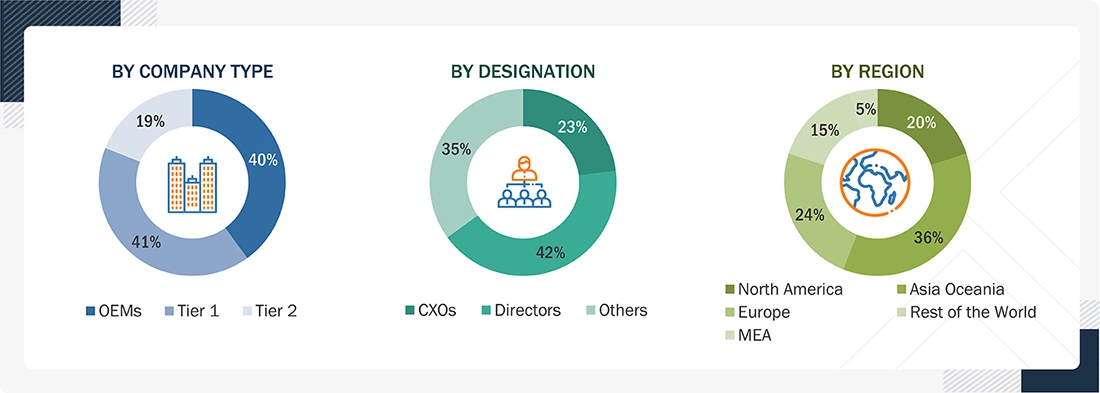
Note: Tiers of companies are based on the value chain of the rolling stock market; companies’ revenues have not been
To know about the assumptions considered for the study, download the pdf brochure
Market Size Estimation
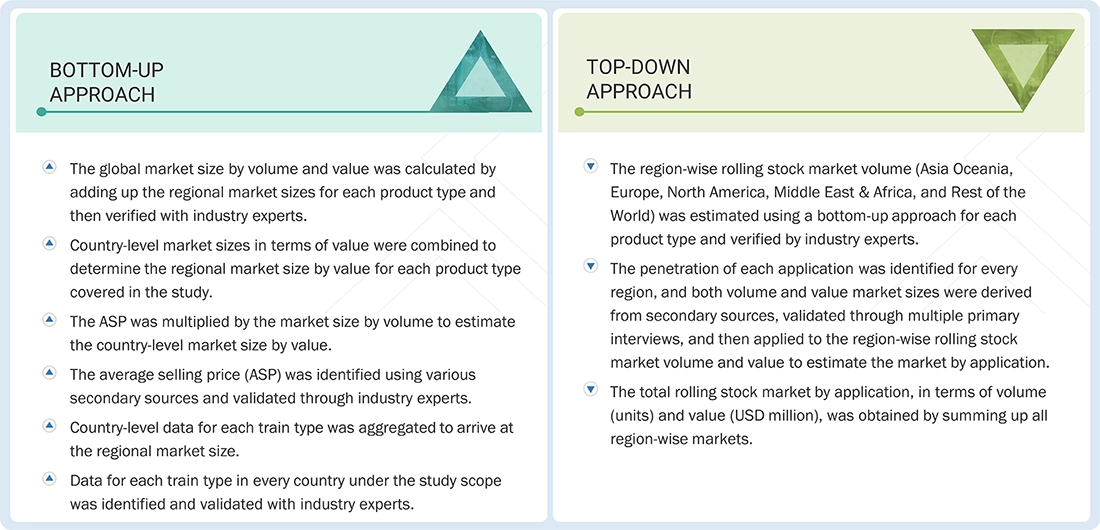
Bottom-up and top-down approaches were used to estimate and validate the total size of the rolling stock market. This method was also used extensively to estimate the size of various subsegments in the market. The research methodology used to estimate the market size includes the following:
Rolling Stock Market : Top-Down and Bottom-Up Approach
Data Triangulation
After arriving at the overall market size using the market size estimation processes as explained above, the market was split into several segments and subsegments. To complete the overall market engineering process and arrive at the exact statistics of each market segment and subsegment, data triangulation and market breakdown procedures were employed, wherever applicable. The data was triangulated by studying various factors and trends from both the demand and supply sides.
Market Definition
Rolling stock refers to railway vehicles. They are powered as well as unpowered vehicles such as locomotives, railroad cars, coaches, and wagons. Rolling stock is used for freight and passenger transport and plays a vital role in the transport infrastructure of a city or country. Rapid urbanization and industrialization, and the increasing use of public transport to reduce traffic congestion, are the key factors driving the growth of the rolling stock market.
Stakeholders
- Rolling stock manufacturers
- Rolling stock component and subsystem suppliers
- Rail technology providers
- Leasing companies and financial institutions
- Maintenance, repair, and overhaul (MRO) service providers
- Government bodies and regulatory authorities
- Rail infrastructure developers
- Investors and public-private partnerships (PPPs)
- Rail operators and service providers
Report Objectives
- To segment and forecast the size of the rolling stock market in terms of value (USD million) and volume (units)
- To define, describe, and forecast the market-based product type, locomotive technology, application, components, and region
-
To analyze regional markets for growth trends, prospects, and their contribution to the overall market
- To segment and forecast the market size by product type (locomotives, rapid transit, wagons, and coaches)
- To provide a qualitative analysis of other product types
- To segment and forecast the market size by locomotive technology (conventional locomotives and turbocharged locomotives), with qualitative insights on Maglev
- To segment and forecast the market size by application (passenger transportation and freight transportation)
- To provide a qualitative analysis of component segments (pantographs, axles, wheelsets, traction motors, passenger information systems, air conditioning systems, auxiliary power systems, train control systems, brakes, baffle gears, couplers, and gearboxes)
- To forecast the market size by region [North America, Europe, Asia Oceania, the Middle East & Africa (MEA), and the Rest of the World (RoW)]
- To analyze technological developments impacting the market
- To provide detailed information about the major factors influencing the market growth (drivers, challenges, restraints, and opportunities)
- To strategically analyze the market, considering individual growth trends, prospects, and contributions to the total market
-
To study the following concerning the market
- Supply Chain Analysis
- Ecosystem Analysis
- Technology Analysis
- Trade Analysis
- Case Study Analysis
- Patent Analysis
- Regulatory Landscape
- Impact of AI/Gen AI
- Trend and Disruption Impact
- Key Stakeholders and Buying Criteria
- Key Conferences and Events
- Investment and Funding Scenarios
- Strategic Pathways for Alternative Propulsion Systems
- Rail Infrastructure Modernization Strategy
- Implementation Framework for Autonomous Train Technology
- Success Stories and Real-world Applications
- To strategically profile key players and comprehensively analyze their market shares and core competencies
- To analyze the impact of recession on the market
- To track and analyze competitive developments such as deals (joint ventures, mergers & acquisitions, contracts, partnerships, collaborations), product developments and launches, and other activities carried out by key industry participants.
Available Customizations
With the given market data, MarketsandMarkets offers customizations in accordance with company-specific needs.
- Rolling stock market, by technology type at the country level (For countries covered in the report)
- Rolling stock market, by product type at the country level (For countries covered in the report)
- Company information
- Profiling of additional market players (up to five)
Get the Full Rolling Stock Market Report
Full forecast, segment splits, and company analysis for all Rolling Stock Market.
- China Rolling Stock Market
- India Rolling Stock Market
- Japan Rolling Stock Market
- South Korea Rolling Stock Market
- Germany Rolling Stock Market
- France Rolling Stock Market
- UK Rolling Stock Market
- Italy Rolling Stock Market
- Spain Rolling Stock Market
- Mexico Rolling Stock Market
- Canada Rolling Stock Market
- South Africa Rolling Stock Market
- UAE Rolling Stock Market
- Egypt Rolling Stock Market
- Russia Rolling Stock Market
- US Rolling Stock Market
Need a Tailored Report?
Customize this report to your needs
Get 10% FREE Customization
Customize This Report
