
Russia Semi-Autonomous & Autonomous Trucks and Buses Market (2024-2029)

The Russia Semi-Autonomous & Autonomous Trucks and Buses Market was valued at $5 Million in 2024 and projected to reach to $5 Million by 2029, representing a compound annual growth rate of CAGR 1.6%. Russia's semi-autonomous and autonomous trucks and buses market faces significant structural challenges that will constrain growth through 2029.


| Market Size in | USD 26.32 MN |
| Market Forecast in | |
| CAGR | |
| Forecast Period | |
| Units Considered | Value (USD MN) |
Russia Semi-Autonomous & Autonomous Trucks and Buses Market Trends and Insights
- Russia's limited market expansion in this segment is driven by geopolitical constraints, regulatory uncertainty, and reduced access to advanced automotive technologies.
- The Russian market for autonomous commercial vehicles remains nascent compared to global peers, with adoption concentrated in select logistics and public transportation operators. Despite global momentum in autonomous vehicle development, Russia faces structural headwinds that constrain market growth between 2024 and 2029.
- Russia's domestic automotive supply chains have become increasingly isolated, limiting integration of cutting-edge autonomous systems and sensor technologies.
- Investment in autonomous vehicle infrastructure and R&D remains subdued in Russia, with most development efforts focused on conventional vehicle improvements rather than autonomous capabilities.
- The stagnant market trajectory reflects Russia's position as a peripheral player in the global semi-autonomous and autonomous commercial vehicle ecosystem..
Key Market Statistics
- CAGR (2024-2029) CAGR 1.6%
- Market Size, 2024 ~USD 5 Million
- Forecast, 2029 ~USD 5 Million
- Country Russia
Russia Semi-Autonomous & Autonomous Trucks and Buses Market Overview
Stagnant Market Growth :
Russia's semi-autonomous and autonomous trucks and buses market remains flat at $5.0 million in both 2024 and 2029, with a minimal CAGR of 1.6%, significantly lagging the global growth rate of 14.4%.
Geopolitical Headwinds :
International sanctions and geopolitical tensions have severely restricted Russia's access to cutting-edge autonomous vehicle technologies and components from Western manufacturers.
Regulatory Uncertainty :
Lack of clear autonomous vehicle regulations and safety standards in Russia creates barriers to market entry and slows adoption of semi-autonomous and fully autonomous commercial vehicles.
Technology Access Constraints :
Limited availability of advanced sensors, AI platforms, and software solutions due to trade restrictions forces Russian operators to rely on domestic alternatives with slower innovation cycles.
Russia Semi-Autonomous & Autonomous Trucks and Buses Market Dynamics
- Geopolitical isolation, international sanctions, and restricted access to Western technology platforms create a challenging environment for market expansion.
- Domestic manufacturers are developing localized solutions, but these lack the sophistication and reliability of global competitors, limiting commercial viability. The market is expected to remain relatively dormant, with minimal investment in autonomous capabilities as logistics operators prioritize cost efficiency and operational stability over technological advancement.
- Government initiatives to develop domestic autonomous vehicle capabilities may provide modest support, but without international partnerships and technology transfer, meaningful market growth remains unlikely in the forecast period..
Market Ecosystem
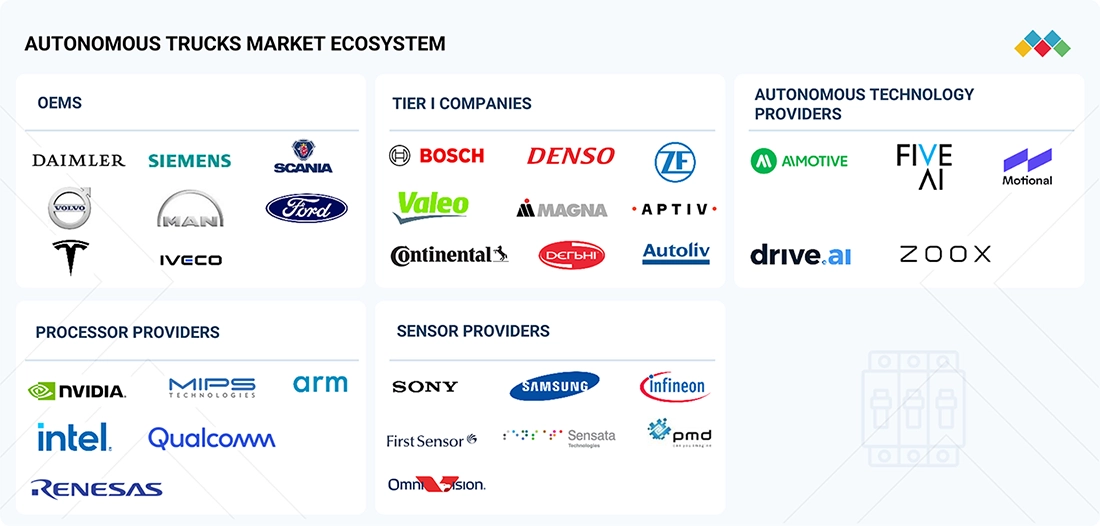
AUTONOMOUS TRUCKS MARKET SIZE, SHARE & ANALYSIS: COMMERCIAL USE CASES ACROSS INDUSTRIES
| COMPANY | USE CASE DESCRIPTION | BENEFITS |
|---|---|---|
 |
Autonomous hub-to-hub freight transportation using autonomous heavy-duty trucks on dedicated logistics corridors and highway routes. | Reduces driver dependency, improves fleet utilization, lowers operating costs, and enables 24/7 freight movement. |
 |
Long-haul autonomous freight transportation through autonomous truck platforms developed with technology partners such as Torc Robotics. | Addresses driver shortages, improves route efficiency, and supports continuous freight operations. |
 |
Truck platooning and connected freight operations for highway logistics and fleet optimization. | Reduces fuel consumption, improves traffic flow, and lowers fleet operating expenses. |
 |
Autonomous long-haul freight transportation through collaborations with autonomous driving technology providers. | Supports efficient freight movement, reduces driver workload, and improves logistics productivity. |
 |
Autonomous freight operations through advanced driver assistance and autonomous-ready platforms for Kenworth and Peterbilt trucks. | Improves safety, reduces operating costs, and supports scalable autonomous fleet deployment. |
Logos and trademarks shown above are the property of their respective owners. Their use here is for informational and illustrative purposes only.
Related Ecosystem
Automotive Advance Technologies
- Battery Electric Vehicle (BEV)
- Light Commercial Vehicles (LCVs)
- Fuel Cell Electric Vehicle (FCEV)
- Hybrid Electric Vehicle (HEV)
- Internal Combustion Engine (ICE)
- BOSCH LIMITED
- Continental ag
- Visteon Corporation
- DENSO Corporation
- ZF FRIEDRICHSHAFEN AG
Semi Autonomous And Autonomous Vehicle
- Light Commercial Vehicles (LCVs)
- Battery Electric Vehicle (BEV)
- Fuel Cell Electric Vehicle (FCEV)
- Internal Combustion Engine (ICE)
- Fuel Cell
- BOSCH LIMITED
- Continental ag
- Visteon Corporation
- DENSO Corporation
- Infineon technologies ag
Key Takeaways
- Russia's semi-autonomous and autonomous trucks and buses market is valued at $5.0 million in 2024 with minimal growth projected to $5.0 million by 2029, representing a 1.6% CAGR.
- Russia faces significant barriers to autonomous vehicle adoption including geopolitical isolation, supply chain disruptions, and limited access to advanced sensor and AI technologies.
- The Russian market remains underdeveloped relative to global standards, with autonomous vehicle deployment concentrated in niche logistics and public transit applications.
- Russia's stagnant market growth reflects structural constraints in technology access, regulatory frameworks, and domestic R&D investment in autonomous commercial vehicle systems.
Semi-Autonomous & Autonomous Trucks and Buses Market Report Scope
| Report Metric | Details |
|---|---|
| Base Year | 2024 |
| Fastest Growing Segment | L5 (Level Of Autonomy) |
| Forecast Period | 2024–2029 |
| Growth Rate | CAGR of 14.4% from 2024 to 2029 |
| Largest Segment | TRUCKS (Vehicle Type) |
| Market Size Base Year (Billions) | ~USD 40.96 (2024) |
| Revenue Forecast (Billions) | ~USD 80.26 (2029) |
| Segments Covered | Application, Level Of Autonomy, Propulsion Type, Sensor Type, Vehicle Class, Vehicle Type |
Russia Semi-Autonomous & Autonomous Trucks and Buses Market Report Segmentation
6 segment dimensions are covered across the global market.
By Application
- Intercity/Intracity Buses
- Last-Mile Delivery Trucks
- Mining Trucks
- Shuttles
By Level Of Autonomy
- L1
- L2 And L3
- L4
- L5
By Propulsion Type
- Diesel
- Electric
By Sensor Type
- Cameras
- Lidar
- Radar Sensors
- Ultrasonic Sensors
By Vehicle Class
- Class 1–3
- Class 4–6
- Class 7–8
By Vehicle Type
- Buses
- Trucks
Target Audience
- Russian Automotive Manufacturers : Need market intelligence on autonomous vehicle development priorities, regulatory requirements, and competitive positioning to guide R&D investments in domestic autonomous truck and bus solutions.
- Logistics and Transportation Operators : Require insights into available autonomous vehicle options, technology maturity, and cost-benefit analysis to evaluate adoption feasibility and timeline for fleet modernization in Russia.
- Government and Policy Makers : Need comprehensive market data to inform autonomous vehicle regulations, safety standards, and strategic initiatives supporting domestic technology development and industrial competitiveness.
- Technology and Software Developers : Seek market analysis to identify opportunities for developing Russia-specific autonomous vehicle platforms, localized AI solutions, and sensor technologies adapted to local infrastructure and conditions.
- International Investors and Consultants : Require detailed market forecasts and risk assessments to evaluate investment potential, partnership opportunities, and strategic entry strategies in Russia's constrained autonomous vehicle market.
Key Companies in the Russia Semi-Autonomous & Autonomous Trucks and Buses Market
| Company | HQ | Ownership | Strongest segments |
|---|---|---|---|
| AB VOLVO | Sweden | Public Company | L1 ADAS trucks (diesel, all classes),L2/L3 highway-assist trucks (primarily Class 8 diesel),L4 autonomous pilots and confined-site trucks, |
| DAIMLER TRUCK AG | Germany | Public Company | L1 ADAS-equipped trucks and buses,L2/L3-ready highway tractors with connectivity,Electric and hybrid autonomous-ready trucks and buses, |
| IVECO S.P.A. | Italy | Public Company | L1–L2 ADAS on diesel heavy trucks,L1–L2 ADAS on medium and light commercial vehicles,L2/L3 highway pilot and advanced ADAS packages, |
| PACCAR INC. | United States | Public Company | L1 ADAS-equipped trucks,L2/L3 highway-assist trucks,L4/L5 autonomous trucks, |
| HYUNDAI MOTOR CORPORATION | South Korea | Public Company | L1–L2 ADAS-equipped trucks,L2/L3 highway automation trucks,L4 autonomous pilots and platforms, |
| AURORA INNOVATION INC. | United States | Public Company | L4 autonomous trucking stack (Aurora Driver for Class 8, diesel-dominant),Data services, mapping, and simulation for autonomous trucks,L2/L3 ADAS and enabling components for trucks, |
| NVIDIA CORPORATION | United States | Public Company | In-vehicle autonomous compute platforms (DRIVE for L2/L3/L4),Data center GPUs for AV training and simulation,Autonomous driving software, toolchains, and middleware, |
| CONTINENTAL AG | Germany | Public Company | ADAS & Autonomous Driving (sensors, ECUs, software),Tires & Digital Tire Management for Trucks,Rubber & Industrial Solutions for Off-Highway/Mining Trucks, |
| KODIAK ROBOTICS INC. | United States | Public Company | L4 driver-as-a-service for long-haul freight,Defense autonomous ground vehicles (AGVs) with General Dynamics Land Systems,Industrial and yard trucking autonomy, |
| NAVYA | France | Private Company | Level 4 autonomous driving systems and shuttles (people and goods in controlled environments),Software, fleet management, and remote supervision services,Technology integration for existing fleets and consulting (network, charging, design), |
| YUTONG BUS CO., LTD. | China | Public Company | L1/L2 ADAS-equipped commercial platforms,L2/L3 autonomous-ready electric platforms,Specialized vehicles for logistics-like use (airport, security, emergency), |
| KARSAN | Turkey | Public Company | L1 ADAS-enabled trucks (diesel and electric),L2/L3 autonomous-ready medium trucks (primarily electric),L4 depot/yard and shuttle-style freight platforms, |
AB VOLVO
AB Volvo is a Swedish public company founded in 1915 that employs 89,299 people. The company operates as a major manufacturer in its industry with a century-long operational history.
DAIMLER TRUCK AG
Daimler Truck AG is a German public company founded in 1896 with 108,655 employees. As one of the industry's established manufacturers, it has maintained significant operations for over 125 years.
IVECO S.P.A.
IVECO S.P.A. is an Italian public company founded in 1864 with 35,083 employees. As one of the industry's oldest manufacturers, it maintains substantial global operations.
PACCAR INC.
PACCAR Inc. is a United States public company founded in 1905 with 25,900 employees. The company has over a century of manufacturing experience in its sector.
HYUNDAI MOTOR CORPORATION
Hyundai Motor Corporation is a South Korean public company founded in 1967. The company is a major automotive manufacturer with significant global presence.
AURORA INNOVATION INC.
Aurora Innovation Inc. is a United States public company founded in 2017 with 1,900 employees. The company operates in the autonomous vehicle technology sector.
NVIDIA CORPORATION
NVIDIA Corporation is a United States public company founded in 1993 with 42,000 employees. The company is a leading designer of graphics processing units and AI computing platforms.
CONTINENTAL AG
Continental AG is a German public company founded in 1871 with 22,076 employees. The company operates as a major supplier of automotive components and systems.
KODIAK ROBOTICS INC.
Kodiak Robotics Inc. is a United States public company founded in 2018 with 342 employees. The company develops autonomous trucking technology and solutions.
NAVYA
NAVYA is a French private company founded in 2014 with 266 employees. The company specializes in autonomous vehicle technology development.
YUTONG BUS CO., LTD.
Yutong Bus Co., Ltd. is a Chinese public company founded in 1963 with 16,707 employees. The company is a major manufacturer of buses and commercial vehicles.
KARSAN
Karsan is a Turkish public company founded in 1966 with 2,214 employees. The company operates as a manufacturer of commercial vehicles.
Reasons to Buy this Report
- Understand Market Stagnation Drivers : Gain detailed insights into why Russia's autonomous vehicle market remains flat despite global growth, including geopolitical, regulatory, and technology access factors critical for strategic planning.
- Identify Localization Opportunities : Discover gaps in domestic autonomous vehicle solutions and opportunities to develop Russia-specific technologies that comply with local regulations and operate independently of Western platforms.
- Competitive Intelligence for Domestic Players : Access comprehensive analysis of the competitive landscape for Russian manufacturers and technology providers developing autonomous solutions in isolation from global supply chains.
- Risk Assessment for Market Entry : Evaluate geopolitical, regulatory, and technology risks before investing in Russia's autonomous vehicle sector, with clear forecasts through 2029 to inform investment decisions.
- Government Policy Insights : Understand current and anticipated government initiatives supporting domestic autonomous vehicle development, including potential subsidies, regulations, and strategic priorities for commercial transportation.
Frequently asked questions
What is the current market size of semi-autonomous and autonomous trucks and buses in Russia?
Russia's semi-autonomous and autonomous trucks and buses market was valued at $5.0 million in 2024 and is expected to remain at $5.0 million in 2029.
What is the projected growth rate for Russia's autonomous vehicle market?
Russia's market is projected to grow at a compound annual growth rate of 1.6% from 2024 to 2029, indicating minimal expansion.
Why is Russia's autonomous vehicle market growing so slowly?
Russia's slow growth is attributed to geopolitical constraints, supply chain isolation, limited access to advanced technologies, and reduced investment in autonomous vehicle infrastructure and R&D.
Which sectors in Russia are adopting semi-autonomous and autonomous vehicles?
Adoption in Russia is concentrated in select logistics operators and public transportation providers, with limited penetration across broader commercial vehicle segments.
How does Russia's autonomous vehicle market compare to the global market?
Russia represents a marginal segment of the global market, which is projected to grow from $40.96 billion in 2024 to $179.9 billion by 2029 at a 14.4% CAGR, far outpacing Russia's 1.6% growth.
RESEARCH METHODOLOGY
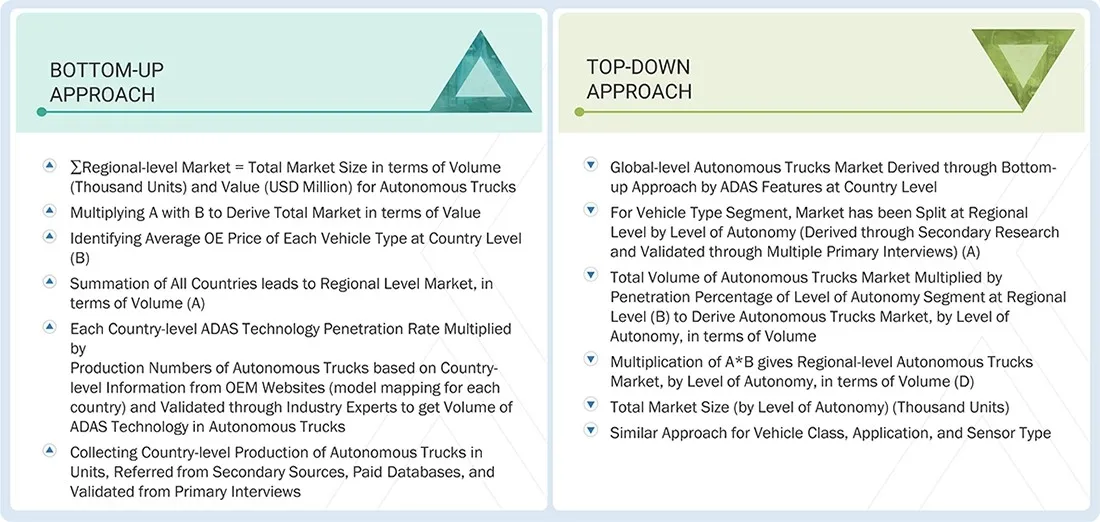
This study involved four major activities in estimating the current size of the autonomous trucks market. Exhaustive secondary research was done to collect information on the market, the peer market, and the child markets. The next step was to validate these findings and assumptions and size them with industry experts across value chains through primary research. The top-down and bottom-up approaches were employed to estimate the complete market size. Thereafter, market breakdown and data triangulation processes were used to estimate the market size of segments and subsegments.
Secondary Research
In the secondary research process, various secondary sources such as company annual reports/presentations, press releases, industry association publications [for example, European Alternative Fuels Observatory (EAFO), European Automobile Manufacturers' Association (ACEA), China Association of Automobile Manufacturers (CAAM), International Organization of Motor Vehicle Manufacturers (OICA), Electrical Vehicle Charging Association (EVCA), National Highway Traffic Safety Administration (NHTSA), International Energy Association (IEA)], articles, directories, technical handbooks, trade websites, technical articles, and databases (for example, Marklines, and Factiva) were used to identify and collect information useful for an extensive commercial study of the autonomous trucks market.
Primary Research
Extensive primary research was conducted after acquiring an understanding of the autonomous trucks market scenario through secondary research. Several primary interviews were conducted with market experts from both the demand (OEMs) and supply sides (autonomous truck manufacturers, service providers, and component manufacturers) across major regions: North America, Europe, Asia Pacific, and the Rest of the World. Approximately 24% and 76% of primary interviews were conducted from the demand and supply sides, respectively. Primary data was collected through questionnaires, emails, and telephonic interviews.
In the canvassing of primaries, various departments within organizations, such as sales, operations, and marketing, were covered to provide a holistic viewpoint in the report. After interacting with industry experts, brief sessions were conducted with highly experienced independent consultants to reinforce the findings from primaries. This, along with in-house subject matter experts’ opinions, led to the findings described in the remainder of this report.
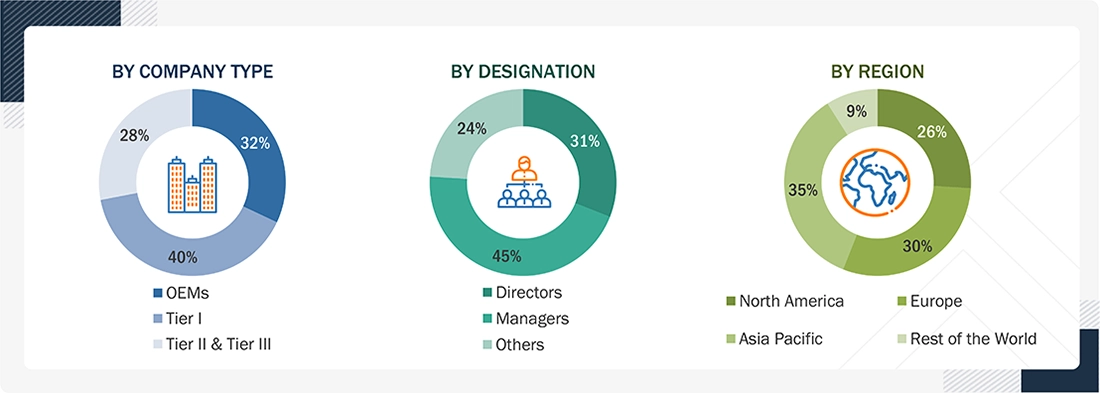
Note: Three tiers of companies are defined based on their total revenue for the year ended 31st December 2025; Tier 1 companies’ revenues are more than USD 1 billion; Tier 2 companies’ revenues range between USD 1 billion and 500 million; and Tier 3 companies’ revenues range less than USD 500 million
To know about the assumptions considered for the study, download the pdf brochure
Market Size Estimation
Both top-down and bottom-up approaches were used to estimate and validate the total size of the market. These methods were also used extensively to estimate the size of various subsegments in the market. The research methodology used to estimate the market size includes the following:
Data Triangulation
After arriving at the overall market size—using the market size estimation processes as explained above—the market was split into several segments and subsegments. To complete the overall market engineering process and arrive at the exact statistics of each market segment and subsegment, data triangulation and market breakdown procedures were employed, wherever applicable. The data was triangulated by studying various factors and trends from both the demand and supply sides.
Market Definition
Autonomous trucks are commercial vehicles equipped with advanced technologies such as sensors, cameras, radar, LiDAR, artificial intelligence (AI), and autonomous driving software that enable them to operate with limited or no human intervention. These vehicles are primarily used for freight transportation and logistics applications to improve operational efficiency, reduce transportation costs, and enhance road safety. Autonomous trucks can function at different automation levels, ranging from driver-assistance systems to fully driverless operations. They are increasingly being deployed across long-haul, middle-mile, and hub-to-hub freight routes and can be integrated with electric powertrains, connected vehicle systems, and smart logistics networks to support the future of autonomous transportation.
Key Stakeholders
- Automobile Original Equipment Manufacturers (OEMs)
- Automotive Insurance Providers
- Automobile Industry (End-use Industries and Regional Automobile Associations)
- Cybersecurity Providers for Autonomous Trucks
- Legal and Regulatory Authorities
- Manufacturers of Autonomous Trucks
- Manufacturers of Autonomous Truck Components
- Raw Material Suppliers
- Sensor Manufacturers
- Software Providers
- Traders, Distributors, and Suppliers
Report Objectives
- To define, describe, and forecast the autonomous trucks market based on ADAS Feature, Application, Vehicle Type, Level of Autonomy, Vehicle Class, Propulsion Type, Sensor Type, and region
- To segment and forecast the market size by volume (thousand units) based on application (Last-mile Delivery Trucks, Mining Trucks, Shuttles, and Intercity/Intracity Trucks)
- To provide qualitative insights on ADAS features [Adaptive Cruise Control (ACC), Automatic Emergency Braking (AEB), Blind Spot Detection (BSD), Lane Keep Assist (LKA), Intelligent Park Assist (IPA), Traffic Jam Assist (TJA), Highway Pilot (HP)]
- To segment and forecast the market size by volume (thousand units) based on level of autonomy (L1, L2 & L3, L4, and L5)
- To segment and forecast the market size by volume (thousand units) based on propulsion type (Diesel, Electric, and Hybrid)
- To segment and forecast the market size by volume (thousand units) based on sensor type (Camera, Radar, LiDAR, and Ultrasonic)
- To segment and forecast the market size by volume (thousand units) based on vehicle class (Class 1–Class 3, Class 4–Class 6, Class 7–Class 8)
-
To segment and forecast the market size by volume (thousand units) and value
(USD million) based on vehicle type (Trucks) - To segment and forecast the market size by volume (thousand units) based on region [North America, Europe, Asia Pacific, and Rest of the World (RoW)]
- To provide detailed information regarding the major factors influencing the market growth (drivers, challenges, restraints, and opportunities)
- To strategically analyze the market with respect to individual growth trends, prospects, and contributions to the total market
- To study the following with respect to the market
- Value Chain Analysis
- Ecosystem Analysis
- Technology Analysis
- Case Study Analysis
- Patent Analysis
- Regulatory Landscape
- Average Selling Price Analysis
- Buying Criteria
- Impact of AI
- Investment and Funding Scenario
- Trends and Disruptions impacting Customer Business
- Bill of Materials
- Evolution of Autonomous Trucks
- Opportunities for Autonomous Trucks
- Future of Autonomous Trucks
- Key Stakeholders and Buying Criteria
- Performance Indicators for Autonomous Trucks
- Power Booster for Autonomous Trucks
- To strategically profile key players and comprehensively analyze their market shares and core competencies
- To track and analyze competitive developments such as deals, product developments, and other activities carried out by key industry participants
Available customizations:
With the given market data, MarketsandMarkets offers customizations in line with company-specific needs.
- Further breakdown for the autonomous trucks market, by propulsion type, at the country level (for countries not covered in the report)
- Further breakdown of the autonomous trucks market, by sensor type, at the country level (for countries not covered in the report)
COMPANY INFORMATION
- Profiles of additional market players (up to five)
Get the Full Semi-Autonomous & Autonomous Trucks and Buses Market Report
Full forecast, segment splits, and company analysis for all Semi-Autonomous & Autonomous Trucks and Buses Market.
- China Semi-Autonomous & Autonomous Trucks and Buses Market
- Japan Semi-Autonomous & Autonomous Trucks and Buses Market
- India Semi-Autonomous & Autonomous Trucks and Buses Market
- South Korea Semi-Autonomous & Autonomous Trucks and Buses Market
- France Semi-Autonomous & Autonomous Trucks and Buses Market
- Germany Semi-Autonomous & Autonomous Trucks and Buses Market
- Italy Semi-Autonomous & Autonomous Trucks and Buses Market
- Spain Semi-Autonomous & Autonomous Trucks and Buses Market
- UK Semi-Autonomous & Autonomous Trucks and Buses Market
- Canada Semi-Autonomous & Autonomous Trucks and Buses Market
- US Semi-Autonomous & Autonomous Trucks and Buses Market
- Brazil Semi-Autonomous & Autonomous Trucks and Buses Market
Need a Tailored Report?
Customize this report to your needs
Get 10% FREE Customization
Customize This Report
