
Brazil Smart Cities Market (2025-2030)

The Brazil Smart Cities Market was valued at $14300 Million in 2025 and projected to reach to $31400 Million by 2030, representing a compound annual growth rate of 17.1%. Brazil's smart cities market is poised for exceptional growth through 2030, driven by urbanization pressures affecting major metropolitan regions and government commitment to modernizing urban infrastructure.


| Market Size in | USD 26.32 MN |
| Market Forecast in | |
| CAGR | |
| Forecast Period | |
| Units Considered | Value (USD MN) |
Brazil Smart Cities Market Trends and Insights
- This accelerated growth in Brazil reflects increasing urbanization, government investment in digital infrastructure, and rising demand for intelligent urban solutions across major metropolitan areas.
- Brazil's smart cities initiatives are driving adoption of IoT, cloud computing, and AI-powered systems to address urban challenges including traffic management, energy efficiency, and public safety. The Brazilian smart cities market is outpacing global growth trends, with the country emerging as a key innovation hub in Latin America.
- Brazil's strategic focus on sustainable urban development and digital transformation is attracting both domestic and international technology providers.
- By 2030, Brazil is expected to consolidate its position as a leading smart cities market in the region, supported by favorable regulatory frameworks and increasing public-private partnerships that enhance infrastructure modernization across Brazilian cities..
Key Market Statistics
- CAGR (2025-2030) 17.1% CAGR
- Market Size, 2025 ~USD 14300 Million
- Forecast, 2030 ~USD 31400 Million
- Country Brazil
Brazil Smart Cities Market Overview
Rapid Market Expansion :
Brazil's smart cities market is projected to nearly double from USD 14,300 million in 2025 to USD 31,400 million by 2030, driven by accelerating urbanization and digital transformation initiatives across major metropolitan areas.
Government Digital Infrastructure Investment :
Brazilian federal and municipal governments are significantly increasing funding for smart city infrastructure, including IoT networks, data analytics platforms, and integrated urban management systems to address congestion and service delivery challenges.
Metropolitan Area Adoption :
Major Brazilian cities including São Paulo, Rio de Janeiro, and Brasília are leading smart city implementations, deploying intelligent transportation systems, smart utilities, and citizen engagement platforms to enhance urban livability.
Strong Growth Outpacing Global Average :
Brazil's 17.1% CAGR significantly exceeds the global smart cities market CAGR of 15.6%, positioning the country as a high-growth opportunity within Latin America and attracting substantial technology vendor investment.
Brazil Smart Cities Market Dynamics
- The country's digital transformation agenda, coupled with increasing private sector participation and technology partnerships, creates a favorable environment for smart city solutions deployment.
- Municipal governments are prioritizing intelligent transportation, energy management, and public safety systems to address urban challenges and improve citizen quality of life.
- Continued investment in broadband connectivity and 5G infrastructure will further accelerate smart city adoption across Brazilian cities..
Market Ecosystem
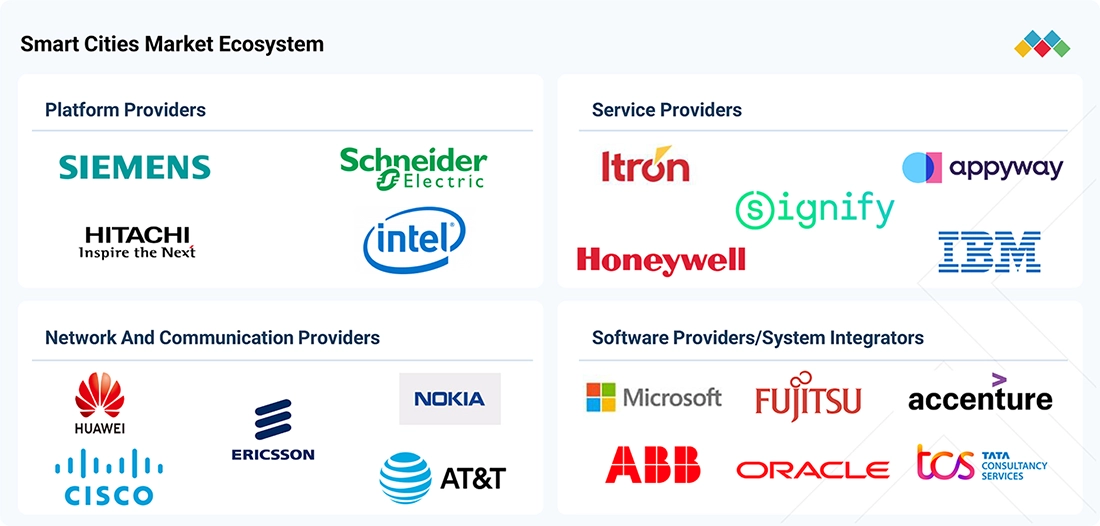
SMART CITIES MARKET: COMMERCIAL USE CASES ACROSS INDUSTRIES
| COMPANY | USE CASE DESCRIPTION | BENEFITS |
|---|---|---|
 |
Indore, India: Schneider Electric deployed its EcoStruxure Asset Advisor for Atal Indore City Transport, enabling remote monitoring of 21 substations through connected UPS systems, predictive analytics, and automated maintenance capabilities to improve public transportation infrastructure reliability. | The solution achieved 80% improvement in time optimization and 30% cost optimization. Continuous monitoring reduced manual inspections, improved maintenance efficiency, and enabled faster identification of equipment issues, supporting safer and more reliable public transportation operations. |
 |
Vijayawada, India: Cisco partnered with the Andhra Pradesh government to develop the Golden Mile smart street project, integrating connected street lighting, public Wi-Fi, environmental monitoring, intelligent transportation, and digital citizen services across a three-kilometer urban corridor. | An assessment reported approximately 70% lower electricity consumption for monitored smart streetlights compared with conventional LED lights. The project also enhanced connectivity, enabled centralized lighting management, improved public safety capabilities, and expanded access to digital municipal services. |
 |
Rio de Janeiro, Brazil: IBM supported the development of an integrated city operations center, connecting municipal agencies, transportation networks, weather monitoring, and emergency services through real-time analytics and predictive technologies to improve urban management and disaster response coordination. | The center integrated information from 30 municipal agencies, enabling 24/7 city monitoring. IBM's forecasting technology can predict heavy rainfall up to 48 hours in advance, supporting improved emergency preparedness, coordinated incident response, and more efficient municipal operations. |
Logos and trademarks shown above are the property of their respective owners. Their use here is for informational and illustrative purposes only.
Related Ecosystem
Digitalization And Iot
- Sensors
- Remote Monitoring
- Supply Chain Management
- Passenger Information System (PIS)
- Platform as A Service (PaaS)
- International Business Machines Corporation
- Cisco Systems, Inc.
- MICROSOFT CORPORATION
- Oracle Corporation
- HUAWEI TECHNOLOGIES CO LTD
Software And Services
- Natural Language Processing (NLP)
- Machine Learning
- Supply Chain Management
- Predictive Analytics
- Image Sensors
- International Business Machines Corporation
- MICROSOFT CORPORATION
- Oracle Corporation
- SAP SE
- Amazon.com, Inc.
Key Takeaways
- Brazil's smart cities market will more than double from USD 14,300M (2025) to USD 31,400M (2030), driven by 17.1% CAGR.
- Brazil is outpacing global smart cities growth, positioning itself as Latin America's leading smart cities innovation hub.
- Government digital transformation initiatives and public-private partnerships are accelerating smart infrastructure deployment across Brazil.
- Brazil's focus on IoT, AI, and cloud solutions addresses critical urban challenges in traffic, energy, and public safety management.
Smart Cities Market Report Scope
| Report Metric | Details |
|---|---|
| Base Year | 2025 |
| Fastest Growing Segment | INFRASTRUCTURE MONITORING & MANAGEMENT (Service) |
| Forecast Period | 2025–2030 |
| Growth Rate | CAGR of 15.6% from 2025 to 2030 |
| Largest Segment | SMART CITIZEN SERVICES (Focus Area) |
| Market Size Base Year (Billions) | ~USD 700.26 (2025) |
| Revenue Forecast (Billions) | ~USD 1445.6 (2030) |
| Segments Covered | Focus Area, Offering, Solution, Service, Type |
Brazil Smart Cities Market Report Segmentation
5 segment dimensions are covered across the global market.
By Focus Area
- Smart Buildings
- Smart Citizen Services
- Smart Transportation
- Smart Utilities
By Offering
- Medical Devices
- Services
- Software
- Solutions
- Systems & Software
By Solution
- Access Control Systems
- Advanced Metering Infrastructure
- Building Infrastructure Management
- Building Parking Management Systems
- Connected Logistics
- Distribution Management Systems
- Elevator & Escalator Management Systems
- Energy Management
- Hvac Control Systems
- Integrated Workplace Management System
- Integrated Workplace Management Systems
- Lighting Systems
- Meter Data Analytics
- Meter Data Management
- Network Management
- Other Smart Transportation Solutions
- Other Smart Utilities Solutions
- Other Smart Utility Solutions
- Other Solutions
- Parking Management
- Passenger Information Management
- Safety Systems
- Security & Emergency Management
- Smart Meters
- Smart Ticketing
- Smart Water Management Systems
- Substation Automation
- Traffic Management
- Traffic Surveillance
- Video Surveillance Systems
By Service
- Consulting
- Deployment & Integration
- Infrastructure Monitoring & Management
By Type
- Airways
- Commercial
- Egovernance
- Energy
- Gas
- Industrial
- Other Types
- Railways
- Residential
- Roadways
- Smart Education
- Smart Healthcare
- Smart Public Safety
- Smart Street Lighting
- Water
Target Audience
- Smart City Technology Vendors : IoT, AI, and software solution providers need Brazil-specific market data to develop localized product strategies, identify municipal customers, and forecast revenue potential in this rapidly expanding market.
- Infrastructure & Construction Companies : Engineering firms and construction companies require detailed market insights to bid on smart city infrastructure projects, understand government procurement trends, and position capabilities for Brazilian municipal contracts.
- Investment & Private Equity Firms : Investors evaluating opportunities in Brazilian smart cities need quantified market sizing, growth projections, and sector dynamics to assess portfolio companies, identify acquisition targets, and evaluate fund deployment strategies.
- Government & Municipal Planners : Brazilian city administrators and government officials use market research to benchmark smart city investments, understand technology trends, justify budget allocations, and develop evidence-based urban modernization strategies.
- Management Consultants & Analysts : Consulting firms and research analysts require Brazil-specific market data to support client engagements, develop strategic recommendations, and provide competitive intelligence for organizations entering or expanding in the Brazilian smart cities sector.
Reasons to Buy this Report
- Market Size & Growth Validation : Quantified market data for Brazil demonstrates USD 14.3B current valuation with 17.1% CAGR through 2030, providing investors and vendors with concrete market sizing to support business case development and resource allocation decisions.
- Competitive Positioning Intelligence : Understand Brazil's market dynamics relative to global trends (15.6% global CAGR) to identify competitive advantages, market entry strategies, and differentiation opportunities in this high-growth emerging market.
- Government & Municipal Investment Tracking : Detailed insights into Brazilian government digital infrastructure spending patterns and municipal smart city initiatives enable vendors to align solutions with public sector priorities and identify procurement opportunities.
- Metropolitan Market Segmentation : Analysis of smart city adoption across major Brazilian metropolitan areas (São Paulo, Rio de Janeiro, Brasília) reveals localized demand patterns, regulatory environments, and technology preferences for targeted market penetration.
- Strategic Planning & Forecasting : Five-year forecast data enables technology companies, consultants, and investors to develop long-term Brazil strategies, anticipate market inflection points, and allocate capital to high-potential smart city segments and geographies.
Frequently asked questions
What is the current size of Brazil's smart cities market?
Brazil's smart cities market is valued at USD 14,300 million in 2025, with strong growth momentum driven by urbanization and digital transformation initiatives.
What is the projected market size for Brazil's smart cities by 2030?
Brazil's smart cities market is forecast to reach USD 31,400 million by 2030, representing more than a doubling of market value over the five-year period.
What is the CAGR for Brazil's smart cities market?
Brazil's smart cities market is growing at a compound annual growth rate of 17.1% from 2025 to 2030, outpacing global average growth rates.
What are the primary drivers of growth in Brazil's smart cities market?
Key growth drivers in Brazil include increasing urbanization, government investment in digital infrastructure, public-private partnerships, and rising demand for IoT and AI-powered urban solutions.
How does Brazil's smart cities market compare to global trends?
Brazil's 17.1% CAGR exceeds the global smart cities market CAGR of 15.6%, demonstrating Brazil's accelerated adoption and positioning as a regional leader in smart city innovation.
RESEARCH METHODOLOGY
The research study involved four major activities to estimate the smart cities market size. Extensive secondary research was conducted to collect relevant information about the smart cities market and related technologies. The findings and assumptions were subsequently validated through primary research with industry experts across the smart cities value chain. Top-down and bottom-up approaches were used to estimate the market size, followed by data triangulation to validate the estimates and determine the sizes of individual segments and sub-segments.
Secondary Research
The market size of companies offering smart cities solutions and services to various end users was determined using secondary data from paid and publicly available sources. The research involved analyzing product portfolios, service offerings, geographical presence, and competitive positioning of major market participants. Various sources were consulted to identify and collect relevant information, including company annual reports, official websites, press releases, investor presentations, product announcements, white papers, industry publications, certified reports, and publications from recognized industry associations, regulatory bodies, and government agencies.
Secondary research was primarily used to obtain critical information about industry trends, market drivers and restraints, the market value chain, the competitive landscape, and the overall pool of key players. It also supported market classification and segmentation by focus area, smart transportation, smart utilities, smart building, smart citizen services, and region, along with the identification of key developments, including product launches, technological advancements, strategic partnerships, mergers and acquisitions, and investments in the smart cities market.
Primary Research
In the primary research process, various stakeholders from the supply and demand sides of the smart cities market were considered to obtain qualitative and quantitative information for the report. These included Chief Executive Officers (CEOs), Chief Technology Officers (CTOs), Chief Information Officers (CIOs), Vice Presidents (VPs), and directors from business development, marketing, product development, and innovation teams, along with key executives from AI solution providers, energy utilities, power generation companies, renewable energy developers, grid operators, system integrators, cloud service providers, consulting firms, industry associations, independent consultants, and key opinion leaders.
Primary interviews were conducted to gather insights, such as market statistics, data on revenue collected from platforms and services, market breakups, market size estimations, market forecasts, and data triangulation. Stakeholders from the demand side, such as Chief Information Officers (CIOs), Chief Finance Officers (CFOs), Chief Strategy Officers (CSOs), and the installation team of end users who use smart cities solutions, were interviewed to understand buyers’ perspectives on suppliers, products, service providers, and their use of smart cities solutions, which is expected to affect the overall smart cities market growth.
Breakdown Of Primary Interviews
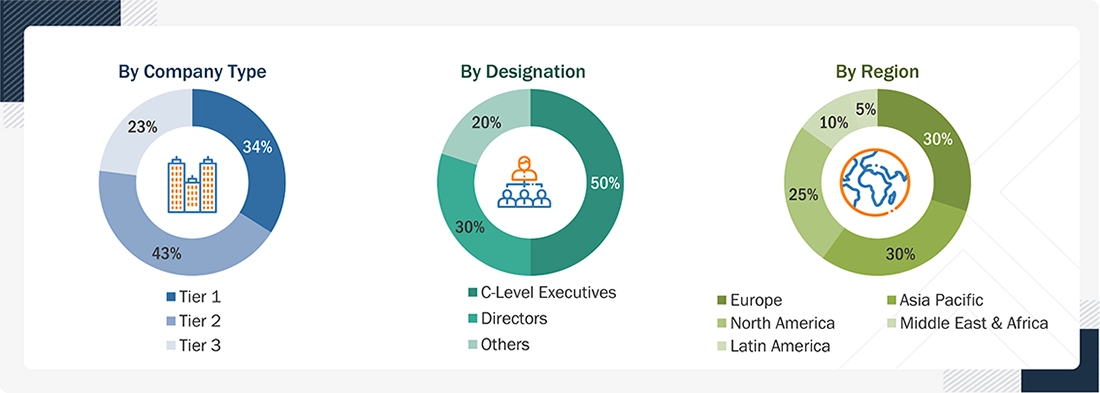
Note: Tier 1 companies have revenues over USD 1 billion, Tier 2 companies have revenues between USD 500 million and 1 billion, and Tier 3 companies have revenues less than USD 500 million.
Other designations include sales managers, marketing managers, and product managers.
Source: Industry Experts
To know about the assumptions considered for the study, download the pdf brochure
Market Size Estimation
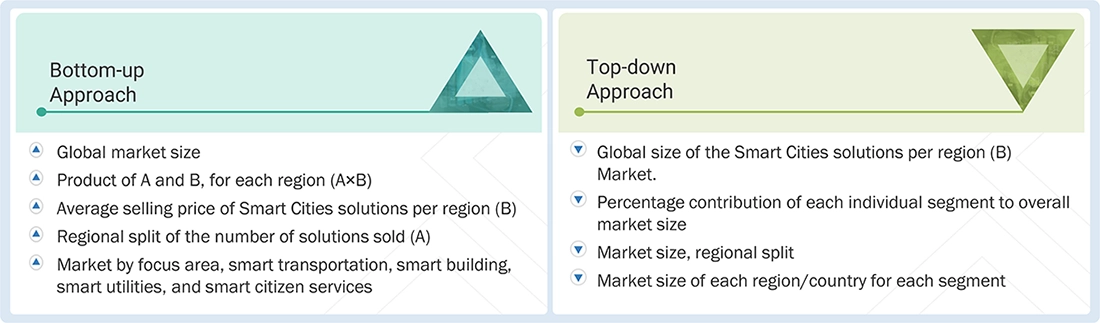
Both top-down and bottom-up approaches were used to estimate and validate the total size of the smart cities market. These methods were also used extensively to estimate the size of various sub-segments in the market.
Smart Cities Market: Top-Down and Bottom-Up Approach
Data Triangulation
The smart cities market was split into several segments and sub-segments after determining the overall market size from the above estimation process. To complete the overall market engineering process and arrive at the exact statistics for all segments and sub-segments, data triangulation and market breakdown procedures were used, wherever applicable. The data was triangulated by studying various factors and trends from the demand and supply sides. The smart cities market size was validated using top-down and bottom-up approaches.
Market Definition
The European Union defines a smart city as a place where traditional networks and services are made more efficient with the use of digital solutions for the benefit of its inhabitants and businesses.
A smart city goes beyond the use of digital technologies for better resource use and fewer emissions. It means smarter urban transport networks, upgraded water supply and waste disposal facilities, and more efficient ways to light and heat buildings. It also means a more interactive and responsive city administration, safer public spaces, and meeting the needs of an aging population.
Key Stakeholders
- National/State Governments
- Municipal Authorities
- Real-estate Developers
- Information Technology (IT) Solution Providers
- Platform Providers
- System Integrators
- Telecom Service Providers
- Networking Solution Providers
- Utility Companies
- Transportation Service Providers
- Independent Software Vendors (ISVs)
- Network Equipment Providers
- Communication Service Providers (CSPs)
Report Objectives
- To determine, segment, and forecast the global smart cities market based on focus area, smart transportation, smart utilities, smart building, smart citizen services, and region in terms of value
- To forecast the size of the market segments to five main regions: North America, Europe, Asia Pacific, Middle East & Africa, and Latin America
- To provide detailed information about the major factors (drivers, opportunities, threats, and challenges) influencing the growth of the smart cities market
- To study the complete value chain and related industry segments and perform a value chain analysis of the smart cities market landscape
- To strategically analyze the macro and micro markets to individual growth trends, prospects, and contributions to the total smart cities market
- To analyze the industry trends, patents, and innovations related to the smart cities market
- To analyze the opportunities for stakeholders by identifying the high-growth segments of the smart cities market
- To profile the key players in the market and comprehensively analyze their market share/ranking and core competencies
- To track and analyze competitive developments, such as mergers & acquisitions, product launches & developments, partnerships, agreements, collaborations, business expansions, and Research & Development (R&D) activities
Available customizations:
With the given market data, MarketsandMarkets offers customizations based on the company’s specific needs. The following customization options are available for the report:
Geographic Analysis
- Further break-up of the Asia Pacific market into countries contributing 75% to the regional market size
- Further break-up of the North American market into countries contributing 75% to the regional market size
- Further break-up of the Latin American market into countries contributing 75% to the regional market size
- Further break-up of the Middle East & African market into countries contributing 75% to the regional market size
- Further break-up of the European market into countries contributing 75% to the regional market size
Company Information
- Detailed analysis and profiling of additional market players (up to five)
Get the Full Smart Cities Market Report
Full forecast, segment splits, and company analysis for all Smart Cities Market.
Need a Tailored Report?
Customize this report to your needs
Get 10% FREE Customization
Customize This Report
