
China Smart Cities Market (2025-2030)

The China Smart Cities Market was valued at $78000 Million in 2025 and projected to reach to $167800 Million by 2030, representing a compound annual growth rate of 16.5%. China's smart cities market is positioned for exceptional growth through 2030, driven by substantial government investments in digital infrastructure and urbanization policies.


| Market Size in | USD 26.32 MN |
| Market Forecast in | |
| CAGR | |
| Forecast Period | |
| Units Considered | Value (USD MN) |
China Smart Cities Market Trends and Insights
- China is leveraging advanced IoT, AI, and 5G technologies to transform urban infrastructure and enhance citizen services across major metropolitan areas.
- The government's commitment to digital transformation and urbanization initiatives is driving substantial investment in smart city solutions throughout China. China's smart cities market growth is underpinned by increasing urbanization, rising demand for efficient resource management, and government support for technology adoption.
- Between 2025 and 2030, China is expected to maintain a compound annual growth rate of 16.5%, significantly outpacing global averages.
- China's strategic focus on sustainable urban development and smart governance frameworks positions the country as a global leader in smart city innovation and deployment. The competitive landscape in China features both domestic technology giants and emerging startups developing integrated smart city platforms.
- China's market expansion is supported by substantial public-private partnerships and municipal investments in connected infrastructure, data analytics, and citizen engagement platforms..
Key Market Statistics
- CAGR (2025-2030) 16.5% CAGR
- Market Size, 2025 ~USD 78000 Million
- Forecast, 2030 ~USD 167800 Million
- Country China
China Smart Cities Market Overview
Rapid Market Expansion :
China's smart cities market is projected to grow from $78,000 million in 2025 to $167,800 million by 2030, representing a robust 16.5% CAGR, outpacing the global average of 15.6%.
Government-Driven Initiatives :
China's central government commitment to digital transformation and urbanization is accelerating smart city deployments across major metropolitan areas including Beijing, Shanghai, Shenzhen, and Hangzhou.
Advanced Technology Integration :
Chinese smart cities are leveraging cutting-edge IoT, artificial intelligence, and 5G technologies to modernize urban infrastructure, optimize traffic management, and enhance citizen services at scale.
Urban Infrastructure Modernization :
Large-scale investments in connected infrastructure, intelligent transportation systems, and smart utilities are transforming how Chinese cities operate and serve their rapidly growing urban populations.
China Smart Cities Market Dynamics
- The nation's technological leadership in 5G deployment and AI development provides a competitive advantage in implementing sophisticated smart city solutions.
- Major cities are increasingly adopting integrated platforms for traffic management, energy efficiency, and public safety. The market will be further propelled by rising urbanization rates, increasing citizen demand for improved services, and China's strategic focus on sustainable urban development.
- Private sector participation is expanding as technology companies and infrastructure providers recognize significant opportunities.
- By 2030, China is expected to host some of the world's most advanced smart city ecosystems, setting global benchmarks for urban innovation and digital governance..
Market Ecosystem
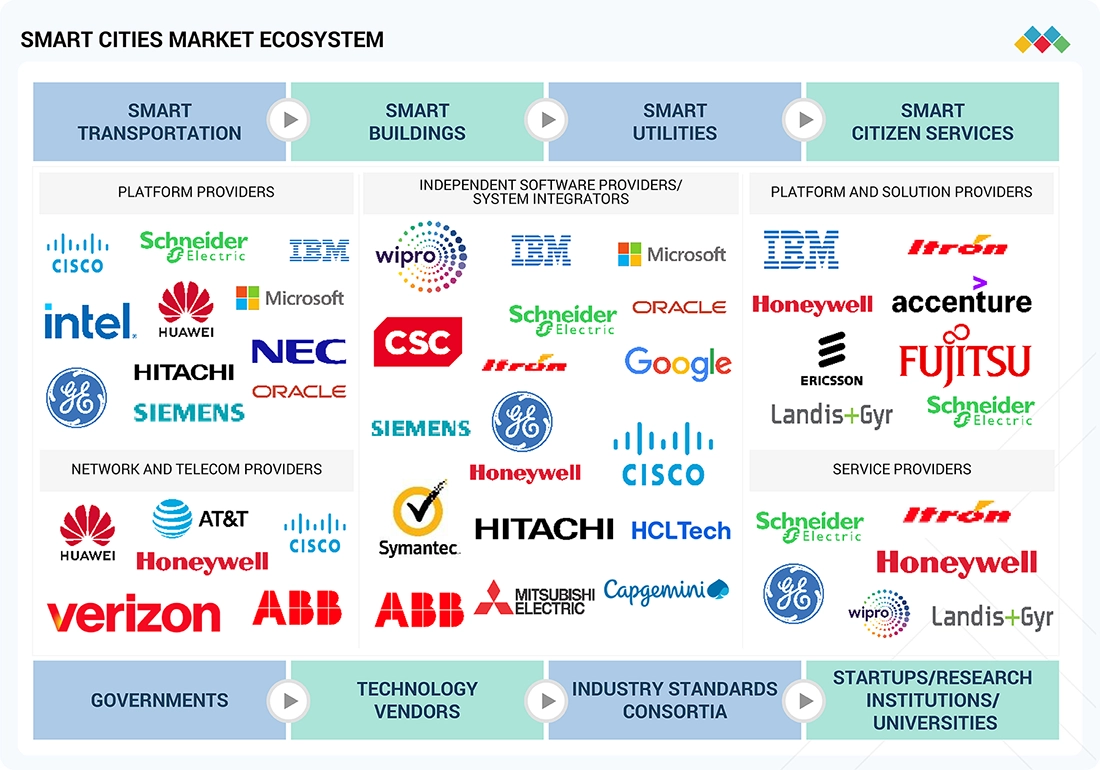
Smart Cities Market: COMMERCIAL USE CASES ACROSS INDUSTRIES
| COMPANY | USE CASE DESCRIPTION | BENEFITS |
|---|---|---|
 |
Fastned is a Dutch provider of fast-charging solutions for electric vehicles. The company provides infrastructure to charge vehicles with renewable energy, such as solar or wind. Fastned wanted to accelerate the adoption of electric vehicles across Europe to reduce CO2 emissions. | ABB offered its ABB Terra 350W chargers, capable of charging 200 km of battery life in just 8 minutes. It also provided its ABB Ability Connected Services Solution to remotely deploy, configure, monitor, and support charging points and with this, Fastned expanded its network to the Netherlands, Germany, Belgium, and the UK, becoming one of the largest EV charging networks in the region. |
 |
Bane NOR is the Norwegian national rail administration; it aimed to renew most of the existing signaling systems on the railway network by 2034 to create a seamless European railway system and increase the competitiveness of European railways. Bane NOR needed a proven and scalable TMS solution that could adapt to the growing and evolving network to meet Norway’s increasing needs for the next 25 years. | Thales offered TMS, which is based on Thales’s ARAMIS system. The solution would provide a cybersecure, cloud-ready platform with a fully adapted human-machine interface (HMI). The solution improved train punctuality, passenger safety, and comfort, and facilitated people, goods, and information mobility throughout the country. |
 |
Curtin University is an Australian public research university and has one of Australia’s largest international student populations, with more than 60,000 students and 4,000 staff. The University needed an IoT solution to create a smart campus that would enhance the student experience and improve classroom learning. | Hitachi offered Hitachi Visualization Suite, Hitachi Video Analytics, Pentaho, Live Face Matching, and Hitachi Data Systems Infrastructure and Compute. This enabled it to implement a smart campus that improves building utilization, enhances classroom learning, and attracts various industries to collaborate with universities on data-driven research. The solution used IoT data analytics to gain insights into the daily running and utilization of the campus and make informed decisions about their classes, operations, and future requirements. |
Logos and trademarks shown above are the property of their respective owners. Their use here is for informational and illustrative purposes only.
Related Ecosystem
Digitalization And Iot
- Sensors
- Remote Monitoring
- Supply Chain Management
- Passenger Information System (PIS)
- Platform as A Service (PaaS)
- International Business Machines Corporation
- Cisco Systems, Inc.
- MICROSOFT CORPORATION
- Oracle Corporation
- HUAWEI TECHNOLOGIES CO LTD
Software And Services
- Natural Language Processing (NLP)
- Machine Learning
- Supply Chain Management
- Predictive Analytics
- Image Sensors
- International Business Machines Corporation
- MICROSOFT CORPORATION
- Oracle Corporation
- SAP SE
- Amazon.com, Inc.
Key Takeaways
- China's smart cities market will more than double from $78 billion in 2025 to $167.8 billion by 2030, driven by 16.5% CAGR growth.
- China is leveraging 5G, IoT, and AI technologies to create integrated smart city ecosystems across major urban centers.
- Government urbanization policies and digital transformation initiatives are primary catalysts for market expansion in China.
- China's smart cities investments focus on sustainable infrastructure, intelligent transportation, and data-driven governance solutions.
Smart Cities Market Report Scope
| Report Metric | Details |
|---|---|
| Base Year | 2025 |
| Fastest Growing Segment | INFRASTRUCTURE MONITORING & MANAGEMENT (Service) |
| Forecast Period | 2025–2030 |
| Growth Rate | CAGR of 15.6% from 2025 to 2030 |
| Largest Segment | SMART CITIZEN SERVICES (Focus Area) |
| Market Size Base Year (Billions) | ~USD 700.26 (2025) |
| Revenue Forecast (Billions) | ~USD 1445.6 (2030) |
| Segments Covered | Focus Area, Offering, Solution, Service, Type |
China Smart Cities Market Report Segmentation
5 segment dimensions are covered across the global market.
By Focus Area
- Smart Buildings
- Smart Citizen Services
- Smart Transportation
- Smart Utilities
By Offering
- Medical Devices
- Services
- Software
- Solutions
- Systems & Software
By Solution
- Access Control Systems
- Advanced Metering Infrastructure
- Building Infrastructure Management
- Building Parking Management Systems
- Connected Logistics
- Distribution Management Systems
- Elevator & Escalator Management Systems
- Energy Management
- Hvac Control Systems
- Integrated Workplace Management System
- Integrated Workplace Management Systems
- Lighting Systems
- Meter Data Analytics
- Meter Data Management
- Network Management
- Other Smart Transportation Solutions
- Other Smart Utilities Solutions
- Other Smart Utility Solutions
- Other Solutions
- Parking Management
- Passenger Information Management
- Safety Systems
- Security & Emergency Management
- Smart Meters
- Smart Ticketing
- Smart Water Management Systems
- Substation Automation
- Traffic Management
- Traffic Surveillance
- Video Surveillance Systems
By Service
- Consulting
- Deployment & Integration
- Infrastructure Monitoring & Management
By Type
- Airways
- Commercial
- Egovernance
- Energy
- Gas
- Industrial
- Other Types
- Railways
- Residential
- Roadways
- Smart Education
- Smart Healthcare
- Smart Public Safety
- Smart Street Lighting
- Water
Target Audience
- Technology Solution Providers : Smart city platform vendors, IoT manufacturers, and AI/5G technology companies need China-specific market data to develop localized solutions and identify partnership opportunities with Chinese enterprises.
- Infrastructure & Construction Firms : Urban development companies and infrastructure contractors require detailed market insights to bid on smart city projects, understand government priorities, and align offerings with Chinese urbanization initiatives.
- Investment & Private Equity Firms : Investors evaluating opportunities in China's digital economy need validated market sizing, growth projections, and regional opportunity analysis to make informed capital allocation decisions.
- Government & Policy Makers : Chinese municipal authorities and central government agencies use market research to benchmark smart city implementations, identify best practices, and optimize resource allocation for urban digital transformation.
- Consulting & Strategy Firms : Management consultants advising clients on China market entry or expansion strategies require comprehensive market data, competitive landscape analysis, and growth forecasts to develop credible business cases.
Reasons to Buy this Report
- Market Size & Growth Validation : Obtain precise market valuation data for China ($78B in 2025) with verified 16.5% CAGR forecasts through 2030, enabling accurate investment planning and competitive positioning in this high-growth market.
- Regional Opportunity Identification : Identify which Chinese metropolitan areas and regions offer the highest smart city adoption potential, allowing targeted market entry strategies and partnership development with local stakeholders.
- Technology Trend Analysis : Understand how IoT, AI, and 5G technologies are being deployed specifically in Chinese smart city projects, informing product development and solution customization for local market requirements.
- Government Policy Insights : Gain detailed understanding of China's digital transformation and urbanization policies driving market growth, enabling alignment with regulatory frameworks and government procurement opportunities.
- Competitive Intelligence : Benchmark against competitors operating in China's smart cities ecosystem, identify market gaps, and develop differentiated strategies to capture market share in this rapidly expanding sector.
Frequently asked questions
What is the projected size of China's smart cities market by 2030?
China's smart cities market is projected to reach $167,800 million by 2030, growing from $78,000 million in 2025.
What is the CAGR for China's smart cities market?
China's smart cities market is expected to grow at a compound annual growth rate of 16.5% between 2025 and 2030.
What technologies are driving China's smart cities market?
China's smart cities market is primarily driven by 5G networks, Internet of Things (IoT), artificial intelligence, cloud computing, and big data analytics technologies.
Which sectors are benefiting most from smart city investments in China?
China's smart city investments are concentrated in intelligent transportation, energy management, public safety, healthcare systems, and municipal governance platforms.
What government policies support China's smart cities development?
China's government supports smart cities through urbanization initiatives, digital transformation policies, and strategic investments in connected infrastructure and sustainable urban development.
RESEARCH METHODOLOGY
This research study utilized a wide range of secondary sources, including directories and databases such as Dun & Bradstreet (D&B) Hoovers, and Bloomberg BusinessWeek, to gather valuable insights for a technical, market-oriented, and commercial analysis of the smart cities market. Industry experts from core and related sectors, as well as preferred suppliers, manufacturers, distributors, service providers, technology developers, and organizations connected to all segments of the value chain in this market were interviewed as part of the study. To obtain and verify critical qualitative and quantitative information, in-depth interviews were conducted with key industry participants, subject matter experts, C-level executives from leading market players, and industry consultants.
Secondary Research
In the secondary research process, various sources were consulted to gather information for the study. These sources included annual reports, press releases, investor presentations from companies, white papers, certified publications, and articles from recognized associations and governmental publications. Several journals and conferences, such as the 27th IEEE International Conference on Intelligent Transportation Systems (IEEE ITSC 2024) and the Smart Building Conference at Integrated Systems Europe (ISE) 2024, were also referenced. This secondary research aimed to obtain crucial information about industry insights, the monetary flow within the market, the landscape of key players, market classification and segmentation based on current industry trends, regional markets, and significant developments from both, market and technology-oriented perspectives.
Primary Research
In the primary research process, various sources from both the supply and demand sides were interviewed to gather qualitative and quantitative information for the report. On the supply side, the primary sources included industry experts such as Chief Executive Officers (CEOs), Chief Technology Officers (CTOs), Chief Operating Officers (COOs), Vice Presidents (VPs), marketing directors, technology and innovation directors, and other key executives from significant companies and organizations involved in the smart cities market. On the demand side, the primary sources consisted of smart cities end users, consultants, specialists, Chief Information Officers (CIOs), and subject-matter experts from enterprises and government associations.
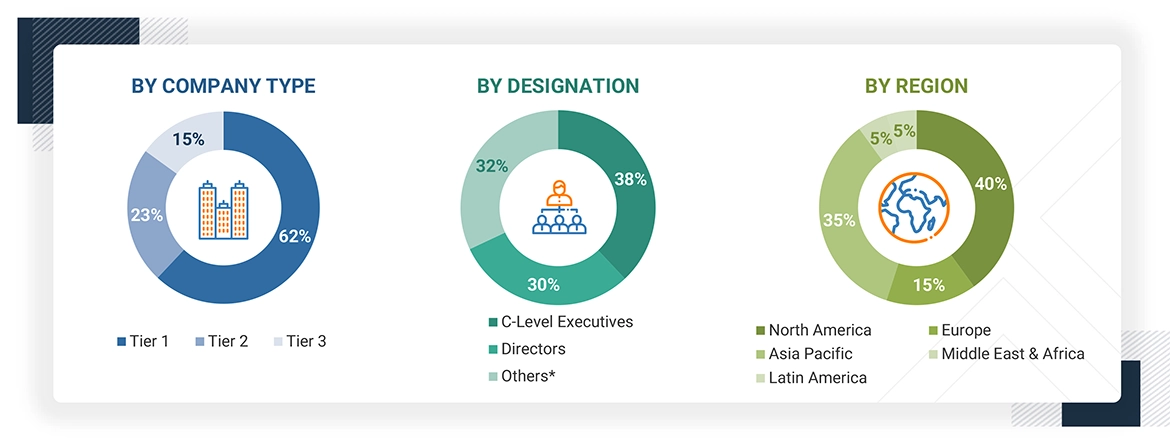
*Others include sales managers, marketing managers, and product managers.
Note: Tier 1 companies: Revenue more than USD 1 billion; Tier 2 companies: Revenue ranges between USD 500 million and 1 billion;
and Tier 3 companies: Revenue ranges between USD 100 million and USD 500 million
To know about the assumptions considered for the study, download the pdf brochure
Smart Cities Market Size Estimation
Several methods were used to estimate and forecast the smart cities market size. The first method involves calculating the market size by adding the revenue generated by companies from the sale of smart city solutions.
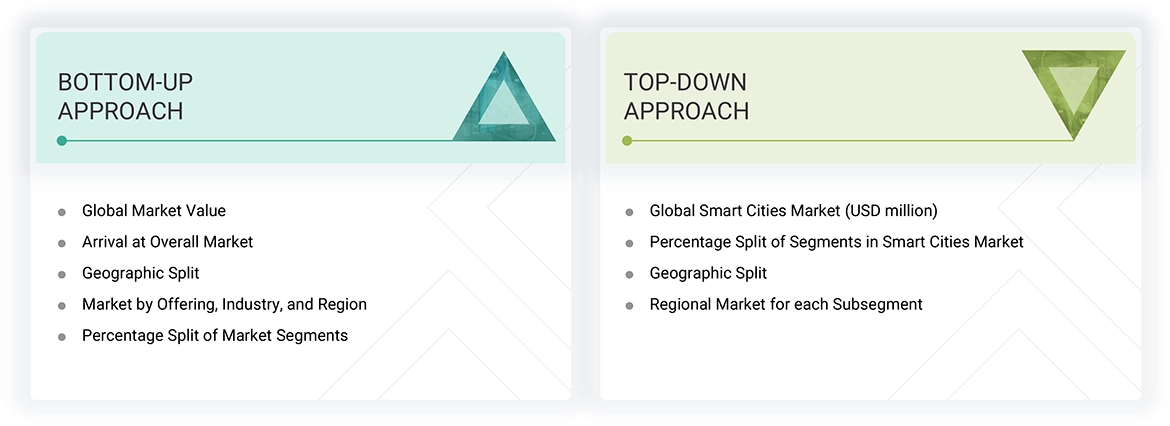
Both, the top-down and bottom-up approaches were used to estimate and validate the total size of the smart cities market. These methods were extensively used to estimate the size of various segments in the market. The research methodology used to estimate the market size includes the following.
- Key players in the market were identified through extensive secondary research.
- In terms of value, the industry’s supply chain and market size were determined through primary and secondary research processes.
- All percentage shares, splits, and breakups were determined using secondary sources and verified through primary sources.
Smart Cities Market : Top-Down and Bottom-Up Approach
Data Triangulation
Upon determining the overall market size, the smart cities market was segmented into various segments and subsegments. A data triangulation process was employed to finalize the overall market engineering and achieve precise statistics for each segment and subsegment, as applicable. This triangulation involved analyzing various factors and trends from both, the demand and supply perspectives. Additionally, the market size was validated using both, the top-down and bottom-up approaches, alongside the data triangulation and market breakdown procedures.
Market Definition
The European Union defines a smart city as a place where traditional networks and services are made more efficient with the use of digital solutions for the benefit of its inhabitants and businesses.
A smart city encompasses more than just the application of digital technologies to enhance resource efficiency and reduce emissions. It includes improved urban transport networks, upgraded water supply and waste disposal systems, and more efficient methods for lighting and heating buildings. Additionally, a smart city features a more interactive and responsive administration, safer public spaces, and addresses the needs of an aging population.
Stakeholders
- National/State Governments
- Municipal Authorities
- Real Estate Developers
- Information Technology (IT) Solution Providers
- Platform Providers
- System Integrators
- Telecom Service Providers
- Networking Solution Providers
- Utility Companies
- Transportation Service Providers
- Independent Software Vendors (ISVs)
- Network Equipment Providers
- Communication Service Providers (CSPs)
Report Objectives
- To determine and forecast the global smart cities market size based on focus areas: smart transportation, smart buildings, smart utilities, smart citizen services, and regions from 2025 to 2030, and analyze the various macroeconomic and microeconomic factors that affect smart cities market growth
- To forecast the size of the market segments concerning five central regions: North America, Europe, Asia Pacific, Latin America, and the Middle East & Africa
- To provide detailed information about the major factors (drivers, restraints, opportunities, and challenges) influencing the growth of the smart cities market.
- To analyze each submarket concerning individual growth trends, prospects, and contributions to the overall smart cities market
- To analyze opportunities in the market for stakeholders by identifying the high-growth segments of the smart cities market
- To profile key market players, provide a comparative analysis based on business overviews, regional presence, product offerings, business strategies, and key financials, and illustrate the market’s competitive landscape.
- To analyze competitive developments in the market, such as mergers & acquisitions, product developments, partnerships, collaborations, and research & development (R&D) activities
Available Customizations
With the given market data, MarketsandMarkets offers customizations as per the company’s specific needs. The following customization options are available for the smart cities market report.
Geographic Analysis as per Feasibility
- Analysis for additional countries (up to five)
Company Information
- Detailed analysis and profiling of additional market players (up to 5)
Get the Full Smart Cities Market Report
Full forecast, segment splits, and company analysis for all Smart Cities Market.
Need a Tailored Report?
Customize this report to your needs
Get 10% FREE Customization
Customize This Report
