
US Smart Cities Market (2025-2030)

The US Smart Cities Market was valued at $192500 Million in 2025 and projected to reach to $374000 Million by 2030, representing a compound annual growth rate of 14.2%. The US smart cities market is poised for sustained expansion through 2030, driven by increasing urbanization, climate change mitigation requirements, and the need for efficient resource management.


| Market Size in | USD 26.32 MN |
| Market Forecast in | |
| CAGR | |
| Forecast Period | |
| Units Considered | Value (USD MN) |
US Smart Cities Market Trends and Insights
- This expansion reflects the US commitment to digital infrastructure, IoT integration, and sustainable urban development across major metropolitan areas.
- The US market benefits from advanced technology adoption, significant government investment in smart infrastructure, and strong private sector participation in smart city initiatives. Driving the US smart cities market is the increasing demand for intelligent transportation systems, smart grid solutions, and connected public services.
- The US is leveraging cloud computing, artificial intelligence, and 5G connectivity to enhance urban efficiency and citizen engagement.
- Between 2025 and 2030, the US market will see accelerated deployment of smart city technologies in transportation, energy management, public safety, and environmental monitoring. The US smart cities ecosystem is characterized by collaboration between municipal governments, technology providers, and infrastructure operators.
- The 14.2% CAGR through 2030 underscores the US position as a leader in smart city innovation and digital transformation of urban environments..
Key Market Statistics
- CAGR (2025-2030) 14.2% CAGR
- Market Size, 2025 ~USD 192500 Million
- Forecast, 2030 ~USD 374000 Million
- Country US
US Smart Cities Market Overview
Market Valuation Growth :
The US smart cities market is valued at $192.5 billion in 2025 and is projected to reach $374 billion by 2030, representing a robust 14.2% CAGR, driven by accelerated digital transformation across urban centers.
Government Investment & Policy Support :
Federal and state governments are allocating substantial funding toward smart infrastructure initiatives, including the Infrastructure Investment and Jobs Act, which catalyzes IoT deployment and connected city solutions across US municipalities.
Technology Adoption Leadership :
The US leads in advanced technology integration including 5G networks, AI-powered traffic management, smart grid systems, and IoT sensors, positioning American cities as innovation hubs for sustainable urban development.
Metropolitan Area Expansion :
Major US metropolitan areas including New York, Los Angeles, Chicago, and San Francisco are implementing comprehensive smart city ecosystems, creating significant opportunities for technology vendors and infrastructure developers.
US Smart Cities Market Dynamics
- Municipal governments are prioritizing smart infrastructure investments to enhance citizen services, reduce operational costs, and improve sustainability metrics.
- The convergence of 5G deployment, edge computing, and AI technologies will enable more sophisticated urban solutions.
- Additionally, public-private partnerships are accelerating innovation cycles and market penetration across diverse city sizes and demographics, from megacities to mid-sized urban centers seeking competitive advantages through digital transformation..
Market Ecosystem
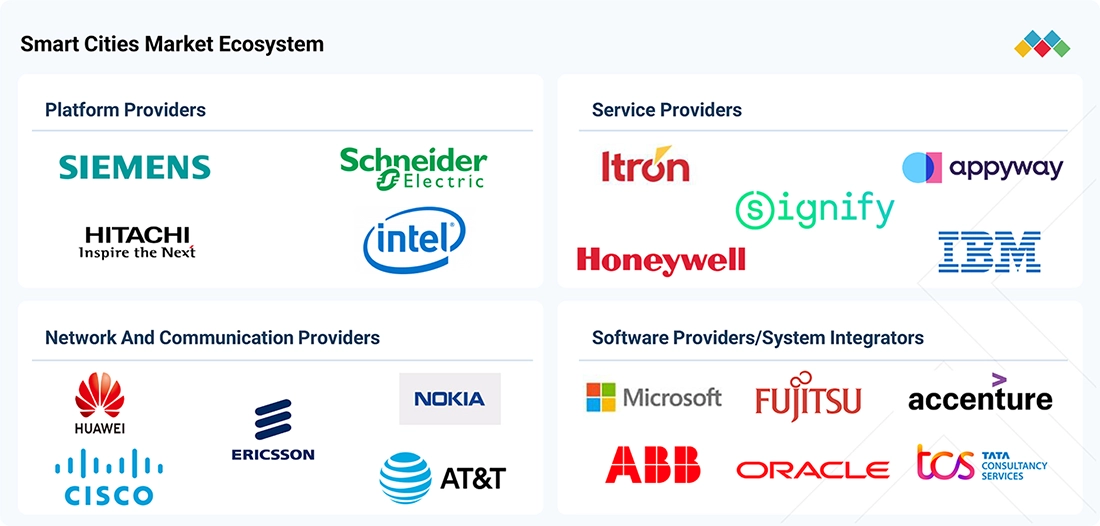
SMART CITIES MARKET: COMMERCIAL USE CASES ACROSS INDUSTRIES
| COMPANY | USE CASE DESCRIPTION | BENEFITS |
|---|---|---|
 |
Indore, India: Schneider Electric deployed its EcoStruxure Asset Advisor for Atal Indore City Transport, enabling remote monitoring of 21 substations through connected UPS systems, predictive analytics, and automated maintenance capabilities to improve public transportation infrastructure reliability. | The solution achieved 80% improvement in time optimization and 30% cost optimization. Continuous monitoring reduced manual inspections, improved maintenance efficiency, and enabled faster identification of equipment issues, supporting safer and more reliable public transportation operations. |
 |
Vijayawada, India: Cisco partnered with the Andhra Pradesh government to develop the Golden Mile smart street project, integrating connected street lighting, public Wi-Fi, environmental monitoring, intelligent transportation, and digital citizen services across a three-kilometer urban corridor. | An assessment reported approximately 70% lower electricity consumption for monitored smart streetlights compared with conventional LED lights. The project also enhanced connectivity, enabled centralized lighting management, improved public safety capabilities, and expanded access to digital municipal services. |
 |
Rio de Janeiro, Brazil: IBM supported the development of an integrated city operations center, connecting municipal agencies, transportation networks, weather monitoring, and emergency services through real-time analytics and predictive technologies to improve urban management and disaster response coordination. | The center integrated information from 30 municipal agencies, enabling 24/7 city monitoring. IBM's forecasting technology can predict heavy rainfall up to 48 hours in advance, supporting improved emergency preparedness, coordinated incident response, and more efficient municipal operations. |
Logos and trademarks shown above are the property of their respective owners. Their use here is for informational and illustrative purposes only.
Related Ecosystem
Digitalization And Iot
- Sensors
- Remote Monitoring
- Supply Chain Management
- Passenger Information System (PIS)
- Platform as A Service (PaaS)
- International Business Machines Corporation
- Cisco Systems, Inc.
- MICROSOFT CORPORATION
- Oracle Corporation
- HUAWEI TECHNOLOGIES CO LTD
Software And Services
- Natural Language Processing (NLP)
- Machine Learning
- Supply Chain Management
- Predictive Analytics
- Image Sensors
- International Business Machines Corporation
- MICROSOFT CORPORATION
- Oracle Corporation
- SAP SE
- Amazon.com, Inc.
Key Takeaways
- The US smart cities market will nearly double from $192.5B in 2025 to $374B by 2030, driven by 14.2% annual growth.
- The US is prioritizing intelligent transportation, smart grids, and connected public services as core smart city investments.
- The US market benefits from strong government funding, 5G infrastructure, and AI-powered urban solutions.
- The US smart cities sector will see increased collaboration between municipalities, tech providers, and infrastructure operators through 2030.
Smart Cities Market Report Scope
| Report Metric | Details |
|---|---|
| Base Year | 2025 |
| Fastest Growing Segment | INFRASTRUCTURE MONITORING & MANAGEMENT (Service) |
| Forecast Period | 2025–2030 |
| Growth Rate | CAGR of 15.6% from 2025 to 2030 |
| Largest Segment | SMART CITIZEN SERVICES (Focus Area) |
| Market Size Base Year (Billions) | ~USD 700.26 (2025) |
| Revenue Forecast (Billions) | ~USD 1445.6 (2030) |
| Segments Covered | Focus Area, Offering, Solution, Service, Type |
US Smart Cities Market Report Segmentation
5 segment dimensions are covered across the global market.
By Focus Area
- Smart Buildings
- Smart Citizen Services
- Smart Transportation
- Smart Utilities
By Offering
- Medical Devices
- Services
- Software
- Solutions
- Systems & Software
By Solution
- Access Control Systems
- Advanced Metering Infrastructure
- Building Infrastructure Management
- Building Parking Management Systems
- Connected Logistics
- Distribution Management Systems
- Elevator & Escalator Management Systems
- Energy Management
- Hvac Control Systems
- Integrated Workplace Management System
- Integrated Workplace Management Systems
- Lighting Systems
- Meter Data Analytics
- Meter Data Management
- Network Management
- Other Smart Transportation Solutions
- Other Smart Utilities Solutions
- Other Smart Utility Solutions
- Other Solutions
- Parking Management
- Passenger Information Management
- Safety Systems
- Security & Emergency Management
- Smart Meters
- Smart Ticketing
- Smart Water Management Systems
- Substation Automation
- Traffic Management
- Traffic Surveillance
- Video Surveillance Systems
By Service
- Consulting
- Deployment & Integration
- Infrastructure Monitoring & Management
By Type
- Airways
- Commercial
- Egovernance
- Energy
- Gas
- Industrial
- Other Types
- Railways
- Residential
- Roadways
- Smart Education
- Smart Healthcare
- Smart Public Safety
- Smart Street Lighting
- Water
Target Audience
- Municipal Government Officials : City planners and administrators need US market data to justify smart city investments, benchmark against peer municipalities, and align budget allocations with national growth trends and best practices.
- Technology & Infrastructure Vendors : IoT, software, and hardware providers require US-specific market intelligence to identify high-growth segments, target metropolitan areas with highest adoption potential, and develop localized go-to-market strategies.
- Investment & Private Equity Firms : Investors evaluating smart city companies and infrastructure funds need validated US market sizing, growth projections, and sector dynamics to assess portfolio opportunities and capital allocation decisions.
- Consulting & Systems Integrators : Professional services firms advising municipalities and enterprises require comprehensive US market data to support client engagements, validate business cases, and recommend technology solutions aligned with market trends.
- Policy Makers & Regulatory Bodies : Federal and state officials developing smart city policies and funding programs need market intelligence to understand industry capacity, investment gaps, and growth drivers for informed policy formulation.
Reasons to Buy this Report
- Market Size & Growth Validation : Quantified US market data with precise valuations ($192.5B in 2025, $374B in 2030) and 14.2% CAGR enables accurate financial forecasting, investment planning, and ROI projections for US-focused business strategies.
- Regional Competitive Intelligence : Gain insights into US-specific market dynamics, competitive landscape, and technology adoption patterns across metropolitan areas to identify market entry opportunities and differentiation strategies for smart city solutions.
- Government & Policy Insights : Understand federal and state-level funding mechanisms, regulatory frameworks, and policy drivers shaping the US smart cities ecosystem, enabling alignment with government procurement priorities and infrastructure initiatives.
- Technology Trend Analysis : Access detailed intelligence on 5G deployment, IoT integration, AI applications, and smart grid adoption specific to US cities, informing product development and technology roadmap decisions for market relevance.
- Strategic Partnership Opportunities : Identify high-potential municipalities, technology vendors, and public-private partnership models within the US market to facilitate collaboration, joint ventures, and ecosystem expansion in the smart cities sector.
Frequently asked questions
What is the current size of the US smart cities market?
The US smart cities market is valued at $192.5 billion in 2025 and is expected to grow to $374 billion by 2030.
What is the growth rate of the US smart cities market?
The US smart cities market is growing at a compound annual growth rate (CAGR) of 14.2% from 2025 to 2030.
What are the main drivers of growth in the US smart cities market?
Key drivers include increased demand for intelligent transportation systems, smart grid solutions, 5G connectivity, AI integration, and government investment in digital urban infrastructure.
Which sectors are leading the US smart cities market?
The US smart cities market is led by intelligent transportation, energy management, public safety, environmental monitoring, and connected public services sectors.
Who are the main participants in the US smart cities market?
The US smart cities market includes municipal governments, technology providers, infrastructure operators, telecommunications companies, and IoT solution vendors.
RESEARCH METHODOLOGY
The research study involved four major activities to estimate the smart cities market size. Extensive secondary research was conducted to collect relevant information about the smart cities market and related technologies. The findings and assumptions were subsequently validated through primary research with industry experts across the smart cities value chain. Top-down and bottom-up approaches were used to estimate the market size, followed by data triangulation to validate the estimates and determine the sizes of individual segments and sub-segments.
Secondary Research
The market size of companies offering smart cities solutions and services to various end users was determined using secondary data from paid and publicly available sources. The research involved analyzing product portfolios, service offerings, geographical presence, and competitive positioning of major market participants. Various sources were consulted to identify and collect relevant information, including company annual reports, official websites, press releases, investor presentations, product announcements, white papers, industry publications, certified reports, and publications from recognized industry associations, regulatory bodies, and government agencies.
Secondary research was primarily used to obtain critical information about industry trends, market drivers and restraints, the market value chain, the competitive landscape, and the overall pool of key players. It also supported market classification and segmentation by focus area, smart transportation, smart utilities, smart building, smart citizen services, and region, along with the identification of key developments, including product launches, technological advancements, strategic partnerships, mergers and acquisitions, and investments in the smart cities market.
Primary Research
In the primary research process, various stakeholders from the supply and demand sides of the smart cities market were considered to obtain qualitative and quantitative information for the report. These included Chief Executive Officers (CEOs), Chief Technology Officers (CTOs), Chief Information Officers (CIOs), Vice Presidents (VPs), and directors from business development, marketing, product development, and innovation teams, along with key executives from AI solution providers, energy utilities, power generation companies, renewable energy developers, grid operators, system integrators, cloud service providers, consulting firms, industry associations, independent consultants, and key opinion leaders.
Primary interviews were conducted to gather insights, such as market statistics, data on revenue collected from platforms and services, market breakups, market size estimations, market forecasts, and data triangulation. Stakeholders from the demand side, such as Chief Information Officers (CIOs), Chief Finance Officers (CFOs), Chief Strategy Officers (CSOs), and the installation team of end users who use smart cities solutions, were interviewed to understand buyers’ perspectives on suppliers, products, service providers, and their use of smart cities solutions, which is expected to affect the overall smart cities market growth.
Breakdown Of Primary Interviews
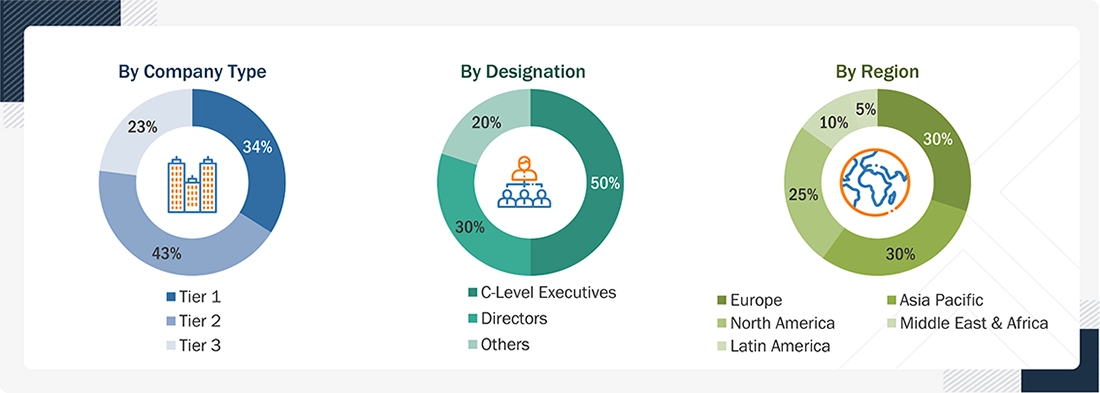
Note: Tier 1 companies have revenues over USD 1 billion, Tier 2 companies have revenues between USD 500 million and 1 billion, and Tier 3 companies have revenues less than USD 500 million.
Other designations include sales managers, marketing managers, and product managers.
Source: Industry Experts
To know about the assumptions considered for the study, download the pdf brochure
Market Size Estimation
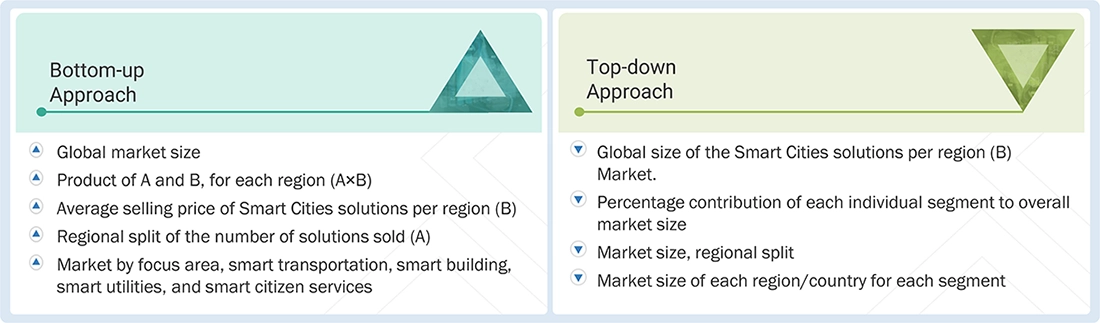
Both top-down and bottom-up approaches were used to estimate and validate the total size of the smart cities market. These methods were also used extensively to estimate the size of various sub-segments in the market.
Smart Cities Market: Top-Down and Bottom-Up Approach
Data Triangulation
The smart cities market was split into several segments and sub-segments after determining the overall market size from the above estimation process. To complete the overall market engineering process and arrive at the exact statistics for all segments and sub-segments, data triangulation and market breakdown procedures were used, wherever applicable. The data was triangulated by studying various factors and trends from the demand and supply sides. The smart cities market size was validated using top-down and bottom-up approaches.
Market Definition
The European Union defines a smart city as a place where traditional networks and services are made more efficient with the use of digital solutions for the benefit of its inhabitants and businesses.
A smart city goes beyond the use of digital technologies for better resource use and fewer emissions. It means smarter urban transport networks, upgraded water supply and waste disposal facilities, and more efficient ways to light and heat buildings. It also means a more interactive and responsive city administration, safer public spaces, and meeting the needs of an aging population.
Key Stakeholders
- National/State Governments
- Municipal Authorities
- Real-estate Developers
- Information Technology (IT) Solution Providers
- Platform Providers
- System Integrators
- Telecom Service Providers
- Networking Solution Providers
- Utility Companies
- Transportation Service Providers
- Independent Software Vendors (ISVs)
- Network Equipment Providers
- Communication Service Providers (CSPs)
Report Objectives
- To determine, segment, and forecast the global smart cities market based on focus area, smart transportation, smart utilities, smart building, smart citizen services, and region in terms of value
- To forecast the size of the market segments to five main regions: North America, Europe, Asia Pacific, Middle East & Africa, and Latin America
- To provide detailed information about the major factors (drivers, opportunities, threats, and challenges) influencing the growth of the smart cities market
- To study the complete value chain and related industry segments and perform a value chain analysis of the smart cities market landscape
- To strategically analyze the macro and micro markets to individual growth trends, prospects, and contributions to the total smart cities market
- To analyze the industry trends, patents, and innovations related to the smart cities market
- To analyze the opportunities for stakeholders by identifying the high-growth segments of the smart cities market
- To profile the key players in the market and comprehensively analyze their market share/ranking and core competencies
- To track and analyze competitive developments, such as mergers & acquisitions, product launches & developments, partnerships, agreements, collaborations, business expansions, and Research & Development (R&D) activities
Available customizations:
With the given market data, MarketsandMarkets offers customizations based on the company’s specific needs. The following customization options are available for the report:
Geographic Analysis
- Further break-up of the Asia Pacific market into countries contributing 75% to the regional market size
- Further break-up of the North American market into countries contributing 75% to the regional market size
- Further break-up of the Latin American market into countries contributing 75% to the regional market size
- Further break-up of the Middle East & African market into countries contributing 75% to the regional market size
- Further break-up of the European market into countries contributing 75% to the regional market size
Company Information
- Detailed analysis and profiling of additional market players (up to five)
Get the Full Smart Cities Market Report
Full forecast, segment splits, and company analysis for all Smart Cities Market.
Need a Tailored Report?
Customize this report to your needs
Get 10% FREE Customization
Customize This Report