
Japan Smart Meter Market (2024-2029)

The Japan Smart Meter Market was valued at $3494.2 Million in 2024 and projected to reach to $6214.2 Million by 2029, representing a compound annual growth rate of CAGR 10.1%. Japan's smart meter market is positioned for sustained expansion through 2029, driven by government-backed digital transformation initiatives and the critical need to modernize aging energy infrastructure.


| Market Size in | USD 26.32 MN |
| Market Forecast in | |
| CAGR | |
| Forecast Period | |
| Units Considered | Value (USD MN) |
Japan Smart Meter Market Trends and Insights
- Japan is leveraging advanced metering infrastructure to modernize its energy grid and enhance operational efficiency across utilities.
- The market in Japan is driven by government initiatives promoting digital transformation in the power sector and increasing demand for real-time energy consumption monitoring. Japan's smart meter adoption is accelerated by regulatory mandates and the nation's commitment to renewable energy integration.
- Japan is investing heavily in IoT-enabled metering solutions to support demand-side management and reduce peak load pressures.
- The forecast period through 2029 reflects Japan's strategic focus on building a resilient and intelligent energy infrastructure that supports both residential and commercial segments..
Key Market Statistics
- CAGR (2024-2029) CAGR 10.1%
- Market Size, 2024 ~USD 3494.2 Million
- Forecast, 2029 ~USD 6214.2 Million
- Country Japan
Japan Smart Meter Market Overview
Market Valuation Growth :
Japan's smart meter market is valued at USD 3,494.2 million in 2024, with a projected CAGR of 10.1% through 2029, reaching USD 6,214.2 million by forecast end.
Government Digital Transformation :
Japanese government initiatives are actively promoting digital transformation in the power sector, driving widespread adoption of advanced metering infrastructure across utilities nationwide.
Grid Modernization Focus :
Japan is leveraging smart meter technology to modernize its energy grid infrastructure, enhancing operational efficiency and enabling real-time monitoring across the utility network.
Outpacing Global Growth :
Japan's smart meter market CAGR of 10.1% exceeds the global average of 9.8%, indicating stronger regional momentum and accelerated market expansion compared to worldwide trends.
Japan Smart Meter Market Dynamics
- Utilities across the nation are increasingly investing in advanced metering infrastructure to enhance grid efficiency, reduce operational costs, and enable demand-side management capabilities.
- The market's 10.1% CAGR reflects strong institutional support and growing recognition of smart meters' role in Japan's energy transition strategy. Looking ahead, Japan's smart meter adoption will be further accelerated by regulatory frameworks promoting grid digitalization and the integration of renewable energy sources.
- The country's focus on achieving energy security and sustainability goals creates a favorable environment for smart meter deployment.
- Additionally, technological advancements in IoT connectivity and data analytics will unlock new value propositions for Japanese utilities, supporting continued market growth and innovation through the forecast period..
Market Ecosystem
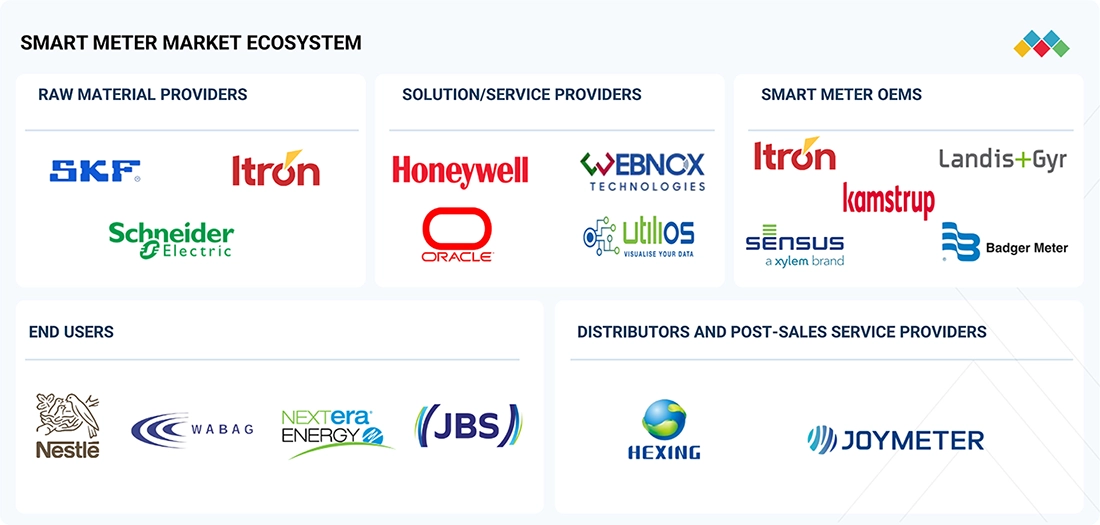
SMART METER MARKET SIZE, SHARE, TRENDS, INDUSTRY, ANALYSIS: COMMERCIAL USE CASES ACROSS INDUSTRIES
| COMPANY | USE CASE DESCRIPTION | BENEFITS |
|---|---|---|
 |
City of Neenah Water Utility (USA) – Landis+Gyr partnered with the City of Neenah and We Energies to deploy a smart water Advanced Metering Infrastructure (AMI) solution by utilizing the electric utility's existing AMI communications network instead of building a dedicated network. The project enabled two-way communication between water meters and the utility using Landis+Gyr's multi-tenant Head End Software. | Eliminated the need for new communications infrastructure, lowering deployment costs. Enabled remote meter reading and reduced manual field visits. Improved leak detection through near-real-time consumption monitoring. Increased operational efficiency while enhancing customer engagement through timely usage data. |
 |
Thane Municipal Corporation (India) – Itron, together with Ceinsys Tech Ltd., deployed smart water meters and its Temetra Meter Data Management (MDM) solution to digitize Thane's municipal water network. The project modernized water distribution by enabling automated data collection and centralized meter management. | Improved leak detection and water conservation. Enhanced billing accuracy through automated meter data collection. Increased operational efficiency by digitizing meter reading and data management. Strengthened water distribution reliability and customer service across the municipality. |
Logos and trademarks shown above are the property of their respective owners. Their use here is for informational and illustrative purposes only.
Related Ecosystem
Smart Energy And Digital Solutions
- Cellular Network
- Analytics Software
- Geographical Information System (GIS)
- Meter Data Management (MDM)
- Smart Meters
- Siemens ag
- SCHNEIDER ELECTRIC SE
- ABB India Limited
- General Electric Company
- Eaton Corporation plc
Smart Grid
- Meter Data Management (MDM)
- Sensors
- Workforce Management
- Cellular Network
- Customer Analytics
- SCHNEIDER ELECTRIC SE
- Siemens ag
- ABB India Limited
- Eaton Corporation plc
- HONEYWELL INTERNATIONAL INC.
Key Takeaways
- Japan's smart meter market will grow from USD 3,494.2 million in 2024 to USD 6,214.2 million by 2029, representing a 10.1% CAGR.
- Japan is prioritizing grid modernization and renewable energy integration through advanced metering technologies.
- Government regulatory support and digital transformation initiatives are primary catalysts for market expansion in Japan.
- Japan's smart meter solutions address both residential and commercial energy management needs with IoT-enabled capabilities.
Smart Meter Market Report Scope
| Report Metric | Details |
|---|---|
| Base Year | 2024 |
| Fastest Growing Segment | WATER (Type) |
| Forecast Period | 2024–2029 |
| Growth Rate | CAGR of 9.8% from 2024 to 2029 |
| Largest Segment | RESIDENTIAL (End User) |
| Market Size Base Year (Billions) | ~USD 26.33 (2024) |
| Revenue Forecast (Billions) | ~USD 46.14 (2029) |
| Segments Covered | Component, Component Type, Communication Technology, Technology, End User, Type |
Japan Smart Meter Market Report Segmentation
6 segment dimensions are covered across the global market.
By Component
- Hardware
- Software
By Component Type
- Communication Interfaces
- Customer Information Systems (Cis)
- Meter Data Management Systems (Mdms)
- Metering & Billing Software
- Microcontrollers
- Power Systems
By Communication Technology
- Cellular
- Power Line Communication (Plc)
- Radio Frequency (Rf)
By Technology
- Advanced Metering Infrastructure (Ami)
- Automatic Meter Reading (Amr)
By End User
- Commercial
- Industrial
- Residential
By Type
- Electric
- Gas
- Water
JAPAN: SMART METER MARKET, BY END USER, 2024–2030
| Segment | 2024 | 2025 | 2026 | 2027 | 2028 | 2029 | 2030 | CAGR (%) |
|---|---|---|---|---|---|---|---|---|
| COMMERCIAL | 278 | 303 | 329.5 | 357.7 | 387.3 | 418.7 | 451.9 | 8.4 |
| INDUSTRIAL | 219.6 | 236.2 | 253.4 | 271.1 | 289.2 | 307.7 | 326.7 | 6.8 |
| RESIDENTIAL | 2996.6 | 3324.1 | 3681 | 4068.4 | 4487.5 | 4942.5 | 5435.7 | 10.4 |
| TOTAL | 3494.2 | 3863.4 | 4264 | 4697.2 | 5164 | 5669 | 6214.2 | 10.1 |
Target Audience
- Utility Companies & Grid Operators : Japanese utilities need detailed market insights to plan smart meter deployment strategies, understand competitive positioning, and align infrastructure investments with government modernization initiatives.
- Smart Meter Manufacturers & Vendors : Equipment suppliers require Japan-specific market data to identify growth opportunities, assess demand forecasts, and develop localized product strategies for the expanding utility sector.
- Energy Sector Investors & PE Firms : Investment professionals need comprehensive Japan market analysis to evaluate portfolio opportunities, assess growth potential, and make informed capital allocation decisions in the smart metering space.
- Government & Policy Makers : Japanese regulatory bodies and energy ministry officials require market intelligence to evaluate policy effectiveness, benchmark against global standards, and refine digital transformation roadmaps.
- Technology & IoT Solution Providers : Software and connectivity companies need Japan-specific insights to understand utility digitalization requirements, identify integration opportunities, and develop solutions aligned with local market needs.
Key Companies in the Japan Smart Meter Market
| Company | HQ | Ownership | Strongest segments |
|---|---|---|---|
| HALMA PLC | United Kingdom | Public Company | Safety,Environmental & Analysis,Healthcare, |
| RICARDO | United Kingdom | Private Company | Energy and Environment (EE),Rail,A&I Established, |
| TECH MAHINDRA LIMITED | India | Public Company | Application, Digital, and Engineering Services,Cloud, Infrastructure, and AIOps,Business Process Services and Platforms, |
| STARHUB | Singapore | Public Company | Mobile telecommunications (consumer and enterprise),Fixed broadband and data connectivity,Television subscription and broadcasting, |
| WNS GLOBAL SERVICES | India | Private Company | Finance & Accounting (F&A) BPM,Customer Experience and Contact Center,Research, Analytics, and Data-led Services, |
| TELEKOM MALAYSIA BERHAD | Malaysia | Public Company | Fixed broadband and last-mile connectivity,Wholesale network and bandwidth,Enterprise ICT, cloud, and managed services, |
| ELSTER GROUP | Germany | Private Company | Gas meters, regulation, and gas infrastructure solutions,Electricity meters and AMI/communications,Water meters and related solutions, |
| ZENSAR TECHNOLOGIES LTD | India | Public Company | Digital and Application Services,Cloud Infrastructure and Security,Consulting, Brand, and Marketing/Insights, |
| VEOLIA | France | Public Company | Municipal and Industrial Water Services,Waste Collection, Recovery, and Hazardous Waste,Energy Services and District Networks, |
| ITRON INC. | United States | Public Company | Device Solutions,Networked Solutions,Outcomes, |
| SIEMENS | Germany | Public Company | Digital Industries (automation, drives, PLM, simulation),Smart Infrastructure (electrification, buildings, grid),Mobility (rail systems, automation, services), |
| SCHNEIDER ELECTRIC | France | Public Company | Low- and medium-voltage equipment and systems,Building management, power metering, and smart controls,Industrial automation, drives, and control software, |
| WASION GROUP | Hong Kong | Public Company | Smart grid solutions,AI-integrated energy efficiency solutions,Digital energy services, |
| BADGER METER, INC. | United States | Public Company | Utility water smart metering hardware (meters, endpoints, radios),Software, NaaS, and analytics (BEACON, utility platforms, consumer portals),Industrial and OEM flow instrumentation (meters, valves, sensors), |
| HONEYWELL INTERNATIONAL INC. | United States | Public Company | Industrial Automation,Building Automation,Energy and Sustainability Solutions (UOP and related), |
| LARSEN & TOUBRO LIMITED | India | Public Company | Infrastructure Projects (buildings, transport, heavy civil, T&D, water, renewables, minerals & metals),Energy Projects (clean energy, oil & gas, refineries, petrochemicals, offshore wind, CarbonLite solutions),Hi-Tech Manufacturing (nuclear, green hydrogen, defense platforms, aerospace, precision/electronics, electrolysers), |
| GENUS | United Kingdom | Public Company | Genus PIC (porcine genetics and services),Genus ABS (dairy and beef genetics),Genus Research and Development, |
HALMA PLC
Halma PLC is a United Kingdom-based public company founded in 1894 that employs 9,000 people. The company operates as an established industrial and safety solutions provider with over a century of operational history.
RICARDO
Ricardo is a United Kingdom-based private company founded in 1915 with 2,600 employees. The company provides engineering and environmental consulting services to the automotive and energy sectors.
TECH MAHINDRA LIMITED
Tech Mahindra Limited is an Indian public company founded in 1986 with 119,337 employees. The company is a major information technology services and business process management provider serving global clients.
STARHUB
StarHub is a Singapore-based public company founded in 1998 with 1,637 employees. The company provides integrated telecommunications, media, and entertainment services to residential and business customers.
WNS GLOBAL SERVICES
WNS Global Services is an Indian private company founded in 1998 with 66,085 employees. The company provides business process management and IT services to enterprises across multiple industries globally.
TELEKOM MALAYSIA BERHAD
Telekom Malaysia Berhad is a Malaysian public company founded in 1946 with 18,000 employees. The company is a leading telecommunications provider offering fixed-line, mobile, and broadband services.
ELSTER GROUP
Elster Group is a German private company with 6,985 employees. The company specializes in smart metering and energy management solutions for utilities and consumers.
ZENSAR TECHNOLOGIES LTD
Zensar Technologies Ltd is an Indian public company founded in 1963 with 10,066 employees. The company provides IT services, digital transformation, and software development solutions to global clients.
VEOLIA
Veolia is a French public company founded in 1853 with 203,100 employees. The company is a global leader in environmental services including water, waste, and energy management.
ITRON INC.
Itron Inc. is a United States-based public company founded in 1977 with 4,987 employees. The company provides smart metering, software, and services for utilities managing electricity, gas, and water.
SIEMENS
Siemens is a German public company founded in 1847 with 310,312 employees. The company is a global conglomerate providing electrification, automation, and digitalization solutions across multiple industries.
SCHNEIDER ELECTRIC
Schneider Electric is a French public company founded in 1836 with 158,122 employees. The company is a global leader in energy management and automation solutions for residential, commercial, and industrial applications.
WASION GROUP
Wasion Group is a Hong Kong-based public company founded in 2000 with 5,448 employees. The company manufactures smart meters and energy management solutions for utilities worldwide.
BADGER METER, INC.
Badger Meter, Inc. is a United States-based public company founded in 1905 with 2,477 employees. The company manufactures and markets water meters and flow measurement solutions for utilities and industrial applications.
HONEYWELL INTERNATIONAL INC.
Honeywell International Inc. is a United States-based public company founded in 1885 with 101,000 employees. The company is a diversified technology and manufacturing conglomerate serving aerospace, building, performance materials, and safety sectors.
LARSEN & TOUBRO LIMITED
Larsen & Toubro Limited is an Indian public company founded in 1938 with 55,662 employees. The company is a major engineering, procurement, and construction firm providing services across infrastructure, power, and industrial sectors.
GENUS
Genus is a United Kingdom-based public company founded in 1994 with 3,190 employees. The company provides software and services for the energy and water utility sectors.
Reasons to Buy this Report
- Market Size & Growth Validation : Obtain precise valuation data for Japan's smart meter market (USD 3,494.2M in 2024) with verified 10.1% CAGR projections through 2029, enabling accurate business planning and investment decisions.
- Government Initiative Insights : Understand Japan's specific digital transformation policies and regulatory drivers shaping smart meter adoption, allowing you to align strategies with government priorities and funding opportunities.
- Competitive Landscape Analysis : Gain detailed intelligence on Japan's utility sector dynamics, key market players, and deployment trends to identify partnership opportunities and competitive positioning strategies.
- Regional Growth Outperformance : Leverage insights into why Japan's 10.1% CAGR exceeds global averages (9.8%), revealing unique market drivers and expansion opportunities unavailable in broader market reports.
- Infrastructure Modernization Roadmap : Access Japan-specific data on grid modernization timelines, utility investment priorities, and technology adoption patterns to forecast demand and plan product/service offerings accordingly.
Frequently asked questions
What is the current size of Japan's smart meter market?
Japan's smart meter market was valued at USD 3,494.2 million in 2024 and is expected to reach USD 6,214.2 million by 2029.
What is the projected growth rate for smart meters in Japan?
Japan's smart meter market is projected to grow at a compound annual growth rate (CAGR) of 10.1% from 2024 to 2029.
What are the main drivers of smart meter adoption in Japan?
Key drivers include government regulatory mandates, renewable energy integration goals, demand for real-time energy monitoring, and Japan's commitment to grid modernization and digital transformation.
Which segments are driving growth in Japan's smart meter market?
Both residential and commercial segments are contributing to growth in Japan, supported by IoT-enabled metering solutions and demand-side management initiatives.
How does Japan's smart meter market compare to global trends?
Japan's 10.1% CAGR slightly exceeds the global average of 9.8%, reflecting the nation's accelerated focus on energy infrastructure modernization and renewable energy adoption.
RESEARCH METHODOLOGY
This study involved major activities in estimating the current size of the smart meter market. Exhaustive secondary research was conducted to collect information on the peer and parent markets. The next step involved validating these findings, assumptions, and sizing with industry experts across the value chain through primary research. Both top-down and bottom-up approaches were employed to estimate the complete market size. Thereafter, market breakdown and data triangulation were used to estimate the market size of the segments and subsegments.
Secondary Research
This research study involved the use of extensive secondary sources, directories, and databases, such as Hoovers, Bloomberg, Businessweek, Factiva, International Energy Agency, and BP Statistical Review of World Energy, to identify and collect information useful for a technical, market-oriented, and commercial study of the smart meter market. The other secondary sources included annual reports, press releases, and investor presentations of companies, white papers, certified publications, articles by recognized authors, manufacturer associations, trade directories, and databases.
Primary Research
The smart meter market comprises several stakeholders, such as smart meter manufacturers, manufacturers of components of smart meter infrastructure, technology providers, and technology support providers in the supply chain. The demand side of this market is characterized by the rising demand for smart meters in nations to reduce non-revenue water losses and to improve the power infrastructure. The supply side is characterized by rising demand for contracts from the distribution utilities, and mergers and acquisitions among big players. Various primary sources from both the supply and demand sides of the market were interviewed to obtain qualitative and quantitative information.
The following is the breakdown of primary respondents:
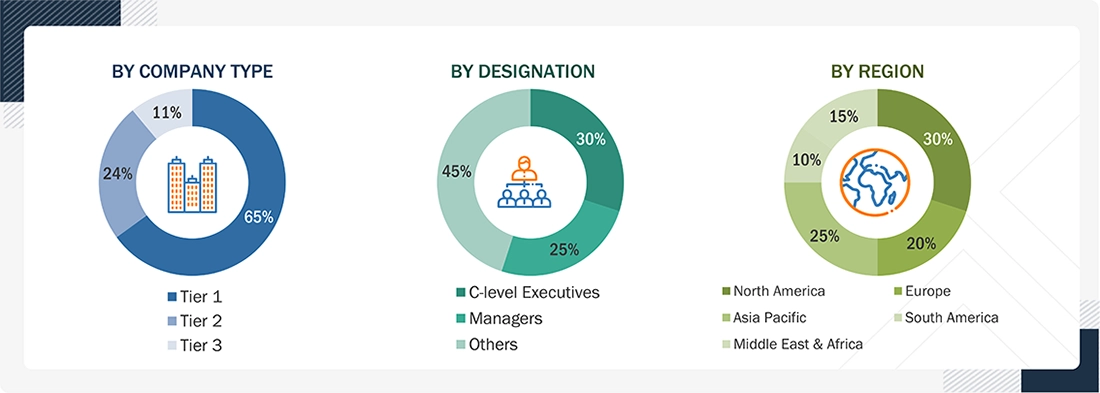
To know about the assumptions considered for the study, download the pdf brochure
Market Size Estimation
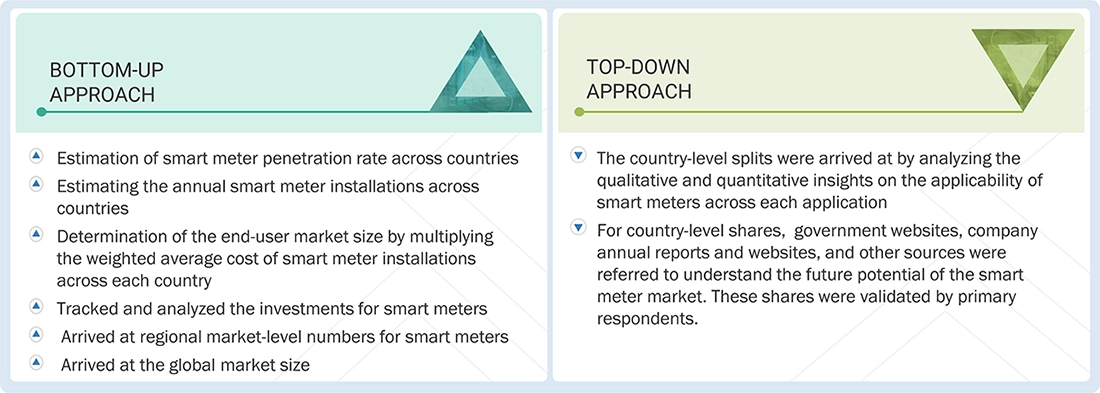
Both the top-down and bottom-up approaches were used to estimate and validate the size of the smart meters market and its dependent submarkets. The key players in the market were identified through secondary research, and their market share in the respective regions was obtained through primary and secondary research. The research methodology included the study of the annual and financial reports of top market players and interviews with industry experts, such as chief executive officers, vice presidents, directors, sales managers, and marketing executives, for key quantitative and qualitative insights related to the smart meter market.
Smart Meter Market : Top-Down and Bottom-Up Approach
Data Triangulation
After arriving at the overall market size from the estimation process explained above, the total market was split into several segments and subsegments. To complete the overall market engineering process and arrive at the exact statistics for all the segments and subsegments, the data triangulation and market breakdown processes were employed, wherever applicable. The data was triangulated by studying various factors and trends from both the demand and supply sides. Along with this, the market was validated using both the top-down and bottom-up approaches.
Market Definition
Smart meters are devices that measure and send instant utility consumption data for electricity, gas, and water service providers. Digital communication systems built into these meters allow automatic data sharing, which results in improved billing procedures, grid efficiency, and consumer demand control systems. Smart meters use wireless networks and sensors to measure power consumption patterns and detect unusual patterns to boost energy efficiency programs. Smart meters achieve remote monitoring and predictive maintenance of utilities through IoT and AI combined with cloud-based platforms, while modern utility infrastructure benefits from their seamless connectivity.
Key Stakeholders
- Detection Tools Manufacturers
- Component Suppliers
- Original Equipment Manufacturers (OEMs)
- End Users
- System Integrators
- Resellers and Distributors
- Regulatory Bodies and Compliance Agencies
- Research Institutions
- Industry Associations and Organizations
- Investors and Financial Institutions
Report Objectives
- To define, describe, analyze, and forecast the size of the smart meter market, by type, component, technology, communication technology, and end user in terms of value
- To forecast the market size for five major regions-North America, Europe, Asia Pacific, South America, Middle East & Africa-along with their key countries
- To forecast the market, by region, in terms of volume
- To provide detailed information about the major drivers, restraints, opportunities, and industry-specific challenges influencing the growth of the market
- To provide detailed information on the market map, value chain, case studies, technologies, market ecosystem, tariff & regulatory landscape, Porter’s Five Forces, and trends/disruptions impacting customers’ businesses that are specific to the smart meter market
- To analyze market opportunities for stakeholders and draw a competitive landscape for market players
- To benchmark players within the market using the company evaluation matrix, which analyzes market players on various parameters within the broad categories of business excellence and strength of product portfolio
- To compare key market players with respect to market share, product specifications, and end users
- To strategically analyze micromarkets with regard to individual growth trends, prospects, and contributions to the total market
- To strategically profile the key players and comprehensively analyze their market share and core competencies
- To analyze competitive developments in the market, such as expansions, product launches, and acquisitions
- To study the impact of AI/Gen AI on the market under study, along with the macroeconomic outlook for each region.
Available customizations:
With the given market data, MarketsandMarkets offers customizations according to the company’s specific needs. The following customization options are available for the report:
Get the Full Smart Meter Market Report
Full forecast, segment splits, and company analysis for all Smart Meter Market.
- China Smart Meter Market
- Australia Smart Meter Market
- South Korea Smart Meter Market
- India Smart Meter Market
- Germany Smart Meter Market
- France Smart Meter Market
- Italy Smart Meter Market
- UK Smart Meter Market
- Spain Smart Meter Market
- Poland Smart Meter Market
- US Smart Meter Market
- Canada Smart Meter Market
- Mexico Smart Meter Market
- Brazil Smart Meter Market
- Argentina Smart Meter Market
- Chile Smart Meter Market
- Saudi Arabia Smart Meter Market
- UAE Smart Meter Market
- Qatar Smart Meter Market
- Israel Smart Meter Market
- South Africa Smart Meter Market
- Egypt Smart Meter Market
- Turkey Smart Meter Market
Need a Tailored Report?
Customize this report to your needs
Get 10% FREE Customization
Customize This Report
