
US Smart Railways Market (2025-2030)

The US Smart Railways Market was valued at $9864.1 Million in 2025 and projected to reach to $15821.9 Million by 2030, representing a compound annual growth rate of 9.9%. The US smart railways market is positioned for sustained growth through 2030, driven by continued federal infrastructure investments and the railway sector's commitment to digital modernization.


| Market Size in | USD 26.32 MN |
| Market Forecast in | |
| CAGR | |
| Forecast Period | |
| Units Considered | Value (USD MN) |
US Smart Railways Market Trends and Insights
- This 9.9% compound annual growth rate reflects the US railway sector's accelerating digital transformation, driven by investments in automation, real-time monitoring systems, and integrated passenger information platforms.
- The US is leveraging advanced IoT sensors, AI-powered predictive maintenance, and cloud-based operations management to modernize aging infrastructure and enhance operational efficiency across freight and passenger networks. Key drivers propelling the US smart railways market include federal infrastructure funding, regulatory mandates for safety and emissions reduction, and growing demand for seamless multimodal transportation integration.
- The US railway industry is prioritizing cybersecurity, data analytics, and autonomous train technologies to address capacity constraints and improve service reliability.
- Between 2025 and 2030, the US market will benefit from increased public-private partnerships, technology vendor consolidation, and widespread adoption of 5G connectivity for real-time asset tracking and fleet management..
Key Market Statistics
- CAGR (2025-2030) 9.9% CAGR
- Market Size, 2025 ~USD 9864.1 Million
- Forecast, 2030 ~USD 15821.9 Million
- Country US
US Smart Railways Market Overview
Market Valuation Growth :
The US smart railways market is valued at $9,864.1 million in 2025 and is projected to reach $15,821.9 million by 2030, representing a robust 9.9% CAGR that outpaces the global average of 8.3%.
Digital Transformation Leadership :
US railways are accelerating digital transformation initiatives with significant investments in automation technologies, real-time monitoring systems, and integrated passenger information platforms across major transit networks.
Infrastructure Modernization :
Federal and state funding initiatives are driving modernization of aging US railway infrastructure, with smart technologies enabling predictive maintenance, operational efficiency, and enhanced safety protocols.
Passenger Experience Enhancement :
US rail operators are prioritizing smart solutions for real-time passenger information, mobile ticketing, and integrated mobility platforms to improve customer engagement and operational transparency.
US Smart Railways Market Dynamics
- Major US rail operators are increasingly adopting IoT sensors, AI-powered analytics, and cloud-based management systems to optimize operations and reduce costs.
- The integration of smart technologies with existing rail networks presents significant opportunities for vendors and service providers.
- Regulatory support for sustainable transportation and smart city initiatives further accelerates market expansion, with particular emphasis on freight optimization and passenger safety enhancements across regional and national rail systems..
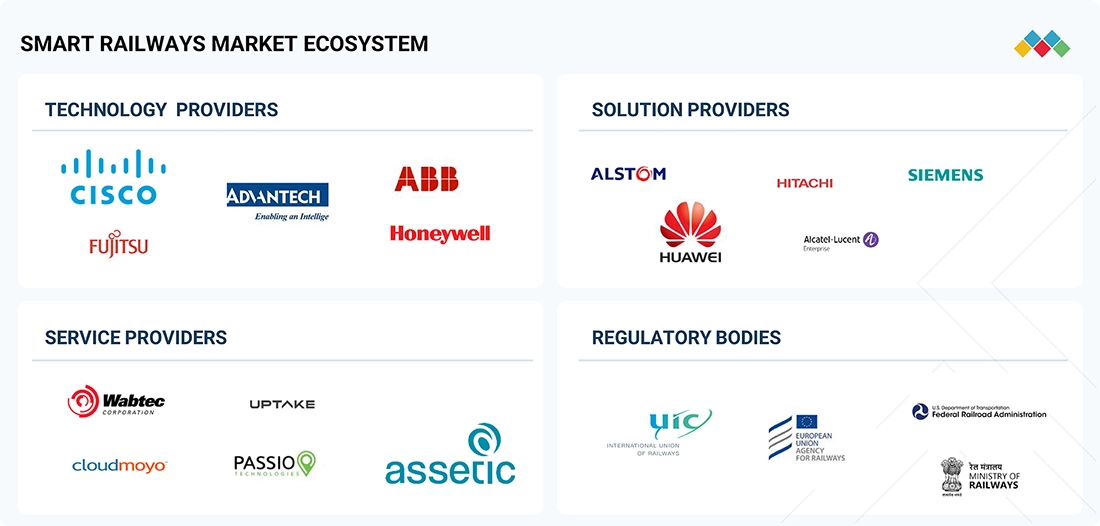
Market Ecosystem
Smart Railways Market: COMMERCIAL USE CASES ACROSS INDUSTRIES
| COMPANY | USE CASE DESCRIPTION | BENEFITS |
|---|---|---|
 |
HealthHub predictive-maintenance and fleet monitoring for rolling stock and infrastructure (continuous condition monitoring and AI analytics). | Reduced downtime, lower maintenance costs, higher asset availability. |
 |
Private 5G and digital services for rail operations — telemetry, predictive maintenance and readiness for FRMCS/mission-critical apps. | Deterministic connectivity, faster troubleshooting, improved operational efficiency |
 |
HMAX digital asset management / condition-based maintenance (example: Copenhagen Metro deployment) using sensors and analytics. | Shift to condition-based maintenance, fewer interventions, longer component life. |
 |
5G rail corridors and mission-critical 4G/5G deployments for train-to-ground communications, passenger broadband and real-time IoT | High-capacity comms, support for FRMCS, resilient passenger/operational services. |
 |
FRMCS-ready train-to-ground solutions and onboard connectivity (real-time CCTV, PTT/voice, passenger information systems) | Future-proof wireless standard support, safer operations, better passenger experience |
Logos and trademarks shown above are the property of their respective owners. Their use here is for informational and illustrative purposes only.
Related Ecosystem
Locomotives And Rolling Stock
- Sensors
- Passenger Information System (PIS)
- Cartesian Robots
- Flow Sensors
- Gas Sensors
- Siemens ag
- Alstom s.a.
- Hitachi, Ltd.
- Knorr-bremse ag
- RAILPROS
Digitalization And Iot
- Sensors
- Remote Monitoring
- Supply Chain Management
- Passenger Information System (PIS)
- Platform as A Service (PaaS)
- International Business Machines Corporation
- Cisco Systems, Inc.
- MICROSOFT CORPORATION
- Oracle Corporation
- SAP SE
Mobility And Telecom
- Smart Utilities
- Smart Healthcare
- Sensors
- Parking Management System
- Passenger Information System (PIS)
- AT&T Inc.
- Cisco Systems, Inc.
- HUAWEI TECHNOLOGIES CO LTD
- Telefonaktiebolaget LM Ericsson (publ)
- International Business Machines Corporation
Key Takeaways
- The US smart railways market will grow from $9.86B in 2025 to $15.82B in 2030, representing a 9.9% CAGR.
- US federal infrastructure investments and regulatory compliance requirements are primary catalysts for smart railway adoption.
- The US market is increasingly focused on predictive maintenance, cybersecurity, and autonomous train technologies.
- 5G connectivity and AI-driven analytics are transforming US railway operations and passenger experience by 2030.
Smart Railways Market Report Scope
| Report Metric | Details |
|---|---|
| Base Year | 2025 |
| Fastest Growing Segment | SERVICES (Offering) |
| Forecast Period | 2025–2030 |
| Growth Rate | CAGR of 8.3% from 2025 to 2030 |
| Largest Segment | SOLUTIONS (Offering) |
| Market Size Base Year (Billions) | ~USD 36.45 (2025) |
| Revenue Forecast (Billions) | ~USD 54.31 (2030) |
| Segments Covered | Offering, Type, Solutions, Passenger Information System, Freight Management System, Security And Safety Solutions, Rail Communication And Networking System, Rail Asset Management And Maintenance Solutions, Services, Professional Services |
US Smart Railways Market Report Segmentation
10 segment dimensions are covered across the global market.
By Offering
- Services
- Solutions
By Type
- Access Control
- Asset Planning And Scheduling
- Condition-Based Monitoring
- Consulting
- Fire Alarm And Voice Evacuation
- Freight Management System
- Freight Operation Management
- Freight Tracking
- Ground-To-Train Communication
- Intrusion Detection
- Managed Services
- Multimedia Information And Entertainment
- Network Connectivity
- Others*
- Passenger Information System
- Predictive Maintenance
- Professional Services
- Rail Analytics System
- Rail Asset Management And Maintenance Solutions
- Rail Communication And Networking System
- Rail Operation And Control Solutions
- Security And Safety Solutions
- Smart Ticketing System
- System Integration And Deployment
- Train-To-Train Communication
- Training, Support, And Maintenance
- Video Surveillance And Analytics
- Workforce Management And Optimization
By Solutions
- Freight Management System
- Passenger Information System
- Rail Analytics System
- Rail Asset Management And Maintenance Solutions
- Rail Communication And Networking System
- Rail Operation And Control Solutions
- Security And Safety Solutions
- Smart Ticketing System
By Passenger Information System
- Multimedia Information And Entertainment
- Network Connectivity
By Freight Management System
- Freight Operation Management
- Freight Tracking
By Security And Safety Solutions
- Access Control
- Fire Alarm And Voice Evacuation
- Intrusion Detection
- Others*
- Video Surveillance And Analytics
By Rail Communication And Networking System
- Ground-To-Train Communication
- Train-To-Train Communication
By Rail Asset Management And Maintenance Solutions
- Asset Planning And Scheduling
- Condition-Based Monitoring
- Others*
- Predictive Maintenance
- Workforce Management And Optimization
By Services
- Managed Services
- Professional Services
By Professional Services
- Consulting
- System Integration And Deployment
- Training, Support, And Maintenance
Target Audience
- Rail Technology Vendors : Smart rail solution providers need US market data to identify growth opportunities, benchmark competitive positioning, and develop localized product strategies for American railway operators and transit authorities.
- Infrastructure Investment Firms : Private equity and infrastructure funds require detailed US market analysis to evaluate investment returns, assess technology adoption rates, and identify acquisition targets within the smart railways ecosystem.
- Government & Transit Agencies : US Department of Transportation, state DOTs, and regional transit authorities use market intelligence to justify modernization budgets, evaluate vendor capabilities, and align procurement with industry trends.
- Railway Operators & Logistics Companies : Amtrak, freight rail operators, and regional transit systems need competitive market insights to guide technology investments, operational efficiency improvements, and digital transformation roadmaps.
- Management Consultants & Analysts : Strategy consultants and financial analysts require verified US market data to support client recommendations, industry reports, and investment theses related to transportation technology and infrastructure modernization.
Key Companies in the US Smart Railways Market
| Company | HQ | Ownership | Strongest segments |
|---|---|---|---|
| BELDEN INC | United States | Public Company | Industrial Ethernet switches and industrial networking,Structured cabling for enterprise and smart buildings,Industrial and specialty fiber/copper cables, |
| ALTRAN | France | Private Company | Engineering & R&D Services,Organization & IT Systems Consulting,Specialized Embedded & Next-Gen Connectivity Projects, |
| PRYSMIAN S.P.A | Italy | Public Company | Transmission (HVDC, HVAC, submarine power and telecom, offshore specialties, EOSS high voltage),Power Grid (power distribution, overhead lines, MV/LV network components, EOSS MV/LV),Electrification (building, industrial, and related products including enclosures), |
| SENER | Spain | Private Company | Space equipment, subsystems, and engineering,Defence systems and engineering solutions,Aeronautics and vehicle structures and controls, |
| ZENSAR TECHNOLOGIES LTD | India | Public Company | Digital and Application Services,Cloud Infrastructure and Security,Brand, Marketing, and Consulting Services, |
| KNORR-BREMSE AG | Germany | Public Company | Rail Vehicle Systems,Commercial Vehicle Systems,Other services (leasing, logistics, media, IT), |
| ALSTOM | France | Public Company | Rolling stock (metros, regional, high-speed, locomotives, light rail),Services (maintenance, overhaul, parts, support),Signaling (urban, mainline, freight and mining), |
| CISCO | United States | Public Company | Enterprise and service provider networking (switching, routing, wireless),Security (network security, SASE, identity, threat detection and response),Collaboration (Webex suite, devices, contact center, CPaaS), |
| HITACHI | Japan | Public Company | Digital Systems & Services (IT, cloud, integration, ATMs),Green Energy & Mobility (power grids, energy, rail),Connective Industries (industrial automation, e-mobility, elevators), |
| WABTEC | United States | Public Company | Freight locomotives and propulsion (new build and modernization),Freight car components and braking systems,Transit systems and components, |
| SIEMENS | Germany | Public Company | Digital Industries (automation, PLM, simulation),Smart Infrastructure (buildings, grid, electrification),Mobility (rail systems, automation, services), |
| IBM | United States | Public Company | Software (Hybrid Cloud & AI),Consulting,Infrastructure (Servers, Storage, Lifecycle Services), |
| INDRA SISTEMAS | Spain | Public Company | Defense Systems & Solutions,Air Traffic Management,Mobility & Transport Systems, |
| HONEYWELL | United States | Public Company | Industrial Automation (controls, instrumentation, smart energy, sensing, PPE, software and analytics),Building Automation (BMS software, controls, security, fire, services),Energy and Sustainability Solutions / UOP (licensed process tech, equipment, catalysts, software), |
| ABB | Switzerland | Public Company | Electrification,Motion,Automation, |
| ADVANTECH | Taiwan | Public Company | Embedded boards and design-in platforms,Industrial PCs and edge servers,IoT automation hardware, |
| FUJITSU | Japan | Public Company | Service Solutions (consulting, cloud, SI, BPO, managed services),Hardware Solutions (computer platforms, infrastructure),Ubiquitous Solutions (devices, edge, vertical solutions), |
| TOSHIBA | Japan | Private Company | Energy Systems & Solutions,Infrastructure Systems & Solutions,Building Solutions, |
BELDEN INC
Belden Inc. is a publicly traded American company founded in 1902 that employs 8,000 people. The company operates as a manufacturer and supplier of signal transmission products and solutions.
ALTRAN
Altran is a large French private engineering and consulting company founded in 1970, employing over 50,000 professionals worldwide.
PRYSMIAN S.P.A
Prysmian S.p.A. is an Italian public company established in 1879 with 33,824 employees, specializing in the production of cables and cable systems.
SENER
Sener is a Spanish private engineering and technology company founded in 1956 with 5,558 employees.
ZENSAR TECHNOLOGIES LTD
Zensar Technologies Ltd. is an Indian public company established in 1963 with 10,066 employees, providing IT services and solutions.
KNORR-BREMSE AG
Knorr-Bremse AG is a German public company founded in 1905 with 26,629 employees, specializing in braking systems and safety technology.
ALSTOM
Alstom is a large French public company founded in 1928 with 87,832 employees, specializing in rail transport and energy solutions.
CISCO
Cisco is an American public technology company founded in 1984 with 86,200 employees, known for networking and IT infrastructure products.
HITACHI
Hitachi is a Japanese public conglomerate founded in 1910 with 287,901 employees, operating across multiple industrial and technology sectors.
WABTEC
Wabtec is an American public company founded in 1869 with 31,000 employees, specializing in equipment and services for the rail and transit industries.
SIEMENS
Siemens is a German public industrial conglomerate founded in 1847 with 310,312 employees, operating across electrification, automation, and digitalization.
IBM
IBM is an American public technology company founded in 1911 with 264,300 employees, providing IT services, software, and hardware solutions.
INDRA SISTEMAS
Indra Sistemas is a Spanish public company founded in 1921 with 62,689 employees, operating in defense, security, and IT solutions.
HONEYWELL
Honeywell is an American public diversified technology company founded in 1885 with 101,000 employees, serving aerospace, building, and industrial markets.
ABB
ABB is a Swiss public multinational company founded in 1883 with 112,700 employees, specializing in robotics, power, and automation technologies.
ADVANTECH
Advantech is a Taiwanese public company founded in 1981 with 2,526 employees, providing industrial computing and IoT solutions.
FUJITSU
Fujitsu is a Japanese public technology company founded in 1935 with 99,203 employees, offering IT services, systems, and semiconductor products.
TOSHIBA
Toshiba is a Japanese private conglomerate founded in 1875 with 106,648 employees, operating across electronics, energy, and infrastructure sectors.
Reasons to Buy this Report
- Market Size & Growth Validation : Quantified US market data with precise valuations ($9.9B in 2025, $15.8B in 2030) and verified 9.9% CAGR enables accurate financial forecasting and investment decision-making for US-focused rail technology initiatives.
- Competitive Landscape Intelligence : Gain insights into US-specific market dynamics, regional operator strategies, and technology adoption patterns to identify competitive advantages and partnership opportunities within the American railway sector.
- Investment & Funding Opportunities : Understand federal and state funding mechanisms driving US railway modernization, enabling strategic positioning for government contracts, venture capital allocation, and infrastructure development projects.
- Technology Adoption Roadmap : Access detailed analysis of automation, IoT, and AI implementation trends specific to US railways, helping technology providers align product development with actual market demands and regulatory requirements.
- Strategic Market Entry Planning : Develop targeted go-to-market strategies for the US railway sector with country-specific insights on operator priorities, procurement processes, and regional variations across freight and passenger rail networks.
Frequently asked questions
What is the current size of the US smart railways market in 2025?
The US smart railways market is valued at $9,864.1 million in 2025, with expectations to reach $15,821.9 million by 2030.
What is the projected growth rate for the US smart railways market?
The US smart railways market is expected to grow at a compound annual growth rate (CAGR) of 9.9% from 2025 to 2030.
What are the main drivers of growth in the US smart railways market?
Key drivers include federal infrastructure funding, regulatory mandates for safety and emissions, demand for multimodal integration, and adoption of IoT, AI, and 5G technologies.
Which technologies are most critical to the US smart railways market?
Predictive maintenance systems, real-time monitoring platforms, cybersecurity solutions, AI analytics, autonomous train technologies, and 5G connectivity are essential to the US market.
How will the US smart railways market evolve between 2025 and 2030?
The US market will see increased public-private partnerships, vendor consolidation, widespread 5G deployment, and greater emphasis on autonomous operations and data-driven decision-making.
RESEARCH METHODOLOGY
This research study involved the extensive use of secondary sources, directories, and databases, such as Dun & Bradstreet (D&B) Hoovers and Bloomberg BusinessWeek, to identify and collect information useful for a technical, market-oriented, and commercial study of the smart railways market. The primary sources were mainly industry experts from the core and related industries and preferred suppliers, manufacturers, distributors, service providers, technology developers, alliances, and organizations related to all segments of the value chain of this market. In-depth interviews were conducted with various primary respondents, including key industry participants, subject matter experts, C-level executives of key market players, and industry consultants, to obtain and verify critical qualitative and quantitative information.
Secondary Research
The market size of companies offering smart railways worldwide was arrived at based on secondary data available through paid and unpaid sources. It was also arrived at by analyzing the product portfolio of major companies and rating them based on their performance and quality.
In the secondary research process, various secondary sources were referred to to identify and collect information for the study. The secondary sources included annual reports, press releases, and investor presentations of companies; white papers, journals, and certified publications; and articles from recognized authors, directories, and databases. The data was also collected from the OECD, International Railway Journal, Railway Gazette International, and the US DoT. The spending by various countries in the railway sector was extracted from their respective transportation associations, such as Société Nationale Des Chemins De Fer Français (SNCF), Taiwan Railways Administration (TRA), Passenger Rail Agency of South Africa (PRASA), European Rail Freight Association, and the European Union (EU) Agency for Railways.
Secondary research was mainly used to obtain key information about the industry’s value chain and supply chain and to identify key players through various solutions and services, market classification and segmentation according to offerings of major players, industry trends related to technologies, applications, and regions, and key developments from both market-oriented and technology-oriented perspectives.
Primary Research
In the primary research process, various primary sources from the supply and demand sides were interviewed to obtain qualitative and quantitative information on the market. The primary sources from the supply side included various industry experts, including chief experience officers (CXOs); vice presidents (VPs); directors from business development, marketing, and product development/innovation teams; related key executives from smart railways solution vendors, professional service providers, and industry associations; and key opinion leaders.
Primary interviews were conducted to gather insights, such as market statistics, revenue data collected from solutions and services, market breakups, market size estimations, market forecasts, and data triangulation. Primary research also helped in understanding various trends related to technologies, applications, deployments, and regions. Stakeholders from the demand side, such as chief information officers (CIOs), chief technology officers (CTOs), chief strategy officers (CSOs), and end users using smart railways solutions, were interviewed to understand the buyer’s perspective on suppliers, products, service providers, and their current usage of smart railways solutions, which would impact the overall smart railways market.
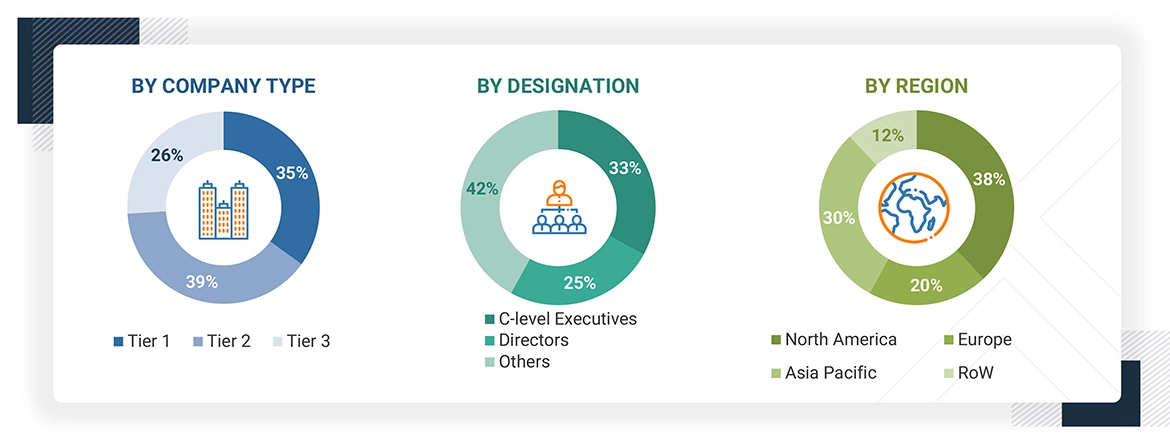
Note: Tier 1 companies’ revenue is more than USD 1 billion; Tier 2 companies’ revenue ranges between USD
500 million and 1 billion; and Tier 3 companies’ revenue ranges between USD 100 million and 500 million. Other designations include sales
managers, marketing managers, and product managers.
To know about the assumptions considered for the study, download the pdf brochure
Market Size Estimation
Multiple approaches were adopted to estimate and forecast the size of the smart railways market. The first approach involves estimating market size by summing up the revenue generated by companies through the sale of smart railway offerings.
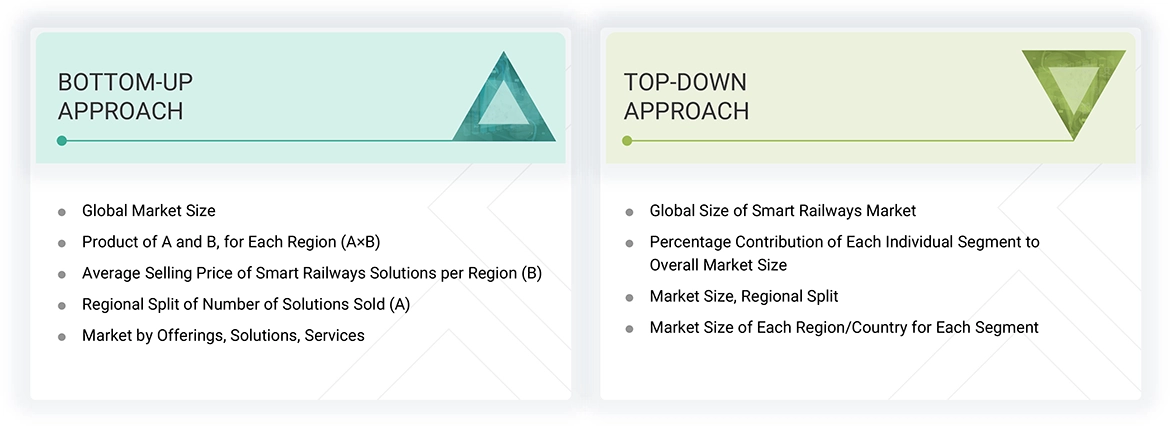
Top-down and bottom-up approaches were used to estimate and validate the total size of the smart railways market. These methods were also extensively used to estimate the size of various market segments. The research methodology used to evaluate the market size is listed below.
- Key players in the market were identified through extensive secondary research.
- In terms of value, the industry’s supply chain and market size were determined through primary and secondary research processes.
- All percentage shares, splits, and breakups were determined using secondary sources and verified through primary sources.
Smart Railways Market : Top-Down and Bottom-Up Approach
Data Triangulation
After determining the overall market size, the smart railways market was divided into several segments and subsegments. A data triangulation procedure was used to complete the overall market engineering process and arrive at the exact statistics for all segments and subsegments, wherever applicable. The data was triangulated by studying various factors and trends from the demand and supply sides. Along with data triangulation and market breakdown, the market size was validated by the top-down and bottom-up approaches.
Market Definition
Smart railways involve the integration of advanced solutions and services that utilize Information and Communication Technology (ICT) in railway operations. This integration can transform key aspects of rail transportation, making them more focused on customer needs. By sharing data, information, and insights with supply chain partners, smart railways enhance the efficiency and effectiveness of railway services. The smart railways market is composed of various systems, associated solutions (software and applications), and services. Smart railways include passenger information systems (PIS), freight management systems, security and safety solutions, rail communication and networking systems, smart ticketing systems, rail analytics systems, rail asset management and maintenance solutions, and rail operation and control solutions. These solutions and systems optimize the performance, costs, and risks for the entire smart rail infrastructure.
Stakeholders
- Smart Railway Vendors
- Network and System Integrators (SIs)
- Cloud Service Providers
- Railway Infrastructure Providers
- Railway Support Service Providers
- National Railway Governing Authorities/Regulators/Bodies
- Railway Operators and Agencies
- Value-added Resellers (VARs) and Distributors
Report Objectives
- To determine and forecast the smart railways market by offering (solutions and services) and region
- To forecast the size of the market segments for North America, Europe, Asia Pacific, Latin America, and the Middle East & Africa
- To provide detailed information about the major factors (drivers, restraints, opportunities, and challenges) influencing the market’s growth
- To analyze each submarket concerning individual growth trends, prospects, and contributions to the overall market
- To analyze the opportunities in the market for stakeholders by identifying high-growth segments of the market
- To profile the key market players; provide a comparative analysis based on business overviews, regional presence, product offerings, business strategies, and key financials; and illustrate the market’s competitive landscape
- To track and analyze competitive developments in the market, such as mergers and acquisitions, product developments, partnerships, collaborations, and research and development (R&D) activities
Available Customizations
With the given market data, MarketsandMarkets offers customizations to meet the company’s specific needs. The following customization options are available for the report:
Geographic Analysis as per Feasibility
- Analysis for additional countries (up to five)
Company Information
- Detailed analysis and profiling of additional market players (up to 5)
Get the Full Smart Railways Market Report
Full forecast, segment splits, and company analysis for all Smart Railways Market.
Need a Tailored Report?
Customize this report to your needs
Get 10% FREE Customization
Customize This Report
