
Japan Smart Transportation Market (2026-2031)

The Japan Smart Transportation Market was valued at $5251.3 Million in 2026 and projected to reach to $8359.6 Million by 2031, representing a compound annual growth rate of CAGR 16.9%. Japan's Smart Transportation market is poised for significant expansion as the nation prioritizes infrastructure modernization and digital transformation.


| Market Size in | USD 26.32 MN |
| Market Forecast in | |
| CAGR | |
| Forecast Period | |
| Units Considered | Value (USD MN) |
Japan Smart Transportation Market Trends and Insights
- Support & Maintenance encompasses preventive servicing, diagnostic monitoring, repair operations, and lifecycle management of intelligent transportation infrastructure and connected vehicle systems.
- This segment is expanding at a compound annual growth rate of 16.9%, significantly outpacing the global market average, driven by increasing deployment of IoT sensors, autonomous vehicle technologies, and real-time traffic management systems that require continuous oversight. Support & Maintenance services are essential as smart transportation ecosystems become more complex and mission-critical.
- Between 2026 and 2031, Support & Maintenance demand will intensify due to aging infrastructure upgrades, regulatory compliance requirements, and the need for 24/7 operational reliability across connected roadway networks.
- Organizations are investing heavily in predictive maintenance platforms and remote monitoring capabilities to minimize downtime and optimize asset performance.
- Support & Maintenance represents a high-margin, recurring revenue opportunity for service providers, positioning it as a cornerstone of sustainable smart transportation deployment globally..
Key Market Statistics
- CAGR (2026-2031) CAGR 16.9%
- Market Size, 2026 ~USD 5251.3 Million
- Forecast, 2031 ~USD 8359.6 Million
- Country Japan
Japan Smart Transportation Market Overview
Rapid Market Expansion :
Japan's Smart Transportation market is experiencing robust growth with a 16.9% CAGR, significantly outpacing the global average of 14.7%, driven by aging infrastructure modernization and government digital transformation initiatives.
Infrastructure Maintenance Focus :
The Support & Maintenance segment is critical for Japan's aging roadway systems, with preventive servicing and diagnostic monitoring becoming essential as municipalities invest in intelligent transportation infrastructure across urban and rural networks.
Connected Vehicle Adoption :
Japan's advanced automotive sector is accelerating connected vehicle system deployment, creating substantial demand for lifecycle management services and repair operations in the Support & Maintenance segment.
Substantial Market Value Growth :
The market is projected to grow from $5,251.3 million in 2026 to $8,359.6 million by 2031, representing a $3.1 billion expansion opportunity driven by smart city initiatives and transportation digitalization.
Japan Smart Transportation Market Dynamics
- The Support & Maintenance segment will play a pivotal role, driven by the need to manage aging roadway systems and the rapid proliferation of connected vehicle technologies.
- Government initiatives promoting smart cities and autonomous vehicle ecosystems are accelerating investment in intelligent transportation infrastructure, creating sustained demand for comprehensive maintenance and diagnostic services. The 16.9% CAGR reflects Japan's commitment to leveraging technology for transportation efficiency and safety.
- With a mature automotive industry and advanced technological capabilities, Japanese stakeholders are well-positioned to capitalize on growing opportunities in preventive servicing, repair operations, and lifecycle management.
- The market's expansion from $5.3 billion to $8.4 billion by 2031 underscores the critical importance of robust support infrastructure for intelligent transportation systems..
Market Ecosystem
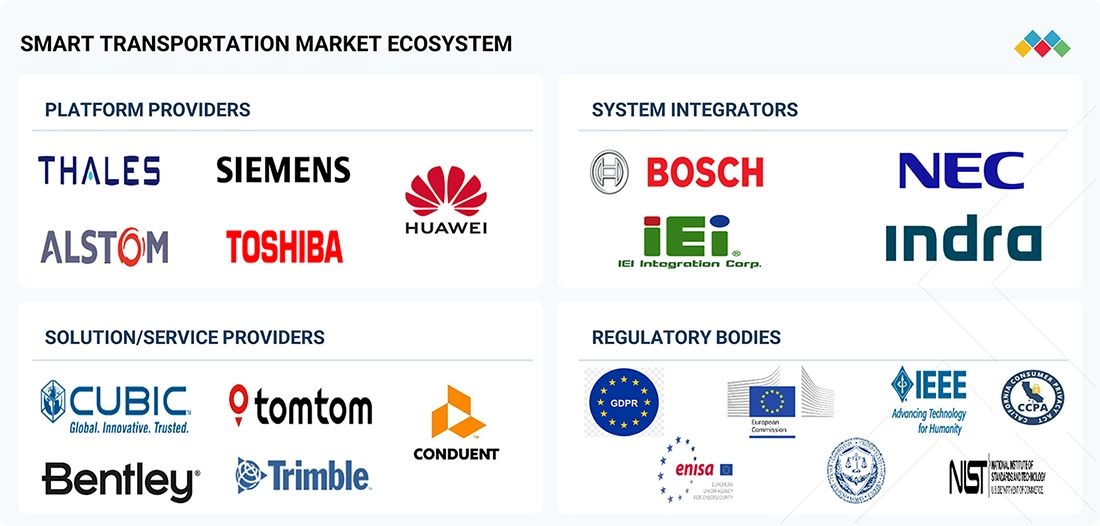
SMART TRANSPORTATION MARKET SIZE, SHARE, GROWTH, LATEST TRENDS: COMMERCIAL USE CASES ACROSS INDUSTRIES
| COMPANY | USE CASE DESCRIPTION | BENEFITS |
|---|---|---|
 |
Siemens Mobility delivers intelligent transportation solutions through advanced traffic management systems, adaptive traffic signal control, connected roadside infrastructure, AI-driven analytics, and integrated mobility platforms. Transportation authorities and city governments deploy these solutions to monitor traffic conditions, optimize signal timing, manage congestion, and improve multimodal transportation operations. The platform combines real-time traffic data, sensors, cameras, and predictive analytics to support efficient traffic flow management, incident detection, and long-term transportation planning across urban and regional networks. | Reduced traffic congestion and travel delays | Improved traffic flow and road network efficiency | Enhanced incident detection and response capabilities | Better transportation planning through real-time and predictive insights |
 |
Thales provides smart transportation solutions through intelligent rail signaling, urban transit management, fare collection systems, passenger information platforms, and integrated transportation control centers. Rail operators, metro agencies, and transportation authorities utilize these technologies to optimize train operations, improve passenger mobility, and enhance network reliability. The platform integrates operational data, communication systems, and analytics to support real-time monitoring, predictive maintenance, capacity management, and seamless passenger experiences across transportation ecosystems. | Improved transit reliability and operational performance | Enhanced passenger safety and travel experience | Increased transportation network capacity and utilization | Reduced maintenance costs through predictive operations |
 |
Huawei offers smart transportation solutions powered by IoT, AI, cloud computing, 5G connectivity, and intelligent transportation management platforms. Cities, highway operators, airports, and public transit agencies deploy these solutions to manage traffic operations, monitor transportation assets, enable connected vehicle ecosystems, and support smart mobility initiatives. The platform leverages real-time data collection, video analytics, and digital infrastructure to improve transportation efficiency, optimize resource allocation, and strengthen operational visibility across complex transportation environments. | Real-time transportation asset and traffic visibility | Improved operational efficiency and resource utilization | Enhanced road safety and traffic incident management | Data-driven decision-making for smart mobility initiatives |
Logos and trademarks shown above are the property of their respective owners. Their use here is for informational and illustrative purposes only.
Related Ecosystem
Automotive Electronics And Electrical Equipment
- Battery Electric Vehicle (BEV)
- Light Commercial Vehicles (LCVs)
- Fuel Cell Electric Vehicle (FCEV)
- Sensors
- Hybrid Electric Vehicle (HEV)
- BOSCH LIMITED
- DENSO Corporation
- Continental ag
- Panasonic Holdings Corporation
- Texas Instruments Incorporated
Digitalization And Iot
- Sensors
- Remote Monitoring
- Supply Chain Management
- Passenger Information System (PIS)
- Platform as A Service (PaaS)
- International Business Machines Corporation
- Cisco Systems, Inc.
- MICROSOFT CORPORATION
- Oracle Corporation
- SAP SE
Mobility And Telecom
- Smart Utilities
- Smart Healthcare
- Sensors
- Parking Management System
- Passenger Information System (PIS)
- AT&T Inc.
- Cisco Systems, Inc.
- HUAWEI TECHNOLOGIES CO LTD
- Telefonaktiebolaget LM Ericsson (publ)
- International Business Machines Corporation
Key Takeaways
- Support & Maintenance will grow from $5.25B (2026) to $8.36B (2031) at a 16.9% CAGR, outpacing overall market growth.
- Support & Maintenance demand is driven by complexity of IoT-enabled infrastructure, autonomous systems, and regulatory compliance mandates.
- Predictive maintenance and remote monitoring technologies are reshaping Support & Maintenance service delivery models and cost structures.
- Support & Maintenance represents a recurring, high-margin revenue stream critical to long-term profitability in smart transportation ecosystems.
Smart Transportation Market Report Scope
| Report Metric | Details |
|---|---|
| Base Year | 2026 |
| Fastest Growing Segment | ASIA PACIFIC (End User) |
| Forecast Period | 2026–2031 |
| Growth Rate | CAGR of 14.7% from 2026 to 2031 |
| Largest Segment | SOLUTIONS (Transportation Mode) |
| Market Size Base Year (Billions) | ~USD 176.07 (2026) |
| Revenue Forecast (Billions) | ~USD 349.54 (2031) |
| Segments Covered | Transportation Mode, Roadway, Roadways Solution, Roadways Service, Railway, Railways Solution, Railways Service, Airway, Airways Solution, Airways Service, Maritime, Maritime Solution, Maritime Service, End User |
Japan Smart Transportation Market Report Segmentation
14 segment dimensions are covered across the global market.
By Transportation Mode
- Airways
- Freight Management
- Maritime
- Other Railway Solutions
- Passenger Information
- Rail Asset Management
- Rail Traffic Management
- Railway Smart Ticketing
- Railways
- Roadways
By Roadway
- Services
- Solutions
By Roadways Solution
- Freight & Fleet Management
- Intelligent Mobility Solutions
- Other Roadway Solutions
- Parking Management
- Passenger Information
- Smart Ticketing
- Traffic Management
By Roadways Service
- Consulting
- Deployment & Integration
- Support & Maintenance
By Railway
- Services
- Solutions
By Railways Solution
- Freight Management
- Other Railway Solutions
- Other Railways Solutions
- Passenger Information
- Rail Asset Management
- Rail Traffic Management
- Railway Smart Ticketing
By Railways Service
- Consulting
- Deployment & Integration
- Railways Service
- Support & Maintenance
By Airway
- Services
- Solutions
By Airways Solution
- Air Traffic Management
- Airport Security Solutions
- Airway Passenger Information
- Freight Management
- Other Airway Solutions
- Other Airways Solutions
- Smart Ticketing
By Airways Service
- Consulting
- Deployment & Integration
- Deployment And Integration
- Support & Maintenance
- Support And Maintenance
By Maritime
- Services
- Solutions
By Maritime Solution
- Maritime Traffic Management
- Other Marine Solutions
- Other Maritime Solutions
- Passenger Information
- Port & Terminal Management
By Maritime Service
- Consulting
- Deployment & Integration
- Support & Maintenance
By End User
- Commercial Organizations
- Government
JAPAN: SMART TRANSPORTATION MARKET, BY END USER, 2026–2032
| Segment | 2026 | 2027 | 2028 | 2029 | 2030 | 2031 | 2032 | CAGR (%) |
|---|---|---|---|---|---|---|---|---|
| COMMERCIAL ORGANIZATIONS | 1560.4 | 1888.9 | 2319.3 | 2588.4 | 3005.4 | 3460.6 | 3947.7 | 16.7 |
| GOVERNMENT | 5004.1 | 5968.4 | 7221.4 | 7942.2 | 9088.9 | 10315.6 | 11600.6 | 15 |
| TOTAL | 6564.4 | 7857.3 | 9540.7 | 10530.7 | 12094.3 | 13776.1 | 15548.3 | 15.5 |
Target Audience
- Transportation Infrastructure Operators : Municipal and regional transportation authorities managing roadway systems need this data to plan maintenance budgets, evaluate smart infrastructure investments, and understand service provider capabilities for intelligent transportation systems.
- Automotive & Connected Vehicle Manufacturers : Japanese and international automotive companies require market insights to develop support service offerings, establish maintenance networks, and capitalize on growing demand for connected vehicle lifecycle management in Japan.
- Technology & Service Providers : IT solution providers and maintenance service companies need Japan-specific market data to identify growth opportunities, develop localized service portfolios, and establish partnerships with infrastructure operators and vehicle manufacturers.
- Investment & Strategy Consultants : Private equity firms, management consultants, and strategic advisors require detailed market forecasts and segment analysis to guide investment decisions, M&A strategies, and business development initiatives in Japan's Smart Transportation sector.
- Government & Policy Makers : Japanese government agencies and policy bodies need comprehensive market intelligence to inform smart city initiatives, infrastructure modernization programs, and regulatory frameworks supporting intelligent transportation system deployment.
Key Companies in the Japan Smart Transportation Market
| Company | HQ | Ownership | Strongest segments |
|---|---|---|---|
| BELDEN INC | United States | Public Company | Industrial Ethernet switches and networking,Structured cabling and enterprise connectivity,Industrial and specialty fiber/copper cables, |
| INFOR INC | United States | Private Company | Data Integration & Engineering,API & Application Integration,Data Quality & Observability, |
| MCLAREN GROUP | United Kingdom | Private Company | Supercars,Ultimate,GT, |
| VELODYNE LIDAR INC | United States | Public Company | Surround-view mechanical lidar (AV, drones, mapping, mobile robots),Solid-state lidar for ADAS and autonomous applications,Software and perception (Vella, Vella Development Kit), |
| TELENET GROUP | Belgium | Private Company | Fixed broadband and connectivity (residential),Pay TV and video (HD, pay TV, VoD),Mobile services (BASE and FMC mobile), |
| ENGHOUSE INTERACTIVE | United States | Private Company | Omnichannel contact center platforms,Telecommunications technology applications,EnghouseAI and automation, |
| ALTRAN | France | Private Company | Engineering and R&D Services,Organization and IT Systems Consulting, |
| SENER | Spain | Private Company | Space systems and mechanisms engineering,Defence systems and integration,Aeronautics engineering and subsystems, |
| FOXCONN INDUSTRIAL INTERNET CO LTD | China | Public Company | Server and storage hardware,Networking equipment,Industrial automation systems and precision components, |
| PARSONS | United States | Public Company | Federal Solutions – Cyber, Intelligence, and Electronic Warfare,Federal Solutions – Space Ground Systems and C2,Federal Solutions – Mission Support and Environmental Remediation, |
| SIEMENS | Germany | Public Company | Digital Industries (automation, PLM, simulation),Smart Infrastructure (electrification, buildings, grid),Mobility (rail systems, automation, services), |
| ALSTOM | France | Public Company | Rolling stock (metros, regional, high-speed, locomotives, light rail, monorail),Services (maintenance, modernization, overhaul, parts, support),Signaling (urban, mainline, freight and mining), |
| HITACHI | Japan | Public Company | Digital Systems & Services (IT, cloud, integration, OT/IT),Green Energy & Mobility (grids, energy, rail systems),Connective Industries (industrial equipment, automation, e-mobility), |
| CISCO | United States | Public Company | Enterprise networking (switching, routing, wireless, campus/DC/branch),Security (network security, SASE, identity, threat detection/response),Collaboration (Webex suite, devices, contact center, CPaaS), |
| CUBIC | United States | Private Company | Transportation systems (fare collection, traffic management),Defense C4ISR (communications, networking, ISR integration),Defense training and simulation, |
| TOSHIBA | Japan | Private Company | Energy Systems & Solutions,Infrastructure Systems & Solutions,Building Solutions, |
| ALMAVIVA | Italy | Private Company | Cloud and Core ICT Services,Contact Center and BPO,AI, Machine Learning, and Advanced Analytics, |
| NEC CORPORATION | Japan | Public Company | Systems integration, outsourcing, and DX consulting,Telecom networks and carrier software,Enterprise IT platforms and applications, |
| BENTLEY SYSTEMS | United States | Public Company | Open modeling applications (MicroStation, OpenRoads, OpenRail, OpenBuildings, OpenPlant, etc.),Open simulation and structural analysis (STAAD, SACS, RAM, ADINA, PLAXIS, GeoStudio, etc.),Infrastructure cloud applications (ProjectWise, SYNCHRO, AssetWise, Cesium, iTwin platform), |
| INDRA | Spain | Public Company | Defense systems (radars, C2, air and naval, land vehicles, UAS),Air Traffic Management systems and services,Mobility, ticketing, tolling, and transport control, |
| TRIMBLE | United States | Public Company | Construction lifecycle software (design, BIM, VDC, owner solutions),Field systems and construction equipment guidance,Positioning and correction services (VRSNow, RTX, xFill, etc.), |
BELDEN INC
Belden Inc is a publicly traded American manufacturer founded in 1902 that employs 8,000 people. The company specializes in signal transmission products and solutions for various industries.
INFOR INC
Infor Inc is a private American software company founded in 1993 with 5,200 employees. It provides enterprise resource planning and business management software solutions.
MCLAREN GROUP
McLaren Group is a British private company established in 1963 with 2,627 employees. The organization is known for its operations in automotive engineering, racing, and technology.
VELODYNE LIDAR INC
Velodyne Lidar Inc is a publicly traded American company founded in 1983 with 407 employees. It specializes in the design and manufacture of lidar sensors for autonomous vehicles and other applications.
TELENET GROUP
Telenet Group is a Belgian private company established in 1994 with 3,467 employees. It operates as a telecommunications and media services provider.
ENGHOUSE INTERACTIVE
Enghouse Interactive is an American private company founded in 1984 with 243 employees. It develops customer engagement and contact center software solutions.
ALTRAN
Altran is a French private company established in 1970 with 50,124 employees. It provides engineering and technology consulting services globally.
SENER
Sener is a Spanish private company founded in 1956 with 5,558 employees. It specializes in engineering, technology, and industrial solutions.
FOXCONN INDUSTRIAL INTERNET CO LTD
Foxconn Industrial Internet Co Ltd is a publicly traded Chinese company founded in 2015 with 217,084 employees. It operates as an industrial internet platform and manufacturing services provider.
PARSONS
Parsons is a publicly traded American engineering and construction company founded in 1944 with 21,000 employees. It provides infrastructure, defense, and technology solutions.
SIEMENS
Alstom is a publicly traded French company established in 1928 with 87,832 employees. It specializes in rail transport and renewable energy solutions.
ALSTOM
Hitachi is a publicly traded Japanese conglomerate founded in 1910 with 287,901 employees. It operates across industrial, digital, and green energy sectors.
HITACHI
Cisco is a publicly traded American technology company founded in 1984 with 86,200 employees. It specializes in networking, cybersecurity, and IT infrastructure solutions.
CISCO
DNV is a Norwegian private company established in 1864 with 15,000 employees. It provides classification, certification, and technical advisory services for maritime and energy sectors.
CUBIC
Toshiba is a Japanese private company founded in 1875 with 106,648 employees. It operates across electronics, energy, and infrastructure sectors.
TOSHIBA
Veson Nautical is an American private company founded in 1979 with 200 employees. It provides software solutions for the maritime and shipping industry.
ALMAVIVA
NEC Corporation is a publicly traded Japanese company founded in 1899 with 101,800 employees. It operates in IT services, network solutions, and semiconductor sectors.
NEC CORPORATION
Bentley Systems is a publicly traded American software company founded in 1984 with 5,800 employees. It provides infrastructure engineering software solutions.
BENTLEY SYSTEMS
Indra is a publicly traded Spanish company established in 1921 with 62,689 employees. It provides technology and consulting services for defense, transportation, and digital sectors.
INDRA
Trimble is a publicly traded American company founded in 1978 with 11,500 employees. It specializes in positioning, modeling, and analytics technologies for various industries.
TRIMBLE
Reasons to Buy this Report
- Market-Specific Growth Intelligence : Gain detailed insights into Japan's 16.9% CAGR trajectory, significantly outpacing global growth, enabling strategic investment decisions in the region's high-growth Smart Transportation ecosystem.
- Segment-Level Opportunity Analysis : Understand the Support & Maintenance segment's $3.1 billion growth potential through 2031, identifying specific revenue streams in preventive servicing, diagnostics, and lifecycle management tailored to Japan's market dynamics.
- Infrastructure Modernization Trends : Access Japan-specific data on aging infrastructure replacement cycles and government digitalization initiatives driving demand for intelligent transportation solutions and maintenance services across municipalities.
- Connected Vehicle Market Positioning : Leverage insights into Japan's advanced automotive sector adoption of connected vehicle technologies, identifying partnership and service delivery opportunities in repair operations and system management.
- Competitive Landscape Clarity : Develop market entry strategies and competitive positioning with Japan-focused analysis of key stakeholders, service providers, and technology vendors operating in the Smart Transportation Support & Maintenance space.
Frequently asked questions
What is included in the Support & Maintenance segment?
Support & Maintenance encompasses preventive servicing, diagnostic monitoring, repair operations, software updates, and lifecycle management of intelligent transportation infrastructure, connected vehicle systems, and roadway IoT sensors.
Why is Support & Maintenance growing faster than the overall Smart Transportation Market?
Support & Maintenance is growing at 16.9% CAGR versus 14.7% globally because increasing system complexity, regulatory requirements, and the mission-critical nature of connected infrastructure demand continuous, specialized oversight and recurring service contracts.
What are the key drivers of Support & Maintenance market expansion through 2031?
Key drivers include proliferation of IoT sensors, autonomous vehicle deployment, aging infrastructure modernization, 24/7 operational reliability mandates, predictive maintenance technology adoption, and regulatory compliance requirements across smart roadway networks.
How is Support & Maintenance service delivery evolving?
Support & Maintenance is shifting toward AI-powered predictive analytics, remote monitoring platforms, automated diagnostics, and proactive intervention models that reduce downtime and optimize total cost of ownership for transportation operators.
What is the market size forecast for Support & Maintenance by 2031?
The Support & Maintenance segment is projected to reach $8,359.6 million by 2031, growing from $5,251.3 million in 2026, representing a 59% increase over the five-year forecast period.
RESEARCH METHODOLOGY
This research study involved extensive secondary sources, directories, and databases, such as Dun & Bradstreet (D&B) Hoovers and Bloomberg BusinessWeek, to identify and collect valuable information for a technical, market-oriented, and commercial study of the smart transportation market. The primary sources were mainly industry experts from the core and related industries and preferred suppliers, manufacturers, distributors, service providers, technology developers, alliances, and organizations related to all segments of the value chain of this market. In-depth interviews were conducted with primary respondents, including key industry participants, subject matter experts, C-level executives of key market players, and industry consultants, to obtain and verify critical qualitative and quantitative information.
Secondary Research
In the secondary research process, various secondary sources were referred to to identify and collect information for the study. The secondary sources included annual reports, press releases, investor presentations of companies, white papers, certified publications, and articles from recognized associations and government publishing sources. Several journals and associations, such as the 27th IEEE International Conference on Intelligent Transportation Systems (IEEE ITSC 2024) and ICTA 2024: 9th International Conference on Sustainable Transportation & Smart Innovations, were also referred to. Secondary research was used to obtain key information about industry insights, the market’s monetary chain, the overall pool of key players, market classification and segmentation according to industry trends to the bottom-most level, regional markets, and key developments from both the market and technology-oriented perspectives.
Primary Research
In the primary research process, various primary sources from both the supply and demand sides were interviewed to obtain qualitative and quantitative information for the report. The primary sources from the supply side included industry experts, such as Chief Executive Officers (CEOs), Chief Technology Officers (CTOs), Chief Operating Officers (COOs), Vice Presidents (VPs), marketing directors, technology and innovation directors, and related key executives from various key companies and organizations operating in the smart transportation market. The primary sources from the demand side included smart transportation end users, consultants/specialists, chief information officers (CIOs), and subject-matter experts from enterprises and government associations.
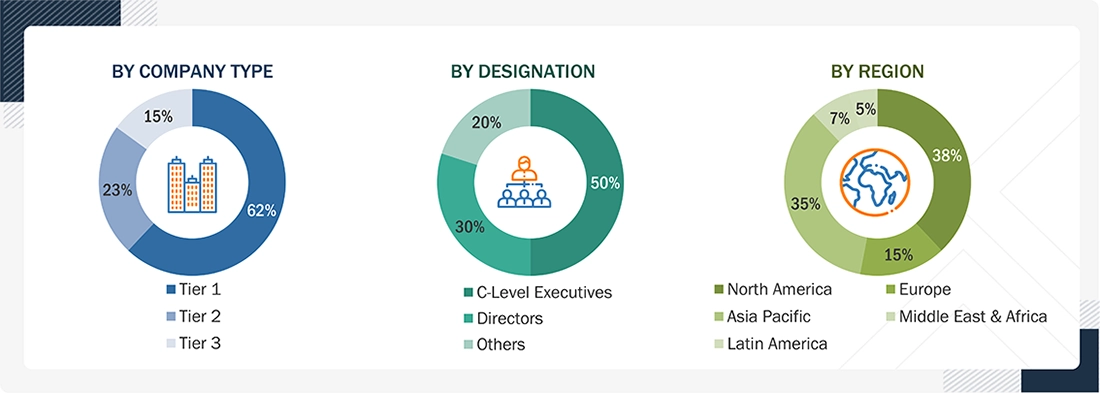
Note: Tier 1 companies’ revenue is more than USD 1 billion; Tier 2 companies ‘revenue ranges between USD 500 million and 1 billion; and Tier 3 companies’ revenue ranges between USD 100 million and USD 500 million. Other designations include sales managers, marketing managers, and product managers.
To know about the assumptions considered for the study, download the pdf brochure
Market Size Estimation
Multiple approaches were adopted to estimate and forecast the size of the smart transportation market. The first approach involves estimating market size by summing up the revenue generated by companies through the sale of smart transportation.
Both top-down and bottom-up approaches were used to estimate and validate the total size of the smart transportation market. These methods were extensively used to estimate the size of various segments in the market. The research methodology used to estimate the market size includes the following:
- Key players in the market were identified through extensive secondary research.
- In terms of value, the industry’s supply chain and market size were determined through primary and secondary research processes.
- All percentage shares, splits, and breakups were determined using secondary sources and verified through primary sources.
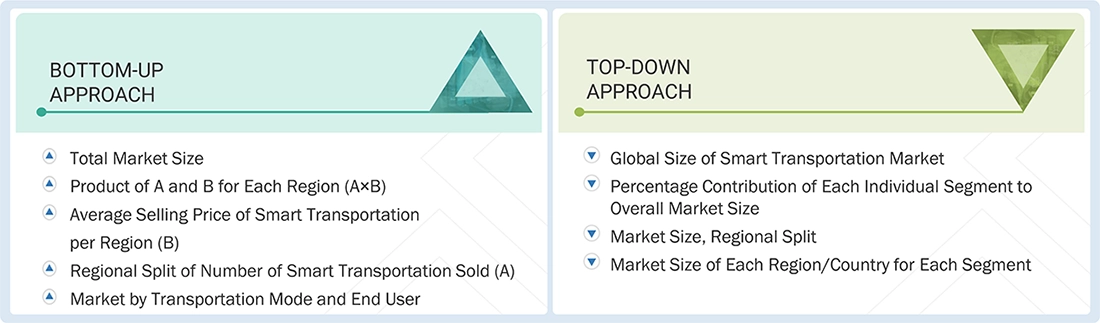
Data Triangulation
After arriving at the overall market size, the smart transportation market was divided into several segments and subsegments. A data triangulation procedure was used to complete the overall market engineering process and arrive at the exact statistics for all segments and subsegments, wherever applicable. The data was triangulated by studying various factors and trends from the demand and supply sides. Along with data triangulation and market breakdown, the market size was validated by the top-down and bottom-up approaches.
Market Definition
Smart transportation refers to an advanced transportation system that integrates technology, data, and innovation to improve the efficiency, safety, accessibility, and sustainability of all modes of transport, such as roadways, railways, maritime, and airways. This transportation system involves an Information and Communication Technology (ICT)-driven framework designed to optimize the efficiency, safety, and sustainability of transportation systems across all modes, such as road, rail, air, water, and urban transit. It integrates advanced technologies such as IoT, AI, cloud computing, big data analytics, and intelligent communication networks to enhance the movement of people and goods through data-driven decision-making and automation.
With the advancement of disruptive technologies such as artificial intelligence (AI), machine learning (ML), the Internet of Things (IoT), and big data analytics, smart transportation aims to provide innovative services related to various modes of transportation and traffic management. These technologies enable users to be better informed and make safer, smarter use of transportation networks.
Key Stakeholders
- Transportation Service Providers
- Solution Vendors
- Networking and Communication Service Providers
- Original Equipment Manufacturers (OEMs)
- Transportation Agencies
- Public Transportation Departments
- Managed Service Providers (MSPs)
- System Integrators
- Consultancy Firms/Advisory Firms
- Investors and Venture Capitalists
- Independent Software Vendors
- Value-added Resellers (VARs) and Distributors
- Governments and Urban Planning Agencies
- Rail Infrastructure Suppliers
- Railway Management Companies (private/public)
- Shipping Operators
- Maritime Technology Vendors
- Airport Authorities
- Airport Technology Vendors
- Transport Operators
- Transport Infrastructure Planners
Report Objectives
- To determine and forecast the smart transportation market by transportation mode (roadways, railways, airways, maritime), solutions, services, end-user, and region from 2026 to 2032, and analyze the various macroeconomic and microeconomic factors that affect the market growth
- To forecast the size of the market segments with respect to five main regions: North America, Europe, Asia Pacific (APAC), Latin America, and the Middle East & Africa (MEA)
- To provide detailed information about the major factors (drivers, restraints, opportunities, and challenges) influencing the growth of the market
- To analyze each submarket with respect to individual growth trends, prospects, and contributions to the overall market
- To analyze the opportunities in the market for stakeholders by identifying the high-growth segments of the market
- To profile the key market players; provide a comparative analysis on the basis of business overviews, regional presence, product offerings, business strategies, and key financials; and illustrate the competitive landscape of the market
- To track and analyze competitive developments, such as mergers and acquisitions, product developments, partnerships and collaborations, and research and development (R&D) activities, in the market
Available customizations:
With the given market data, MarketsandMarkets offers customizations as per the company’s specific needs. The following customization options are available for the report:
Country-wise information
- Analysis for additional countries (up to five)
Company Information
- Detailed analysis and profiling of additional market players (up to 5)
Get the Full Smart Transportation Market Report
Full forecast, segment splits, and company analysis for all Smart Transportation Market.
- US Smart Transportation Market
- Canada Smart Transportation Market
- UK Smart Transportation Market
- Germany Smart Transportation Market
- France Smart Transportation Market
- Italy Smart Transportation Market
- China Smart Transportation Market
- India Smart Transportation Market
- UAE Smart Transportation Market
- Brazil Smart Transportation Market
- Mexico Smart Transportation Market
Need a Tailored Report?
Customize this report to your needs
Get 10% FREE Customization
Customize This Report
