
Brazil Solid-state Transformer Market (2030-2035)

The Brazil Solid-state Transformer Market was valued at $7 Million in 2030 and projected to reach to $33.4 Million by 2035, representing a compound annual growth rate of CAGR 36.9%. Brazil's solid-state transformer market is positioned for exceptional growth through 2035, driven by the country's strategic focus on grid modernization and renewable energy integration.


| Market Size in | USD 26.32 MN |
| Market Forecast in | |
| CAGR | |
| Forecast Period | |
| Units Considered | Value (USD MN) |
Brazil Solid-state Transformer Market Trends and Insights
- This represents a compound annual growth rate of 36.9%, significantly outpacing global trends and reflecting Brazil's increasing adoption of advanced power electronics and grid modernization initiatives.
- Brazil's market expansion is driven by rising demand for efficient energy distribution, renewable energy integration, and industrial automation across the country's manufacturing and utility sectors. The solid-state transformer segment in Brazil benefits from the nation's strategic focus on sustainable infrastructure and digital transformation.
- Brazil's investment in smart grid technologies and electrification of transportation systems is accelerating semiconductor adoption in power conversion applications.
- By 2035, Brazil is expected to emerge as a key regional hub for solid-state transformer deployment, supported by growing industrial capacity and government incentives for clean energy transitions. Brazil's competitive landscape is characterized by increasing participation from both multinational semiconductor firms and regional technology providers.
- The country's favorable regulatory environment and expanding manufacturing base position Brazil as an attractive market for solid-state transformer innovation and commercialization through 2035..
Key Market Statistics
- CAGR (2030-2035) CAGR 36.9%
- Market Size, 2030 ~USD 7 Million
- Forecast, 2035 ~USD 33.4 Million
- Country Brazil
Brazil Solid-state Transformer Market Overview
Explosive Growth Trajectory :
Brazil's solid-state transformer market is projected to grow from $7.0 million in 2030 to $33.4 million by 2035, representing a 36.9% CAGR that outpaces the global average of 40.1%, demonstrating strong regional momentum.
Grid Modernization Initiatives :
Brazil's commitment to upgrading its electrical infrastructure and transitioning to smart grid technologies is driving demand for advanced power electronics solutions, positioning solid-state transformers as critical components.
Renewable Energy Integration :
Increasing adoption of solar and wind energy sources across Brazil necessitates efficient power conversion and distribution technologies, creating substantial opportunities for solid-state transformer deployment.
Industrial Electrification Demand :
Brazil's growing manufacturing sector and industrial expansion are accelerating the need for advanced power management solutions, with solid-state transformers offering superior efficiency and reliability.
Brazil Solid-state Transformer Market Dynamics
- The 36.9% CAGR reflects increasing investments in smart grid infrastructure and the electrification of industrial processes across the nation.
- Government initiatives supporting clean energy adoption and power distribution efficiency are creating favorable conditions for market expansion. The Brazilian market will benefit from rising demand for compact, efficient power conversion solutions in both utility-scale and distributed energy applications.
- As the country continues to develop its renewable energy capacity and modernize aging electrical infrastructure, solid-state transformers will become increasingly essential.
- This growth trajectory positions Brazil as a significant emerging market within the global semiconductor and electronics sector..
Market Ecosystem
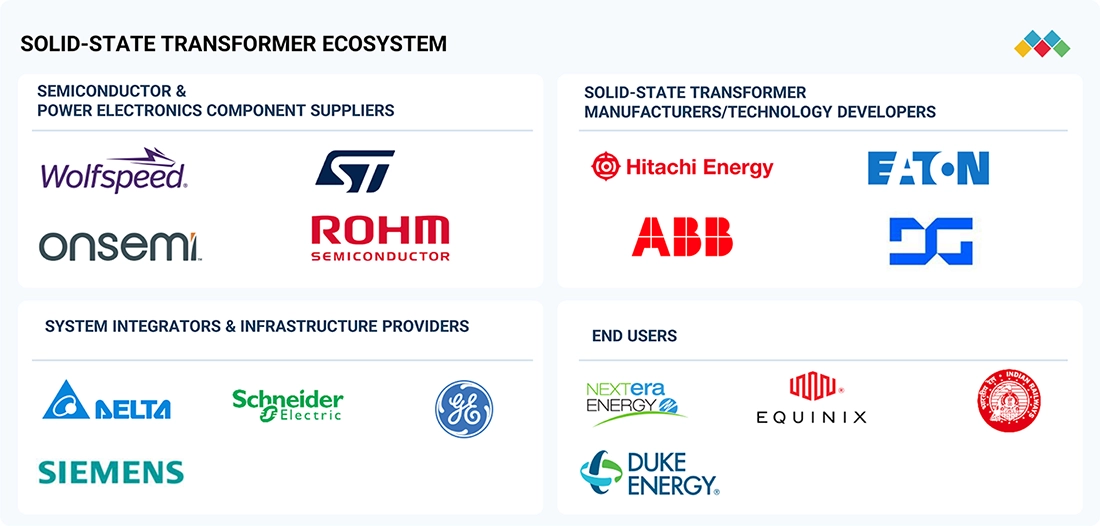
SOLID-STATE TRANSFORMER MARKET: COMMERCIAL USE CASES ACROSS INDUSTRIES
| COMPANY | USE CASE DESCRIPTION | BENEFITS |
|---|---|---|
 |
Development and deployment of solid-state transformer solutions for smart grid infrastructure and digital substations to enable advanced voltage regulation and distributed energy resource integration | Improved grid stability | Efficient renewable integration | Enhanced power quality management |
 |
Integration of solid-state transformer concepts into medium-voltage power conversion platforms for advanced grid-edge applications and digital power distribution systems | Bidirectional power flow | Higher system efficiency | Flexible grid operations |
 |
Development of compact medium-voltage solid-state transformer systems for microgrids, EV charging infrastructure, and industrial power management applications | Improved energy efficiency | Reduced system footprint | Enhanced grid resilience |
 |
Design of high-efficiency power conversion systems incorporating SST architectures for renewable energy integration and data center power infrastructure | Higher power density | Efficient AC/DC power conversion | Optimized energy management |
 |
Deployment of multi-port solid-state transformer platforms to manage AC/DC power conversion and routing in renewable energy, storage systems, and data center power architectures | Intelligent power routing | Reduced infrastructure footprint | Faster deployment of modular power systems |
Logos and trademarks shown above are the property of their respective owners. Their use here is for informational and illustrative purposes only.
Related Ecosystem
Electric Hybrid Vehicles
- Battery Electric Vehicle (BEV)
- Fuel Cell Electric Vehicle (FCEV)
- Light Commercial Vehicles (LCVs)
- Hybrid Electric Vehicle (HEV)
- Agricultural Tractors
- Visteon Corporation
- BOSCH LIMITED
- Byd company ltd.
- Tesla, Inc.
- FORD MOTOR COMPANY
Electrical System And Components
- Natural Language Processing (NLP)
- Sensors
- Machine Learning
- Temperature Sensors
- Actuators
- ABB India Limited
- Siemens ag
- SCHNEIDER ELECTRIC SE
- Eaton Corporation plc
- General Electric Company
Key Takeaways
- Brazil's solid-state transformer market will grow from $7.0M (2030) to $33.4M (2035) at a 36.9% CAGR, outpacing global growth rates.
- Brazil's renewable energy integration and smart grid modernization are primary catalysts driving solid-state transformer adoption.
- Brazil's industrial automation and electrification sectors are expanding demand for advanced power electronics solutions.
- Brazil is positioned to become a regional leader in solid-state transformer deployment by 2035 with supportive regulatory frameworks.
Solid-state Transformer Market Report Scope
| Report Metric | Details |
|---|---|
| Base Year | 2030 |
| Fastest Growing Segment | DATA CENTERS (Application) |
| Forecast Period | 2030–2035 |
| Growth Rate | CAGR of 40.1% from 2030 to 2035 |
| Largest Segment | MEDIUM VOLTAGE (1–35 KV) (Voltage Level) |
| Market Size Base Year (Billions) | ~USD 0.28 (2030) |
| Revenue Forecast (Billions) | ~USD 1.52 (2035) |
| Segments Covered | Power Rating, Voltage Level, Semiconductor Device Type, Deployment Type, Application, End User |
Brazil Solid-state Transformer Market Report Segmentation
6 segment dimensions are covered across the global market.
By Power Rating
- 1–5 Mva
- <1 Mva
- >20 Mva
- >5–20 Mva
By Voltage Level
- High Voltage (>35 Kv)
- Low Voltage (<1 Kv)
- Medium Voltage (1–35 Kv)
By Semiconductor Device Type
- Gallium Nitride (Gan)-Based Sst
- Hybrid Sst (Sic + Gan)
- Silicon Carbide (Sic)-Based Sst
By Deployment Type
- New Installation
- Retrofit/Replacement
By Application
- Data Centers
- Electric Vehicle Infrastructure
- Industrial & Commercial Applications
- Railway & Traction Systems
- Renewable Energy Integration
- Smart Grid & Distribution Networks
By End User
- Commercial & Institutional Operators
- Electric Utilities
- Government & Defense Organizations
- Industrial Enterprises
- Renewable Energy Developers
- Transportation Authorities
BRAZIL: SOLID-STATE TRANSFORMER MARKET, BY APPLICATION, 2030–2035
| Segment | 2030 | 2031 | 2032 | 2033 | 2034 | 2035 | CAGR (%) |
|---|---|---|---|---|---|---|---|
| DATA CENTERS | 1.91 | 2.71 | 3.84 | 5.43 | 7.67 | 10.83 | 41.5 |
| ELECTRIC VEHICLE INFRASTRUCTURE | 1.48 | 2.24 | 2.96 | 3.9 | 5.17 | 6.92 | 36.1 |
| INDUSTRIAL & COMMERCIAL APPLICATIONS | 0.8 | 1.03 | 1.34 | 1.73 | 2.24 | 2.89 | 29.4 |
| RAILWAY & TRACTION SYSTEMS | 0.3 | 0.39 | 0.5 | 0.65 | 0.82 | 1.03 | 28.2 |
| RENEWABLE ENERGY INTEGRATION | 0.36 | 0.5 | 0.67 | 0.9 | 1.18 | 1.54 | 33.5 |
| SMART GRID & DISTRIBUTION NETWORKS | 2.1 | 2.4 | 3.46 | 4.97 | 7.14 | 10.23 | 37.2 |
| TOTAL | 6.95 | 9.28 | 12.78 | 17.58 | 24.22 | 33.44 | 36.9 |
Target Audience
- Power Electronics Manufacturers : Manufacturers need Brazil-specific market data to assess production capacity requirements, localization strategies, and competitive positioning in this rapidly expanding regional market.
- Utility Companies & Grid Operators : Brazilian utilities require detailed market insights to evaluate solid-state transformer adoption timelines, infrastructure investment priorities, and technology integration roadmaps for grid modernization.
- Investment & Private Equity Firms : Investors targeting Brazil's energy and semiconductor sectors need comprehensive market forecasts and growth drivers to identify high-potential investment opportunities and portfolio companies.
- Government & Policy Makers : Brazilian government agencies and regulators need market intelligence to inform energy policy, infrastructure investment decisions, and technology adoption incentives aligned with national development goals.
- System Integrators & Distributors : Regional system integrators and distributors require Brazil-focused market data to plan inventory, develop customer solutions, and capitalize on emerging opportunities in grid modernization projects.
Key Companies in the Brazil Solid-state Transformer Market
| Company | HQ | Ownership | Strongest segments |
|---|---|---|---|
| DIODES INCORPORATED | United States | Public Company | |
| KEC INTERNATIONAL LIMITED | India | Public Company | Transmission Lines & Substations EPC,Railway & Urban Transport EPC,Civil & Industrial Infrastructure, |
| LENOVO | China | Public Company | Small form factor PCs & media players,Thin clients & embedded systems,Tablets & smart devices for kiosks/POS displays, |
| HITACHI, LTD. | Japan | Public Company | Digital Systems & Services,Green Energy & Mobility,Connective Industries, |
| DELTA ELECTRONICS, INC. | Taiwan | Public Company | Power Electronics,Infrastructure,Automation, |
| EATON | Ireland | Public Company | Electrical Americas,Electrical Global,Aerospace, |
| ABB | Switzerland | Public Company | Electrification,Motion,Automation, |
| SOLAREDGE TECHNOLOGIES, INC. | Israel | Public Company | Inverters and power optimizers,Storage solutions (home battery, CSS-OD),EV chargers and e-mobility, |
DIODES INCORPORATED
Diodes Incorporated is a United States-based semiconductor manufacturer founded in 1959, operating as a public company with 7,989 employees. The company designs, manufactures, and markets a broad range of application-specific standard products and custom semiconductors.
KEC INTERNATIONAL LIMITED
KEC International Limited is an Indian public company established in 1945 with 6,709 employees, operating in the engineering and infrastructure sectors. The company provides comprehensive solutions across power transmission, railways, and civil construction.
LENOVO
Lenovo is a Chinese multinational technology company founded in 1984 and operates as a public company. The company is a leading global manufacturer of personal computers, servers, and other computing devices.
HITACHI, LTD.
Hitachi, Ltd. is a Japanese multinational conglomerate founded in 1910 with 287,901 employees, operating as a public company. The company operates across diverse sectors including power systems, industrial equipment, information technology, and consumer electronics.
DELTA ELECTRONICS, INC.
Delta Electronics, Inc. is a Taiwanese public company founded in 1971 with 85,684 employees, specializing in power management and thermal management solutions. The company serves markets including data centers, renewable energy, industrial automation, and consumer electronics.
EATON
Eaton is a multinational diversified industrial company founded in 1911 with 97,303 employees, incorporated in Ireland and operating as a public company. The company provides power management solutions and equipment across electrical, hydraulic, and mechanical technologies.
ABB
ABB is a Swiss multinational corporation founded in 1883 with 111,900 employees, operating as a public company in robotics, power, and automation technology. The company serves customers in utilities, industry, and transport sectors globally.
SOLAREDGE TECHNOLOGIES, INC.
SolarEdge Technologies, Inc. is an Israeli public company founded in 2006 with 3,576 employees, specializing in solar photovoltaic and energy storage solutions. The company designs and manufactures inverters and power optimization devices for residential, commercial, and utility-scale applications.
Reasons to Buy this Report
- Market Entry Strategy : Gain comprehensive insights into Brazil's unique market dynamics, regulatory environment, and growth drivers to develop effective market entry and expansion strategies for solid-state transformer solutions.
- Competitive Intelligence : Understand the competitive landscape specific to Brazil, including local players, international competitors, and market positioning opportunities to identify differentiation strategies.
- Investment Decision Support : Access detailed forecasts and market sizing data for Brazil to support capital allocation decisions, partnership evaluations, and business development initiatives in this high-growth market.
- Technology Roadmap Alignment : Align product development and innovation strategies with Brazil's specific infrastructure needs, regulatory requirements, and customer preferences for solid-state transformer applications.
- Risk Mitigation : Identify market risks, regulatory challenges, and supply chain considerations specific to Brazil to develop contingency plans and ensure successful market operations.
Frequently asked questions
What is the projected market size for solid-state transformers in Brazil by 2035?
Brazil's solid-state transformer market is forecast to reach $33.4 million by 2035, growing from $7.0 million in 2030.
What is the CAGR for Brazil's solid-state transformer market?
Brazil's solid-state transformer market is expected to grow at a compound annual growth rate of 36.9% between 2030 and 2035.
What are the primary drivers of growth in Brazil's solid-state transformer market?
Key growth drivers in Brazil include renewable energy integration, smart grid modernization, industrial automation expansion, and government support for clean energy transitions.
How does Brazil's solid-state transformer market compare to global trends?
Brazil's 36.9% CAGR significantly exceeds the global CAGR of 40.1%, positioning Brazil as a high-growth regional market with strong localized demand dynamics.
What sectors in Brazil are driving solid-state transformer adoption?
Brazil's manufacturing, utilities, renewable energy, and transportation electrification sectors are primary drivers of solid-state transformer demand.
RESEARCH METHODOLOGY
The research study involved four major activities in estimating the size of the solid-state transformer market. Exhaustive secondary research has been conducted to gather key information on the market and peer markets. The validation of these findings, assumptions, and sizing was conducted through primary research with industry experts across the power electronics, power distribution, and energy infrastructure value chain. Both top-down and bottom-up approaches have been used to estimate the market size. Post which, the market breakdown and data triangulation have been adopted to estimate the market sizes of segments and subsegments.
Secondary Research
In the secondary research process, various sources have been consulted to identify and collect the information required for this study. The secondary sources include annual reports, press releases, company investor presentations, white papers, and articles by recognized authors. Secondary research has primarily focused on obtaining key information about the market’s supply chain, the pool of key solid-state transformer manufacturers and power electronics providers, market segmentation based on industry trends, regional outlook, and developments from both market and technology perspectives.
In the solid-state transformer market report, the global market size has been estimated using both the top-down and bottom-up approaches, along with several other dependent submarkets. The major players in the market were identified through extensive secondary research, and their presence was determined through both secondary and primary research. All the percentage shares, splits, and breakdowns have been determined using secondary sources and verified through primary sources.
Primary Research
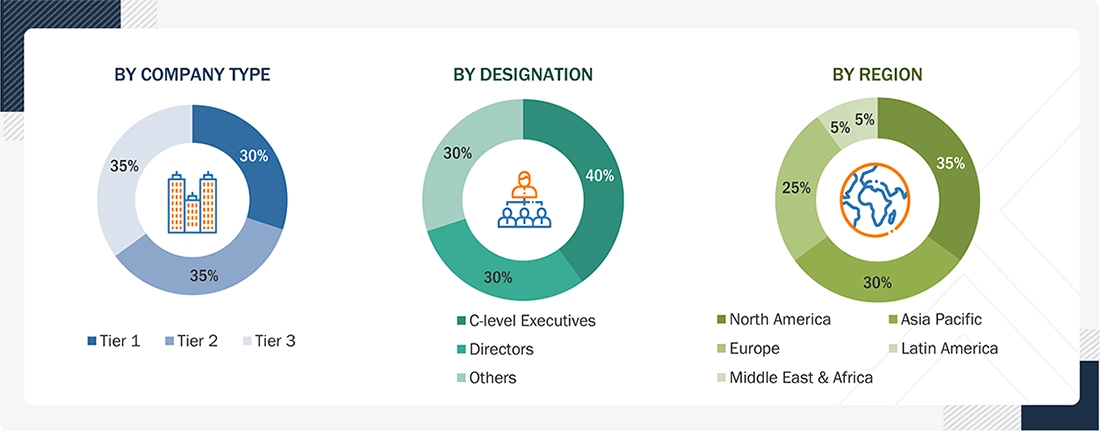
Extensive primary research has been conducted, building on the understanding of the solid-state transformer market scenario from secondary research. Several primary interviews have been conducted with key opinion leaders from both demand- and supply-side vendors across five major regions—Asia Pacific, North America, Europe, Latin America, and Middle East & Africa. Approximately 25% of the primary interviews have been conducted with demand-side vendors, and 75% with supply-side vendors. Primary data has been collected mainly through telephone interviews, which accounted for 80% of the total primary interviews; questionnaires and emails have also been used to collect the data.
Following successful interactions with industry experts, brief sessions were held with highly experienced independent consultants to reinforce the findings of our primary research. This, along with the opinions of our in-house subject-matter experts, has led us to the findings described in the report. The breakdown of primary respondents is as follows:
To know about the assumptions considered for the study, download the pdf brochure
Market Size Estimation
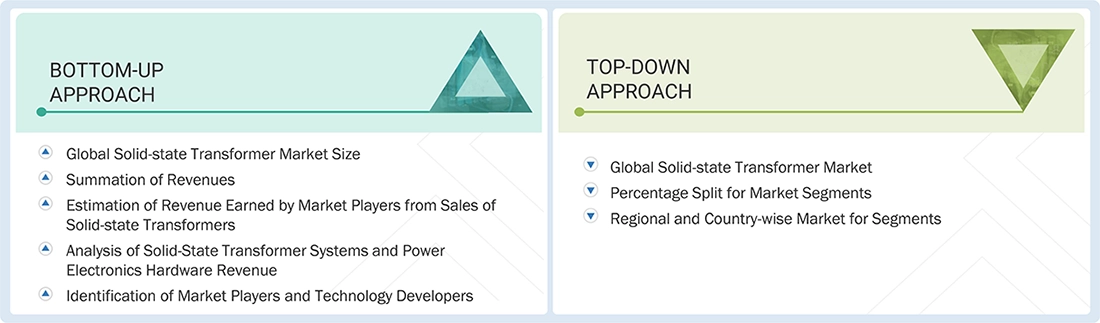
In the market engineering process, both top-down and bottom-up approaches, along with data triangulation methods, have been used to estimate and validate the size of the solid-state transformer market and its dependent submarkets. The research methodology used to estimate the market sizes includes the following:
- Identifying top-line investments and spending across grid modernization, smart grid infrastructure, EV charging systems, renewable energy integration, and advanced power electronics ecosystems while considering segment-level splits and major market developments
- Identifying different stakeholders in the solid-state transformer market that influence the overall market, along with participants across the power electronics and energy infrastructure value chain
- Analyzing major companies in the solid-state transformer ecosystem and studying their product portfolios, technology capabilities, and R&D activities
- Analyzing adoption trends of solid-state transformers across key sectors, including electric utilities, renewable energy developers, transportation electrification, EV charging infrastructure, data centers, industrial enterprises, and commercial & institutional facilities
- Tracking recent and upcoming market developments, including investments, R&D initiatives, product launches, collaborations, agreements, expansions, and partnerships, and forecasting the market size based on these developments and other critical parameters such as regulatory policies, technology adoption rates, pricing trends, supply chain dynamics, demand across key end users, and macroeconomic factors.
- Conducting multiple discussions with key opinion leaders to understand adoption trends and technological developments related to solid-state transformers
- Segmenting the overall market into various segments, such as power rating, voltage level, conversion stage, semiconductor device type, cooling method, deployment type, application, end user, and region
- Validating the estimates at every level through discussions with key opinion leaders, such as chief executives (CXOs), directors, technology specialists, and operations managers, and finally with the domain experts at MarketsandMarket
Solid-State Transformer Market : Top-Down and Bottom-Up Approach
Data Triangulation
After arriving at the overall market size using the market size estimation processes as explained above, the market has been split into several segments and subsegments. To complete the entire market engineering process and obtain the exact statistics for each market segment and subsegment, data triangulation and market breakdown procedures have been employed, as applicable. The data has been triangulated by examining various factors and trends on both the demand and supply sides of the solid-state transformer market.
Market Definition
A solid-state transformer is an advanced power conversion device that uses power electronic components, high-frequency transformers, and digital control systems to convert and regulate electrical power. Unlike conventional transformers, SSTs enable bidirectional power flow, voltage regulation, power quality management, and integration with digital grid systems. These transformers operate using high-frequency switching and wide-bandgap semiconductor devices such as silicon carbide (SiC) and gallium nitride (GaN), enabling higher efficiency, reduced size, and improved power density. Solid-state transformers are increasingly used in smart grids, renewable energy integration, electric vehicle charging infrastructure, railway traction systems, microgrids, and advanced industrial power distribution networks.
Key Stakeholders
- Power semiconductor manufacturers
- Power electronics module and converter manufacturers
- Solid-state transformer manufacturers and technology developers
- Electrical equipment and transformer manufacturers
- Smart grid and digital substation solution providers
- Renewable energy system developers and integrators
- Electric vehicle charging infrastructure providers
- Microgrid and distributed energy resource (DER) solution providers
- Industrial power management and automation solution providers
- Utilities and power distribution companies
- Engineering, procurement, and construction (EPC) companies
- Research institutions and technology laboratories
- Government agencies and regulatory authorities
- Industry associations and standards organizations
- End users
Report Objectives
- To describe, segment, and forecast the size of the solid-state transformer market, by power rating, voltage level, semiconductor device type, deployment type, application, and end user, in terms of value
- To forecast the solid-state transformer market, by region, in terms of volume
- To forecast the size of various segments for five regions: North America, the Asia Pacific, Europe, Latin America, and the Middle East & Africa, in terms of value
- To offer detailed information on drivers, restraints, opportunities, and challenges influencing the growth of the solid-state transformer market
- To provide a detailed overview of the solid-state transformer market value chain
- To strategically analyze the micromarkets concerning individual growth trends, prospects, and contributions to the overall market
- To study industry trends, technological advancements, regulatory landscape, sustainability initiatives, customer landscape & buyer behavior, the impact of AI/Gen AI, along with the macroeconomic outlook
- To analyze opportunities for various stakeholders by identifying the high-growth segments of the market
- To benchmark the key players and analyze their market position in terms of revenue, market share, and core competencies, as well as to provide a detailed competitive landscape for the market leaders
- To analyze competitive developments such as product launches, deals, and expansions carried out by players in the solid-state transformer market
Available customizations:
Based on the given market data, MarketsandMarkets offers customizations tailored to companies' specific requirements. The following customization options are available for the report:
- Detailed analysis and profiling of additional market players (up to 5)
Get the Full Solid-state Transformer Market Report
Full forecast, segment splits, and company analysis for all Solid-state Transformer Market.
- South Africa Solid-state Transformer Market
- Rest Of Europe Solid-state Transformer Market
- Rest Of Asia Pacific Solid-state Transformer Market
- GCC Solid-state Transformer Market
- US Solid-state Transformer Market
- Canada Solid-state Transformer Market
- Germany Solid-state Transformer Market
- France Solid-state Transformer Market
- UK Solid-state Transformer Market
- Italy Solid-state Transformer Market
- Spain Solid-state Transformer Market
- China Solid-state Transformer Market
- Japan Solid-state Transformer Market
- South Korea Solid-state Transformer Market
- India Solid-state Transformer Market
- Argentina Solid-state Transformer Market
- Mexico Solid-state Transformer Market
Need a Tailored Report?
Customize this report to your needs
Get 10% FREE Customization
Customize This Report
