
South Korea Speech and Voice Recognition Market (2025-2030)

The South Korea Speech and Voice Recognition Market was valued at $547.3 Million in 2025 and projected to reach to $1299.8 Million by 2030, representing a compound annual growth rate of 18.9%. South Korea's speech and voice recognition market is poised for accelerated growth through 2030, supported by the nation's advanced semiconductor manufacturing capabilities and strong R&D investments in artificial intelligence.


| Market Size in | USD 26.32 MN |
| Market Forecast in | |
| CAGR | |
| Forecast Period | |
| Units Considered | Value (USD MN) |
South Korea Speech and Voice Recognition Market Trends and Insights
- This 18.9% compound annual growth rate reflects South Korea's leadership in semiconductor and electronics innovation, driven by strong demand for AI-powered voice interfaces across consumer electronics, automotive, and enterprise applications.
- South Korea's advanced technology infrastructure and early adoption of smart devices position the country as a key growth hub in the Asia Pacific region. The market growth in South Korea is underpinned by increasing integration of voice recognition in smartphones, smart home devices, and automotive systems.
- South Korea's major electronics manufacturers are investing heavily in proprietary voice AI solutions, creating competitive advantages in both domestic and export markets.
- Between 2025 and 2030, South Korea is expected to capture significant market share through continuous innovation in natural language processing and multilingual voice recognition capabilities tailored to Korean language nuances..
Key Market Statistics
- CAGR (2025-2030) 18.9% CAGR
- Market Size, 2025 ~USD 547.3 Million
- Forecast, 2030 ~USD 1299.8 Million
- Country South Korea
South Korea Speech and Voice Recognition Market Overview
Market Valuation Growth :
South Korea's speech and voice recognition market is valued at USD 547.3 million in 2025, with projections reaching USD 1,299.8 million by 2030, representing a robust 18.9% CAGR driven by technological advancement and consumer adoption.
AI-Powered Innovation Hub :
South Korea's semiconductor and electronics leadership positions it as a critical hub for AI-powered voice interface development, with major investments from tech giants and startups accelerating commercialization across multiple sectors.
Multi-Sector Demand :
Strong adoption across consumer electronics, automotive, and enterprise segments in South Korea reflects diverse application opportunities, from smart home devices to in-vehicle voice assistants and corporate communication solutions.
Competitive CAGR Performance :
South Korea's 18.9% CAGR closely aligns with the global market growth rate of 19.1%, demonstrating the country's sustained competitiveness and relevance in the rapidly expanding speech and voice recognition ecosystem.
South Korea Speech and Voice Recognition Market Dynamics
- The convergence of 5G infrastructure, IoT proliferation, and consumer demand for intelligent voice interfaces creates substantial opportunities for market expansion across residential, automotive, and industrial applications. Key growth drivers include South Korea's established electronics manufacturing ecosystem, government initiatives supporting AI development, and the presence of major technology corporations investing heavily in voice technology innovation.
- The market's trajectory reflects broader digital transformation trends in the region, with enterprises increasingly adopting voice-enabled solutions for operational efficiency and customer engagement..
Market Ecosystem
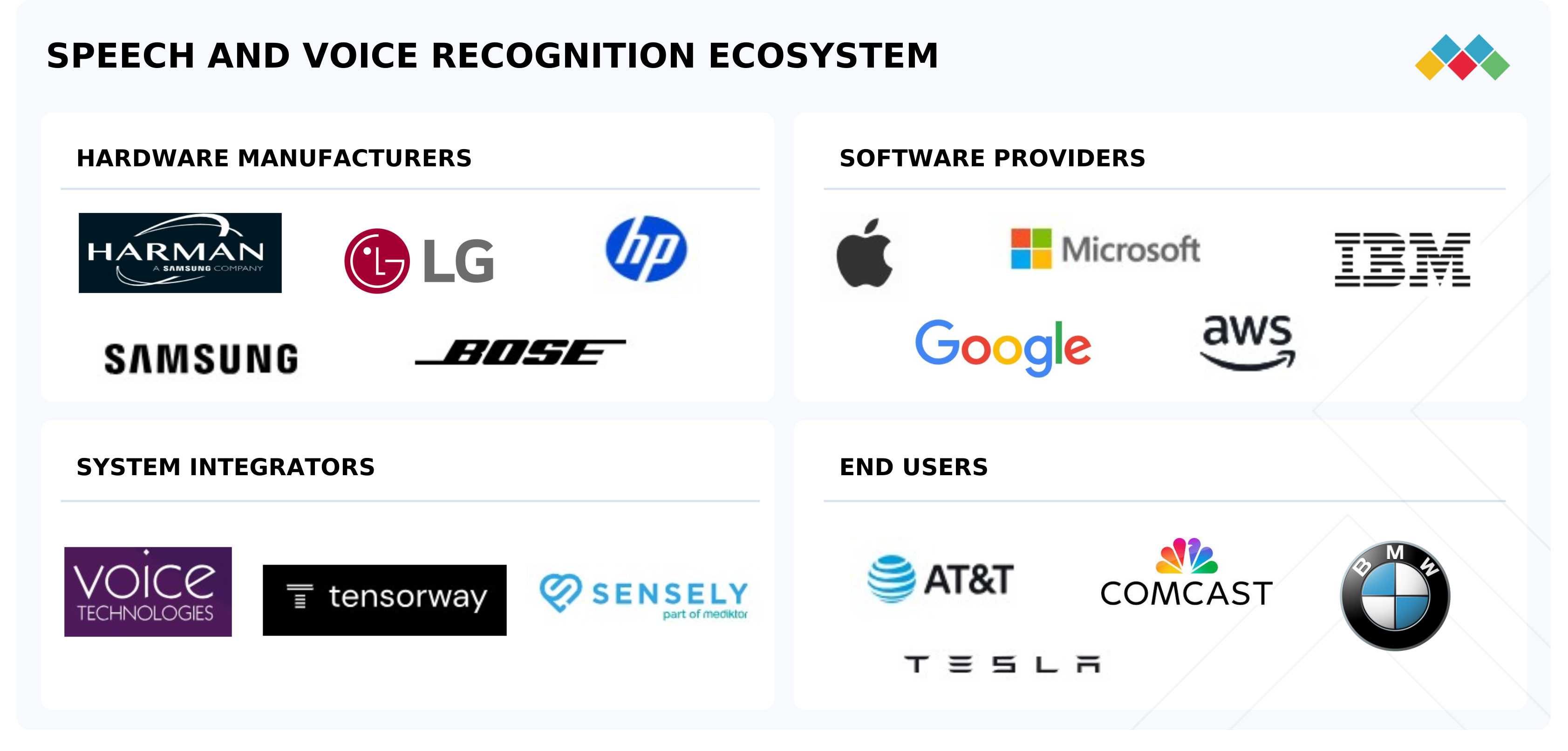
Speech and Voice Recognition Market Growth: COMMERCIAL USE CASES ACROSS INDUSTRIES
| COMPANY | USE CASE DESCRIPTION | BENEFITS |
|---|---|---|
 |
Azure AI Speech offers real-time speech-to-text, text-to-speech, and speech translation services | Enables high-accuracy voice-enabled applications | Supports multilingual transcription | Enhances accessibility |
|
|
IBM Watson Speech-to-Text for transcription and speech analytics in customer service | Fast, accurate transcription in multiple languages | Improves self-service and agent support efficiency |
|
|
Google Cloud Speech-to-Text and Voice Search used in Android and Google services | Real-time and batch transcription with high accuracy | Enables hands-free Google Search and voice commands |
|
|
Alexa voice assistant supports music, tasks, smart home control, and real-time information | Voice search and command features for personalized user experience and smart ecosystem integration |
|
|
Speech-to-Text and Speaker Recognition technologies integrated in Apple devices | Accurate domain-specific transcription | Secure speaker identification across iPhones, Siri, and other devices |
Logos and trademarks shown above are the property of their respective owners. Their use here is for informational and illustrative purposes only.
Related Ecosystem
Internet Of Things And M2M
- Sensors
- Cellular Network
- Digital Signal Processor (DSP)
- Global Positioning System (GPS)
- Image Sensors
- MITSUI ELECTRONICS INC
- MICROSOFT CORPORATION
- INTEL CORPORATION
- Amazon.com, Inc.
- Cisco Systems, Inc.
Key Takeaways
- South Korea's speech and voice recognition market will grow from USD 547.3M (2025) to USD 1,299.8M (2030) at an 18.9% CAGR.
- South Korea's semiconductor expertise and consumer electronics dominance drive rapid adoption of voice AI technologies across multiple sectors.
- South Korea is developing localized voice recognition solutions optimized for Korean language processing and regional market requirements.
- South Korea's investment in AI infrastructure and smart device ecosystems positions it as a critical innovation center for voice recognition in Asia Pacific.
Speech and Voice Recognition Market Report Scope
| Report Metric | Details |
|---|---|
| Base Year | 2025 |
| Fastest Growing Segment | VOICE BIOMETRICS (Application) |
| Forecast Period | 2025-2030 |
| Growth Rate | CAGR of 19.1% from 2025 to 2030 |
| Largest Segment | ON-PREMISES (Deployment Mode) |
| Market Size Base Year (Billions) | ~USD 9.64 (2025) |
| Revenue Forecast (Billions) | ~USD 23.11 (2030) |
| Segments Covered | Technology, Type, Deployment Mode, Vertical, Application, End-Use Application |
South Korea Speech and Voice Recognition Market Report Segmentation
6 segment dimensions are covered across the global market.
By Technology
- Automatic Speech Recognition
- Voice Recognition
By Type
- Speaker Identification
- Speaker Verification
By Deployment Mode
- Cloud-Based
- On-Premises
By Vertical
- Automotive
- Bfsi
- Commercial
- Consumer Electronics
- Education
- Government
- Healthcare
- Legal
- Military
- Other Verticals
- Retail
By Application
- Customer Service
- Real-Time Transcription
- Security Authentication
- Voice Biometrics
- Voice Command
- Voice Search
By End-Use Application
- Access Control Systems
- Border Management Systems
- Call Center Authentication
- Document Transcription
- Education For Disabled & E-Learning
- Enterprise Robotics
- Fraud Identification
- Fraud Investigation
- Identification
- It Security
- Language Learning
- Mobile Banking
- Mobile Device Control
- Patient Medical Record Access
- Point Of Sale Payment
- Robotic Kiosk
- Special-Purpose Robots
- Time & Attendance Systems
- Unstaffed Bank Branches
- Vehicle Control
- Vehicle Insurance
- Verification
- Wearable Device Control
Target Audience
- Technology Companies & OEMs : South Korean and international electronics manufacturers need detailed market insights to develop voice-enabled products, optimize R&D investments, and capture growing demand across consumer and automotive segments.
- Semiconductor & Chipset Manufacturers : Semiconductor firms require market-specific data on voice recognition adoption to design optimized processors, forecast demand for AI accelerators, and plan manufacturing capacity for South Korea's expanding market.
- Investment & Private Equity Firms : Investors evaluating opportunities in South Korea's AI and voice technology sectors need precise market sizing, growth projections, and competitive landscape analysis to identify high-potential acquisition and funding targets.
- Enterprise & Automotive Suppliers : B2B solution providers targeting South Korean enterprises and automotive manufacturers require market intelligence to develop voice-enabled business solutions, assess customer readiness, and plan sales strategies.
- Government & Policy Organizations : South Korean government agencies and economic development bodies need market data to inform AI policy initiatives, allocate innovation funding, and support domestic technology companies in the voice recognition sector.
Reasons to Buy this Report
- Market-Specific Sizing & Forecasts : Access precise valuation data for South Korea's market (USD 547.3M in 2025, USD 1,299.8M in 2030) with country-specific CAGR analysis to inform investment decisions and competitive positioning strategies.
- Sector-Specific Growth Drivers : Understand the unique demand dynamics across South Korea's consumer electronics, automotive, and enterprise segments, enabling targeted product development and market entry strategies tailored to local adoption patterns.
- Competitive Intelligence : Benchmark South Korea's 18.9% CAGR against global performance (19.1%) to identify market opportunities, assess competitive intensity, and evaluate the country's strategic importance within regional and global portfolios.
- Technology & Infrastructure Insights : Leverage analysis of South Korea's semiconductor leadership, 5G infrastructure, and AI innovation ecosystem to identify partnership opportunities and technology integration pathways for voice recognition solutions.
- Strategic Market Entry Planning : Utilize country-specific market intelligence to develop localized go-to-market strategies, identify key stakeholders, and prioritize investment allocation for South Korea's high-growth voice recognition sector.
Frequently asked questions
What is the current market size of speech and voice recognition in South Korea?
South Korea's speech and voice recognition market was valued at USD 547.3 million in 2025, with verified data from KS table sources.
What is the projected market size for South Korea by 2030?
South Korea's speech and voice recognition market is forecast to reach USD 1,299.8 million by 2030, representing significant growth over the forecast period.
What is the CAGR for South Korea's speech and voice recognition market?
South Korea's speech and voice recognition market is expected to grow at a compound annual growth rate of 18.9% from 2025 to 2030.
Which industries are driving voice recognition adoption in South Korea?
South Korea's consumer electronics, automotive, and enterprise sectors are primary drivers of voice recognition technology adoption and investment.
Why is South Korea a key market for speech and voice recognition?
South Korea's advanced semiconductor capabilities, strong electronics manufacturing base, and early technology adoption make it a critical hub for voice recognition innovation and deployment.
RESEARCH METHODOLOGY
The study used four major activities to estimate the speech and voice recognition market size. Exhaustive secondary research was conducted to gather information on the market and its peer and parent markets. The next step was to validate these findings, assumptions, and market size with industry experts across the value chain through primary research. Both top-down and bottom-up approaches were employed to estimate the total market size. Finally, market breakdown and data triangulation methods were used to estimate the market size for different segments and subsegments.
Secondary Research
In the secondary research process, various sources were used to identify and collect information on the speech and voice recognition market. Secondary sources for this research study include corporate filings (such as annual reports, investor presentations, and financial statements); trade, business, and professional associations; white papers; certified publications; and articles by recognized authors, directories, and databases. The secondary data was collected and analyzed to determine the overall market size, and was further validated through primary research.
List of key secondary sources
|
Source |
Web Link |
|
Ministry of Electronics & Information Technology |
https://www.meity.gov.in/esdm/standards |
|
Institute of Electrical & Electronics Engineering |
https://www.ieee.org/ |
|
Semiconductor Industry Association (SIA) |
https://www.semiconductors.org/ |
Primary Research
Primary interviews were conducted to gather insights on market statistics, revenue data, market breakdowns, size estimations, and forecasting. Additionally, primary research was used to comprehend various technologies, types, applications, and regional trends. Interviews with stakeholders from the demand side, including CIOs, CTOs, CSOs, and customer/end user installation teams using speech and voice recognition offerings and processes, were also conducted to understand their perspective on suppliers, products, component providers, and their current and future use of speech and voice recognitions, which will impact the overall market. Several primary interviews were conducted across major countries in North America, Europe, the Asia Pacific, and RoW.
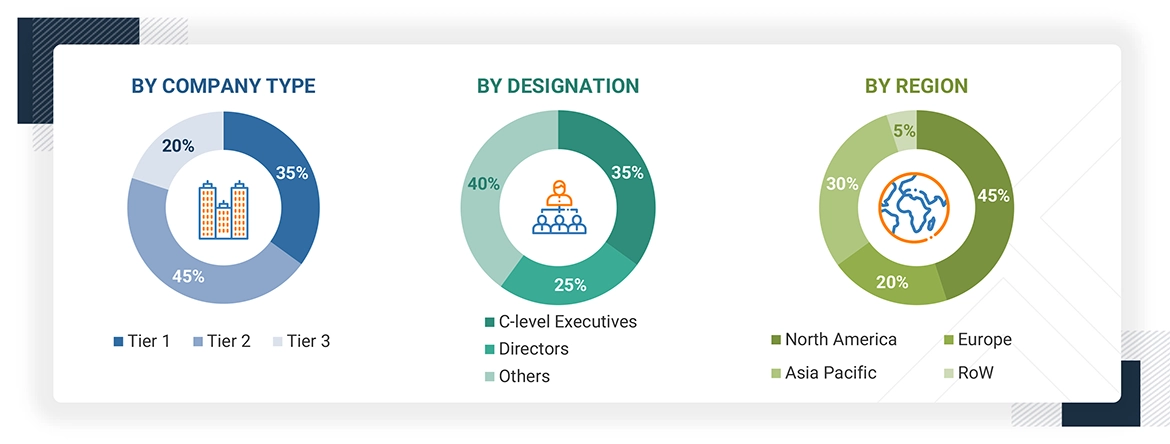
To know about the assumptions considered for the study, download the pdf brochure
Market Size Estimation
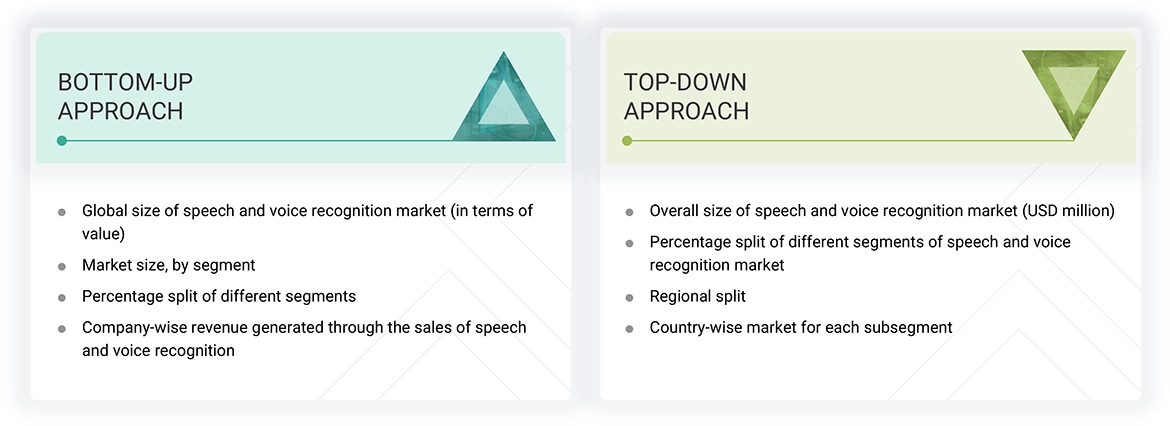
In the complete market engineering process, top-down and bottom-up approaches and several data triangulation methods have been used to estimate and forecast the overall market segments and subsegments listed in this report. Key players in the market have been identified through secondary research, and their market shares in the respective regions have been determined through primary and secondary research. This entire procedure includes the study of annual and financial reports of the top market players and extensive interviews for key insights (quantitative and qualitative) with industry experts (CEOs, VPs, directors, and marketing executives).
All percentage shares, splits, and breakdowns have been determined using secondary sources and verified through primary sources. All the parameters affecting the markets covered in this research study have been accounted for, viewed in detail, verified through primary research, and analyzed to obtain the final quantitative and qualitative data. This data has been consolidated and supplemented with detailed inputs and analysis from MarketsandMarkets and presented in this report. The following figure represents this study's overall market size estimation process.
Speech and Voice Recognition Market : Top-Down and Bottom-Up Approach
Data Triangulation
Once the overall size of the speech and voice recognition market has been determined using the methods described above, it has been divided into multiple segments and subsegments. Market engineering has been performed for each segment and subsegment using market breakdown and data triangulation methods, as applicable, to obtain accurate statistics. Various factors and trends from the demand and supply sides have been studied to triangulate the data. The market size has been validated using both top-down and bottom-up approaches.
Market Definition
Speech recognition is the ability of a machine or program to identify words and phrases in spoken language and convert them to a machine-readable format. In contrast, voice recognition aims to identify the person who is speaking by catching the unique dialect among individuals. Speech and voice recognition is the technology by which sounds, words, or phrases spoken by human beings are converted into electrical signals. These signals are then transformed into coding patterns. Speech and voice recognition software solutions are used for dictation, system control, commercial and industrial applications, voice dialing, and other purposes. Many speech and voice recognition applications and devices are available, but the more advanced solutions rely on artificial intelligence and machine learning. They combine grammar, syntax, structure, and composition of audio and voice signals to interpret and analyze human speech.
Key Stakeholders
- Banking, financial services, and insurance players
- Speech and voice recognition application developers/traders/suppliers
- Speech and voice recognition patent assignees
- Smart home and home automation product manufacturers
- Autonomous car developers and manufacturers
- Research institutes and organizations
- Virtual assistant product manufacturers
- Consumer electronics manufacturers
- Healthcare service providers
- Government agencies
- Speech and voice recognition application program interface (API) providers
- Market research and consulting firms
Report Objectives
- To describe and forecast the speech and voice recognition market, by technology, deployment mode, application, vertical, and region, in terms of value
- To describe and forecast the market for various segments across four main regions, namely, North America, Europe, Asia Pacific, and RoW, in terms of value
- To strategically analyze micromarkets with regard to individual growth trends, prospects, and contributions to the markets
- To provide detailed information regarding drivers, restraints, opportunities, and challenges influencing market growth
- To analyze opportunities for stakeholders by identifying high-growth segments in the market
- To provide a detailed overview of the speech and voice recognition value chain
- To strategically analyze key technologies, average selling price trends, trends impacting customer business, ecosystem, regulatory landscape, patent landscape, Porter's five forces, import and export scenarios, trade landscape, key stakeholders, buying criteria, and case studies pertaining to the market under study
- To strategically profile key players in the speech and voice recognition market and comprehensively analyze their market share and core competencies
- To analyze competitive developments such as partnerships, acquisitions, expansions, collaborations, and product launches, along with R&D in the speech and voice recognition market
Available customizations:
With the given market data, MarketsandMarkets offers customizations according to the specific requirements of companies. The following customization options are available for the report:
Regional Analysis:
- Detailed analysis and profiling of additional market players (up to 5)
- Additional country-level analysis of the speech and voice recognition market
Product Analysis
- The product matrix provides a detailed comparison of the product portfolio of each company in the speech and voice recognition market.
Get the Full Speech and Voice Recognition Market Report
Full forecast, segment splits, and company analysis for all Speech and Voice Recognition Market.
- US Speech and Voice Recognition Market
- Canada Speech and Voice Recognition Market
- Mexico Speech and Voice Recognition Market
- Germany Speech and Voice Recognition Market
- UK Speech and Voice Recognition Market
- France Speech and Voice Recognition Market
- Italy Speech and Voice Recognition Market
- Rest Of Europe Speech and Voice Recognition Market
- China Speech and Voice Recognition Market
- India Speech and Voice Recognition Market
- Japan Speech and Voice Recognition Market
- Rest Of Asia Pacific Speech and Voice Recognition Market
Need a Tailored Report?
Customize this report to your needs
Get 10% FREE Customization
Customize This Report
