
Rest Of Europe Surgical Imaging Market (2025-2030)

The Rest Of Europe Surgical Imaging Market was valued at $312.9 Million in 2025 and projected to reach to $620.1 Million by 2030, representing a compound annual growth rate of 14.7%. Rest Of Europe's surgical imaging market is positioned for sustained expansion through 2030, driven by healthcare modernization initiatives and increasing surgical volumes across Central and Eastern European nations.


| Market Size in | USD 26.32 MN |
| Market Forecast in | |
| CAGR | |
| Forecast Period | |
| Units Considered | Value (USD MN) |
Rest Of Europe Surgical Imaging Market Trends and Insights
- The region is experiencing robust growth driven by increasing adoption of advanced imaging technologies in operating rooms, rising surgical volumes, and growing healthcare infrastructure investments across Central and Eastern European nations.
- Rest Of Europe is projected to expand substantially, reaching $620.1 million by 2030, reflecting a compound annual growth rate of 14.7% over the forecast period. The surgical imaging landscape in Rest Of Europe is characterized by modernization of healthcare facilities and increased demand for minimally invasive surgical procedures.
- Rest Of Europe's growth trajectory outpaces many mature markets, supported by improving reimbursement policies and rising awareness among healthcare providers regarding the benefits of advanced imaging systems.
- Rest Of Europe is attracting significant investment from both established medical device manufacturers and emerging regional players seeking to capitalize on the region's expanding surgical imaging needs..
Key Market Statistics
- CAGR (2025-2030) 14.7% CAGR
- Market Size, 2025 ~USD 312.9 Million
- Forecast, 2030 ~USD 620.1 Million
- Country Rest Of Europe
Rest Of Europe Surgical Imaging Market Overview
Strong Regional Growth Trajectory :
Rest Of Europe's surgical imaging market is projected to grow from $312.9 million in 2025 to $620.1 million by 2030, representing a robust 14.7% CAGR that reflects accelerating adoption of advanced imaging technologies across the region.
Central and Eastern European Expansion :
Emerging markets in Central and Eastern Europe are driving significant growth through increased healthcare infrastructure investments, modernization of surgical facilities, and rising surgical procedure volumes in previously underserved markets.
Operating Room Technology Adoption :
Hospitals across Rest Of Europe are increasingly integrating advanced surgical imaging systems into operating rooms, driven by demand for improved surgical precision, reduced procedure times, and enhanced patient outcomes.
Outpacing Global Growth Rates :
While the global surgical imaging market grows at 17.6% CAGR, Rest Of Europe's 14.7% growth rate reflects a maturing but still rapidly expanding regional market with substantial untapped potential in secondary and tertiary care centers.
Rest Of Europe Surgical Imaging Market Dynamics
- Investment in hospital infrastructure, coupled with rising awareness of advanced imaging benefits, is accelerating technology adoption in both established and emerging markets within the region.
- The market will benefit from growing demand for minimally invasive procedures and improved surgical visualization capabilities. Key growth catalysts include regulatory harmonization across European markets, increasing healthcare spending in developing economies, and the proliferation of specialized surgical centers.
- As hospitals prioritize operational efficiency and patient safety, surgical imaging technologies will become standard equipment in modern operating rooms.
- The region's competitive landscape will intensify as both established European manufacturers and international players expand their presence to capture growing demand..
Market Ecosystem
Related Ecosystem
Diagnostic Imaging
- Magnetic Resonance Imaging (MRI)
- Computed Tomography (CT)
- CT Scanners
- Nuclear Imaging
- Positron Emission Tomography
- Siemens healthineers
- PHILIPS HEALTHCARE
- CANON INC.
- FUJIFILM Holdings Corporation
- UNITED IMAGING HEALTHCARE CO., LTD.
Key Takeaways
- Rest Of Europe's surgical imaging market is valued at $312.9 million in 2025 and is forecast to nearly double to $620.1 million by 2030.
- Rest Of Europe is experiencing a 14.7% CAGR, driven by healthcare modernization and increased adoption of minimally invasive surgical techniques.
- Rest Of Europe's growth is supported by improving reimbursement policies and rising healthcare infrastructure investments across the region.
- Rest Of Europe is becoming an attractive market for both multinational and regional medical device manufacturers seeking expansion opportunities.
Surgical Imaging Market Report Scope
| Report Metric | Details |
|---|---|
| Base Year | 2025 |
| Fastest Growing Segment | OTHER SURGERIES (Surgery Type) |
| Forecast Period | 2025-2030 |
| Growth Rate | CAGR of 17.6% from 2025 to 2030 |
| Largest Segment | HOSPITALS & SURGICAL CENTERS (End User) |
| Market Size Base Year (Billions) | ~USD 5.42 (2025) |
| Revenue Forecast (Billions) | ~USD 12.2 (2030) |
| Segments Covered | Product, Application, End User, Procedure Type, Surgery Type |
Rest Of Europe Surgical Imaging Market Report Segmentation
5 segment dimensions are covered across the global market.
By Product
- Accessories
- C-Arms
- Ct Scanner
- Integrated Mr-Or Systems
- Surgical Navigation Software
- Ultrasound Systems
By Application
- Cardiovascular Surgery
- Endoscopy
- General Surgery
- Laparoscopy
- Minimally Invasive Surgery
- Neurosurgery
- Ob/Gyn Surgery
- Orthopedic & Musculoskeletal Surgery
- Other Procedures
- Other Surgeries
- Urology Surgery
By End User
- Ambulatory Surgical Centers
- Hospitals & Surgical Centers
- Other End Users
- Specialty Clinics
By Procedure Type
- Endoscopy
- Laparoscopy
- Minimally Invasive Surgery
- Other Procedures
By Surgery Type
- Cardiovascular Surgery
- General Surgery
- Neurosurgery
- Ob/Gyn Surgery
- Orthopedic & Musculoskeletal Surgery
- Other Surgeries
- Urology Surgery
Target Audience
- Medical Device Manufacturers : Surgical imaging equipment producers need Rest Of Europe-specific data to identify market opportunities, assess regional demand for advanced imaging systems, and develop localized product strategies for Central and Eastern European hospitals.
- Healthcare Investors & PE Firms : Investment professionals require detailed regional market analysis to evaluate acquisition targets, assess growth potential in Rest Of Europe healthcare assets, and make informed capital allocation decisions in the surgical imaging sector.
- Hospital & Healthcare Administrators : Decision-makers in Rest Of Europe healthcare facilities need market intelligence to benchmark technology investments, understand regional adoption trends, and justify capital expenditures for surgical imaging equipment upgrades.
- Market Research & Consulting Firms : Research organizations require comprehensive Rest Of Europe market data to support client advisory services, validate market assumptions, and provide evidence-based recommendations for healthcare technology strategies.
- Healthcare Technology Distributors : Regional distributors and resellers need Rest Of Europe-specific market insights to identify growth segments, understand hospital procurement patterns, and optimize inventory and sales strategies across Central and Eastern European markets.
Reasons to Buy this Report
- Regional Market Sizing & Forecasts : Obtain precise market valuations specific to Rest Of Europe with detailed 2025-2030 projections, enabling accurate budget allocation and investment planning tailored to regional growth dynamics.
- Country-Level Growth Insights : Understand which Central and Eastern European markets are driving expansion, identify high-potential countries for market entry, and benchmark performance against regional peers with granular geographic analysis.
- Competitive Landscape Intelligence : Analyze regional competitor positioning, market share distribution, and strategic initiatives specific to Rest Of Europe to inform competitive strategy and identify partnership opportunities.
- Healthcare Infrastructure Trends : Access detailed insights on hospital modernization initiatives, surgical volume trends, and technology adoption patterns across Rest Of Europe to align product development with regional demand.
- Investment & Expansion Strategy : Leverage region-specific market data to evaluate expansion feasibility, identify optimal market entry points, and develop targeted go-to-market strategies for Rest Of Europe operations.
Frequently asked questions
What is the current market size of surgical imaging in Rest Of Europe?
Rest Of Europe's surgical imaging market is estimated at $312.9 million in 2025 and is projected to reach $620.1 million by 2030.
What is the growth rate for surgical imaging in Rest Of Europe?
Rest Of Europe is experiencing a compound annual growth rate (CAGR) of 14.7% from 2025 to 2030.
What factors are driving growth in Rest Of Europe's surgical imaging market?
Rest Of Europe's growth is driven by healthcare infrastructure modernization, increased adoption of minimally invasive procedures, improving reimbursement policies, and rising surgical volumes across the region.
How does Rest Of Europe's surgical imaging market compare to other European regions?
Rest Of Europe's 14.7% CAGR demonstrates strong growth momentum, reflecting the region's emerging market dynamics and increasing healthcare investments compared to more mature Western European markets.
What opportunities exist for medical device manufacturers in Rest Of Europe?
Rest Of Europe presents significant opportunities for both established and emerging manufacturers due to rising demand for advanced imaging technologies, expanding healthcare budgets, and the region's growing surgical procedure volumes.
RESEARCH METHODOLOGY
This market research study primarily relied on secondary sources, directories, and databases to collect information for this technical, market-oriented, and financial analysis of the surgical imaging market. In-depth interviews were conducted with various primary respondents, including key industry participants, subject-matter experts (SMEs), C-level executives from major market players, and industry consultants, among others, to gather and verify critical qualitative and quantitative data and assess market prospects. The size of the surgical imaging market was estimated using multiple secondary research methods and confirmed with inputs from primary research to determine the final market size.
Secondary Research
The secondary research process involved extensively using secondary sources, including directories, databases (such as Bloomberg Businessweek, Factiva, and D&B Hoovers), white papers, annual reports, company house documents, investor presentations, and SEC filings of companies. Some non-exclusive secondary sources include the World Health Organization (WHO), the Organisation for Economic Co-operation and Development (OECD), Healthcare Information and Management Systems Society (HIMSS), Centers for Disease Control and Prevention (CDC), ClinicalTrials.gov, expert interviews, and MarketsandMarkets analysis.
Secondary research was conducted to gather information for the detailed, technical, market-focused, and commercial analysis of the surgical imaging market. It was also used to collect key information about major players, market classification, and segmentation based on industry trends, down to the most detailed level, along with significant developments related to market and technology perspectives. Additionally, a database of leading industry players was compiled using secondary research.
Primary Research
During the primary research process, various sources from both the supply and demand sides were interviewed to gather qualitative and quantitative information for this report. Primary sources mainly include industry experts from core and related industries, preferred suppliers, manufacturers, distributors, technology developers, researchers, and organizations involved in all segments of this industry’s value chain. In-depth interviews were conducted with various primary respondents, such as key industry participants, subject-matter experts (SMEs), C-level executives of leading market players, and industry consultants, among other specialists, to obtain and verify critical qualitative and quantitative information as well as assess prospects.
Primary research was conducted to identify segmentation types, industry trends, key players, and key market dynamics such as drivers, restraints, opportunities, challenges, industry trends, and strategies adopted by key players.
After completing the market engineering process- which includes calculations for market statistics, market breakdown, size estimations, forecasting, and data triangulation- extensive primary research was carried out. This research aimed to gather information and verify the key numbers obtained during the market analysis. Additionally, primary research was used to identify different types of market segmentation, analyze industry trends, evaluate the competitive landscape of surgical Imaging solutions offered by various players, and understand key market dynamics such as drivers, restraints, opportunities, challenges, industry trends, and strategies employed by key market players.
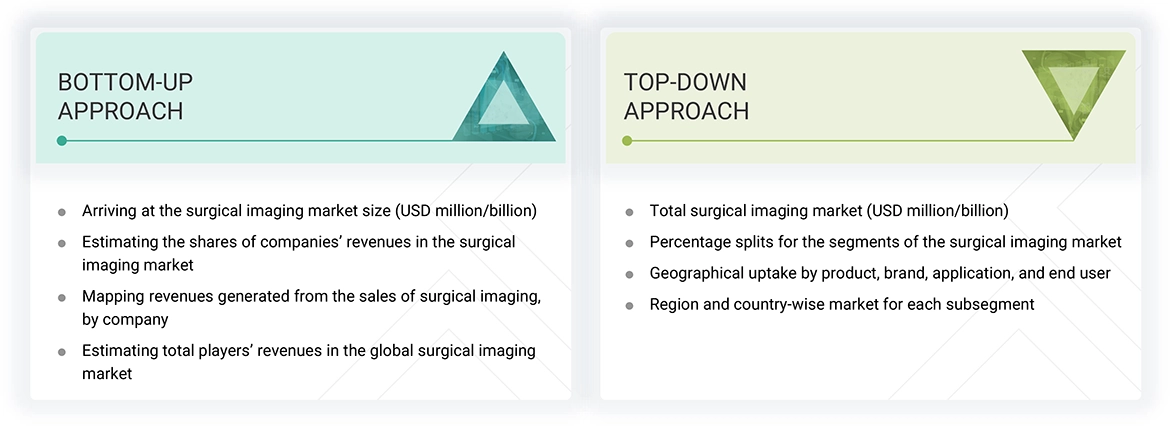
In the complete market engineering process, the top-down and bottom-up approaches, along with several data triangulation methods, were extensively used to estimate and forecast the market segments and subsegments listed in this report. Extensive qualitative and quantitative analysis was conducted on the entire market engineering process to identify key information and insights throughout the report.
Breakdown of Primary Interviews
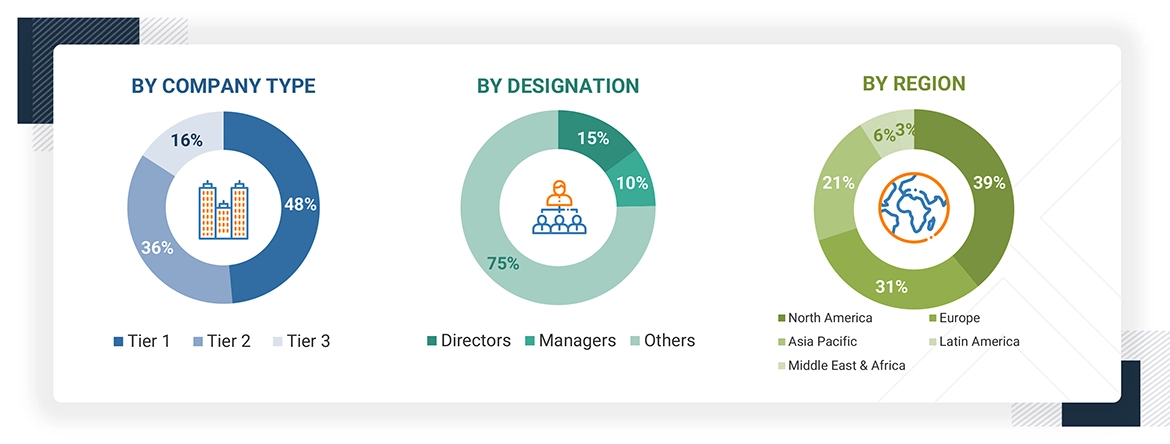
Note 1: Others include sales, marketing, and product managers.
Note 2: Tiers are defined based on a company’s total revenue, as of 2024: Tier 1 = >USD 1 billion, Tier 2 = USD 500 million to USD 1 billion, and Tier 3 = < USD 500 million.
To know about the assumptions considered for the study, download the pdf brochure
Market Size Estimation
The market size estimates and forecasts in this study are based on a combination of the bottom-up approach (revenue share analysis of leading players) and the top-down approach (evaluation of utilization, adoption, and penetration trends by product, application, end user, and region).
Data Triangulation
After determining the overall market size from the estimation process described above, the surgical imaging market was divided into various segments and subsegments. To finalize the overall market analysis and obtain accurate statistics for all segments and subsegments, data triangulation and market breakdown techniques were used whenever applicable. The data was cross-verified by examining different factors and trends from both the demand and supply sides of the surgical imaging market.
Market Definition
The surgical imaging market includes digital systems, software, and integrated solutions that capture, process, and share medical images in real time during surgical procedures. It combines imaging modalities such as fluoroscopy, intraoperative MRI, cone-beam CT, 3D imaging, and ultrasound with IT infrastructure for connectivity across hospital networks and surgical navigation systems. These technologies, often enhanced by AI analysis, augmented reality, and cloud storage, enable precise visualization, guide interventions, and optimize surgical workflows, improving accuracy, efficiency, and patient safety outcomes.
Stakeholders
- Surgical imaging vendors & imaging device manufacturers
- Healthcare Providers (hospitals, outpatient settings, ambulatory surgical centers and specialty clinics, and other healthcare providers)
- Clinical research organizations (CROs)
- R&D companies
- Business research & consulting service providers
- Medical research laboratories
- Academic medical centers/universities/hospitals/research institutes
- Regulatory bodies (FDA, EMA, IAEA)
- AI & algorithm developers
- Venture capitalists
- Advocacy groups
- Investors & financial institutions
- Contract manufacturing organizations (CMOs)
- Contract research organizations (CROs)
Report Objectives
- To define, describe, and forecast the surgical imaging market by product, brand, application, end user, and region
- To provide detailed information regarding the major drivers, restraints, opportunities, and challenges influencing market growth
- To strategically analyze micromarkets with respect to individual growth trends, prospects, and contributions to the overall surgical imaging market
- To analyze market opportunities for stakeholders and provide details of the competitive landscape for key players.
- To forecast the size of the surgical imaging market in five main regions (and their respective countries): North America, Europe, the Asia Pacific, the Middle East & Africa, and Latin America
- To provide key industry insights, such as supply chain, regulatory, patent, and recession impact analysis.
- To profile the key players in the market and comprehensively analyze their core competencies
- To track and analyze competitive developments, such as product launches & upgrades, collaborations, partnerships, acquisitions, investments, contracts, agreements, alliances, mergers, funding, and expansions of the leading players in the market
- To benchmark players within the market using the company evaluation matrix, which analyzes market players on various parameters within the broad categories of business strategy, market share, and product offering
Get the Full Surgical Imaging Market Report
Full forecast, segment splits, and company analysis for all Surgical Imaging Market.
- Canada Surgical Imaging Market
- US Surgical Imaging Market
- Germany Surgical Imaging Market
- UK Surgical Imaging Market
- France Surgical Imaging Market
- Italy Surgical Imaging Market
- Spain Surgical Imaging Market
- Japan Surgical Imaging Market
- China Surgical Imaging Market
- India Surgical Imaging Market
- South Korea Surgical Imaging Market
- Australia Surgical Imaging Market
- Brazil Surgical Imaging Market
- Mexico Surgical Imaging Market
- Rest Of Asia Pacific Surgical Imaging Market
- Rest Of Latin America Surgical Imaging Market
- GCC Countries Surgical Imaging Market
- Romea Surgical Imaging Market
Need a Tailored Report?
Customize this report to your needs
Get 10% FREE Customization
Customize This Report
