
India Text-to-Speech Market (2024-2029)

The India Text-to-Speech Market was valued at $237.8 Million in 2024 and projected to reach to $553.9 Million by 2029, representing a compound annual growth rate of 18.4%. India's Text-to-Speech market is positioned for exceptional growth through 2029, driven by unprecedented digital transformation and accessibility awareness.


| Market Size in | USD 26.32 MN |
| Market Forecast in | |
| CAGR | |
| Forecast Period | |
| Units Considered | Value (USD MN) |
India Text-to-Speech Market Trends and Insights
- This represents a compound annual growth rate (CAGR) of 18.4%, significantly outpacing global growth trends.
- India's rapid digital adoption, expanding smartphone penetration, and increasing demand for accessibility solutions are driving this accelerated market growth. The Text-to-Speech sector in India is benefiting from rising investments in artificial intelligence and natural language processing technologies.
- India's growing e-commerce, education, and customer service sectors are major consumers of TTS solutions, creating substantial opportunities for market participants.
- By 2029, India is expected to consolidate its position as a key regional hub for TTS innovation and deployment across Asia Pacific. India's favorable regulatory environment and large talent pool in software development further strengthen the market's growth trajectory.
- The convergence of cloud computing adoption and mobile-first strategies in India is enabling widespread TTS implementation across diverse industries and consumer applications..
Key Market Statistics
- CAGR (2024-2029) 18.4% CAGR
- Market Size, 2024 ~USD 237.8 Million
- Forecast, 2029 ~USD 553.9 Million
- Country India
India Text-to-Speech Market Overview
Explosive Growth Trajectory :
India's Text-to-Speech market is expanding at 18.4% CAGR, nearly 35% faster than global growth of 13.7%, reflecting strong domestic demand and technological adoption.
Market Valuation Surge :
The market is projected to more than double from USD 237.8 million in 2024 to USD 553.9 million by 2029, representing a USD 316.1 million increase in market value.
Digital Adoption Catalyst :
Rapid smartphone penetration, increasing internet accessibility, and growing digital literacy across India's population are primary drivers fueling Text-to-Speech adoption.
Accessibility & Inclusivity Focus :
Rising demand for accessibility solutions for visually impaired users and multilingual support in regional Indian languages is accelerating market expansion.
India Text-to-Speech Market Dynamics
- The 18.4% CAGR reflects strong investment in AI-powered voice technologies and increasing integration across e-commerce, education, and customer service sectors.
- Smartphone penetration and regional language support initiatives are expanding addressable markets beyond urban centers. The forecast period will witness intensified competition from both global and homegrown players, with significant opportunities in voice-enabled IoT devices, automotive applications, and educational technology.
- Government initiatives promoting digital inclusion and accessibility standards will further accelerate adoption, positioning India as a critical growth engine for the global Text-to-Speech market..
Market Ecosystem
Related Ecosystem
Information System And Analytics
- Machine Learning
- Natural Language Processing (NLP)
- Sensors
- Software as A Service (SaaS)
- Data Loss Prevention (DLP)
- International Business Machines Corporation
- MICROSOFT CORPORATION
- Amazon.com, Inc.
- Oracle Corporation
Software And Services
- Natural Language Processing (NLP)
- Machine Learning
- Supply Chain Management
- Predictive Analytics
- Image Sensors
- International Business Machines Corporation
- MICROSOFT CORPORATION
- Oracle Corporation
- SAP SE
- Amazon.com, Inc.
Key Takeaways
- India's Text-to-Speech market is projected to grow from USD 237.8 million in 2024 to USD 553.9 million by 2029, representing an 18.4% CAGR.
- India's digital transformation and high smartphone adoption rates are primary catalysts for accelerated TTS market expansion.
- India's e-commerce, education, and customer service sectors are driving substantial demand for Text-to-Speech solutions.
- India's strong software development ecosystem and favorable regulatory environment position it as a regional innovation leader in TTS technology.
Text-to-Speech Market Report Scope
| Report Metric | Details |
|---|---|
| Base Year | 2024 |
| Fastest Growing Segment | SPANISH (Language) |
| Forecast Period | 2024-2029 |
| Growth Rate | CAGR of 13.7% from 2024 to 2029 |
| Largest Segment | SERVICES (Offering) |
| Market Size Base Year (Billions) | ~USD 4 (2024) |
| Revenue Forecast (Billions) | ~USD 7.6 (2029) |
| Segments Covered | Offering, Type, Deployment Mode, Organization Size, Voice Type, Language, Vertical |
India Text-to-Speech Market Report Segmentation
7 segment dimensions are covered across the global market.
By Offering
- Services
- Software
By Type
- SaaS
- Support, Implementation & Consulting
By Deployment Mode
- Cloud-Based
- On-Premises
By Organization Size
- Large Enterprises
- Smes
By Voice Type
- Neural & Custom
- Non-Neural
By Language
- Arabic
- Chinese
- English
- Hindi
- Mandarin Chinese
- Other Languages
- Spanish
By Vertical
- Automotive & Transportation
- Bfsi
- Consumer Electronics
- Education
- Enterprises
- Healthcare
- Hospitality
- Other Verticals
- Retail
Target Audience
- Technology Investors & VCs : Evaluate investment opportunities in India's high-growth TTS market with 18.4% CAGR, identifying promising startups and expansion potential for portfolio companies.
- Software & AI Companies : Develop India-specific product strategies, localization roadmaps, and market entry plans leveraging detailed insights into regional language demands and accessibility requirements.
- Semiconductor & Hardware Manufacturers : Understand India's voice-enabled device market potential, IoT integration opportunities, and automotive applications driving demand for embedded TTS solutions.
- Enterprise & Service Providers : Assess market viability for deploying Text-to-Speech solutions across customer service, education, and e-commerce sectors with India-specific adoption metrics and ROI projections.
- Government & Policy Bodies : Leverage market data to inform digital accessibility initiatives, technology adoption policies, and inclusive growth strategies aligned with India's digital transformation agenda.
Reasons to Buy this Report
- Quantified Growth Opportunity : Access precise market sizing (USD 237.8M in 2024) and 5-year forecasts (USD 553.9M by 2029) to identify investment windows and revenue potential in India's high-growth TTS segment.
- Competitive Landscape Intelligence : Understand India-specific market dynamics, local player strategies, and competitive positioning to develop targeted go-to-market approaches for the Indian Text-to-Speech ecosystem.
- Regional Growth Drivers Analysis : Gain insights into India-specific catalysts including smartphone penetration, regional language support, accessibility mandates, and digital adoption patterns driving 18.4% CAGR.
- Segment & Application Breakdown : Identify high-potential use cases across e-commerce, education, automotive, and customer service sectors specific to India's market structure and consumer behavior.
- Strategic Decision Support : Enable informed investment, partnership, and expansion decisions with India-focused market data, trend analysis, and forward-looking forecasts through 2029.
Frequently asked questions
What is the current size of India's Text-to-Speech market?
India's Text-to-Speech market was valued at USD 237.8 million in 2024 and is expected to grow to USD 553.9 million by 2029.
What is the projected growth rate for India's Text-to-Speech market?
India's Text-to-Speech market is projected to grow at a compound annual growth rate (CAGR) of 18.4% from 2024 to 2029.
Which industries in India are driving Text-to-Speech adoption?
India's e-commerce, education, customer service, and accessibility sectors are primary drivers of Text-to-Speech market growth.
Why is India's Text-to-Speech market growing faster than the global average?
India's rapid digital adoption, high smartphone penetration, large tech talent pool, and increasing accessibility requirements are accelerating TTS market growth beyond global rates.
What factors support India's Text-to-Speech market expansion through 2029?
India's cloud computing adoption, mobile-first strategies, AI investments, and favorable regulatory environment are key factors supporting sustained market growth through 2029.
RESEARCH METHODOLOGY
The study involved four major activities in estimating the current size of the Text-to-Speech market. Exhaustive secondary research was done to collect information on the market, peer, and parent markets. The next step was to validate these findings, assumptions, and sizing with industry experts across the value chain through primary research. Both top-down and bottom-up approaches were employed to estimate the complete market size. After that, market breakdown and data triangulation were used to estimate the market size of segments and subsegments.
Secondary Research
Various secondary sources have been referred to in the secondary research process for identifying and collecting information important for this study. The secondary sources include annual reports, press releases, and investor presentations of companies; white papers; journals and certified publications; and articles from recognized authors, websites, directories, and databases. Secondary research has been conducted to obtain key information about the industry’s supply chain, the market’s value chain, the total pool of key players, market segmentation according to the industry trends (to the bottom-most level), regional markets, and key developments from market- and technology-oriented perspectives. The secondary data has been collected and analyzed to determine the overall market size, further validated by primary research.
List of major secondary sources
|
Sources |
Web Link |
|
ResponsiveVoice Text to Speech |
https://responsivevoice.org/ |
|
National Institute of Health |
https://www.nih.gov/ |
|
eLearning Industry |
https://elearningindustry.com/top-10-text-to-speech-tts-software-elearning |
|
Talk Business UK |
https://www.talk-business.co.uk/2019/11/18/the-numerous-benefits-of-using-text-to-speech-for-your-business/ |
Primary Research
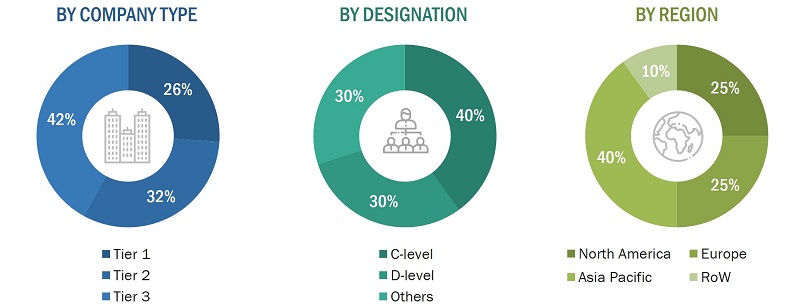
Extensive primary research was conducted after gaining knowledge about the current scenario of the Text-to-Speech market through secondary research. Several primary interviews were conducted with experts from both the demand and supply sides across four major regions—North America, Europe, Asia Pacific and RoW. This primary data was collected through questionnaires, emails, and telephonic interviews.
To know about the assumptions considered for the study, download the pdf brochure
Market Size Estimation
In the complete market engineering process, both top-down and bottom-up approaches have been used, along with several data triangulation methods, to perform market estimation and forecasting for the overall market segments and subsegments listed in this report. Key players in the market have been identified through secondary research, and their market shares in the respective regions have been determined through primary and secondary research. This entire procedure includes the study of annual and financial reports of the top market players and extensive interviews for key insights (quantitative and qualitative) with industry experts (CEOs, VPs, directors, and marketing executives).
All percentage shares, splits, and breakdowns have been determined using secondary sources and verified through primary sources. All the parameters affecting the markets covered in this research study have been accounted for, viewed in detail, verified through primary research, and analyzed to obtain the final quantitative and qualitative data. This data has been consolidated and supplemented with detailed inputs and analysis from MarketsandMarkets and presented in this report. The following figure represents this study’s overall market size estimation process.
Bottom-Up Approach
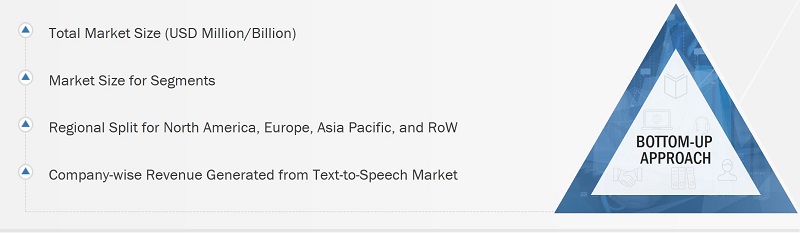
The bottom-up approach was used to arrive at the overall size of the Text-to-Speech market from the revenues of the key players and their shares in the market. The overall market size was calculated based on the revenues of the key players identified in the market.
- Identifying entities in the Text-to-Speech value chain influencing the entire Text-to-Speech industry
- Analyzing each entity along with related major companies identifying technology providers for the implementation of offerings and services
- Estimating the market for these Text-to-Speech end users
- Tracking ongoing and upcoming implementation of Text-to-Speech developments by various companies and forecasting the market based on these developments and other critical parameters
- Arriving at the market size by analyzing Text-to-Speech companies based on their countries and then combining it to get the market estimate by region
- Verifying estimates and crosschecking them by a discussion with key opinion leaders, which include CXOs, directors, and operation managers
Top-Down Approach
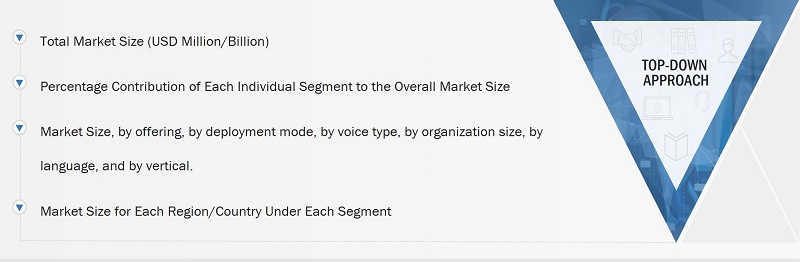
In the top-down approach, the overall market size has been used to estimate the size of individual markets (mentioned in the market segmentation) through percentage splits from secondary and primary research.
The most appropriate immediate parent market size has been used to implement the top-down approach to calculate the market size of specific segments. The top-down approach has been implemented for the data extracted from the secondary research to validate the market size obtained.
Each company’s market share has been estimated to verify the revenue shares used earlier in the top-down approach. This study has determined and confirmed the overall parent market and individual market sizes by the data triangulation method and data validation through primaries. The data triangulation method in this study is explained in the next section.
- Focusing initially on topline investments by market players in the Text-to-Speech ecosystem
- Calculating the market size based on the revenue generated by market players through the sales of Text-to-Speech components
- Mapping the use of Text-to-Speech in different offerings.
- Building and developing the information related to the revenue generated by market players through key products
- Estimating the geographic split using secondary sources considering factors, such as the number of players in a specific country and region, the role of major players in the development of innovative products, and adoption and penetration rates in a particular country for various offerings, deployment modes, voice types, organization sizes, languages, and verticals.
Data Triangulation
After arriving at the overall market size from the estimation process explained above, the overall market has been split into several segments and subsegments. The data triangulation procedure has been employed wherever applicable to complete the overall market engineering process and arrive at the exact statistics for all segments and subsegments. The data has been triangulated by studying various factors and trends from both the demand and supply sides. Additionally, the market size has been validated using top-down and bottom-up approaches.
Market Definition
Speech recognition involves a machine or program's capability to interpret dictation or recognize and execute spoken commands. Text-to-speech (TTS) technology, on the other hand, converts digital text into spoken language. Initially developed to aid the visually impaired, TTS systems find application in various scenarios, assisting those who read slowly, face concentration challenges, need writing feedback, experience visual stress, and more. Over time, technological progress has expanded the use of TTS across diverse applications, including providing directions on navigation devices, facilitating public announcements, and serving as voices for virtual assistants.
Key Stakeholders
- Software providers
- Defense controlling system manufacturers
- Smart car manufacturers
- Mobile handset manufacturers
- Healthcare industry players
- Industry experts
Report Objectives
- To describe and forecast the Text-to-Speech market, in terms of value, based on offering, deployment mode, voice type, organization size, language, and vertical.
- To forecast the market size, in terms of value, for various segments with regard to 4 main regions, namely, North America, Europe, Asia Pacific (APAC), and the Rest of the World (RoW)
- To provide detailed information regarding the major factors influencing the growth of the Text-to-Speech market (drivers, restraints, opportunities, and industry-specific challenges)
- To analyze the micro markets with respect to individual growth trends, prospects, and contributions to the total market
- To study the complete value chain and allied industry segments, and perform a value chain analysis of the Text-to-Speech landscape
- To analyze the opportunities in the market for various stakeholders by identifying the high-growth segments of the market
- To profile the key players and comprehensively analyze their market position in terms of ranking and core competencies, along with detailing the competitive landscape for the market leaders
- To analyze competitive developments, such as partnerships and joint ventures, mergers and acquisitions, new product developments, expansions, and research and development, in the Text-to-Speech market
- To track and analyze competitive developments, such as partnerships, collaborations, agreements, joint ventures, mergers and acquisitions, expansions, product/service launches, and other developments in the market.
Available Customizations
With the given market data, MarketsandMarkets offers customizations according to the specific requirements of companies. The following customization options are available for the report:
- Detailed analysis and profiling of additional market players (up to 5)
- Additional country-level analysis of the Text-to-Speech market
Product Analysis
- Product matrix, which provides a detailed comparison of the product portfolio of each company in the Text-to-Speech market.
Get the Full Text-to-Speech Market Report
Full forecast, segment splits, and company analysis for all Text-to-Speech Market.
- US Text-to-Speech Market
- Canada Text-to-Speech Market
- Mexico Text-to-Speech Market
- UK Text-to-Speech Market
- Germany Text-to-Speech Market
- France Text-to-Speech Market
- Spain Text-to-Speech Market
- Italy Text-to-Speech Market
- Rest Of Europe Text-to-Speech Market
- China Text-to-Speech Market
- Japan Text-to-Speech Market
- South Korea Text-to-Speech Market
- Rest Of Asia Pacific Text-to-Speech Market
Need a Tailored Report?
Customize this report to your needs
Get 10% FREE Customization
Customize This Report
