
Japan Tissue Diagnostics Market (2025-2030)

The Japan Tissue Diagnostics Market was valued at $184 Million in 2025 and projected to reach to $312.4 Million by 2030, representing a compound annual growth rate of 11.2%. Japan's tissue diagnostics market is poised for sustained growth through 2030, driven by the convergence of an aging population requiring advanced diagnostic solutions and continuous investment in healthcare infrastructure modernization.


| Market Size in | USD 26.32 MN |
| Market Forecast in | |
| CAGR | |
| Forecast Period | |
| Units Considered | Value (USD MN) |
Japan Tissue Diagnostics Market Trends and Insights
- Japan's advanced healthcare infrastructure and aging population are driving demand for sophisticated diagnostic solutions, positioning the country as a key market in the Asia Pacific region.
- The 11.2% compound annual growth rate reflects Japan's commitment to precision medicine and early disease detection. Japan's tissue diagnostics sector benefits from strong investment in healthcare technology and a highly educated medical workforce.
- By 2030, Japan is expected to see increased adoption of digital pathology and automated tissue analysis systems.
- Japan's regulatory environment and emphasis on quality standards further support market expansion, making it an attractive hub for both domestic and international diagnostic providers seeking to serve the broader Asia Pacific market..
Key Market Statistics
- CAGR (2025-2030) 11.2% CAGR
- Market Size, 2025 ~USD 184 Million
- Forecast, 2030 ~USD 312.4 Million
- Country Japan
Japan Tissue Diagnostics Market Overview
Market Valuation Growth :
Japan's tissue diagnostics market is valued at $184.0 million in 2025, with projections reaching $312.4 million by 2030, representing a robust 11.2% CAGR that outpaces the global average of 10%.
Aging Population Driver :
Japan's rapidly aging demographic, with over 29% of the population aged 65+, is significantly increasing demand for advanced tissue diagnostic solutions for cancer detection and chronic disease management.
Advanced Healthcare Infrastructure :
Japan's world-class healthcare system, high healthcare spending per capita, and strong adoption of cutting-edge diagnostic technologies create an ideal environment for tissue diagnostics market expansion.
Asia Pacific Leadership :
As a key market in the Asia Pacific region, Japan's sophisticated diagnostic capabilities and regulatory framework position it as a benchmark for tissue diagnostics innovation and adoption across the broader region.
Japan Tissue Diagnostics Market Dynamics
- The country's commitment to precision medicine and early disease detection aligns with increasing healthcare expenditures and technological adoption rates among leading medical institutions. The 11.2% CAGR reflects strong demand from pathology laboratories, hospitals, and diagnostic centers seeking to enhance accuracy in cancer diagnosis and tissue analysis.
- Japan's regulatory environment supports innovation while maintaining stringent quality standards, attracting both domestic and international diagnostic manufacturers to expand their presence in this lucrative market..
Market Ecosystem
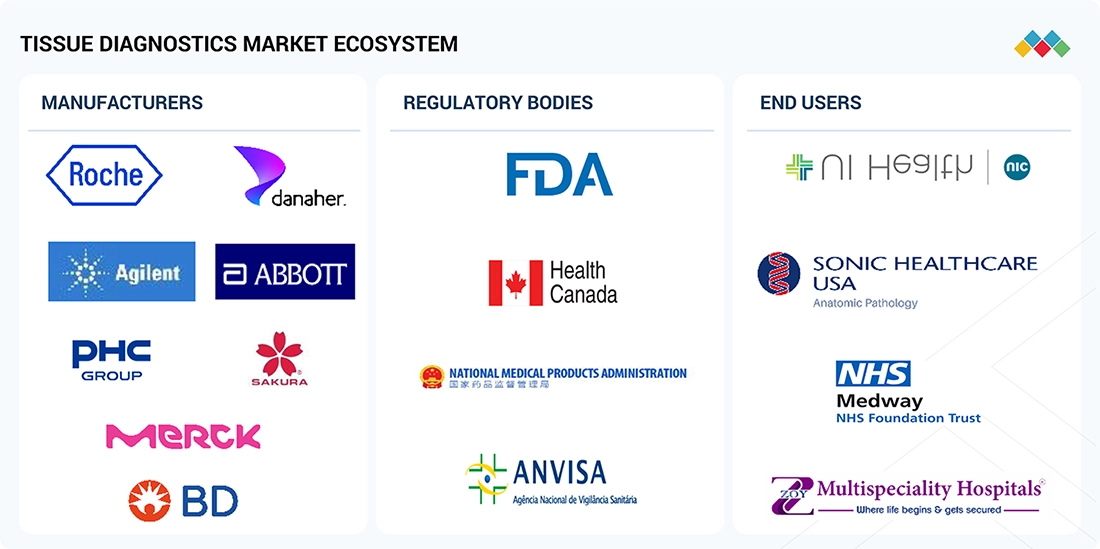
TISSUE DIAGNOSTICS MARKET: COMMERCIAL USE CASES ACROSS INDUSTRIES
| COMPANY | USE CASE DESCRIPTION | BENEFITS |
|---|---|---|
 |
Offers integrated tissue diagnostics and digital pathology solutions using VENTANA series scanners for whole-slide imaging and quantitative IHC biomarker analysis (e.g., PD-L1 scoring in NSCLC) | High-quality digitized images, faster and reproducible biomarker scoring, optimized workflow efficiency, supports telepathology, reduces manual errors |
 |
Provides complete pathology workflow solutions including sample preparation, automated staining (BOND RX/RXm), and imaging for IHC, ISH, and immunofluorescence applications | Standardized staining, high-throughput processing, reduced manual errors, flexible protocols, supports research and diagnostic workflows |
 |
Supplies automated instruments for tissue processing: microtomes, tissue processors, embedding systems, and staining platforms to standardize histology workflows | Consistent tissue preparation, reduced labor and turnaround time, improved assay reliability, supports large-scale laboratory workflows |
 |
Offers automated IHC/ISH staining instruments (Dako Omnis), reagents, and multiplex workflows for spatial biomarker analysis and companion diagnostics | Multiplex testing on single instrument, consistent results with ready-to-use reagents, high-throughput biomarker analysis, supports companion diagnostics |
Logos and trademarks shown above are the property of their respective owners. Their use here is for informational and illustrative purposes only.
Related Ecosystem
In Vitro Diagnostics
- Polymerase Chain Reaction (PCR)
- Enzyme-Linked Immunosorbent Assay (ELISA)
- Dna Microarrays
- Assay Kits
- Microarrays
- ROCHE HOLDINGS AG
- Thermo Fisher Scientific Inc.
- Danaher Corporation
- Abbott Laboratories
- Biomerieux s.a.
Medical Devices
- Polymerase Chain Reaction (PCR)
- Magnetic Resonance Imaging (MRI)
- Disposable Autoinjectors
- Pulse Oximeters
- Blood Pressure Monitors
- Medtronic plc
- Abbott Laboratories
- Stryker Corporation
- Becton, Dickinson and Company
- JOHNSON & JOHNSON
Key Takeaways
- Japan's tissue diagnostics market will grow from $184.0M (2025) to $312.4M (2030) at an 11.2% CAGR.
- Japan's aging population and advanced healthcare infrastructure drive strong demand for precision diagnostic solutions.
- Digital pathology and automation adoption in Japan is accelerating tissue diagnostic capabilities and efficiency.
- Japan's stringent regulatory standards and quality focus position it as a trusted market for diagnostic innovation in Asia Pacific.
Tissue Diagnostics Market Report Scope
| Report Metric | Details |
|---|---|
| Base Year | 2025 |
| Fastest Growing Segment | ANTIBODIES (Type) |
| Forecast Period | 2025–2030 |
| Growth Rate | CAGR of 10% from 2025 to 2030 |
| Largest Segment | CONSUMABLES (Product & Service) |
| Market Size Base Year (Billions) | ~USD 6.74 (2025) |
| Revenue Forecast (Billions) | ~USD 10.86 (2030) |
| Segments Covered | Product & Service, Type, Technology, Disease, Sample Type, End User |
Japan Tissue Diagnostics Market Report Segmentation
6 segment dimensions are covered across the global market.
By Product & Service
- Consumables
- Instruments
- Services
- Software
By Type
- Animal Immunohistochemistry Kits
- Antibodies
- Blocking Sera And Reagents
- Chromogenic Substrates
- Digital Pathology Scanners
- Diluents
- Fixation Reagent
- H&E Stainers
- Human Immunohistochemistry Kits
- Ihc Stainers
- Kits
- Microtomes
- Organic Solvents
- Other Instruments
- Other Reagents
- Primary Antibodies
- Probes
- Proteolytic Enzymes
- Reagents
- Secondary Antibodies
- Slide-Staining Systems
- Special Stainers
- Tissue-Processing Systems
By Technology
- Digital Pathology
- Immunohistochemistry (Ihc)
- In Situ Hybridization (Ish)
- Special Staining
By Disease
- Breast Cancer
- Gastric Cancer
- Lymphoma
- Non-Small Cell Lung Cancer
- Other Diseases
- Prostate Cancer
By Sample Type
- Breast Samples
- Dermatology Samples
- Gi Samples
- Gynecological Samples
- Lung Samples
- Other Samples
- Urological Samples
By End User
- Contract Research Organizations
- Hospitals
- Other End Users
- Pharmaceutical Companies
- Research Laboratories
JAPAN: TISSUE DIAGNOSTICS MARKET, BY END USER, 2023–2030
| Segment | 2023 | 2024 | 2025 | 2026 | 2027 | 2028 | 2029 | 2030 | CAGR (%) |
|---|---|---|---|---|---|---|---|---|---|
| CONTRACT RESEARCH ORGANIZATIONS | 27.5 | 29.2 | 31.6 | 34.3 | 37.2 | 40.6 | 44.5 | 48.8 | 9.1 |
| HOSPITALS | 163.1 | 176.7 | 194.6 | 215 | 238 | 264.4 | 294.9 | 329.9 | 11.1 |
| OTHER END USERS | 9.4 | 10 | 10.7 | 11.5 | 12.4 | 13.5 | 14.7 | 16 | 8.4 |
| PHARMACEUTICAL COMPANIES | 37.8 | 41.1 | 45.5 | 50.6 | 56.3 | 62.9 | 70.5 | 79.4 | 11.8 |
| RESEARCH LABORATORIES | 60.2 | 64.2 | 69.7 | 75.9 | 82.8 | 90.7 | 99.7 | 110 | 9.6 |
| TOTAL | 298 | 321.2 | 352.1 | 387.2 | 426.7 | 472.1 | 524.3 | 584.2 | 10.7 |
Target Audience
- Diagnostic Equipment Manufacturers : Need Japan-specific market data to assess market entry feasibility, competitive positioning, and revenue potential for tissue diagnostics equipment and technology solutions in this high-value healthcare market.
- Healthcare Investment Firms : Require detailed market analysis and growth projections for Japan to evaluate investment opportunities in diagnostic companies, healthcare infrastructure, and precision medicine ventures with strong growth trajectories.
- Hospital & Laboratory Networks : Need market intelligence on tissue diagnostics trends, technology adoption rates, and competitive offerings in Japan to optimize procurement strategies and upgrade diagnostic capabilities.
- Pharmaceutical & Biotech Companies : Require understanding of Japan's tissue diagnostics landscape to support companion diagnostic development, clinical trial planning, and market launch strategies for oncology and specialty therapeutics.
- Healthcare Consultants & Advisors : Need comprehensive Japan market data to provide strategic recommendations to clients on market opportunities, competitive positioning, and growth strategies in the tissue diagnostics sector.
Key Companies in the Japan Tissue Diagnostics Market
| Company | HQ | Ownership | Strongest segments |
|---|---|---|---|
| MEDIMMUNE | United States | Private Company | Synagis (palivizumab) and RSV franchise including MEDI8897,IMFINZI (durvalumab) oncology,Influenza vaccines (FluMist Quadrivalent and Trivalent T/LAIV), |
| PHILIPS | Netherlands | Public Company | Diagnosis & Treatment (Imaging and Image-Guided Therapy),Connected Care (Monitoring, Enterprise Informatics, Sleep and Respiratory Care),Personal Health, |
| CERNOSTICS | United States | Private Company | TissueCypher Barrett’s clinical testing,Research-use and exploratory tissue analytics,Other potential or legacy pathology services, |
| SIENNA CANCER DIAGNOSTICS | Australia | Private Company | hTERT bladder cancer diagnostic test,Other assays, services, and R&D-related income, |
| GENOMIC HEALTH INC | United States | Private Company | Oncotype DX Breast,Oncotype DX Colon,Prostate and other oncology assays, |
| DANAHER CORPORATION | United States | Public Company | Biotechnology (bioprocessing and bioproduction solutions),Life Sciences (genomics, analytical instruments, and research tools),Diagnostics (clinical instruments, consumables, and software), |
| AGILENT TECHNOLOGIES, INC. | United States | Public Company | Life Sciences and Diagnostics Markets,Agilent CrossLab,Applied Markets, |
| MERCK KGAA | Germany | Public Company | Life Science (tools, reagents, bioprocessing, CDMO),Healthcare (specialty pharma and biopharmaceuticals),Electronics (semiconductor and display materials, specialty gases), |
| ABBOTT | United States | Public Company | Diagnostic Products,Medical Devices,Nutritional Products, |
| BECTON, DICKINSON AND COMPANY | United States | Public Company | Medical Essentials (syringes, needles, catheters, sharps, enteral),Connected Care (infusion, medication management, automation, informatics),BioPharma Systems (prefillable drug delivery systems), |
| SYSMEX CORPORATION | Japan | Public Company | Hematology analyzers and reagents (XN-Series, XN-V, ProCyte Dx),Coagulation diagnostics,Blood gas, electrolyte, and urinalysis systems, |
MEDIMMUNE
Medimmune is a private company founded in 1987 in the United States with 2,359 employees.
PHILIPS
Philips is a public company founded in 1891 in the Netherlands with 64,317 employees.
CERNOSTICS
Cernostics is a private company founded in 2008 in the United States.
SIENNA CANCER DIAGNOSTICS
Sienna Cancer Diagnostics is a private company founded in 2002 in Australia.
GENOMIC HEALTH INC
Genomic Health Inc is a private company founded in 2000 in the United States with 829 employees.
DANAHER CORPORATION
Danaher Corporation is a public company founded in 1969 in the United States with 59,000 employees.
AGILENT TECHNOLOGIES, INC.
Agilent Technologies, Inc. is a public company founded in 1999 in the United States with 18,000 employees.
MERCK KGAA
Merck KGaA is a public company founded in 1668 in Germany with 59,077 employees.
ABBOTT
Abbott is a public company founded in 1888 in the United States with 115,000 employees.
BECTON, DICKINSON AND COMPANY
Becton, Dickinson and Company is a public company founded in 1897 in the United States with 72,000 employees.
SYSMEX CORPORATION
Sysmex Corporation is a public company founded in 1968 in Japan with 10,861 employees.
Reasons to Buy this Report
- Market Size & Growth Validation : Obtain precise market valuation data for Japan ($184.0M in 2025) with verified 11.2% CAGR projections through 2030, enabling accurate financial forecasting and investment decision-making specific to the Japanese market.
- Competitive Landscape Intelligence : Understand Japan-specific competitive dynamics, key players, market share distribution, and strategic positioning within Asia Pacific's most advanced healthcare economy to identify partnership and expansion opportunities.
- Demographic & Healthcare Insights : Access detailed analysis of Japan's aging population impact on tissue diagnostics demand, healthcare spending patterns, and institutional adoption rates to tailor product development and market entry strategies.
- Regulatory & Reimbursement Framework : Gain comprehensive understanding of Japan's unique regulatory requirements, reimbursement policies, and healthcare system structure to navigate market entry and ensure compliance with local standards.
- Growth Opportunity Identification : Identify high-potential segments, emerging applications, and underserved diagnostic niches within Japan's market to prioritize resource allocation and develop targeted go-to-market strategies for maximum ROI.
Frequently asked questions
What is the current size of Japan's tissue diagnostics market?
Japan's tissue diagnostics market is valued at $184.0 million in 2025 and is projected to reach $312.4 million by 2030.
What is the growth rate of Japan's tissue diagnostics market?
Japan's tissue diagnostics market is growing at a compound annual growth rate (CAGR) of 11.2% from 2025 to 2030.
What factors are driving growth in Japan's tissue diagnostics market?
Japan's aging population, advanced healthcare infrastructure, investment in precision medicine, and adoption of digital pathology technologies are key growth drivers.
How does Japan's tissue diagnostics market compare to other Asia Pacific countries?
Japan's 11.2% CAGR and mature healthcare system position it as a leading market in Asia Pacific, with strong regulatory standards and technological adoption.
What technologies are emerging in Japan's tissue diagnostics sector?
Digital pathology, automated tissue analysis systems, and AI-powered diagnostic tools are increasingly being adopted across Japan's healthcare institutions.
RESEARCH METHODOLOGY
The study involved major activities in estimating the current market size for the global tissue diagnostics market.
Exhaustive secondary research was done to collect information on the global tissue diagnostics market. The next step was to validate these findings, assumptions, and sizing with industry experts across the value chain using primary research. Different approaches, such as top-down and bottom-up, were employed to estimate the total market size. After that, the market breakup and data triangulation procedures were used to estimate the market size of the segments and subsegments of the global tissue diagnostics market.
Four steps involved in estimating the market size are as follows:/p>
Secondary Research
In the secondary research process, various secondary sources such as annual reports, press releases & investor presentations of companies, white papers, certified publications, articles by recognized authors, gold-standard & silver-standard websites, regulatory bodies, and databases (such as D&B Hoovers, Bloomberg Business, and Factiva) were referred to identify and collect information for this study.
Primary Research
In the primary research process, various sources from the supply and demand sides were interviewed to obtain qualitative and quantitative information for this report. Primary sources were mainly industry experts from core and related industries and preferred suppliers, manufacturers, distributors, service providers, technology developers, researchers, and organizations related to all segments of this industry's value chain. In-depth interviews were conducted with various primary respondents, including key industry participants, subject-matter experts, C-level executives of key market players, and industry consultants, to obtain and verify critical qualitative and quantitative information as well as assess prospects.
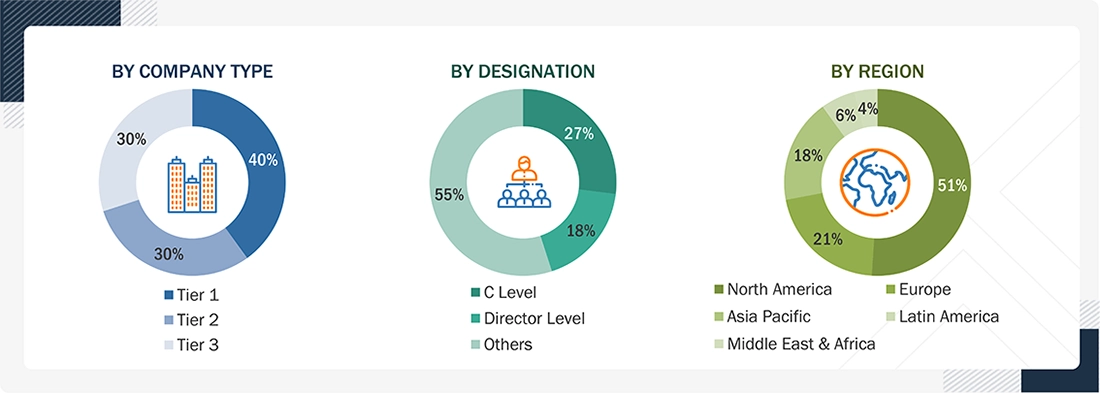
Note 1: Others include Sales Managers, Marketing Managers, and Product Managers.
Note 2: Companies are classified into tiers based on their total revenue. Here's the breakdown of tiers:
Tier 1 = > USD 100 million, tier 2 = USD 10 million to USD 100 million, and tier 3 = < USD 10 million
To know about the assumptions considered for the study, download the pdf brochure
Market Size Estimation
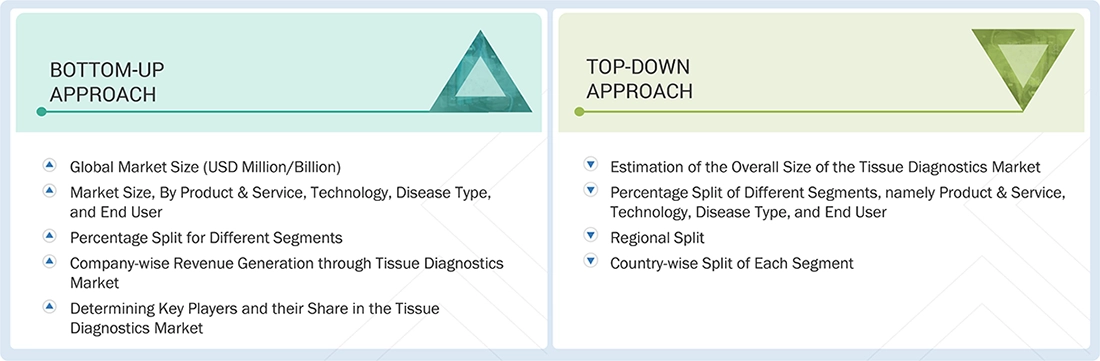
Both the top-down and bottom-up approaches were used to estimate and validate the global tissue diagnostics market's total size. These methods were also used extensively to estimate the size of various subsegments in the market. The research methodology used to estimate the market size included the following:
- The key players in the industry have been identified through extensive secondary research.
- The revenues generated by leading players operating in the tissue diagnostics market have been determined through primary and secondary research.
- All percentage shares, splits, and breakdowns have been determined using secondary sources and verified through primary sources.
The research methodology used to estimate the market size included the following:
Tissue Diagnostics Market : Top-Down and Bottom-Up Approach
Data Triangulation
After arriving at the overall market size by applying the process mentioned above, the total market was split into several segments and subsegments. To complete the overall market engineering process and arrive at the exact statistics for all segments and subsegments, data triangulation and market breakdown procedures were employed, wherever applicable. The data was triangulated by studying various factors and trends from both the demand and supply sides.
Market Definition
Tissue-based diagnostic tests are performed for screening, diagnosing, and monitoring the response of cancer patients to therapy. Tissue diagnosis refers to the examination of intact tissues obtained during a medical procedure, such as biopsies and surgeries. Tissue-based diagnostic tests are used in the treatment of breast cancer, gastric cancer, lymphoma, prostate cancer, non-small cell lung cancer, and other diseases (bone cancer, cervical cancer, colon cancer, cervix cancer, gallbladder carcinoma, skin cancer, HBV, Epstein-Barr virus, hepatitis, and muscular dystrophies). These diagnostic tests are carried out to identify a medical condition in its early stage so as to establish the correct course of treatment. Tissue diagnostic tests are also carried out to determine the course of recovery and response to the treatment.
Key Stakeholders
- Senior Management
- End Users
- Finance/Procurement Department
- R&D Department
Report Objectives
- To define, describe, segment, and forecast the global tissue diagnostics market by product & service, technology, disease type, end user, and region
- To provide detailed information regarding the major factors influencing market growth (such as drivers, restraints, opportunities, and challenges)
- To analyze the micromarkets with respect to individual growth trends, prospects, and contributions to the global tissue diagnostics market
- To analyze market opportunities for stakeholders and provide details of the competitive landscape for key players
- To forecast the size of the market segments with respect to five regions, namely, North America, Europe, Asia Pacific, Latin America, and the Middle East & Africa
- To profile the key players and comprehensively analyze their product portfolios, market positions, and core competencies
- To track and analyze company developments such as product launches & approvals, partnerships, acquisitions, agreements, and other developments
- To benchmark players within the global tissue diagnostics market using the Company Evaluation Matrix framework, which analyzes market players on various parameters within the broad categories of business strategy, market share, and product offerings
- To study the impact of AI/Gen AI on the market, along with the macroeconomic outlook for each region
Customization Options:
MarketsandMarkets offers the following customizations for this market report.
Country Information
- Additional country-level analysis of the global tissue diagnostics market Company profiles
Company profiles
- Additional five company profiles of players operating in the global tissue diagnostics market
- Product matrix, which provides a detailed comparison of the product portfolio of each company in the global tissue diagnostics market
Get the Full Tissue Diagnostics Market Report
Full forecast, segment splits, and company analysis for all Tissue Diagnostics Market.
- Canada Tissue Diagnostics Market
- US Tissue Diagnostics Market
- Germany Tissue Diagnostics Market
- France Tissue Diagnostics Market
- UK Tissue Diagnostics Market
- Italy Tissue Diagnostics Market
- Spain Tissue Diagnostics Market
- China Tissue Diagnostics Market
- India Tissue Diagnostics Market
- Brazil Tissue Diagnostics Market
- Mexico Tissue Diagnostics Market
Need a Tailored Report?
Customize this report to your needs
Get 10% FREE Customization
Customize This Report
