
Brazil Unmanned Systems Market (2024-2029)

The Brazil Unmanned Systems Market was valued at $61661 Million in 2024 and projected to reach to $76142 Million by 2029, representing a compound annual growth rate of CAGR 3.6%. Brazil's unmanned systems market is poised for steady expansion as the country strengthens its aerospace and defence capabilities through technological modernization.


| Market Size in | USD 26.32 MN |
| Market Forecast in | |
| CAGR | |
| Forecast Period | |
| Units Considered | Value (USD MN) |
Brazil Unmanned Systems Market Trends and Insights
- Brazil's aerospace and defence sector is increasingly adopting unmanned technologies across military, commercial, and civil applications, driven by modernization initiatives and infrastructure development.
- The market growth in Brazil reflects rising demand for surveillance, reconnaissance, and logistics solutions tailored to the country's geographic and operational requirements. During the 2024-2029 forecast period, Brazil is expected to see steady expansion in unmanned systems adoption, supported by government investments in defence capabilities and commercial drone regulations.
- Brazil's strategic position in Latin America and its growing technological capabilities position the country as a key market for unmanned systems development.
- The moderate growth rate of 3.6% in Brazil reflects a maturing market with established regulatory frameworks and increasing private sector participation alongside traditional defence procurement..
Key Market Statistics
- CAGR (2024-2029) CAGR 3.6%
- Market Size, 2024 ~USD 61661 Million
- Forecast, 2029 ~USD 76142 Million
- Country Brazil
Brazil Unmanned Systems Market Overview
Market Size & Growth :
Brazil's unmanned systems market is valued at USD 61,661 million in 2024, with projected growth to USD 76,142 million by 2029, reflecting a CAGR of 3.6% during the forecast period.
Military Modernization Drive :
Brazil's defence sector is prioritizing unmanned technologies for surveillance, reconnaissance, and tactical operations, supported by government modernization initiatives and increased defence spending allocations.
Commercial & Civil Applications :
Beyond military use, Brazil's unmanned systems are expanding into agriculture, infrastructure inspection, environmental monitoring, and disaster response, driven by regulatory framework development and industry adoption.
Regional Market Position :
As Latin America's largest economy, Brazil represents a significant growth opportunity for unmanned systems, though its 3.6% CAGR trails the global average of 8.2%, indicating emerging market potential.
Brazil Unmanned Systems Market Dynamics
- Government initiatives supporting domestic defence manufacturing and infrastructure development are creating sustained demand for unmanned solutions across military, commercial, and civil sectors.
- The market benefits from Brazil's strategic position in Latin America and growing investments in border security and maritime surveillance. While Brazil's 3.6% CAGR reflects a more conservative growth trajectory compared to global markets, emerging opportunities in agricultural automation, environmental monitoring, and smart city infrastructure present significant upside potential.
- Regulatory clarity and increased private sector participation are expected to accelerate adoption rates, positioning Brazil as a key regional hub for unmanned systems innovation and deployment through 2029..
Market Ecosystem
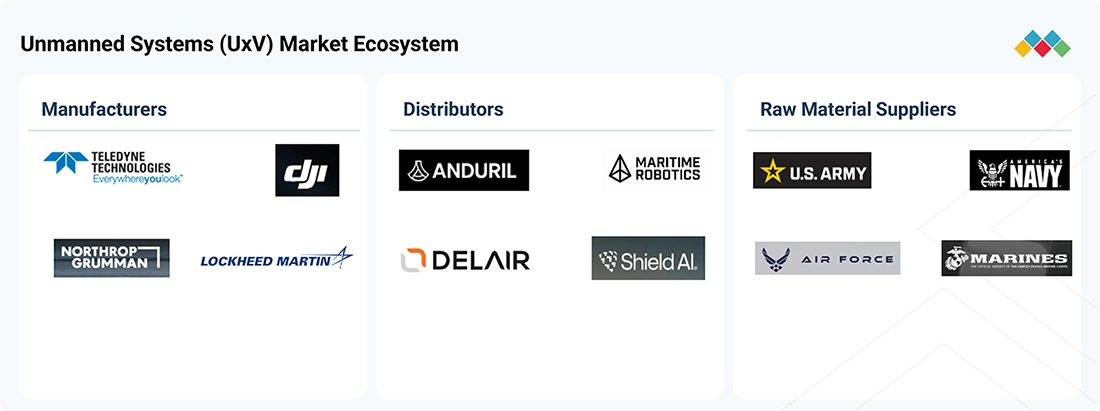
UNMANNED SYSTEMS (UxV) MARKET SIZE & GROWTH: COMMERCIAL USE CASES ACROSS INDUSTRIES
| COMPANY | USE CASE DESCRIPTION | BENEFITS |
|---|---|---|
 |
Northrop Grumman’s MQ-4C Triton is used for long-endurance maritime intelligence, surveillance, reconnaissance, and targeting missions. The unmanned aircraft can operate above 50,000 ft for more than 24 hours and uses a 360-degree multi-intelligence sensor suite to detect, classify, and track targets across large ocean and coastal areas. It is operated by the US Navy and Royal Australian Air Force. | Provides persistent surveillance across large maritime areas without requiring an onboard crew. Its long endurance, wide-area sensor coverage, and high operating altitude allow fewer sorties while supporting continuous monitoring, targeting, and maritime situational awareness. |
 |
Teledyne FLIR Defense’s Centaur UGV is used by US Army, Navy, Air Force, and Marine Corps EOD teams to identify and handle improvised explosive devices, landmines, unexploded ordnance, and other hazards. Different sensors and payloads can also be fitted for CBRN detection, reconnaissance, route clearance, and other hazardous missions. | Allows personnel to detect and handle hazardous objects from a safer stand-off distance. Its modular payload design supports several mission types on a common platform, helping simplify training, maintenance, payload integration, and field support. |
 |
Lockheed Martin’s Indago 4 tactical UAS is used for reconnaissance and surveillance missions requiring a small, rapidly deployable aerial platform. The quadcopter provides 360-degree surveillance, high-resolution payload options, onboard edge computing, and GPS-denied navigation, and can be deployed from a backpack in about two minutes. | Gives operators a portable aerial surveillance capability that can be deployed quickly in areas that are difficult to access from the ground. Its low acoustic signature, modular payload interfaces, and GPS-denied navigation support reconnaissance and monitoring in complex operating environments. |
Logos and trademarks shown above are the property of their respective owners. Their use here is for informational and illustrative purposes only.
Related Ecosystem
Aviation
- Narrow Body Aircraft
- Wide Body Aircraft
- Military Helicopters
- Special Mission Aircraft
- Fighter Aircraft
- HONEYWELL INTERNATIONAL INC.
- COLLINS AEROSPACE
- Thales group
- Safran group
- HEICO Corporation
Defence Platforms And Systems
- Sensors
- Unmanned Ground Vehicles (UGV)
- Fighter Aircraft
- Special Mission Aircraft
- Antennas
- BAE Systems plc
- Thales group
- LOCKHEED MARTIN CORPORATION
- Northrop Grumman Corporation
- L3Harris Technologies, Inc.
Unmanned Systems
- Rotary Wing Aircraft
- Fixed-Wing Drones
- Sensors
- Fuel Cell
- Fixed Wing Aircraft
- LOCKHEED MARTIN CORPORATION
- Northrop Grumman Corporation
- ISRAEL AEROSPACE INDUSTRIES LTD
- Thales group
- BAE Systems plc
Key Takeaways
- Brazil's unmanned systems market is valued at USD 61,661 million in 2024 and will reach USD 76,142 million by 2029.
- Brazil is experiencing a 3.6% CAGR, reflecting steady but moderate growth compared to global expansion rates.
- Brazil's market is driven by defence modernization, commercial drone adoption, and expanding regulatory frameworks.
- Brazil's geographic scale and strategic importance in Latin America support long-term unmanned systems market development.
Unmanned Systems Market Report Scope
| Report Metric | Details |
|---|---|
| Base Year | 2024 |
| Fastest Growing Segment | UNMANNED MARINE VEHICLES (Type) |
| Forecast Period | 2024-2029 |
| Growth Rate | CAGR of 8.2% from 2024 to 2029 |
| Largest Segment | UNMANNED AERIAL VEHICLES (Type) |
| Market Size Base Year (Billions) | ~USD 27.13 (2024) |
| Revenue Forecast (Billions) | ~USD 40.24 (2029) |
| Segments Covered | Type, Mode Of Operation, Application |
Brazil Unmanned Systems Market Report Segmentation
3 segment dimensions are covered across the global market.
By Type
- Autonomous Underwater Vehicles
- Extra Large
- Hybrid
- Large
- Legged
- Medium
- Medium & Large
- Remotely Operated Vehicles
- Small
- Strategic
- Tactical
- Tracked
- Unmanned Aerial Vehicles
- Unmanned Ground Vehicles
- Unmanned Marine Vehicles
- Wheeled
By Mode Of Operation
- Autonomous
- Fully Autonomous
- Optionally Piloted
- Remotely Operated
- Remotely Piloted
- Teleoperated
- Tethered
By Application
- Commercial
- Consumer
- Defense
- Government & Law Enforcement
Target Audience
- Defence & Aerospace Manufacturers : Companies developing unmanned systems require Brazil-specific market data to assess demand, identify military modernization opportunities, and develop localized product strategies for the region's defence sector.
- Government & Military Agencies : Brazilian defence ministries and armed forces use market intelligence to evaluate technology options, benchmark international capabilities, and plan procurement budgets for unmanned systems modernization initiatives.
- Commercial & Agricultural Enterprises : Agribusiness, infrastructure, and environmental companies seek market insights on unmanned system adoption, regulatory frameworks, and ROI potential to justify investments in drone technology for operational efficiency.
- Investment & Venture Capital Firms : Investors targeting Brazil's aerospace and defence sector require detailed market analysis, growth forecasts, and competitive landscapes to evaluate startup opportunities and portfolio company performance in unmanned systems.
- Technology Consultants & Analysts : Consulting firms and research organizations use Brazil market data to support client advisory services, competitive analysis, and strategic planning for companies entering or expanding in Latin America's unmanned systems market.
Reasons to Buy this Report
- Strategic Market Entry Planning : Comprehensive data on Brazil's unmanned systems landscape enables informed market entry strategies, competitive positioning, and localization approaches for aerospace and defence companies targeting Latin America's largest economy.
- Investment & Funding Decisions : Detailed market sizing, growth forecasts, and segment analysis provide critical intelligence for venture capital, private equity, and strategic investors evaluating opportunities in Brazil's emerging unmanned technology sector.
- Government & Defence Procurement : Brazilian defence ministries and government agencies gain insights into market trends, technology adoption patterns, and competitive landscapes to inform procurement strategies and modernization program planning.
- Commercial Expansion Opportunities : Businesses in agriculture, infrastructure, and environmental sectors identify high-growth applications for unmanned systems in Brazil, supported by market data on adoption rates, regulatory environment, and end-user demand.
- Competitive Intelligence & Benchmarking : Market participants access regional performance metrics, growth trajectories, and comparative analysis against global benchmarks to optimize product development, pricing strategies, and resource allocation in Brazil.
Frequently asked questions
What is the current size of Brazil's unmanned systems market?
Brazil's unmanned systems market is estimated at USD 61,661 million in 2024.
What is the projected market size for Brazil by 2029?
Brazil's unmanned systems market is projected to reach USD 76,142 million by 2029.
What is the CAGR for Brazil's unmanned systems market?
Brazil's unmanned systems market is expected to grow at a CAGR of 3.6% from 2024 to 2029.
What are the primary drivers of growth in Brazil's unmanned systems market?
Growth in Brazil is driven by defence modernization initiatives, commercial drone adoption, expanding regulatory frameworks, and increasing demand for surveillance and reconnaissance capabilities.
How does Brazil's market growth compare to global trends?
Brazil's 3.6% CAGR is more moderate than the global unmanned systems market CAGR of 8.2%, reflecting a more mature regional market with established infrastructure.
RESEARCH METHODOLOGY
The study used four main activities to estimate the current size of the unmanned systems (UxV) market. First, detailed secondary research was conducted to collect information on UxV manufacturers, applications, defense programs, procurement contracts, deliveries, deployments, and ongoing development programs. The collected information and key assumptions were then checked through primary interviews with industry participants and experts across the value chain. Demand-side analysis was used to estimate spending on unmanned systems (UxV) by mode of operation, application, end user, and region. Finally, market breakdown and data triangulation were used to calculate the size of each segment and subsegment.
Secondary Research
Secondary research included information from government procurement portals, defense ministries, armed forces, defense agencies, company annual reports, regulatory filings, investor presentations, product documents, press releases, technical papers, journals, along with recognized defense databases. Sources such as SIPRI were used to review military spending, equipment transfers, and procurement activity, while government budget documents and procurement records were used to track UxV programs, contracts, orders, and deliveries. Company filings and official product information were used to study UxV portfolios, revenues, contracts, technologies, applications, customers, and geographical presence.
Primary Research
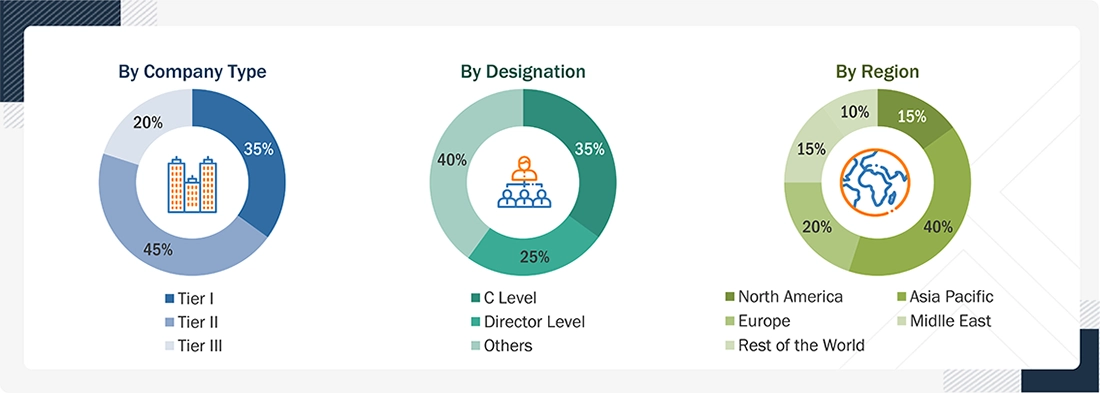
Primary research was conducted after completing the secondary research. Interviews were carried out with unmanned system manufacturers, component and payload suppliers, autonomy and software providers, system integrators, distributors, procurement officials, commercial operators, defense personnel, and other industry participants. The interviews covered major countries across North America, Europe, Asia Pacific, the Middle East, and the Rest of the world. Primary information was collected through questionnaires, emails, and telephone interviews and was used to check market estimates, procurement trends, platform demand, pricing, delivery patterns, applications, adoption rates, and segment-level assumptions.
To know about the assumptions considered for the study, download the pdf brochure
Market Size Estimation
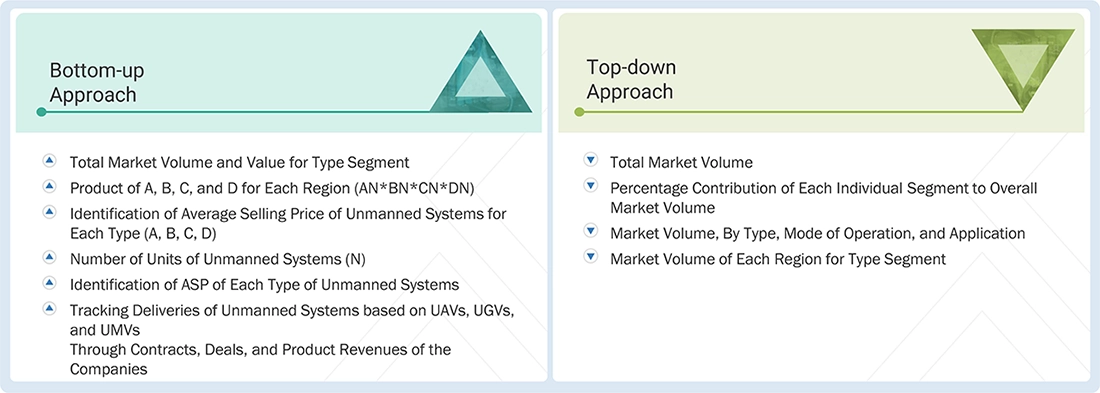
The top-down and bottom-up approaches were used to estimate and validate the size of the unmanned systems (UxV) market. The research methodology used to estimate the size of the market included the following details:
- Key UxV companies were identified through secondary research. Their market positions were estimated using company revenues, unmanned system portfolios, contract activity, delivery volumes, application presence, and regional presence. Annual reports, financial filings, product documents, procurement records, government sources, and interviews with company executives, engineers, system integrators, distributors, operators, and other industry participants were used for the analysis.
- Market shares, segment splits, regional shares, and growth rates were first estimated using secondary sources and then checked through primary interviews. The analysis covered type, application, and mode of operation, along with pricing, delivery volumes, installed/deployed platforms, procurement activity, and regional demand patterns.
- Demand for UxVs across commercial, military, government, and public safety applications was considered. The analysis included defense procurement programs, infrastructure inspection, agriculture, mapping, logistics, surveillance, maritime operations, public safety, regulatory requirements, autonomy adoption, payload integration, and platform replacement. For example, the US Department of Defense’s FY2026 budget separately identified USD 13.4 billion for autonomy and autonomous systems across aerial, ground, surface, underwater, and enabling capabilities. Commercial UAV demand was also assessed using operating and regulatory developments covering package delivery, agriculture, surveying, and BVLOS operations.
- The collected information was compared and combined through data triangulation. Final market values were calculated using company-level revenues, platform delivery volumes, average selling prices, contract values, procurement activity, commercial deployment patterns, regional demand, and primary interview validation.
Unmanned Systems (UxV) Market Size: Bottom-up and Top-down Approaches
Data Triangulation
After determining the overall market size, the unmanned systems (UxV) market was divided into its main segments and subsegments. Data triangulation and market breakdown were used to develop estimates for each segment and subsegment. The analysis considered factors from both the demand and supply sides, including UxV procurement, platform deliveries, commercial deployments, defense programs, applications, pricing, regulatory conditions, company participation, and regional demand. For aerial systems, factors such as routine commercial operations, BVLOS approvals, package delivery, and UAS traffic management development were also considered because they influence deployment levels and operating scale. The final market estimates were then checked using both top-down and bottom-up approaches to maintain consistency across the overall market, regions, segments, and subsegments.
Market Definition
Unmanned systems or unmanned vehicles refer to vehicles that operate without direct human intervention, often controlled remotely or autonomously through pre-programmed instructions or AI. These systems are commonly used in various sectors, including defense, agriculture, logistics, and transportation. They include different types of vehicles and platforms, as mentioned in the following:
Unmanned aerial vehicles (UAVs) are remotely piloted, optionally piloted, or fully autonomous aerial vehicles that play a significant role in the defense and commercial sectors. They are commonly termed drones and are mostly known for their wide use in various military missions, such as border surveillance and combat operations. These vehicles are also used for mapping, surveying, and determining the weather conditions of a specific area.
Unmanned ground vehicles (UGVs) operate on the ground without human presence onboard. These vehicles are used for protection or rescue duties in hazardous environments or for carrying out repetitive tasks. Unmanned ground vehicles are actively developed for both commercial and military use. They are typically deployed for reconnaissance, monitoring buildings and infrastructure, border surveillance, rescue missions, transportation of goods, explosive ordnance disposal, and mine clearance.
Unmanned marine vehicles (UMVs) are vehicles that operate on or below the water, including surface and underwater operations. These vehicles are used for surveillance, environmental monitoring, and naval missions. There are two types of UMVs: unmanned surface vehicles (USVs) and unmanned underwater vehicles (UUVs).
Unmanned surface vehicles (USVs) are marine vessels that operate on the water surface without human intervention. They have a complex system, including system integration, environment perception, and autonomous decision & control. USVs are powered by diesel/gasoline engines, rechargeable lithium-ion batteries, or solar energy. These vehicles are also equipped with various sensors, cameras, communications systems, and other payloads to collect data, perform tasks, and communicate information back to a control station or operator. They are primarily utilized for ocean exploration and various maritime applications.
Unmanned underwater vehicles (UUVs) are submersible marine vessels that operate under the water surface without human intervention. These vehicles are deployed to conduct tasks such as measuring oceanographic data, capturing bottom images, bathymetric imaging, collecting intelligence, obtaining intelligence, surveillance, and reconnaissance (ISR) data, cable laying, and mine detecting. The size of UUVs varies from small to large depending on various factors, such as their capabilities, dimensions, power, speed, and sensors.
Key Stakeholders
- Defense Ministries, Procurement Agencies & Government Buyers
- Armed Forces, Security Agencies & Other End Users
- UxV OEMs & Defense / Aerospace Prime Contractors
- Sensors, Payloads, Propulsion, Battery & Component Suppliers
- AI, Autonomy, Navigation, Communications & C2 Technology Providers
- System Integrators, Software Developers & Engineering Service Providers
- R&D, Testing, Certification & Regulatory Organizations
- Maintenance, Training, Repair & Lifecycle Support Providers
- Standards Bodies, Defense Alliances & Interoperability Organizations
Report Objectives
- To define, describe, segment, and forecast the size of the unmanned systems (UxV) market based on type, application, mode of operation, and region
- To forecast the size of market segments across five regions: North America, Europe, Asia Pacific, the Middle East, and the Rest of the World
- To identify and analyze key drivers, restraints, opportunities, and challenges influencing the growth of the market
- To identify industry trends, market trends, and technology trends in the market
- To analyze micro markets with respect to individual technology trends, growth prospects, and their contribution to the overall market
- To strategically profile key market players and analyze their market position and core capabilities
- To provide a detailed competitive landscape of the market and analyze competitive strategies such as product launches, partnerships, agreements, and collaborations adopted by key players
- To assess the financial position of key players along with their key products, unique offerings, and recent developments
Available customizations:
MarketsandMarkets offers the following customizations for this market report:
- Additional country-level analysis of the unmanned systems (UxV) market
- Profiling of other market players (up to five)
Product Analysis
- Product matrix, which provides a detailed comparison of the product portfolio of each company in the unmanned systems (UxV) market
Get the Full Unmanned Systems Market Report
Full forecast, segment splits, and company analysis for all Unmanned Systems Market.
- Canada Unmanned Systems Market
- US Unmanned Systems Market
- France Unmanned Systems Market
- Germany Unmanned Systems Market
- UK Unmanned Systems Market
- Australia Unmanned Systems Market
- India Unmanned Systems Market
- Japan Unmanned Systems Market
- South Korea Unmanned Systems Market
- Mexico Unmanned Systems Market
- Israel Unmanned Systems Market
- Saudi Arabia Unmanned Systems Market
- South Africa Unmanned Systems Market
- Turkey Unmanned Systems Market
- UAE Unmanned Systems Market
Need a Tailored Report?
Customize this report to your needs
Get 10% FREE Customization
Customize This Report
