
South Korea Wi-Fi Chipset Market (2025-2030)

The South Korea Wi-Fi Chipset Market was valued at $399.2 Million in 2025 and projected to reach to $576 Million by 2030, representing a compound annual growth rate of CAGR 7.6%. South Korea's Wi-Fi chipset market is poised for accelerated growth through 2030, driven by the nation's leadership in semiconductor innovation and aggressive digital infrastructure investments.


| Market Size in | USD 26.32 MN |
| Market Forecast in | |
| CAGR | |
| Forecast Period | |
| Units Considered | Value (USD MN) |
South Korea Wi-Fi Chipset Market Trends and Insights
- This represents a compound annual growth rate (CAGR) of 7.6%, outpacing the global average of 5.8%, reflecting South Korea's strong position in semiconductor innovation and digital infrastructure development.
- The market is driven by South Korea's leadership in consumer electronics, 5G deployment, and IoT adoption across residential and enterprise segments. South Korea's advanced manufacturing ecosystem and high concentration of technology companies position the nation as a critical hub for Wi-Fi chipset production and consumption.
- Between 2025 and 2030, South Korea is expected to benefit from increased demand for next-generation Wi-Fi 6E and Wi-Fi 7 chipsets, particularly in smart home devices, gaming peripherals, and industrial IoT applications.
- South Korea's commitment to digital transformation and smart city initiatives further accelerates chipset adoption across multiple verticals..
Key Market Statistics
- CAGR (2025-2030) CAGR 7.6%
- Market Size, 2025 ~USD 399.2 Million
- Forecast, 2030 ~USD 576 Million
- Country South Korea
South Korea Wi-Fi Chipset Market Overview
Market Valuation & Growth :
South Korea's Wi-Fi chipset market is valued at USD 399.2 million in 2025, with a projected expansion to USD 576.0 million by 2030, representing a robust 7.6% CAGR that significantly outpaces the global average of 5.8%.
Semiconductor Leadership :
South Korea's dominance in semiconductor manufacturing and innovation positions it as a critical hub for Wi-Fi chipset development, supported by major players like Samsung and SK Hynix investing heavily in next-generation wireless technologies.
5G & IoT Integration :
The convergence of 5G infrastructure rollout and rapid IoT adoption across South Korean industries is driving demand for advanced Wi-Fi chipsets in smart homes, industrial automation, and connected devices.
Digital Infrastructure Investment :
South Korea's government-backed digital transformation initiatives and world-leading broadband infrastructure create sustained demand for high-performance Wi-Fi chipsets across consumer and enterprise segments.
South Korea Wi-Fi Chipset Market Dynamics
- The 7.6% CAGR reflects strong demand from consumer electronics manufacturers, telecommunications providers, and enterprise sectors adopting advanced wireless solutions.
- South Korea's strategic position in the global semiconductor supply chain, combined with domestic demand from smart home and IoT applications, ensures sustained market expansion. The market will benefit from South Korea's continued focus on 5G ecosystem development and emerging technologies like Wi-Fi 6E and Wi-Fi 7.
- Local manufacturers' competitive advantages in chip design and production efficiency, coupled with government support for semiconductor R&D, will maintain South Korea's premium market positioning.
- Enterprise adoption of wireless networking solutions and increasing consumer demand for high-speed connectivity will further propel market growth through the forecast period..
Market Ecosystem
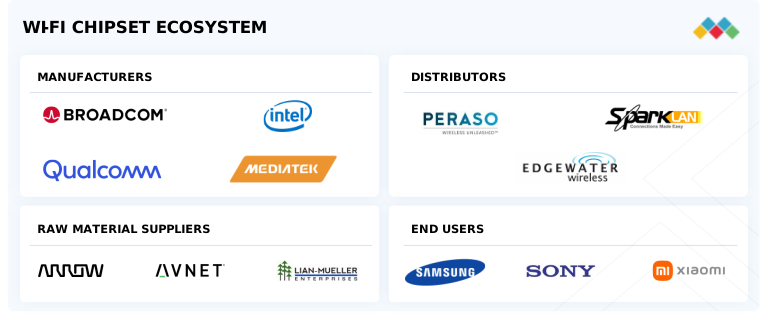
Wi-Fi Chipset Market: COMMERCIAL USE CASES ACROSS INDUSTRIES
| COMPANY | USE CASE DESCRIPTION | BENEFITS |
|---|---|---|
 |
Wi-Fi chipsets for enterprise networking equipment, broadband gateways, and high-performance routers | High throughputlow latency|Enterprise-grade security| Improved coverage for dense environments|Seamless multi-device connectivity |
 |
Advanced Wi-Fi chipsets for smartphones, automotive, XR devices, and next-gen access points | Cutting-edge Wi-Fi 6/6E/7 support |Optimized for AR/VR and gaming |Superior power efficiency |Enhanced mobility|Immersive experiences |
 |
Integrated Wi-Fi solutions for consumer electronics, smart home devices, and mid-range smartphones | Cost-effective design, energy efficiency|Strong integration with SoCs | Enabling affordable connectivity across smart devices |
 |
Wi-Fi chipsets for laptops, PCs, and enterprise platforms with cloud/edge integration | Reliable connectivity for hybrid work |Seamless collaboration|Support for Wi-Fi 6E/7|Robust enterprise-grade performance and security |
 |
Wi-Fi solutions for IoT devices, wearables, and smart home applications | Compact|Low-power chipsets |Affordable design |Srong compatibility|Supporting smart appliances|Home automation|Battery-efficient IoT ecosystems |
Logos and trademarks shown above are the property of their respective owners. Their use here is for informational and illustrative purposes only.
Related Ecosystem
Key Takeaways
- South Korea's Wi-Fi chipset market is valued at USD 399.2 million in 2025, growing at a 7.6% CAGR through 2030.
- South Korea's market growth rate exceeds the global average, driven by advanced semiconductor manufacturing and high tech adoption.
- South Korea is a key production and consumption hub for next-generation Wi-Fi 6E and Wi-Fi 7 chipsets.
- South Korea's digital transformation initiatives and smart city projects are primary catalysts for sustained market expansion.
Wi-Fi Chipset Market Report Scope
| Report Metric | Details |
|---|---|
| Base Year | 2025 |
| Fastest Growing Segment | 802.11BE (WI-FI 7) (Ieee Standard) |
| Forecast Period | 2025-2030 |
| Growth Rate | CAGR of 5.8% from 2025 to 2030 |
| Largest Segment | NETWORKING DEVICES (End-Use Application) |
| Market Size Base Year (Billions) | ~USD 22.52 (2025) |
| Revenue Forecast (Billions) | ~USD 29.86 (2030) |
| Segments Covered | Ieee Standard, Band, Mimo Configuration, Antenna Configuration, Vertical, End-Use Application, Type, Standard |
South Korea Wi-Fi Chipset Market Report Segmentation
8 segment dimensions are covered across the global market.
By Ieee Standard
- 802.11Ac (Wi-Fi 5)
- 802.11Ad
- 802.11Ax (Wi-Fi 6 & 6E)
- 802.11B/G/N
- 802.11Be (Wi-Fi 7)
By Band
- Single & Dual Band
- Single & Dual-Band
- Tri-Band
By Mimo Configuration
- Mu-Mimo
- Su-Mimo
By Antenna Configuration
- 1X1
- 2X2
- 3X3
- 4X4
- 8X8
By Vertical
- Automotive
- Bfsi
- Consumer Electronics
- Enterprise
- Healthcare
- Industrial
- Other Verticals
- Retail
By End-Use Application
- Ar/Vr Devices
- Cameras
- Consumer Devices
- Drones
- Gaming Devices
- In-Vehicle Infotainment
- Mobile Robots
- Mpos
- Networking Devices
- Other End-Use Applications
- Smart Home Devices
By Type
- Access Points
- Gateways & Routers
- Laptops & Pcs
- Other Appliances
- Smart Speakers
- Smart Tvs
- Smartphones
- Tablets
By Standard
- 802.11Ac (Wi-Fi 5)
- 802.11Ad
- 802.11Ax (Wi-Fi 6 & 6E)
- 802.11B/G/N
- 802.11Be (Wi-Fi 7)
- T 802.11Ad
Target Audience
- Semiconductor Manufacturers : South Korean and international chipset producers need market-specific data to benchmark performance, identify growth opportunities, and develop products aligned with local demand for advanced Wi-Fi solutions in consumer and enterprise segments.
- Electronics OEMs & Device Makers : Consumer electronics manufacturers and IoT device producers in South Korea require insights into chipset availability, pricing trends, and technology roadmaps to optimize product design and supply chain decisions.
- Telecommunications & Network Providers : South Korean telecom operators and network infrastructure companies need market intelligence to plan 5G-Wi-Fi integration strategies, infrastructure investments, and service offerings aligned with market growth projections.
- Investment & Private Equity Firms : Investors targeting South Korea's semiconductor and electronics sectors require detailed market valuations, growth forecasts, and competitive analysis to identify acquisition targets and investment opportunities in the Wi-Fi chipset space.
- Government & Policy Makers : South Korean government agencies and policy bodies need market data to inform semiconductor industry support programs, R&D funding decisions, and digital infrastructure initiatives aligned with market growth and technological advancement.
Reasons to Buy this Report
- Market-Specific Growth Insights : Gain detailed understanding of South Korea's 7.6% CAGR trajectory and identify growth drivers unique to the Korean market, including 5G integration, IoT expansion, and government digital initiatives that outpace global trends.
- Competitive Landscape Analysis : Access comprehensive data on South Korean chipset manufacturers, their market share, technological capabilities, and strategic positioning within the global semiconductor ecosystem to inform competitive strategy.
- Investment & Expansion Opportunities : Identify high-potential segments and geographic pockets within South Korea for market entry, partnership development, or manufacturing expansion based on demand forecasts and infrastructure investments through 2030.
- Technology Trend Forecasting : Understand South Korea-specific adoption patterns for emerging Wi-Fi standards (Wi-Fi 6E, Wi-Fi 7), 5G convergence, and IoT applications to align product development and go-to-market strategies with local demand.
- Supply Chain & Sourcing Intelligence : Leverage detailed market data to optimize sourcing strategies, identify key suppliers and manufacturers in South Korea, and assess supply chain resilience for Wi-Fi chipset procurement and production planning.
Frequently asked questions
What is the current size of South Korea's Wi-Fi chipset market?
South Korea's Wi-Fi chipset market is valued at USD 399.2 million in 2025.
What is the projected market size for South Korea by 2030?
South Korea's Wi-Fi chipset market is forecast to reach USD 576.0 million by 2030.
What is the CAGR for South Korea's Wi-Fi chipset market?
South Korea's Wi-Fi chipset market is expected to grow at a CAGR of 7.6% from 2025 to 2030.
How does South Korea's growth rate compare to the global market?
South Korea's CAGR of 7.6% exceeds the global CAGR of 5.8%, indicating stronger regional growth momentum.
What factors are driving growth in South Korea's Wi-Fi chipset market?
South Korea's market growth is driven by advanced semiconductor manufacturing, 5G deployment, IoT adoption, smart city initiatives, and leadership in consumer electronics.
RESEARCH METHODOLOGY
The study involved major activities in estimating the current size of the Wi-Fi chipset market. Exhaustive secondary research was done to collect information on the Wi-Fi chipset. The next step was to validate these findings, assumptions, and sizing with industry experts across the value chain using primary research. Different approaches, such as top-down and bottom-up, were employed to estimate the total market size. After that, the market breakup and data triangulation procedures were used to estimate the market size of the segments and subsegments of the Wi-Fi chipset.
Secondary Research
In the secondary research process, various secondary sources have been used to identify and collect information for this study. The secondary sources referred to for this research study include corporate filings (annual reports, investor presentations, and financial statements); trade, business, and professional associations; white papers, wireless communication-related journals, certified publications, and articles from recognized authors; gold standard and silver standard websites; directories; and databases.
Secondary research has mainly been used to obtain key information about the industry’s value chain, the market’s monetary chain, the total pool of key players, market segmentation according to industry trends to the bottom-most level, geographic markets, and key developments from market- and technology-oriented perspectives. The secondary data was collected and analyzed to determine the overall market size, further validated by primary research.
Primary Research
In the primary research process, various primary sources from both supply and demand sides have been interviewed to obtain qualitative and quantitative information for this report. The primary sources from the supply side include industry experts, such as CEOs, vice presidents, marketing directors, technology and innovation directors, and related key executives, from leading companies and organizations operating in the Wi-Fi technology and other wireless communication markets.
After the complete market engineering (calculations for market statistics, market breakdown, market size estimations, market forecasting, and data triangulation), extensive primary research has been conducted to gather information and verify and validate the numbers obtained. Primary research has also been conducted to identify the segmentation types, industry trends, Porter’s analysis, key players, competitive landscape, and key market dynamics (drivers, restraints, opportunities, challenges, and industry trends) along with the key strategies adopted by the market players.
Extensive primary research has been conducted after acquiring knowledge about the Wi-Fi chipset market scenario through secondary research. Several primary interviews have been conducted with market experts from the demand and supply sides across four major geographical regions—North America, Europe, Asia Pacific, and RoW. RoW comprises the Middle East and Africa. Approximately 40% of the primary interviews have been conducted with the demand side and 60% with the supply side. This primary data has been collected through questionnaires, e-mails, and telephonic interviews.
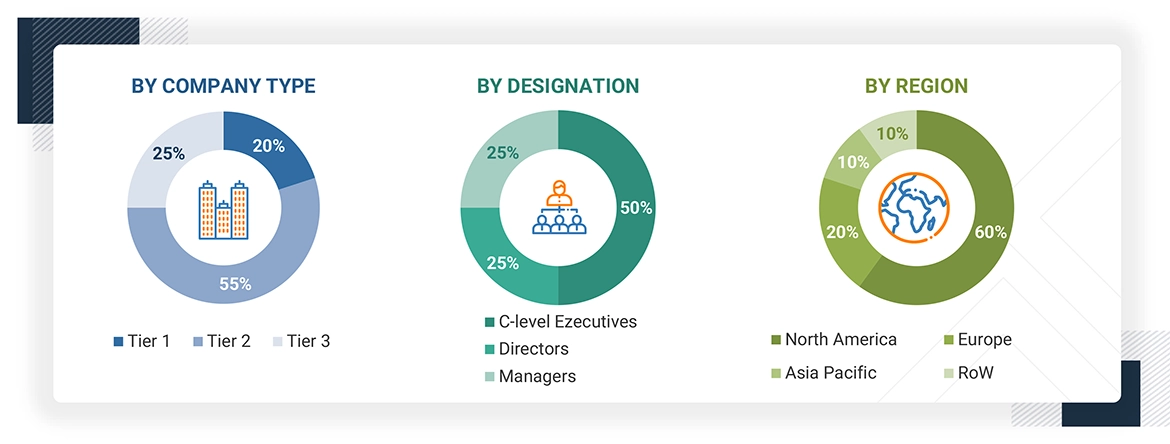
Note: RoW includes the Middle East, Africa, and South America. Other designations include product managers, sales managers, and marketing managers.
The 3 tiers of the companies have been defined based on their total/segmental revenue as of 2024: Tier 1 => USD 1,000 million, Tier 2 = USD 100 million to USD 1,000 million, and Tier 3 = USD 100 million.
To know about the assumptions considered for the study, download the pdf brochure
Market Size Estimation
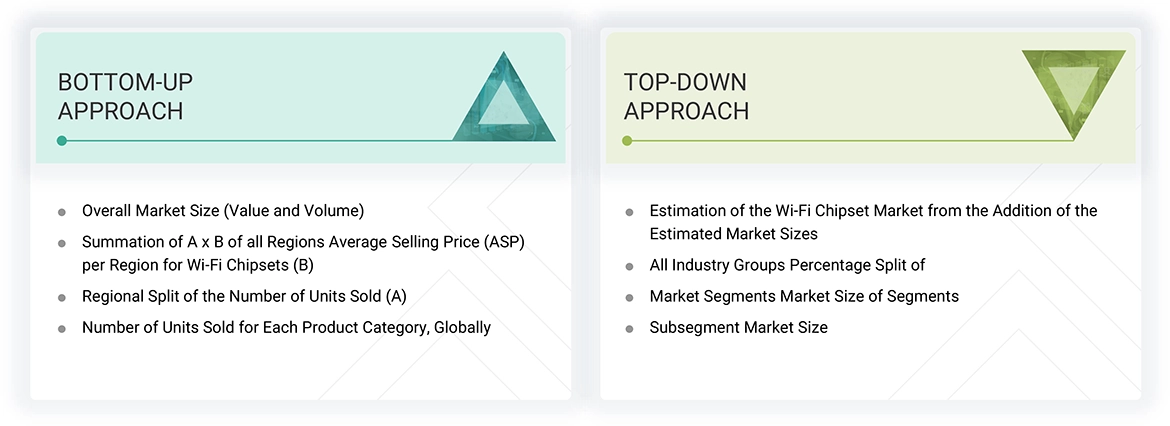
In the complete market engineering process, the top-down and bottom-up approaches and several data triangulation methods have been used to estimate and forecast the size of the market and its segments and subsegments listed in the report. Extensive qualitative and quantitative analyses have been carried out on the complete market engineering process to list the key information/insights pertaining to the Wi-Fi chipset market.
All percentage shares, splits, and breakdowns have been determined using secondary sources and verified through primary sources. All the possible parameters affecting the markets covered in this research study have been accounted for, viewed in detail, verified through primary research, and analyzed to obtain the final quantitative and qualitative data. This data has been consolidated and supplemented with detailed inputs and analysis from MarketsandMarkets and presented in this report.
Top-down and bottom-up approaches have been used to estimate and validate the size of the global market and various other dependent submarkets. Key players involved in manufacturing Wi-Fi chipsets have been identified through secondary research, and their market shares in the respective regions have been determined through primary and secondary research. The research methodology includes the study of the annual and financial reports of the top market players and extensive interviews with industry leaders, such as CEOs, VPs, directors, and marketing executives, for key insights.
All the percentage shares, splits, and breakdowns have been determined using secondary sources and verified through primary sources. All the possible parameters that affect the markets covered in this research study have been accounted for, viewed in detail, verified through primary research, and analyzed to obtain the final quantitative and qualitative data. This data has been consolidated and supplemented with detailed input and analysis from MarketsandMarkets and presented in this report.
Wi-Fi Chipset Market : Top-Down and Bottom-Up Approach
Data Triangulation
After arriving at the overall market size from the market size estimation process explained in the earlier section, the overall Wi-Fi chipset market has been split into several segments. The data triangulation and market breakdown procedures have been employed, wherever applicable, to complete the overall market engineering process and arrive at the exact statistics for all segments and subsegments. The data has been triangulated by studying the various factors and trends from the demand and supply sides. Along with this, the Wi-Fi chipset market has been validated using the top-down and bottom-up approaches.
Market Definition
Wi-Fi chipsets in this report refer to the chipsets that use IEEE 802.11 standards and radio waves between 2.4 GHz and 60 GHz to provide high-speed wireless Internet connectivity and network connections. IEEE 802.11be (Wi-Fi 7), 802.11ax (Wi-Fi 6 & 6E), 802.11ac (Wi-Fi 5), 802.11ad, and 802.11b/g/n standards are considered within the scope of this study. Wi-Fi Alliance-certified Wi-Fi chipsets for security, interoperability, and application-specific protocols (labeled “Wi-Fi CERTIFIED”) are considered for the market size calculation.
The Wi-Fi Chipset Market is segmented based on sensor technology, implementation type, detection range, process stage, application, and region. The market comprises electrochemical, catalytic, metal-oxide-semiconductor (MOS), thermal conductivity, and micro-electromechanical systems (MEMS) by sensor technology. Each sensor type offers unique advantages, such as fast response time, high sensitivity, and cost-efficiency, making them suitable for various industrial requirements. In terms of implementation type, hydrogen detectors are available as fixed and portable systems, with fixed systems deployed in industrial plants and portable units used for field inspections or emergency response. The market is also categorized by detection range, including 0–1,000 ppm, 0–5,000 ppm, 0–20,000 ppm, and beyond 20,000 ppm, based on the safety threshold and detection needs of different environments. The hydrogen lifecycle is addressed across four process stages: generation, storage, transportation, and usage, each requiring real-time leak monitoring and safety assurance. Key application areas include oil & gas, automotive & transportation, chemicals, metals & mining, power & energy, and other sectors such as semiconductors, food & beverage, and medical industries. Each segment demands tailored detection technologies to meet compliance, safety, and operational efficiency standards.
Key Stakeholders
- Raw material and manufacturing equipment suppliers
- Electronic design automation (EDA) and design tool vendors
- Component manufacturers
- Original equipment manufacturers (OEMs)
- Integrated device manufacturers (IDMs)
- Original design manufacturers (ODMs)
- ODM and OEM technology solution providers
- Assembly, testing, and packaging vendors
- Technology, service, and solution providers
- Intellectual property (IP) core and licensing providers
- Suppliers and distributors
- Government and other telecom regulatory bodies
- Technology investors
- Research institutes and organizations
- Wireless communication IC manufacturers
- Semiconductor foundry service providers
- Market research and consulting firms
Report Objectives
- To define, describe, and forecast the Wi-Fi chipset market, by standard, multiple-input multiple-output (MIMO) configuration, band, vertical, and end-use application, in terms of volume, and by end-use application, in terms of value
- To provide detailed information on the major factors that influence the growth of the Wi-Fi chipset market (drivers, restraints, opportunities, and challenges)
- To forecast the market size for various segments with regard to 4 main regions—North America, Europe, Asia Pacific, and RoW, in terms of value and volume
- To provide a detailed overview of the value chain of the market and analyze the impact of Porter’s five forces on the market
- To analyze the opportunities in the market for stakeholders and describe the competitive landscape of the market
- To analyze the opportunities in the market for various stakeholders by identifying the high-growth segments of the market
- To strategically analyze micromarkets1 with respect to individual growth trends, prospects, and contributions to the overall market
- To strategically profile key players and comprehensively analyze their core competencies2
- To analyze competitive developments, such as collaborations, agreements, contracts, partnerships, acquisitions, new product launches, and research & development, in the market
- To analyze the impact of AI/Gen AI and the 2025 US tariff, and the macroeconomic outlook for each region in the Wi-Fi chipset market
Customization Options
With the market data given, MarketsandMarkets offers customizations according to the company’s specific needs. The following customization options are available for the report:
Company Information
- Detailed analysis and profiling of additional market players (up to 7)
Get the Full Wi-Fi Chipset Market Report
Full forecast, segment splits, and company analysis for all Wi-Fi Chipset Market.
- China Wi-Fi Chipset Market
- Japan Wi-Fi Chipset Market
- Rest Of Asia Pacific Wi-Fi Chipset Market
- GCC Wi-Fi Chipset Market
- US Wi-Fi Chipset Market
- Canada Wi-Fi Chipset Market
- Mexico Wi-Fi Chipset Market
- UK Wi-Fi Chipset Market
- Germany Wi-Fi Chipset Market
- France Wi-Fi Chipset Market
- Italy Wi-Fi Chipset Market
- Rest Of Europe Wi-Fi Chipset Market
Need a Tailored Report?
Customize this report to your needs
Get 10% FREE Customization
Customize This Report
