Network Slicing Market by Offering (Solution, Service (Professional Services, Managed Services)), End User (Telecom Operators, Enterprises (Manufacturing, Automotive, Government & Public Sector, Healthcare & Life Sciences)) - Global Forecast to 2030

icon1
USD 2.81 BN
MARKET SIZE, 2030
icon2
CAGR 16.6%
(2025-2030)
icon3
256
REPORT PAGES
icon4
249
MARKET TABLES

OVERVIEW

Network Slicing Market Overview

Source: Secondary Research, Interviews with Experts, MarketsandMarkets Analysis

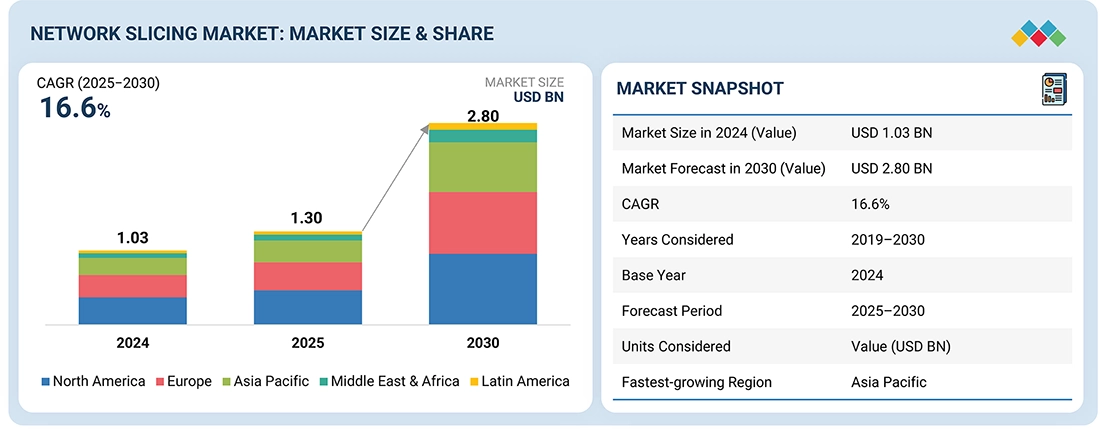
The Network Slicing market is projected to reach USD 2.81 billion by 2030 from USD 1.30 billion in 2025, at a CAGR of 16.6% from 2025 to 2030. The growth of the aerospace materials market is driven by the rising demand for advanced materials that deliver superior performance, efficiency, and sustainability in modern aircraft.

KEY TAKEAWAYS

  • By Region
    The North America XYZ market accounted for a 37.2% revenue share in 2024.
  • By Offering
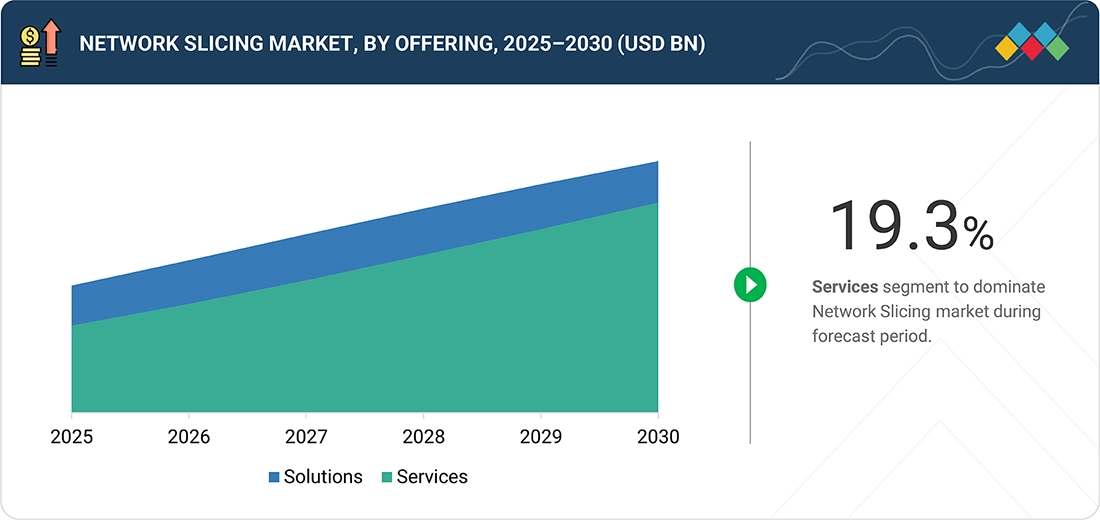
    By offering, the Services segment is expected to register the highest CAGR of 19.3%.
  • By End User
    By end user, the Telecom Operators segment is projected to grow at the fastest rate from 2025 to 2030.

The network slicing market is witnessing robust growth, with North America accounting for a significant 37.2% revenue share in 2024. Among offerings, the services segment is projected to record the highest CAGR of 19.3%, driven by increasing demand for managed and orchestration services. By end user, telecom operators are expected to grow at the fastest pace from 2025 to 2030 as they leverage network slicing for enhanced service delivery and monetization. Leading players such as Broadcom, Nokia, and Ericsson dominate the global landscape with strong market presence and advanced product portfolios, while emerging firms like Parallel Wireless, Affirmed Networks, and Celona are gaining traction in niche areas, positioning themselves as potential future leaders.

TRENDS & DISRUPTIONS IMPACTING CUSTOMERS' CUSTOMERS

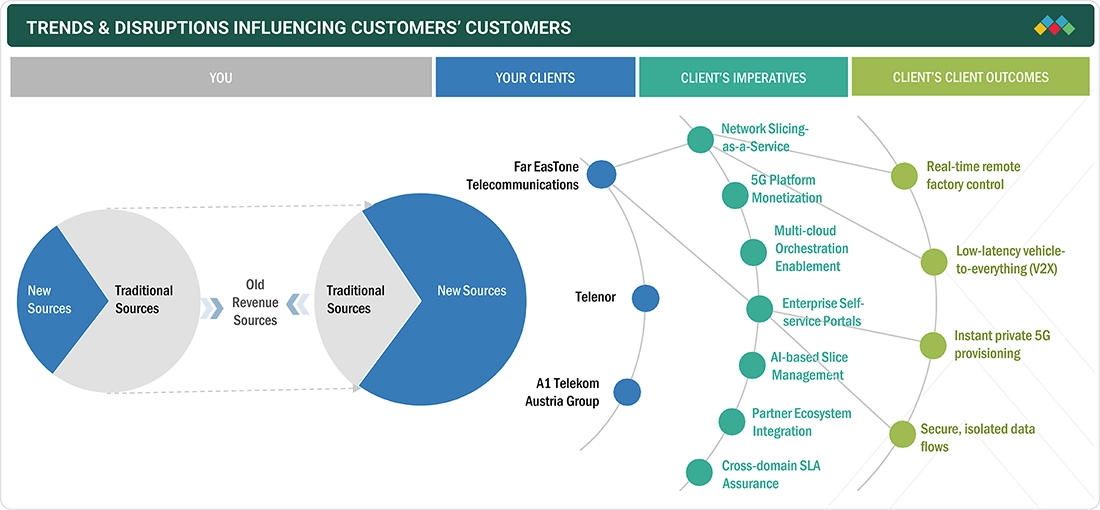
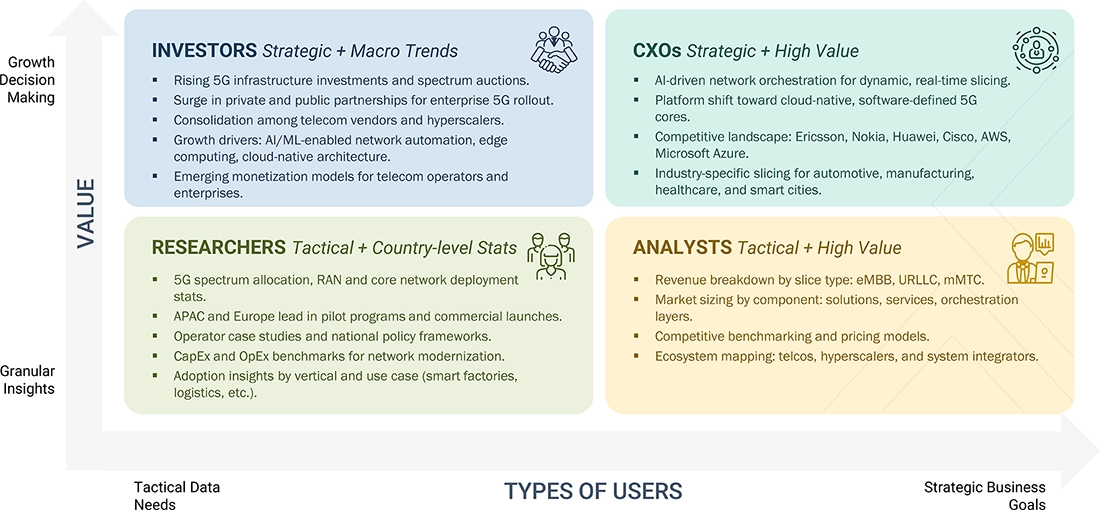
The network slicing market is experiencing a major shift from traditional connectivity services to advanced, high-value solutions driven by new technologies, use cases, and ecosystems. Companies such as Ericsson, Huawei, Nokia, Cisco, and ZTE are focusing on enabling network slicing-as-a-service, AI-based slice management, and multi-cloud orchestration to support industry-specific applications. This evolution is helping telecom operators and enterprises unlock new revenue streams through 5G platform monetization and partner ecosystem integration. As a result, clients are achieving outcomes such as real-time automation, ultra-low latency connectivity, secure data flows, and new digital service models tailored to diverse industry needs.

Network Slicing Market Disruptions

Source: Secondary Research, Interviews with Experts, MarketsandMarkets Analysis

MARKET DYNAMICS

Drivers
Impact
Level
  • Ultra-low latency slicing for real-time use cases
  • Rising enterprise demand for network customization
RESTRAINTS
Impact
Level
  • Lack of unified standards across ecosystems
  • High cost of network transformation for smaller players
OPPORTUNITIES
Impact
Level
  • AI-powered orchestration for zero-touch slicing
  • Edge computing integration with slicing
CHALLENGES
Impact
Level
  • SLA enforcement remains difficult in live deployments
  • Shortage of slicing-skilled workforce

Source: Secondary Research, Interviews with Experts, MarketsandMarkets Analysis

Driver: Ultra-low latency slicing for real-time use cases

Network slicing provides a solution to URLLC (Ultra-Reliable Low-Latency Communication) by allowing mobile networks to build virtual networks intended for highly sensitive applications. For industries such as autonomous vehicles, industrial automation, and telemedicine services, being timely is crucial and makes this capability very valuable. A consistent quality of service is achieved because network slicing can assign resources as needed and improve their performance. Robotic systems and similar applications require a very fast reaction time of under 10 milliseconds in all-latency networks. Deutsche Telekom and Siemens collaborated in January 2025 to carry out network slicing in a German factory and prove that specific procedures in machinery were finished within a set time frame.

Restraint: Lack of unified standards across ecosystems

While the concept of network slicing is clearly defined by 3GPP, how it is practiced varies greatly among operators and vendors. The absence of standard practices for all ecosystems makes operating in multiple-vendor or cross-operator situations very hard. Consequently, difficulties occur in handling orchestration, ensuring service quality, and managing the lifecycle. Despite repeating the need for standardized APIs and interfaces, progress in the industry has not been swift. Standardized northbound APIs are important for consistent slicing, yet there has been little adoption according to the GSMA’s report in December 2024, and this is hindering European telecom network deployment.

Opportunity: AI-powered orchestration for zero-touch slicing

Telecom operators can use artificial intelligence to quickly and efficiently set up, watch over, and automate network slice management. Utilizing AI in closed-loop orchestration, operators can make operations more efficient and immediately deliver tailored slices as needed. Implementing this approach saves money, allows services to launch faster, and supports meeting service-level expectations. AI plays a role in allocating resources wisely and managing faults, which helps the network respond quickly and stay resilient. Ericsson and Singtel demonstrated an AI-powered system in February 2025 that was able to provide slices for applications such as e-sports and remote surgery, providing proof of intelligent automation’s use in telecom networks.

Challenge: SLA enforcement remains difficult in live deployments

Providing stable service in several different network slices at the same time is very hard to achieve. As more slices are created, it gets harder to ensure that each slice achieves the required values for latency, bandwidth, and jitter. Due to this complexity, fixing any issues can be difficult and opens operators to the risk of late SLAs, unhappy customers, and harm to their image. Conventional systems do not provide quick and detailed insights for each slice, pushing the market to develop advanced and predictive tools. For instance, there was a problem at a major sporting event in Paris in January 2025 when a premium video slice was unable to keep up with the latency needed, which greatly affected broadcasters’ experience.

Network Slicing Market: COMMERCIAL USE CASES ACROSS INDUSTRIES

COMPANY USE CASE DESCRIPTION BENEFITS
Ericsson enables dynamic 5G network slicing for telecom operators, supporting enterprise-specific applications such as smart manufacturing, connected healthcare, and mission-critical communication. Delivers ultra-reliable, low-latency connectivity, faster service provisioning, and improved monetization for operators through differentiated network performance.
Huawei provides end-to-end network slicing solutions with AI-driven orchestration and intelligent slice lifecycle management for industries like automotive, energy, and public safety. Enhances operational efficiency and service quality while reducing OPEX through automation and real-time resource optimization.
Nokia’s slicing platform enables multi-domain network slicing across RAN, transport, and core networks, allowing CSPs to deliver customizable connectivity for enterprise and IoT services. Enables rapid deployment of tailored 5G services, greater scalability, and new revenue opportunities through on-demand, SLA-based connectivity.
Cisco offers a cloud-native 5G network slicing solution integrated with its Service Orchestrator and Crosswork Automation Suite, enabling operators to dynamically create, manage, and assure network slices across RAN, transport, and core domains. Delivers end-to-end visibility, automated slice lifecycle management, and assured QoS, helping operators accelerate time-to-market for enterprise 5G services and reduce network complexity.
ZTE provides a full-stack network slicing solution leveraging AI-based orchestration and intelligent service assurance. It supports multi-scenario slicing for industries like manufacturing, transportation, and public safety through its Common Network Resource Pool (CNRP) framework. Improves network agility and reliability with on-demand slice creation, ensures efficient resource utilization, and enables differentiated services for diverse verticals through intelligent automation.

Logos and trademarks shown above are the property of their respective owners. Their use here is for informational and illustrative purposes only.

MARKET ECOSYSTEM

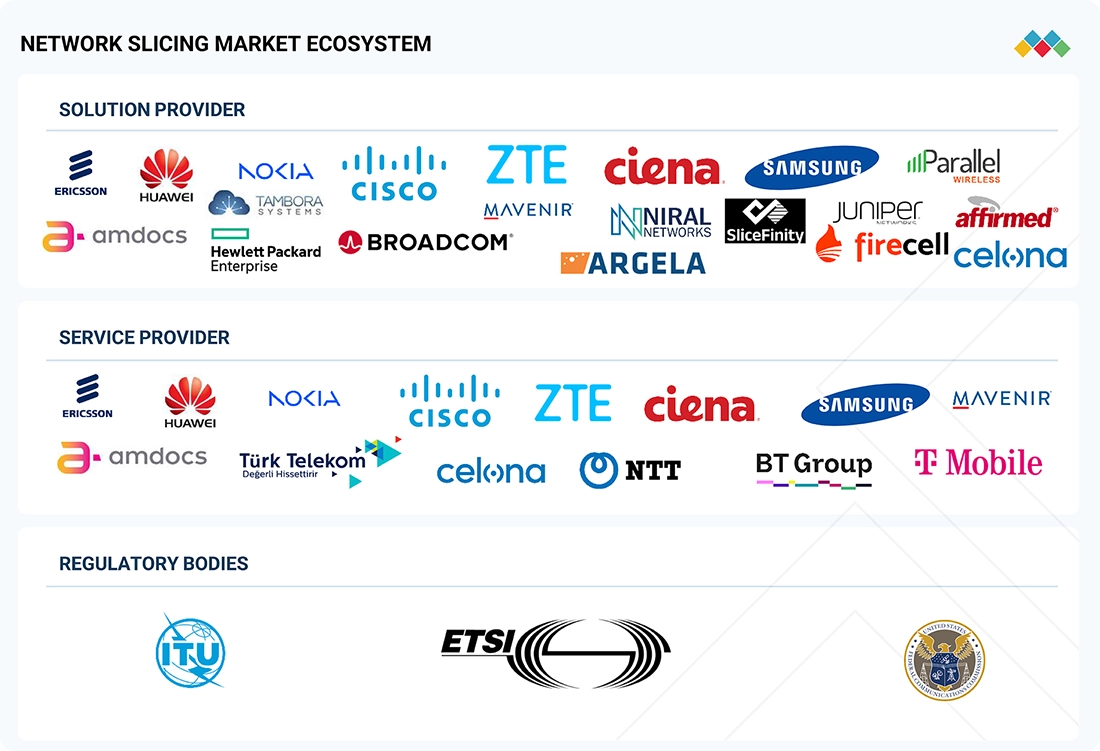
The network slicing market ecosystem consists of solution providers, service providers, and regulatory bodies working together to enable scalable 5G connectivity. Solution providers such as Ericsson, Huawei, Nokia, Cisco, ZTE, Ciena, and Samsung develop core technologies like orchestration platforms, virtualization tools, and AI-based management systems, supported by innovators like Celona, Parallel Wireless, and Affirmed Networks. Service providers including BT Group, NTT, Türk Telekom, and T-Mobile deploy these solutions to deliver industry-specific 5G services with enhanced performance and reliability. Regulatory bodies such as the ITU and ETSI ensure standardization, interoperability, and security compliance, creating a unified framework that drives the adoption and commercialization of network slicing globally.

Network Slicing Market Ecosystem

Logos and trademarks shown above are the property of their respective owners. Their use here is for informational and illustrative purposes only.

MARKET SEGMENTS

Network Slicing Market Segments

Source: Secondary Research, Interviews with Experts, MarketsandMarkets Analysis

Aerospace Materials Market, By Offering

The network slicing market is projected to grow significantly from 2025 to 2030, with the services segment expected to lead the market at a CAGR of 19.3%. This growth is primarily driven by the increasing demand for managed and professional services that support network deployment, orchestration, and lifecycle management, as telecom operators and enterprises focus on optimizing 5G network performance and delivering customized connectivity solutions across industries.

REGION

Asia Pacific to be fastest-growing region in global Network Slicing market during forecast period

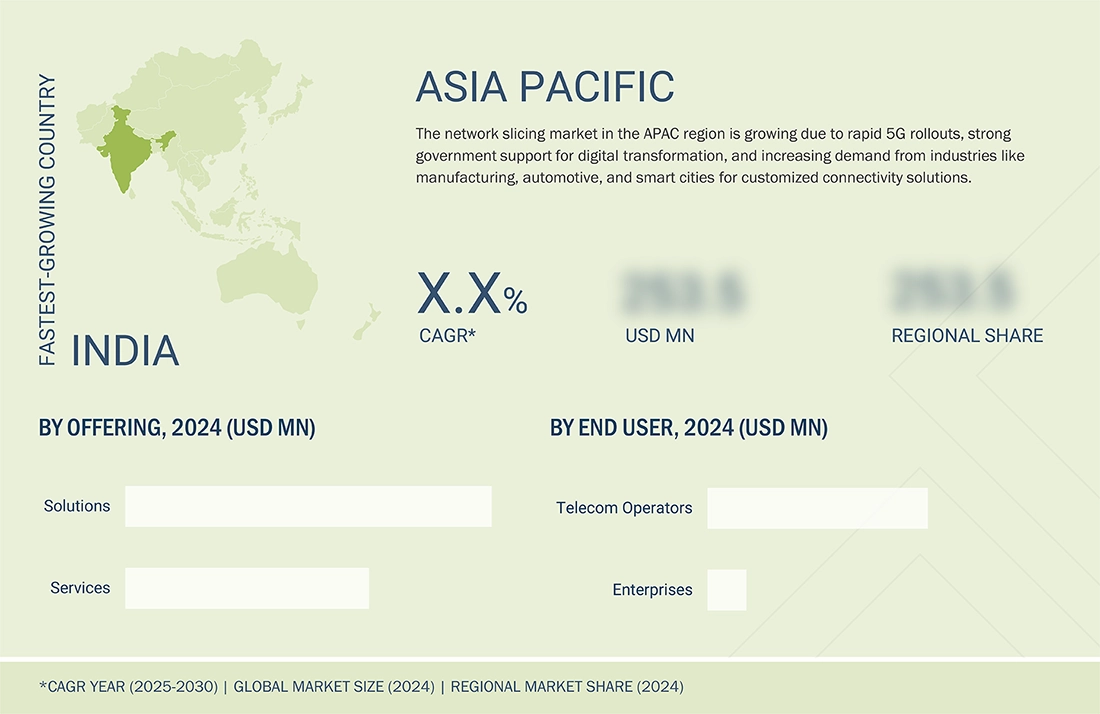
The network slicing market in the Asia Pacific region is expected to witness strong growth, registering a CAGR of 18.1% from 2025 to 2030. This growth is driven by rapid 5G rollouts, increasing digital transformation initiatives, and rising adoption of smart city and industrial automation projects across countries such as India, China, Japan, and South Korea. India, in particular, is emerging as the fastest-growing market, supported by government-led 5G initiatives and expanding enterprise demand for customized connectivity. The telecom operators segment dominates the market by end user, while the services segment leads by offering, as enterprises increasingly rely on managed network slicing solutions to enable reliable, low-latency, and scalable 5G applications.

Network Slicing Market Region

Network Slicing Market: COMPANY EVALUATION MATRIX

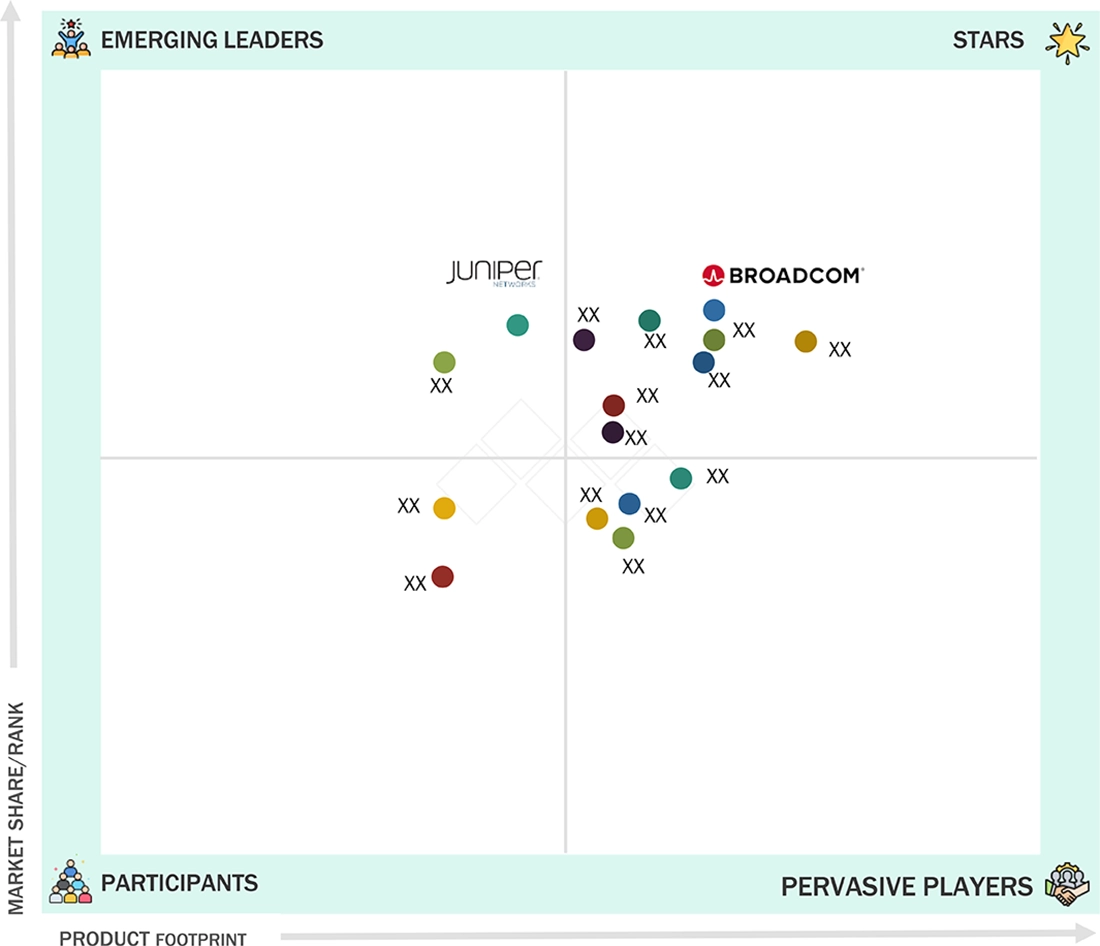
The company evaluation matrix for the network slicing market categorizes players based on their market share and product footprint. Companies positioned in the “Stars” quadrant, including Broadcom, Nokia, Ericsson, Cisco, Huawei, ZTE, Ciena, and Amdocs, are recognized as market leaders with strong technological capabilities, extensive product portfolios, and significant market presence. Emerging Leaders like Juniper Networks and T-Mobile are gaining momentum through innovative solutions and expanding partnerships, positioning themselves for future growth. Pervasive Players such as Samsung, NTT, HPE, and Türk Telekom have established operational footprints but are focusing on broadening their product offerings to strengthen competitiveness. Meanwhile, Participants like Mavenir and BT are active in specific niches or early stages of adoption, with potential to move upward through targeted innovation and ecosystem collaboration.

Network Slicing Market Evaluation Metrics

Source: Secondary Research, Interviews with Experts, MarketsandMarkets Analysis

MARKET SCOPE

REPORT METRIC DETAILS
Market Size in 2024 (Value) USD 1.03 Billion
Market Forecast in 2030 (Value) USD 2.80 Billion
Growth Rate CAGR of 16.6% from 2025-2030
Years Considered 2019-2030
Base Year 2024
Forecast Period 2025-2030
Units Considered Value (USD Million/Billion)
Report Coverage Revenue forecast, company ranking, competitive landscape, growth factors, and trends
Segments Covered
  • By Offering: Solutions and Services
  • By End User:
    • Telecom Operators
    • and Enterprises
Regions Covered North America, Asia Pacific, Europe, South America, Middle East & Africa

WHAT IS IN IT FOR YOU: Network Slicing Market REPORT CONTENT GUIDE

Network Slicing Market Content Guide

DELIVERED CUSTOMIZATIONS

We have successfully delivered the following deep-dive customizations:

CLIENT REQUEST CUSTOMIZATION DELIVERED VALUE ADDS
Leading Service Provider (US)
  • Regional Analysis: Further breakdown of the North American network slicing market
  • Further breakdown of the European network slicing market
  • Further breakdown of the Asia Pacific network slicing market
  • Further breakdown of the Middle Eastern & African network slicing market
  • Further breakdown of the Latin American network slicing market
  • Identifies high-growth regional opportunities, enabling tailored market entry strategies.
  • Optimizes resource allocation and investment based on region-specific demand and trends.
Company Information Detailed analysis and profiling of additional market players (up to 5)
  • Broadens competitive insights, helping clients make informed strategic and investment decisions.
  • Reveals market gaps and opportunities, supporting differentiation and targeted growth initiatives.

RECENT DEVELOPMENTS

  • April 2025 : In April 2025, OPPO and Ericsson collaborated to explore 5G network slicing, aiming to enhance mobile experiences through tailored connectivity solutions.
  • March 2025 : In March 2025, U Mobile teamed up with Huawei and ZTE to roll out Malaysia's Next Gen 5G network. The plan is to incorporate network slicing for enterprise-grade services and achieve 80% coverage in the first year.
  • September 2024 : In September 2024, Ericsson and Concordia University partnered to explore innovative solutions in 5G and beyond, focusing on R&D in advanced wireless technologies.

Table of Contents

Exclusive indicates content/data unique to MarketsandMarkets and not available with any competitors.

TITLE
PAGE NO
1
INTRODUCTION


26
2
RESEARCH METHODOLOGY


31
3
EXECUTIVE SUMMARY


41
4
PREMIUM INSIGHTS


43
5
MARKET OVERVIEW AND INDUSTRY TRENDS
AI-driven orchestration and 5G adoption redefine network slicing amid regulatory and cost challenges.


46
 
5.1
INTRODUCTION


5.2
MARKET DYNAMICS


5.2.1
DRIVERS


5.2.1.1
ULTRA-LOW LATENCY SLICING FOR REAL-TIME USE CASES


5.2.1.2
RISING ENTERPRISE DEMAND FOR NETWORK CUSTOMIZATION


5.2.1.3
PRIVATE 5G ADOPTION FUELING SLICING DEPLOYMENT


5.2.2
RESTRAINTS


5.2.2.1
LACK OF UNIFIED STANDARDS ACROSS ECOSYSTEMS


5.2.2.2
HIGH COST OF NETWORK TRANSFORMATION FOR SMALLER PLAYERS


5.2.2.3
SECURITY RISKS IN MULTI-TENANT ENVIRONMENTS


5.2.3
OPPORTUNITIES


5.2.3.1
AI-POWERED ORCHESTRATION FOR ZERO-TOUCH SLICING


5.2.3.2
EDGE COMPUTING INTEGRATION WITH SLICING


5.2.3.3
CROSS-INDUSTRY CO-DEVELOPMENT OF SLICING USE CASES


5.2.4
CHALLENGES


5.2.4.1
SLA ENFORCEMENT REMAINS DIFFICULT IN LIVE DEPLOYMENTS


5.2.4.2
SHORTAGE OF SLICING-SKILLED WORKFORCE


5.2.4.3
OPERATIONAL COMPLEXITY IN MANAGING MULTIPLE SLICES
 
 
5.3
EVOLUTION OF NETWORK SLICING SOLUTIONS AND SERVICES


5.4
NETWORK SLICING MARKET: ECOSYSTEM ANALYSIS/MARKET MAP


5.5
CASE STUDY ANALYSIS


5.5.1
FAR?EASTONE AND ERICSSON DEMONSTRATED WORLD’S FIRST 5G?END-TO-END MULTIPLE NETWORK SLICING USING ERICSSON DYNAMIC NETWORK SLICE SELECTION SOLUTION


5.5.2
TELENOR & NOKIA SHOWCASED ZERO-TOUCH 5G-VINNI DIGITAL ORCHESTRATION FOR NETWORK SLICING


5.5.3
A1 TELEKOM AUSTRIA GROUP AND AMDOCS SHOWCASED LIVE END-TO-END 5G NETWORK SLICING WITH AMDOCS’ E2E SERVICE & NETWORK ORCHESTRATION AND 5G MONETIZATION SOLUTIONS


5.6
VALUE CHAIN ANALYSIS


5.7
REGULATORY LANDSCAPE


5.7.1
REGULATORY BODIES, GOVERNMENT AGENCIES, AND OTHER ORGANIZATIONS


5.7.1.1
INTERNATIONAL TELECOMMUNICATION UNION (ITU)


5.7.1.2
FEDERAL COMMUNICATIONS COMMISSION (FCC) – UNITED STATES


5.7.1.3
GSMA (GLOBAL SYSTEM FOR MOBILE COMMUNICATIONS ASSOCIATION)


5.7.2
KEY REGULATIONS


5.7.2.1
NORTH AMERICA


5.7.2.2
EUROPE


5.7.2.3
ASIA PACIFIC


5.7.2.4
MIDDLE EAST & AFRICA


5.7.2.5
LATIN AMERICA
 
 
5.8
PRICING ANALYSIS


5.8.1
INDICATIVE PRICING ANALYSIS OF NETWORK SLICING SOLUTIONS, BY KEY PLAYER, 2024


5.8.2
INDICATIVE PRICING ANALYSIS OF NETWORK SLICING SOLUTIONS, BY END USER, 2024


5.9
TECHNOLOGY ANALYSIS


5.9.1
KEY TECHNOLOGIES


5.9.1.1
SOFTWARE-DEFINED NETWORKING (SDN)


5.9.1.2
NETWORK FUNCTION VIRTUALIZATION (NFV)


5.9.1.3
5G CORE


5.9.1.4
ORCHESTRATION & AUTOMATION PLATFORMS


5.9.1.5
MULTI-ACCESS EDGE COMPUTING (MEC)


5.9.2
ADJACENT TECHNOLOGIES


5.9.2.1
INTENT-BASED NETWORKING


5.9.2.2
ARTIFICIAL INTELLIGENCE & MACHINE LEARNING (AI/ML)


5.9.2.3
DIGITAL TWIN


5.9.2.4
OPEN RAN


5.9.2.5
SEGMENT ROUTING


5.9.3
COMPLEMENTARY TECHNOLOGIES


5.9.3.1
INTERNET OF THINGS (IOT)


5.9.3.2
BLOCKCHAIN


5.9.3.3
CYBERSECURITY
 
 
5.10
PATENT ANALYSIS


5.11
PORTER’S FIVE FORCES ANALYSIS


5.11.1
THREAT OF NEW ENTRANTS


5.11.2
THREAT OF SUBSTITUTES


5.11.3
BARGAINING POWER OF SUPPLIERS


5.11.4
BARGAINING POWER OF BUYERS


5.11.5
INTENSITY OF COMPETITIVE RIVALRY


5.12
TRENDS/DISRUPTIONS IMPACTING CUSTOMERS’ BUSINESSES


5.13
KEY STAKEHOLDERS AND BUYING CRITERIA


5.13.1
KEY STAKEHOLDERS IN BUYING PROCESS


5.13.2
BUYING CRITERIA


5.14
KEY CONFERENCES AND EVENTS


5.15
TECHNOLOGY ROADMAP FOR NETWORK SLICING MARKET


5.15.1
SHORT-TERM ROADMAP (2025–2026)


5.15.2
MID-TERM ROADMAP (2027–2028)


5.15.3
LONG-TERM ROADMAP (2029–2030)


5.16
BEST PRACTICES IN NETWORK SLICING MARKET


5.16.1
CONTINUOUS SECURITY AND MONITORING


5.16.2
INTENT-BASED SLICE MANAGEMENT


5.16.3
LEVERAGE AI/ML-DRIVEN ORCHESTRATION


5.16.4
EMBRACE OPEN STANDARDS AND DISAGGREGATED RAN


5.16.5
AUTOMATE SLICE LIFECYCLE MANAGEMENT


5.17
INVESTMENT AND FUNDING SCENARIO


5.18
IMPACT OF GENERATIVE AI ON NETWORK SLICING MARKET


5.18.1
TOP USE CASES AND MARKET POTENTIAL


5.18.1.1
KEY USE CASES


5.18.2
BEST PRACTICES


5.18.2.1
TELECOM INDUSTRY


5.18.2.2
MANUFACTURING INDUSTRY


5.18.2.3
CRITICAL INFRASTRUCTURE


5.18.3
CASE STUDIES OF GENERATIVE AI IMPLEMENTATION


5.18.3.1
AI-DRIVEN VIRTUAL EXPERT FOR SLICE CONFIGURATION


5.18.3.2
HYBRID GENERATIVE AI FOR DYNAMIC RESOURCE ALLOCATION


5.18.3.3
DIGITAL TWIN-POWERED SLICE SIMULATION FRAMEWORK


5.18.4
CLIENT READINESS AND IMPACT ASSESSMENT


5.18.4.1
CLIENT A: ENTERPRISE WIRELESS PROVIDER


5.18.4.2
CLIENT B: GLOBAL COMMUNICATIONS SERVICE PROVIDER


5.18.4.3
CLIENT C: TELECOM R&D CONSORTIUM
 
 
5.19
IMPACT OF 2025 US TARIFF – OVERVIEW


5.19.1
INTRODUCTION


5.19.2
KEY TARIFF RATES


5.19.3
PRICE IMPACT ANALYSIS


5.19.4
IMPACT ON COUNTRY/REGION


5.19.4.1
NORTH AMERICA


5.19.4.2
EUROPE


5.19.4.3
APAC


5.19.5
END-USE INDUSTRY IMPACT
 
 
6
NETWORK SLICING MARKET, BY OFFERING
Market Size & Growth Rate Forecast Analysis to 2030 in USD Million | 20 Data Tables


87
 
6.1
INTRODUCTION


6.1.1
OFFERING: NETWORK SLICING MARKET DRIVERS


6.2
SOLUTION


6.3
SERVICE


6.3.1
PROFESSIONAL SERVICES


6.3.1.1
NETWORK PLANNING & DESIGNING


6.3.1.2
DEPLOYMENT & INTEGRATION


6.3.1.3
SUPPORT & MAINTENANCE


6.3.2
MANAGED SERVICES
 
 
7
NETWORK SLICING MARKET, BY END USER
Market Size & Growth Rate Forecast Analysis to 2030 in USD Million | 6 Data Tables


99
 
7.1
INTRODUCTION


7.1.1
END USER: NETWORK SLICING MARKET DRIVERS


7.2
TELECOM OPERATORS


7.3
ENTERPRISES


8
NETWORK SLICING MARKET, BY ENTERPRISE
Market Size & Growth Rate Forecast Analysis to 2030 in USD Million | 18 Data Tables


104
 
8.1
INTRODUCTION


8.1.1
ENTERPRISE: NETWORK SLICING MARKET DRIVERS


8.2
MANUFACTURING


8.3
AUTOMOTIVE


8.4
GOVERNMENT & PUBLIC SECTOR


8.5
TRANSPORTATION & LOGISTICS


8.6
ENERGY & UTILITIES


8.7
HEALTHCARE & LIFE SCIENCES


8.8
MEDIA & ENTERTAINMENT


8.9
OTHER ENTERPRISES


9
NETWORK SLICING MARKET, BY REGION
Comprehensive coverage of 8 Regions with country-level deep-dive of 18 Countries | 122 Data Tables.


116
 
9.1
INTRODUCTION


9.2
NORTH AMERICA


9.2.1
NORTH AMERICA: MACROECONOMIC OUTLOOK


9.2.2
US


9.2.2.1
VERIZON AND T-MOBILE HAVE COMMERCIALIZED NETWORK SLICING FOR CONSUMER AND PUBLIC SAFETY, WITH AT&T EXPECTED TO FOLLOW BY 2025


9.2.3
CANADA


9.2.3.1
CANADA PROGRESSING TOWARD FULL-SCALE NETWORK SLICING WITH NATIONWIDE TRIALS
 
 
9.3
EUROPE


9.3.1
EUROPE: MACROECONOMIC OUTLOOK


9.3.2
GERMANY


9.3.2.1
GERMANY LEADING SLICING USE IN PRIVATE 5G NETWORKS FOR INDUSTRIAL AUTOMATION, USING LOCALIZED SPECTRUM, TELCO-LED CAMPUS NETWORKS, AND EDGE INTEGRATION


9.3.3
UK


9.3.3.1
UK ADVANCING NETWORK SLICING THROUGH OPERATOR TRIALS, PUBLIC SECTOR-BACKED TESTBEDS, AND INDUSTRY-SPECIFIC SLICING PILOTS IN SECTORS LIKE TRANSPORT AND LOGISTICS


9.3.4
FRANCE


9.3.4.1
FRANCE ADVANCING NETWORK SLICING THROUGH TRIALS IN RAILWAYS AND PUBLIC SERVICES, OPERATOR-DRIVEN SA DEPLOYMENT, AND SOVEREIGN TECH COLLABORATIONS


9.3.5
SPAIN


9.3.5.1
SPAIN LEVERAGING SLICING FOR CONNECTED MOBILITY, URBAN SERVICES, AND SME DIGITALIZATION THROUGH PUBLIC-PRIVATE PARTNERSHIPS AND 5G CORRIDOR PILOTS


9.3.6
ITALY


9.3.6.1
ITALY PUSHING NETWORK SLICING FOR CRITICAL COMMUNICATION IN TRANSPORT, HEALTHCARE, AND RURAL DIGITAL SERVICES WITH SUPPORT FROM TELCOS AND DEFENSE ENTITIES


9.3.7
NORDIC COUNTRIES


9.3.7.1
NORDIC COUNTRIES ARE LEADING SLICING INNOVATION IN TRANSPORT, ENERGY, AND INDUSTRIAL AUTOMATION


9.3.8
REST OF EUROPE


9.4
ASIA PACIFIC


9.4.1
ASIA PACIFIC: MACROECONOMIC OUTLOOK


9.4.2
CHINA


9.4.2.1
CHINA’S NETWORK SLICING ECOSYSTEM HAS EVOLVED INTO EXTENSIVE CITYWIDE PILOTS AND ADVANCED ARCHITECTURE ROLLOUTS


9.4.3
JAPAN


9.4.3.1
JAPAN’S NETWORK SLICING ADVANCES FROM DYNAMIC POCS WITH ERICSSON TO PLANNED COMMERCIAL SA ROLLOUTS TARGETING AUTOMOTIVE, RETAIL, AND HEALTHCARE APPLICATIONS


9.4.4
INDIA


9.4.4.1
INDIA’S NETWORK SLICING ECOSYSTEM DRIVEN BY LAB-BASED VALIDATIONS, CARRIER TESTBEDS, AND GOVERNMENT INITIATIVES THAT SPUR ENTERPRISE AND RURAL CONNECTIVITY TRIALS


9.4.5
AUSTRALIA & NEW ZEALAND


9.4.5.1
AUSTRALIA & NEW ZEALAND HAVE MOVED FROM SLICING TRIALS TO MANAGED ENTERPRISE OFFERINGS, POWERED BY TELSTRA’S PROOF OF VALUE ENGINE AND SPARK’S EDGE-BASED SA DEPLOYMENTS


9.4.6
SOUTH KOREA


9.4.6.1
SOUTH KOREA LEADS IN AI-ENHANCED NETWORK SLICING, COMBINING REAL-TIME ANALYTICS AND SDN/NFV ORCHESTRATION FOR ADAPTIVE SLAS IN INDUSTRIAL AND MEDIA APPLICATIONS


9.4.7
SOUTHEAST ASIA


9.4.7.1
SOUTHEAST ASIA’S NETWORK SLICING PIONEERS INCLUDE SINGTEL’S APP-BASED OFFERINGS AND DEFENSE-GRADE SLICES, COMPLEMENTED BY REGIONAL PRIVATE NETWORK TRIALS FOR MANUFACTURING AND EMERGENCY SERVICES


9.4.8
REST OF ASIA PACIFIC


9.5
MIDDLE EAST & AFRICA


9.5.1
MIDDLE EAST & AFRICA: MACROECONOMIC OUTLOOK


9.5.2
KINGDOM OF SAUDI ARABIA (KSA)


9.5.2.1
SAUDI ARABIA IS ALIGNING ITS NETWORK SLICING STRATEGY WITH VISION 2030, LEVERAGING ADVANCED SPECTRUM, 5G STANDALONE UPGRADES, AND SMART CITY INITIATIVES TO ENABLE USE CASES IN OIL, LOGISTICS, AND AUTOMATION


9.5.3
UAE


9.5.3.1
UAE IS POSITIONING ITSELF AS A FIRST-MOVER IN NETWORK SLICING COMMERCIALIZATION THROUGH REGULATORY SUPPORT, DENSE 5G COVERAGE, AND TRIALS IN SMART MOBILITY, PUBLIC SAFETY, AND IMMERSIVE DIGITAL SERVICES.


9.5.4
SOUTH AFRICA


9.5.4.1
SOUTH AFRICA PREPARING TO SCALE NETWORK SLICING THROUGH 5G EDGE TRIALS, SPECTRUM PLANNING, AND VERTICAL-FOCUSED APPLICATIONS IN MINING, FINANCE, AND SMART COMMUNITIES


9.5.5
REST OF MIDDLE EAST & AFRICA


9.6
LATIN AMERICA


9.6.1
LATIN AMERICA: MACROECONOMIC OUTLOOK


9.6.2
BRAZIL


9.6.2.1
BRAZIL LEADS LATIN AMERICA IN NETWORK SLICING COMMERCIALIZATION WITH TIM’S PUBLIC 5G SLICE FOR REAL-TIME VIDEO


9.6.3
MEXICO


9.6.3.1
MEXICO PREPARING FOR NETWORK SLICING COMMERCIALIZATION THROUGH 5G STANDALONE UPGRADES BY TELCEL AND AT&T MEXICO


9.6.4
REST OF LATIN AMERICA
 
 
10
COMPETITIVE LANDSCAPE
Discover dominant market players and strategies shaping competitive dynamics through 2025.


169
 
10.1
INTRODUCTION


10.2
KEY PLAYER STRATEGIES/RIGHT TO WIN, 2022–2025


10.3
MARKET SHARE ANALYSIS, 2024


10.3.1
MARKET RANKING ANALYSIS


10.4
REVENUE ANALYSIS, 2020–2024


10.5
BRAND/PRODUCT COMPARISON


10.6
COMPANY VALUATION AND FINANCIAL METRICS


10.7
COMPANY EVALUATION MATRIX: KEY PLAYERS, 2024


10.7.1
STARS


10.7.2
EMERGING LEADERS


10.7.3
PERVASIVE PLAYERS


10.7.4
PARTICIPANTS


10.7.5
COMPANY FOOTPRINT: KEY PLAYERS, 2024


10.7.5.1
COMPANY FOOTPRINT


10.7.5.2
REGION FOOTPRINT


10.7.5.3
OFFERING FOOTPRINT


10.7.5.4
END USER FOOTPRINT


10.7.5.5
ENTERPRISE FOOTPRINT
 
 
10.8
COMPANY EVALUATION MATRIX: STARTUPS/SMES, 2024


10.8.1
PROGRESSIVE COMPANIES


10.8.2
RESPONSIVE COMPANIES


10.8.3
DYNAMIC COMPANIES


10.8.4
STARTING BLOCKS


10.8.5
COMPETITIVE BENCHMARKING: STARTUPS/SMES, 2024


10.8.5.1
DETAILED LIST OF KEY STARTUPS/SMES


10.8.5.2
COMPETITIVE BENCHMARKING OF KEY STARTUPS/SMES
 
 
10.9
COMPETITIVE SCENARIO


10.9.1
PRODUCT LAUNCHES


10.9.2
DEALS
 
 
11
COMPANY PROFILES
In-depth Company Profiles of Leading Market Players with detailed Business Overview, Product and Service Portfolio, Recent Developments, and Unique Analyst Perspective (MnM View)


190
 
11.1
KEY PLAYERS


11.1.1
ERICSSON


11.1.1.1
BUSINESS OVERVIEW


11.1.1.2
PRODUCTS/SOLUTIONS/SERVICES OFFERED


11.1.1.3
RECENT DEVELOPMENTS


11.1.1.4
MNM VIEW


11.1.2
HUAWEI


11.1.3
NOKIA


11.1.4
CISCO SYSTEMS, INC.


11.1.5
ZTE


11.1.6
CIENA CORPORATION


11.1.7
AMDOCS


11.1.8
TURK TELEKOM


11.1.9
SAMSUNG


11.1.10
HPE


11.1.11
NTT


11.1.12
BT GROUP


11.1.13
BROADCOM


11.1.14
JUNIPER NETWORKS


11.1.15
T-MOBILE


11.1.16
MAVENIR


11.2
STARTUPS/SMES


11.2.1
PARALLEL WIRELESS


11.2.2
AFFIRMED NETWORKS


11.2.3
CELONA


11.2.4
ARGELA TECHNOLOGIES


11.2.5
TAMBORA SYSTEMS


11.2.6
FIRECELL


11.2.7
DRUID SOFTWARE


11.2.8
NIRAL NETWORKS


11.2.9
SLICEFINITY
 
 
12
ADJACENT AND RELATED MARKETS


237
 
12.1
INTRODUCTION


12.2
NETWORK AUTOMATION MARKET


12.2.1
MARKET DEFINITION


12.2.2
MARKET OVERVIEW


12.2.3
NETWORK AUTOMATION MARKET, BY SOLUTION


12.2.4
NETWORK AUTOMATION MARKET, BY PROFESSIONAL SERVICE


12.2.5
NETWORK AUTOMATION MARKET, BY NETWORK TYPE


12.2.6
NETWORK AUTOMATION MARKET, BY DEPLOYMENT TYPE


12.2.7
NETWORK AUTOMATION MARKET, BY END USER


12.2.8
NETWORK AUTOMATION MARKET, BY ORGANIZATION SIZE


12.2.9
NETWORK AUTOMATION MARKET, BY ENTERPRISE VERTICAL


12.2.10
NETWORK AUTOMATION MARKET, BY REGION


12.3
NETWORK AS A SERVICE MARKET


12.3.1
MARKET DEFINITION


12.3.2
NETWORK AS A SERVICE MARKET, BY TYPE


12.3.3
NETWORK AS A SERVICE MARKET, BY ORGANIZATION SIZE


12.3.4
NETWORK AS A SERVICE MARKET, BY END USER


12.3.5
NETWORK AS A SERVICE MARKET, BY REGION
 
 
13
APPENDIX


249
 
13.1
DISCUSSION GUIDE


13.2
KNOWLEDGESTORE: MARKETSANDMARKETS’ SUBSCRIPTION PORTAL


13.3
CUSTOMIZATION OPTIONS


13.4
RELATED REPORTS


13.5
AUTHOR DETAILS


LIST OF TABLES


TABLE 1
USD EXCHANGE RATES, 2020–2024


TABLE 2
NETWORK SLICING MARKET: ECOSYSTEM


TABLE 3
NORTH AMERICA: LIST OF REGULATORY BODIES, GOVERNMENT AGENCIES, AND OTHER ORGANIZATIONS


TABLE 4
EUROPE: LIST OF REGULATORY BODIES, GOVERNMENT AGENCIES, AND OTHER ORGANIZATIONS


TABLE 5
ASIA PACIFIC: LIST OF REGULATORY BODIES, GOVERNMENT AGENCIES, AND OTHER ORGANIZATIONS


TABLE 6
ROW: LIST OF REGULATORY BODIES, GOVERNMENT AGENCIES, AND OTHER ORGANIZATIONS


TABLE 7
INDICATIVE PRICING ANALYSIS OF NETWORK SLICING SOLUTIONS, BY KEY PLAYER, 2024


TABLE 8
INDICATIVE PRICING ANALYSIS OF NETWORK SLICING SOLUTIONS, BY END USER, 2024


TABLE 9
LIST OF KEY PATENTS


TABLE 10
PORTER’S FIVE FORCES’ IMPACT ON NETWORK SLICING MARKET


TABLE 11
INFLUENCE OF STAKEHOLDERS ON BUYING PROCESS FOR END USERS


TABLE 12
KEY BUYING CRITERIA FOR END USERS


TABLE 13
NETWORK SLICING MARKET: DETAILED LIST OF KEY CONFERENCES AND EVENTS, 2025–2026


TABLE 14
US-ADJUSTED RECIPROCAL TARIFF RATES


TABLE 15
EXPECTED CHANGE IN PRICES AND LIKELY IMPACT ON END-USE MARKET DUE TO TARIFF IMPACT


TABLE 16
NETWORK SLICING MARKET, BY OFFERING, 2019–2024 (USD MILLION)


TABLE 17
NETWORK SLICING MARKET, BY OFFERING, 2025–2030 (USD MILLION)


TABLE 18
SOLUTION: NETWORK SLICING MARKET, BY REGION, 2019–2024 (USD MILLION)


TABLE 19
SOLUTION: NETWORK SLICING MARKET, BY REGION, 2025–2030 (USD MILLION)


TABLE 20
SERVICE: NETWORK SLICING MARKET, BY REGION, 2019–2024 (USD MILLION)


TABLE 21
SERVICE: NETWORK SLICING MARKET, BY REGION, 2025–2030 (USD MILLION)


TABLE 22
SERVICE: NETWORK SLICING MARKET, BY TYPE, 2019–2024 (USD MILLION)


TABLE 23
SERVICE: NETWORK SLICING MARKET, BY TYPE, 2025–2030 (USD MILLION)


TABLE 24
PROFESSIONAL SERVICES: NETWORK SLICING MARKET, BY REGION, 2019–2024 (USD MILLION)


TABLE 25
PROFESSIONAL SERVICES: NETWORK SLICING MARKET, BY REGION, 2025–2030 (USD MILLION)


TABLE 26
PROFESSIONAL SERVICES: NETWORK SLICING MARKET, BY TYPE, 2019–2024 (USD MILLION)


TABLE 27
PROFESSIONAL SERVICES: NETWORK SLICING MARKET, BY TYPE, 2025–2030 (USD MILLION)


TABLE 28
NETWORK PLANNING & DESIGNING: NETWORK SLICING MARKET, BY REGION, 2019–2024 (USD MILLION)


TABLE 29
NETWORK PLANNING & DESIGNING: NETWORK SLICING MARKET, BY REGION, 2025–2030 (USD MILLION)


TABLE 30
DEPLOYMENT & INTEGRATION: NETWORK SLICING MARKET, BY REGION, 2019–2024 (USD MILLION)


TABLE 31
DEPLOYMENT & INTEGRATION: NETWORK SLICING MARKET, BY REGION, 2025–2030 (USD MILLION)


TABLE 32
SUPPORT & MAINTENANCE: NETWORK SLICING MARKET, BY REGION, 2019–2024 (USD MILLION)


TABLE 33
SUPPORT & MAINTENANCE: NETWORK SLICING MARKET, BY REGION, 2025–2030 (USD MILLION)


TABLE 34
MANAGED SERVICES: NETWORK SLICING MARKET, BY REGION, 2019–2024 (USD MILLION)


TABLE 35
MANAGED SERVICES: NETWORK SLICING MARKET, BY REGION, 2025–2030 (USD MILLION)


TABLE 36
NETWORK SLICING MARKET, BY END USER, 2019–2024 (USD MILLION)


TABLE 37
NETWORK SLICING MARKET, BY END USER, 2025–2030 (USD MILLION)


TABLE 38
TELECOM OPERATORS: NETWORK SLICING MARKET, BY REGION, 2019–2024 (USD MILLION)


TABLE 39
TELECOM OPERATORS: NETWORK SLICING MARKET, BY REGION, 2025–2030 (USD MILLION)


TABLE 40
ENTERPRISE: NETWORK SLICING MARKET, BY REGION, 2019–2024 (USD MILLION)


TABLE 41
ENTERPRISE: NETWORK SLICING MARKET, BY REGION, 2025–2030 (USD MILLION)


TABLE 42
NETWORK SLICING MARKET, BY ENTERPRISE, 2019–2024 (USD MILLION)


TABLE 43
NETWORK SLICING MARKET, BY ENTERPRISE, 2025–2030 (USD MILLION)


TABLE 44
MANUFACTURING: NETWORK SLICING MARKET, BY REGION, 2019–2024 (USD MILLION)


TABLE 45
MANUFACTURING: NETWORK SLICING MARKET, BY REGION, 2025–2030 (USD MILLION)


TABLE 46
AUTOMOTIVE: NETWORK SLICING MARKET, BY REGION, 2019–2024 (USD MILLION)


TABLE 47
AUTOMOTIVE: NETWORK SLICING MARKET, BY REGION, 2025–2030 (USD MILLION)


TABLE 48
GOVERNMENT & PUBLIC SECTOR: NETWORK SLICING MARKET, BY REGION, 2019–2024 (USD MILLION)


TABLE 49
GOVERNMENT & PUBLIC SECTOR: NETWORK SLICING MARKET, BY REGION, 2025–2030 (USD MILLION)


TABLE 50
TRANSPORTATION & LOGISTICS: NETWORK SLICING MARKET, BY REGION, 2019–2024 (USD MILLION)


TABLE 51
TRANSPORTATION & LOGISTICS: NETWORK SLICING MARKET, BY REGION, 2025–2030 (USD MILLION)


TABLE 52
ENERGY & UTILITIES: NETWORK SLICING MARKET, BY REGION, 2019–2024 (USD MILLION)


TABLE 53
ENERGY & UTILITIES: NETWORK SLICING MARKET, BY REGION, 2025–2030 (USD MILLION)


TABLE 54
HEALTHCARE & LIFE SCIENCES: NETWORK SLICING MARKET, BY REGION, 2019–2024 (USD MILLION)


TABLE 55
HEALTHCARE & LIFE SCIENCES: NETWORK SLICING MARKET, BY REGION, 2025–2030 (USD MILLION)


TABLE 56
MEDIA & ENTERTAINMENT: NETWORK SLICING MARKET, BY REGION, 2019–2024 (USD MILLION)


TABLE 57
MEDIA & ENTERTAINMENT: NETWORK SLICING MARKET, BY REGION, 2025–2030 (USD MILLION)


TABLE 58
OTHER ENTERPRISES: NETWORK SLICING MARKET, BY REGION, 2019–2024 (USD MILLION)


TABLE 59
OTHER ENTERPRISES: NETWORK SLICING MARKET, BY REGION, 2025–2030 (USD MILLION)


TABLE 60
NETWORK SLICING MARKET, BY REGION, 2019–2024 (USD MILLION)


TABLE 61
NETWORK SLICING MARKET, BY REGION, 2025–2030 (USD MILLION)


TABLE 62
NORTH AMERICA: NETWORK SLICING MARKET, BY OFFERING, 2019–2024 (USD MILLION)


TABLE 63
NORTH AMERICA: NETWORK SLICING MARKET, BY OFFERING, 2025–2030 (USD MILLION)


TABLE 64
NORTH AMERICA: NETWORK SLICING MARKET, BY SERVICE, 2019–2024 (USD MILLION)


TABLE 65
NORTH AMERICA: NETWORK SLICING MARKET, BY SERVICE, 2025–2030 (USD MILLION)


TABLE 66
NORTH AMERICA: NETWORK SLICING MARKET, BY PROFESSIONAL SERVICE, 2019–2024 (USD MILLION)


TABLE 67
NORTH AMERICA: NETWORK SLICING MARKET, BY PROFESSIONAL SERVICE, 2025–2030 (USD MILLION)


TABLE 68
NORTH AMERICA: NETWORK SLICING MARKET, BY END USER, 2019–2024 (USD MILLION)


TABLE 69
NORTH AMERICA: NETWORK SLICING MARKET, BY END USER, 2025–2030 (USD MILLION)


TABLE 70
NORTH AMERICA: NETWORK SLICING MARKET, BY ENTERPRISE, 2019–2024 (USD MILLION)


TABLE 71
NORTH AMERICA: NETWORK SLICING MARKET, BY ENTERPRISE, 2025–2030 (USD MILLION)


TABLE 72
NORTH AMERICA: NETWORK SLICING MARKET, BY COUNTRY, 2019–2024 (USD MILLION)


TABLE 73
NORTH AMERICA: NETWORK SLICING MARKET, BY COUNTRY, 2025–2030 (USD MILLION)


TABLE 74
US: NETWORK SLICING MARKET, BY OFFERING, 2019–2024 (USD MILLION)


TABLE 75
US: NETWORK SLICING MARKET, BY OFFERING, 2025–2030 (USD MILLION)


TABLE 76
US: NETWORK SLICING MARKET, BY SERVICE, 2019–2024 (USD MILLION)


TABLE 77
US: NETWORK SLICING MARKET, BY SERVICE, 2025–2030 (USD MILLION)


TABLE 78
US: NETWORK SLICING MARKET, BY PROFESSIONAL SERVICE, 2019–2024 (USD MILLION)


TABLE 79
US: NETWORK SLICING MARKET, BY PROFESSIONAL SERVICE, 2025–2030 (USD MILLION)


TABLE 80
US: NETWORK SLICING MARKET, BY END USER, 2019–2024 (USD MILLION)


TABLE 81
US: NETWORK SLICING MARKET, BY END USER, 2025–2030 (USD MILLION)


TABLE 82
US: NETWORK SLICING MARKET, BY ENTERPRISE, 2019–2024 (USD MILLION)


TABLE 83
US: NETWORK SLICING MARKET, BY ENTERPRISE, 2025–2030 (USD MILLION)


TABLE 84
CANADA: NETWORK SLICING MARKET, BY OFFERING, 2019–2024 (USD MILLION)


TABLE 85
CANADA: NETWORK SLICING MARKET, BY OFFERING, 2025–2030 (USD MILLION)


TABLE 86
CANADA: NETWORK SLICING MARKET, BY SERVICE, 2019–2024 (USD MILLION)


TABLE 87
CANADA: NETWORK SLICING MARKET, BY SERVICE, 2025–2030 (USD MILLION)


TABLE 88
CANADA: NETWORK SLICING MARKET, BY PROFESSIONAL SERVICE, 2019–2024 (USD MILLION)


TABLE 89
CANADA: NETWORK SLICING MARKET, BY PROFESSIONAL SERVICE, 2025–2030 (USD MILLION)


TABLE 90
CANADA: NETWORK SLICING MARKET, BY END USER, 2019–2024 (USD MILLION)


TABLE 91
CANADA: NETWORK SLICING MARKET, BY END USER, 2025–2030 (USD MILLION)


TABLE 92
CANADA: NETWORK SLICING MARKET, BY ENTERPRISE, 2019–2024 (USD MILLION)


TABLE 93
CANADA: NETWORK SLICING MARKET, BY ENTERPRISE, 2025–2030 (USD MILLION)


TABLE 94
EUROPE: NETWORK SLICING MARKET, BY OFFERING, 2019–2024 (USD MILLION)


TABLE 95
EUROPE: NETWORK SLICING MARKET, BY OFFERING, 2025–2030 (USD MILLION)


TABLE 96
EUROPE: NETWORK SLICING MARKET, BY SERVICE, 2019–2024 (USD MILLION)


TABLE 97
EUROPE: NETWORK SLICING MARKET, BY SERVICE, 2025–2030 (USD MILLION)


TABLE 98
EUROPE: NETWORK SLICING MARKET, BY PROFESSIONAL SERVICE, 2019–2024 (USD MILLION)


TABLE 99
EUROPE: NETWORK SLICING MARKET, BY PROFESSIONAL SERVICE, 2025–2030 (USD MILLION)


TABLE 100
EUROPE: NETWORK SLICING MARKET, BY END USER, 2019–2024 (USD MILLION)


TABLE 101
EUROPE: NETWORK SLICING MARKET, BY END USER, 2025–2030 (USD MILLION)


TABLE 102
EUROPE: NETWORK SLICING MARKET, BY ENTERPRISE, 2019–2024 (USD MILLION)


TABLE 103
EUROPE: NETWORK SLICING MARKET, BY ENTERPRISE, 2025–2030 (USD MILLION)


TABLE 104
EUROPE: NETWORK SLICING MARKET, BY COUNTRY, 2019–2024 (USD MILLION)


TABLE 105
EUROPE: NETWORK SLICING MARKET, BY COUNTRY, 2025–2030 (USD MILLION)


TABLE 106
GERMANY: NETWORK SLICING MARKET, BY OFFERING, 2019–2024 (USD MILLION)


TABLE 107
GERMANY: NETWORK SLICING MARKET, BY OFFERING, 2025–2030 (USD MILLION)


TABLE 108
GERMANY: NETWORK SLICING MARKET, BY SERVICE, 2019–2024 (USD MILLION)


TABLE 109
GERMANY: NETWORK SLICING MARKET, BY SERVICE, 2025–2030 (USD MILLION)


TABLE 110
GERMANY: NETWORK SLICING MARKET, BY PROFESSIONAL SERVICE, 2019–2024 (USD MILLION)


TABLE 111
GERMANY: NETWORK SLICING MARKET, BY PROFESSIONAL SERVICE, 2025–2030 (USD MILLION)


TABLE 112
GERMANY: NETWORK SLICING MARKET, BY END USER, 2019–2024 (USD MILLION)


TABLE 113
GERMANY: NETWORK SLICING MARKET, BY END USER, 2025–2030 (USD MILLION)


TABLE 114
GERMANY: NETWORK SLICING MARKET, BY ENTERPRISE, 2019–2024 (USD MILLION)


TABLE 115
GERMANY: NETWORK SLICING MARKET, BY ENTERPRISE, 2025–2030 (USD MILLION)


TABLE 116
ASIA PACIFIC: NETWORK SLICING MARKET, BY OFFERING, 2019–2024 (USD MILLION)


TABLE 117
ASIA PACIFIC: NETWORK SLICING MARKET, BY OFFERING, 2025–2030 (USD MILLION)


TABLE 118
ASIA PACIFIC: NETWORK SLICING MARKET, BY SERVICE, 2019–2024 (USD MILLION)


TABLE 119
ASIA PACIFIC: NETWORK SLICING MARKET, BY SERVICE, 2025–2030 (USD MILLION)


TABLE 120
ASIA PACIFIC: NETWORK SLICING MARKET, BY PROFESSIONAL SERVICE, 2019–2024 (USD MILLION)


TABLE 121
ASIA PACIFIC: NETWORK SLICING MARKET, BY PROFESSIONAL SERVICE, 2025–2030 (USD MILLION)


TABLE 122
ASIA PACIFIC: NETWORK SLICING MARKET, BY END USER, 2019–2024 (USD MILLION)


TABLE 123
ASIA PACIFIC: NETWORK SLICING MARKET, BY END USER, 2025–2030 (USD MILLION)


TABLE 124
ASIA PACIFIC: NETWORK SLICING MARKET, BY ENTERPRISE, 2019–2024 (USD MILLION)


TABLE 125
ASIA PACIFIC: NETWORK SLICING MARKET, BY ENTERPRISE, 2025–2030 (USD MILLION)


TABLE 126
ASIA PACIFIC: NETWORK SLICING MARKET, BY COUNTRY, 2019–2024 (USD MILLION)


TABLE 127
ASIA PACIFIC: NETWORK SLICING MARKET, BY COUNTRY, 2025–2030 (USD MILLION)


TABLE 128
CHINA: NETWORK SLICING MARKET, BY OFFERING, 2019–2024 (USD MILLION)


TABLE 129
CHINA: NETWORK SLICING MARKET, BY OFFERING, 2025–2030 (USD MILLION)


TABLE 130
CHINA: NETWORK SLICING MARKET, BY SERVICE, 2019–2024 (USD MILLION)


TABLE 131
CHINA: NETWORK SLICING MARKET, BY SERVICE, 2025–2030 (USD MILLION)


TABLE 132
CHINA: NETWORK SLICING MARKET, BY PROFESSIONAL SERVICE, 2019–2024 (USD MILLION)


TABLE 133
CHINA: NETWORK SLICING MARKET, BY PROFESSIONAL SERVICE, 2025–2030 (USD MILLION)


TABLE 134
CHINA: NETWORK SLICING MARKET, BY END USER, 2019–2024 (USD MILLION)


TABLE 135
CHINA: NETWORK SLICING MARKET, BY END USER, 2025–2030 (USD MILLION)


TABLE 136
CHINA: NETWORK SLICING MARKET, BY ENTERPRISE, 2019–2024 (USD MILLION)


TABLE 137
CHINA: NETWORK SLICING MARKET, BY ENTERPRISE, 2025–2030 (USD MILLION)


TABLE 138
MIDDLE EAST & AFRICA: NETWORK SLICING MARKET, BY OFFERING, 2019–2024 (USD MILLION)


TABLE 139
MIDDLE EAST & AFRICA: NETWORK SLICING MARKET, BY OFFERING, 2025–2030 (USD MILLION)


TABLE 140
MIDDLE EAST & AFRICA: NETWORK SLICING MARKET, BY SERVICE, 2019–2024 (USD MILLION)


TABLE 141
MIDDLE EAST & AFRICA: NETWORK SLICING MARKET, BY SERVICE, 2025–2030 (USD MILLION)


TABLE 142
MIDDLE EAST & AFRICA: NETWORK SLICING MARKET, BY PROFESSIONAL SERVICE, 2019–2024 (USD MILLION)


TABLE 143
MIDDLE EAST & AFRICA: NETWORK SLICING MARKET, BY PROFESSIONAL SERVICE, 2025–2030 (USD MILLION)


TABLE 144
MIDDLE EAST & AFRICA: NETWORK SLICING MARKET, BY END USER, 2019–2024 (USD MILLION)


TABLE 145
MIDDLE EAST & AFRICA: NETWORK SLICING MARKET, BY END USER, 2025–2030 (USD MILLION)


TABLE 146
MIDDLE EAST & AFRICA: NETWORK SLICING MARKET, BY ENTERPRISE, 2019–2024 (USD MILLION)


TABLE 147
MIDDLE EAST & AFRICA: NETWORK SLICING MARKET, BY ENTERPRISE, 2025–2030 (USD MILLION)


TABLE 148
MIDDLE EAST & AFRICA: NETWORK SLICING MARKET, BY COUNTRY, 2019–2024 (USD MILLION)


TABLE 149
MIDDLE EAST & AFRICA: NETWORK SLICING MARKET, BY COUNTRY, 2025–2030 (USD MILLION)


TABLE 150
KSA: NETWORK SLICING MARKET, BY OFFERING, 2019–2024 (USD MILLION)


TABLE 151
KSA: NETWORK SLICING MARKET, BY OFFERING, 2025–2030 (USD MILLION)


TABLE 152
KSA: NETWORK SLICING MARKET, BY SERVICE, 2019–2024 (USD MILLION)


TABLE 153
KSA: NETWORK SLICING MARKET, BY SERVICE, 2025–2030 (USD MILLION)


TABLE 154
KSA: NETWORK SLICING MARKET, BY PROFESSIONAL SERVICE, 2019–2024 (USD MILLION)


TABLE 155
KSA: NETWORK SLICING MARKET, BY PROFESSIONAL SERVICE, 2025–2030 (USD MILLION)


TABLE 156
KSA: NETWORK SLICING MARKET, BY END USER, 2019–2024 (USD MILLION)


TABLE 157
KSA: NETWORK SLICING MARKET, BY END USER, 2025–2030 (USD MILLION)


TABLE 158
KSA: NETWORK SLICING MARKET, BY ENTERPRISE, 2019–2024 (USD MILLION)


TABLE 159
KSA: NETWORK SLICING MARKET, BY ENTERPRISE, 2025–2030 (USD MILLION)


TABLE 160
LATIN AMERICA: NETWORK SLICING MARKET, BY OFFERING, 2019–2024 (USD MILLION)


TABLE 161
LATIN AMERICA: NETWORK SLICING MARKET, BY OFFERING, 2025–2030 (USD MILLION)


TABLE 162
LATIN AMERICA: NETWORK SLICING MARKET, BY SERVICE, 2019–2024 (USD MILLION)


TABLE 163
LATIN AMERICA: NETWORK SLICING MARKET, BY SERVICE, 2025–2030 (USD MILLION)


TABLE 164
LATIN AMERICA: NETWORK SLICING MARKET, BY PROFESSIONAL SERVICE, 2019–2024 (USD MILLION)


TABLE 165
LATIN AMERICA: NETWORK SLICING MARKET, BY PROFESSIONAL SERVICE, 2025–2030 (USD MILLION)


TABLE 166
LATIN AMERICA: NETWORK SLICING MARKET, BY END USER, 2019–2024 (USD MILLION)


TABLE 167
LATIN AMERICA: NETWORK SLICING MARKET, BY END USER, 2025–2030 (USD MILLION)


TABLE 168
LATIN AMERICA: NETWORK SLICING MARKET, BY ENTERPRISE, 2019–2024 (USD MILLION)


TABLE 169
LATIN AMERICA: NETWORK SLICING MARKET, BY ENTERPRISE, 2025–2030 (USD MILLION)


TABLE 170
LATIN AMERICA: NETWORK SLICING MARKET, BY COUNTRY, 2019–2024 (USD MILLION)


TABLE 171
LATIN AMERICA: NETWORK SLICING MARKET, BY COUNTRY, 2025–2030 (USD MILLION)


TABLE 172
BRAZIL: NETWORK SLICING MARKET, BY OFFERING, 2019–2024 (USD MILLION)


TABLE 173
BRAZIL: NETWORK SLICING MARKET, BY OFFERING, 2025–2030 (USD MILLION)


TABLE 174
BRAZIL: NETWORK SLICING MARKET, BY SERVICE, 2019–2024 (USD MILLION)


TABLE 175
BRAZIL: NETWORK SLICING MARKET, BY SERVICE, 2025–2030 (USD MILLION)


TABLE 176
BRAZIL: NETWORK SLICING MARKET, BY PROFESSIONAL SERVICE, 2019–2024 (USD MILLION)


TABLE 177
BRAZIL: NETWORK SLICING MARKET, BY PROFESSIONAL SERVICE, 2025–2030 (USD MILLION)


TABLE 178
BRAZIL: NETWORK SLICING MARKET, BY END USER, 2019–2024 (USD MILLION)


TABLE 179
BRAZIL: NETWORK SLICING MARKET, BY END USER, 2025–2030 (USD MILLION)


TABLE 180
BRAZIL: NETWORK SLICING MARKET, BY ENTERPRISE, 2019–2024 (USD MILLION)


TABLE 181
BRAZIL: NETWORK SLICING MARKET, BY ENTERPRISE, 2025–2030 (USD MILLION)


TABLE 182
OVERVIEW OF STRATEGIES ADOPTED BY KEY NETWORK SLICING MARKET PLAYERS, JANUARY 2022–APRIL 2025


TABLE 183
NETWORK SLICING MARKET: DEGREE OF COMPETITION


TABLE 184
NETWORK SLICING MARKET: REGION FOOTPRINT


TABLE 185
NETWORK SLICING MARKET: OFFERING FOOTPRINT


TABLE 186
NETWORK SLICING MARKET: END USER FOOTPRINT


TABLE 187
NETWORK SLICING MARKET: ENTERPRISE FOOTPRINT


TABLE 188
NETWORK SLICING MARKET: LIST OF KEY STARTUPS/SMES


TABLE 189
NETWORK SLICING MARKET: COMPETITIVE BENCHMARKING OF KEY STARTUPS/SMES


TABLE 190
NETWORK SLICING MARKET: PRODUCT LAUNCHES, JANUARY 2022–APRIL 2025


TABLE 191
NETWORK SLICING MARKET: DEALS, JANUARY 2022–APRIL 2025


TABLE 192
ERICSSON: COMPANY OVERVIEW


TABLE 193
ERICSSON: PRODUCTS/SOLUTIONS/SERVICES OFFERED


TABLE 194
ERICSSON: DEALS


TABLE 195
HUAWEI: COMPANY OVERVIEW


TABLE 196
HUAWEI: PRODUCTS/SOLUTIONS/SERVICES OFFERED


TABLE 197
HUAWEI: DEALS


TABLE 198
NOKIA: COMPANY OVERVIEW


TABLE 199
NOKIA: PRODUCTS/SOLUTIONS/SERVICES OFFERED


TABLE 200
NOKIA: PRODUCT LAUNCHES


TABLE 201
NOKIA: DEALS


TABLE 202
CISCO SYSTEMS, INC.: COMPANY OVERVIEW


TABLE 203
CISCO SYSTEMS, INC.: PRODUCTS/SOLUTIONS/SERVICES OFFERED


TABLE 204
CISCO SYSTEMS, INC.: DEALS


TABLE 205
ZTE: COMPANY OVERVIEW


TABLE 206
ZTE: PRODUCTS/SOLUTIONS/SERVICES OFFERED


TABLE 207
ZTE: DEALS


TABLE 208
CIENA CORPORATION: COMPANY OVERVIEW


TABLE 209
CIENA CORPORATION: PRODUCTS/SOLUTIONS/SERVICES OFFERED


TABLE 210
CIENA CORPORATION: PRODUCT LAUNCHES


TABLE 211
CIENA CORPORATION: DEALS


TABLE 212
AMDOCS: COMPANY OVERVIEW


TABLE 213
AMDOCS: PRODUCTS/SOLUTIONS/SERVICES OFFERED


TABLE 214
AMDOCS: DEALS


TABLE 215
TURK TELEKOM: COMPANY OVERVIEW


TABLE 216
TURK TELECOM: PRODUCTS/SOLUTIONS/SERVICES OFFERED


TABLE 217
TURK TELEKOM: DEALS


TABLE 218
SAMSUNG: COMPANY OVERVIEW


TABLE 219
SAMSUNG: PRODUCTS/SOLUTIONS/SERVICES OFFERED


TABLE 220
SAMSUNG: DEALS


TABLE 221
HPE: COMPANY OVERVIEW


TABLE 222
HPE: PRODUCTS/SOLUTIONS/SERVICES OFFERED


TABLE 223
HPE: DEALS


TABLE 224
NETWORK AUTOMATION MARKET, BY COMPONENT, 2014–2019 (USD MILLION)


TABLE 225
NETWORK AUTOMATION MARKET, BY COMPONENT, 2020–2025 (USD MILLION)


TABLE 226
NETWORK AUTOMATION MARKET, BY SOLUTION, 2014–2019 (USD MILLION)


TABLE 227
NETWORK AUTOMATION MARKET, BY SOLUTION, 2020–2025 (USD MILLION)


TABLE 228
NETWORK AUTOMATION MARKET, BY PROFESSIONAL SERVICE, 2014–2019 (USD MILLION)


TABLE 229
NETWORK AUTOMATION MARKET, BY PROFESSIONAL SERVICE, 2020–2025 (USD MILLION)


TABLE 230
NETWORK AUTOMATION MARKET, BY NETWORK TYPE, 2014–2019 (USD MILLION)


TABLE 231
NETWORK AUTOMATION MARKET, BY NETWORK TYPE, 2020–2025 (USD MILLION)


TABLE 232
NETWORK AUTOMATION MARKET, BY DEPLOYMENT MODE, 2014–2019 (USD MILLION)


TABLE 233
NETWORK AUTOMATION MARKET, BY DEPLOYMENT MODE, 2020–2025 (USD MILLION)


TABLE 234
NETWORK AUTOMATION MARKET, BY END USER, 2014–2019 (USD MILLION)


TABLE 235
NETWORK AUTOMATION MARKET, BY END USER, 2020–2025 (USD MILLION)


TABLE 236
NETWORK AUTOMATION MARKET, BY ORGANIZATION SIZE, 2014–2019 (USD MILLION)


TABLE 237
NETWORK AUTOMATION MARKET, BY ORGANIZATION SIZE, 2020–2025 (USD MILLION)


TABLE 238
NETWORK AUTOMATION MARKET, BY ENTERPRISE VERTICAL, 2014–2019 (USD MILLION)


TABLE 239
NETWORK AUTOMATION MARKET, BY ENTERPRISE VERTICAL, 2020–2025 (USD MILLION)


TABLE 240
NETWORK AUTOMATION MARKET, BY REGION, 2014–2019 (USD MILLION)


TABLE 241
NETWORK AUTOMATION MARKET, BY REGION, 2020–2025 (USD MILLION)


TABLE 242
NETWORK AS A SERVICE MARKET, BY TYPE, 2016–2021 (USD MILLION)


TABLE 243
NETWORK AS A SERVICE MARKET, BY TYPE, 2022–2027 (USD MILLION)


TABLE 244
NETWORK AS A SERVICE MARKET, BY ORGANIZATION SIZE, 2016–2021 (USD MILLION)


TABLE 245
NETWORK AS A SERVICE MARKET, BY ORGANIZATION SIZE, 2022–2027 (USD MILLION)


TABLE 246
NETWORK AS A SERVICE MARKET, BY END USER, 2016–2021 (USD MILLION)


TABLE 247
NETWORK AS A SERVICE MARKET, BY END USER, 2022–2027 (USD MILLION)


TABLE 248
NETWORK AS A SERVICE MARKET, BY REGION, 2016–2021 (USD MILLION)


TABLE 249
NETWORK AS A SERVICE MARKET, BY REGION, 2022–2027 (USD MILLION)


LIST OF FIGURES


FIGURE 1
NETWORK SLICING MARKET: RESEARCH DESIGN


FIGURE 2
BREAKDOWN OF PRIMARY INTERVIEWS, BY COMPANY TYPE, DESIGNATION, AND REGION


FIGURE 3
NETWORK SLICING MARKET: TOP-DOWN AND BOTTOM-UP APPROACHES


FIGURE 4
MARKET SIZE ESTIMATION METHODOLOGY – APPROACH 1 (SUPPLY SIDE): REVENUE OF VENDORS IN NETWORK SLICING MARKET


FIGURE 5
MARKET SIZE ESTIMATION METHODOLOGY – APPROACH 2 (DEMAND SIDE): NETWORK SLICING MARKET


FIGURE 6
MARKET SIZE ESTIMATION METHODOLOGY: DEMAND-SIDE ANALYSIS


FIGURE 7
MARKET SIZE ESTIMATION USING BOTTOM-UP APPROACH


FIGURE 8
NETWORK SLICING MARKET: DATA TRIANGULATION


FIGURE 9
NETWORK SLICING MARKET, 2023–2030 (USD MILLION)


FIGURE 10
NETWORK SLICING MARKET, BY REGION (2025)


FIGURE 11
RISING GOVERNMENT INITIATIVES FOR SMART CITY DEPLOYMENTS LEVERAGING NETWORK SLICING MARKET GROWTH


FIGURE 12
SOLUTION SEGMENT TO DOMINATE MARKET DURING FORECAST PERIOD


FIGURE 13
DEPLOYMENT & INTEGRATION SERVICE SEGMENT TO ACCOUNT FOR LARGEST MARKET SHARE DURING FORECAST PERIOD


FIGURE 14
TELECOM OPERATORS SEGMENT TO ACCOUNT FOR LARGER MARKET SHARE DURING FORECAST PERIOD


FIGURE 15
MANUFACTURING SEGMENT TO ACCOUNT FOR LARGEST MARKET SHARE DURING FORECAST PERIOD


FIGURE 16
SOLUTION AND MANUFACTURING SEGMENTS TO ACCOUNT FOR SIGNIFICANT MARKET SHARES IN 2025


FIGURE 17
NETWORK SLICING MARKET: DRIVERS, RESTRAINTS, OPPORTUNITIES, AND CHALLENGES


FIGURE 18
EVOLUTION: NETWORK SLICING SOLUTIONS AND SERVICES


FIGURE 19
KEY PLAYERS IN NETWORK SLICING MARKET ECOSYSTEM


FIGURE 20
NETWORK SLICING MARKET: VALUE CHAIN ANALYSIS


FIGURE 21
INDICATIVE PRICING ANALYSIS OF NETWORK SLICING SOLUTIONS, BY KEY PLAYER, 2024


FIGURE 22
LIST OF KEY PATENTS FOR NETWORK SLICING, 2013–2024


FIGURE 23
NETWORK SLICING MARKET: PORTER’S FIVE FORCES ANALYSIS


FIGURE 24
NETWORK SLICING MARKET: DISRUPTIONS IMPACTING CUSTOMERS’ BUSINESSES


FIGURE 25
INFLUENCE OF STAKEHOLDERS ON BUYING PROCESS FOR END USERS


FIGURE 26
KEY BUYING CRITERIA FOR TOP END USERS


FIGURE 27
INVESTMENT AND FUNDING SCENARIO, 2019–2024 (USD MILLION)


FIGURE 28
MARKET POTENTIAL OF GENERATIVE AI IN ENHANCING NETWORK SLICING ACROSS VARIOUS TYPES OF SOLUTIONS


FIGURE 29
GENERATIVE AI BEST PRACTICES ACROSS MAJOR INDUSTRIES


FIGURE 30
SERVICE SEGMENT TO GROW AT HIGHER CAGR DURING FORECAST PERIOD


FIGURE 31
MANAGED SERVICES TO GROW AT HIGHER CAGR DURING FORECAST PERIOD


FIGURE 32
SUPPORT & MAINTENANCE SEGMENT TO GROW AT HIGHEST CAGR DURING FORECAST PERIOD


FIGURE 33
TELECOM OPERATORS TO GROW AT HIGHER CAGR DURING FORECAST PERIOD


FIGURE 34
HEALTHCARE & LIFE SCIENCES SEGMENT TO GROW AT HIGHEST CAGR DURING FORECAST PERIOD


FIGURE 35
NORTH AMERICA: NETWORK SLICING MARKET SNAPSHOT


FIGURE 36
ASIA PACIFIC: NETWORK SLICING MARKET SNAPSHOT


FIGURE 37
SHARES OF LEADING COMPANIES IN NETWORK SLICING MARKET, 2024


FIGURE 38
NETWORK SLICING MARKET: RANKING ANALYSIS OF TOP FIVE PLAYERS


FIGURE 39
REVENUE ANALYSIS OF KEY PLAYERS IN NETWORK SLICING MARKET, 2020–2024 (USD MILLION)


FIGURE 40
NETWORK SLICING MARKET: BRAND/PRODUCT COMPARISON


FIGURE 41
COMPANY VALUATION, 2025


FIGURE 42
FINANCIAL METRICS OF KEY VENDORS, 2025


FIGURE 43
NETWORK SLICING MARKET: COMPANY EVALUATION MATRIX (KEY PLAYERS), 2024


FIGURE 44
NETWORK SLICING MARKET: COMPANY FOOTPRINT


FIGURE 45
NETWORK SLICING MARKET: COMPANY EVALUATION MATRIX (STARTUPS/SMES), 2024


FIGURE 46
ERICSSON: COMPANY SNAPSHOT


FIGURE 47
NOKIA: COMPANY SNAPSHOT


FIGURE 48
CISCO SYSTEMS, INC.: COMPANY SNAPSHOT


FIGURE 49
ZTE: COMPANY SNAPSHOT


FIGURE 50
CIENA CORPORATION: COMPANY SNAPSHOT


FIGURE 51
AMDOCS: COMPANY SNAPSHOT


FIGURE 52
TURK TELEKOM: COMPANY SNAPSHOT


FIGURE 53
SAMSUNG: COMPANY SNAPSHOT


FIGURE 54
HPE: COMPANY SNAPSHOT


Methodology

The research study involved four major activities in estimating the network slicing market size. Exhaustive secondary research has been done to collect important information about the market and peer markets. The next step has been to validate these findings and assumptions and size them with the help of primary research with industry experts across the value chain. Both top-down and bottom-up approaches have been used to estimate the market size. Post which the market breakdown and data triangulation have been adopted to estimate the market sizes of segments and sub-segments.

Secondary Research

The market size of the companies offering network slicing solutions to various end users was arrived at based on the secondary data available through paid and unpaid sources, analyzing the product portfolios of major companies in the ecosystem, and rating the companies based on their performance and quality. In the secondary research process, various sources were referred to identify and collect information for the study. The secondary sources include annual reports, press releases, investor presentations of companies, white papers, certified publications, and articles from recognized associations and government publishing sources.

Secondary research was mainly used to obtain critical information about industry insights, the market’s monetary chain, the overall pool of key players, market classification and segmentation according to industry trends to the bottom-most level, regional markets, and key developments from both market-oriented and technology-oriented perspectives.

Primary Research

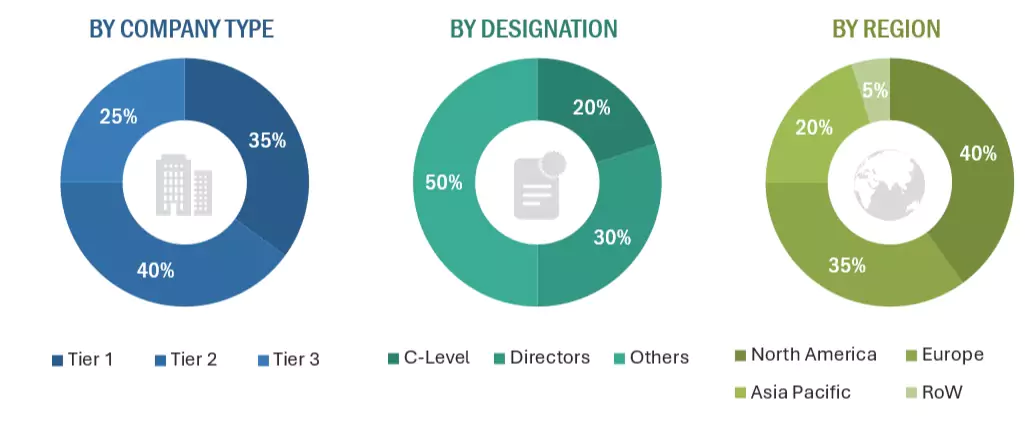
In the primary research process, various sources from the supply and demand sides were interviewed to obtain qualitative and quantitative information for the report, such as Chief Experience Officers (CXOs), Vice Presidents (VPs), directors from business development, marketing, and product development/innovation teams, and related key executives from network slicing solutions vendors, system integrators, professional and managed service providers, industry associations, independent consultants, and key opinion leaders.

Primary interviews were conducted to gather insights, such as market statistics, data on revenue collected from platforms and services, market breakups, market size estimations, market forecasts, and data triangulation. Stakeholders from the demand side, such as Chief Information Officers (CIOs), Chief Finance Officers (CFOs), Chief Strategy Officers (CSOs), and the installation team of end users who use network slicing solutions, were interviewed to understand buyers’ perspectives on suppliers, products, service providers, and their current use of network slicing solutions which is expected to affect the overall network slicing market growth.

Network Slicing Market Size, and Share

Notes: Tier 1 companies have revenues over USD 1 billion, Tier 2 companies have revenues between USD
500 million and 1 billion, and Tier 3 companies have revenues less than USD 500 million.
Other designations include sales managers, marketing managers, and product managers.
Source: Industry Experts

To know about the assumptions considered for the study, download the pdf brochure

Market Size Estimation

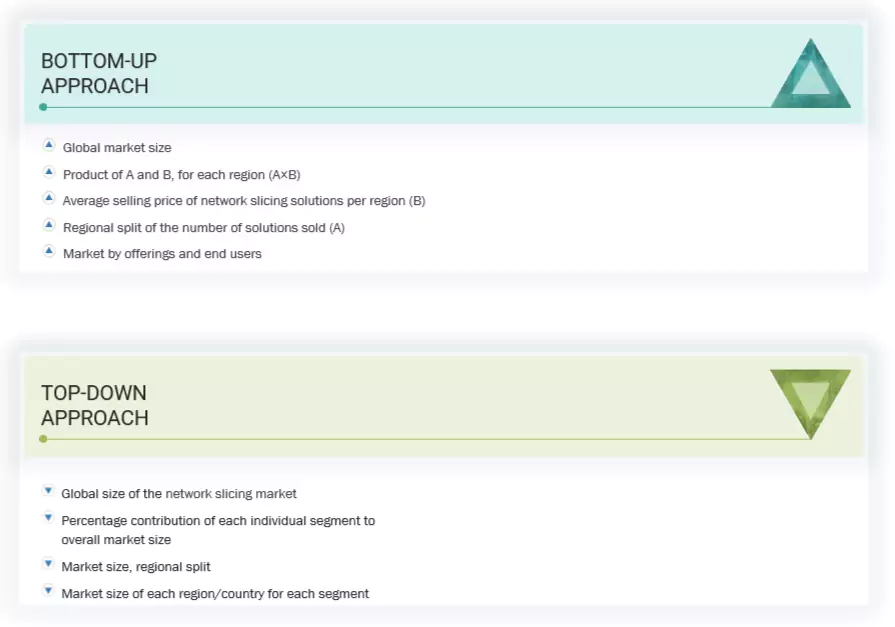
Both top-down and bottom-up approaches were used to estimate and validate the total size of the Network slicing market. These methods were also used extensively to estimate the size of various subsegments in the market. The research methodology used to estimate the market size includes the following:

Network Slicing Market : Top-Down and Bottom-Up Approach

Network Slicing Market Top Down and Bottom Up Approach

Data Triangulation

After arriving at the overall market size from the above estimation process, the network slicing market has been split into several segments and sub-segments. To complete the overall market engineering process and arrive at the exact statistics for all segments and sub-segments, data triangulation and market breakdown procedures have been used, wherever applicable. The data has been triangulated by studying various factors and trends from both the demand and supply sides. The network slicing market size has been validated using top-down and bottom-up approaches.

Market Definition

According to Ericsson, network slicing enables multiple logical networks to operate on a shared physical network infrastructure by creating “slices” that are logically separated, self-contained, independent, and secured. These sliced networks can be independently configured to target specific services or users with distinct speed, latency, and reliability needs. It provides an opportunity to monetize 5G network investments and unleash the power of differentiated connectivity.

As per Celona, network slicing is a type of functionality that enables multiple independent networks to exist on the same physical network, using different “slices” of the same spectrum band. This allows organizations to accommodate different application requirements for security, reliability, and performance on the same network. It leverages Software-defined Networking (SDN), Network Function Virtualization (NFV), and automation to quickly segment the network and its resources to support specific applications, devices, domains, and groups.

Stakeholders

  • System Integrators
  • Network Infrastructure Enablers
  • Technology Vendors
  • Resellers
  • Value-added Resellers (VARs)
  • Independent Software Vendors (ISVs)
  • Managed Service Providers (MSPs)
  • Compliance Regulatory Authorities
  • Government Authorities
  • Investment Firms
  • Network Slicing Alliances/Groups
  • Enterprises/Businesses

Report Objectives

  • To determine, segment, and forecast the network slicing market based on offering, end user, and region in terms of value
  • To forecast the size of the market segments with respect to five main regions: North America, Europe, Asia Pacific, Middle East & Africa, and Latin America
  • To provide detailed information about the major factors (drivers, restraints, opportunities, and challenges) influencing the growth of the market
  • To study the complete value chain and related industry segments, and perform a value chain analysis of the market landscape
  • To strategically analyze the macro and micromarkets with respect to individual growth trends, prospects, and contributions to the total market
  • To analyze the industry trends, pricing data, patents, and innovations related to the market
  • To analyze the opportunities for stakeholders by identifying the high-growth segments of the market
  • To profile the key players in the market and comprehensively analyze their market share/ranking and core competencies
  • To track and analyze competitive developments, such as mergers & acquisitions, product launches & developments, partnerships, agreements, collaborations, business expansions, and research & development (R&D) activities

Available Customizations

With the given market data, MarketsandMarkets offers customizations per the company’s specific needs. The following customization options are available for the report:

Geographic Analysis as per Feasibility

  • Further break-up of the Asia Pacific market into countries contributing 75% to the regional market size
  • Further break-up of the North American market into countries contributing 75% to the regional market size
  • Further break-up of the Latin American market into countries contributing 75% to the regional market size
  • Further break-up of the Middle East & African market into countries contributing 75% to the regional market size
  • Further break-up of the European market into countries contributing 75% to the regional market size

Company Information

  • Detailed analysis and profiling of additional market players (up to five)


Key Questions Addressed by the Report

What is the definition of network slicing?

According to Ericsson, network slicing enables multiple logical networks to operate on a shared physical network infrastructure by creating “slices” that are logically separated, self-contained, independent, and secured. These sliced networks can be independently configured to target specific services or users with distinct speed, latency, and reliability needs. It provides an opportunity to monetize 5G network investments and unleash the power of differentiated connectivity.

What is the size of the network slicing market?

The network slicing market is projected to grow from USD 1.30  billion in 2025 to USD 2.81  billion by 2030, at a CAGR of 16.6% during the forecast period.

What are the major drivers of the network slicing market?

Major drivers of the network slicing market include the ultra-low latency slicing for real-time use cases, rising enterprise demand for network customization, and private 5G adoption fueling slicing deployment.

Who are the key players operating in the network slicing market?

The major players in the network slicing market include Ericsson (Sweden), Huawei (China), Nokia (Finland), Cisco (US), ZTE (China), Ciena Corporation (US), Amdocs (US), Turk Telekom (Turkey), Samsung (South Korea), HPE (US), NTT (Japan), BT Group (UK), and Broadcom (US), Juniper Networks (US), T-Mobile (US), Mavenir (US), Parallel Wireless (US), Affirmed Networks (US), Celona (US), Argela Technologies (Turkey), Tambora Systems (Singapore), Firecell (France), Druid Software (Ireland), Niral Networks (New York), and SLICEFINITY (UK). These players have adopted various growth strategies, such as partnerships, agreements and collaborations, product launches/enhancements, and acquisitions to expand their footprint in the network slicing market.

What are the opportunities for new entrants in the network slicing market?

New organizations entering the network slicing space can find success by supplying cloud-native, AI-powered orchestration tools that help operators deploy slices more easily. Companies can help underserved sectors like healthcare or utilities by providing specialized slicing services. Making managed slice lifecycle services accessible to companies who do not have 5G expertise can help telecoms quickly build a business in this outsourced area.

Personalize This Research

  • Triangulate with your Own Data
  • Get Data as per your Format and Definition
  • Gain a Deeper Dive on a Specific Application, Geography, Customer or Competitor
  • Any level of Personalization
Request A Free Customisation

Let Us Help You

  • What are the Known and Unknown Adjacencies Impacting the Network Slicing Market

  • What will your New Revenue Sources be?
  • Who will be your Top Customer; what will make them switch?
  • Defend your Market Share or Win Competitors
  • Get a Scorecard for Target Partners
Customized Workshop Request

Custom Market Research Services

We Will Customise The Research For You, In Case The Report Listed Above Does Not Meet With Your Requirements

Get 10% Free Customisation

Growth opportunities and latent adjacency in Network Slicing Market

DMCA.com Protection Status