
Satellite Communication (SATCOM) Equipment Market Size & Growth

Satellite Communication (SATCOM) Equipment Market by Solution (Antennas, Transceivers, Power Amplifiers, Converters, Modem), Terminal (LTE, Non-LTE based), Platform, Type, Vrtical, Frequency, Connectivity, Technology, and Region - Global Forecast to 2032




SATELLITE COMMUNICATION (SATCOM) EQUIPMENT MARKET OVERVIEW
Source: Secondary Research, Interviews with Experts, MarketsandMarkets Analysis
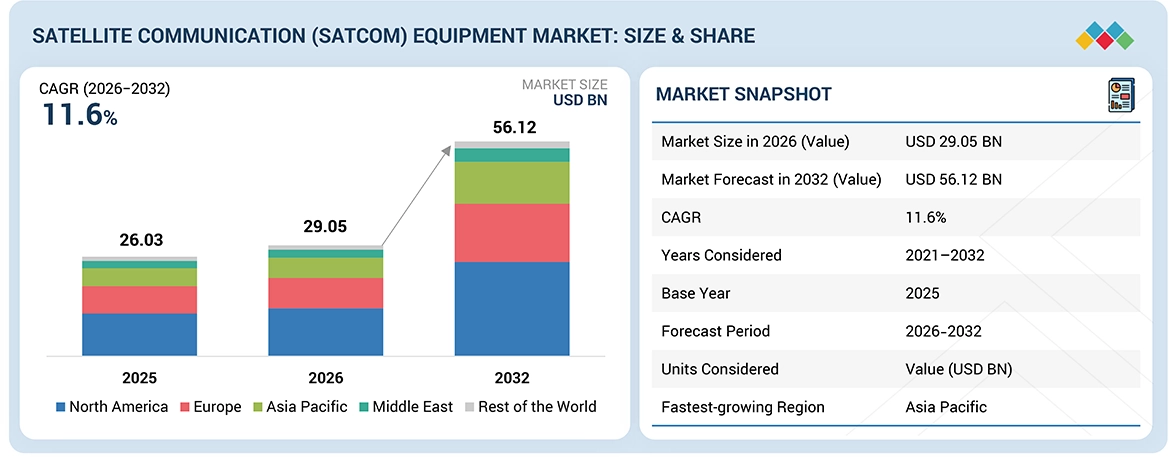
The Satellite Communication (SATCOM) Equipment Market is projected to grow from USD 29.05 billion in 2026 to USD 56.12 billion by 2032, at a CAGR of 11.6% during the forecast period. The market is growing because users need reliable connectivity across aircraft, ships, vehicles, remote sites, and critical operations centers. Terrestrial networks are not always available in these locations, so SATCOM equipment such as terminals, antennas, modems, routers, and radios is becoming more important. Rising demand from defense, aviation, maritime, telecom backhaul, and enterprise users is creating a strong need for secure voice, data, and broadband communication across fixed and mobile platforms.
SATELLITE COMMUNICATION (SATCOM) EQUIPMENT MARKET KEY TAKEAWAYS
-
By RegionNorth American is expected to account for a market share of 43.1% in 2026.
-
By PlatformThe airborne segment is expected to register the highest CAGR of 13.9% between 2026 and 2032.
-
By VerticalThe commercial segment is expected to dominate the market during the forecast period.
-
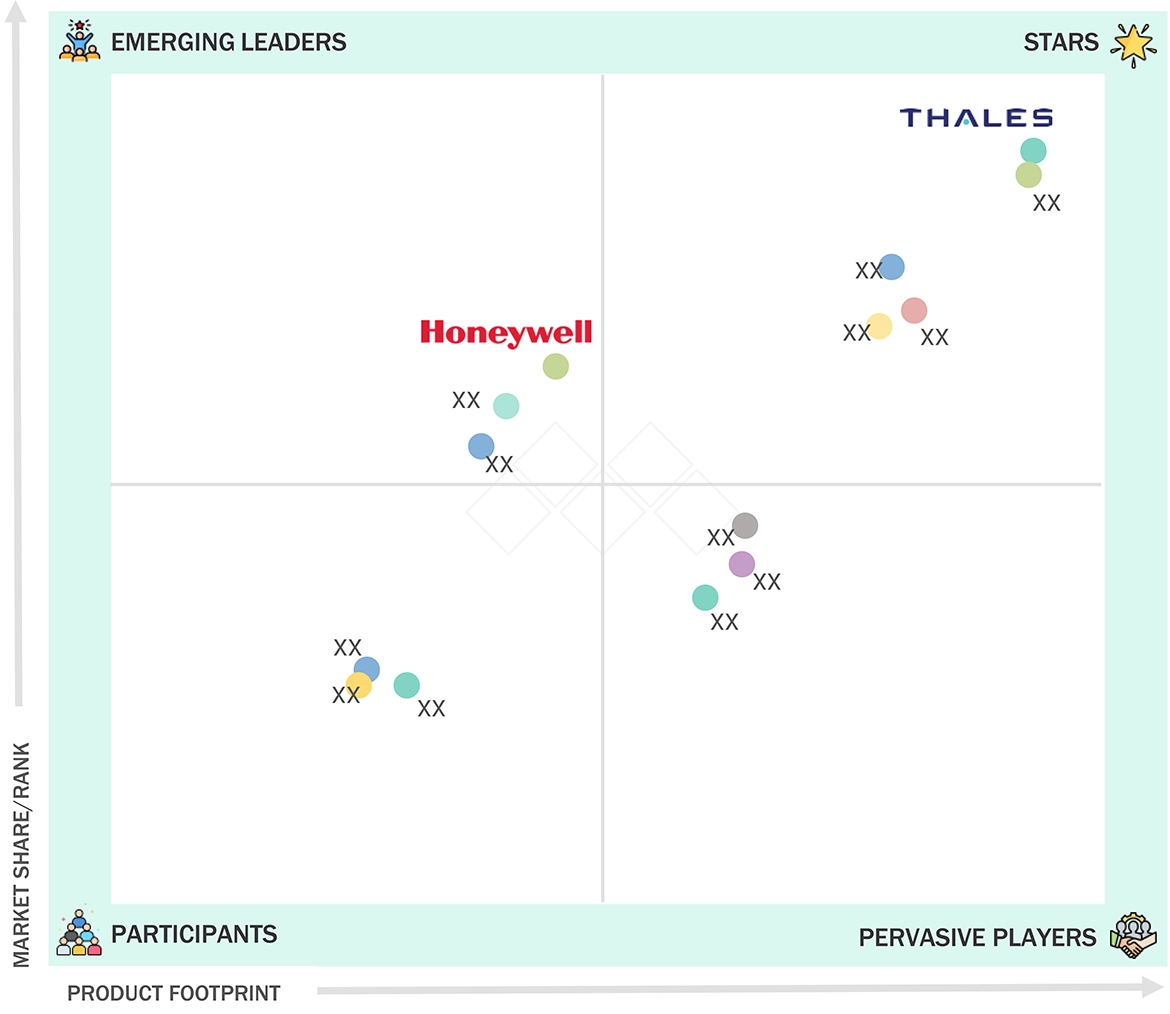
Competitive LandscapeThales, Viasat, and L3Harris Technologies, Inc. were identified as some of the star players in the global SATCOM equipment market, given their strong market share and product footprint.
The SATCOM Equipment Industry is growing as satellites are increasingly used for more complex, longer-duration missions across communications, Earth observation, navigation, and defense. As operators expand their constellations and launch higher-value satellites, propulsion systems are becoming increasingly important for controlling orbit, managing missions and ensuring safe end-of-life disposal. This is pushing satellite manufacturers and propulsion suppliers to develop lighter, more efficient, and reliable systems. The focus is on helping satellites operate smoothly, reduce launch weight, and improve overall mission cost over time.
TRENDS & DISRUPTIONS IMPACTING CUSTOMERS' CUSTOMERS
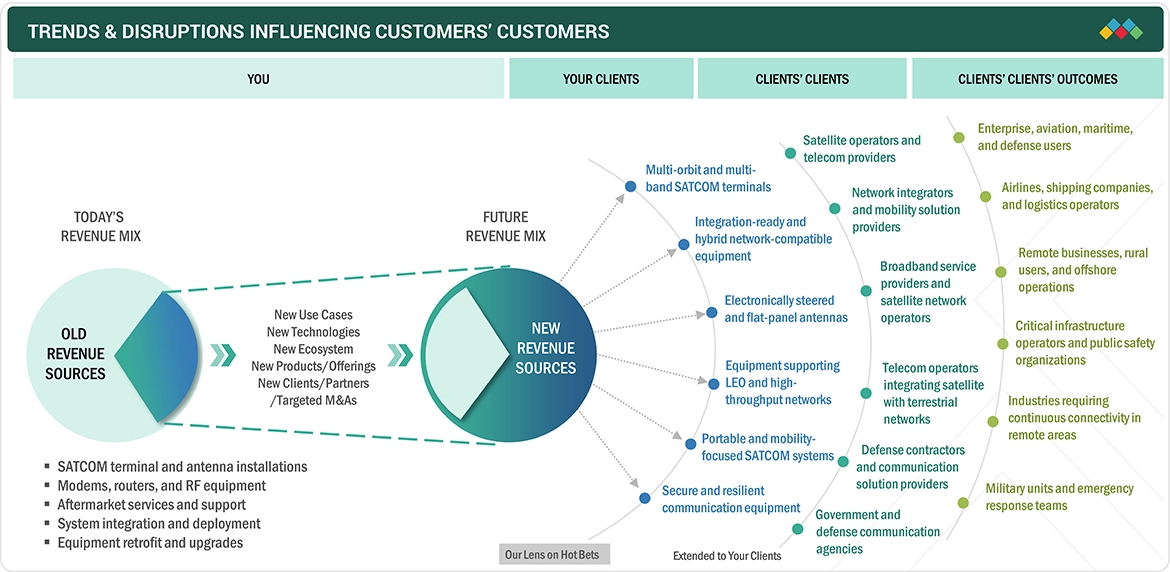
The impact on customers’ customers in the SATCOM equipment market primarily stems from the growing need for reliable connectivity across aircraft, ships, vehicles, remote sites, and critical operations centers. As users increasingly depend on voice, data and broadband communication, equipment buyers such as telecom operators, defense agencies, airlines, maritime companies, and enterprise network providers are looking for better SATCOM systems. At the same time, new developments such as compact antennas, electronically steered terminals, multi-orbit connectivity, advanced modems, and hybrid satellite-terrestrial networks are changing how SATCOM equipment is designed and used. As a result, there is greater demand for scalable, secure, and efficient SATCOM solutions. End users are also looking for systems that support mobility, remote communication, network redundancy, emergency response, and continuous connectivity in areas where terrestrial networks are weak or not available.
Source: Secondary Research, Interviews with Experts, MarketsandMarkets Analysis
SATELLITE COMMUNICATION (SATCOM) EQUIPMENT MARKET DYNAMICS

Level
-
Surge in demand for connectivity in remote and mobility-based environments

-
Extensive use of SATCOM in defense and emergency operations


Level
-
High capital requirement

-
Substantial development and maintenance costs of SATCOM infrastructure


Level
-
Shift toward multi-orbit and hybrid networks

-
Improvements in hardware efficiency and form factor


Level
-
Cybersecurity and signal protection risks

-
Regulatory and spectrum management issues

Source: Secondary Research, Interviews with Experts, MarketsandMarkets Analysis
Driver: Surge in demand for connectivity in remote and mobility-based environments
The main driver of the SATCOM equipment market is the growing need for reliable communication across aircraft, ships, vehicles, remote sites, and critical operations centers. Many of these platforms operate in areas where terrestrial networks are weak or unavailable. This is increasing the use of SATCOM terminals, antennas, modems, routers, and radios for secure voice, data, and broadband connectivity across both commercial and government use.
Restraint: High capital requirement
The main restraint is the high cost of SATCOM equipment and its related infrastructure. Advanced antennas, terminals, modems, radomes, integration work, and network setup need heavy investment. For smaller enterprises, regional operators, and price-sensitive users, this upfront cost can slow down adoption. Maintenance, certification, and installation costs also increase the total cost, particularly for aviation, maritime, and defense platforms.
Opportunity: Shift toward multi-orbit and hybrid networks
A major opportunity is the shift toward multi-orbit and hybrid satellite-terrestrial networks. Users are no longer dependent on only one satellite network or orbit type. They need systems that can switch between GEO, MEO, LEO, and terrestrial networks to improve coverage, speed, and reliability. This is creating strong demand for advanced terminals, electronically steered antennas, multi-band equipment, and smarter network management solutions.
Challenge: Cybersecurity and signal protection risks
The main challenge is protecting SATCOM networks from cybersecurity threats, jamming, interference, and signal disruption. As SATCOM becomes more important for defense, aviation, maritime, emergency response, and enterprise communication, the risk of network attacks and signal interference also increases. Equipment providers need to offer secure, encrypted, and interference-resistant systems, which adds more technical complexity and cost to product development.
SATELLITE COMMUNICATION (SATCOM) EQUIPMENT MARKET SIZE & GROWTH: COMMERCIAL USE CASES ACROSS INDUSTRIES
| COMPANY | USE CASE DESCRIPTION | BENEFITS |
|---|---|---|
 |
Hughes Network’s JUPITER system is used to support high-throughput broadband delivery in remote and underserved regions where traditional terrestrial networks have limited reach. It uses advanced satellite modems, gateway infrastructure, optimized modulation, and bandwidth management to improve broadband performance across large coverage areas. | Supports efficient use of satellite bandwidth, improves network scalability, increases data throughput, and enables reliable broadband connectivity in areas with limited ground infrastructure. |
 |
Iridium Certus terminals are used for global mobility connectivity across maritime, aviation, and land transport applications. These platforms often operate outside terrestrial network coverage and need continuous communication for safety, operational coordination and data exchange. | Provides global L-band connectivity, supports voice and data communication, offers low-latency service compared with traditional GEO systems, and enables stable communication in remote and polar regions. |
 |
L3Harris maritime SATCOM terminals are used for naval and commercial vessel communication at sea. These terminals support vessels that operate under constant movement, harsh weather conditions, and limited terrestrial network availability. | Enables stable satellite links under dynamic sea conditions, supports multiple frequency bands, including X, Ka, Ku and C-band, improves compatibility with military and commercial satellite networks, and supports continuous naval and maritime operations. |
Logos and trademarks shown above are the property of their respective owners. Their use here is for informational and illustrative purposes only.
SATELLITE COMMUNICATION (SATCOM) EQUIPMENT MARKET ECOSYSTEM
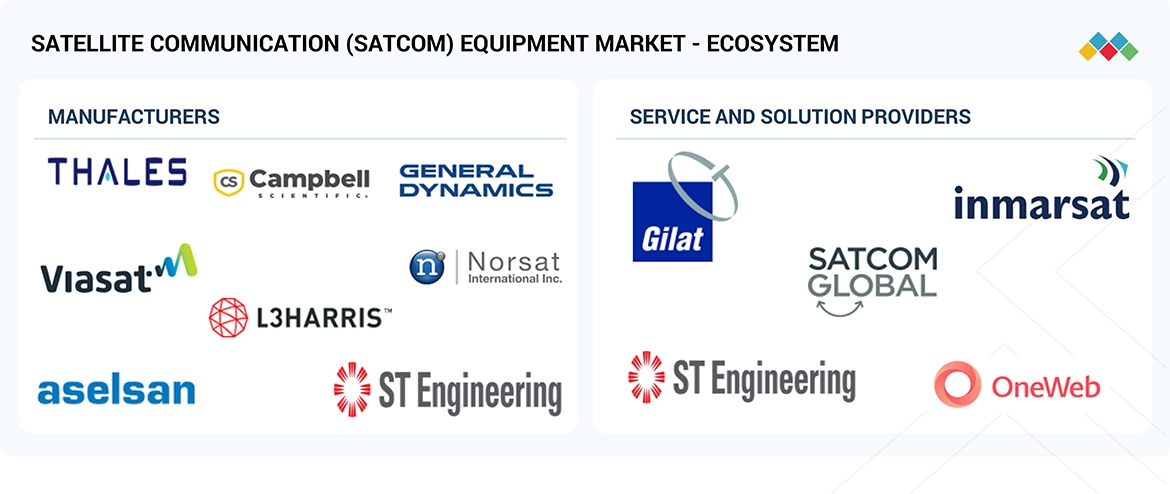
The SATCOM equipment market includes a mix of OEM manufacturers, service providers, and solution providers. OEM manufacturers such as Viasat, General Dynamics, Thales, L3Harris, Campbell, Norsat International, Aselsan, ST Engineering, RTX, Ball, EchoStar, ThinKom, Honeywell, SWE-DISH, and Holkirk support the market through terminals, antennas, modems, routers, radios, radomes, and other SATCOM hardware. These companies serve aviation, maritime, land mobile, land fixed, and portable communication needs across commercial and government users. Service and solution providers such as ST Engineering, Gilat, SATCOM Global, Inmarsat, and OneWeb support the market through connectivity services, system integration, installation, network management, and maintenance. This ecosystem helps improve SATCOM adoption, service availability, and reliable communication across remote and mobility-based environments.
Logos and trademarks shown above are the property of their respective owners. Their use here is for informational and illustrative purposes only.
SATELLITE COMMUNICATION (SATCOM) EQUIPMENT MARKET SEGMENTS
Source: Secondary Research, Interviews with Experts, MarketsandMarkets Analysis
SATCOM Equipment Market, by Platform
The airborne segment is the largest platform segment because aircraft use high-value SATCOM systems for passenger connectivity, cockpit communication, aircraft operations, mission data, and secure command-and-control. Commercial aircraft, military aircraft, business jets, and UAVs require certified antennas, terminals, modems, routers, radomes, and integration support, thereby increasing overall equipment value. Strong retrofit work across existing fleets also supports its leading position.
SATCOM Equipment Market, by Vertical
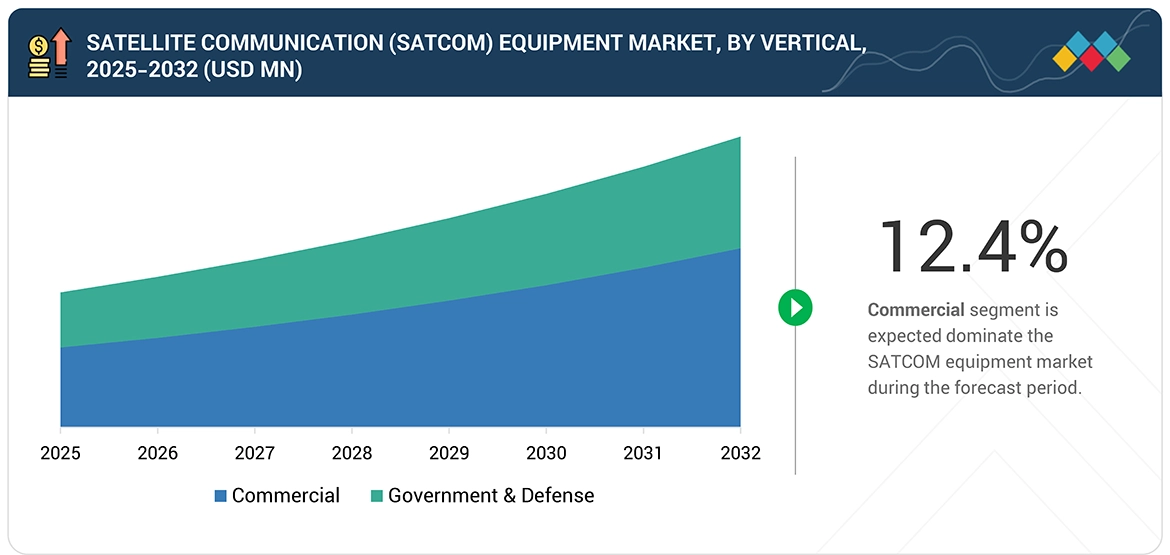
The commercial vertical dominates the SATCOM equipment market because demand is spread across aviation, maritime, telecom backhaul, enterprise connectivity, media, energy, and remote industrial operations. Commercial users need reliable broadband, operational communication and backup connectivity in areas where terrestrial networks are weak or not available. This segment also has a broader user base and more frequent deployments than government and defense programs.
SATCOM Equipment Market, by Type
The SATCOM-on-the-Move segment is the largest segment because many high-value platforms require continuous connectivity while operating in motion. Aircraft, ships, military vehicles, emergency vehicles, trains, and mobile command units depend on SATCOM equipment for secure voice, data, tracking, and broadband communication. These systems require stabilized antennas, rugged terminals, and reliable network switching, thereby increasing the overall equipment value.
SATCOM Equipment Market, by Frequency
The Ku Band is the largest frequency segment because it is widely used across commercial aviation, maritime connectivity, VSAT networks, DTH services, enterprise communication, and mobile SATCOM platforms. It gives a good balance of bandwidth, coverage, antenna size, and equipment cost, making it suitable for both fixed and mobile applications. Its large installed base and strong equipment ecosystem continue to support its dominance.
SATCOM Equipment Market, by Terminal
The non-LTE-based terminal segment is the largest because most SATCOM equipment still relies on traditional satellite communication standards, VSAT systems, proprietary waveforms, and dedicated satellite terminals rather than LTE-based systems. These terminals are used widely across aviation, maritime, defense, enterprise, DTH, and remote connectivity applications. The segment also has a large installed base of satellite modems, antennas, routers, and ground equipment, which are already built around non-LTE SATCOM networks.
SATCOM Equipment Market, by Connectivity
The MEO/GEO orbit segment dominates the SATCOM equipment market because GEO satellites have been used for many years in broadcasting, VSAT, aviation, maritime, enterprise, and defense communication. GEO systems provide wide-area coverage and already have strong ground infrastructure, terminals, and service networks. MEO also supports high-capacity connectivity for enterprise, mobility, and government users. Together, their large installed base and mature ecosystem keeps this segment ahead of newer LEO-based connectivity.
SATCOM Equipment Market, by Technology
The legacy technology segment is the largest because a significant portion of SATCOM equipment still relies on conventional terminals, mechanically steered antennas, GEO-based connectivity, standard modems, and existing ground network infrastructure. Many aviation, maritime, defense, and enterprise users continue to use these systems because they are reliable, certified, compatible, and have long service lives. Since replacement cycles are slow and installed systems remain active for many years, legacy technology still holds the dominant share.
SATCOM Equipment Market, by Solution
The products segment dominates the SATCOM equipment market because hardware is the main revenue base of the market. Antennas, terminals, modems, routers, radios, power amplifiers, converters, radomes, and related equipment are needed before any SATCOM service can be used. These products are purchased across aircraft, ships, vehicles, fixed sites, and portable platforms, often with high unit value and platform-specific integration needs. This makes product revenue larger than service-based revenue in the market.
SATELLITE COMMUNICATION (SATCOM) EQUIPMENT MARKET REGION
Asia Pacific to register fastest growth in SATCOM equipment market during forecast period
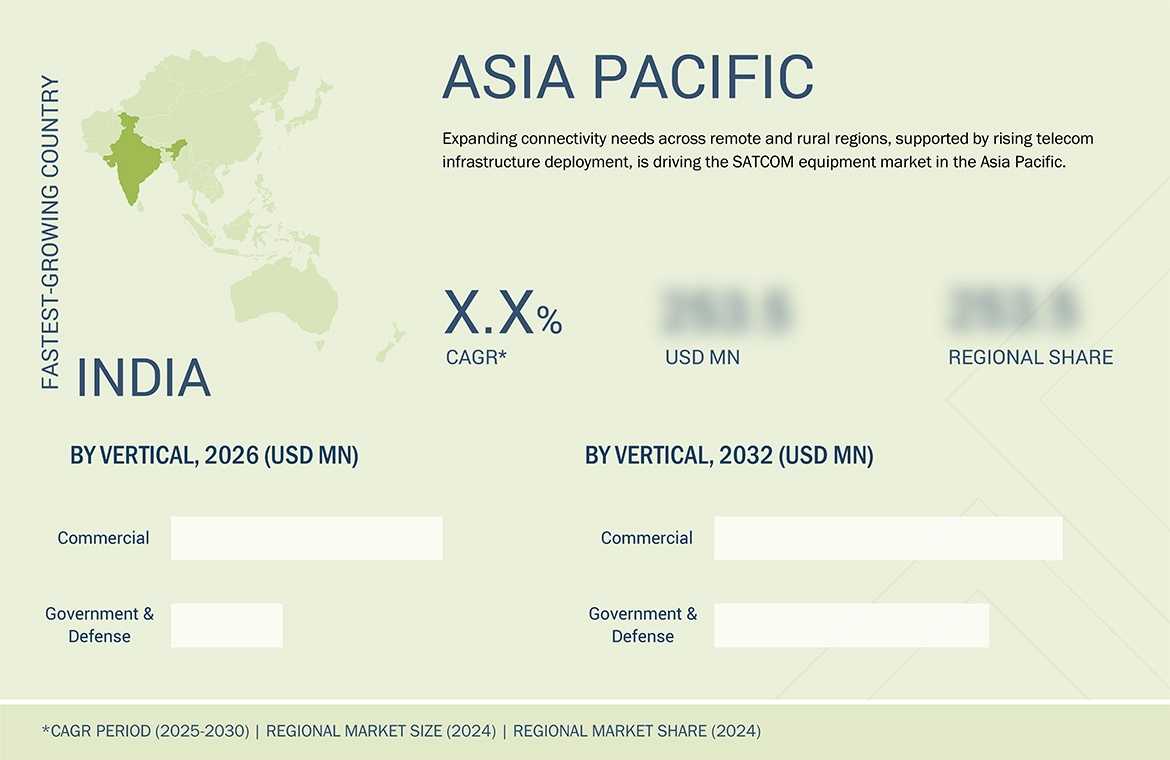
The Asia Pacific SATCOM equipment market is expected to be the fastest-growing region during the forecast period. The market is driven by the rising demand from aviation, maritime, defense, telecom backhaul, enterprise connectivity, and remote industrial users. Expanding air travel, large coastal economies, island geographies, defense modernization, and limited terrestrial network coverage in remote areas are supporting wider adoption of SATCOM terminals, antennas, modems, routers, and related systems across the region.
SATELLITE COMMUNICATION (SATCOM) EQUIPMENT MARKET SIZE & GROWTH: COMPANY EVALUATION MATRIX
In the SATCOM equipment market matrix, Thales (Star) leads with a strong market presence and broad SATCOM capabilities across defense, aerospace, secure communications, terminals, antennas, and ground connectivity systems. Its position is supported by long-standing relationships with government, defense, and commercial customers, along with strong integration capabilities across airborne, land, maritime, and fixed communication platforms. Honeywell International (Emerging Leader) is slowly building its position through aviation-focused SATCOM and connectivity solutions, mainly for aircraft communication, cockpit connectivity, and passenger broadband applications. While Thales has a wider SATCOM portfolio and a stronger defense communications presence, Honeywell shows good potential to move closer to the leaders as demand for airborne SATCOM, connected aircraft systems, and mobility-based communications continues to grow.
Source: Secondary Research, Interviews with Experts, MarketsandMarkets Analysis
SATELLITE COMMUNICATION (SATCOM) EQUIPMENT MARKET KEY PLAYERS
List of Top Satellite Communication (SATCOM) Equipment Market Companies
- Thales (France)
- General Dynamics Corporation (US)
- L3Harris Technologies, Inc. (US)
- RTX (US)
- Viasat, Inc. (US)
- Cobham Satcom (Denmark)
- Honeywell International Inc. (US)
- EchoStar Corporation (US)
- Gilat Satellite Networks (Israel)
- Iridium Communications Inc. (US)
- ASELSAN A.S. (Turkey)
- Intellian Technologies, Inc. (South Korea)
- ST Engineering (Singapore)
- SPACEX (US)
- Elbit Systems Ltd. (Israel)
SATELLITE COMMUNICATION (SATCOM) EQUIPMENT MARKET SCOPE
| REPORT METRIC | DETAILS |
|---|---|
| Market Size in 2026 (Value) | USD 29.05 Billion |
| Market Forecast in 2031 (Value) | USD 56.12 Billion |
| CAGR | 11.6% |
| Years Considered | 2021–2032 |
| Base Year | 2025 |
| Forecast Period | 2026–2032 |
| Units Considered | Value (USD Million/Billion) |
| Report Coverage | Revenue Forecast, Company Ranking, Competitive Landscape, Growth Factors, and Trends |
| Segments Covered |
|
| Regions Covered | North America, Asia Pacific, Europe, Middle East & Africa, Latin America |
WHAT IS IN IT FOR YOU: SATELLITE COMMUNICATION (SATCOM) EQUIPMENT MARKET SIZE & GROWTH REPORT CONTENT GUIDE
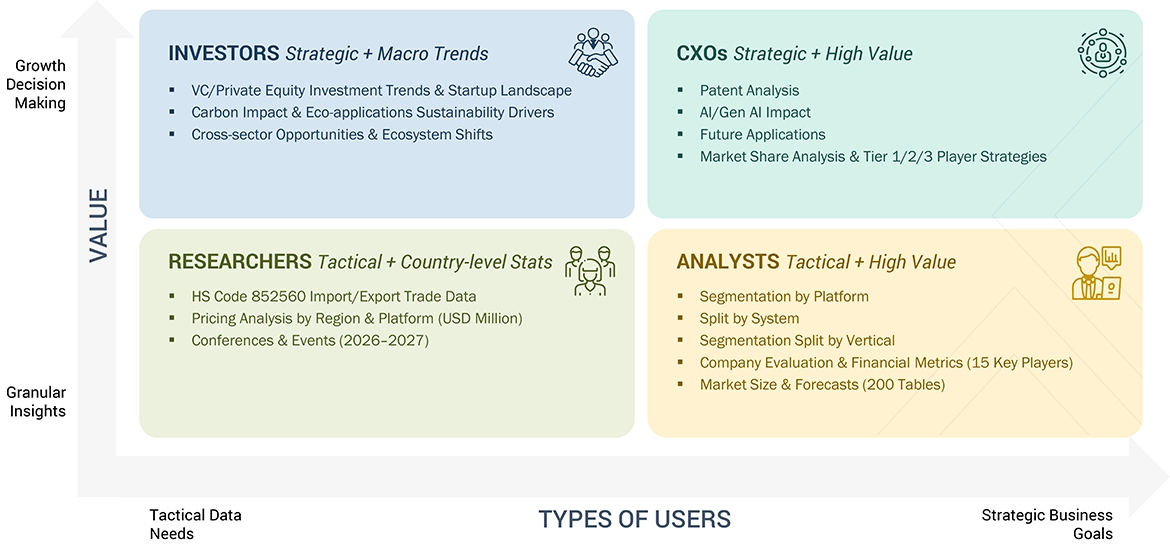
DELIVERED CUSTOMIZATIONS
We have successfully delivered the following deep-dive customizations:
| CLIENT REQUEST | CUSTOMIZATION DELIVERED | VALUE ADDS |
|---|---|---|
| SATCOM Equipment Analysis for Space Application | Deep-dive analysis for SATCOM Power Electronics Market | Detailed assessment of SATCOM power electronics used in space applications, covering key components, platform relevance, supplier landscape, demand drivers, technology trends, and market opportunity to support a better understanding of revenue potential in satellite communication payloads and spacecraft systems |
RECENT DEVELOPMENTS
- March 2026 : RTX received a contract modification for the production of Advanced Extremely High Frequency (AEHF) SATCOM terminals. These terminals provide secure communication for military operations. The contract includes continued manufacturing and delivery of SATCOM ground terminals. It focuses on high-security SATCOM equipment.
- February 2026 : Gilat Satellite Networks secured a USD 9 million contract to deliver SATCOM equipment, including advanced defense modems. The scope includes integration of SATCOM ground system components to support secure and reliable communications. These systems are designed for mission-critical defense operations in challenging environments. The deal focuses on SATCOM equipment deployment for military use.
- February 2026 : Thales, Safran, Hellas Sat, and CNES signed a framework agreement to develop an optical SATCOM system for the Hellas Sat 5 geostationary satellite. The project includes the development of an onboard optical communication payload and a prototype optical ground station for data transmission. The system is designed to enable high-speed satellite communication using optical (laser) links. The agreement covers the development and integration of next-generation optical communication infrastructure.
- January 2026 : Viasat partnered with BSNL to support the Indian Navy’s satellite communication modernization program. The agreement includes the deployment of Ka-band and L-band SATCOM systems to enhance connectivity for naval platforms. It also involves the integration of satellite infrastructure and ground systems to improve coverage and reliability.
- December 2025 : Cobham Satcom announced the merger of its Network Division with Gatehouse Satcom to form a new entity focused on 5G NTN satellite communication solutions. The combined capabilities include the development of satellite network software and integration with ground infrastructure and communication systems. The initiative supports next-generation satellite connectivity across commercial, defense, and enterprise applications. The deal focuses on expanding satellite communication technology and solutions.
Table of Contents
 Exclusive indicates content/data unique to MarketsandMarkets and not available with any competitors.
Methodology
The study involved four major activities in estimating the current size of the satellite communication (SATCOM) equipment market. Exhaustive secondary research was done to collect information on the market, its adjacent markets, and its parent market. The next step was to validate these findings, assumptions, and sizing with industry experts across the value chain through primary research. Demand-side analysis was conducted to estimate the overall market size. After that, market breakdown and data triangulation procedures were employed to estimate the sizes of various segments and subsegments within the market.
Secondary Research
During the secondary research process, various sources were consulted to identify and collect information for this study. The secondary sources included government sources, such as SIPRI; corporate filings, including annual reports, press releases, and investor presentations from companies; white papers, journals, and certified publications; and articles from recognized authors, directories, and databases.
Primary Research
Extensive primary research was conducted after acquiring information regarding the SATCOM equipment market scenario through secondary research. Several primary interviews were conducted with market experts from the demand and supply sides across major countries of North America, Europe, Asia Pacific, the Middle East & Africa, and Latin America. Primary data was collected through questionnaires, emails, and telephonic interviews.
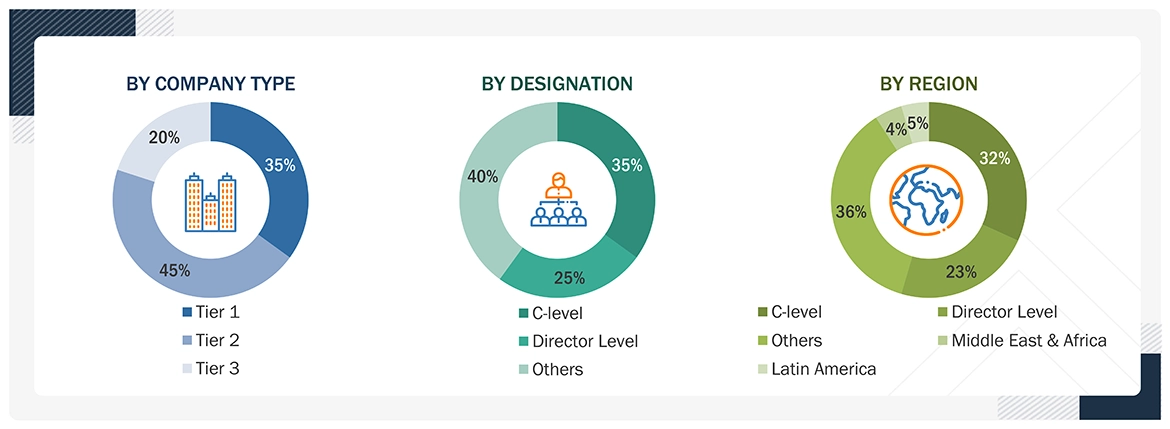
To know about the assumptions considered for the study, download the pdf brochure
Market Size Estimation
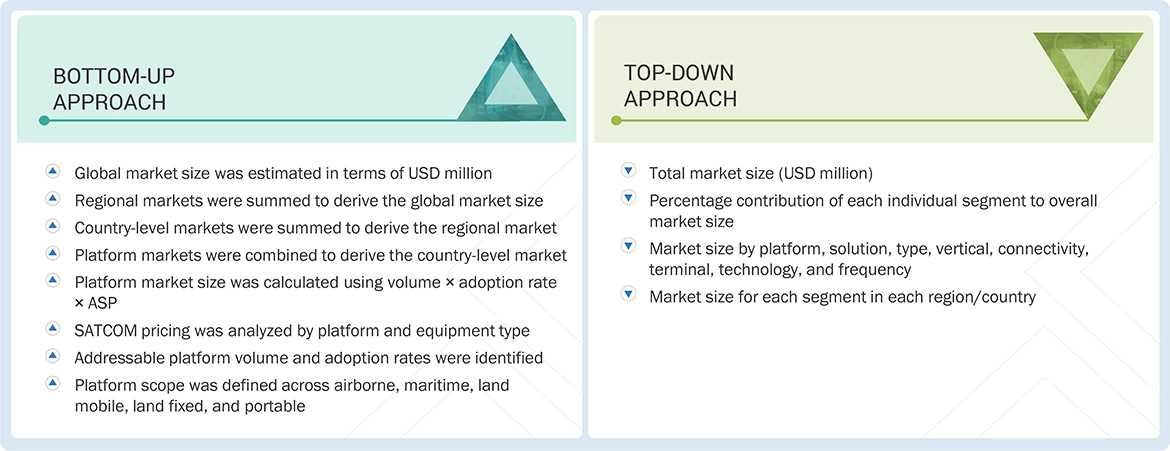
The top-down and bottom-up approaches were used to estimate and validate the size of the SATCOM equipment market. The research methodology used to estimate the size of the market included the following details:
- Key players in the SATCOM equipment market were identified through secondary research, and their market shares were determined through a combination of primary and secondary research. This included a study of the annual and financial reports of the top market players, as well as extensive interviews with leaders, including directors, engineers, marketing executives, and other key stakeholders of leading companies operating in the market.
- All percentage shares, splits, and breakdowns were determined using secondary sources and verified through primary sources.
- All possible parameters that affect the markets covered in this research study were accounted for, viewed in extensive detail, verified through primary research, and analyzed to obtain the final quantitative and qualitative data on the SATCOM equipment market. This data was consolidated, enhanced with detailed inputs, analyzed by MarketsandMarkets, and presented in this report.
Satellite Communication (SATCOM) Equipment Market : Top-Down and Bottom-Up Approach
Data Triangulation
After determining the overall market size, the total market was divided into several segments and subsegments. The data triangulation and market breakdown procedures explained below were implemented, wherever applicable, to complete the overall market engineering process and arrive at the estimated market numbers for the market segments and subsegments. The data was triangulated by studying various factors and trends from the demand and supply sides. Additionally, the market size was validated using top-down and bottom-up approaches.
Market Definition
The SATCOM equipment market comprises the design, manufacturing, integration, sale, installation, and lifecycle support of satellite communication equipment and related ground-segment solutions used to transmit, receive, process, and manage satellite-based communications. It includes antennas, terminals, modems, gateways, routers, RF equipment, network control and management systems, and associated services such as engineering & integration, installation, logistics, and maintenance across fixed, portable, mobile, maritime, airborne, enterprise, government, and defense applications.
Key Stakeholders
- Equipment Manufacturers
- Satellite Operators and Service Providers
- Network Integrators and System Integrators
- Telecom Operators and Connectivity Providers
- Government and Defense Organizations
- Aviation, Maritime, and Land Mobility Operators
- Technology and Component Suppliers (Chips, RF, Semiconductors)
- Installation, Maintenance, and Service Providers
- Distributors and Channel Partners
- Regulatory Bodies and Spectrum Authorities
- Research Institutions and Industry Associations
Report Objectives
- To define, describe, segment, and forecast the size of the SATCOM equipment market based on solution (product and service), vertical, connectivity, frequency, platform, terminal, technology, type, and region
- To forecast the size of market segments based on five regions: North America, Europe, Asia Pacific, the Middle East & Africa, and Latin America
- To identify and analyze key drivers, restraints, opportunities, and challenges influencing the growth of the market
- To identify industry trends, market trends, and technology trends prevailing in the market
- To analyze micro markets with respect to individual technological trends, prospects, and their contribution to the overall market
- To strategically profile key market players and comprehensively analyze their market ranking and core competencies
- To provide a detailed competitive landscape of the market and analyze competitive growth strategies, such as product developments, contracts, partnerships, agreements, and collaborations adopted by key players in the market
- To identify the detailed financial position of key players, as well as their key products, unique selling points, and key developments
Customization Options
MarketsandMarkets offers the following customizations for this market report:
- Additional country-level analysis of the SATCOM equipment market
- Profiling of other market players (up to 5)
Product Analysis
- Product matrix, which provides a detailed comparison of the product portfolio of each company in the SATCOM equipment market
Key Questions Addressed by the Report
1. What is the current size of the Satellite Communication (SATCOM) Equipment Market?
The Satellite Communication (SATCOM) Equipment Market is projected to grow from USD 24.27 billion in 2024 to USD 41.51 billion by 2029 at a CAGR of 11.3% during the forecast period. The growth is driven by increasing demand for high-speed connectivity, satellite broadband services, and advanced communication infrastructure.
2. What factors are driving the growth of the SATCOM Equipment Market?
The Satellite Communication (SATCOM) Equipment Market Growth is primarily driven by rising satellite launches, increasing demand for broadband connectivity in remote areas, and expanding applications in defense, aviation, and maritime sectors. Technological advancements in antennas, transceivers, and communication electronics are also supporting market expansion.
3. What is SATCOM equipment and how does it work?
SATCOM equipment refers to devices and systems used to transmit and receive signals via communication satellites. These systems typically include antennas, transceivers, converters, and power amplifiers that enable communication between ground stations, satellites, and end-user devices, ensuring reliable data transmission over long distances.
4. Which industries use SATCOM equipment the most?
The SATCOM Equipment Market Industry serves several sectors including telecommunications, defense and military, aviation, maritime, broadcasting, and emergency services. These industries rely on satellite communication for secure connectivity, remote operations, and real-time data transmission.
5. What are the major components of SATCOM equipment?
Major components in the Satellite Communication Equipment Market include antennas, transceivers, converters, modems, and power amplifiers. These components work together to establish satellite links and maintain reliable communication networks between space and ground infrastructure.
6. Which region leads the SATCOM Equipment Market?
North America holds a dominant share in the SATCOM Equipment Market, largely due to strong investments in satellite technology, increasing defense spending, and the presence of leading satellite communication companies and space organizations.
7. What are the key technologies shaping the SATCOM Equipment Market?
Key technologies influencing Satellite Communication (SATCOM) Equipment Market Trends include low Earth orbit (LEO) satellite constellations, phased-array antennas, AI-driven network optimization, and cloud-based satellite systems, which enhance connectivity, bandwidth, and latency performance.
8. What are the different types of SATCOM equipment systems?
SATCOM equipment systems are generally categorized into SATCOM-on-the-move (SOTM) and SATCOM-on-the-pause (SOTP) systems. SOTM systems allow continuous communication while vehicles or aircraft are in motion, making them particularly valuable for military and mobile operations.
9. Who are the major companies in the SATCOM Equipment Market?
Some of the key companies operating in the Satellite Communication (SATCOM) Equipment Market Industry include General Dynamics, Gilat Satellite Networks, Viasat, Raytheon Technologies, and L3Harris Technologies, which provide advanced satellite communication solutions for commercial and defense applications.
10. What are the key trends shaping the future of the SATCOM Equipment Market?
Major Satellite Communication (SATCOM) Equipment Market Trends include the rapid deployment of LEO satellite constellations, increasing demand for satellite broadband, integration with 5G networks, and growing use of SATCOM for autonomous systems and remote connectivity applications. These trends are expected to significantly expand the market over the coming years.
Need a Tailored Report?
Customize this report to your needs
Get 10% FREE Customization
Customize This ReportPersonalize This Research
- Triangulate with your Own Data
- Get Data as per your Format and Definition
- Gain a Deeper Dive on a Specific Application, Geography, Customer or Competitor
- Any level of Personalization
Let Us Help You
- What are the Known and Unknown Adjacencies Impacting the Satellite Communication (SATCOM) Equipment Market
- What will your New Revenue Sources be?
- Who will be your Top Customer; what will make them switch?
- Defend your Market Share or Win Competitors
- Get a Scorecard for Target Partners

Custom Market Research Services
We Will Customise The Research For You, In Case The Report Listed Above Does Not Meet With Your Requirements
Get 10% Free CustomisationTESTIMONIALS
Growth opportunities and latent adjacency in Satellite Communication (SATCOM) Equipment Market






Finn
Apr, 2026
Do you cover frequency segmentation (C, Ku, Ka, X, multi band, etc.) with use case mapping across defense, aviation, and telecom sectors?.
Ethan
Apr, 2026
Does the study evaluate the growing role of SATCOM in IoT ecosystems, especially for remote connectivity and satellite based IoT networks?.