
US Anatomic Pathology Market (2026-2031)

The US Anatomic Pathology Market was valued at $1508.4 Million in 2026 and projected to reach to $2453.4 Million by 2031, representing a compound annual growth rate of 10.2%. The US anatomic pathology market is positioned for robust growth through 2031, driven by technological innovation, increasing cancer prevalence, and the healthcare system's shift toward precision medicine.


| Market Size in | USD 26.32 MN |
| Market Forecast in | |
| CAGR | |
| Forecast Period | |
| Units Considered | Value (USD MN) |
US Anatomic Pathology Market Trends and Insights
- This robust expansion reflects the US healthcare system's increasing demand for advanced diagnostic services, digital pathology adoption, and automation in laboratory workflows.
- The US market benefits from high healthcare spending, sophisticated laboratory infrastructure, and strong regulatory frameworks that support innovation in pathology services. Key drivers of growth in the US anatomic pathology market include rising cancer incidence, aging demographics, and the shift toward personalized medicine.
- The US is experiencing accelerated adoption of whole slide imaging and artificial intelligence-powered diagnostic tools, which enhance accuracy and operational efficiency.
- Between 2026 and 2031, the US market will be shaped by consolidation among pathology service providers, increased outsourcing of anatomic pathology services, and growing investment in laboratory information systems that integrate with electronic health records..
Key Market Statistics
- CAGR (2026-2031) 10.2% CAGR
- Market Size, 2026 ~USD 1508.4 Million
- Forecast, 2031 ~USD 2453.4 Million
- Country US
US Anatomic Pathology Market Overview
Market Valuation Growth :
The US anatomic pathology market is valued at $1,508.4 million in 2026 and is projected to reach $2,453.4 million by 2031, demonstrating strong market expansion driven by healthcare modernization and diagnostic advancement.
Digital Pathology Adoption :
US healthcare institutions are increasingly adopting digital pathology solutions, enabling remote consultations, improved workflow efficiency, and enhanced diagnostic accuracy across major hospital networks and independent laboratories.
Laboratory Automation Trends :
Automation in US pathology laboratories is accelerating to address workforce shortages, reduce turnaround times, and improve operational efficiency, with significant investments from major diagnostic service providers.
Regulatory and Reimbursement Environment :
The US market benefits from favorable reimbursement policies, FDA support for innovative diagnostic technologies, and increasing insurance coverage for advanced pathology services, supporting sustained market growth.
US Anatomic Pathology Market Dynamics
- Digital transformation initiatives and laboratory automation are reshaping service delivery models, enabling pathologists to handle higher case volumes while improving diagnostic accuracy.
- Healthcare consolidation and the expansion of reference laboratory networks further support market expansion.
- Continued investment in AI-powered diagnostic tools and telepathology platforms will enhance accessibility across rural and urban healthcare settings, reinforcing the market's upward trajectory..
Market Ecosystem
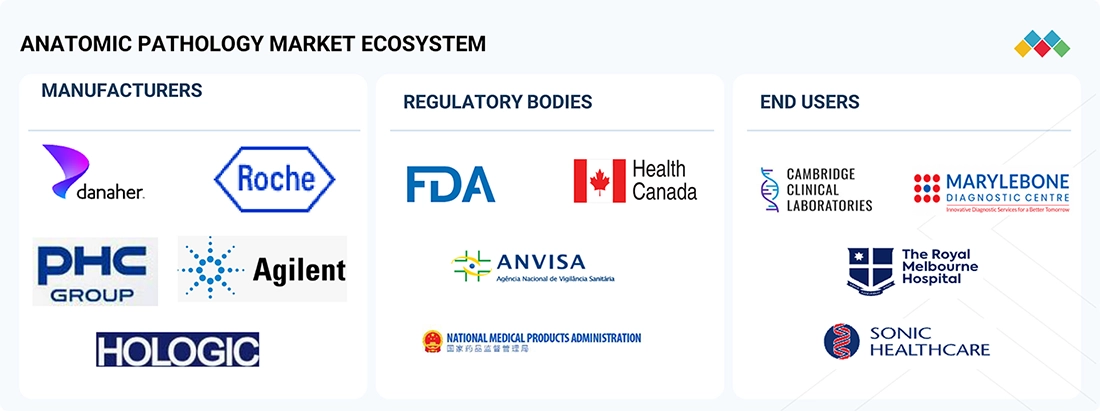
ANATOMIC PATHOLOGY MARKET: COMMERCIAL USE CASES ACROSS INDUSTRIES
| COMPANY | USE CASE DESCRIPTION | BENEFITS |
|---|---|---|
 |
Offers comprehensive anatomic pathology solutions through tissue processors, microtomes, staining systems, digital pathology scanners, and workflow automation platforms used for histopathology, immunohistochemistry (IHC), and cancer diagnostics. | Improves laboratory efficiency, enhances diagnostic accuracy, supports workflow standardization, and enables high-throughput pathology operations. |
 |
Provides tissue diagnostics solutions through its portfolio, including automated IHC and ISH staining systems, digital pathology platforms, image analysis software, and biomarker testing solutions for cancer diagnosis and tissue characterization. | Enables precise tissue analysis, supports personalized treatment decisions, improves pathology workflow productivity, and enhances diagnostic confidence. |
 |
Offers a broad portfolio of histology and cytology products, including tissue processors, microtomes, cryostats, slide printers, staining systems, and pathology workflow solutions for specimen preparation and analysis. | Enhances specimen traceability, improves laboratory productivity, streamlines tissue preparation workflows, and supports consistent diagnostic outcomes. |
 |
Provides anatomic pathology consumables and instruments, including antibodies, reagents, automated staining platforms, IHC and ISH solutions, and biomarker testing products used in cancer diagnostics and pathology laboratories. | Delivers high-quality staining performance, supports biomarker analysis, improves laboratory efficiency, and enables accurate tissue-based diagnosis. |
 |
Offers cytopathology and digital diagnostics solutions, including ThinPrep sample preparation systems and Genius Digital Diagnostics platforms for cervical cancer screening and cytology testing workflows. | Improves screening efficiency, enhances diagnostic accuracy, supports automated review processes, and increases laboratory throughput. |
Logos and trademarks shown above are the property of their respective owners. Their use here is for informational and illustrative purposes only.
Related Ecosystem
In Vitro Diagnostics
- Polymerase Chain Reaction (PCR)
- Enzyme-Linked Immunosorbent Assay (ELISA)
- Dna Microarrays
- Assay Kits
- Microarrays
- ROCHE HOLDINGS AG
- Thermo Fisher Scientific Inc.
- Danaher Corporation
- Abbott Laboratories
- Biomerieux s.a.
Key Takeaways
- The US anatomic pathology market will grow from $1,508.4M in 2026 to $2,453.4M in 2031 at a 10.2% CAGR.
- Digital pathology and AI-driven diagnostic tools are accelerating adoption across US laboratories and healthcare systems.
- Rising cancer prevalence and an aging US population are primary drivers of increased demand for anatomic pathology services.
- Consolidation and outsourcing trends in the US are reshaping the competitive landscape and service delivery models.
Anatomic Pathology Market Report Scope
| Report Metric | Details |
|---|---|
| Base Year | 2026 |
| Fastest Growing Segment | DIGITAL PATHOLOGY (Process) |
| Forecast Period | 2026-2031 |
| Growth Rate | CAGR of 10.2% from 2026 to 2031 |
| Largest Segment | IN-HOUSE (Model) |
| Market Size Base Year (Billions) | ~USD 8.92 (2026) |
| Revenue Forecast (Billions) | ~USD 14.5 (2031) |
| Segments Covered | Type, Process, Disease, End User, Model |
US Anatomic Pathology Market Report Segmentation
5 segment dimensions are covered across the global market.
By Type
- AI-Integrated Software
- Cell Processors
- Consumables
- Coverslippers
- Cytopathology Antibodies
- Cytopathology Consumables
- Cytopathology Fixatives
- Cytopathology Kits & Reagents
- Cytopathology Probes
- Cytopathology Services
- Cytopathology Stains & Solvents
- Digital Pathology Scanner
- Digital Pathology Scanners
- Embedding Systems
- Histopathology Antibodies
- Histopathology Consumables
- Histopathology Fixatives
- Histopathology Kits & Reagents
- Histopathology Probes
- Histopathology Services
- Histopathology Stains & Solvents
- Instruments
- Microtomes
- Non-AI-Integrated Software
- Other Cytopathology Consumables
- Other Cytopathology Kits & Reagents
- Other Histopathology Consumables
- Other Histopathology Kits & Reagents
- Other Instruments
- Primary Cytopathology Antibodies
- Primary Histopathology Antibodies
- Secondary Cytopathology Antibodies
- Secondary Histopathology Antibodies
- Slide Staining Systems
- Software
- Storage Systems
- Tissue Processing Systems
By Process
- Advanced Staining/Ihc
- Digital Pathology
- Preanalytics/Sample Preparation
- Primary & Special Staining
By Disease
- Breast Cancer
- Gastric Cancer
- Lymphoma
- Non-Small-Cell Lung Cancer
- Other Diseases
- Prostate Cancer
By End User
- Contract Research Organizations
- Hospitals
- Other End Users
- Pharmaceutical Companies
- Research Laboratories
By Model
- In-House
- Outsourced
Target Audience
- Diagnostic Equipment Manufacturers : Need US market data to assess demand for pathology instruments, digital imaging systems, and laboratory automation equipment, and to develop targeted sales strategies for American healthcare institutions.
- Pathology Service Providers : Require market insights to benchmark performance, identify growth opportunities, evaluate competitive positioning, and make informed decisions about service expansion and technology investments in the US market.
- Healthcare IT & Software Vendors : Seek detailed understanding of US adoption trends for digital pathology platforms, LIS systems, and AI-powered diagnostic tools to guide product development and market penetration strategies.
- Hospital & Laboratory Administrators : Need market intelligence to justify capital expenditures for pathology modernization, benchmark operational metrics against industry standards, and plan workforce and technology investments.
- Investment & Private Equity Firms : Require comprehensive US market analysis to evaluate investment opportunities in pathology companies, assess growth potential, identify consolidation targets, and support due diligence processes.
Reasons to Buy this Report
- Market Size & Growth Validation : Obtain precise US market valuation data ($1,508.4M in 2026) and verified growth projections through 2031, enabling accurate financial planning and investment decisions for pathology service providers and diagnostic equipment manufacturers.
- Competitive Landscape Intelligence : Understand the US-specific competitive dynamics, market consolidation trends, and key player strategies to identify partnership opportunities, acquisition targets, and differentiation strategies within the American pathology sector.
- Technology Adoption Insights : Access detailed analysis of digital pathology and automation adoption rates across US healthcare systems, helping technology vendors prioritize market entry strategies and product development roadmaps for maximum ROI.
- Regulatory & Reimbursement Guidance : Gain comprehensive understanding of US-specific regulatory requirements, Medicare/insurance reimbursement policies, and compliance frameworks essential for market entry and sustainable business operations.
- Strategic Growth Opportunities : Identify high-growth segments, underserved geographic regions, and emerging service models within the US market to guide expansion strategies, resource allocation, and new service line development.
Frequently asked questions
What is the current size of the US anatomic pathology market?
The US anatomic pathology market is estimated at $1,508.4 million in 2026 and is expected to reach $2,453.4 million by 2031.
What is the projected growth rate for the US anatomic pathology market?
The US anatomic pathology market is projected to grow at a compound annual growth rate (CAGR) of 10.2% from 2026 to 2031.
What are the main drivers of growth in the US anatomic pathology market?
Key growth drivers in the US include rising cancer incidence, an aging population, adoption of digital pathology and AI technologies, and the shift toward personalized medicine and precision diagnostics.
How is digital pathology impacting the US anatomic pathology market?
Digital pathology is transforming the US market by enabling whole slide imaging, remote consultations, AI-assisted diagnostics, and improved workflow efficiency, driving adoption across hospitals and independent laboratories.
What market consolidation trends are occurring in US anatomic pathology?
The US anatomic pathology market is experiencing consolidation among service providers, increased outsourcing of pathology services, and integration with laboratory information systems and electronic health records.
RESEARCH METHODOLOGY
The objective of this study is to analyze the key dynamics influencing the anatomic pathology market, including drivers, restraints, opportunities, challenges, and emerging technology trends. The study also evaluates competitive developments such as product launches, regulatory approvals, acquisitions, partnerships, collaborations, and geographic expansions undertaken by leading market participants. Furthermore, it assesses the competitive landscape of the anatomic pathology market by profiling key players and benchmarking them across various business and product strategy parameters. Both top-down and bottom-up approaches were employed to estimate the overall market size, while market breakdown and data triangulation methodologies were used to validate the size of individual segments and subsegments and ensure the accuracy of market estimates.
The four steps involved in estimating the market size are as follows:
Secondary Research
Secondary research for the anatomic pathology market drew on a wide range of credible commercial and regulatory sources, including Bloomberg Business, Factiva, and Dun & Bradstreet for corporate financial and operational data. White papers, scientific publications, annual reports, investor presentations, and SEC filings provided additional context on product pipelines, revenue structures, and market positioning. Regulatory databases were used to track device clearances and approvals in key geographies.
Primary Research
In the primary research process, various sources from both the supply and demand sides were interviewed to obtain qualitative and quantitative information for this report. Supply-side primary interviews were conducted with project managers, product managers, sales directors, vice presidents of diagnostics, CEOs, and business development directors at manufacturers of anatomic pathology products, as well as reagent kit suppliers, laboratory automation vendors, and IVD distributors. Demand-side primary interviews covered laboratory directors and clinical pathologists at hospital and reference laboratories, research laboratory managers, health clinic directors, academic research scientists, and procurement officers at pharmaceutical and biotechnology companies.
The following is a breakdown of the primary respondents:
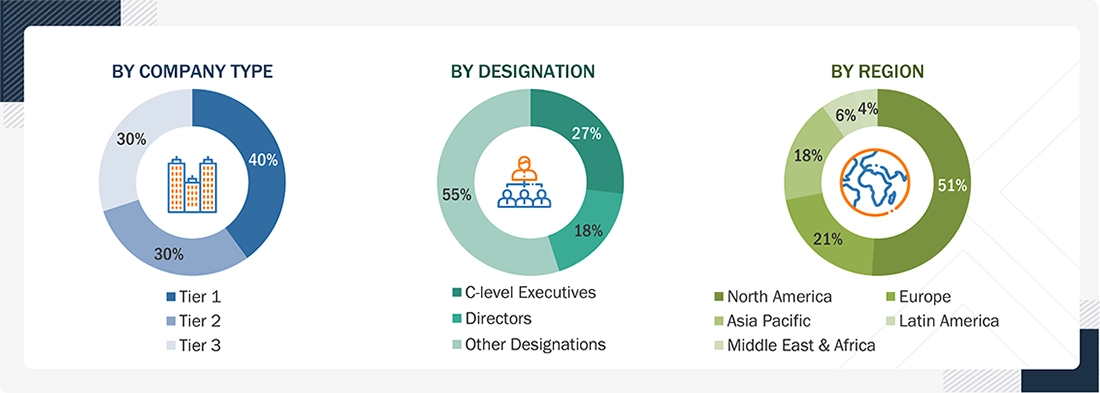
Note: Others include sales, marketing, and product managers.
Companies are classified into tiers based on their total revenues. As of 2025, Tier 1 = >USD 100 million, Tier 2 = USD 10 million to USD 100 million, and Tier 3 = <USD 10 million.
|
COMPANY NAME |
DESIGNATION |
|
Danaher Corporation (US) |
Sales Manager |
|
F. Hoffmann-La Roche AG (Switzerland) |
Product Manager |
To know about the assumptions considered for the study, download the pdf brochure
Market Size Estimation
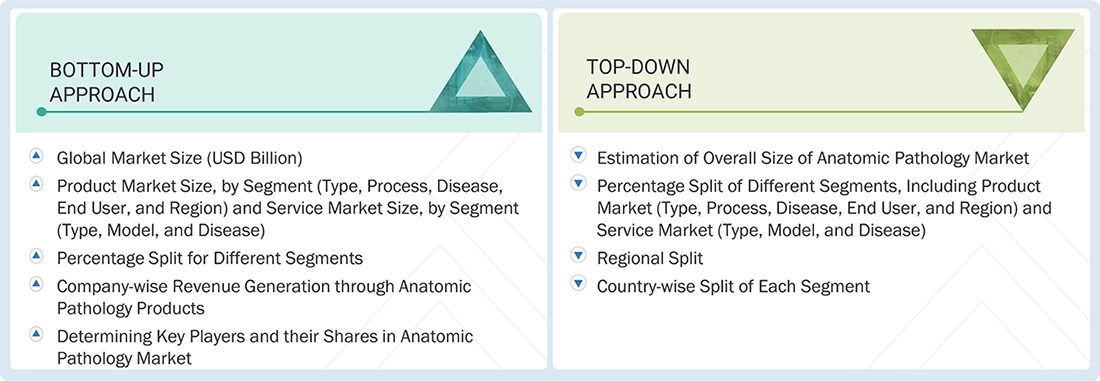
Both top-down and bottom-up approaches were used to estimate and validate the anatomic pathology market’s total size. These methods were also used extensively to estimate the size of various subsegments in the market. The research methodology used to estimate the market size includes the following:
- The key players in the industry have been identified through extensive secondary research
- The revenues generated by leading players operating in the anatomic pathology market were determined through primary and secondary research.
- All percentage shares, splits, and breakdowns have been determined using secondary sources and verified through primary sources.
Anatomic Pathology Market : Top-Down and Bottom-Up Approach
Data Triangulation
After arriving at the overall market size by applying the process mentioned above, the total market was split into several segments and subsegments. The data triangulation and market breakdown procedures were employed to validate and complete the overall market engineering process and arrive at the exact statistics for all segments and subsegments of the anatomic pathology market. The data was triangulated by studying various factors and trends from the demand and supply sides in the anatomic pathology market.
Market Definition
Anatomic pathology is a subspeciality of pathology that focuses on the diagnosis and characterization of diseases through the examination of organs, tissues, cells, and bodily fluids obtained from patients through biopsies, surgical procedures, and other sampling methods. Anatomic pathology testing (APT) encompasses the range of diagnostic technologies, products, and services used within this field, including histopathology, cytopathology, digital pathology and amongst others. These techniques play a critical role in the detection, classification, prognosis, and monitoring of cancer, infectious diseases, and other medical conditions, supporting clinical decision-making and personalized treatment strategies.
Key Stakeholders
- Product Manufacturers, Distributors, and Suppliers
- Diagnostic Laboratories and Clinical Laboratories
- Research Laboratories and CROs
- Academic Universities and Medical Research Centers
- Research and Development (R&D) Centers
- Pharmaceutical and Biotechnology Companies
- Anatomic Pathology Companies
- Market Research and Consulting Firms
- Government Associations
Report Objectives
- To define, describe, and forecast the anatomic pathology product market (type, process, disease, end user, and region), Service market (type, model, disease)
- To provide detailed information about the key factors influencing the growth of the Anatomic Pathology Market (drivers, restraints, opportunities, and challenges)
- To analyze the micromarkets with respect to individual growth trends, prospects, and contributions to the overall market
- To analyze market opportunities for stakeholders and provide the competitive landscape details of the key players
- To forecast the revenue of market segments across five main regions: North America, Europe, Asia Pacific, Latin America, and Middle East & Africa
- To profile the key players of the Anatomic Pathology Market and comprehensively analyze their core competencies and market shares
- To benchmark players within the market using the proprietary Company Evaluation Matrix framework, which analyzes market players on various parameters within the broad categories of business and product excellence
- To study the impact of AI on the market, along with the macroeconomic outlook for each region
Available customizations:
MarketsandMarkets offers the following customizations for this market report.
Company Information
- Additional country-level analysis of the anatomic pathology market
Company Profiles
- Additional five company profiles of players operating in the anatomic pathology market.
Product Analysis
-
Product matrix, which provides a detailed comparison of the product portfolio of each company in the anatomic pathology market
Get the Full Anatomic Pathology Market Report
Full forecast, segment splits, and company analysis for all Anatomic Pathology Market.
- Canada Anatomic Pathology Market
- Germany Anatomic Pathology Market
- UK Anatomic Pathology Market
- France Anatomic Pathology Market
- Italy Anatomic Pathology Market
- Spain Anatomic Pathology Market
- China Anatomic Pathology Market
- Japan Anatomic Pathology Market
- India Anatomic Pathology Market
- Rest Of Europe Anatomic Pathology Market
- Rest Of Asia Pacific Anatomic Pathology Market
Need a Tailored Report?
Customize this report to your needs
Get 10% FREE Customization
Customize This Report
