
Brazil Anti-money Laundering (AML) Market (2025-2030)

The Brazil Anti-money Laundering (AML) Market was valued at $145 Million in 2025 and projected to reach to $280 Million by 2030, representing a compound annual growth rate of 14.1%. Brazil's AML market is poised for sustained growth as regulatory bodies intensify enforcement mechanisms and financial institutions prioritize compliance infrastructure.


| Market Size in | USD 26.32 MN |
| Market Forecast in | |
| CAGR | |
| Forecast Period | |
| Units Considered | Value (USD MN) |
Brazil Anti-money Laundering (AML) Market Trends and Insights
- Brazil's expanding financial services sector, coupled with increasingly stringent regulatory requirements from authorities such as the Central Bank and Financial Intelligence Unit (UIF), is driving demand for advanced AML solutions across banking, fintech, and payment service providers.
- Brazil's position as Latin America's largest economy amplifies the urgency for sophisticated compliance infrastructure. The growth trajectory in Brazil reflects heightened enforcement actions and cross-border transaction monitoring mandates that have made AML technology adoption critical for financial institutions.
- Brazil's regulatory environment continues to evolve, with enhanced due diligence requirements and real-time reporting obligations pushing organizations to invest in automated compliance platforms.
- Between 2025 and 2030, Brazil's AML market will benefit from digital transformation initiatives, the rise of cryptocurrency regulation, and the integration of artificial intelligence and machine learning into compliance workflows. Brazil's competitive landscape includes both global AML solution providers and emerging local vendors tailored to the country's unique regulatory framework.
- The market's expansion is underpinned by Brazil's commitment to international compliance standards and the Financial Action Task Force (FATF) recommendations, ensuring sustained investment in AML infrastructure..
Key Market Statistics
- CAGR (2025-2030) 14.1% CAGR
- Market Size, 2025 ~USD 145 Million
- Forecast, 2030 ~USD 280 Million
- Country Brazil
Brazil Anti-money Laundering (AML) Market Overview
Market Valuation Growth :
Brazil's AML market is valued at USD 145.0 million in 2025 and is projected to reach USD 280.0 million by 2030, demonstrating strong market expansion driven by regulatory pressures and financial sector modernization.
Regulatory Compliance Drivers :
Stringent requirements from Brazil's Central Bank and Financial Intelligence Unit (FIU) are compelling financial institutions to invest heavily in AML solutions, creating sustained demand for compliance technologies and services.
Financial Services Expansion :
Brazil's rapidly expanding financial services sector, including fintech growth and digital banking adoption, is increasing the complexity of money laundering risks and necessitating advanced AML infrastructure investments.
Competitive CAGR Performance :
With a CAGR of 14.1% from 2025-2030, Brazil's AML market is growing at a solid pace, reflecting the country's commitment to combating financial crime and enhancing institutional compliance frameworks.
Brazil Anti-money Laundering (AML) Market Dynamics
- The Central Bank and Financial Intelligence Unit's evolving guidelines are compelling banks, fintechs, and payment processors to adopt sophisticated AML solutions.
- Digital transformation in Brazil's financial sector is accelerating demand for automated compliance tools, real-time transaction monitoring, and advanced analytics platforms. The market will benefit from increased cross-border transaction scrutiny, rising cybercrime threats, and Brazil's participation in international anti-money laundering frameworks.
- Investment in AI-driven detection systems and blockchain-based compliance solutions is expected to accelerate.
- As Brazil strengthens its position in Latin America's financial ecosystem, AML technology adoption will become a competitive necessity for all financial service providers operating in the country..
Market Ecosystem
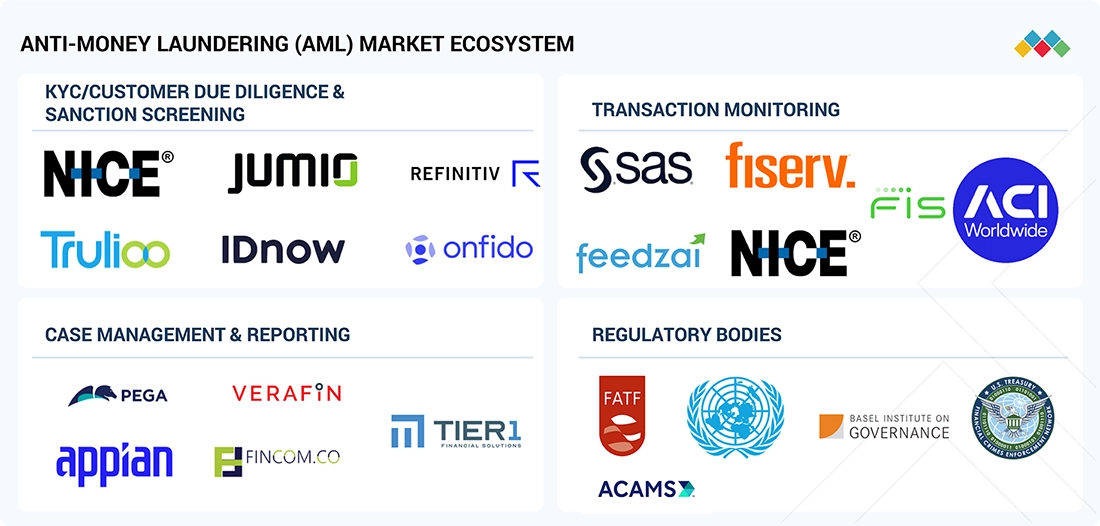
Anti-Money Laundering Market: COMMERCIAL USE CASES ACROSS INDUSTRIES
| COMPANY | USE CASE DESCRIPTION | BENEFITS |
|---|---|---|
 |
A leading global bank deployed LexisNexis RiskNarrative and WorldCompliance for real-time transaction screening, sanctions and PEP checks, and integrated risk scoring to strengthen AML compliance. | Achieved faster customer due-diligence, reduced false positives by ~40%, improved regulatory reporting timelines, and lowered compliance costs |
 |
A regional financial institution adopted Oracle Financial Services AML to unify transaction monitoring, suspicious-activity reporting, and case management across all channels. | Improved detection of unusual cross-border flows, cut investigation time by ~30%, enhanced reporting accuracy, and ensured adherence to FATF/EU directives |
 |
A large retail bank implemented FIS AML Compliance Suite with AI-based behavioral analytics to detect hidden laundering patterns and high-risk entities. | Increased early-stage detection of suspicious activities, reduced alert backlogs by ~35%, and strengthened oversight for correspondent banking transactions |
 |
A mid-sized US bank modernized its legacy monitoring with Fiserv AML Risk Manager, enabling automated watch-list screening, customer risk-scoring, and SAR workflows. | Decreased false-alert volume, improved investigator productivity by ~25%, reduced reporting delays, and boosted audit readiness |
 |
A fintech platform integrated Jumio’s eKYC and AML Screening for onboarding, combining biometric ID verification with ongoing sanctions and adverse-media checks. | Lowered onboarding-related AML risks, improved user-verification speed by ~50%, and raised conversion rates while maintaining compliance |
Logos and trademarks shown above are the property of their respective owners. Their use here is for informational and illustrative purposes only.
Related Ecosystem
Bfsi Security
- Multi-Factor Authentication
- Single-Factor Authentication
- Biometric Systems
- Fraud Analytics
- Application Integration
- International Business Machines Corporation
- ROLAND BERGER
- Fiserv, Inc.
- FINASTRA
- MICROSOFT CORPORATION
Cyber Security
- Cloud Security
- Biometric Systems
- Data Loss Prevention (DLP)
- Multi-Factor Authentication
- Security Analytics
- International Business Machines Corporation
- MITSUI BUSSAN SECURE DIRECTIONS INC
- Cisco Systems, Inc.
- MICROSOFT CORPORATION
- Allot Ltd.
Key Takeaways
- Brazil's AML market is projected to nearly double from USD 145.0 million (2025) to USD 280.0 million (2030) at a 14.1% CAGR, driven by regulatory tightening and fintech proliferation.
- Brazil's Central Bank and UIF enforcement actions are compelling financial institutions to adopt advanced AML technologies, including AI-powered transaction monitoring and real-time compliance reporting.
- Brazil's cryptocurrency and digital asset regulation is emerging as a key growth catalyst, requiring AML platforms to address new asset classes and cross-border payment flows.
- Brazil's competitive market includes both multinational compliance vendors and localized solutions providers, with integration capabilities and regulatory expertise becoming critical differentiators.
Anti-money Laundering (AML) Market Report Scope
| Report Metric | Details |
|---|---|
| Base Year | 2025 |
| Fastest Growing Segment | TRANSACTION MONITORING (Solution) |
| Forecast Period | 2025–2030 |
| Growth Rate | CAGR of 17.8% from 2025 to 2030 |
| Largest Segment | SOLUTIONS (Offering) |
| Market Size Base Year (Billions) | ~USD 4.14 (2025) |
| Revenue Forecast (Billions) | ~USD 9.38 (2030) |
| Segments Covered | Offering, Solution, Deployment Mode, Organization Size, End User |
Brazil Anti-money Laundering (AML) Market Report Segmentation
5 segment dimensions are covered across the global market.
By Offering
- Services
- Solution
- Solutions
By Solution
- Case Management & Reporting
- Kyc/Cdd & Sanction Screening
- Transaction Monitoring
By Deployment Mode
- Cloud
- On-Premises
By Organization Size
- Large Enterprises
- Smes
By End User
- Banks & Financial Institutes
- Gaming & Gambling
- Insurance
BRAZIL: ANTI-MONEY LAUNDERING MARKET, BY END USER, 2025–2030
| Segment | 2025 | 2026 | 2027 | 2028 | 2029 | 2030 | CAGR (%) |
|---|---|---|---|---|---|---|---|
| BANKS & FINANCIAL INSTITUTES | 99.5 | 113 | 128.6 | 149.2 | 170.2 | 195 | 14.4 |
| GAMING & GAMBLING | 18.1 | 20.3 | 23.5 | 27.5 | 31.3 | 36.1 | 14.8 |
| INSURANCE | 27.4 | 30.2 | 33.5 | 38.3 | 43.2 | 48.9 | 12.3 |
| TOTAL | 145 | 163.5 | 185.7 | 214.9 | 244.6 | 280 | 14.1 |
Target Audience
- Financial Institution Executives : Banks, credit unions, and payment processors in Brazil need market intelligence to justify AML technology investments, understand regulatory expectations, and benchmark compliance spending against industry peers.
- AML Software & Service Providers : Compliance technology vendors and consulting firms require Brazil-specific market data to identify growth opportunities, assess market demand, and develop localized solutions for Brazilian financial institutions.
- Regulatory & Compliance Officers : Compliance professionals in Brazil need detailed market insights to stay informed on regulatory trends, best practices, and technology solutions that enhance their institution's AML effectiveness and reduce risk exposure.
- Investment & Private Equity Firms : Investors evaluating opportunities in Brazil's fintech and compliance technology sectors require market forecasts and growth analysis to assess portfolio companies and identify acquisition targets in the AML space.
- Government & Regulatory Bodies : Brazilian regulatory agencies and policymakers benefit from market analysis to understand AML technology adoption rates, identify compliance gaps, and develop evidence-based policies for financial crime prevention.
Key Companies in the Brazil Anti-money Laundering (AML) Market
| Company | HQ | Ownership | Strongest segments |
|---|---|---|---|
| ORACLE | United States | Public Company | Database and infrastructure technologies (incl. Oracle Database, MySQL, Autonomous DB, middleware, Java),Cloud applications (Fusion ERP/EPM/SCM/HCM, NetSuite, Oracle Health, Fusion CX),Cloud infrastructure (compute, storage, networking, OCI services incl. AI/ML, IoT, blockchain), |
| FIS | United States | Public Company | Banking Solutions (core, digital, fraud/compliance),Card & Retail Payments, EFT & Networks,Capital Market Solutions (trading, treasury, risk), |
| GB GROUP PLC | United Kingdom | Public Company | Identity Data Verification & KYC/KYB,Document & Biometric Verification,Location Intelligence & Address Verification, |
| FICO | United States | Public Company | Scores (B2B credit and related scores),Scores (B2C myFICO and consumer services),Pre-configured software solutions (fraud, originations, customer management, marketing), |
| ACI WORLDWIDE | United States | Public Company | Banking & Processor Payment Software (Acquiring, Issuing, RTGS, Real-Time Payments, Central Infrastructure),Biller Services & Speedpay,Payments Orchestration & Merchant Solutions, |
| EXPERIAN | Ireland | Public Company | Business-to-Business – Credit & Risk Data,Business-to-Business – Software, Decisioning & AI Analytics,Business-to-Business – Marketing & Affordability Insights, |
| WOLTERS KLUWER | Netherlands | Public Company | Health (clinical and GenAI solutions),Tax & Accounting (AI-powered cloud and on-premise suites),Financial & Corporate Compliance, |
| TRANSUNION | United States | Public Company | Core Credit Reporting (Consumer & Commercial),Analytics, Scoring & Decisioning,Fraud, Identity & Authentication, |
ORACLE
Oracle is a multinational technology company founded in 1977 and headquartered in the United States. With 141,000 employees, it is a publicly traded corporation that develops database software, cloud computing solutions, and enterprise applications.
FIS
FIS is a publicly traded financial services technology company founded in 1968 in the United States. With 44,000 employees, it provides payment processing, banking, and financial software solutions.
GB GROUP PLC
GB Group PLC is a publicly traded UK company founded in 1989 with 1,055 employees. It provides identity verification, fraud prevention, and data quality solutions.
FICO
FICO is a publicly traded analytics software company founded in 1956 in the United States. With 3,876 employees, it is known for developing credit scoring models and decision management solutions.
ACI WORLDWIDE
ACI Worldwide is a publicly traded payments technology company founded in 1975 in the United States. With 2,930 employees, it provides payment systems and solutions for financial institutions and businesses.
EXPERIAN
Experian is a publicly traded data and analytics company founded in 1826 and headquartered in Ireland. With 25,200 employees, it provides credit reporting, identity verification, and risk management services globally.
WOLTERS KLUWER
Wolters Kluwer is a publicly traded Dutch company founded in 1836 with 19,812 employees. It provides professional information, software, and services for the legal, tax, accounting, and healthcare sectors.
TRANSUNION
TransUnion is a publicly traded credit reporting and information services company founded in 1968 in the United States. With 13,500 employees, it provides credit data, analytics, and risk management solutions.
Reasons to Buy this Report
- Regulatory Intelligence : Gain comprehensive insights into Brazil's Central Bank and FIU requirements, enabling your organization to align AML strategies with local compliance mandates and avoid regulatory penalties.
- Market Entry Strategy : Understand Brazil's AML market dynamics, competitive landscape, and growth opportunities to develop targeted go-to-market strategies for fintech, banking, and payment processing segments.
- Investment Decision Support : Access detailed market sizing and forecasts (USD 145M to USD 280M by 2030) to support capital allocation decisions and identify high-growth segments within Brazil's AML ecosystem.
- Technology Adoption Trends : Identify emerging AML technology preferences among Brazilian financial institutions, including AI, automation, and blockchain solutions, to guide product development and positioning strategies.
- Competitive Benchmarking : Compare your AML solutions and services against Brazil-specific market standards and competitor offerings to optimize pricing, features, and customer value propositions for the Brazilian market.
Frequently asked questions
What is the current size of Brazil's AML market in 2025?
Brazil's AML market is valued at USD 145.0 million in 2025, with expectations to grow significantly through 2030.
What is the projected market size for Brazil's AML sector by 2030?
Brazil's AML market is forecast to reach USD 280.0 million by 2030, representing a 14.1% compound annual growth rate.
Which regulatory bodies are driving AML compliance in Brazil?
Brazil's Central Bank (Banco Central do Brasil) and the Financial Intelligence Unit (UIF) are the primary regulators enforcing AML requirements and compliance standards.
What technologies are shaping Brazil's AML market growth?
Artificial intelligence, machine learning, real-time transaction monitoring, and blockchain-based compliance solutions are key technologies transforming Brazil's AML landscape.
How does Brazil's AML market compare to global growth rates?
Brazil's AML market CAGR of 14.1% is below the global average of 17.8%, reflecting regional economic factors and a more mature but still-expanding compliance infrastructure.
RESEARCH METHODOLOGY
Secondary research was conducted to collect information useful for this technical, market-oriented, and commercial study of the global AML market. The next step was to validate these findings, assumptions, and sizing with industry experts across the value chain using primary research. Different approaches, such as top-down and bottom-up, were employed to estimate the total market size. After that, the market breakup and data triangulation procedures were used to estimate the market size of the segments and subsegments of the AML market.
Secondary Research
In the secondary research process, various secondary sources were referred to for identifying and collecting information regarding the study. The secondary sources included annual reports, press releases, investor presentations of AML solution and service vendors, forums, certified publications, and whitepapers. The secondary research was mainly used to obtain key information about the industry’s supply chain, the total pool of key players, market classification and segmentation according to industry trends to the bottom-most level, regional markets, and key developments from both market- and technology-oriented perspectives, all of which were further validated by primary sources.
Primary Research
In the primary research process, various primary sources from both the supply and demand sides were interviewed to obtain qualitative and quantitative information for this report. The primary sources from the supply side included various industry experts, including Chief Executive Officers (CEOs), Vice Presidents (VPs), marketing directors, technology and innovation directors, and related key executives from various key companies and organizations operating in the AML market.
In the market engineering process, top-down and bottom-up approaches were extensively used, along with several data triangulation methods, to perform the market estimation and market forecasting for the overall market segments and subsegments listed in this report. Extensive qualitative and quantitative analysis was performed on the complete market engineering process to list key information/insights throughout the report.
After the complete market engineering process (including calculations for market statistics, market breakups, market size estimations, market forecasts, and data triangulation), extensive primary research was conducted to gather information and verify & validate the critical numbers arrived at. The primary research was also conducted to identify the segmentation types, industry trends, competitive landscape of AML market players, and key market dynamics, such as drivers, restraints, opportunities, challenges, industry trends, and key strategies.
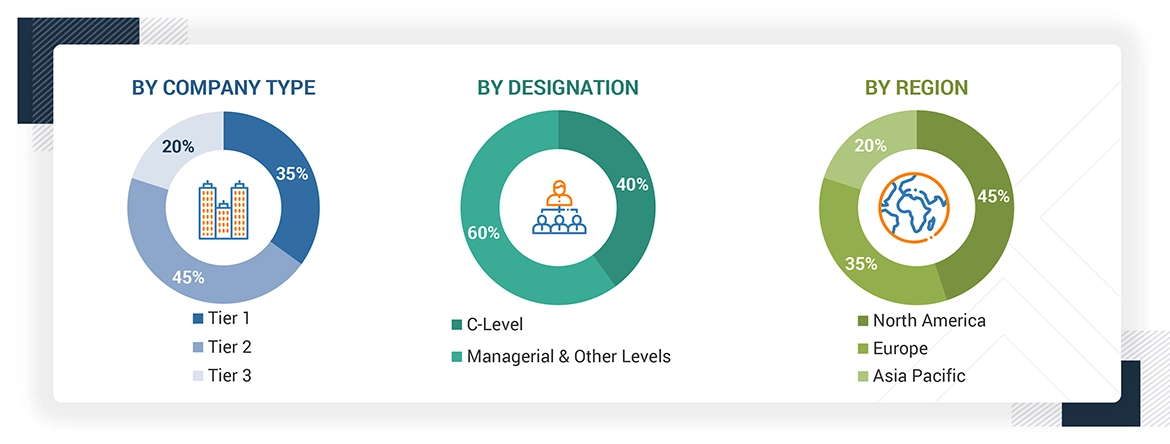
Note: Other levels include sales managers, marketing managers, and product managers.
Tier 1 companies receive revenues higher than USD 10 billion; Tier 2 companies' revenues range between USD 1 and 10 billion; and Tier 3
companies' revenues range between USD 500 million and USD 1 billion.
Source: Industry Experts
To know about the assumptions considered for the study, download the pdf brochure
Market Size Estimation
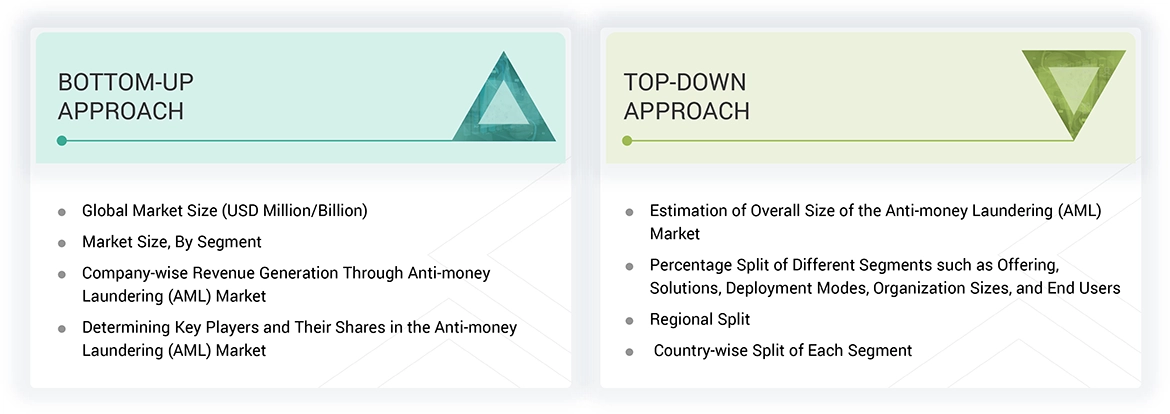
Top-down and bottom-up approaches were used to estimate and validate the size of the AML market and the size of various dependent subsegments in the overall AML market. The research methodology used to estimate the market size includes the following details: critical players in the market were identified through secondary research, and their market shares in the respective regions were determined through primary and secondary research. This entire procedure included the study of the annual and financial reports of the top market players, and extensive interviews were conducted for key insights from the industry leaders, such as CEOs, VPs, directors, and marketing executives.
All percentage splits and breakdowns were determined using secondary sources and verified through primary sources. All possible parameters that affect the market covered in this research study have been accounted for, viewed in extensive detail, verified through primary research, and analyzed to get the final quantitative and qualitative data. This data is consolidated and added to detailed inputs and analysis from MarketsandMarkets.
Anti-money Laundering (AML) Market : Top-Down and Bottom-Up Approach
Data Triangulation
The market was split into several segments and subsegments after arriving at the overall market size using the market size estimation processes explained above. The data triangulation and market breakup procedures were employed, wherever applicable, to complete the overall market engineering process and arrive at the exact statistics of each market segment and subsegment. The data was triangulated by studying various factors and trends from both the demand and supply sides.
Market Definition
MarketsandMarkets defines anti-money laundering as a practice by financial institutes such as banks, insurance, or gaming & gambling enterprises to monitor and prevent any illegal activities that support money laundering and terrorist financing. These banks and financial institutes follow a set of policies and regulations during KYC/CDD, transaction screening & monitoring, and compliance to avoid fraudulent and illegal activities around financial systems.
Stakeholders
- Chief technology and data officers
- Anti-money laundering service professionals
- Business analysts
- Information technology (IT) professionals
- Government agencies
- Investors and venture capitalists
- Small and medium-sized enterprises (SMEs) and large enterprises
- Third-party providers
- Consultants/Consultancies/Advisory firms
- Managed and professional service providers
Report Objectives
- To describe and forecast the global AML market by offering, solution, deployment mode, organization size, end user, and region
- To forecast the market size of the five main regions: North America, Europe, Asia Pacific (APAC), the Middle East & Africa, and Latin America
- To provide detailed information related to significant factors (drivers, restraints, opportunities, and challenges) influencing the growth of the market
- To analyze the subsegments of the market concerning individual growth trends, prospects, and contributions to the overall market
- To profile the key players of the AML market and comprehensively analyze their market shares and core competencies
- To analyze the opportunities in the market for stakeholders and provide the competitive landscape details of major players
- To map the companies to get competitive intelligence based on company profiles, key player strategies, and game-changing developments such as product developments, collaborations, and acquisitions
- To track and analyze the competitive developments, such as product enhancements & product launches, acquisitions, and partnerships & collaborations, in the AML market globally
Available Customizations
With the given market data, MarketsandMarkets offers customizations based on company-specific needs. The following customization options are available for the report:
Geographic Analysis as per Feasibility
- Further breakup of the Asia Pacific market into countries contributing to the rest of the regional market size
- Further breakup of the North American market into countries contributing to the rest of the regional market size
- Further breakup of the Latin American market into countries contributing to the rest of the regional market size
- Further breakup of the Middle East & African market into countries contributing to the rest of the regional market size
- Further breakup of the European market into countries contributing to the rest of the regional market size
Company Information
- Detailed analysis and profiling of additional market players (up to 5)
Get the Full Anti-money Laundering (AML) Market Report
Full forecast, segment splits, and company analysis for all Anti-money Laundering (AML) Market.
- Canada Anti-money Laundering (AML) Market
- US Anti-money Laundering (AML) Market
- UK Anti-money Laundering (AML) Market
- Germany Anti-money Laundering (AML) Market
- France Anti-money Laundering (AML) Market
- Italy Anti-money Laundering (AML) Market
- Portugal Anti-money Laundering (AML) Market
- China Anti-money Laundering (AML) Market
- Japan Anti-money Laundering (AML) Market
- Singapore Anti-money Laundering (AML) Market
- India Anti-money Laundering (AML) Market
- UAE Anti-money Laundering (AML) Market
- Mexico Anti-money Laundering (AML) Market
- Rest Of Europe Anti-money Laundering (AML) Market
- Anz Anti-money Laundering (AML) Market
- Rest Of Asia Pacific Anti-money Laundering (AML) Market
- GCC Countries Anti-money Laundering (AML) Market
- Rest Of Middle East Anti-money Laundering (AML) Market
- Ksa Anti-money Laundering (AML) Market
- Rest Of GCC Countries Anti-money Laundering (AML) Market
Need a Tailored Report?
Customize this report to your needs
Get 10% FREE Customization
Customize This Report
