
China Augmented and Virtual Reality Market (2026-2031)

The China Augmented and Virtual Reality Market was valued at $6207.2 Million in 2026 and projected to reach to $19724.2 Million by 2031, representing a compound annual growth rate of 21.3%. China's augmented and virtual reality market is poised for exceptional growth, driven by increasing consumer adoption, technological advancement, and substantial government support for digital transformation initiatives.


| Market Size in | USD 26.32 MN |
| Market Forecast in | |
| CAGR | |
| Forecast Period | |
| Units Considered | Value (USD MN) |
China Augmented and Virtual Reality Market Trends and Insights
- Japan's 21.3% compound annual growth rate significantly outpaces the global average of 18.4%, reflecting strong domestic demand for immersive technologies across gaming, enterprise, and industrial applications.
- Japan's advanced semiconductor ecosystem and consumer electronics expertise position the nation as a critical hub for AR/VR innovation in the Asia Pacific region. The Japanese market benefits from early technology adoption, substantial investment in mixed reality infrastructure, and integration of AR/VR solutions in manufacturing and retail sectors.
- Japan's commitment to next-generation display technologies and spatial computing drives competitive advantage in the global landscape.
- Between 2026 and 2031, Japan is expected to capture increasing market share as enterprises and consumers embrace immersive experiences, supported by Japan's robust telecommunications infrastructure and digital transformation initiatives..
Key Market Statistics
- CAGR (2026-2031) 21.3% CAGR
- Market Size, 2026 ~USD 6207.2 Million
- Forecast, 2031 ~USD 19724.2 Million
- Country China
China Augmented and Virtual Reality Market Overview
Explosive Growth Trajectory :
China's AR/VR market is projected to grow from $6,207.2 million in 2026 to $19,724.2 million by 2031, representing a 21.3% CAGR that significantly outpaces the global average of 18.4%.
Gaming & Entertainment Dominance :
China's massive gaming industry and consumer base drive substantial demand for immersive AR/VR experiences, positioning the country as a global leader in content creation and hardware adoption.
Enterprise & Industrial Adoption :
Manufacturing, logistics, and training sectors across China are rapidly integrating AR/VR technologies to enhance operational efficiency, worker safety, and skill development programs.
Semiconductor Innovation Hub :
China's growing semiconductor capabilities and chipset manufacturing enable competitive AR/VR hardware production, reducing costs and accelerating market penetration across consumer and enterprise segments.
China Augmented and Virtual Reality Market Dynamics
- The 21.3% CAGR reflects strong momentum across gaming, entertainment, and emerging enterprise applications.
- Major tech companies and startups are investing heavily in AR/VR development, creating a competitive ecosystem that fosters innovation.
- By 2031, China is expected to capture a significant share of the global AR/VR market, supported by its large population, rising disposable incomes, and digital-first consumer culture.
- Industrial applications in manufacturing and logistics will further accelerate market expansion as enterprises recognize productivity and safety benefits..
Market Ecosystem
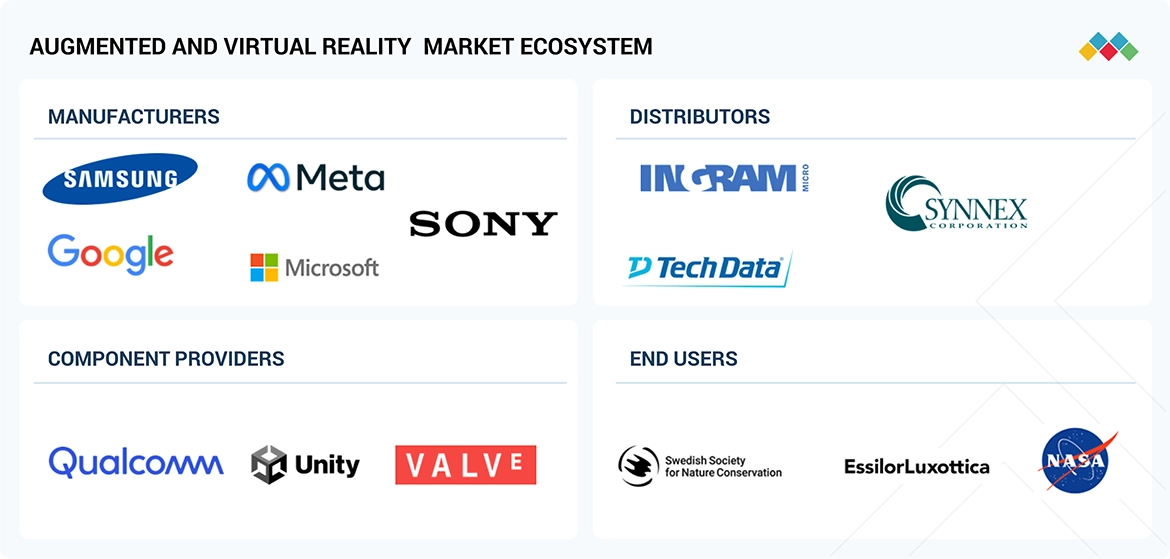
AUGMENTED AND VIRTUAL REALITY MARKET SIZE, SHARE & GROWTH: COMMERCIAL USE CASES ACROSS INDUSTRIES
| COMPANY | USE CASE DESCRIPTION | BENEFITS |
|---|---|---|
 |
Implemented AR and VR technologies for automotive design collaboration, enabling global teams to interact with 3D vehicle models in shared virtual environments, reducing dependence on physical prototypes and in-person meetings | Lowered prototyping and travel costs | Improved design efficiency | Accelerated iteration cycles | Enhanced global collaboration |
 |
Deployed immersive VR solutions to support remote collaboration of automotive design teams, enabling real-time interaction with digital prototypes and facilitating design reviews across geographically dispersed teams | Reduced travel dependency | Improved workflow efficiency | Enabled real-time design modifications | Ensured business continuity during restricted mobility conditions |
 |
Collaborated with BMW to integrate AR and VR technologies into smart vehicle environments, enabling immersive in-car experiences, such as virtual displays, interactive entertainment, and hands-free communication | Enhanced passenger experience | Enabled next-generation in-car interfaces | Improved engagement | Supported development of smart mobility ecosystems |
 |
Delivered high-fidelity VR/XR headsets for astronaut and pilot training, enabling realistic simulation of mission scenarios, cockpit procedures, and emergency situations in fully immersive virtual environments | Improved training realism and precision | Reduced reliance on physical simulators | Enhanced preparedness for complex missions | Lowered training costs and risks |
Logos and trademarks shown above are the property of their respective owners. Their use here is for informational and illustrative purposes only.
Related Ecosystem
Aviation
- Narrow Body Aircraft
- Wide Body Aircraft
- Military Helicopters
- Special Mission Aircraft
- Fighter Aircraft
- HONEYWELL INTERNATIONAL INC.
- COLLINS AEROSPACE
- Thales group
- Safran group
- HEICO Corporation
Simulation And Training
- Sensors
- Augmented Reality
- Augmented Reality Devices
- Virtual Reality
- Virtual Reality Devices
- MICROSOFT CORPORATION
- Lenovo
- MAGIC LEAP INC
- EON REALITY
Automotive Electronics And Electrical Equipment
- Battery Electric Vehicle (BEV)
- Light Commercial Vehicles (LCVs)
- Fuel Cell Electric Vehicle (FCEV)
- Sensors
- Hybrid Electric Vehicle (HEV)
- BOSCH LIMITED
- Continental ag
- DENSO Corporation
- Texas Instruments Incorporated
- Panasonic Holdings Corporation
Key Takeaways
- Japan's AR/VR market will grow from $6,207.2M (2026) to $19,724.2M (2031), representing a 21.3% CAGR that exceeds global growth rates.
- Japan's advanced semiconductor and consumer electronics capabilities create a competitive advantage in developing next-generation AR/VR hardware and solutions.
- Enterprise adoption in Japan's manufacturing and retail sectors is accelerating, driving demand for immersive training, design, and customer engagement applications.
- Japan's early technology adoption culture and strong digital infrastructure position it as a regional leader in AR/VR innovation within Asia Pacific.
Augmented and Virtual Reality Market Report Scope
| Report Metric | Details |
|---|---|
| Base Year | 2026 |
| Fastest Growing Segment | HEAD-MOUNTED DISPLAYS (Device Type) |
| Forecast Period | 2026–2031 |
| Growth Rate | CAGR of 18.4% from 2026 to 2031 |
| Largest Segment | SOFTWARE (Offering) |
| Market Size Base Year (Billions) | ~USD 97.49 (2026) |
| Revenue Forecast (Billions) | ~USD 226.84 (2031) |
| Segments Covered | Technology, Offering, Component, Application, Deployment Type, Device Type |
China Augmented and Virtual Reality Market Report Segmentation
6 segment dimensions are covered across the global market.
By Technology
- Anchor-Based
- Marker-Based
- Markerless
- Non-Immersive
- Semi & Fully Immersive
By Offering
- Hardware
- Software
By Component
- Cameras
- Displays & Projectors
- Other Hardware Components
- Position/Room Trackers
- Semiconductor Components
- Sensors
By Application
- Aerospace & Defense
- Automotive
- Commercial
- Consumer
- Energy
- Enterprise
- Healthcare
- Other Ar Applications
- Other Vr Applications
By Deployment Type
- Cloud
- On-Premises
By Device Type
- Gesture-Tracking Devices
- Head-Mounted Displays
- Head-Up Displays
- Projectors & Display Walls
Target Audience
- Technology Hardware Manufacturers : Need detailed market sizing and growth projections to plan AR/VR device production, supply chain optimization, and market entry strategies in China's rapidly expanding ecosystem.
- Software & Content Developers : Require insights into China's application demand, consumer preferences, and enterprise use cases to prioritize development efforts and localize content for maximum market penetration.
- Investment & Private Equity Firms : Seek comprehensive market analysis and growth forecasts to identify investment opportunities, evaluate startup valuations, and assess portfolio company performance in China's AR/VR sector.
- Enterprise & Industrial Buyers : Need market intelligence on AR/VR solutions, vendor capabilities, and ROI benchmarks to make informed procurement decisions and implement immersive technologies across operations.
- Strategic Consultants & Analysts : Require detailed market data, competitive intelligence, and trend analysis to advise clients on market positioning, M&A opportunities, and long-term strategy in China's AR/VR landscape.
Key Companies in the China Augmented and Virtual Reality Market
| Company | HQ | Ownership | Strongest segments |
|---|---|---|---|
| QINETIQ GROUP PLC | United Kingdom | Public Company | HMD and HUD-based immersive training and mission rehearsal,Projector & display wall non-immersive and semi-immersive simulation,Markerless and anchor-based AR for test, evaluation, and maintenance, |
| EPAM SYSTEMS, INC. | United States | Public Company | Non-immersive AR/VR applications,Semi & fully immersive solutions (HMD-centric),Markerless AR, |
| AT&S | Austria | Public Company | HMD manufacturing automation (non-immersive, semi & fully immersive),Gesture tracking and sensor module automation,Projector & display wall / HUD automation, |
| TIANMA MICROELECTRONICS | China | Public Company | HMD Displays (VR/AR headsets and smart glasses),Automotive HUD and Cluster Displays,IT and Monitor Panels for Non-immersive AR/VR, |
| NITTO DENKO CORPORATION | Japan | Public Company | HMD-related optical films, adhesives, and thermal materials,HUD and automotive AR materials,Display wall, projector, and non-immersive AR materials, |
| CORETRONIC CORPORATION | Taiwan | Public Company | Projectors & Display Wall Systems,Backlights, Panel Modules & Intelligent Displays,AR/MR Wearable Display Solutions & Optical Engines, |
| SOPRA STERIA | United States | Public Company | Non-immersive and projector/display wall solutions,Semi & fully immersive (HMD-based) solutions,Markerless and anchor-based AR, |
| VOITH | Germany | Private Company | Non-immersive AR/VR and Projector & Display Wall,Semi & Fully Immersive VR (training and simulation),Markerless and Anchor-Based AR (maintenance and field support), |
| META PLATFORMS, INC. | United States | Public Company | HMD – VR (Meta Quest family, semi & fully immersive),AR & AI Glasses (Ray-Ban Meta, Oakley Meta, Meta Ray-Ban Display),Content, Apps & Services (VR software, social, fitness, entertainment), |
| META | United States | Public Company | HMD (VR headsets, including Meta Quest),AI Glasses and Wearables (Ray-Ban Meta, Oakley Meta, Meta Ray-Ban Display, Meta Neural Band),Software, Content, and Platforms (non-immersive, semi & fully immersive, AR modalities), |
| XIAOMI | China | Public Company | Non-immersive AR (smartphones, TVs, tablets),Semi & fully immersive HMD (consumer VR),Wearables & gesture-tracking devices, |
| SONY CORPORATION | Japan | Public Company | HMD (VR/AR headsets),HUD,Gesture Tracking Devices & Sensors, |
| APPLE INC. | United States | Public Company | Mobile AR (iPhone/iPad + ARKit apps),Vision Pro and future HMDs,Wearables and accessories (Watch, AirPods, others in AR stack), |
| HTC CORPORATION | Thailand | Public Company | HMD (VR/AR headsets),HUD,Gesture Tracking Device, |
| United States | Public Company | Non-immersive and mobile AR (Search, Maps, Lens, YouTube, Android),HMD, HUD, and immersive platforms (Android XR, YouTube VR, partner devices),Markerless and anchor-based AR SDKs and cloud services, | |
| MICROSOFT | United States | Public Company | HMD (HoloLens and compatible headsets),Non-immersive and semi-immersive AR (Windows, Teams, Xbox),Markerless and anchor-based AR services on Azure, |
| SAMSUNG | South Korea | Public Company | Non-immersive & Semi-immersive (smartphones, tablets, monitors, signage),Components for HMD/HUD (displays, memory, sensors),Wearables & Gesture/Tracking-capable Devices, |
| PTC | United States | Public Company | Markerless AR (including model targets and spatial tracking),Anchor-Based AR (IoT/PLM-linked experiences),Marker-Based AR, |
| SEIKO EPSON CORPORATION | Japan | Public Company | Projector & Display Wall (non-immersive and semi-immersive),Smart Glasses / HMD (assisted and semi-immersive AR),Components & Enabling Tech for AR/VR (optical engines, LSIs, sensors), |
| LENOVO | China | Public Company | Non-immersive & Semi-immersive (PCs, tablets, signage controllers),HMD / VR-ready compute bundles,Projector & Display Wall controllers, |
QINETIQ GROUP PLC
QinetiQ Group PLC is a United Kingdom-based public company founded in 2001 with 7,378 employees.
EPAM SYSTEMS, INC.
EPAM Systems, Inc. is a United States-based public company founded in 1993 that employs 62,850 people.
AT&S
AT&S is an Austrian public company founded in 1978 with 7,000 employees.
TIANMA MICROELECTRONICS
Tianma Microelectronics is a Chinese public company founded in 1983 with 23,538 employees.
NITTO DENKO CORPORATION
Nitto Denko Corporation is a Japanese public company founded in 1918 that employs 26,477 people.
CORETRONIC CORPORATION
Coretronic Corporation is a Taiwanese public company founded in 1992.
SOPRA STERIA
Sopra Steria is a United States-based public company founded in 1968 with 51,275 employees.
VOITH
Voith is a German private company founded in 1867 with 23,224 employees.
META PLATFORMS, INC.
Meta Platforms, Inc. is a United States-based public company founded in 2004 that employs 77,986 people.
META
Meta is a United States-based public company founded in 2004 that employs 77,986 people.
XIAOMI
Xiaomi is a Chinese public company founded in 2010 with 55,994 employees.
SONY CORPORATION
Sony Corporation is a Japanese public company founded in 1946 that employs 94,900 people.
APPLE INC.
Apple Inc. is a United States-based public company founded in 1976 with 166,000 employees.
HTC CORPORATION
HTC Corporation is a Thailand-based public company founded in 1969 with 1,543 employees.
Google is a United States-based public company founded in 1998 with 194,668 employees.
MICROSOFT
Microsoft is a United States-based public company founded in 1975 with 228,000 employees.
SAMSUNG
Samsung is a South Korean public company founded in 1969 with 128,735 employees.
PTC
PTC is a United States-based public company founded in 1985 with 7,000 employees.
SEIKO EPSON CORPORATION
Seiko Epson Corporation is a Japanese public company founded in 1942 with 74,619 employees.
LENOVO
Lenovo is a Chinese public company founded in 1984.
Reasons to Buy this Report
- Market Size & Growth Validation : Obtain precise market valuation data for China ($6.2B in 2026, $19.7B in 2031) with detailed CAGR analysis to support investment decisions and competitive positioning strategies.
- Segment-Specific Insights : Access granular breakdowns of China's AR/VR market by application (gaming, enterprise, industrial, healthcare) to identify high-growth opportunities and emerging use cases.
- Competitive Landscape Analysis : Understand key players, market consolidation trends, and competitive dynamics specific to China's AR/VR ecosystem to benchmark performance and identify partnership opportunities.
- Regional Growth Drivers : Analyze China-specific factors including government policies, semiconductor capabilities, consumer behavior, and digital infrastructure investments that differentiate the market from global trends.
- Strategic Planning & Forecasting : Leverage 5-year forecasts and trend analysis to develop market entry strategies, product roadmaps, and resource allocation plans tailored to China's unique market dynamics.
Frequently asked questions
What is the projected market size of Japan's AR/VR market by 2031?
Japan's augmented and virtual reality market is projected to reach $19,724.2 million by 2031, growing from $6,207.2 million in 2026.
How does Japan's AR/VR growth rate compare to global trends?
Japan's 21.3% CAGR outpaces the global average of 18.4%, demonstrating stronger market momentum and adoption acceleration within Japan.
Which industries are driving AR/VR adoption in Japan?
Japan's manufacturing, retail, gaming, and enterprise sectors are primary growth drivers, leveraging immersive technologies for training, design, and customer engagement.
What competitive advantages does Japan hold in the AR/VR market?
Japan's advanced semiconductor ecosystem, consumer electronics expertise, and early technology adoption culture provide significant competitive advantages in AR/VR hardware and solution development.
How is Japan's digital infrastructure supporting AR/VR market growth?
Japan's robust telecommunications infrastructure, 5G deployment, and digital transformation initiatives create an enabling environment for AR/VR application development and deployment.
RESEARCH METHODOLOGY
The study involved major activities in estimating the current size of the augmented and virtual reality market. Exhaustive secondary research was done to collect information on the market. The next step was to validate these findings and assumptions and validate them with industry experts across the supply chain through primary research. Different approaches, including top-down and bottom-up methods, were employed to estimate the total market size. Following this, the market breakup and data triangulation procedures were employed to determine the market size of the segments and subsegments within the augmented and virtual reality market.
Secondary Research
Secondary research for this study involved gathering information from various credible sources, such as company reports, white papers, journals, and industry publications. This process helps in understanding the supply and value chains, identifying key players, analyzing market segmentation and regional trends, and tracking major market and technology developments. The data collected was used to estimate the overall market size, which was later validated through primary research.
Primary Research
Extensive primary research was conducted after gaining knowledge about the current scenario of the augmented and virtual reality market through secondary research. Several primary interviews were conducted with experts from the demand and supply sides across three major regions—North America, Asia Pacific, Europe, South America, and the Middle East & Africa. This primary data was collected through questionnaires, emails, and telephonic interviews.
Breakdown of Primary Interviews
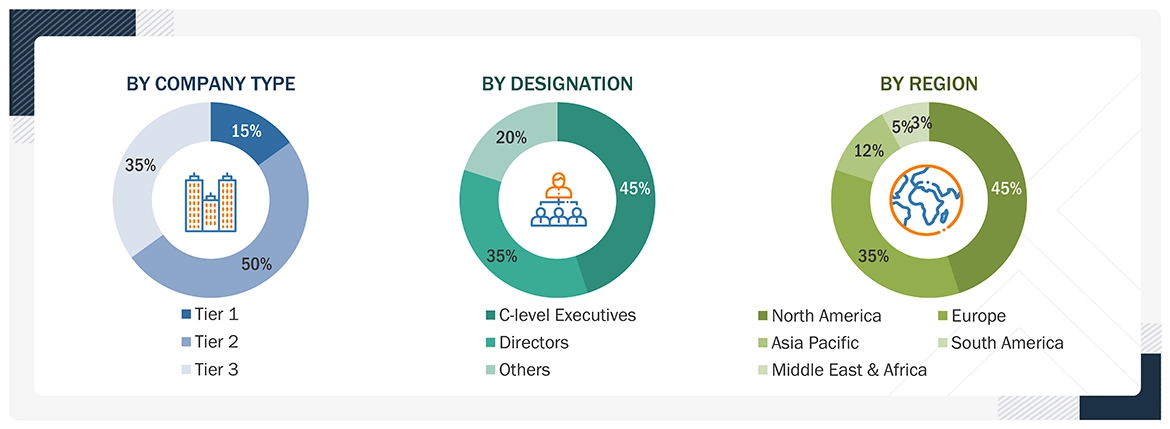
Notes: Other designations include product managers, sales managers, and marketing managers.
Tier 1 companies include market players with revenues above USD 500 million; tier 2 companies earn revenues between USD 100 million and USD 500 million; and tier 3 companies earn up to USD 100 million.
Note: Tier 1 companies receive revenues higher than USD 10 billion; Tier 2 companies' revenues range between USD 1 and 10 billion; and Tier 3 companies' revenues range between USD 500 million and USD 1 billion. Other designations include sales, marketing, and product managers.
To know about the assumptions considered for the study, download the pdf brochure
Market Size Estimation
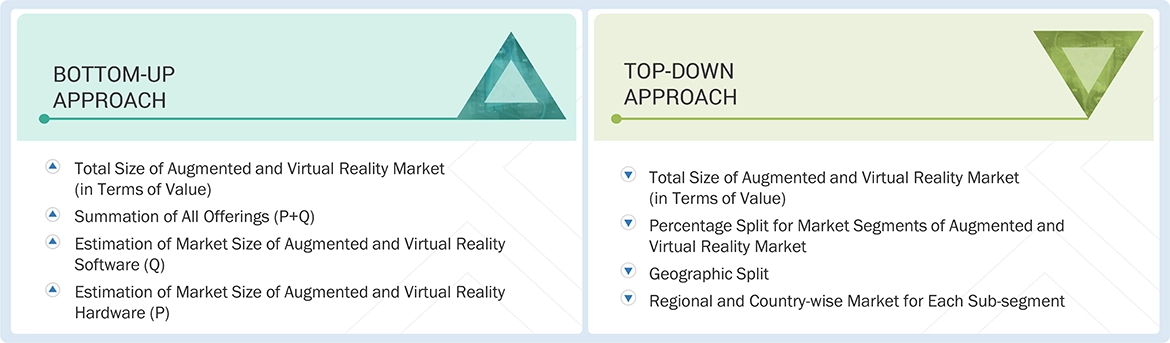
A bottom-up approach has been used to determine the overall size of the augmented and virtual reality market.
- Identifying the total number of augmented and virtual reality head-mounted displays shipped globally
- Understanding the average selling price (ASP) of augmented and virtual reality head-mounted displays
- Deriving the revenue of the augmented and virtual reality head-mounted displays market by multiplying shipments and ASP
- Estimating the market size of other augmented and virtual reality device types by understanding their penetration in the market
- Deriving the market size of the augmented and virtual reality hardware market by the summation of device types
- Estimating the revenue of the augmented and virtual reality software market by understanding the penetration in the hardware market and the global augmented and virtual reality market
- Deriving the global augmented and virtual reality market size by the summation of software and hardware revenue
- Identifying the upcoming products related to augmented and virtual reality by various companies in different regions, and forecasting the market size based on these developments and other key parameters
The top-down approach has been used to estimate and validate the total size of the augmented and virtual reality market.
- Focusing on top-line investments and expenditures made in the ecosystems of various applications
- Calculating the market size, considering revenues from major players through the cost of augmented and virtual reality systems
- Estimating the percentage split of each offering and device type by application and deriving the global application market size
- Segmenting each application of the augmented and virtual reality system by region and deriving the global regional market size
- Estimating country-level market size by analyzing the percentage split for each region by country
- Analyzing information related to revenues generated by players through their crucial product offerings
- Conducting multiple on-field discussions with key opinion leaders involved in developing various augmented and virtual reality solutions
INFOGRAPHIC DEPICTING BOTTOM-UP AND TOP-DOWN APPROACHES
Data Triangulation
After arriving at the overall market size using the market size estimation processes as explained above, the market has been split into several segments and subsegments. Data triangulation and market breakdown procedures have been employed to complete the entire market engineering process and arrive at the exact statistics of each market segment and subsegment. The data has been triangulated by studying various factors and trends from the demand and supply sides in the augmented and virtual reality market.
Market Definition
The augmented and virtual reality market encompasses technologies that create immersive digital experiences by either overlaying virtual elements onto the real world (AR) or generating fully simulated environments (VR). It spans hardware and software across industries such as consumer, commercial, enterprise, healthcare, and automotive. The market is driven by the rising demand for immersive user experiences, advancements in display and processing technologies, and growing enterprise adoption for training and simulation.
Key Stakeholders
- Raw material and manufacturing equipment suppliers
- Semiconductor foundries
- Original equipment manufacturers (OEMs)
- Augmented and virtual reality device manufacturers
- Original design manufacturers (ODMs) and OEM technology solution providers
- Software and technology providers
- Standardization and testing firms
- Government bodies, such as regulatory authorities and policymakers
- Research institutes and organizations
- Market research and consulting firms
- Technology investors
Report Objectives
- To define, analyze, and forecast the augmented and virtual reality market, by technology, offering, device type, and application, in terms of value
- To define, analyze, and forecast the augmented and virtual reality market, by device type, in terms of volume
- To forecast the market size for various segments with respect to five main regions, namely North America, Europe, Asia Pacific, South America, and the Middle East & Africa, in terms of value
- To provide detailed information regarding the major drivers, restraints, opportunities, and challenges influencing the growth of the augmented and virtual reality market
- To study the complete value chain and related industry segments for the augmented and virtual reality market
- To strategically analyze the micromarkets with respect to individual growth trends, prospects, and contributions to the total market
- To analyze the value chain; market ecosystem, trends/disruptions impacting customer business, technology analysis, pricing analysis, Porter’s five forces analysis, key stakeholders and buying criteria, the impact of Gen AI/AI, case study analysis, the impact of 2025 US tariff, trade analysis, patent analysis, key conferences and events, regulations, macroeconomic outlook analysis, and investment and funding scenario
- To analyze opportunities in the market for various stakeholders by identifying the high-growth segments of the market
- To strategically profile key players and comprehensively analyze their market position in terms of ranking, core competencies, company valuation and financial metrics, and product/brand comparison, along with detailing the competitive landscape for the market leaders
- To analyze competitive developments, such as product launches/developments, partnerships, collaborations, acquisitions, joint investments, agreements, contracts, expansions, and research & development (R&D) activities, carried out by players in the augmented and virtual reality market
Available customizations:
With the given market data, MarketsandMarkets offers customizations according to the company‘s specific needs. The following customization options are available for the report.
Company Information:
- Detailed analysis and profiling of additional market players (up to five)
Get the Full Augmented and Virtual Reality Market Report
Full forecast, segment splits, and company analysis for all Augmented and Virtual Reality Market.
- US Augmented and Virtual Reality Market
- Canada Augmented and Virtual Reality Market
- Mexico Augmented and Virtual Reality Market
- UK Augmented and Virtual Reality Market
- Germany Augmented and Virtual Reality Market
- France Augmented and Virtual Reality Market
- Spain Augmented and Virtual Reality Market
- Italy Augmented and Virtual Reality Market
- Nordic Countries Augmented and Virtual Reality Market
- Rest Of Europe Augmented and Virtual Reality Market
- Japan Augmented and Virtual Reality Market
- India Augmented and Virtual Reality Market
- South Korea Augmented and Virtual Reality Market
- Australia Augmented and Virtual Reality Market
- Rest Of Asia Pacific Augmented and Virtual Reality Market
- GCC Countries Augmented and Virtual Reality Market
- South Africa Augmented and Virtual Reality Market
- Brazil Augmented and Virtual Reality Market
- Argentina Augmented and Virtual Reality Market
- Rest Of South America Augmented and Virtual Reality Market
Need a Tailored Report?
Customize this report to your needs
Get 10% FREE Customization
Customize This Report
