
Japan Automotive E-Compressor Market (2024-2029)

The Japan Automotive E-Compressor Market was valued at $2129 Million in 2024 and projected to reach to $4693 Million by 2029, representing a compound annual growth rate of 9.2%. Japan's automotive e-compressor market is poised for sustained expansion driven by the country's aggressive electrification roadmap and the dominance of major OEMs transitioning to battery electric and hybrid platforms.


| Market Size in | USD 26.32 MN |
| Market Forecast in | |
| CAGR | |
| Forecast Period | |
| Units Considered | Value (USD MN) |
Japan Automotive E-Compressor Market Trends and Insights
- Japan's advanced automotive manufacturing ecosystem and early adoption of electrification technologies position the country as a critical hub for e-compressor innovation and deployment.
- The market expansion in Japan reflects the nation's commitment to reducing vehicle emissions and enhancing energy efficiency across its automotive sector through 2029. Japan's leadership in hybrid and electric vehicle production drives substantial demand for e-compressor systems, as these components are essential for thermal management in next-generation powertrains.
- Major Japanese automotive manufacturers are investing heavily in e-compressor technology to meet stringent domestic and international regulatory standards.
- Japan's market growth trajectory outpaces many developed economies, supported by strong domestic OEM capabilities and increasing consumer preference for environmentally sustainable vehicles through the forecast period..
Key Market Statistics
- CAGR (2024-2029) 9.2% CAGR
- Market Size, 2024 ~USD 2129 Million
- Forecast, 2029 ~USD 4693 Million
- Country Japan
Japan Automotive E-Compressor Market Overview
Market Valuation & Growth :
Japan's automotive e-compressor market reached USD 2,129 million in 2024 and is projected to grow to USD 4,693 million by 2029, with a CAGR of 9.2%, outpacing many developed markets in adoption velocity.
Manufacturing Leadership :
Japan's established automotive manufacturing ecosystem, home to Toyota, Honda, and Nissan, drives significant e-compressor demand as OEMs integrate electrification across vehicle platforms and thermal management systems.
Early Electrification Adoption :
Japanese automakers lead global EV and hybrid adoption, creating accelerated demand for advanced e-compressor technologies essential for battery cooling, cabin climate control, and heat pump systems in electric vehicles.
Innovation & Technology Hub :
Japan's commitment to automotive innovation and stringent emissions regulations position the country as a critical development center for next-generation e-compressor solutions and supplier partnerships.
Japan Automotive E-Compressor Market Dynamics
- The 9.2% CAGR reflects strong demand from both domestic consumption and export markets, as Japanese manufacturers leverage their technological expertise to capture global EV market share.
- Regulatory pressures and consumer preference for efficient thermal management systems further accelerate e-compressor adoption across vehicle segments. Looking ahead, Japan's market will benefit from continuous innovation in compressor efficiency, integration with heat pump technologies, and supply chain consolidation among Tier-1 suppliers.
- Strategic partnerships between automotive OEMs and component manufacturers will drive cost optimization and performance improvements, positioning Japan as a critical hub for e-compressor technology development and export.
- The market's growth trajectory remains robust, supported by Japan's leadership in EV infrastructure and commitment to carbon neutrality by 2050..
Market Ecosystem
Related Ecosystem
Automotive Materials
- Light Commercial Vehicles (LCVs)
- Battery Electric Vehicle (BEV)
- Hybrid Electric Vehicle (HEV)
- Fuel Cell Electric Vehicle (FCEV)
- Agricultural Tractors
- AISIN CORPORATION
- GORKOVSKY AVTOMOBILNY ZAVOD
- Continental ag
- Basf se
- BOSCH LIMITED
Key Takeaways
- Japan's e-compressor market will more than double from USD 2,129M (2024) to USD 4,693M (2029) at a 9.2% CAGR.
- Japan's advanced EV and hybrid vehicle manufacturing base creates sustained demand for thermal management e-compressor solutions.
- Stringent Japanese emissions regulations and consumer sustainability preferences accelerate e-compressor adoption across Japan's automotive sector.
- Japan's domestic OEM innovation and supply chain maturity position the country as a regional leader in e-compressor technology development.
Automotive E-Compressor Market Report Scope
| Report Metric | Details |
|---|---|
| Base Year | 2024 |
| Fastest Growing Segment | FCEV (Propulsion) |
| Forecast Period | 2024-2029 |
| Growth Rate | CAGR of 12.5% from 2024 to 2029 |
| Largest Segment | PASSENGER CARS (Vehicle Type) |
| Market Size Base Year (Billions) | ~USD 6.55 (2024) |
| Revenue Forecast (Billions) | ~USD 11.8 (2029) |
| Segments Covered | Compressor Type, Capacity, Vehicle Type, Propulsion |
Japan Automotive E-Compressor Market Report Segmentation
4 segment dimensions are covered across the global market.
By Compressor Type
- Centrifugal Compressors
- Reciprocating Compressors
- Rotary Screw Compressors
- Scroll Compressors
By Capacity
- Large
- Medium
- Small
By Vehicle Type
- Heavy Commercial Vehicles
- Light Commercial Vehicles
- Passenger Cars
By Propulsion
- Bev
- Fcev
- Hev
- Phev
Target Audience
- Automotive OEMs : Japanese and international automakers need Japan-specific e-compressor market data to optimize supply chain decisions, forecast component costs, and align electrification strategies with domestic manufacturing capabilities and export demands.
- Tier-1 & Tier-2 Suppliers : Component manufacturers and system integrators require detailed market insights to identify growth segments, benchmark competitive positioning, and develop targeted solutions for Japanese OEM requirements and global export opportunities.
- Investment & Private Equity Firms : Investors evaluating opportunities in Japan's automotive supply chain need comprehensive market analysis to assess growth potential, identify acquisition targets, and understand regulatory and technology trends driving e-compressor market expansion.
- Technology & Innovation Teams : R&D departments and engineering teams need Japan-focused market intelligence to guide product development priorities, understand customer requirements, and align innovation roadmaps with emerging thermal management and electrification standards.
- Market Strategists & Consultants : Business strategists and management consultants require Japan-specific market data to support client advisory services, competitive benchmarking, and strategic planning for automotive suppliers and OEMs operating in or targeting the Japanese market.
Reasons to Buy this Report
- Japan-Specific Market Sizing : Access precise valuation data for Japan's e-compressor market (USD 2,129M in 2024) with detailed forecasts through 2029, enabling accurate investment planning and revenue projections tailored to the Japanese automotive sector.
- OEM & Supplier Landscape Analysis : Understand the competitive dynamics among Japan's leading automakers (Toyota, Honda, Nissan) and Tier-1 suppliers, identifying partnership opportunities and market positioning strategies specific to Japanese manufacturing ecosystems.
- Electrification Roadmap Insights : Gain intelligence on Japan's EV adoption trajectory and regulatory drivers shaping e-compressor demand, including heat pump integration and thermal management requirements across vehicle platforms and segments.
- Technology & Innovation Trends : Discover Japan-specific advancements in e-compressor efficiency, performance metrics, and integration capabilities that differentiate Japanese suppliers in global markets and inform product development strategies.
- Strategic Market Entry & Expansion : Leverage Japan-focused market intelligence to identify growth opportunities, assess competitive threats, and develop localized go-to-market strategies for component suppliers, OEMs, and technology investors targeting the Japanese automotive sector.
Frequently asked questions
What is the current size of Japan's automotive e-compressor market?
Japan's automotive e-compressor market was valued at USD 2,129 million in 2024 and is expected to reach USD 4,693 million by 2029.
What is the projected growth rate for Japan's e-compressor market?
Japan's automotive e-compressor market is projected to grow at a compound annual growth rate (CAGR) of 9.2% from 2024 to 2029.
Why is Japan's e-compressor market growing faster than global averages?
Japan's market growth is driven by its leadership in EV and hybrid vehicle production, stringent emissions regulations, and strong domestic OEM investment in electrification technologies.
Which Japanese automotive manufacturers are leading e-compressor adoption?
Major Japanese OEMs including Toyota, Honda, Nissan, and Mazda are investing significantly in e-compressor technology for their hybrid and electric vehicle platforms.
What role do e-compressors play in Japan's automotive electrification strategy?
E-compressors are critical for thermal management and climate control in Japan's growing fleet of hybrid and electric vehicles, improving energy efficiency and vehicle performance.
RESEARCH METHODOLOGY
Various secondary sources, directories, and databases have been used to identify and collect information for an extensive study of the automotive e-compressor market. The study involved four main activities in estimating the current size of the market: secondary research, validation through primary research, assumptions, and market analysis. Exhaustive secondary research was carried out to collect information on the market, the peer market, and the child markets. The next step was to validate these findings, assumptions, and market analysis with industry experts across the value chain through primary research. The top-down approach was employed to estimate the complete market size for vehicle and propulsion segments considered in this study.
Secondary Research
In the secondary research process, various secondary sources such as company annual reports/presentations, press releases, industry association publications [for example, publications of electric vehicle manufacturers, International Energy Agency (IEA), ACEA (European Automobile Manufacturers Association),Alternative Fuel Data Center (AFDC), European Alternate Fuels Observatory (EAFO), Federal Transit Administration (FTA), Regional Transportation Authority (RTA), country-level vehicle associations and trade organizations, and the US Department of Transportation (DOT)], EV related magazine articles, directories, technical handbooks, World Economic Outlook, trade websites, government organizations websites, and technical articles have been used to identify and collect information useful for an extensive study of the global electric vehicle and electric compressor market
Primary Research
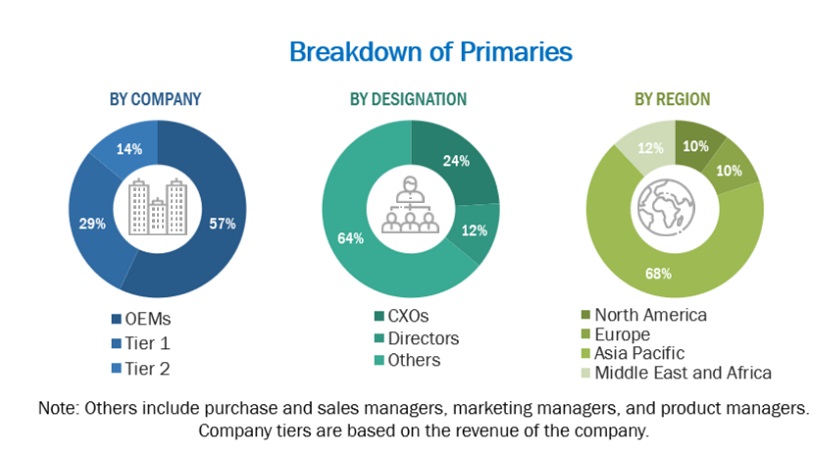
Extensive primary research has been conducted after acquiring and understanding of this market scenario through secondary research. Several primary interviews have been conducted with market experts from the demand- and supply-side OEMs across four major regions, namely, Asia Pacific, Europe, North America, Middle East & Africa. Primary data has been collected through questionnaires, emails, LinkedIn, and telephonic interviews. In the canvassing of primaries, we have strived to cover various departments within organizations, such as sales, operations, and administration, to provide a holistic viewpoint in our report.
After interacting with industry experts, we conducted brief sessions with highly experienced independent consultants to reinforce the findings from our primaries. This, along with the in-house subject matter experts’ opinions, has led us to the findings as described in the remainder of this report. Following is the breakdown of primary respondents.
To know about the assumptions considered for the study, download the pdf brochure
Market Size Estimation
A detailed market estimation approach was followed to estimate and validate the value of the automotive e-compressor market and other dependent submarkets, as mentioned below:
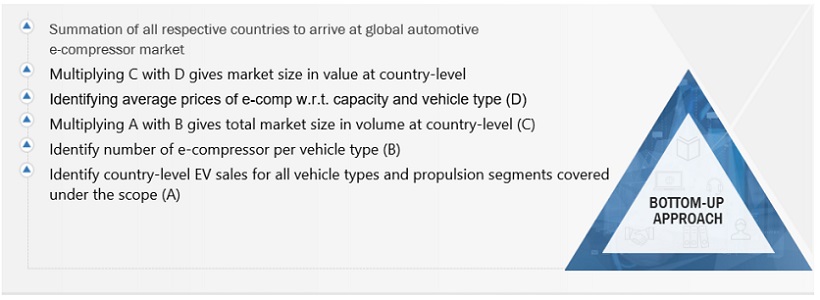
The bottom-up approach has been used to estimate and validate the size of the E-compressor market. In this approach, vehicle sales statistics for each vehicle type have been considered at the country and regional levels. The penetration of each propulsion for each vehicle type at the country level has been identified through model mapping to determine the e-compressor market size in terms of volume. Then, the penetration of each propulsion at vehicle type for all countries has been applied to obtain the volume of the e-compressor market.
Extensive secondary and primary research has been conducted to understand the global market scenario for the e-compressor used in the automotive sector. Several primary interviews have been conducted with key opinion leaders related to e-compressors, including OEMs, Tier 1 suppliers, and applications. Qualitative aspects such as drivers, restraints, opportunities, and challenges have been considered while calculating and forecasting the market size.
Automotive E-Compressor Market: Bottom-Up Approach
To know about the assumptions considered for the study, Request for Free Sample Report
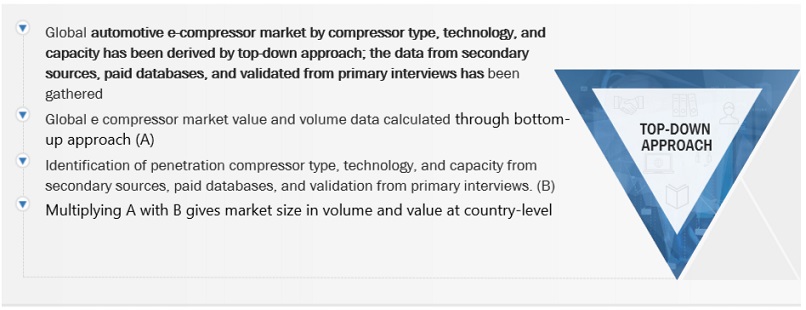
Automotive E-Compressor Market: Top-Down Approach
- The top-down approach has been used to determine the size of the automotive e-compressor market for the segment. Although the total market size in value (USD million) is derived using the bottom-up approach, the segment – by compressor, technology, and capacity is derived using the top-down approach.
- We have collected data from secondary research and paid databases and validated it through primary interviews. We have identified the penetration for each segment from the secondary sources. Additionally, the summation of companies’ revenue generated through the sale of a product and the total market size is calculated .
Data Triangulation
After arriving at the overall market size—using the market size estimation processes as explained above—the market was split into several segments and sub-segments. To complete the overall market engineering process and arrive at the exact statistics of each market segment and sub segment, data triangulation and market breakdown procedures were employed, wherever applicable. The data was triangulated by studying various factors and trends.
Market Definition
An electric compressor, or e-compressor, is a power unit that circulates refrigerant under pressure through the thermal management system. It is a crucial component in the thermal management system of electric vehicles. The primary function of the automotive e-compressor is to regulate the temperature within the vehicle cabin and manage the thermal conditions of critical components, such as batteries and power electronics.
In the HVAC (heating, ventilation, and air conditioning) system, the e-compressor plays a crucial role in providing efficient heating and cooling, ensuring passenger comfort. It also contributes to the thermal management of the battery pack, optimizing its performance and extending its lifespan. The e-compressor’s ability to operate independently from the vehicle’s engine allows for precise control over the climate inside the vehicle, enhancing energy efficiency and supporting the environmentally conscious goals of electric and hybrid vehicle technologies.
Stakeholders
- Automobile Organizations/Associations
- Country-specific Automotive Associations
- Dealers and Distributors of E-compressors
- Government & Research Organizations
- Manufacturers of Automotive E-compressors and Components
- Original Equipment Manufacturers (OEMs)
- Raw Material Suppliers for E-compressors
- Regulatory Bodies
- Traders and Suppliers of Automotive E-compressor Components
Report Objectives
- To define, describe, segment, and forecast the size of the automotive e-compressor market in terms of volume (thousand units) and value (USD billion/million), from 2019 to 2033
- To define, describe, and forecast the size of the market based on compressor type, capacity, vehicle type, propulsion, technology, and region
- To segment and forecast the size of the market, in terms of volume (thousand units) and value (USD million), based on compressor type (scroll compressors, rotary screw compressors, centrifugal compressors, reciprocating compressors, and axial compressors)
- To segment and forecast the size of the market, in terms of volume (thousand units) and value (USD million), based on capacity (small, medium, and large)
- To segment and forecast the size of the market, in terms of volume (thousand units) and value (USD million), based on vehicle type (passenger cars, light commercial vehicles, and heavy commercial vehicles)
- To segment and forecast the size of the market, in terms of volume (thousand units) and value (USD million), based on propulsion (BEV, PHEV, HEV, and FCEV)
- To segment the market based on technology [variable frequency drive (VFD) and fixed-speed]
- To define, describe, and forecast the size of the market, in terms of volume (units) and value (USD million), based on region (Asia Pacific, Europe, North America, Middle East & Africa)
- To understand the market dynamics (drivers, restraints, opportunities, and challenges) and conduct patent analysis, case study analysis, value chain analysis, regulatory analysis, and ecosystem mapping
- To strategically analyze markets with respect to individual growth trends, prospects, and contributions to the total market
- To strategically profile key players and comprehensively analyze their respective market share and core competencies
- To analyze recent developments, such as agreements, partnerships, collaborations, expansions, contracts, and product developments of key players in the automotive e-compressor market
- To understand the dynamics of the key market players and distinguish them into stars, emerging leaders, pervasive players, and participants according to their product portfolio strength and business strategies
- To analyze the opportunities offered by various segments of the market to its stakeholders
Available Customizations
Along with the market data, MarketsandMarkets offers customizations in accordance with company-specific needs.
The following customization options are available for the report:
- Market Size In Terms of Value (USD Million) And Volume (Thousand Units) At Country Level, By Propulsion Type
- Market Size In Terms Of Value (USD Million) And Volume (Thousand Units) At Country Level, By Compressor Type
- Detailed Analysis and Profiling of Additional Market Players
Get the Full Automotive E-Compressor Market Report
Full forecast, segment splits, and company analysis for all Automotive E-Compressor Market.
Need a Tailored Report?
Customize this report to your needs
Get 10% FREE Customization
Customize This Report
