
Spain Automotive Heat Exchanger Market (2025-2030)

The Spain Automotive Heat Exchanger Market was valued at $16839 Million in 2025 and projected to reach to $18000 Million by 2030, representing a compound annual growth rate of 1.0%. Spain's automotive heat exchanger market is positioned for steady growth through 2030, supported by the country's robust automotive manufacturing ecosystem and the transition toward electrified vehicles.


| Market Size in | USD 26.32 MN |
| Market Forecast in | |
| CAGR | |
| Forecast Period | |
| Units Considered | Value (USD MN) |
Spain Automotive Heat Exchanger Market Trends and Insights
- Spain's market reflects steady but modest expansion, driven by the country's established automotive manufacturing base and increasing adoption of advanced thermal management technologies in vehicles.
- The Spanish automotive sector continues to invest in heat exchanger innovations to meet stringent EU emissions regulations and improve vehicle efficiency. During the 2025-2030 forecast period, Spain's heat exchanger market will benefit from rising demand for electric and hybrid vehicle platforms, which require sophisticated cooling solutions.
- Spain's position as a major European automotive hub supports sustained demand for OEM and aftermarket heat exchangers.
- However, the relatively low CAGR of 1.0% reflects market maturity and competitive pressures within the region, as manufacturers balance cost efficiency with technological advancement in thermal management systems..
Key Market Statistics
- CAGR (2025-2030) 1.0% CAGR
- Market Size, 2025 ~USD 16839 Million
- Forecast, 2030 ~USD 18000 Million
- Country Spain
Spain Automotive Heat Exchanger Market Overview
Steady Market Growth :
Spain's automotive heat exchanger market is valued at USD 16,839 million in 2025 and is projected to reach USD 18,000 million by 2030, with a CAGR of 1.0%, reflecting consistent but modest expansion in the region.
Strong Manufacturing Base :
Spain hosts one of Europe's largest automotive manufacturing sectors, with major OEM facilities driving sustained demand for advanced thermal management solutions and heat exchanger components.
Thermal Management Innovation :
Increasing adoption of advanced thermal management technologies in Spanish vehicle production, including electric and hybrid powertrains, is driving modernization of heat exchanger designs and materials.
EU Regulatory Compliance :
Spain's automotive sector is adapting to stringent EU emissions and efficiency regulations, spurring investment in high-performance heat exchangers for improved vehicle thermal efficiency.
Spain Automotive Heat Exchanger Market Dynamics
- The market's 1.0% CAGR reflects a mature but resilient sector adapting to evolving thermal management requirements.
- Spanish OEMs and suppliers are increasingly investing in advanced cooling technologies to meet EU environmental standards and enhance vehicle performance.
- The integration of electric and hybrid powertrains in Spanish production facilities is creating new opportunities for specialized heat exchanger solutions.
- Regional supply chain consolidation and technological partnerships are expected to strengthen market competitiveness and support sustainable expansion..
Market Ecosystem
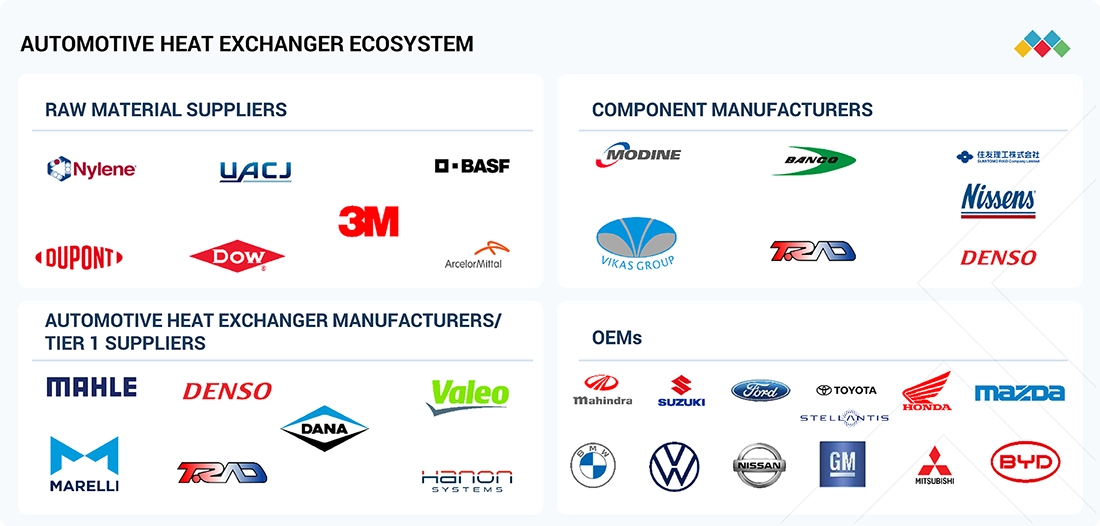
Automotive Heat Exchanger: COMMERCIAL USE CASES ACROSS INDUSTRIES
| COMPANY | USE CASE DESCRIPTION | BENEFITS |
|---|---|---|
 |
Supply high-performance polymers, coatings, and thermal interface materials used in heat exchanger manufacturing to improve durability, corrosion resistance, and thermal conductivity | Enables lightweight construction, extended lifecycle, and improved efficiency of heat exchangers under harsh thermal and chemical environments |
 |
Manufacture radiators, condensers, evaporators, EGR coolers, and battery cooling plates with precision brazing and advanced micro-channel designs | Provides high heat transfer efficiency, compact packaging for modern vehicles, and compliance with emission and fuel efficiency standards |
 |
Develop integrated thermal management modules for ICE, hybrid, and EV platforms, including battery thermal systems and cabin HVAC | Enhances vehicle performance, reduces emissions, and ensures thermal safety of batteries and power electronics in EVs |
 |
Integrate advanced heat exchangers into vehicle platforms to support combustion efficiency, lightweighting, and EV thermal management | Improves fuel economy in ICE vehicles, extends battery life in EVs, and ensures compliance with regulatory emission and safety standards |
Logos and trademarks shown above are the property of their respective owners. Their use here is for informational and illustrative purposes only.
Related Ecosystem
Automotive Materials
- Light Commercial Vehicles (LCVs)
- Battery Electric Vehicle (BEV)
- Hybrid Electric Vehicle (HEV)
- Fuel Cell Electric Vehicle (FCEV)
- Agricultural Tractors
- GORKOVSKY AVTOMOBILNY ZAVOD
- AISIN CORPORATION
- Continental ag
- Basf se
- BOSCH LIMITED
Key Takeaways
- Spain's automotive heat exchanger market is valued at USD 16,839 million in 2025 and will reach USD 18,000 million by 2030 at a 1.0% CAGR.
- Spain's mature automotive manufacturing sector drives steady demand for both OEM and aftermarket heat exchanger solutions.
- Electric and hybrid vehicle adoption in Spain is accelerating demand for advanced thermal management technologies.
- Spain's compliance with EU emissions standards and vehicle efficiency regulations supports continued investment in heat exchanger innovation.
Automotive Heat Exchanger Market Report Scope
| Report Metric | Details |
|---|---|
| Base Year | 2025 |
| Fastest Growing Segment | BATTERY ELECTRIC VEHICLE (Electric Vehicle Type) |
| Forecast Period | 2025-2030 |
| Growth Rate | CAGR of 1.5% from 2025 to 2030 |
| Largest Segment | ICE (Propulsion) |
| Market Size Base Year (Billions) | ~USD 26.98 (2025) |
| Revenue Forecast (Billions) | ~USD 29.06 (2030) |
| Segments Covered | Propulsion, Design, Vehicle Type, Electric Vehicle Type, Off-Highway Vehicle Type |
Spain Automotive Heat Exchanger Market Report Segmentation
5 segment dimensions are covered across the global market.
By Propulsion
- EV
- ICE
By Design
- Bar And Plate
- Plate Type
- Tube And Fin
By Vehicle Type
- Bus
- Light Commercial Vehicle
- Passenger Car
- Truck
By Electric Vehicle Type
- Battery Electric Vehicle
- Hybrid Electric Vehicle
- Plug-In Hybrid Vehicle
By Off-Highway Vehicle Type
- Agricultural Equipment
- Construction Equipment
Target Audience
- Automotive OEMs : Spanish and international vehicle manufacturers need market intelligence to optimize heat exchanger sourcing strategies, forecast component demand, and align production planning with regional market growth.
- Thermal Management Suppliers : Heat exchanger manufacturers and thermal solution providers require Spain-specific market data to identify growth opportunities, benchmark competitive positioning, and plan capacity investments.
- Investment & Private Equity : Financial investors evaluating automotive supply chain opportunities in Spain need detailed market sizing, growth projections, and sector dynamics to assess investment viability and returns.
- Automotive Consultants : Strategy and management consulting firms advising clients on Spanish automotive operations require granular market data, CAGR analysis, and regional trends to support client recommendations.
- Government & Trade Bodies : Spanish automotive industry associations, trade organizations, and government agencies need market intelligence to support policy development, industry advocacy, and economic planning initiatives.
Reasons to Buy this Report
- Market Size & Valuation Data : Access precise market valuation for Spain at USD 16,839 million (2025) and USD 18,000 million (2030), enabling accurate financial forecasting and investment planning specific to the Spanish market.
- Regional Growth Trajectory : Understand Spain's 1.0% CAGR in context of the global 1.5% rate, identifying localized growth drivers and competitive positioning within the European automotive heat exchanger landscape.
- Manufacturing Sector Insights : Leverage detailed analysis of Spain's established automotive manufacturing base, including OEM facility locations, production volumes, and thermal management technology adoption patterns.
- Regulatory & Technology Trends : Gain intelligence on EU compliance requirements, electrification trends, and advanced cooling technology implementations specific to Spanish automotive production and supply chains.
- Strategic Market Entry : Develop targeted go-to-market strategies for Spain with country-specific demand forecasts, competitive dynamics, and supplier ecosystem analysis to maximize market penetration.
Frequently asked questions
What is the current size of Spain's automotive heat exchanger market?
Spain's automotive heat exchanger market is valued at USD 16,839 million in 2025.
What is the projected market size for Spain's automotive heat exchanger market by 2030?
Spain's automotive heat exchanger market is forecast to reach USD 18,000 million by 2030.
What is the CAGR for Spain's automotive heat exchanger market?
Spain's automotive heat exchanger market is expected to grow at a CAGR of 1.0% from 2025 to 2030.
What factors are driving growth in Spain's automotive heat exchanger market?
Growth in Spain is driven by the country's established automotive manufacturing base, increasing EV and hybrid vehicle adoption, and compliance with EU emissions regulations.
Why is Spain's CAGR lower than the global average?
Spain's 1.0% CAGR reflects market maturity, competitive pressures, and a well-established automotive supply chain that limits explosive growth compared to emerging markets.
RESEARCH METHODOLOGY
The study encompasses four primary tasks to determine the present and future scope of the automotive heat exchanger market. Initially, extensive secondary research has been conducted to gather data on the market, its related sectors, and overarching industries. Subsequently, primary research involving industry experts across the value chain corroborated and validated these findings and assumptions. The complete market size has been estimated by using both top-down and bottom-up methodology. Following this, a market breakdown and data triangulation approach were utilized to determine the size of specific segments and subsegments within the market.
Secondary Research
In the secondary research process, various secondary sources such as company annual reports/presentations, press releases, industry association publications [for instance, International Organization of Motor Vehicle Manufacturers (OICA), National Highway Traffic Safety Administration (NHTSA), International Energy Association (IEA)], articles, directories, technical handbooks, trade websites, technical articles, and databases (for instance, MarkLines and Factiva) have been used to identify and collect information useful for an extensive commercial study of the global automotive heat exchanger market.
Primary Research
In the primary research process, various primary sources from both the supply and demand sides have been interviewed to obtain qualitative and quantitative information on the market. The primary sources from the supply side included various industry experts, such as CXOs, vice presidents, directors from business development, marketing, product development/innovation teams, and related key executives from various key companies. Various system integrators, industry associations, independent consultants/industry veterans, and key opinion leaders were also interviewed.
Primary interviews have been conducted to gather insights such as sizing estimates on the automotive heat exchanger market and forecast, future technology trends, and upcoming technologies in the automotive heat exchanger market. Data triangulation of all these points has been done using the information gathered from secondary research and model mapping. Stakeholders from the demand and supply sides have been interviewed to understand their views on the abovementioned points.
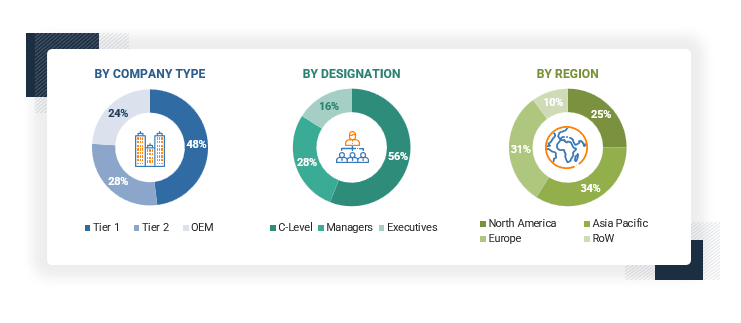
Note 1: Others include sales managers, marketing managers, and product managers.
Note 2: Tier 1 companies’ revenues are more than USD 10 billion; tier 2 companies’ revenues range between USD 1 and 10 billion; and tier 3 companies’ revenues range between USD 500 million and USD 1 billion.
Source: Industry Experts
To know about the assumptions considered for the study, download the pdf brochure
Market Size Estimation
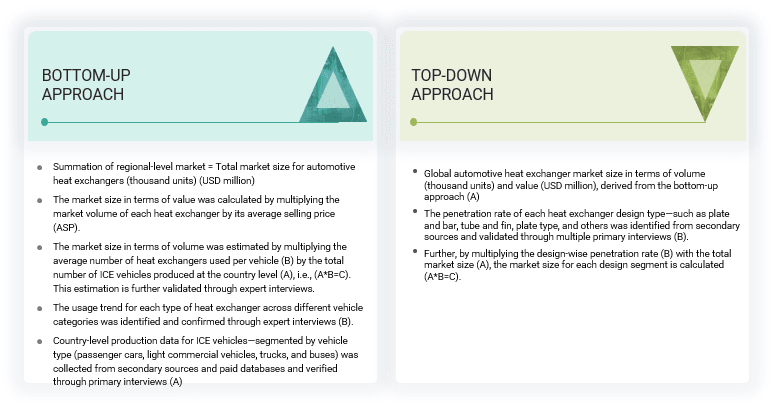
Both top-down and bottom-up approaches have been used to estimate and validate the total size of the automotive heat exchanger market. These methods have also been used extensively to estimate the size of various subsegments in the market. The research methodology used to estimate the market size includes the following:
Automotive Heat Exchanger Market : Top-Down and Bottom-Up Approach
Data Triangulation
After arriving at the overall market size, using the market size estimation processes as explained above, the market has been split into several segments and subsegments. To complete the overall market engineering process and arrive at the exact statistics of each market segment and subsegment, data triangulation and market breakdown procedures have been employed, wherever applicable. The data has been triangulated by studying various factors and trends from both the demand and supply sides.
Market Definition
Automotive heat exchangers are components used to transfer heat between fluids, such as coolants, oil, or refrigerants, to regulate temperatures in various vehicle systems. They play a critical role in engine cooling, air conditioning, battery thermal management, and power electronics in ICE and electric vehicles.
Stakeholders
- Automotive component manufacturers
- Associations, forums, and alliances related to automobiles
- Automotive original equipment manufacturers
- Automotive investors
- Raw material suppliers for automotive heat exchangers
- Automotive heat exchanger manufacturers
- Government agencies and policymakers
- Traders and distributors of automotive heat exchangers
Report Objectives
-
To define, segment, and forecast the size of the automotive heat exchanger market in terms of value (USD million) and volume (thousand units) from 2025 to 2032, based on
- Propulsion type (ICE and EV)
- Design (bar and plate, tube and fin, plate type, and others)
- Off-highway vehicle type (agricultural equipment and construction equipment)
- Vehicle type (passenger car, light commercial vehicle, truck, and bus)
- Electric vehicle type (BEV, PHEV, and HEV)
- Component (Radiator, condenser, evaporator, oil cooler (transmission & engine oil), heater, charge air cooler, exhaust gas recovery, battery cooling system, chiller, and water-cooled condenser)
- Region (Asia Pacific, Europe, North America, and the Rest of the World)
- To identify and analyze key drivers, restraints, opportunities, and challenges influencing market growth
- To strategically analyze the market for individual growth trends, prospects, and contributions to the total market
-
To study the following with respect to the market
- Supply Chain Analysis
- Ecosystem Analysis
- Technology Analysis
- Trade Analysis
- Pricing Analysis
- Case Study Analysis
- Patent Analysis
- Regulatory Framework
- Key Stakeholders and Buying Criteria
- Key Conferences and Events
- MNM Insights on Advancements in Heat Exchangers
- Future of Automotive Heat Exchangers for Alternative Fuel Technologies
- Key OEM Refrigerant Trend, By Region
- Supplier Analysis
- MNM Insights on Future Heat Exchanger Products
- To strategically profile key players and comprehensively analyze their market share and core competencies
- To analyze the opportunities for stakeholders and the competitive landscape for market leaders
- To track and analyze competitive developments such as deals (collaboration, agreement, and acquisition), product launches/developments, expansions, and other activities undertaken by the key industry participants
Available Customizations
With the given market data, MarketsandMarkets offers customizations in accordance with company-specific needs.
AUTOMOTIVE HEAT EXCHANGER MARKET BY EV TYPE, AT COUNTRY LEVEL
AUTOMOTIVE HEAT EXCHANGER MARKET BY COMPONENT TYPE, AT COUNTRY LEVEL
COMPANY INFORMATION
- Profiling of additional market players (up to five)
Get the Full Automotive Heat Exchanger Market Report
Full forecast, segment splits, and company analysis for all Automotive Heat Exchanger Market.
- China Automotive Heat Exchanger Market
- India Automotive Heat Exchanger Market
- Japan Automotive Heat Exchanger Market
- South Korea Automotive Heat Exchanger Market
- Germany Automotive Heat Exchanger Market
- France Automotive Heat Exchanger Market
- UK Automotive Heat Exchanger Market
- Italy Automotive Heat Exchanger Market
- Canada Automotive Heat Exchanger Market
- Mexico Automotive Heat Exchanger Market
- US Automotive Heat Exchanger Market
- Brazil Automotive Heat Exchanger Market
- Russia Automotive Heat Exchanger Market
- South Africa Automotive Heat Exchanger Market
- Rest Of Europe Automotive Heat Exchanger Market
- Rest Of Asia Pacific Automotive Heat Exchanger Market
Need a Tailored Report?
Customize this report to your needs
Get 10% FREE Customization
Customize This Report
