
Latin America Automotive Software Market (2026-2031)

The Latin America Automotive Software Market was valued at $1383.2 Million in 2026 and projected to reach to $2501.2 Million by 2031, representing a compound annual growth rate of 8.8%. Latin America's automotive software market is positioned for sustained growth through 2031, driven by increasing vehicle electrification, connectivity demands, and regulatory pressures for emissions reduction.


| Market Size in | USD 26.32 MN |
| Market Forecast in | |
| CAGR | |
| Forecast Period | |
| Units Considered | Value (USD MN) |
Latin America Automotive Software Market Trends and Insights
- This 8.8% compound annual growth rate reflects Latin America's increasing adoption of connected vehicle technologies, autonomous driving capabilities, and digital transformation across the automotive sector.
- Latin America is capitalizing on regional manufacturing hubs and rising consumer demand for advanced infotainment and safety systems. The Latin America automotive software market is driven by regulatory pressures for emissions compliance, growing vehicle electrification, and the integration of artificial intelligence and cloud-based solutions.
- Latin America's automotive OEMs and suppliers are investing heavily in software development to remain competitive globally.
- Between 2026 and 2031, Latin America will see accelerated deployment of over-the-air updates, cybersecurity frameworks, and mobility-as-a-service platforms, positioning the region as a key player in the global automotive software ecosystem..
Key Market Statistics
- CAGR (2026-2031) 8.8% CAGR
- Market Size, 2026 ~USD 1383.2 Million
- Forecast, 2031 ~USD 2501.2 Million
- Geography Latin America
Latin America Automotive Software Market Overview
Strong Regional Growth Trajectory :
Latin America's automotive software market is expanding at 8.8% CAGR, growing from $1,383.2 million in 2026 to $2,501.2 million by 2031, demonstrating robust demand for digital automotive solutions across the region.
Connected Vehicle Adoption Surge :
Increasing adoption of connected vehicle technologies is driving market expansion in Latin America, as manufacturers and consumers embrace IoT-enabled features, real-time diagnostics, and cloud-based vehicle management systems.
Autonomous Driving Integration :
Latin American automotive sector is progressively integrating autonomous driving capabilities, with software solutions enabling advanced driver assistance systems (ADAS) and self-driving functionalities across vehicle platforms.
Digital Transformation Momentum :
The region is experiencing accelerated digital transformation in automotive operations, including fleet management software, predictive maintenance systems, and enhanced in-vehicle infotainment platforms.
Latin America Automotive Software Market Dynamics
- Major automotive manufacturers are investing heavily in software development centers across Brazil and Mexico, capitalizing on the region's technical talent and manufacturing infrastructure. The market will benefit from rising consumer expectations for advanced features, growing middle-class vehicle ownership, and government incentives for smart mobility solutions.
- Strategic partnerships between global software providers and regional OEMs will accelerate innovation, while cloud computing adoption and 5G infrastructure expansion will enable next-generation automotive applications across Latin America..
Market Ecosystem
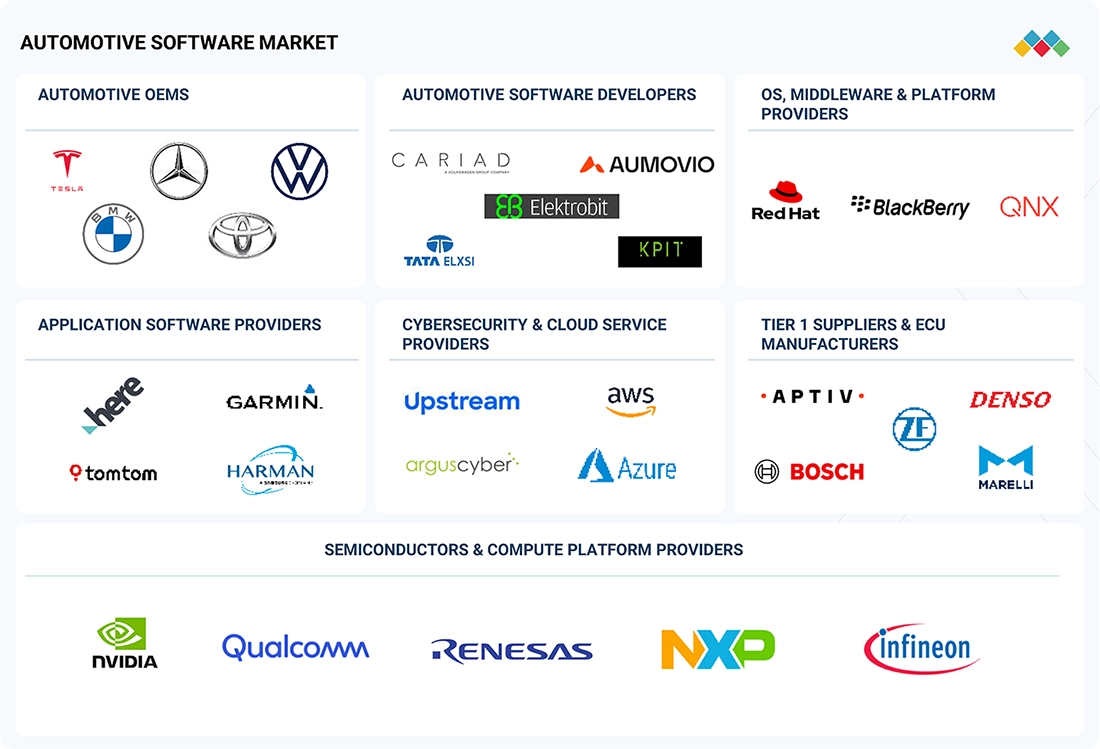
AUTOMOTIVE SOFTWARE MARKET SIZE, SHARE & ANALYSIS: COMMERCIAL USE CASES ACROSS INDUSTRIES
| COMPANY | USE CASE DESCRIPTION | BENEFITS |
|---|---|---|
 |
Development of software-defined vehicle platforms integrating vehicle operating systems, ADAS, AI, software lifecycle management, and cloud connected services across multiple vehicle domains | Accelerates software deployment, enables continuous feature upgrades, reduces development complexity, and supports recurring software revenue |
 |
AI driven centralized vehicle computing platform supporting autonomous driving, digital cockpit, and Generative AI applications through the NVIDIA DRIVE software stack | Supports AI-intensive workloads, enables centralized computing, improves software scalability, and reduces time to deployment |
 |
Software-enabled vehicle compute platforms supporting domain controllers, middleware, secure connectivity, and service-oriented vehicle architectures | Enables scalable software integration, improves vehicle cybersecurity, and supports migration to centralized vehicle architectures |
 |
Development of ADAS and automated driving software platforms, including computer vision, REM mapping, driver monitoring, sensor fusion, and autonomous driving solutions such as Mobileye SuperVision and Chauffeur | Enables scalable ADAS deployment, improves perception and automated driving capabilities, supports hands free driving, and provides OEMs with a software-based path toward higher levels of vehicle automation |
 |
Development of software platforms for ADAS, vehicle connectivity, cockpit systems, and centralized vehicle architectures for software-defined vehicles | Improves software integration, supports faster feature deployment, enhances vehicle intelligence, and enables scalable software platforms |
Logos and trademarks shown above are the property of their respective owners. Their use here is for informational and illustrative purposes only.
Related Ecosystem
Automotive Advance Technologies
- Battery Electric Vehicle (BEV)
- Light Commercial Vehicles (LCVs)
- Fuel Cell Electric Vehicle (FCEV)
- Hybrid Electric Vehicle (HEV)
- Internal Combustion Engine (ICE)
- BOSCH LIMITED
- Continental ag
- Visteon Corporation
- DENSO Corporation
- ZF FRIEDRICHSHAFEN AG
Key Takeaways
- Latin America's automotive software market will nearly double from $1,383.2M (2026) to $2,501.2M (2031), representing an 8.8% CAGR.
- Latin America is witnessing rapid adoption of connected vehicle and autonomous driving technologies, driven by OEM investment and consumer demand.
- Regulatory compliance for emissions and safety standards is accelerating software innovation across Latin America's automotive supply chain.
- Latin America's regional manufacturing strength positions it as a critical hub for software development and integration in the Americas.
Automotive Software Market Report Scope
| Report Metric | Details |
|---|---|
| Base Year | 2026 |
| Fastest Growing Segment | AUTOPILOT (Ev Application) |
| Forecast Period | 2026-2031 |
| Growth Rate | CAGR of 9.8% from 2026 to 2031 |
| Largest Segment | OEM (Sales Channel) |
| Market Size Base Year (Billions) | ~USD 43.27 (2026) |
| Revenue Forecast (Billions) | ~USD 69.06 (2031) |
| Segments Covered | Ice Application, Software Layer, Vehicle Type, Ev Application, Sales Channel, Propulsion |
Latin America Automotive Software Market Report Segmentation
6 segment dimensions are covered across the global market.
By Ice Application
- ADAS & Safety Systems
- AI
- Autopilot
- Body Control & Comfort System
- Body Control & Comfort Systems
- Engine Management & Powertrain
- Infotainment System
- Infotainment Systems
- Vehicle Management & Telematics
- Vehicle Telematics
By Software Layer
- Application Software
- Middleware
- Operating System
By Vehicle Type
- Heavy Commercial Vehicle
- Light Commercial Vehicle
- Passenger Car
By Ev Application
- ADAS & Safety Systems
- AI
- Autopilot
- Battery Management Systems
- Body Control & Comfort Systems
- Electric Drive
- Engine Management & Powertrain
- Infotainment Systems
- Vehicle Management & Telematics
By Sales Channel
- Aftermarket
- OEM
By Propulsion
- Electric Vehicle
- Internal Combustion Engine
Target Audience
- Automotive OEMs & Tier-1 Suppliers : Manufacturers and suppliers need Latin America-specific market data to develop regional product strategies, allocate R&D budgets, and identify partnership opportunities in connected and autonomous vehicle segments.
- Software & Technology Companies : Software providers require detailed market insights to assess Latin America's growth potential, understand regional customer needs, and develop localized solutions for automotive applications.
- Investment & Private Equity Firms : Investors need comprehensive market forecasts and country-level data to evaluate acquisition targets, fund automotive tech startups, and identify high-growth opportunities in Latin America.
- Automotive Fleet Operators : Fleet management companies require market intelligence on software solutions, pricing trends, and technology adoption rates to optimize operations and select appropriate software platforms.
- Government & Policy Makers : Regional authorities need market data to develop automotive policies, incentivize software innovation, support digital transformation initiatives, and align with global sustainability standards.
Countries within Latin America - compare and drill down
| Country | 2025 size (native) |
|---|---|
| Brazil | USD 1913.4 Million |
| Mexico | USD 3306.1 Million |
| Argentina | USD 490.2 Million |
| Rest Of Latin America | USD 97.5 Million |
Country market size visualization
Reasons to Buy this Report
- Market Size & Growth Validation : Comprehensive data validating Latin America's $1,383.2M market size in 2026 and $2,501.2M forecast for 2031, enabling accurate business planning and investment decisions specific to the region.
- Country-Level Intelligence : Detailed market breakdowns for Brazil, Mexico, and Argentina, allowing stakeholders to identify high-opportunity markets and tailor go-to-market strategies by country-specific dynamics.
- Technology Trend Analysis : In-depth insights into connected vehicles, autonomous driving adoption, and digital transformation initiatives across Latin America, helping identify emerging opportunities and competitive positioning.
- Competitive Landscape Mapping : Strategic understanding of regional and global players entering Latin America's automotive software space, enabling informed partnership and acquisition strategies.
- Investment & Expansion Planning : Actionable forecasts and market dynamics to support capital allocation decisions, R&D investments, and regional expansion strategies for automotive software providers.
Frequently asked questions
What is the current size of the automotive software market in Latin America?
In 2026, Latin America's automotive software market is valued at $1,383.2 million USD, with expectations to reach $2,501.2 million by 2031.
What is the projected growth rate for automotive software in Latin America?
Latin America's automotive software market is projected to grow at a compound annual growth rate (CAGR) of 8.8% from 2026 to 2031.
What are the primary drivers of automotive software growth in Latin America?
Key drivers in Latin America include vehicle electrification, connected vehicle adoption, regulatory emissions compliance, autonomous driving development, and digital transformation initiatives by regional OEMs.
Which segments are leading automotive software adoption in Latin America?
Latin America is seeing strong adoption in infotainment systems, advanced driver assistance systems (ADAS), cybersecurity solutions, and over-the-air update platforms.
How does Latin America's automotive software market compare to global trends?
Latin America's 8.8% CAGR is slightly below the global average of 9.8%, reflecting regional economic conditions while still demonstrating strong market momentum and investment potential.
RESEARCH METHODOLOGY
The study involved four major activities to estimate the current size of the automotive software market. Exhaustive secondary research was done to collect information on the market, the peer market, and model mapping. The next step was to validate these findings, assumptions, and sizing with the industry experts across value chains through primary research. The bottom-up and top-down approaches were employed to estimate the total market size. After that, market breakdown and data triangulation were used for determining the market size of segments and subsegments.
Secondary Research
Secondary sources referred to for this research study included automotive industry organizations involved with automotive software; publications from government sources [such as country level automotive associations and organizations, Organisation for Economic Co-operation and Development (OECD), World Bank, CDC, and Eurostat]; corporate filings (annual reports, investor presentations, and financial statements); and trade, business, and automotive associations. Secondary data was collected and analyzed to arrive at the overall market size, which was further validated through primary research.
Primary Research
Extensive primary research was conducted after acquiring an understanding of the automotive software market scenario through secondary research. Several primary interviews were conducted with market experts from both the demand (OEMs) and supply (automotive software providers, technology providers, and component manufacturers) sides across major regions: North America, Europe, Asia Pacific, Latin America, and the Rest of the World. Approximately 40% and 60% of primary interviews were conducted from the demand and supply sides, respectively. Primary data was collected through questionnaires, emails, and telephonic interviews.
In the canvassing of primaries, various departments within organizations, such as sales, operations, and marketing, were covered to provide a holistic viewpoint in the report. After interacting with industry experts, brief sessions were conducted with highly experienced independent consultants to reinforce the findings from primaries. This, along with the in-house subject matter experts’ opinions, led to the findings described in the remainder of this report.
BREAKDOWN OF PRIMARIES
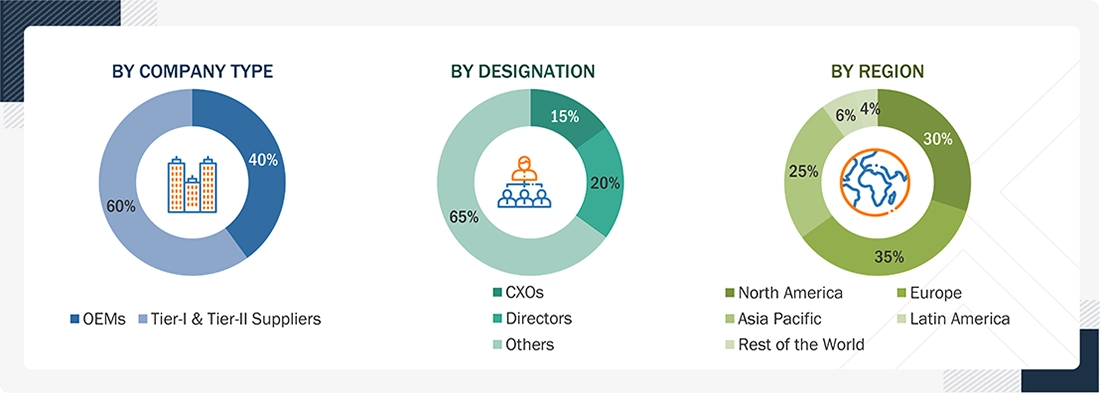
Note: Tiers of companies are based on the value chain of the automotive software market; the revenues of companies were not considered. Tier 1 companies include automotive software providers, and Tier II companies are system integrators.
To know about the assumptions considered for the study, download the pdf brochure
Market Size Estimation
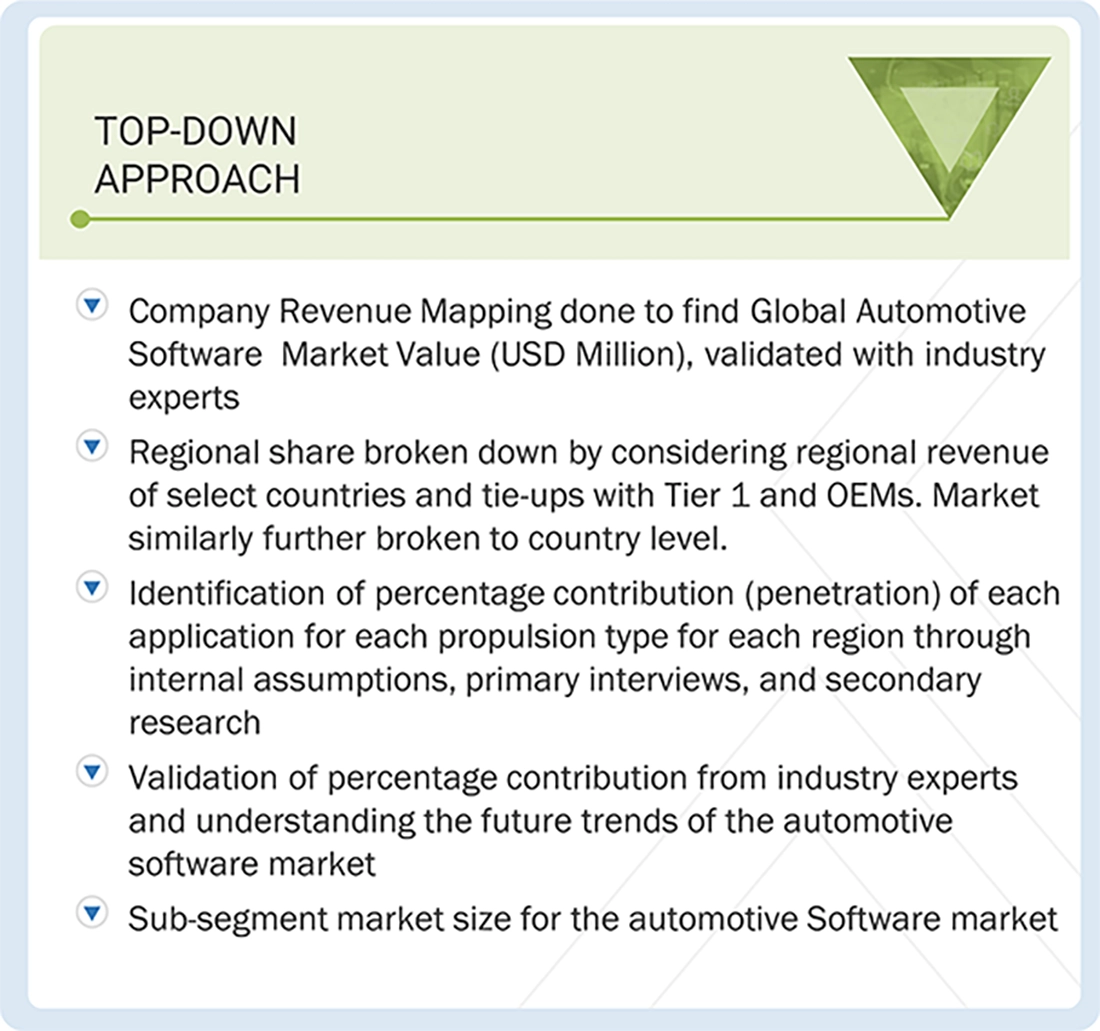
The top-down methodology was followed for the estimation of the automotive software market by software layer, propulsion, channel sales, and application. The segmental split of the software layer segment was derived by mapping software solutions across operating systems, middleware, and application software layers used in vehicles. The segmental split of the propulsion segment was derived by analyzing software requirements across internal combustion engines and electric vehicles. The segmental split of the channel sales segment was derived by identifying software deployment through OEMs and aftermarket across vehicle type. The segmental split of the application segment was derived by mapping software deployment across ADAS and autonomous driving, infotainment and digital cockpit, connected vehicle, powertrain, body and comfort, cybersecurity, and other vehicle applications. This provides the regional market size by software layer, propulsion, and application in terms of value. The summation of all regional markets leads to the global-level market in terms of volume and value.
Automotive Software Market : Top-Down and Bottom-Up Approach
Data Triangulation
After arriving at the overall market size of the global market through the above-mentioned methodology, this market was split into several segments and subsegments. The data triangulation and market breakdown procedure were employed, wherever applicable, to complete the overall market engineering process and arrive at the exact market value data for the key segments and subsegments. The extrapolated market data was triangulated by studying various macro indicators and regional trends from both the demand- and supply-side participants.
Market Definition
Automotive software is a collected programmable data instructions used for performing operations of computer-based in-vehicle applications. It also refers to the software used for in-vehicle embedded systems. Computer-based in-vehicle applications include telematics, infotainment, powertrain, body control and comfort, communication, ADAS, and safety.
Key Stakeholders
- ADAS Manufacturers
- Associations, Forums, and Alliances Related to Automotive Software
- Authorized and Independent Automobile Service Centers
- Automotive Component Manufacturers
- Automotive Cybersecurity Providers
- Automotive Dealers and Distributors
- Automotive Electronic Control Unit Manufacturers
- Automotive OEMs
- Automotive Software Consortiums
- Automotive Component Manufacturers
- Automotive Software Manufacturers
- Automotive Telematics Control Unit Manufacturers
- Autonomous Vehicle Manufacturers
- Autonomous Vehicle System Suppliers
- ECU Manufacturers
- Electrical and Electronic Component Suppliers
- EV Charging Manufacturers and Service Providers
- EV Component Manufacturers
- EV Manufacturers
- Legal and Regulatory Authorities
- Raw Material Suppliers for Automotive OEMs
- Raw Material Suppliers for Automotive Software or Components
- Sensor Manufacturers
- Vehicle Safety Regulatory Bodies
- Network Providers
- SOS Services Providers
Report Objectives
-
To define, describe, and forecast the global automotive software market based on software layer, ICE application, EV application, propulsion, sales channel, vehicle type, and region
-
To segment and forecast the market size by software layer (operating system, middleware, and application software)
-
To segment and forecast the market size by ICE application (ADAS & safety systems, autonomous driving, body & comfort systems, infotainment systems, engine management & powertrain, and vehicle telematics)
-
To segment and forecast the market size by EV application (electric drive, battery management systems, ADAS & safety systems, autonomous driving, body control & comfort systems, infotainment systems, engine management & powertrain, and vehicle telematics)
-
To segment and forecast the market size by vehicle type (passenger car, light commercial vehicle, and heavy commercial vehicle)
-
To segment and forecast the market size by EV propulsion (electric vehicle (EV), internal combustion engine (ICE))
-
To segment and forecast the market size by sales channel (aftermarket, OEM)
-
To forecast the market size with respect to key regions: Asia Pacific, Europe, North America, Latin America, and the Rest of the World
-
To provide detailed information regarding the major factors influencing the market growth (drivers, challenges, restraints, and opportunities)
-
To strategically analyze the market with respect to individual growth trends, prospects, and contributions to the total market
-
To study the following with respect to the market
- Supply Chain Analysis
- Ecosystem Analysis
- Technology Analysis
- Case Study Analysis
- Patent Analysis
- Regulatory Landscape
- AI Adoption Across Vehicle Domains
- Investment and Funding Scenario
- Trends and Disruptions impacting Customer Business
- Key Stakeholders and Buying Criteria
- OEM Software Transformation & Next-generation Vehicle Architecture
- Software Revenue Pool Analysis
- Feature On-Demand (FoD) & Software Monetization
- Software Development Cost Analysis
-
To strategically profile key players and comprehensively analyze their market shares and core competencies
-
To track and analyze competitive developments such as deals, product developments, and other activities carried out by key industry participants
Available customizations:
With the given market data, MarketsandMarkets offers customizations in accordance with the company’s specific needs.
- Automotive Software Market, by EV Application, at Country Level (For countries covered in the report)
- Automotive Software Market, by Vehicle Type, at Country Level (For countries covered in the report)
- Automotive Software Market, by EV Propulsion, at Country Level (For countries covered in the report)
- Profiling of Additional Market Players (Up to 5)
Get the Full Automotive Software Market Report
Full forecast, segment splits, and company analysis for all Automotive Software Market.
- Mexico Automotive Software Market
- US Automotive Software Market
- Brazil Automotive Software Market
- Argentina Automotive Software Market
- Iran Automotive Software Market
- South Africa Automotive Software Market
- Rest Of Europe Automotive Software Market
- Rest Of Asia Pacific Automotive Software Market
- Rest Of Latin America Automotive Software Market
- China Automotive Software Market
- India Automotive Software Market
- Japan Automotive Software Market
- South Korea Automotive Software Market
- Thailand Automotive Software Market
- Germany Automotive Software Market
- France Automotive Software Market
- UK Automotive Software Market
- Spain Automotive Software Market
- Italy Automotive Software Market
- Russia Automotive Software Market
- Turkey Automotive Software Market
- Canada Automotive Software Market
Need a Tailored Report?
Customize this report to your needs
Get 10% FREE Customization
Customize This Report
