
US Autonomous Driving Software Market (2024-2029)

The US Autonomous Driving Software Market was valued at $1950.5 Million in 2024 and projected to reach to $2285.4 Million by 2029, representing a compound annual growth rate of 8.5%. The US autonomous driving software market is positioned for sustained growth as major OEMs and tech companies accelerate Level 2 and Level 3 deployment across consumer and commercial vehicle segments.


| Market Size in | USD 26.32 MN |
| Market Forecast in | |
| CAGR | |
| Forecast Period | |
| Units Considered | Value (USD MN) |
US Autonomous Driving Software Market Trends and Insights
- The US market is driven by significant investments from major automotive manufacturers and technology companies developing Level 2 and Level 3 autonomous capabilities.
- In 2024, the US leads North America in autonomous driving adoption, with regulatory frameworks and infrastructure investments supporting deployment across multiple vehicle segments. By 2029, the US autonomous driving software market will benefit from accelerating consumer acceptance, expanded OEM partnerships, and advancements in sensor fusion and AI algorithms.
- The US market growth is supported by federal initiatives promoting vehicle automation safety standards and state-level pilot programs.
- Key players in the US are focusing on software-as-a-service models and cloud-based platforms to enhance scalability and reduce development costs across the forecast period..
Key Market Statistics
- CAGR (2024-2029) 8.5% CAGR
- Market Size, 2024 ~USD 1950.5 Million
- Forecast, 2029 ~USD 2285.4 Million
- Country US
US Autonomous Driving Software Market Overview
Market Valuation :
The US autonomous driving software market is valued at $1,950.5 million in 2024, with strong growth trajectory driven by domestic innovation and regulatory support for self-driving technology development.
Growth Momentum :
With an 8.5% CAGR through 2029, the US market is expanding faster than global average, reaching $2,285.4 million by forecast end, reflecting accelerating adoption of Level 2 and Level 3 autonomous capabilities.
Key Market Drivers :
Significant investments from major US automotive manufacturers and Silicon Valley technology companies are propelling development of advanced autonomous systems, supported by favorable regulatory frameworks and consumer demand.
Technology Leadership :
The US maintains leadership in North America's autonomous driving sector, with concentrated innovation in California, Michigan, and Texas, attracting global talent and venture capital investment.
US Autonomous Driving Software Market Dynamics
- Regulatory clarity from NHTSA and state-level initiatives will continue to facilitate market expansion, while competition intensifies among Tesla, traditional automakers, and autonomous vehicle startups.
- Investment in edge computing, AI algorithms, and sensor fusion technologies will drive innovation cycles and market consolidation through 2029..
Market Ecosystem
Related Ecosystem
Automotive Advance Technologies
- Battery Electric Vehicle (BEV)
- Light Commercial Vehicles (LCVs)
- Fuel Cell Electric Vehicle (FCEV)
- Hybrid Electric Vehicle (HEV)
- Internal Combustion Engine (ICE)
- BOSCH LIMITED
- Continental ag
- Visteon Corporation
- DENSO Corporation
- ZF FRIEDRICHSHAFEN AG
Key Takeaways
- The US autonomous driving software market reaches $1,950.5M in 2024 and grows to $2,285.4M by 2029 at 8.5% CAGR.
- The US market is dominated by Level 2 and Level 3 autonomous systems, with OEM partnerships accelerating commercialization.
- The US regulatory environment and federal safety standards are key enablers for market expansion through 2029.
- The US market increasingly adopts cloud-based and SaaS delivery models to reduce deployment complexity and costs.
Autonomous Driving Software Market Report Scope
| Report Metric | Details |
|---|---|
| Base Year | 2024 |
| Fastest Growing Segment | L4 (Level Of Autonomy) |
| Forecast Period | 2024-2029 |
| Growth Rate | CAGR of 13.3% from 2024 to 2029 |
| Largest Segment | PASSENGER CARS (Vehicle Type) |
| Market Size Base Year (Billions) | ~USD 1.77 (2024) |
| Revenue Forecast (Billions) | ~USD 3.31 (2029) |
| Segments Covered | Level Of Autonomy, Vehicle Type, Propulsion |
US Autonomous Driving Software Market Report Segmentation
3 segment dimensions are covered across the global market.
By Level Of Autonomy
- L2+
- L3
- L4
By Vehicle Type
- Passenger Cars
By Propulsion
- Electric
- ICE
Target Audience
- Automotive OEMs : US-based and international automakers need detailed market analysis to guide autonomous software development investments, supplier selection, and competitive positioning in the rapidly evolving American market.
- Technology Companies : Software developers and AI/ML companies targeting the US autonomous vehicle sector require market sizing, growth forecasts, and competitive intelligence to prioritize R&D spending and partnership strategies.
- Venture Capital & Private Equity : Investors evaluating autonomous driving software startups and established players need US-specific market data, growth trajectories, and exit opportunities to make informed funding and acquisition decisions.
- Tier-1 Automotive Suppliers : Component and software suppliers require US market insights to align product roadmaps, forecast demand for autonomous-capable systems, and identify partnership opportunities with OEMs and tech companies.
- Policy & Regulatory Bodies : Government agencies, transportation departments, and regulatory organizations need market analysis to inform autonomous vehicle policy development, safety standards, and infrastructure investment decisions.
Reasons to Buy this Report
- US-Specific Market Sizing : Obtain precise valuation data for the US market ($1,950.5M in 2024) with country-specific forecasts through 2029, enabling accurate budget allocation and revenue projections for North American operations.
- Competitive Landscape Intelligence : Understand the competitive positioning of US-based autonomous driving software developers, including Tesla, traditional OEMs, and emerging startups, with insights into market share and strategic initiatives.
- Regulatory & Policy Insights : Access analysis of US regulatory environment, NHTSA guidelines, and state-level autonomous vehicle policies that directly impact market growth, product development timelines, and go-to-market strategies.
- Investment & Funding Trends : Identify venture capital and corporate investment patterns specific to US autonomous driving software companies, revealing growth opportunities and potential acquisition targets in the sector.
- Technology Adoption Roadmap : Benchmark Level 2 and Level 3 adoption rates across US vehicle segments and manufacturers, informing product development priorities and market entry strategies for autonomous software solutions.
Frequently asked questions
What is the current size of the US autonomous driving software market in 2024?
The US autonomous driving software market is valued at $1,950.5 million in 2024.
What is the projected size of the US autonomous driving software market by 2029?
The US autonomous driving software market is projected to reach $2,285.4 million by 2029.
What is the CAGR for the US autonomous driving software market?
The US autonomous driving software market is expected to grow at a compound annual growth rate of 8.5% from 2024 to 2029.
Which autonomous driving levels dominate the US market?
The US market is primarily driven by Level 2 and Level 3 autonomous systems, with major OEMs investing heavily in these capabilities.
What regulatory factors influence the US autonomous driving software market?
The US market is shaped by federal safety standards, NHTSA guidelines, and state-level pilot programs that establish frameworks for autonomous vehicle deployment.
RESEARCH METHODOLOGY
The study involved four major activities in estimating the current size of the autonomous driving software market. Exhaustive secondary research was done to collect information on the market, the peer market, and the child markets. The next step was to validate these findings, assumptions, and sizing with the industry experts across value chains through primary research. The top-down and bottom-up approaches were employed to estimate the complete market size. Thereafter, market breakdown and data triangulation processes were used to estimate the market size of segments and subsegments.
Secondary Research
In the secondary research process, various secondary sources such as company annual reports/presentations, press releases, industry association publications [for example, International Organization of Motor Vehicle Manufacturers (OICA), National Highway Traffic Safety Administration (NHTSA), International Energy Association (IEA)], articles, directories, technical handbooks, trade websites, technical articles, and databases (for example, Marklines, and Factiva) have been used to identify and collect information useful for an extensive commercial study of the global autonomous driving software market.
Primary Research
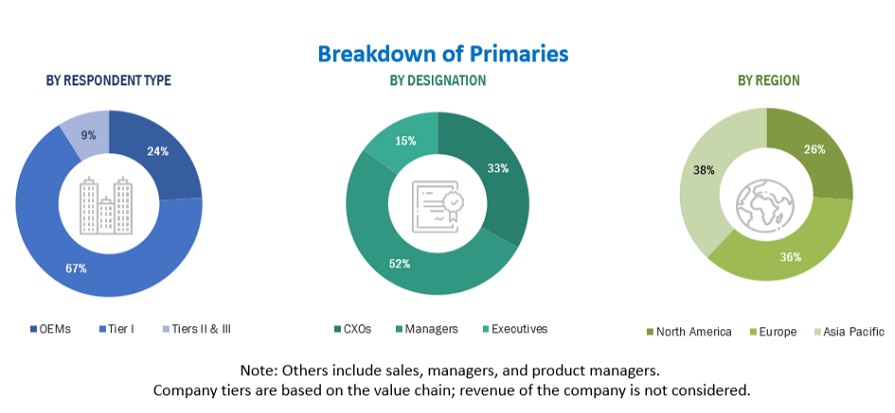
Extensive primary research was conducted after understanding the scenario of the autonomous driving software market through secondary research. Several primary interviews were conducted with market experts from both the demand (OEMs) and supply (hardware providers, software providers, autonomous driving platform/OS providers, and other component manufacturers) across three major regions: North America, Europe and Asia Pacific. Approximately 52% and 48% of primary interviews were conducted from the demand and supply sides. Primary data was collected through questionnaires, emails, and telephonic interviews.
In the canvassing of primaries, various departments within organizations, such as sales, operations, and administration, were covered to provide a holistic viewpoint in this report. After interacting with industry experts, brief sessions with highly experienced independent consultants were also conducted to reinforce the findings from primaries. This and the in-house subject-matter experts’ opinions led to the findings described in the remainder of this report.
To know about the assumptions considered for the study, download the pdf brochure
Market Size Estimation
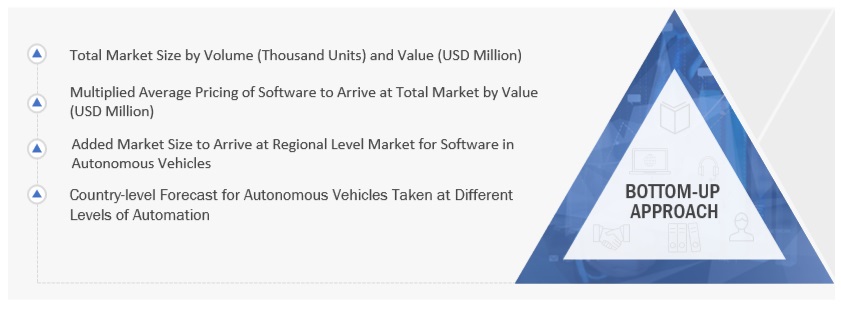
The bottom-up approach was used to estimate and validate the size of the autonomous driving software market. This method was also used extensively to estimate the size of various subsegments in the market. The research methodology used to estimate the market size includes the following:
- The key players in the industry and markets have been identified through extensive secondary research.
- The industry’s supply chain and market size, in terms of volume, have been determined through primary and secondary research processes.
All percentage shares, splits, and breakdowns have been determined using secondary sources and verified through primary sources.
To know about the assumptions considered for the study, Request for Free Sample Report
Market Size Validation
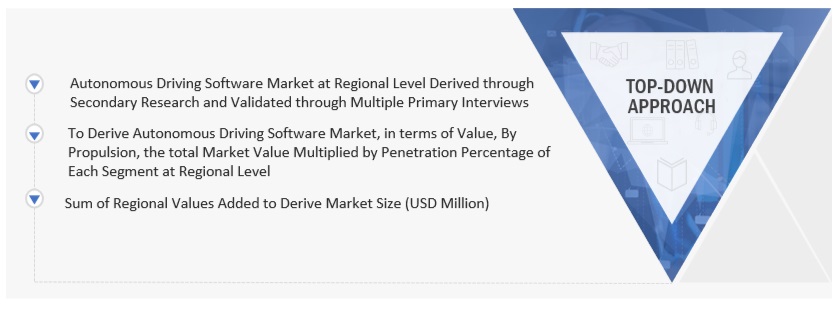
The top-down approach was used to determine the size of the autonomous driving software market for the propulsion segment. The market size breakdown by propulsion type in value (USD million) was derived using the top-down approach. For instance, the autonomous driving software market for the propulsion segment was derived using the top-down approach to estimate its subsegments. Mapping was carried out at the regional level to understand the contribution by propulsion type. The market size was derived at the regional level in terms of value.
Data Triangulation
After arriving at the overall market size—using the market size estimation processes as explained above—the market was split into several segments and subsegments. To complete the overall market engineering process and arrive at the exact statistics of each market segment and subsegment, data triangulation, and market breakdown procedures were employed, wherever applicable. The data was triangulated by studying various factors and trends from both the demand and supply sides.
Market Definition
Autonomous driving software is a set of computer programs and algorithms that allow a vehicle to operate autonomously, without the intervention of a human driver. This program observes, determines, and controls the vehicle's path by utilizing environmental data from sensors, cameras, and other sources. These technologies allow a vehicle to recognize things, determine pathways, and manage motion while moving on a roadway, avoiding impediments and obeying traffic laws safely and efficiently.
List of Key Stakeholders
- ADAS Integrators
- ADAS Solution Suppliers
- Associations, forums, and alliances related to autonomous vehicles
- Automotive Component Manufacturers
- Automotive sensor manufacturers
- Automotive SoC and ECU Manufacturers
- Automotive Software and Platform Providers
- Autonomous Driving Platform Providers
- Autonomous vehicle manufacturers
- Connectivity Service Providers
- Country-specific Automotive Associations
- Designing & Testing Companies
- European Automobile Manufacturers’ Association (ACEA)
- National Highway Traffic Safety Administration (NHTSA)
Available Customizations
With the given market data, MarketsandMarkets offers customizations in accordance with the company’s specific needs.
- Autonomous driving software market, by Software Subscription, at regional level
- Autonomous driving software market, by Propulsion, at country level
- Profiling of additional market players (up to 3)
Get the Full Autonomous Driving Software Market Report
Full forecast, segment splits, and company analysis for all Autonomous Driving Software Market.
- China Autonomous Driving Software Market
- Japan Autonomous Driving Software Market
- South Korea Autonomous Driving Software Market
- India Autonomous Driving Software Market
- Germany Autonomous Driving Software Market
- France Autonomous Driving Software Market
- UK Autonomous Driving Software Market
- Spain Autonomous Driving Software Market
- Sweden Autonomous Driving Software Market
- Canada Autonomous Driving Software Market
Need a Tailored Report?
Customize this report to your needs
Get 10% FREE Customization
Customize This Report
