
Germany Carbon Footprint Management Market (2025-2030)

The Germany Carbon Footprint Management Market was valued at $911 Million in 2025 and projected to reach to $2402.3 Million by 2030, representing a compound annual growth rate of 21.4%. Germany's carbon footprint management market is positioned for exceptional growth through 2030, driven by the country's ambitious climate neutrality goals and Europe's most stringent environmental policies.


| Market Size in | USD 26.32 MN |
| Market Forecast in | |
| CAGR | |
| Forecast Period | |
| Units Considered | Value (USD MN) |
Germany Carbon Footprint Management Market Trends and Insights
- This represents a compound annual growth rate of 21.4%, outpacing global averages and reflecting Germany's commitment to stringent environmental regulations and corporate sustainability mandates.
- Germany's leadership in the European energy transition, coupled with mandatory carbon reporting requirements under EU directives, is driving widespread adoption of carbon management solutions across industrial, manufacturing, and service sectors. The German market benefits from strong regulatory frameworks, including the German Supply Chain Due Diligence Act and alignment with EU Green Deal objectives.
- Germany's established base of mid-market and enterprise organizations is increasingly investing in digital carbon accounting platforms, emissions tracking software, and sustainability consulting services.
- Between 2025 and 2030, Germany is expected to consolidate its position as Europe's largest carbon footprint management market, with growing demand from both large corporations seeking net-zero compliance and smaller enterprises responding to supply chain pressures. Key drivers include Germany's industrial heritage requiring decarbonization, competitive advantages in green technology exports, and investor pressure for transparent ESG reporting.
- Germany's market maturity and regulatory sophistication position it as a critical hub for carbon management innovation and implementation across the continent..
Key Market Statistics
- CAGR (2025-2030) 21.4% CAGR
- Market Size, 2025 ~USD 911 Million
- Forecast, 2030 ~USD 2402.3 Million
- Country Germany
Germany Carbon Footprint Management Market Overview
Market Valuation Growth :
Germany's carbon footprint management market is valued at $911.0 million in 2025 and is projected to reach $2,402.3 million by 2030, representing a 163% increase over five years.
Above-Average CAGR :
Germany's market growth rate of 21.4% CAGR significantly outpaces the global average of 20.4%, demonstrating accelerated adoption driven by EU regulations and corporate sustainability initiatives.
Regulatory Leadership :
Germany's stringent environmental regulations, including the German Supply Chain Due Diligence Act and EU Green Deal compliance, are primary drivers pushing enterprises to invest in carbon management solutions.
Industrial Decarbonization Focus :
Germany's manufacturing and energy sectors are prioritizing carbon footprint reduction to meet net-zero targets by 2045, creating substantial demand for monitoring and reporting technologies.
Germany Carbon Footprint Management Market Dynamics
- The manufacturing, energy, and automotive sectors are leading adoption of carbon management solutions to comply with regulatory requirements and meet investor ESG expectations.
- German enterprises are increasingly integrating carbon accounting software, emissions monitoring platforms, and sustainability reporting tools into their operations. The market will be further accelerated by mandatory corporate sustainability reporting under the Corporate Sustainability Reporting Directive (CSRD) and growing consumer demand for transparent environmental practices.
- Investment in green technology infrastructure and the transition to renewable energy sources will create sustained demand for sophisticated carbon tracking and management solutions throughout the forecast period..
Market Ecosystem
Related Ecosystem
Automotive Advance Technologies
- Battery Electric Vehicle (BEV)
- Light Commercial Vehicles (LCVs)
- Fuel Cell Electric Vehicle (FCEV)
- Hybrid Electric Vehicle (HEV)
- Internal Combustion Engine (ICE)
- BOSCH LIMITED
- Continental ag
- Visteon Corporation
- DENSO Corporation
- ZF FRIEDRICHSHAFEN AG
Decarbonization
- Battery Electric Vehicle (BEV)
- Energy Management Systems
- Fuel Cell
- Fuel Cell Electric Vehicle (FCEV)
- Geographical Information System (GIS)
- TotalEnergies SE
- Siemens ag
- Mitsui & Co., Ltd.
- General Electric Company
- Thyssenkrupp ag
Key Takeaways
- Germany's carbon footprint management market will grow from $911.0M (2025) to $2,402.3M (2030) at a 21.4% CAGR, significantly outpacing global growth rates.
- Germany's stringent EU regulatory environment and mandatory carbon reporting requirements are primary catalysts driving market expansion across all industrial sectors.
- Germany's position as Europe's largest economy and industrial powerhouse creates substantial demand for enterprise-grade carbon accounting and emissions tracking solutions.
- Digital transformation and ESG compliance pressures are accelerating adoption of cloud-based carbon management platforms among German mid-market and large corporations.
Carbon Footprint Management Market Report Scope
| Report Metric | Details |
|---|---|
| Base Year | 2025 |
| Fastest Growing Segment | FINANCIAL SERVICES (Vertical) |
| Forecast Period | 2025–2030 |
| Growth Rate | CAGR of 20.4% from 2025 to 2030 |
| Largest Segment | SOLUTIONS (Component) |
| Market Size Base Year (Billions) | ~USD 15.07 (2025) |
| Revenue Forecast (Billions) | ~USD 38.14 (2030) |
| Segments Covered | Organization Size, Vertical, Industry, Component, Service, Deployment Mode, Manufacturing Industry |
Germany Carbon Footprint Management Market Report Segmentation
7 segment dimensions are covered across the global market.
By Organization Size
- Corporates/Enterprises
- Mid-Tier Enterprises
- Small Businesses
By Vertical
- Energy & Utilities
- Financial Services
- Government
- It & Telecom
- Manufacturing
- Residential & Commercial Buildings
- Transportation & Logistics
By Industry
- Automotive
- Chemical & Materials
- Electronics & Consumer Goods
- Food & Beverages
- Metals & Mining
- Pharmaceutical & Healthcare
By Component
- Services
- Solutions
By Service
- Consulting
- Integration & Deployment
- Support & Maintenance
By Deployment Mode
- Cloud
- On-Premises
By Manufacturing Industry
- Automotive
- Chemical & Materials
- Electronic & Consumer Goods
- Electronics & Consumer Goods
- Food & Beverages
- Metals & Mining
- Pharmaceutical & Healthcare
Target Audience
- Carbon Management Software Vendors : Need detailed market data to identify expansion opportunities in Germany, understand customer requirements, and develop localized solutions compliant with German and EU regulations.
- Sustainability Consulting Firms : Require market intelligence to advise clients on carbon footprint management investments, benchmark against German industry standards, and recommend appropriate technology solutions.
- Corporate Sustainability Officers : Need market insights to evaluate carbon management solution providers, understand best practices in German enterprises, and justify investments in emissions tracking infrastructure.
- Private Equity & Investment Firms : Seek comprehensive market analysis to identify acquisition targets, assess growth potential of German carbon management companies, and evaluate sector investment opportunities.
- Energy & Manufacturing Companies : Need market data to benchmark their carbon management initiatives against competitors, identify leading solution providers, and plan digital transformation investments for emissions reduction.
Key Companies in the Germany Carbon Footprint Management Market
| Company | HQ | Ownership | Strongest segments |
|---|---|---|---|
| AISIN SEIKI CO LTD | Japan | Public Company | Automatic, CVT, and manual transmissions,eAxle and electrified driveline,Brakes, steering, doors, roofs, and body systems, |
| BOOZ ALLEN HAMILTON | United States | Public Company | AI and Advanced Analytics Solutions,Cybersecurity Solutions and Services,Cloud, Data Platforms, and Modernization, |
| BAKER HUGHES INC. | United States | Public Company | Drilling, Completions & Well Services,Subsea, Surface & Pressure Control Systems,Artificial Lift, Chemicals & Production Optimization, |
| EVRAZ | United Kingdom | Private Company | Infrastructure steel & construction long products,Rails and railway products,Pipes and OCTG, |
| CLP POWER HONG KONG LIMITED | Hong Kong | Private Company | Transmission and distribution network services,Generation (gas-fired combined-cycle),Generation (coal-fired units), |
| SAP SE | Germany | Public Company | SAP S/4HANA and core ERP,SAP SuccessFactors and HR solutions,SAP Business Technology Platform and Business AI, |
| SALESFORCE, INC. | United States | Public Company | Core CRM, Sales & Service (including Agentforce Sales and Agentforce Service),Platform, Data 360, Informatica, and Integration/Analytics,Slack and Collaboration, |
| ENGIE | France | Public Company | Renewables & Flex Power,Networks (Gas & Power Infrastructure),Local Energy Infrastructures, |
| SCHNEIDER ELECTRIC | France | Public Company | Low- and medium-voltage products and systems,Building management, power metering, and critical power (UPS, cooling),Industrial automation, drives, and control software, |
| IBM | United States | Public Company | Software (Hybrid Cloud & AI Platforms),Consulting (Strategy, Technology, Operations),Infrastructure (Servers, Storage, Lifecycle Services), |
AISIN SEIKI CO LTD
AISIN SEIKI CO LTD is a Japanese public company founded in 1943 with 113,292 employees. The company operates as a major automotive supplier and diversified manufacturer.
BOOZ ALLEN HAMILTON
Booz Allen Hamilton is a United States-based public company founded in 1914 with 31,500 employees. The company provides consulting, analytics, and digital solutions primarily to government and commercial clients.
BAKER HUGHES INC.
Baker Hughes Inc. is a United States-based public company founded in 2016 with 53,000 employees. The company operates in the energy sector, providing equipment and services for oil, gas, and geothermal energy.
EVRAZ
EVRAZ is a United Kingdom-based private company founded in 1992 with 71,591 employees. The company is a major steel and mining producer serving global markets.
CLP POWER HONG KONG LIMITED
CLP Power Hong Kong Limited is a Hong Kong-based private company founded in 1901 with 4,411 employees. The company is a leading electricity provider in Hong Kong and surrounding regions.
SAP SE
SAP SE is a German public company founded in 1972 with 111,038 employees. The company is a global leader in enterprise resource planning (ERP) software and business applications.
SALESFORCE, INC.
Salesforce, Inc. is a United States-based public company founded in 1999 with 83,334 employees. The company provides cloud-based customer relationship management (CRM) and enterprise software solutions.
ENGIE
ENGIE is a French public company founded in 1880 with 84,809 employees. The company is a global leader in energy and environmental services, including utilities and renewable energy.
SCHNEIDER ELECTRIC
Schneider Electric is a French public company founded in 1836 with 158,122 employees. The company specializes in energy management and automation solutions for industrial, commercial, and residential markets.
IBM
IBM is a United States-based public company founded in 1911 with 264,300 employees. The company provides information technology services, software, and hardware solutions to businesses and organizations worldwide.
Reasons to Buy this Report
- Regulatory Compliance Intelligence : Understand Germany's evolving regulatory landscape including CSRD, Supply Chain Due Diligence Act, and EU Green Deal requirements to ensure your solutions meet mandatory compliance standards.
- Market Entry Strategy : Identify high-growth opportunities in Germany's manufacturing, automotive, and energy sectors with detailed insights into sector-specific carbon management needs and adoption rates.
- Competitive Positioning : Analyze the competitive landscape of German carbon management providers to benchmark your offerings, identify market gaps, and develop differentiated value propositions for German enterprises.
- Investment Decision Support : Access comprehensive market sizing, growth projections, and trend analysis to support investment decisions, partnership evaluations, and resource allocation in the German market.
- Customer Segmentation Insights : Understand which German industries, company sizes, and regions offer the highest ROI potential, enabling targeted marketing and sales strategies for maximum market penetration.
Frequently asked questions
What is the projected market size for carbon footprint management in Germany by 2030?
Germany's carbon footprint management market is projected to reach $2,402.3 million by 2030, up from $911.0 million in 2025, representing a 21.4% compound annual growth rate.
What regulatory drivers are accelerating carbon footprint management adoption in Germany?
Germany's adoption is driven by EU Green Deal compliance, mandatory carbon reporting under the Corporate Sustainability Reporting Directive (CSRD), the German Supply Chain Due Diligence Act, and national net-zero targets requiring transparent emissions tracking.
Which industries in Germany are driving the highest demand for carbon management solutions?
Germany's manufacturing, automotive, chemicals, energy, and logistics sectors are primary drivers, as these capital-intensive industries face the most stringent decarbonization requirements and supply chain pressures.
How does Germany's market growth compare to the global carbon footprint management market?
Germany's 21.4% CAGR exceeds the global average of 20.4%, reflecting Germany's advanced regulatory environment, industrial scale, and corporate sustainability commitments.
What types of carbon management solutions are most in demand in Germany?
German organizations are increasingly adopting digital carbon accounting platforms, emissions tracking software, sustainability consulting services, and integrated ESG reporting tools to meet regulatory and investor requirements.
RESEARCH METHODOLOGY
This study involved four major activities in estimating the current size of the carbon footprint management market. Exhaustive secondary research was done to collect information on the market, peer market, and parent market. The next step was to validate these findings, assumptions, and market sizing with industry experts across the value chain through primary research. Both top-down and bottom-up approaches were used to estimate the total market size. After that, the market breakdown and data triangulation were done to estimate the market size of the segments and sub-segments.
Secondary Research
This research study involved extensive secondary sources, directories, and databases, such as Hoover’s, Bloomberg BusinessWeek, Factiva, and Magazine, to identify and collect information useful for a technical, market-oriented, and commercial study of the global carbon footprint management market. Other secondary sources included annual reports, press releases & investor presentations of companies, white papers, certified publications, articles by recognized authors, manufacturer associations, trade directories, and databases.
Primary Research
The carbon footprint management market comprises stakeholders, such as end-product manufacturers, service providers, and end users in the supply chain. This market’s demand side is characterized by its end users, such as manufacturing, energy and utilities, residential and commercial buildings, transportation and logistics, IT and telecom, financial services, and government. The supply side is characterized by carbon footprint management system manufacturers and others. Various primary sources from the supply and demand sides of the market were interviewed to obtain qualitative and quantitative information. The breakdown of primary respondents is given below:
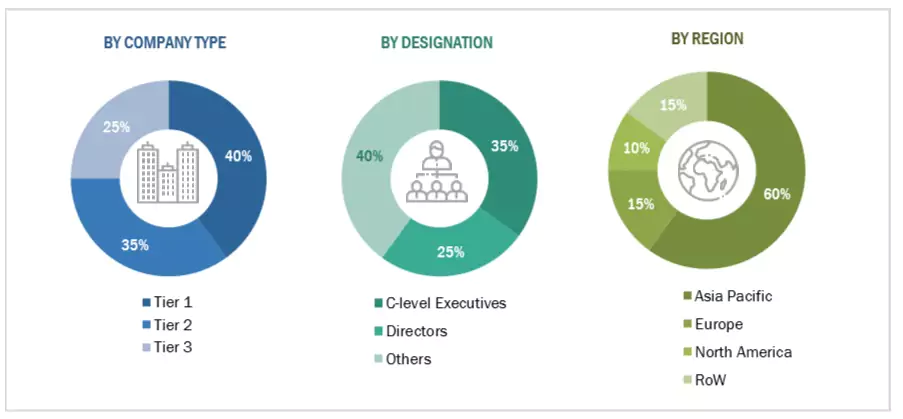
Note: “Others” include sales managers, engineers, and regional managers
The tiers of the companies are defined based on their total revenue as of 2021: Tier 1: >USD 1
billion, Tier 2: USD 500 million–1 billion, and Tier 3:
To know about the assumptions considered for the study, download the pdf brochure
Market Size Estimation
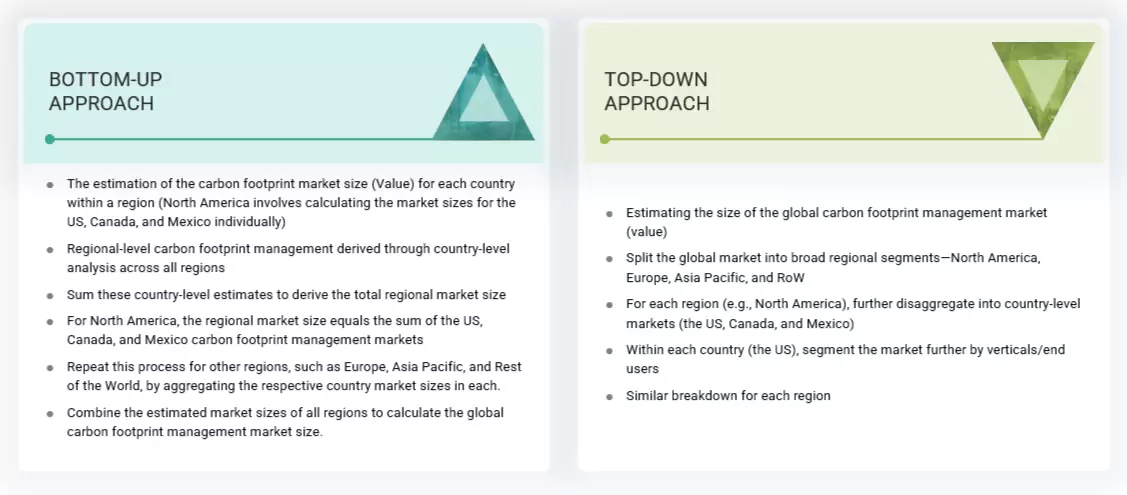
Both top-down and bottom-up approaches have been used to estimate and validate the size of the global carbon footprint management market and its dependent submarkets. These methods were also used extensively to estimate the size of various sub-segments in the market. The research methodology used to estimate the market size includes the following:
- The industry and market’s key players have been identified through extensive secondary research, and their market share in the respective regions has been determined through primary and secondary research.
- In terms of value, the industry’s supply chain and market size have been determined through primary and secondary research processes.
- All percentage shares, splits, and breakdowns have been determined using secondary sources and verified through primary sources.
Data Triangulation
After arriving at the overall market size, the market was split into several segments and subsegments—using the market size estimation processes as explained above. Data triangulation and market breakdown procedures were employed to complete the overall market engineering process and arrive at the exact statistics of each market segment and subsegment, wherever applicable. The data was triangulated by studying various factors and trends from both the demand and supply sides.
Market Definition
Carbon footprint management software is a tool to help raise awareness, measure emissions, data collection, enable sustainability reporting, reduce costs, and engage staff in the carbon management program. The carbon footprint is an environmental indicator representing the total amount of greenhouse gas (GG) emissions caused by an individual, event, organization, service, place, or product. It measures both direct and indirect emissions of compounds such as methane (CH4), nitrous oxide (N2O), hydrofluorocarbons (HFCs), perfluorocarbons (PFCs), sulfur hexafluoride (SF6), and carbon dioxide (CO2). The carbon footprint management software is designed to assist manufacturing companies and corporate organizations in maintaining compliance. It assesses the carbon footprint of organizations’ products according to international standards.
Stakeholders
- Utilities
- Environmental Research Institutions
- Energy Service Providers (Private/Government)
- Heavy Industries
- Government and Research Organizations
- State and National Regulatory Authorities
- Carbon Footprint Management Solutions and Services Providers
- Organizations, Forums, Alliances, and Associations Related to Various Verticals
- Investors/Shareholders
- Investment Banks
Report Objectives
- To define, describe, segment, and forecast the carbon footprint management market, by component, by deployment mode, by organization size, by vertical, and region, in terms of value.
- To provide comprehensive information about drivers, restraints, opportunities, and industry-specific challenges that affect the market growth
- To strategically analyze the global carbon footprint management market with respect to individual growth trends, future expansions, and each segment’s contribution to the market.
- To analyze market opportunities for stakeholders and details of the competitive landscape for market leaders.
- To forecast the growth of the global carbon footprint management market with respect to the five main regions, namely Asia Pacific, North America, Europe, the Middle East & Africa, and South America
- To profile and rank key players and comprehensively analyze their market share
- To analyze competitive developments, such as contracts & agreements, product launches, and mergers & acquisitions, in the carbon footprint management market
- This report covers the global carbon footprint management market size in terms of value.
Available Customizations
MarketsandMarkets offers customizations according to the specific needs of the companies with the given market data.
The following customization options are available for the report:
Product Analysis
- Product matrix, which gives a detailed comparison of the product portfolio of each company
Geographic Analysis as per Feasibility
- Further breakdown of the carbon footprint management market, by country
Company Information
- Detailed analysis and profiling of additional market players (up to five)
Get the Full Carbon Footprint Management Market Report
Full forecast, segment splits, and company analysis for all Carbon Footprint Management Market.
- US Carbon Footprint Management Market
- Canada Carbon Footprint Management Market
- Mexico Carbon Footprint Management Market
- France Carbon Footprint Management Market
- UK Carbon Footprint Management Market
- Australia Carbon Footprint Management Market
- China Carbon Footprint Management Market
- India Carbon Footprint Management Market
- Japan Carbon Footprint Management Market
- Singapore Carbon Footprint Management Market
- Saudi Arabia Carbon Footprint Management Market
- UAE Carbon Footprint Management Market
- Brazil Carbon Footprint Management Market
Need a Tailored Report?
Customize this report to your needs
Get 10% FREE Customization
Customize This Report
