
South Korea Customer Data Platform Market (2025-2030)

The South Korea Customer Data Platform Market was valued at $334.6 Million in 2025 and projected to reach to $1448.2 Million by 2030, representing a compound annual growth rate of 34.0%. South Korea's Customer Data Platform market is poised for exceptional growth through 2030, driven by the nation's advanced technological infrastructure and data-centric business culture.


| Market Size in | USD 26.32 MN |
| Market Forecast in | |
| CAGR | |
| Forecast Period | |
| Units Considered | Value (USD MN) |
South Korea Customer Data Platform Market Trends and Insights
- This represents a compound annual growth rate of 34.0%, significantly outpacing global trends and reflecting South Korea's advanced digital infrastructure and data-driven business environment.
- South Korea's technology-forward enterprises are increasingly adopting CDP solutions to unify customer data, enhance personalization, and drive competitive advantage in the Asia Pacific region. The growth trajectory in South Korea is driven by strong demand from e-commerce, fintech, and digital marketing sectors, where customer intelligence is critical.
- South Korea's regulatory framework and emphasis on data privacy are spurring investment in compliant CDP platforms.
- By 2030, South Korea is expected to consolidate its position as a leading CDP market in Asia Pacific, with enterprises leveraging advanced analytics and AI-powered customer insights to optimize marketing ROI and customer lifetime value..
Key Market Statistics
- CAGR (2025-2030) 34.0% CAGR
- Market Size, 2025 ~USD 334.6 Million
- Forecast, 2030 ~USD 1448.2 Million
- Country South Korea
South Korea Customer Data Platform Market Overview
Exceptional Growth Trajectory :
South Korea's CDP market is expanding at 34% CAGR, significantly outpacing the global rate of 30.7%, driven by aggressive digital transformation across enterprises and government initiatives supporting data-driven innovation.
Rapid Market Expansion :
The market is projected to grow from $334.6 million in 2025 to $1,448.2 million by 2030, representing a 333% increase over five years, reflecting strong demand from South Korea's technology-forward business ecosystem.
Advanced Digital Infrastructure :
South Korea's world-class broadband penetration, 5G adoption, and tech-savvy workforce create an ideal environment for CDP implementation, enabling enterprises to leverage sophisticated customer data strategies.
Enterprise-Driven Adoption :
Leading South Korean conglomerates, e-commerce giants, and fintech companies are rapidly adopting CDPs to enhance customer personalization, competitive positioning, and data monetization capabilities in highly competitive markets.
South Korea Customer Data Platform Market Dynamics
- Major enterprises across retail, finance, and technology sectors are increasingly investing in CDP solutions to enhance customer experiences and operational efficiency.
- Government support for digital innovation and strict data governance frameworks are accelerating adoption while ensuring compliance standards. The competitive landscape will intensify as both global CDP vendors and local Korean technology firms expand their market presence.
- Integration with AI and machine learning capabilities, coupled with growing emphasis on first-party data strategies, will define market evolution.
- South Korea's position as a digital innovation hub ensures sustained investment momentum and premium pricing for advanced CDP solutions through 2030..
Market Ecosystem
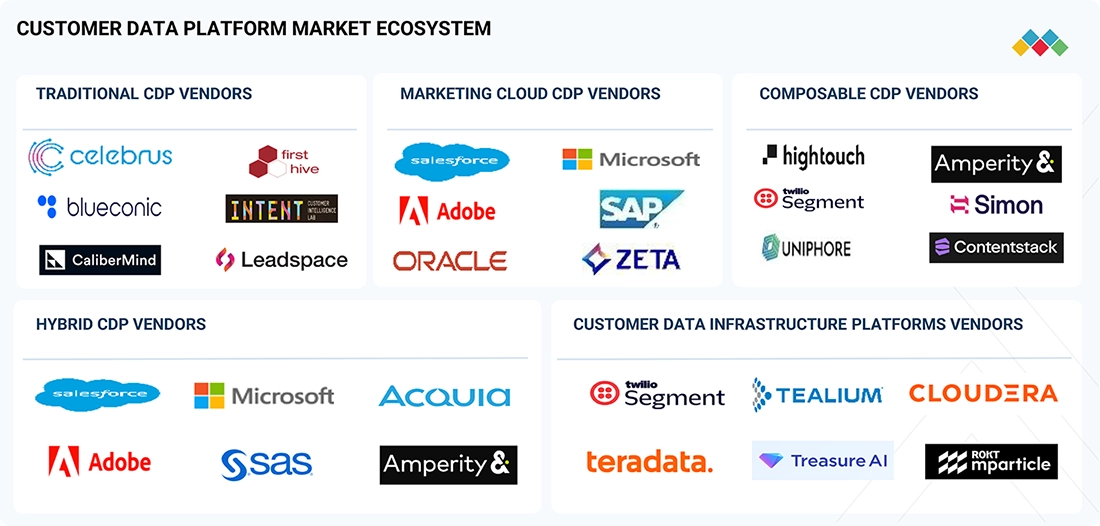
CUSTOMER DATA PLATFORM (CDP) MARKET: COMMERCIAL USE CASES ACROSS INDUSTRIES
| COMPANY | USE CASE DESCRIPTION | BENEFITS |
|---|---|---|
 |
The Home Depot implemented Adobe Real-Time CDP to combine customer information from website activity, in-store purchases, call-center interactions, returns, order cancellations, and other touchpoints into unified customer profiles. The retailer uses real-time behavioral signals and profile information to understand customer projects, develop high-value audience segments, and deliver relevant media campaigns, offers, recommendations, and digital customer journeys. | Established unified profiles across online and offline channels. | Managed approximately 170 million customer profiles | Reduced audience-to-experience deployment time from as long as 10 days to approximately 24 hours | Improved personalized offers, messaging, and project-related recommendations (Adobe Business) |
 |
FedEx deployed Salesforce Data 360 to unify sales, shipping, website, marketing, and customer interaction data that was previously distributed across separate systems. The unified environment enables the company to identify inactive business customers, develop actionable audience segments, and coordinate personalized marketing and sales follow-up for international shipping and other relevant services. | Achieved more than 2,000% return on investment | Improved customer activation by 13% | Supported approximately one billion personalized emails annually | Reduced the time required to identify inactive customers from weeks to hours (Salesforce) |
 |
Iberia implemented Tealium to unify CRM, transactional, behavioral, and digital interaction data into a consistent customer view. The airline uses improved customer identification, real-time data, and audience orchestration to recognize abandoned booking journeys, retarget relevant travelers, and coordinate personalized engagement across customer touchpoints. | Increased recovery of users abandoning bookings by 57% | Generated a 12% sales uplift from retargeting flows | Improved customer identification across booking journeys | Strengthened collaboration among marketing, data, and customer experience teams (Tealium) |
Logos and trademarks shown above are the property of their respective owners. Their use here is for informational and illustrative purposes only.
Related Ecosystem
Analytics
- Natural Language Processing (NLP)
- Machine Learning
- Supply Chain Management
- Predictive Analytics
- Image Sensors
- International Business Machines Corporation
- MICROSOFT CORPORATION
- Oracle Corporation
- SAP SE
Cloud Computing
- Software as A Service (SaaS)
- Natural Language Processing (NLP)
- Platform as A Service (PaaS)
- Machine Learning
- Supply Chain Management
- International Business Machines Corporation
- MICROSOFT CORPORATION
- Oracle Corporation
- Amazon.com, Inc.
Software And Services
- Natural Language Processing (NLP)
- Machine Learning
- Supply Chain Management
- Predictive Analytics
- Image Sensors
- International Business Machines Corporation
- MICROSOFT CORPORATION
- Oracle Corporation
- SAP SE
- Amazon.com, Inc.
Key Takeaways
- South Korea's CDP market will grow from $334.6M (2025) to $1,448.2M (2030) at a 34.0% CAGR, outpacing global growth rates.
- South Korea's e-commerce and fintech sectors are primary drivers of CDP adoption and investment.
- South Korea's data privacy regulations and compliance requirements are accelerating enterprise CDP implementation.
- South Korea is positioned as a regional leader in CDP innovation within Asia Pacific by 2030.
Customer Data Platform Market Report Scope
| Report Metric | Details |
|---|---|
| Base Year | 2025 |
| Fastest Growing Segment | ZERO-PARTY DATA (Data Type) |
| Forecast Period | 2025-2030 |
| Growth Rate | CAGR of 30.7% from 2025 to 2030 |
| Largest Segment | CLOUD (Deployment Type) |
| Market Size Base Year (Billions) | ~USD 9.73 (2025) |
| Revenue Forecast (Billions) | ~USD 37.11 (2030) |
| Segments Covered | Offering, Platform, Service, Professional Service, Deployment Mode, Data Type, Data Channel, Application, Vertical, Platform Type, Deployment Type, Organization Size, Component |
South Korea Customer Data Platform Market Report Segmentation
13 segment dimensions are covered across the global market.
By Offering
- Platforms
- Services
- Solutions
By Platform
- Analytics Cdp
- Campaign Cdp
- Data Cdp
- Delivery Cdp
- Other Platforms
By Service
- Managed Services
- Professional Services
By Professional Service
- Consulting & Training
- Support & Maintenance
- System Integration & Implementation
By Deployment Mode
- Cloud
- On-Premises
By Data Type
- First-Party Data
- Second-Party Data
- Third-Party Data
- Zero-Party Data
By Data Channel
- Call Center
- Contact Centers & Crm Systems
- In-Store
- Mobile
- Other Data Channels
- Sms & Mobile Messaging
- Social Media
- Web
By Application
- Audience Segmentation & Behavioral Targeting
- Churn Prediction & Propensity Modeling
- Customer Behavior Analytics
- Customer Data Collection & Management
- Customer Experience Management
- Customer Retention & Engagement
- Customer Retention & Journey Orchestration
- Customer Segmentation & Targeting
- Data Activation & Real-Time Execution
- Omnichannel Campaign Management
- Omnichannel Marketing
- Other Applications
- Personalized Recommendation
- Personalized Recommendations
- Predictive Analytics & Modeling
- Profile Unification & Identity Resolution
- Risk & Compliance Management
By Vertical
- Automotive
- Bfsi
- Construction & Real Estate
- Education
- Energy & Utilities
- Government & Defense
- Healthcare
- Healthcare & Life Sciences
- It & Telecom
- Manufacturing
- Media & Entertainment
- Other Verticals
- Other Verticals*
- Public Sector
- Retail
- Retail & E-Commerce
- Retail & Ecommerce
- Technology & Software
- Telecom
- Telecommunications
- Travel & Hospitality
By Platform Type
- Analytics Cdp
- Campaign Cdp
- Data Cdp
- Delivery Cdp
By Deployment Type
- Cloud
- On-Premises
By Organization Size
- Large Enterprises
- Smes
By Component
- Platforms
- Services
Target Audience
- South Korean Enterprise Executives : C-suite leaders and digital transformation officers need market intelligence to justify CDP investments, benchmark against competitors, and align technology strategies with market trends.
- CDP Vendors & Solution Providers : Global and regional CDP vendors require detailed South Korea market data to develop localized go-to-market strategies, pricing models, and product customizations for Korean enterprises.
- Management Consulting Firms : Consultants advising South Korean clients on digital transformation need market-specific insights to develop recommendations, validate business cases, and support technology selection processes.
- Investment & Private Equity Firms : Investors evaluating opportunities in South Korea's technology sector need comprehensive market sizing, growth projections, and competitive dynamics to assess CDP-related investment potential.
- Technology & Marketing Agencies : Agencies supporting South Korean brands need market intelligence to advise clients on CDP adoption, customer data strategies, and competitive positioning in the rapidly evolving landscape.
Reasons to Buy this Report
- Market-Specific Growth Intelligence : Gain detailed insights into South Korea's 34% CAGR trajectory and understand the unique drivers propelling the market faster than global averages, enabling strategic investment decisions.
- Competitive Landscape Analysis : Identify key South Korean and international CDP vendors, their market positioning, and competitive strategies specific to the Korean enterprise environment and regulatory landscape.
- Enterprise Adoption Patterns : Understand how South Korean conglomerates, fintech companies, and e-commerce leaders are implementing CDP solutions, including use cases, implementation challenges, and ROI metrics.
- Regulatory & Compliance Framework : Navigate South Korea's specific data protection regulations, GDPR-equivalent requirements, and government digital initiatives that impact CDP deployment and vendor selection.
- Investment & Expansion Opportunities : Identify market entry strategies, partnership opportunities, and growth segments within South Korea's rapidly expanding CDP ecosystem through 2030.
Frequently asked questions
What is the current size of South Korea's Customer Data Platform market?
South Korea's CDP market is valued at $334.6 million in 2025 and is expected to grow to $1,448.2 million by 2030.
What is the projected growth rate for South Korea's CDP market?
South Korea's CDP market is projected to grow at a compound annual growth rate (CAGR) of 34.0% from 2025 to 2030.
Which industries are driving CDP adoption in South Korea?
E-commerce, fintech, and digital marketing sectors are the primary drivers of CDP adoption in South Korea due to their need for advanced customer intelligence.
How does South Korea's CDP market growth compare to global trends?
South Korea's 34.0% CAGR significantly exceeds the global CDP market CAGR of 30.7%, reflecting stronger regional demand and digital maturity.
What role does data privacy play in South Korea's CDP market growth?
South Korea's stringent data privacy regulations and compliance requirements are driving enterprise investment in compliant CDP platforms to manage customer data responsibly.
RESEARCH METHODOLOGY
The research methodology for the customer data platform market report involved extensive secondary research using company publications, regulatory documents, industry association materials, standards publications, peer-reviewed journals, and reputable corporate technology portals to identify and collect relevant information for this technology-driven market study. In-depth interviews were conducted with various primary respondents, including CDP platform providers, marketing technology companies, customer data management vendors, cloud service providers, systems integrators, consulting firms, implementation partners, data privacy specialists, and senior executives from organizations deploying customer data platforms. These interviews, along with inputs from customers and industry consultants, were used to obtain and validate critical qualitative and quantitative information and assess market trends, technology advancements, deployment models, adoption patterns, and demand across key verticals and regions.
Secondary Research
During the secondary research process, various sources were consulted to identify, collect, and validate information for the study. The secondary sources included annual reports, press releases, investor presentations, product documentation, technical white papers, customer case studies, regulatory publications, corporate blogs, and official company websites. Additional information was obtained from peer-reviewed publications covering customer analytics, data management, marketing technology, artificial intelligence, privacy engineering, identity resolution, customer experience, and information systems.
Recognized associations, standards bodies, regulators, and government organizations consulted included, but were not limited to, the International Association of Privacy Professionals, World Wide Web Consortium, Organisation for Economic Co-operation and Development, US Federal Trade Commission, National Institute of Standards and Technology, European Data Protection Board, European Commission, UK Information Commissioner’s Office, Asia-Pacific Economic Cooperation, and relevant national data protection authorities. These sources were used to obtain and validate technical information, market developments, regulatory requirements, privacy frameworks, platform capabilities, competitive intelligence, and adoption patterns across the global customer data platform ecosystem. Secondary research was also used to gather information on the industry value chain, supply chain, vendor landscape, market classification, segmentation, regional adoption, deployment models, technology developments, partnerships, acquisitions, product launches, and evolving customer requirements. No syndicated market research websites were used as information sources.
Primary Research
In the primary research process, a diverse range of stakeholders from the supply and demand sides of the customer data platform ecosystem were interviewed to gather qualitative and quantitative insights specific to the market. From the supply side, key industry experts, including chief executive officers, vice presidents, marketing directors, technology and innovation directors, product managers, data architects, solution consultants, and technical specialists from companies offering CDP platforms, customer data infrastructure, marketing technology solutions, identity resolution, consent management, analytics, and personalization capabilities, were consulted. Additionally, cloud service providers, system integrators, implementation partners, consulting firms, managed service providers, and digital agencies involved in deploying customer data platform solutions were included in the study. On the demand side, inputs were obtained from chief marketing officers, chief data officers, customer experience leaders, CRM managers, digital commerce heads, data engineers, marketing operations teams, privacy professionals, and enterprise technology decision-makers across retail, BFSI, healthcare, telecommunications, media, travel, manufacturing, and other verticals to understand adoption patterns, implementation challenges, budget priorities, and future investment plans.
The primary research ensured that all critical parameters influencing the Customer Data Platform market, including customer data unification requirements, real-time activation, AI-driven personalization, data privacy, cloud adoption, composable architectures, identity resolution, and evolving enterprise use cases, were thoroughly assessed. Each factor was carefully analyzed, verified through primary interviews, and evaluated to obtain precise qualitative and quantitative inputs for the study.
Once the initial phase of market engineering was completed, including detailed calculations for market statistics, segment-specific growth forecasts, vendor revenue estimates, and data triangulation, a second round of primary research was conducted. This stage was crucial for refining and validating key data points, including platform and services adoption, cloud and on-premises deployment patterns, enterprise-size distribution, vertical demand, regional penetration, vendor positioning, and key market dynamics such as drivers, opportunities, challenges, and restraints. Additional validation covered increasing adoption of AI-enabled decisioning, zero-copy data access, privacy-safe collaboration, customer journey orchestration, real-time profile management, and managed CDP services across major industries.
The comprehensive market engineering process, together with top-down and bottom-up approaches and multiple data triangulation methods, was extensively employed to estimate and forecast the overall market, as well as all major segments and subsegments. Extensive qualitative and quantitative validation was conducted throughout the market engineering process to capture critical information and insights across the entire customer data platform value chain.
Breakdown of Primary Interviews
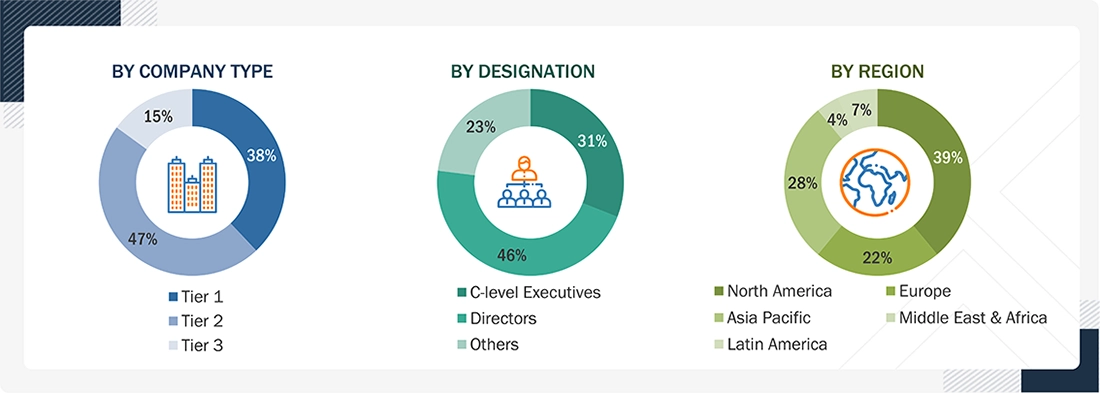
Note: Others include sales, marketing, and product managers; tier 1 companies’ revenues are more than USD 500 million, tier 2 companies’ revenues range between USD 500 and 100 million, and tier 3 companies’ revenues are equals to or less than USD 100 million.
To know about the assumptions considered for the study, download the pdf brochure
Market Size Estimation
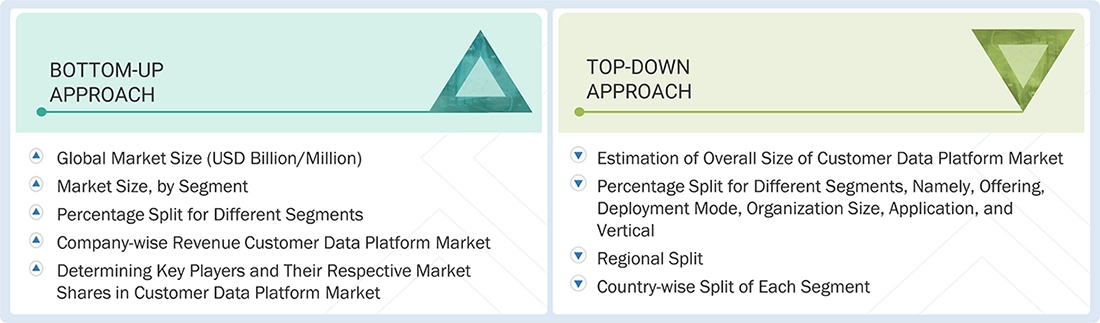
The top-down and bottom-up approaches were employed to estimate and forecast the customer data platform market, as well as its dependent submarkets. This multi-layered analysis was further reinforced through data triangulation, which incorporated primary and secondary research inputs. The market figures were also validated against the existing MarketsandMarkets repository for accuracy.
Customer Data Platform Market : Top-Down and Bottom-Up Approach
Data Triangulation
The market was divided into several segments and subsegments after determining the overall market size using the market size estimation processes described above. To complete the overall market engineering process and determine the exact statistics for each market segment and subsegment, data triangulation and market segmentation procedures were employed, wherever applicable. The overall market size was then used in the top-down approach to estimate the size of other individual markets by applying percentage splits to the market segmentation.
Market Definition
A customer data platform (CDP) is packaged software that collects and integrates customer data from multiple online and offline sources, applies identity resolution to create persistent and unified customer profiles, and makes these profiles accessible to other enterprise systems. CDPs connect previously fragmented data from customer relationship management, marketing automation, ecommerce, customer service, mobile applications, websites, transaction systems, and other engagement channels within a governed customer data environment. The platform supports real-time or near-real-time profile updates, segmentation, analytics, personalization, journey orchestration, and activation across marketing, sales, commerce, service, and advertising channels. By providing a consistent, user-level view of customer interactions and attributes, CDPs enable organizations to improve customer intelligence, coordinate omnichannel engagement, and support AI-driven decision-making. The category was introduced by David Raab in 2013 and is commonly defined as packaged software that builds a persistent, unified customer database accessible to other systems. Salesforce emphasizes the role of CDPs in consolidating data from multiple channels and systems into real-time customer profiles, while Oracle highlights their ability to create comprehensive customer databases that support interaction tracking, analysis, and engagement across touchpoints.
Key Stakeholders
- Customer data platform vendors
- Customer data infrastructure providers
- CRM and marketing automation platform providers
- Cloud service and data warehouse providers
- Identity resolution and customer identity providers
- Consent management and data privacy solution providers
- Customer analytics and intelligence platform providers
- Personalization and recommendation solution providers
- Customer journey orchestration providers
- System integrators and implementation service providers
- Consulting and managed service providers
- Digital agencies, value-added resellers, and technology partners
Report Objectives
- To define, describe, and predict the customer data platform market by offering, deployment mode, enterprise size, application, vertical, and region
- To provide detailed information related to major factors (drivers, restraints, opportunities, and industry-specific challenges) influencing market growth
- To analyze opportunities in the market and provide details of the competitive landscape for stakeholders and market leaders
- To forecast the market size of segments with respect to five main regions: North America, Europe, Asia Pacific, the Middle East & Africa, and Latin America
- To analyze each submarket with respect to individual growth trends, prospects, and contributions to the overall customer data platform market
- To analyze competitive developments, such as partnerships, new product launches, mergers & acquisitions, in the customer data platform market
- To analyze the impact of macroeconomic factors on the customer data platform market across all regions
Available customizations:
Using the provided market data, MarketsandMarkets offers customizations tailored to the company’s specific needs. The following customization options are available for the report.
Product Analysis
-
Product comparative analysis, which gives a detailed comparison of innovative products being offered by prominent vendors
Geographic Analysis
-
Further breakup of additional European countries by offering, deployment mode, enterprise size, application, and vertical
-
Further breakup of additional Asia Pacific countries by offering, deployment mode, enterprise size, application, and vertical
-
Further breakup of additional Middle Eastern & African countries by offering, deployment mode, enterprise size, application, and vertical
-
Further breakup of additional Latin American countries by offering, deployment mode, enterprise size, application, and vertical
Company Information
- Product comparative analysis, which gives a detailed comparison of innovative products being offered by prominent vendors
Get the Full Customer Data Platform Market Report
Full forecast, segment splits, and company analysis for all Customer Data Platform Market.
- US Customer Data Platform Market
- UK Customer Data Platform Market
- Germany Customer Data Platform Market
- France Customer Data Platform Market
- Italy Customer Data Platform Market
- Spain Customer Data Platform Market
- China Customer Data Platform Market
- Japan Customer Data Platform Market
- India Customer Data Platform Market
- Saudi Arabia Customer Data Platform Market
- UAE Customer Data Platform Market
- Turkey Customer Data Platform Market
- South Africa Customer Data Platform Market
- Brazil Customer Data Platform Market
- Mexico Customer Data Platform Market
- Argentina Customer Data Platform Market
- Rest Of Europe Customer Data Platform Market
- Anz Customer Data Platform Market
- Rest Of Asia Pacific Customer Data Platform Market
- Rest Of Latin America Customer Data Platform Market
- Canada Customer Data Platform Market
Need a Tailored Report?
Customize this report to your needs
Get 10% FREE Customization
Customize This Report
