
Canada Data Center Cooling Market (2025-2030)

The Canada Data Center Cooling Market was valued at $350 Million in 2025 and projected to reach to $787.5 Million by 2030, representing a compound annual growth rate of 12.3%. Canada's data center cooling market is poised for substantial growth over the forecast period, driven by the country's emergence as a key data center hub in North America.


| Market Size in | USD 26.32 MN |
| Market Forecast in | |
| CAGR | |
| Forecast Period | |
| Units Considered | Value (USD MN) |
Canada Data Center Cooling Market Trends and Insights
- This expansion in Canada reflects increasing demand for advanced cooling solutions driven by the proliferation of data centers across the country and rising computational workloads.
- Canada's strategic position as a hub for cloud infrastructure and AI deployment is accelerating investment in efficient thermal management technologies. The Canadian market benefits from favorable regulatory environments and growing awareness of energy efficiency in data center operations.
- Between 2025 and 2030, Canada is expected to see significant adoption of liquid cooling, immersion cooling, and AI-optimized cooling systems.
- Canada's commitment to sustainability and lower operational costs are key factors propelling market growth, positioning the country as a critical market within North America's broader data center cooling ecosystem..
Key Market Statistics
- CAGR (2025-2030) 12.3% CAGR
- Market Size, 2025 ~USD 350 Million
- Forecast, 2030 ~USD 787.5 Million
- Country Canada
Canada Data Center Cooling Market Overview
Market Valuation Growth :
Canada's data center cooling market is valued at $350.0 million in 2025 and is projected to reach $787.5 million by 2030, demonstrating strong market expansion driven by infrastructure investments.
Above-Global Growth Rate :
Canada's market CAGR of 12.3% outpaces the global average of 11.8%, indicating accelerated adoption of cooling technologies and competitive advantages in the Canadian data center sector.
Data Center Proliferation :
Increasing establishment of data centers across major Canadian cities and regions is driving demand for advanced cooling solutions to manage rising computational workloads and energy efficiency requirements.
Strategic Geographic Position :
Canada's cool climate and proximity to major North American markets position it as an attractive hub for data center development, supporting sustained cooling solution demand through 2030.
Canada Data Center Cooling Market Dynamics
- The 12.3% CAGR reflects increasing investments in cloud infrastructure, AI computing capabilities, and enterprise data storage solutions across Canadian provinces.
- Rising energy costs and environmental regulations are accelerating the adoption of innovative cooling technologies, including liquid cooling and AI-optimized thermal management systems. The market outlook remains positive as major technology companies and hyperscalers expand their Canadian operations.
- Government initiatives supporting digital infrastructure and renewable energy integration further bolster market prospects.
- By 2030, Canada's cooling market is expected to benefit from technological advancements, increased data localization requirements, and growing demand for sustainable cooling solutions that align with the country's climate commitments..
Market Ecosystem
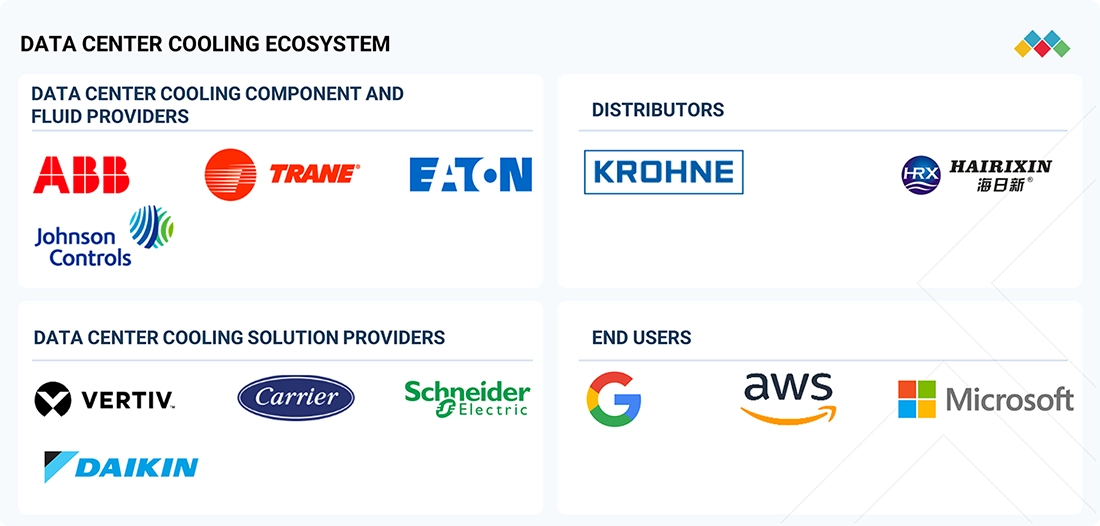
DATA CENTER COOLING MARKET: COMMERCIAL USE CASES ACROSS INDUSTRIES
| COMPANY | USE CASE DESCRIPTION | BENEFITS |
|---|---|---|
 |
Implemented liquid immersion cooling in Azure data centers to manage high-performance computing (HPC) and AI workloads | Reduced energy consumption by up to 30% | Improved server density and performance | Enhanced sustainability through lower water and power usage |
 |
Deployed AI-driven cooling optimization using DeepMind technology to automate real-time temperature and airflow control | Achieved up to 40% reduction in cooling energy | Improved PUE (Power Usage Effectiveness) | Lower carbon emissions and operational costs |
 |
Introduced evaporative and liquid cooling systems in hyperscale data centers for high-demand cloud operations | Increased energy efficiency and thermal stability | Significant reduction in carbon footprint | Cost savings from optimized cooling loads |
 |
Adopted direct-to-chip liquid cooling and waste heat recovery systems in its data centers in Denmark and the US | Enables reuse of waste heat for local heating | Supports net-zero sustainability targets | Reduces water usage compared to conventional systems |
 |
Integrated modular cooling infrastructure for colocation data centers to support rapid deployment and mixed workloads | Flexible scaling based on client demand | Lower operational risk and downtime | Enhanced cooling efficiency for diverse tenants |
Logos and trademarks shown above are the property of their respective owners. Their use here is for informational and illustrative purposes only.
Related Ecosystem
Equipment Machine And Tooling
- Wastewater Treatment
- Air Cooled Heat Exchangers
- Diaphragm Pumps
- Fiberglass
- HVAC System
- Alfa Laval Corporate AB
- Veolia
- Johnson Controls International plc
- Daikin Industries,Ltd.
- Parker-Hannifin Corporation
Key Takeaways
- Canada's data center cooling market will more than double from $350.0M (2025) to $787.5M (2030) at a 12.3% CAGR.
- Canada is emerging as a preferred location for hyperscale data centers due to cooler climate and renewable energy availability.
- Advanced cooling technologies including liquid and immersion cooling are gaining traction across Canada's data center infrastructure.
- Canada's regulatory focus on energy efficiency and sustainability is driving adoption of next-generation cooling solutions.
Data Center Cooling Market Report Scope
| Report Metric | Details |
|---|---|
| Base Year | 2025 |
| Fastest Growing Segment | LIQUID COOLING (Technology) |
| Forecast Period | 2025–2030 |
| Growth Rate | CAGR of 11.8% from 2025 to 2030 |
| Largest Segment | AIR COOLING (Technology) |
| Market Size Base Year (Billions) | ~USD 11.08 (2025) |
| Revenue Forecast (Billions) | ~USD 19.35 (2030) |
| Segments Covered | Technology, Solutions, Components, Type Of Cooling, Data Center Type, End-Use Industry, Component |
Canada Data Center Cooling Market Report Segmentation
7 segment dimensions are covered across the global market.
By Technology
- Air Cooling
- Liquid Cooling
By Solutions
- Hardware
- Services
By Components
- Air Conditioning
- Chilling Units
- Control Systems
- Cooling Towers
- Economizer Systems
- Liquid Cooling Systems
- Other Components
By Type Of Cooling
- Room-Based Cooling
- Row/Rack-Based Cooling
By Data Center Type
- Enterprise Data Centers
- Large Data Centers
- Mid-Sized Data Centers
By End-Use Industry
- Bfsi
- Energy
- Government & Defense
- Healthcare
- It & Telecom
- Manufacturing
- Other End-Use Industries
- Research & Academic
- Retail
By Component
- Services
- Solution
- Solutions
Target Audience
- Data Center Operators : Canadian data center operators need market intelligence to optimize cooling infrastructure investments, manage operational costs, and maintain competitive positioning as the market expands at 12.3% annually.
- Cooling Solution Providers : Manufacturers and vendors of cooling technologies require Canada-specific market data to identify growth opportunities, develop localized product strategies, and capture market share in this high-growth segment.
- Enterprise IT Decision Makers : Canadian enterprises planning data center expansion or cloud migration need insights into cooling market trends to evaluate infrastructure costs, sustainability options, and technology partnerships.
- Investment & Private Equity Firms : Investors evaluating opportunities in Canadian data center and cooling infrastructure sectors require detailed market forecasts and growth metrics to assess ROI potential and portfolio positioning.
- Government & Policy Advisors : Canadian government agencies and policy makers need market data to inform digital infrastructure strategy, sustainability regulations, and economic development initiatives supporting the data center sector.
Key Companies in the Canada Data Center Cooling Market
| Company | HQ | Ownership | Strongest segments |
|---|---|---|---|
| PCCW | Hong Kong | ||
| BHARTI AIRTEL LIMITED | India | Public Company | Air Conditioning,Chilling Unit,Cooling Tower, |
| TELIA COMPANY | Sweden | Public Company | Air Conditioning,Chilling Unit,Cooling Tower, |
| THE HCI GROUP | United States | Public Company | Air Conditioning,Chilling Unit,Cooling Tower, |
| PENTAIR PLC | United Kingdom | Public Company | Liquid Cooling System (pumps, vessels, filtration within liquid loops),Chilling Unit and water-side infrastructure components,Cooling Tower and heat rejection–related flow systems, |
| XEROX CORPORATION | United States | ||
| FIRST SOLAR, INC. | United States | Public Company | PV solar modules for utility-scale data center power,PV solar modules for C&I data centers and on-site arrays,Project development, EPC, and related services, |
| SUNTECH POWER HOLDINGS CO. LTD | China | Private Company | Utility-scale PV for data center campuses,Commercial and industrial rooftop PV for edge and enterprise data centers,Residential and small-scale PV indirectly supporting edge compute, |
| LENOVO | China | Public Company | Airflow-optimized servers and racks (air conditioning–aligned),Liquid cooling–ready and high-density systems,Management and control software for thermal optimization, |
| VERTIV GROUP CORP. | United States | Private Company | Air Conditioning (CRAC/CRAH and room cooling),Chilling Units and Cooling Towers,Economizer Systems, |
| JOHNSON CONTROLS | Ireland | Public Company | Air Conditioning,Chilling Unit,Cooling Tower, |
| CARRIER | United States | Public Company | Air Conditioning,Chilling Unit,Cooling Tower, |
| SCHNEIDER ELECTRIC | France | Public Company | Air Conditioning Solutions,Chilling Units,Cooling Towers & Economizer Systems, |
| MITSUBISHI ELECTRIC CORPORATION | Japan | Public Company | Air Conditioning,Chilling Unit,Cooling Tower, |
| TRANE TECHNOLOGIES PLC | Ireland | Public Company | Air Conditioning,Chilling Unit,Cooling Tower, |
| MUNTERS GROUP AB | Sweden | Public Company | Air Conditioning (CRAC/CRAH and air handling-based cooling),Chilling Unit,Cooling Tower, |
PCCW
PCCW is a Hong Kong-based telecommunications and media company offering fixed-line, mobile, broadband, and pay-TV services.
BHARTI AIRTEL LIMITED
Bharti Airtel Limited is an Indian multinational telecommunications company founded in 1995, operating as a public company with 28,730 employees providing mobile, broadband, and digital services.
TELIA COMPANY
Telia Company is a Swedish public telecommunications company founded in 1853 with 14,552 employees, providing mobile, broadband, and TV services across the Nordic and Baltic regions.
THE HCI GROUP
The HCI Group is a United States-based public company founded in 2006 with 594 employees, operating in the insurance and financial services sector.
PENTAIR PLC
Pentair PLC is a United Kingdom-based public company founded in 1966 with 9,000 employees, specializing in water and fluid management solutions.
XEROX CORPORATION
Xerox Corporation is a United States-based technology company providing document management, printing, and business services solutions.
FIRST SOLAR, INC.
First Solar, Inc. is a United States-based public company founded in 1999 with 7,900 employees, specializing in photovoltaic solar energy solutions.
SUNTECH POWER HOLDINGS CO. LTD
Suntech Power Holdings Co. Ltd is a Chinese private company founded in 2001 with 17,693 employees, operating in the solar photovoltaic industry.
LENOVO
Lenovo is a Chinese public company founded in 1984, a global leader in personal computers, smartphones, and enterprise technology solutions.
VERTIV GROUP CORP.
Vertiv Group Corp. is a United States-based private company founded in 1965 with 19,000 employees, providing critical infrastructure and continuity solutions.
JOHNSON CONTROLS
Johnson Controls is an Ireland-based public company founded in 1885 with 87,000 employees, specializing in building efficiency, HVAC, and security solutions.
CARRIER
Carrier is a United States-based public company founded in 2019 with 47,000 employees, providing HVAC, refrigeration, and fire and security solutions.
SCHNEIDER ELECTRIC
Schneider Electric is a French public company founded in 1836 with 158,122 employees, specializing in energy management and automation solutions.
MITSUBISHI ELECTRIC CORPORATION
Mitsubishi Electric Corporation is a Japanese public company founded in 1921 with 150,386 employees, manufacturing electrical equipment, electronics, and industrial automation solutions.
TRANE TECHNOLOGIES PLC
Trane Technologies PLC is an Ireland-based public company founded in 1885 with 44,000 employees, providing climate control and building solutions.
MUNTERS GROUP AB
Munters Group AB is a Swedish public company founded in 1955 with 5,305 employees, specializing in humidity and temperature control solutions.
Reasons to Buy this Report
- Canada-Specific Market Sizing : Access precise valuation data for Canada's market at $350M (2025) and $787.5M (2030), enabling accurate financial forecasting and investment planning tailored to the Canadian market landscape.
- Competitive Growth Intelligence : Understand Canada's 12.3% CAGR advantage over global 11.8%, identifying market dynamics and competitive opportunities unique to Canadian data center operators and cooling solution providers.
- Regional Expansion Strategy : Develop targeted go-to-market strategies for Canadian provinces and cities with data center concentration, leveraging insights on infrastructure proliferation and regional cooling demand patterns.
- Technology Adoption Trends : Identify emerging cooling technologies gaining traction in Canada, including liquid cooling and AI-optimized systems, to align product development and marketing efforts with local market preferences.
- Investment Decision Support : Make informed capital allocation decisions for Canadian data center projects and cooling infrastructure investments based on comprehensive market forecasts and growth trajectory analysis through 2030.
Frequently asked questions
What is the current size of Canada's data center cooling market?
Canada's data center cooling market is valued at $350.0 million in 2025 and is expected to grow to $787.5 million by 2030.
What is the projected growth rate for Canada's data center cooling market?
Canada's data center cooling market is projected to grow at a compound annual growth rate (CAGR) of 12.3% from 2025 to 2030.
Why is Canada becoming a major hub for data center cooling solutions?
Canada's cooler climate, abundant renewable energy resources, favorable regulatory environment, and strategic location make it an attractive destination for hyperscale data center investments requiring advanced cooling infrastructure.
Which cooling technologies are most in demand in Canada?
Liquid cooling, immersion cooling, and AI-optimized cooling systems are experiencing significant adoption in Canada's data center market due to their energy efficiency and performance benefits.
What factors are driving growth in Canada's data center cooling market?
Key drivers include increased cloud infrastructure deployment, AI workload expansion, energy efficiency regulations, sustainability commitments, and the need for cost-effective thermal management solutions across Canada's growing data center footprint.
RESEARCH METHODOLOGY
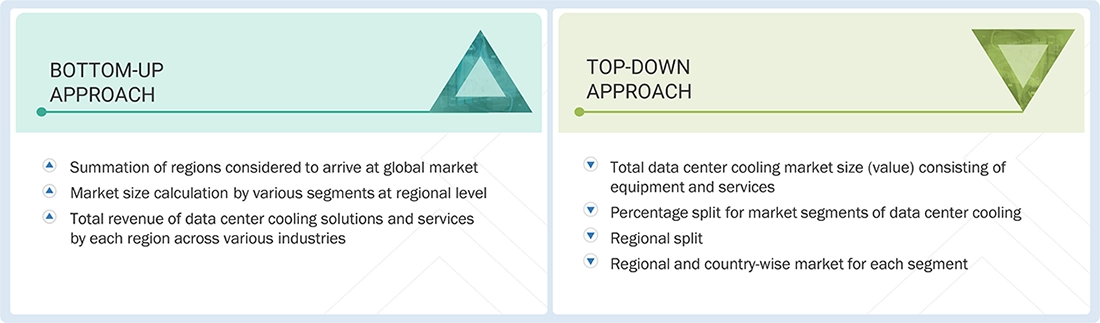
The study involved four major activities to estimate the current data center cooling market size. Exhaustive secondary research was conducted to collect information on the market, peer markets, and parent markets. The next step was to validate these findings, assumptions, and sizes with industry experts across the data center cooling value chain through primary research. Both top-down and bottom-up approaches were employed to estimate the total market size. After that, market breakdown and data triangulation were used to calculate the size of the market’s segments and subsegments.
Secondary Research
The research methodology used to estimate and forecast the data center cooling market begins with capturing data on the revenues of key vendors in the market through secondary research. In the secondary research process, various secondary sources, such as Hoovers, Bloomberg BusinessWeek, Factiva, World Bank, and Industry Journals, were consulted to identify and collect information for this study. These secondary sources included annual reports, press releases & investor presentations of companies; white papers; certified publications; articles by recognized authors; notifications by regulatory bodies; trade directories; and databases. Vendor offerings have also been taken into consideration to determine market segmentation.
Primary Research
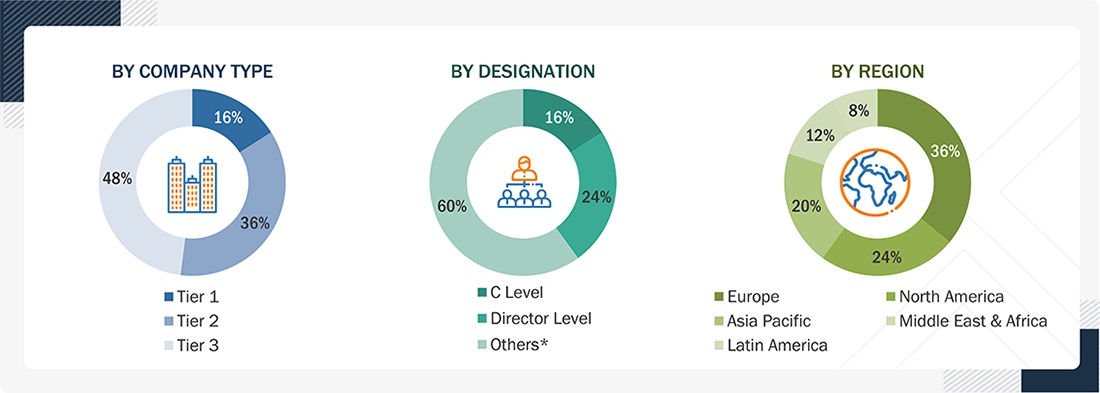
The data center cooling market comprises several stakeholders, including raw material suppliers, processors, recycling companies, data center cooling manufacturers, and regulatory organizations across the supply chain. Qualitative and quantitative information was gathered through interviews with primary sources from both the supply and demand sides of the market. Supply-side primary sources included industry experts such as Chief Executive Officers (CEOs), vice presidents, marketing directors, technology and innovation directors, and other key executives from companies and organizations operating in the data center cooling market. Demand-side primary sources included directors, marketing heads, and purchasing managers from various sourcing industries. The following is the breakdown of the primary respondents:
To know about the assumptions considered for the study, download the pdf brochure
Market Size Estimation
The top-down and bottom-up approaches have been used to estimate and validate the total size of the data center cooling market. These approaches have also been used extensively to estimate the size of various dependent market subsegments. The research methodology used to estimate the market size included the following steps.
The following segments provide details about the overall market size estimation process employed in this study:
- The key players in the market were identified through secondary research.
- The market share in the respective regions was identified through primary and secondary research.
- The value chain and market size of the data center cooling market, in terms of value, were determined through primary and secondary research.
- All percentage shares, splits, and breakdowns were determined using secondary sources and verified through primary sources.
- All possible parameters that affect the market covered in this research study were accounted for, viewed in extensive detail, verified through primary research, and analyzed to obtain the final quantitative and qualitative data.
- The research included studying the annual and financial reports of the top market players and interviewing industry experts, such as CEOs, VPs, directors, sales managers, and marketing executives, for key insights, both quantitative and qualitative.
Global Data Center Cooling Market Size: Bottom-up Approach and Top-down Approac
Data Triangulation
After determining the overall market size using the market size estimation processes explained above, the market was segmented into several segments and subsegments. To complete the overall market engineering process and arrive at the exact statistics for each market segment and subsegment, data triangulation and market breakdown procedures were employed wherever applicable. The data was triangulated by analyzing various factors and trends from both the demand and supply sides in the data center cooling sector.
Market Definition
Data center cooling is a system of equipment, tools, processes, and techniques designed to manage and control the heat generated by hardware within data centers and to maintain the temperature of the data center infrastructure at an optimal level, keeping systems running and avoiding downtime. Air and liquid systems are among the cooling methods used to ventilate and maintain equipment at its optimum temperatures. The global data center cooling market is growing quickly due to increasing data generation, the adoption of cloud computing, and a rising number of hyper-scale and edge data centers. All of this high power density poses a significant challenge to cooling solutions; if not well designed, it can threaten the safety of hardware facilities, which is quite common in traditional infrastructures. The market trend is moving toward high-end liquid cooling and power-saving technologies, driven by environmental regulations and the need to reduce energy consumption and carbon emissions.
Key Stakeholders
- NGOs, Governments, Investment Banks, Venture Capitalists, and Private Equity Firms
- Telecom Services Providers
- Original Equipment Manufacturers
- Value-added Service Providers
- Data Center Cooling Solution Vendors
- Data Center Operators
- Data Center Colocation Service Providers
- System Integrators
- Cloud Service Providers
Report Objectives
- To define, describe, and forecast the global data center cooling market based on component, solution, type of cooling, service, data center type, end-use industry, and region
- To provide detailed information regarding major factors influencing the growth of the market (drivers, restraints, opportunities, and challenges)
- To strategically analyze micromarkets concerning individual growth trends, prospects, and contributions to the total market
- To forecast the market size relating to five central regions, namely, North America, Europe, Asia Pacific, the Middle East & Africa, and Latin America
- To analyze competitive developments such as joint ventures, mergers & acquisitions, product launches, and research & development (R&D) activities in the data center cooling market
- To strategically profile the key market players and comprehensively analyze their core competencies
Available customizations:
With the given market data, MarketsandMarkets offers customizations according to the client-specific needs.
The following customization options are available for the report:
- Additional country-level analysis of the data center cooling market
- Profiling of additional market players (up to 5)
Product Analysis
- Product matrix, which gives a detailed comparison of the product portfolio of each company.
Get the Full Data Center Cooling Market Report
Full forecast, segment splits, and company analysis for all Data Center Cooling Market.
- China Data Center Cooling Market
- India Data Center Cooling Market
- Japan Data Center Cooling Market
- South Korea Data Center Cooling Market
- Mexico Data Center Cooling Market
- US Data Center Cooling Market
- Germany Data Center Cooling Market
- UK Data Center Cooling Market
- Netherlands Data Center Cooling Market
- France Data Center Cooling Market
- Italy Data Center Cooling Market
- South Africa Data Center Cooling Market
- Brazil Data Center Cooling Market
- Rest Of Europe Data Center Cooling Market
- Rest Of Asia Pacific Data Center Cooling Market
- -Rest Of The GCC Countries Data Center Cooling Market
- Rest Of South America Data Center Cooling Market
Need a Tailored Report?
Customize this report to your needs
Get 10% FREE Customization
Customize This Report
