
Middle East Empty Capsules Market (2025-2030)

The Middle East Empty Capsules Market was valued at $57.4 Million in 2025 and projected to reach to $68.5 Million by 2030, representing a compound annual growth rate of 3.6%. The Middle East empty capsules market is poised for steady expansion driven by increasing healthcare investments and the region's growing pharmaceutical manufacturing base.


| Market Size in | USD 26.32 MN |
| Market Forecast in | |
| CAGR | |
| Forecast Period | |
| Units Considered | Value (USD MN) |
Middle East Empty Capsules Market Trends and Insights
- The Middle East's pharmaceutical and nutraceutical sectors are increasingly adopting empty capsules as a preferred delivery mechanism, driven by rising healthcare expenditure and growing demand for customized dosage forms.
- In the Middle East, regulatory frameworks are becoming more stringent, encouraging manufacturers to adopt standardized capsule solutions that meet international quality standards. The Middle East empty capsules market is characterized by steady demand from both pharmaceutical manufacturers and contract manufacturers serving regional and international clients.
- The Middle East's strategic geographic position and expanding healthcare infrastructure support market expansion through 2030.
- In the Middle East, the shift toward plant-based and vegetarian capsule alternatives is gaining momentum, reflecting evolving consumer preferences and regulatory requirements across the region..
Key Market Statistics
- CAGR (2025-2030) 3.6% CAGR
- Market Size, 2025 ~USD 57.4 Million
- Forecast, 2030 ~USD 68.5 Million
- Geography Middle East
Middle East Empty Capsules Market Overview
Market Valuation :
The Middle East empty capsules market is valued at $57.4 million in 2025, with steady growth projected through 2030 as pharmaceutical manufacturers expand operations across the region.
Growth Trajectory :
Expanding at a CAGR of 3.6% from 2025 to 2030, the Middle East market demonstrates moderate but consistent growth, reaching $68.5 million by forecast end, outpacing some mature markets.
Pharmaceutical Adoption :
Rising healthcare expenditure and regulatory support in Middle Eastern countries are driving increased adoption of empty capsules for pharmaceutical and nutraceutical applications, particularly in customized dosage forms.
Regional Dynamics :
Saudi Arabia and UAE lead the region's market, supported by advanced healthcare infrastructure, growing pharmaceutical manufacturing capacity, and increasing demand for personalized medicine solutions.
Middle East Empty Capsules Market Dynamics
- Saudi Arabia and the UAE are emerging as key hubs for capsule production and consumption, supported by government initiatives to develop local pharmaceutical industries and reduce import dependency.
- Rising prevalence of chronic diseases and growing consumer preference for capsule-based supplements are further accelerating market penetration. Looking ahead to 2030, the market will benefit from technological advancements in capsule manufacturing, expansion of contract manufacturing organizations (CMOs), and increased collaboration between regional and international pharmaceutical companies.
- The shift toward personalized medicine and customized dosage forms presents significant opportunities for market players to differentiate their offerings and capture growing demand across the Middle East's diverse healthcare landscape..
Market Ecosystem
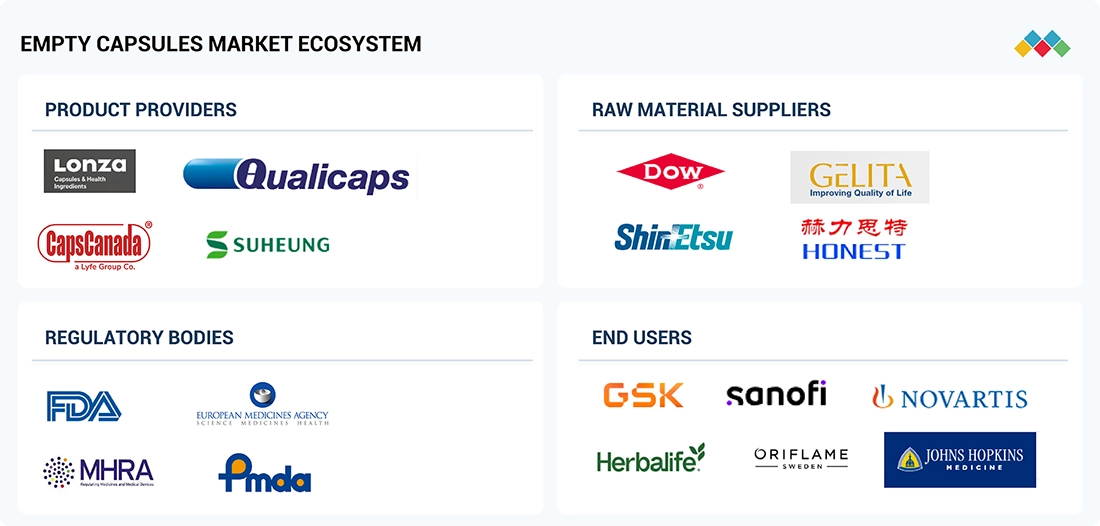
Related Ecosystem
Pharmaceuticals
- Bioreactors
- Analytical Testing
- Bioanalytical Testing Services
- Cell Counters
- Data Management Services
- Thermo Fisher Scientific Inc.
- Merck KGaA
- SANOFI
- Pfizer Inc.
- NOVARTIS
Key Takeaways
- The Middle East empty capsules market is valued at $57.4 million in 2025 and will reach $68.5 million by 2030, growing at 3.6% CAGR.
- The Middle East pharmaceutical and nutraceutical sectors are driving demand for standardized, high-quality empty capsule solutions.
- The Middle East market is experiencing increased adoption of plant-based and vegetarian capsule alternatives due to regulatory and consumer preferences.
- The Middle East's expanding healthcare infrastructure and rising pharmaceutical manufacturing activity support sustained market growth through 2030.
Empty Capsules Market Report Scope
| Report Metric | Details |
|---|---|
| Base Year | 2025 |
| Fastest Growing Segment | SUSTAINED-RELEASE CAPSULES (Functionality) |
| Forecast Period | 2025–2030 |
| Growth Rate | CAGR of 5.6% from 2025 to 2030 |
| Largest Segment | IMMEDIATE-RELEASE CAPSULES (Functionality) |
| Market Size Base Year (Billions) | ~USD 3.19 (2025) |
| Revenue Forecast (Billions) | ~USD 4.19 (2030) |
| Segments Covered | Type, Raw Material, Functionality, Size, Therapeutic Application, End User |
Middle East Empty Capsules Market Report Segmentation
6 segment dimensions are covered across the global market.
By Type
- Gelatin Capsules
- Non-Gelatin Capsules
By Raw Material
- Bonemeal Gelatin
- Bovine-Derived Gelatin
- Hydroxypropyl Methylcellulose (Hpmc)
- Other Gelatin Sources
- Porcine Gelatin
- Pullulan & Starch
By Functionality
- Delayed-Release Capsules
- Immediate-Release Capsules
- Sustained-Release Capsules
By Size
- Size 0
- Size 00
- Size 000
- Size 1
- Size 2
- Size 3
- Size 4
- Size 5
By Therapeutic Application
- Antacid & Antiflatulent Preparations
- Anti-Inflammatory Drugs
- Antianemic Preparations
- Antibiotic & Antibacterial Drugs
- Cardiovascular Therapy Drugs
- Cough & Cold Drugs
- Dietary Supplements
- Other Therapeutic Applications
By End User
- Cosmetic Industry
- Nutraceutical Industry
- Pharmaceutical Industry
- Research Laboratories
Target Audience
- Pharmaceutical Manufacturers : Manufacturers seeking to establish or expand operations in the Middle East need regional market data to assess demand, identify distribution partners, and optimize production capacity planning.
- Nutraceutical Companies : Nutraceutical producers targeting Middle Eastern consumers require insights into capsule preferences, regulatory requirements, and market growth rates to develop region-specific product portfolios.
- Contract Manufacturing Organizations : CMOs operating in the GCC region benefit from understanding local market size, customer demand patterns, and competitive dynamics to secure contracts and optimize service offerings.
- Capsule Suppliers & Distributors : Raw material suppliers and distributors need country-level market data to forecast demand, negotiate supply agreements, and identify emerging opportunities across Saudi Arabia, UAE, and neighboring markets.
- Healthcare Investors & Consultants : Investment firms and management consultants advising on Middle East healthcare expansion require validated market forecasts and regional trends to support due diligence and strategic recommendations.
Key Companies in the Middle East Empty Capsules Market
| Company | HQ | Ownership | Strongest segments |
|---|---|---|---|
| PATHEON INC | Netherlands | Private Company | Drug product services (finished dosage manufacturing, packaging, lifecycle management),Pharmaceutical development services (formulation, clinical trial supply),Drug substance services (API and biologics substance), |
| ALLERGAN PLC | Ireland | Private Company | Medical aesthetics and dermatology,Eye care,Neuroscience and CNS, |
| HELM AG | Germany | Private Company | Basic Chemicals, Acids and Lyes,Plastics and Polyurethanes,Crop Protection and Fertilizers, |
| SUNIL HEALTHCARE LIMITED | India | Public Company | Standard empty hard gelatin capsules (incl. BSE/TSE free, pearl, natural color),Functional and specialty capsules (liquid-fill, preservative-free, stick-free, flavored, SLS-free, non-AZO),HPMC/vegetable capsules, |
| NATURAL CAPSULES LIMITED | India | Public Company | Standard hard gelatin capsule shells,Vegetarian and cellulose-based capsule shells,Enteric, fast-release, and functional capsules, |
| ANHUI HUANGSHAN CAPSULE CO., LTD. | China | Public Company | Vacant gelatin capsules (standard),Enteric-coated / entersoluble gelatin capsules,Vegetable capsules (HPMC, pullulan, vegetable entersoluble), |
PATHEON INC
Patheon Inc. is a Netherlands-based private company with 9,100 employees operating in the pharmaceutical and contract manufacturing sector.
ALLERGAN PLC
Allergan PLC is an Ireland-incorporated private company founded in 1983 with 17,400 employees, operating in the pharmaceutical and specialty healthcare industry.
HELM AG
Helm AG is a Germany-based private company founded in 1900 with 1,430 employees, operating in the pharmaceutical and chemical distribution industry.
SUNIL HEALTHCARE LIMITED
Sunil Healthcare Limited is an India-based public company founded in 1973 with 161 employees operating in the pharmaceutical sector.
NATURAL CAPSULES LIMITED
Natural Capsules Limited is an India-based public company founded in 1993 with 615 employees operating in the pharmaceutical capsule manufacturing industry.
ANHUI HUANGSHAN CAPSULE CO., LTD.
Anhui Huangshan Capsule Co., Ltd. is a China-based public company founded in 1989 with 639 employees operating in the pharmaceutical capsule manufacturing industry.
Countries within Middle East - compare and drill down
| Country | 2025 size (native) |
|---|---|
| Saudi Arabia | USD 14.9 Million |
| UAE | USD 7.7 Million |
| Rest Of GCC Countries | USD 6.9 Million |
| Rest Of Middle East | USD 1.15 Million |
Country market size visualization
Reasons to Buy this Report
- Regional Market Sizing : Obtain precise market valuation and forecasts specific to the Middle East, enabling accurate budget allocation and investment decisions for regional expansion strategies.
- Country-Level Insights : Access granular data on Saudi Arabia, UAE, and other GCC markets to identify high-potential territories and tailor go-to-market strategies for individual countries.
- Growth Opportunity Assessment : Understand the 3.6% CAGR trajectory and $11.1 million market expansion opportunity from 2025-2030 to prioritize resource allocation and competitive positioning.
- Competitive Landscape : Benchmark your performance against regional market dynamics and identify gaps in the Middle East's pharmaceutical and nutraceutical capsule supply chain.
- Strategic Planning : Leverage Middle East-specific trends in healthcare expenditure, regulatory environment, and customized dosage adoption to inform long-term business strategy and partnership development.
Frequently asked questions
What is the current size of the Middle East empty capsules market?
The Middle East empty capsules market is valued at $57.4 million in 2025.
What is the projected market size for the Middle East empty capsules market by 2030?
The Middle East empty capsules market is projected to reach $68.5 million by 2030.
What is the growth rate of the Middle East empty capsules market?
The Middle East empty capsules market is expected to grow at a CAGR of 3.6% from 2025 to 2030.
What are the main drivers of growth in the Middle East empty capsules market?
Key drivers in the Middle East include rising healthcare expenditure, growing pharmaceutical manufacturing, increasing demand for customized dosage forms, and the shift toward plant-based capsule alternatives.
Which capsule types are gaining traction in the Middle East market?
Plant-based and vegetarian empty capsules are gaining significant momentum in the Middle East due to evolving consumer preferences and stricter regulatory requirements.
RESEARCH METHODOLOGY
This research extensively utilized secondary sources, directories, and databases to gather valuable information for analyzing the global empty capsules market. In-depth interviews were conducted with various primary respondents, including key industry players, subject-matter experts (SMEs), C-level executives, and industry consultants, to obtain and verify important qualitative and quantitative data and assess the market's growth prospects. The global market size estimated through secondary research was then triangulated with inputs from primary research to determine the final market size.
Secondary Research
Secondary research was used mainly to identify and collect information for the extensive, technical, market-oriented, and commercial study of the Empty capsules market. The secondary sources used for this study includes European Federation of Pharmaceutical Industries and Associations (EFPIA), United States Food and Drug Administration (US FDA), Central Drugs Standard Control Organisation (CDSCO), Drugs Technical Advisory Board (DTAB), Pharmaceutical Research and Manufacturers of America (PhRMA), Indian Pharmaceutical Association (IPA), National Institutes of Health (NIH), World Health Organization (WHO), among others. Secondary sources also include corporate and regulatory filings, such as annual reports, SEC filings, investor presentations, and financial statements; business magazines & research journals; press releases; trade, business, and professional associations; and MarketsandMarkets Analysis. These sources were also used to obtain key information about major players, market classification, and segmentation according to industry trends, regional/country-level markets, market developments, and technology perspectives.
Primary Research
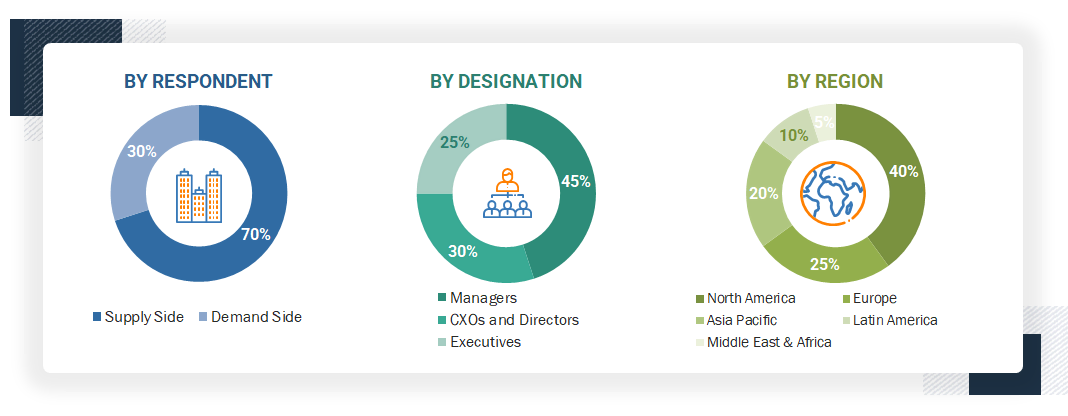
After an initial assessment of the global empty capsules market landscape through secondary research, comprehensive primary research was conducted. This involved conducting in-depth interviews with market experts from the demand side, including stakeholders from the pharmaceutical, nutraceutical, and cosmetic industries, as well as research laboratories. Additionally, interviews were held with key supply-side participants, such as C-suite and senior executives, product managers, and marketing and sales leaders from leading empty capsules manufacturers, distributors, and channel partners. The research covered six major regions: North America, Europe, the Asia Pacific, Latin America, the Middle East, and Africa. About 70% of the primary interviews were with supply-side participants, while 30% involved demand-side experts. Data collection methods included structured questionnaires, email correspondence, online surveys, personal interviews, and phone discussions to thoroughly understand market dynamics.
The following is a breakdown of the primary respondents:
To know about the assumptions considered for the study, download the pdf brochure
Market Size Estimation
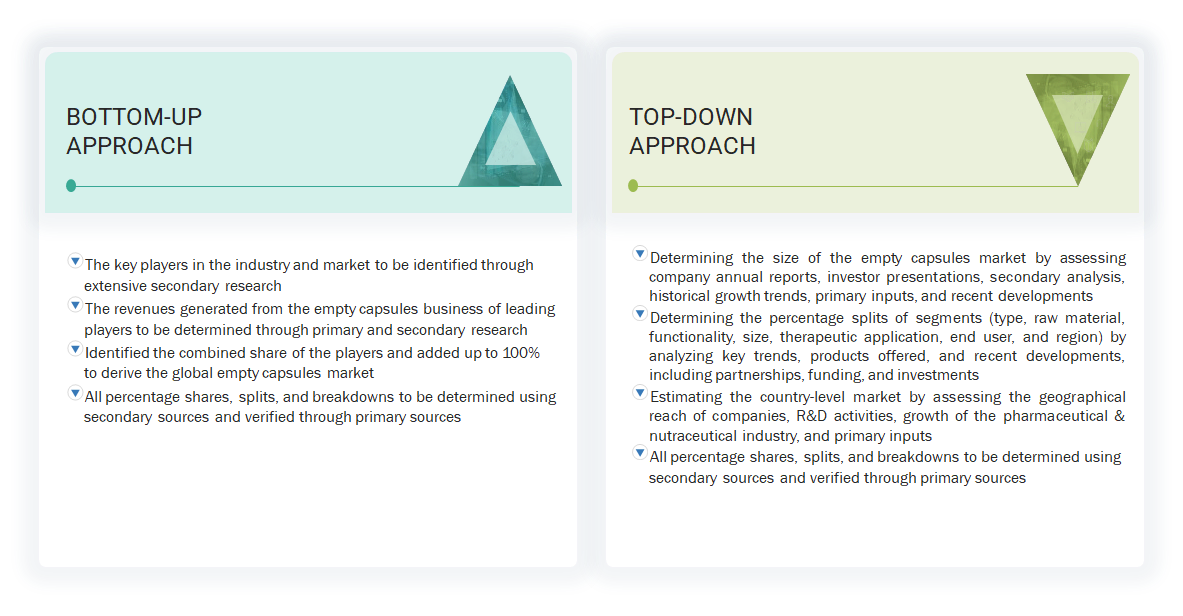
Both bottom-up and top-down approaches were used to estimate and validate the total size of the empty capsules market. These methods were also used extensively to estimate the size of various subsegments in the market. The research methodology used to estimate the market size includes the following:
A list of the major global players operating in the empty capsules market was generated.
The revenues generated from their empty capsules product have been determined through annual reports and secondary sources (including paid databases)
The products were mapped according to the segments of the market. Percentage shares and splits were determined based on the revenue contributed to each segment. This was verified using secondary sources and by industry experts.
The combined revenue share of the players was estimated and then added up to 100% to derive the global empty capsules market.
All assumptions, approaches, and individual shares/revenue estimates were validated through expert interviews.
Global Empty Capsules Market Size: Bottom-up and Top-down Approach
Data Triangulation
After determining the market size through the estimation process described above, the total market was divided into several segments and subsegments. To complete the overall market engineering process and obtain precise statistics for all segments and subsegments, data triangulation and market breakdown methods were used whenever applicable. The data was triangulated by analyzing various factors and trends from both the demand and supply sides.
Market Definition
A capsule is a form of solid oral dosage that consists of a container, usually made of gelatin or HPMC material, filled with a medicinal substance. Empty capsules are hard shells of various shapes, typically designed to hold a single dose of active ingredients. At the time of sale, these capsules are not filled with any pharmaceutical or nutraceutical ingredients. They are made in two halves: a smaller-diameter “body” that is filled and sealed with a larger-diameter “cap”.
Stakeholders
- Empty Capsules Manufacturing Companies
- Pharmaceutical Companies
- Nutraceutical Companies
- Contract Research Organizations (CROs)
- Contract Manufacturing Organizations (CMOs)
- Research Laboratories & Academic Institutes.
- Market Research & Consulting Firms
- Regulatory Bodies
Report Objectives
- To define, describe, and forecast the empty capsules market based on type, raw material, functionality, size, therapeutic application, end user, and region
- To provide detailed information regarding the major factors influencing market growth (such as drivers, restraints, opportunities, and challenges)
- To strategically analyze micromarkets concerning individual growth trends, prospects, and contributions to the empty capsules market
- To analyze the opportunities in the market for stakeholders and provide details of the competitive landscape for market leaders
- To forecast the size of the market segments concerning six main regions—North America, Europe, the Asia Pacific, Latin America, the Middle East, and Africa
- To profile the key players in the global Empty capsules market and comprehensively analyze their product portfolios, market positions, and core competencies
- To track and analyze competitive developments such as product approvals and launches, expansions, agreements, and collaborations in the empty capsules market
- To benchmark players within the empty capsules market using the company evaluation matrix framework, which analyzes market players based on various parameters within the broad categories of business strategies and product footprints.
Get the Full Empty Capsules Market Report
Full forecast, segment splits, and company analysis for all Empty Capsules Market.
- Canada Empty Capsules Market
- US Empty Capsules Market
- Germany Empty Capsules Market
- UK Empty Capsules Market
- France Empty Capsules Market
- Italy Empty Capsules Market
- Spain Empty Capsules Market
- Netherlands Empty Capsules Market
- China Empty Capsules Market
- India Empty Capsules Market
- Japan Empty Capsules Market
- South Korea Empty Capsules Market
- Australia Empty Capsules Market
- New Zealand Empty Capsules Market
- Brazil Empty Capsules Market
- Mexico Empty Capsules Market
- Saudi Arabia Empty Capsules Market
- UAE Empty Capsules Market
- Rest Of Europe Empty Capsules Market
- Rest Of Asia Pacific Empty Capsules Market
- Rest Of Latin America Empty Capsules Market
- Rest Of GCC Countries Empty Capsules Market
- GCC Countries Empty Capsules Market
- Rest Of Middle East Empty Capsules Market
Need a Tailored Report?
Customize this report to your needs
Get 10% FREE Customization
Customize This Report
