
Australia Endoscopy Equipment Market (2025-2030)

The Australia Endoscopy Equipment Market was valued at $301.1 Million in 2025 and projected to reach to $417.1 Million by 2030, representing a compound annual growth rate of 6.7%. Australia's endoscopy equipment market is poised for steady growth driven by an aging population requiring increased diagnostic and therapeutic procedures.


| Market Size in | USD 26.32 MN |
| Market Forecast in | |
| CAGR | |
| Forecast Period | |
| Units Considered | Value (USD MN) |
Australia Endoscopy Equipment Market Trends and Insights
- Australia's healthcare infrastructure and aging population are driving demand for advanced diagnostic and therapeutic endoscopy devices.
- The market in Australia is supported by strong healthcare spending, regulatory frameworks, and increasing adoption of minimally invasive procedures across hospitals and diagnostic centers. The endoscopy equipment sector in Australia benefits from rising prevalence of gastrointestinal disorders, colorectal cancer screening programs, and technological advancements in endoscopic imaging.
- Australia's commitment to early disease detection and patient outcomes is accelerating the uptake of high-definition and robotic-assisted endoscopy systems.
- Between 2025 and 2030, Australia's market is expected to experience steady expansion driven by healthcare modernization, increased procedural volumes, and growing investment in medical device innovation..
Key Market Statistics
- CAGR (2025-2030) 6.7% CAGR
- Market Size, 2025 ~USD 301.1 Million
- Forecast, 2030 ~USD 417.1 Million
- Country Australia
Australia Endoscopy Equipment Market Overview
Market Valuation :
Australia's endoscopy equipment market is valued at USD 301.1 million in 2025, with projected growth to USD 417.1 million by 2030, reflecting strong healthcare investment and adoption of advanced diagnostic technologies.
Aging Population Driver :
Australia's rapidly aging demographic is significantly increasing demand for endoscopic procedures, as older populations require more frequent gastrointestinal and respiratory diagnostics, driving equipment sales across public and private healthcare facilities.
Healthcare Infrastructure Strength :
Australia's robust healthcare system, supported by Medicare and private insurance, enables consistent funding for endoscopy equipment upgrades and maintenance, positioning the country as a stable market for manufacturers and suppliers.
Regulatory Environment :
Stringent TGA (Therapeutic Goods Administration) regulations ensure high-quality endoscopy equipment standards in Australia, creating opportunities for premium device manufacturers while maintaining patient safety and clinical efficacy standards.
Australia Endoscopy Equipment Market Dynamics
- The country's advanced healthcare infrastructure, coupled with strong government healthcare spending and private sector investment, supports consistent demand for innovative endoscopic devices.
- Hospitals and diagnostic centers across major cities are upgrading to minimally invasive technologies, enhancing procedural outcomes and patient recovery times. The 6.7% CAGR reflects Australia's mature healthcare market with sustained investment in medical technology.
- Key growth catalysts include rising prevalence of gastrointestinal disorders, increased cancer screening programs, and adoption of advanced visualization technologies.
- Private healthcare expansion and growing medical tourism further bolster market opportunities, positioning Australia as a premium market for high-end endoscopy equipment manufacturers..
Market Ecosystem
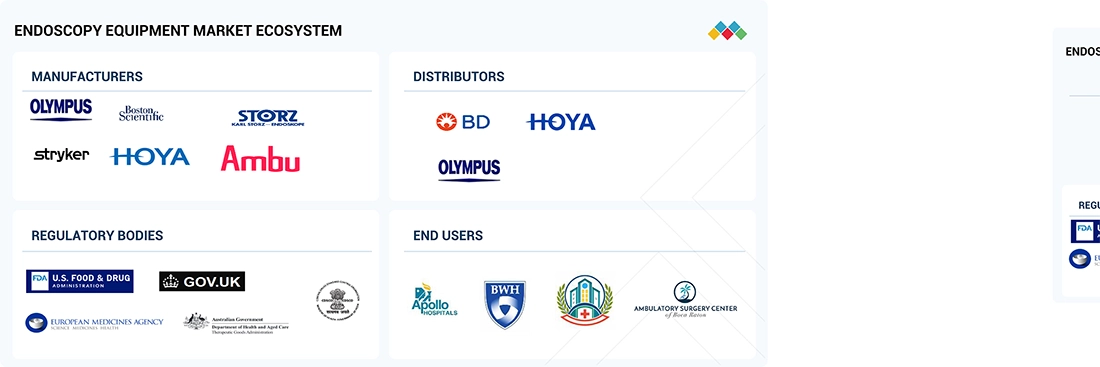
Endoscopy Equipment Market: COMMERCIAL USE CASES ACROSS INDUSTRIES
| COMPANY | USE CASE DESCRIPTION | BENEFITS |
|---|---|---|
 |
EVIS X1 platform integrates TXI, RDI, and NBI on the CV-1500 processor for advanced GI visualization and is applied across GI and bronchoscopy portfolios . Advanced CMOS sensor and real-time image processing optimize texture, color, and brightness for lesion visibility . | Enhances detection and margin visualization via TXI/NBI and speeds hemostasis by highlighting bleeding sources with RDI . Compact integrated processor aids workflow efficiency and OR footprint reduction . |
 |
1788 4K visualization platform adds HDR and Tone Mode with integrated fluorescence and SPY overlay for multi-agent imaging across specialties . Designed as a next-generation, multi-specialty MIS system with broadened clinical applications . | Provides clearer fluorescence delineation for anatomy and perfusion plus best-in-class 4K imaging to support efficient OR workflows . Future-ready architecture improves usability and cross-specialty standardization . |
 |
ELUXEO system with LCI/BLI and CAD EYE AI supports real-time polyp detection and characterization in colonoscopy . CAD EYE switches detection/characterization by mode to streamline use during procedures . | Improves detection of flat and corner lesions and supports expert-level characterization to raise efficiency and diagnostic confidence . Integrated LCI/BLI enhances mucosal contrast for earlier disease recognition . |
 |
GI Genius AI module integrates with existing processors to deliver real-time computer-aided polyp detection during colonoscopy . Randomized data and FDA summary show increased adenoma detection rates versus standard colonoscopy . | Raises ADR and small/right-sided adenoma detection, supporting earlier colorectal cancer prevention outcomes . Modular integration allows scalable deployment across facilities without replacing towers . |
 |
EXALT Model D is a sterile, single-use duodenoscope for ERCP that eliminates reprocessing and repairs while preserving familiar handling . FDA 510(k) cleared with Breakthrough Device designation and clinical validation for ERCP performance . | Reduces cross-contamination risk by providing a new sterile device per patient and simplifies logistics by avoiding reprocessing . Delivers consistent performance and short learning curve through familiar duodenoscope design . |
Logos and trademarks shown above are the property of their respective owners. Their use here is for informational and illustrative purposes only.
Related Ecosystem
Medical Devices
- Polymerase Chain Reaction (PCR)
- Magnetic Resonance Imaging (MRI)
- Disposable Autoinjectors
- Pulse Oximeters
- Blood Pressure Monitors
- Medtronic plc
- Abbott Laboratories
- Stryker Corporation
- Becton, Dickinson and Company
- CONMED Corporation
Key Takeaways
- Australia's endoscopy equipment market is valued at USD 301.1 million in 2025 and will reach USD 417.1 million by 2030.
- Australia's market is growing at a 6.7% CAGR, driven by aging demographics and increased minimally invasive procedure adoption.
- Australia's strong healthcare infrastructure and regulatory environment support sustained demand for advanced endoscopy technologies.
- Australia's colorectal cancer screening programs and gastrointestinal disease prevalence are key growth catalysts through 2030.
Endoscopy Equipment Market Report Scope
| Report Metric | Details |
|---|---|
| Base Year | 2025 |
| Fastest Growing Segment | UROLOGY ENDOSCOPY (CYSTOSCOPY) (Application) |
| Forecast Period | 2025–2030 |
| Growth Rate | CAGR of 7.6% from 2025 to 2030 |
| Largest Segment | HOSPITALS (End User) |
| Market Size Base Year (Billions) | ~USD 37.12 (2025) |
| Revenue Forecast (Billions) | ~USD 53.54 (2030) |
| Segments Covered | Type, Application, End User |
Australia Endoscopy Equipment Market Report Segmentation
3 segment dimensions are covered across the global market.
By Type
- 3-Chip Cameras
- 3D Cameras
- 4K Cameras
- Accessories
- Arthroscopes
- Biopsy Forceps
- Biopsy Valves
- Bronchoscope
- Bronchoscope S
- Bronchoscopes
- Camera Heads
- Capsule Endoscopes
- Carts
- Cleaning Brushes
- Colonoscope
- Colonoscopes
- Cystoscopes
- Cytoscopes
- Duodenoscope
- Duodenoscopes
- Electronic Endoscopy Equipment
- Endoscopes
- Endoscopic Light Sources
- Endoscopy Fluid Management Systems
- Endoscopy Ultrasound Systems
- Fiber Bronchoscopes
- Fiber Colonoscopes
- Fiber Duodenoscope
- Fiber Duodenoscopes
- Fiber Laryngoscopes
- Fiber Nasopharyngoscopes
- Fiber Pharyngoscopes
- Fiber Rhinoscopes
- Fiber Sigmoidoscopes
- Flexible Endoscopes
- Fluid Flushing Devices
- Graspers
- Gynecology Endoscopes
- Hd Cameras
- Insufflators
- Laparoscope
- Laparoscopes
- Laryngoscope
- Laryngoscopes
- Light Cables
- Mechanical Endoscopy Equipment
- Mouth Pieces
- Mouthpieces
- Nasopharyngoscope
- Nasopharyngoscopes
- Needle Holders/ Forceps
- Needle Holders/Forceps
- Neuroendoscopes
- Other Accessories
- Other Electronic Endoscopy Equipment
- Other Endoscopy Equipment
- Other Fiber Flexible Endoscopes
- Other Flexible Endoscope
- Other Flexible Endoscopes
- Other Flexible Fiber Endoscopes
- Other Flexible Video Endoscopes
- Other Mechanical Endoscopic Equipment
- Other Rigid Endoscopes
- Other Video Flexible Endoscopes
- Other Visualization Equipment
- Other Visualization Systems
- Overtubes
- Pharyngoscope
- Pharyngoscopes
- Rhinoscope
- Rhinoscopes
- Rigid Endoscopes
- Robot-Assisted Endoscopes
- Sigmoidoscope
- Sigmoidoscopes
- Single-Chip Cameras
- Snares
- Surgical Dissectors
- Transmitter & Receivers
- Trocar & Cannulas
- Trocars & Cannulas
- Upper Gastrointestinal Endoscope
- Upper Gastrointestinal Endoscopes
- Upper Gastrointestinal Fiberscopes
- Upper Gastrointestinal Videoscopes
- Urology Endoscopes
- Video Bronchoscopes
- Video Colonoscopes
- Video Converters
- Video Duodenoscope
- Video Duodenoscopes
- Video Laryngoscopes
- Video Nasopharyngoscopes
- Video Pharyngoscopes
- Video Processors
- Video Recorders
- Video Rhinoscopes
- Video Sigmoidoscopes
- Visualization Systems
- Wireless Displays & Monitors
By Application
- Arthroscopy
- Bronchoscopy
- Ent Endoscopy
- Gastrointestinal Endoscopy
- Laparoscopy
- Mediastinoscopy
- Obstetrics/ Gynecology Endoscopy
- Other Applications
- Urology Endoscopy (Cystoscopy)
By End User
- Ambulatory Surgery Centers
- Ambulatory Surgical Centers (Ascs)
- Clinics
- Hospitals
- Other End Users
AUSTRALIA: ENDOSCOPY EQUIPMENT MARKET, BY END USER, 2023–2030
| Segment | 2023 | 2024 | 2025 | 2026 | 2027 | 2028 | 2029 | 2030 | CAGR (%) |
|---|---|---|---|---|---|---|---|---|---|
| AMBULATORY SURGICAL CENTERS (ASCS) | 162.4 | 172.9 | 183.1 | 194.7 | 207.8 | 222.6 | 239.1 | 257.5 | 7.1 |
| CLINICS | 93.2 | 98.9 | 104.4 | 110.7 | 117.7 | 125.7 | 134.6 | 144.4 | 6.7 |
| HOSPITALS | 317.2 | 337 | 356.4 | 378.5 | 403.2 | 431.1 | 462.4 | 497.2 | 6.9 |
| OTHER END USERS | 159.9 | 167.3 | 174.2 | 182.1 | 191.1 | 201.2 | 212.5 | 224.9 | 5.2 |
| TOTAL | 732.7 | 776.1 | 818.2 | 866 | 919.8 | 980.6 | 1048.6 | 1124 | 6.6 |
Target Audience
- Medical Device Manufacturers : Manufacturers need Australia-specific market data to develop localized product strategies, understand regulatory pathways through TGA, and identify growth opportunities in this high-value healthcare market with strong purchasing power.
- Healthcare Facility Administrators : Hospital and clinic managers require market insights to justify capital equipment investments, benchmark procurement costs, and plan endoscopy department upgrades aligned with patient demand and clinical best practices.
- Distributors & Suppliers : Medical equipment distributors need Australia market intelligence to optimize inventory management, identify emerging demand trends, and develop targeted sales strategies for hospitals and diagnostic centers across the country.
- Investment & Private Equity Firms : Investors evaluating healthcare sector opportunities in Australia require detailed market sizing and growth forecasts to assess investment returns in endoscopy equipment companies and healthcare service providers.
- Healthcare Consultants & Analysts : Consultants advising healthcare organizations need Australia-specific market data to develop strategic recommendations, conduct competitive analysis, and support business development initiatives in the endoscopy equipment sector.
Reasons to Buy this Report
- Market-Specific Growth Projections : Access detailed forecasts showing Australia's endoscopy market expanding from USD 301.1M to USD 417.1M by 2030, enabling precise investment planning and resource allocation for market entry or expansion strategies.
- Demographic Insights : Understand Australia's aging population dynamics and their direct impact on endoscopy procedure volumes, helping manufacturers and distributors tailor product portfolios and marketing strategies to address specific clinical needs.
- Regulatory & Compliance Framework : Gain insights into TGA requirements and Australian healthcare standards, reducing market entry risks and accelerating product commercialization timelines for endoscopy equipment suppliers.
- Competitive Landscape Analysis : Identify key market players, distribution channels, and competitive positioning within Australia's healthcare sector, enabling strategic partnerships and differentiation opportunities in this premium market.
- Healthcare Spending Trends : Leverage data on Australian government and private healthcare expenditure patterns to forecast demand for endoscopy equipment and identify high-opportunity segments and geographic regions within the country.
Frequently asked questions
What is the current size of Australia's endoscopy equipment market?
Australia's endoscopy equipment market is valued at USD 301.1 million in 2025.
What is the projected market size for Australia by 2030?
Australia's endoscopy equipment market is projected to reach USD 417.1 million by 2030.
What is the growth rate of Australia's endoscopy equipment market?
Australia's endoscopy equipment market is growing at a compound annual growth rate (CAGR) of 6.7% from 2025 to 2030.
What factors are driving growth in Australia's endoscopy equipment market?
Key drivers in Australia include an aging population, rising gastrointestinal disease prevalence, colorectal cancer screening programs, and increased adoption of minimally invasive procedures.
Which endoscopy procedures are most common in Australia?
Australia sees high demand for gastrointestinal endoscopy, colonoscopy, and bronchoscopy procedures, supported by national screening initiatives and healthcare modernization efforts.
RESEARCH METHODOLOGY
The study estimated the current market size for the global endoscopy equipment market. Exhaustive secondary research was done to collect information on the endoscopy equipment industry. The next step was to validate these findings, assumptions, and sizing with industry experts across the value chain using primary research. Different approaches, such as top-down and bottom-up, were employed to estimate the total market size. Thereafter, the market breakup and data triangulation procedures were used to estimate the market size of the segments and subsegments of the endoscopy equipment market.
Secondary Research
The secondary research process involves the widespread use of secondary sources, directories, databases (such as Bloomberg Businessweek, Factiva, and D&B Hoovers), white papers, annual reports, investor presentations, SEC filings of companies and publications from government sources [such as National Institutes of Health (NIH), US FDA, US Census Bureau, World Health Organization (WHO), International Trade Administration (ITA), Global Burden of Disease Study, and Centers for Medicare and Medicaid Services (CMS) were referred to identify and collect information for the global endoscopy equipment market study. It was also used to obtain important information about the key players and market classification & segmentation according to industry trends, to the bottom-most level, and key developments related to market and technology perspectives. A database of the key industry leaders was also prepared using secondary research.
Primary Research
In the primary research process, various sources from the supply and demand sides were interviewed to obtain qualitative and quantitative information for this report. The primary sources from the supply side include industry experts such as CEOs, vice presidents, marketing and sales directors, technology & innovation directors, and related key executives from various key companies and organizations in the endoscopy equipment market. The primary sources from the demand side include ambulatory surgical centers, hospitals, clinics, and other end users. Primary research was conducted to validate the market segmentation, identify key players in the market, and gather insights into key industry trends & key market dynamics.
The following is a breakdown of the primary respondents:
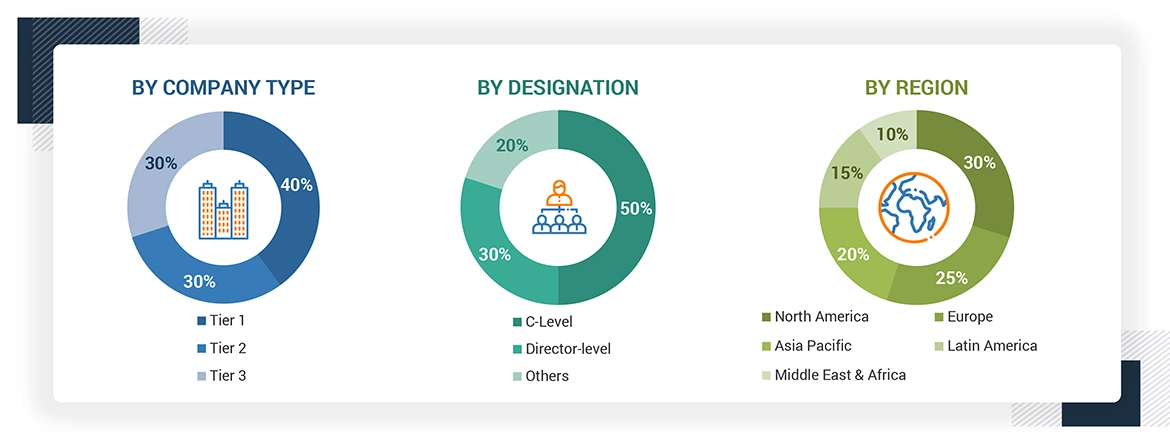
Source: MarketsandMarkets Analysis
To know about the assumptions considered for the study, download the pdf brochure
Market Size Estimation
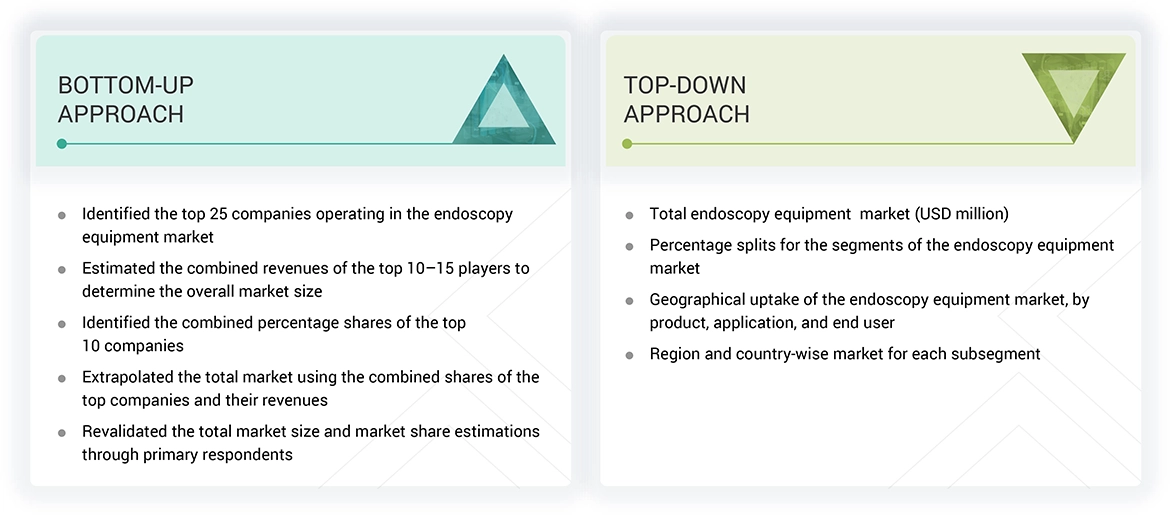
Annual revenues were calculated based on the revenue mapping of major product manufacturers and OEMs active in the global endoscopy equipment market for the global market value. All major product manufacturers were identified at the global and/or country/regional level. Revenue mapping for the respective business segments/sub-segments was done for the major players. Also, the global endoscopy equipment market was split into various segments and sub-segments based on:
- List of major players operating in the products market at the regional and/or country level
- Product mapping of various endoscopy equipment manufacturers at the regional and/or country level
- Mapping of annual revenue generated by listed major players from endoscopy equipment (or the nearest reported business unit/product category)
- Extrapolation of the revenue mapping of the listed major players to derive the global market value of the respective segments/subsegments
- Summation of the market value of all segments/subsegments to arrive at the global endoscopy equipment market
The aforementioned data was consolidated and added with detailed inputs and analysis from MarketsandMarkets and presented in this report.
Market Size Estimation (Bottom-Up Approach &Top-down Approach)
Data Triangulation
After determining the overall size of the global endoscopy equipment market through the aforementioned methodology, this market was split into several segments and subsegments. The data triangulation and market breakdown procedures were employed, wherever applicable, to complete the overall market engineering process and derive the exact market value data for key segments and subsegments. The extrapolated market data was triangulated by studying various macro indicators and regional trends from demand- and supply-side participants.
Market Definition
An endoscope is a tubular viewing device that allows physicians to look inside joints and body cavities that could otherwise be examined through invasive procedures, such as open surgeries. Endoscopy equipment includes endoscopes, visualization systems, and other instruments used to support endoscopic surgical procedures. Accessories are designed to facilitate instrument handling during surgeries.
Stakeholders
- Manufacturing companies of endoscopes and related devices
- Suppliers and distributors of endoscopy devices
- Hospitals, diagnostic centers, and medical colleges
- Private offices of physicians and surgeons
- Ambulatory surgery centers
- Teaching hospitals and academic medical centers
- Government bodies/municipal corporations
- Business research and consulting service providers
- Venture capitalists
Report Objectives
- To define, describe, segment, and forecast the global endoscopy equipment market by product, application, end user, and region
- To provide detailed information about the factors influencing the market growth (such as drivers, restraints, opportunities, and challenges) of the global endoscopy equipment market
- To analyze micromarkets with respect to individual growth trends, prospects, and contributions to the overall global endoscopy equipment market
- To analyze market opportunities for stakeholders and provide details of the competitive landscape for key players in the global endoscopy equipment market
- To forecast the size of the global endoscopy equipment market in five main regions (along with their respective key countries), namely, North America, Europe, the Asia Pacific, Latin America, and the Middle East & Africa
- To profile the key players in the global endoscopy equipment market and comprehensively analyze their core competencies and market shares
- To track and analyze competitive developments such as acquisitions, product launches, expansions, collaborations, agreements, partnerships, and R&D activities of the leading players in the global endoscopy equipment market
- To benchmark players within the global endoscopy equipment market using the Company Evaluation Matrix framework, which analyzes market players on various parameters within the broad categories of business strategy, market share, and product offerings
Get the Full Endoscopy Equipment Market Report
Full forecast, segment splits, and company analysis for all Endoscopy Equipment Market.
- US Endoscopy Equipment Market
- Canada Endoscopy Equipment Market
- Germany Endoscopy Equipment Market
- UK Endoscopy Equipment Market
- France Endoscopy Equipment Market
- Italy Endoscopy Equipment Market
- Spain Endoscopy Equipment Market
- China Endoscopy Equipment Market
- Japan Endoscopy Equipment Market
- India Endoscopy Equipment Market
- South Korea Endoscopy Equipment Market
- Brazil Endoscopy Equipment Market
- Mexico Endoscopy Equipment Market
- Rest Of Europe Endoscopy Equipment Market
Need a Tailored Report?
Customize this report to your needs
Get 10% FREE Customization
Customize This Report
