
Asia Pacific Engineering Plastics Market (2025-2030)

The Asia Pacific Engineering Plastics Market was valued at $19728 Million in 2025 and projected to reach to $25435.1 Million by 2030, representing a compound annual growth rate of 5.2%. Asia Pacific's engineering plastics market is positioned for sustained expansion through 2030, fueled by accelerating automotive electrification, robust electronics manufacturing, and industrial modernization across emerging economies.


| Market Size in | USD 26.32 MN |
| Market Forecast in | |
| CAGR | |
| Forecast Period | |
| Units Considered | Value (USD MN) |
Asia Pacific Engineering Plastics Market Trends and Insights
- Asia Pacific's 5.2% compound annual growth rate outpaces the global average, driven by rapid industrialization, automotive electrification, and increased demand from electronics manufacturers across the region.
- The region's dominance in manufacturing and rising consumer spending on durable goods position Asia Pacific as a critical growth engine for the global engineering plastics sector. Asia Pacific's engineering plastics market benefits from strong demand in automotive, electrical & electronics, and industrial applications.
- Key markets including China, India, and Southeast Asia are investing heavily in infrastructure and manufacturing capabilities, creating sustained demand for high-performance polymers.
- Between 2025 and 2030, Asia Pacific is expected to capture significant market share as regional producers expand capacity and OEMs localize supply chains to meet growing end-user requirements..
Key Market Statistics
- CAGR (2025-2030) 5.2% CAGR
- Market Size, 2025 ~USD 19728 Million
- Forecast, 2030 ~USD 25435.1 Million
- Geography Asia Pacific
Asia Pacific Engineering Plastics Market Overview
Regional Growth Outpacing Global Average :
Asia Pacific's 5.2% CAGR significantly exceeds the global engineering plastics market growth of 4.1%, positioning the region as a key growth engine driven by rapid industrialization and manufacturing expansion.
Automotive Electrification Momentum :
The region's automotive sector is undergoing rapid electrification, creating substantial demand for lightweight, high-performance engineering plastics in EV components, battery housings, and thermal management systems.
Electronics Manufacturing Hub :
Asia Pacific's dominance in electronics manufacturing drives consistent demand for engineering plastics in consumer electronics, semiconductors, and telecommunications equipment across China, Japan, South Korea, and Taiwan.
Market Expansion Trajectory :
The market is projected to grow from USD 19,728 million in 2025 to USD 25,435.1 million by 2030, representing a USD 5.7 billion expansion opportunity over the five-year forecast period.
Asia Pacific Engineering Plastics Market Dynamics
- China's manufacturing dominance, coupled with India's rapid industrialization and Japan's advanced technology integration, creates a diversified growth landscape.
- The region's competitive advantages in production capacity and supply chain infrastructure support continued market penetration. Key growth catalysts include increasing adoption of lightweight materials in electric vehicles, rising consumer electronics demand, and infrastructure development projects across Southeast Asia.
- Investment in advanced manufacturing capabilities and R&D for high-performance polymers will further strengthen Asia Pacific's market position.
- Strategic partnerships between regional manufacturers and global players are expected to accelerate innovation and market consolidation through 2030..
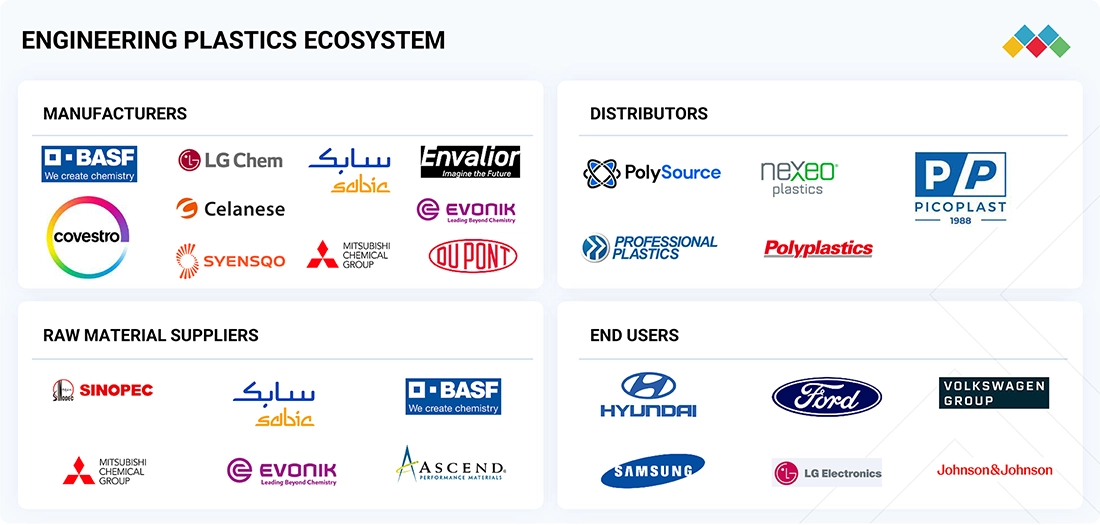
Market Ecosystem
Engineering Plastics Market: COMMERCIAL USE CASES ACROSS INDUSTRIES
| COMPANY | USE CASE DESCRIPTION | BENEFITS |
|---|---|---|
 |
First production vehicle (86 GRMN sports car) with plasma-coated polycarbonate rear quarter window, developed with SABIC’s LEXAN resin | 50% lighter than conventional glass, superior durability, global regulatory compliance, and improved driver visibility |
 |
GPC analysis of nylon 6, nylon 12, polycarbonate, polyacetal, and polysulfone to determine molecular weight distribution | Provides accurate polymer characterization, predicts mechanical performance and degradation, and supports advanced engineering applications |
 |
Supplied TRISTAR PC-10R-GY339(V) to replace polycarbonate and support old tooling with on-site technical and inventory services | High gloss, UV resistant, impact and chemical resistant, UL 94 V-2 enables easier molding, reliable supply, and new application opportunities |
 |
Makrolon outdoor polycarbonate with EMI shielding for PV and ESS inverter enclosures, replacing metal | Lightweight, durable, UV- and impact-resistant, flame-retardant, cost-effective, reliable, and eco-friendly |
Logos and trademarks shown above are the property of their respective owners. Their use here is for informational and illustrative purposes only.
Related Ecosystem
Resins And Polymers
- Polycarbonate
- Acrylonitrile Butadiene Styrene (ABS)
- Epoxy Resin
- Light Commercial Vehicles (LCVs)
- Polypropylene (PP)
- Basf se
- DOW CHEMICAL COMPANY
- Solvay sa
- Saudi arabia basic industries corporation (sabic)
- DuPont de Nemours, Inc.
Key Takeaways
- Asia Pacific engineering plastics market valued at USD 19,728 million in 2025, expanding to USD 25,435.1 million by 2030
- Asia Pacific's 5.2% CAGR significantly exceeds the global growth rate of 4.1%, reflecting regional manufacturing strength
- Automotive electrification and electronics demand are primary growth drivers across Asia Pacific markets
- China, India, and Southeast Asia represent the highest-growth segments within the Asia Pacific region
Engineering Plastics Market Report Scope
| Report Metric | Details |
|---|---|
| Base Year | 2025 |
| Fastest Growing Segment | BIO-BASED & SPECIALTY POLYAMIDE (Type) |
| Forecast Period | 2025–2030 |
| Growth Rate | CAGR of 4.1% from 2025 to 2030 |
| Largest Segment | AUTOMOTIVE & TRANSPORTATION (End-Use Industry) |
| Market Size Base Year (Billions) | ~USD 107.14 (2025) |
| Revenue Forecast (Billions) | ~USD 130.98 (2030) |
| Segments Covered | Type, End-Use Industry |
Asia Pacific Engineering Plastics Market Report Segmentation
2 segment dimensions are covered across the global market.
By Type
- Acrylonitrile Butadiene Styrene (Abs)
- Fluoropolymer
- Other Types
- Polyacetal
- Polyamide
- Polyamides
- Polycarbonate
- Thermoplastic Polyester (Pet & Pbt)
By End-Use Industry
- Automotive & Transportation
- Consumer Appliances
- Electrical & Electronics
- Industrial & Machinery
- Other End-Use Industries
- Packaging
Target Audience
- Automotive Manufacturers & Suppliers : Need Asia Pacific market intelligence to develop lightweight material strategies for EV platforms, optimize supply chains, and capitalize on the region's automotive electrification boom.
- Electronics & Semiconductor Companies : Require regional demand forecasts and country-specific insights to secure engineering plastics supply, plan production capacity, and support consumer electronics growth across Asia Pacific.
- Plastics & Materials Producers : Depend on detailed market segmentation and growth projections to identify expansion opportunities, optimize product portfolios, and establish manufacturing facilities in high-demand Asia Pacific markets.
- Investment & Private Equity Firms : Need comprehensive regional market data and growth forecasts to evaluate investment opportunities in engineering plastics companies, identify acquisition targets, and assess market potential.
- Strategic Consultants & Business Analysts : Utilize Asia Pacific market intelligence to advise clients on market entry strategies, competitive positioning, and growth opportunities in the region's rapidly expanding engineering plastics sector.
Key Companies in the Asia Pacific Engineering Plastics Market
| Company | HQ | Ownership | Strongest segments |
|---|---|---|---|
| SOJITZ CORPORATION | Japan | Public Company | Automotive, Industrial Machinery & Transportation Equipment,Energy, Power & Infrastructure (IPP, IPP/IWPP, LNG, Oil & Gas, Nuclear-related),Metals, Mineral Resources & Recycling, |
| ELIX POLYMERS | Spain | Subsidiary | Standard and high-heat ABS for automotive,ABS for consumer goods and appliances,Healthcare and medical-grade ABS, |
| KANEKA CORPORATION | Japan | Public Company | PVC and related vinyl polymers,Specialty additives and engineering resins,Advanced films, foams, and thermal solutions, |
| THE CHEMOURS COMPANY | United States | Public Company | Titanium Technologies (Ti-Pure TiO2),Thermal & Specialized Solutions (Freon, Opteon, propellants, blowing agents),Advanced Performance Materials (Teflon, Viton, Krytox, Nafion and related), |
| ESSENTRA PLC | United Kingdom | Public Company | Protection and finishing (caps, plugs, pipe and flange protection, masking, hose protection, tube inserts and glides),Fasteners and mechanical hardware (nuts, washers, rivets, screws, spacers, standoffs, POS hardware),Electronic and telecom components (cable management, PCB hardware, fiber management, motion control and power transmission), |
| BOREALIS AG | Austria | Private Company | Polyethylene (PE) solutions,Polypropylene (PP) solutions,Recyclates and circular polyolefin materials, |
| BASF | Germany | Public Company | Chemicals,Materials,Industrial Solutions, |
| COVESTRO AG | Germany | Public Company | Performance Materials (polyurethanes, polycarbonates, base chemicals),Solutions & Specialties (polycarbonates, TPU, specialty films, coatings precursors, elastomers), |
| CELANESE CORPORATION | United States | Public Company | Acetyl Chain (acetic acid, anhydride, VAM, acetates, solvents),Engineered Materials – Engineering Thermoplastics (POM, nylon, PBT, PP compounds),Engineered Elastomers and TPEs (Santoprene, Vamac, TPE-S, TPV, TPE-E), |
| DUPONT | United States | Public Company | Construction materials (TYVEK, STYROFOAM, CORIAN and related),Water filtration and separation (AMBERLITE, FILMTEC, INGE, ITEGRATEC),Healthcare and medical components (including TYVEK medical packaging), |
| SYENSQO | Belgium | Public Company | Specialty Polymers and Advanced Materials,Performance & Care (Surfactants, Solvents, Specialty Chemicals),Flavors, Fragrances, and Renewable/Biobased Polymers, |
| LG CHEM | South Korea | Public Company | Ethylene-based synthetic resins (EVA, HDPE, LDPE, LLDPE, POE, PVC, metallocene PE, UNIQABLE),Styrene-based resins and polycarbonate,Polypropylene and superabsorbent polymer, |
| SABIC | Saudi Arabia | Public Company | Petrochemicals (olefins, aromatics, methanol, glycols, MTBE, CO2),Polyolefins (PE and PP, including compounds),Specialties and Engineering Plastics, |
| EVONIK INDUSTRIES AG | Germany | Public Company | Advanced Technologies,Custom Solutions,Infrastructure, |
| MITSUBISHI CHEMICAL GROUP CORPORATION | Japan | Public Company | MMA & Derivatives / PMMA,Basic Materials & Polymers (commodity polymers, petrochemicals),Specialty Materials (engineering plastics, high-performance polymers, carbon fiber composites), |
| KINGFA SCI.&TECH. CO.,LTD. | China | Public Company | Modified plastics for automotive and home appliances,Specialty engineering plastics and fiber-reinforced composites,Recycled and biodegradable plastics, |
| ASAHI KASEI CORPORATION | Japan | Public Company | Advanced electronic and semiconductor materials (Pimel, Sunfort, Novacure, glass fabric, photopolymers),Battery separators and energy-related materials (Hipore, Celgard, Aqualyzer-linked materials),Membranes and process systems (Microza, Aciplex, industrial systems), |
| ARKEMA | France | Public Company | Adhesive Solutions,Advanced Materials,Coating Solutions, |
| EASTMAN CHEMICAL COMPANY | United States | Public Company | Additives & Functional Products,Advanced Materials,Chemical Intermediates, |
| CHIMEI | Taiwan | Private Company | Styrenic resins (ABS, MABS, ASA, SAN, PS, SMMA),Engineering plastics (PC, PC alloys, PMMA resins),Electronic and optical materials, |
SOJITZ CORPORATION
Sojitz Corporation is a Japanese public company founded in 1862 with 26,789 employees. It operates as a diversified trading and investment company with global operations.
ELIX POLYMERS
Elix Polymers is a Spanish subsidiary company founded in 1975. It operates within the polymer manufacturing and processing sector.
KANEKA CORPORATION
Kaneka Corporation is a Japanese public company founded in 1949 with 11,762 employees. It operates in the chemical, materials, and specialty products sectors.
THE CHEMOURS COMPANY
The Chemours Company is a United States public company founded in 2014 with 5,700 employees. It produces specialty chemicals and fluoroproducts for various industrial applications.
ESSENTRA PLC
Essentra PLC is a United Kingdom public company founded in 2005 with 2,998 employees. It provides essential components and solutions to industrial markets.
BOREALIS AG
Borealis AG is an Austrian private company founded in 1994 with 5,887 employees. It specializes in polyolefins, base chemicals, and fertilizers.
BASF
BASF is a German public company founded in 1865 with 106,428 employees. It is one of the world's largest chemical manufacturers producing a wide range of products.
COVESTRO AG
Covestro AG is a German public company founded in 1863 with 17,806 employees. It manufactures high-performance polymers and chemical materials.
CELANESE CORPORATION
Celanese Corporation is a United States public company founded in 1912 with 11,434 employees. It produces specialty chemicals and engineered materials.
DUPONT
DuPont is a United States public company founded in 2015 with 15,000 employees. It manufactures specialty chemicals, materials, and agricultural products.
SYENSQO
Syensqo is a Belgian public company founded in 1863 with 13,000 employees. It produces specialty chemicals and advanced materials for industrial applications.
LG CHEM
LG Chem is a South Korean public company founded in 1947 with 14,019 employees. It manufactures chemicals, petrochemicals, and advanced materials.
SABIC
SABIC is a Saudi Arabian public company founded in 1976 with 35,000 employees. It is a major global petrochemical manufacturer producing plastics and chemicals.
EVONIK INDUSTRIES AG
Evonik Industries AG is a German public company founded in 1847 with 30,643 employees. It produces specialty chemicals, advanced materials, and performance products.
MITSUBISHI CHEMICAL GROUP CORPORATION
Mitsubishi Chemical Group Corporation is a Japanese public company founded in 1933 with 56,678 employees. It operates across chemicals, plastics, and advanced materials sectors.
KINGFA SCI.&TECH. CO.,LTD.
Kingfa Sci. & Tech. Co., Ltd. is a Chinese public company founded in 1993 with 14,111 employees. It specializes in engineering plastics and composite materials.
ASAHI KASEI CORPORATION
Asahi Kasei Corporation is a Japanese public company founded in 1922 with 47,895 employees. It produces chemicals, fibers, electronics, and healthcare products.
ARKEMA
Arkema is a French public company founded in 2003 with 20,700 employees. It manufactures specialty chemicals and advanced materials for industrial applications.
EASTMAN CHEMICAL COMPANY
Eastman Chemical Company is a United States public company founded in 1920 with 13,000 employees. It produces specialty chemicals, advanced materials, and fibers.
CHIMEI
Chimei is a Taiwanese private company founded in 1960 with 1,842 employees. It manufactures specialty chemicals and polymer materials.
Countries within Asia Pacific - compare and drill down
| Country | 2025 size (native) |
|---|---|
| China | USD 39060.9 Million |
| India | USD 9050.5 Million |
| Japan | USD 5944.8 Million |
| South Korea | USD 3884 Million |
| Taiwan | USD 3110.2 Million |
| Indonesia | USD 2854.1 Million |
| Rest Of Asia Pacific | USD 5644.8 Million |
Country market size visualization
Reasons to Buy this Report
- Regional Market Sizing & Forecasts : Obtain precise market valuations for Asia Pacific and individual country-level data, enabling accurate business planning and investment decisions specific to the region's growth trajectory through 2030.
- Competitive Landscape Intelligence : Understand market dynamics, key players, and competitive positioning across Asia Pacific's engineering plastics sector to identify partnership and expansion opportunities in high-growth markets.
- Sector-Specific Growth Drivers : Gain insights into automotive electrification, electronics manufacturing, and industrial applications driving demand across China, India, Japan, and Southeast Asia for targeted market entry strategies.
- Country-Level Market Analysis : Access detailed breakdowns for China, India, Japan, South Korea, Taiwan, and Indonesia to prioritize market expansion efforts and allocate resources to highest-potential geographies.
- Strategic Planning & Risk Assessment : Leverage comprehensive regional data to develop informed go-to-market strategies, assess competitive threats, and identify emerging opportunities in Asia Pacific's fastest-growing segments.
Frequently asked questions
What is the current size of the Asia Pacific engineering plastics market?
The Asia Pacific engineering plastics market is valued at USD 19,728 million in 2025 and is projected to reach USD 25,435.1 million by 2030.
What is the growth rate for engineering plastics in Asia Pacific?
Asia Pacific's engineering plastics market is growing at a compound annual growth rate (CAGR) of 5.2% from 2025 to 2030, outpacing the global average of 4.1%.
Which industries drive demand for engineering plastics in Asia Pacific?
Key demand drivers in Asia Pacific include automotive (especially electric vehicles), electrical & electronics, industrial equipment, and consumer durables manufacturing.
Which countries are the largest markets for engineering plastics in Asia Pacific?
China, India, and Southeast Asian nations represent the largest and fastest-growing markets for engineering plastics in the Asia Pacific region.
Why is Asia Pacific's growth rate higher than the global average?
Asia Pacific's superior growth is driven by rapid industrialization, expanding manufacturing capacity, automotive electrification trends, and rising electronics consumption across the region.
RESEARCH METHODOLOGY
The study involved four major activities to estimate the current size of the global engineering plastics market. Exhaustive secondary research was carried out to collect information on the market, the peer product market, and the parent product group market. The next step was to validate these findings, assumptions, and sizes with the industry experts across the value chain of engineering plastics through primary research. The top-down and bottom-up approaches were employed to estimate the overall size of the engineering plastics market. After that, market breakdown and data triangulation procedures were used to determine the size of different segments and subsegments of the market.
Secondary Research
The market for companies offering engineering plastics is arrived at by secondary data available through paid and unpaid sources, analyzing the product portfolios of the major companies in the ecosystem, and rating the companies by their performance and quality. Various secondary sources, such as Business Standard, Bloomberg, World Bank, and Factiva, were referred to identify and collect information for this study on the engineering plastics market. In the secondary research process, various secondary sources were referred to identify and collect information related to the study. Secondary sources included annual reports, press releases, and investor presentations of vendors, forums, certified publications, and whitepapers. The secondary research was used to obtain critical information on the industry’s value chain, the total pool of key players, market classification, and segmentation from the market and technology-oriented perspectives.
Primary Research
In the primary research process, various primary sources from both the supply and demand sides were interviewed to obtain qualitative and quantitative information for this report. The primary sources from the supply side included industry experts, such as chief executive officers (CEOs), vice presidents (VPs), marketing directors, technology and innovation directors, and related key executives from several key companies and organizations operating in the engineering plastics market. After the complete market engineering (calculations for market statistics, market breakdown, market size estimations, market forecasting, and data triangulation), extensive primary research was conducted to gather information and verify and validate the critical numbers arrived at. Primary research was also conducted to identify the segmentation types, industry trends, competitive landscape of engineering plastics offered by various market players, and key market dynamics, such as drivers, restraints, opportunities, challenges, industry trends, and key player strategies. In the complete market engineering process, the top-down and bottom-up approaches and several data triangulation methods were extensively used to perform the market estimation and market forecasting for the overall market segments and subsegments listed in this report. Extensive qualitative and quantitative analysis was performed on the complete market engineering process to list the key information/insights throughout the report.
The following is the breakdown of primary respondents:

Notes: Other designations include sales, marketing, and product managers.
Tier 1: >USD 1 billion; Tier 2: USD 500 million–1 billion; and Tier 3: < USD 500 million.
To know about the assumptions considered for the study, download the pdf brochure
Market Size Estimation
The top-down and bottom-up approaches were used to estimate and validate the size of the global engineering plastics market. These approaches were also used extensively to estimate the size of various dependent market segments. The research methodology used to estimate the market size included the following:

Data Triangulation
After arriving at the overall market size using the market size estimation processes, the market was split into several segments and subsegments. The data triangulation and market breakup procedures were employed, wherever applicable, to complete the overall market engineering process and arrive at the exact statistics of each market segment and subsegment. The data was triangulated by studying various factors and trends from both the demand and supply sides.
Market Definition
Engineering plastics, or performance plastics, possess superior mechanical, thermal, and chemical resistance to commodity plastics. They are extensively utilized in situations where durability, safety, precision, and reliability are paramount. These materials offer enhanced properties, including elevated strength-to-weight ratios, resistance to impact and abrasion, dimensional stability, and durability against heat, chemicals, and wear, rendering them appropriate substitutes for metals, glass, and ceramics in structural and functional applications. Engineering plastics, acknowledged by organizations including the American Chemical Society (ACS), the Society of Plastics Engineers (SPE), and ASTM International, encompass materials such as Acrylonitrile Butadiene Styrene (ABS), Polyamide (PA), Polycarbonate (PC), Thermoplastic Polyester (PET & PBT), Polyacetal (POM), fluoropolymers, and various specialty polymers. The materials are developed and rigorously tested according to various global standards such as ISO 178 for flexural properties, ISO 527 for tensile properties, and ASTM D256 for impact resistance. Their versatility allows for lightweighting, energy efficiency, and freedom of design, allowing for use in the automotive and transportation, electrical and electronics, consumer appliances, industrial equipment, medical devices, and packaging sectors. Engineering plastics play an essential role in supporting innovation in many sectors, and their growing demand for high-performance, sustainable, and durable products.
Stakeholders
- To define, describe, and forecast the size of the global engineering plastics market, based on type, end-use industry, and region in terms of value and volume
- To provide detailed information on the significant drivers, restraints, opportunities, and challenges influencing the market
- To strategically analyze micromarkets concerning individual growth trends, prospects, and their contribution to the market
- To assess the growth opportunities in the market for stakeholders and provide details on the competitive landscape for market leaders
- To forecast the market size of segments and subsegments for North America, Europe, Asia Pacific, South America, and the Middle East & Africa
- To strategically profile the key players and comprehensively analyze their market shares and core competencies
- To analyze competitive developments such as product launches, acquisitions, expansions, partnerships, and agreements in the engineering plastics market
- To provide the impact of AI/Gen AI on the market
Report Objectives
- Engineering Plastic Manufacturers
- Raw Material Suppliers
- Converters and Processors
- Distributors and Traders
- Industry Associations and Regulatory Bodies
- End Users
Get the Full Engineering Plastics Market Report
Full forecast, segment splits, and company analysis for all Engineering Plastics Market.
- Germany Engineering Plastics Market
- France Engineering Plastics Market
- Italy Engineering Plastics Market
- Russia Engineering Plastics Market
- UK Engineering Plastics Market
- Canada Engineering Plastics Market
- Mexico Engineering Plastics Market
- US Engineering Plastics Market
- South Africa Engineering Plastics Market
- Brazil Engineering Plastics Market
- Argentina Engineering Plastics Market
- Rest Of Europe Engineering Plastics Market
- Rest Of Asia Pacific Engineering Plastics Market
- GCC Countries Engineering Plastics Market
- –Rest Of GCC Countries Engineering Plastics Market
- China Engineering Plastics Market
- India Engineering Plastics Market
- Japan Engineering Plastics Market
- South Korea Engineering Plastics Market
- Taiwan Engineering Plastics Market
- Indonesia Engineering Plastics Market
Need a Tailored Report?
Customize this report to your needs
Get 10% FREE Customization
Customize This Report
