
Australia Flow Battery Market (2024-2029)

The Australia Flow Battery Market was valued at $31.2 Million in 2024 and projected to reach to $96.1 Million by 2029, representing a compound annual growth rate of 20.6%. Australia's flow battery market is positioned for accelerated growth as the nation transitions toward its renewable energy commitments and grid decarbonization goals.


| Market Size in | USD 26.32 MN |
| Market Forecast in | |
| CAGR | |
| Forecast Period | |
| Units Considered | Value (USD MN) |
Australia Flow Battery Market Trends and Insights
- This represents a compound annual growth rate of 20.6%, driven by Australia's commitment to renewable energy integration and grid stabilization.
- Australia's geographic isolation and increasing renewable capacity necessitate advanced energy storage solutions, positioning flow batteries as a critical technology for the nation's energy transition. The Australian market benefits from supportive government policies, substantial investment in clean energy infrastructure, and growing demand from both utility-scale and commercial applications.
- Australia's abundant solar and wind resources create a compelling case for long-duration energy storage, where flow batteries excel.
- Between 2024 and 2029, Australia is expected to see accelerated adoption across multiple sectors, supported by declining technology costs and enhanced grid reliability requirements..
Key Market Statistics
- CAGR (2024-2029) 20.6% CAGR
- Market Size, 2024 ~USD 31.2 Million
- Forecast, 2029 ~USD 96.1 Million
- Country Australia
Australia Flow Battery Market Overview
Market Valuation Growth :
Australia's flow battery market is valued at $31.2 million in 2024, with projections reaching $96.1 million by 2029, representing a 20.6% CAGR driven by renewable energy expansion and grid modernization initiatives.
Renewable Energy Integration :
Australia's high solar and wind capacity penetration necessitates advanced energy storage solutions. Flow batteries provide long-duration storage capabilities essential for managing intermittency and stabilizing the National Electricity Market.
Geographic Isolation Advantage :
Australia's isolated grid infrastructure and distance from international power networks create unique demand for distributed energy storage. Flow batteries offer scalable, modular solutions ideal for remote regions and island communities.
Government Support & Policy :
Australian federal and state governments are implementing renewable energy targets and grid resilience programs that incentivize flow battery deployment, particularly in South Australia, Victoria, and Western Australia.
Australia Flow Battery Market Dynamics
- The 20.6% CAGR reflects increasing investments in energy storage infrastructure to support the integration of variable renewable sources and enhance grid stability.
- State-level initiatives and corporate sustainability targets are driving adoption across utility-scale and behind-the-meter applications. The forecast expansion to $96.1 million by 2029 underscores growing recognition of flow batteries' advantages in long-duration storage, cost-effectiveness, and environmental benefits.
- Key drivers include declining technology costs, supportive regulatory frameworks, and the critical need for energy security in Australia's isolated electricity system.
- Market participants should anticipate increased competition and technological innovation as major energy companies and startups establish local manufacturing and deployment capabilities..
Market Ecosystem
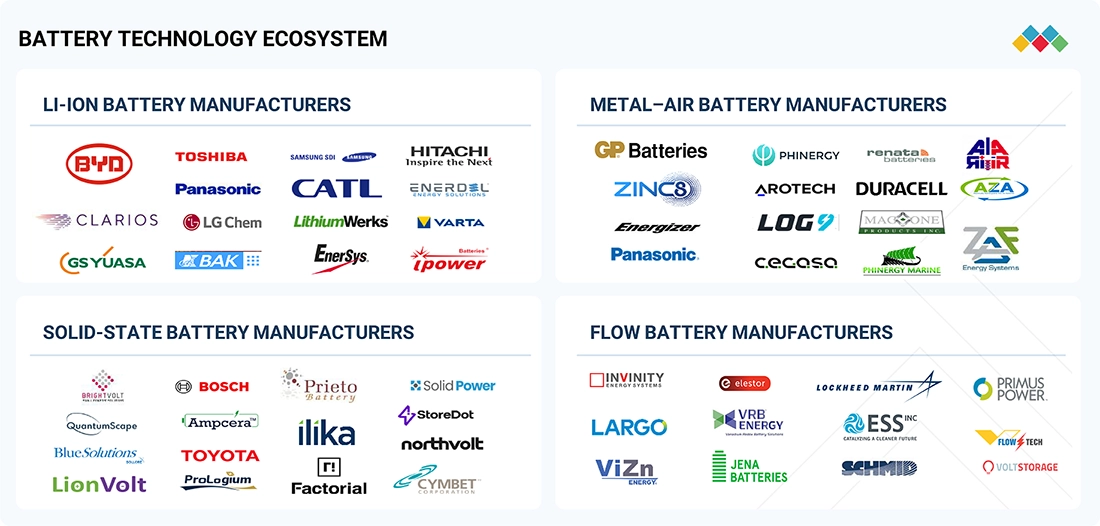
FLOW BATTERY MARKET SIZE, SHARE AND TRENDS 2030: COMMERCIAL USE CASES ACROSS INDUSTRIES
| COMPANY | USE CASE DESCRIPTION | BENEFITS |
|---|---|---|
 |
Sumitomo deploys large-scale vanadium redox flow battery (VRFB) systems for renewable energy integration, grid stabilization, and long-duration peak-shifting, with installations supporting solar and wind plants, microgrids, and utility transmission networks. | Improves grid reliability, enables high renewable penetration, reduces curtailment, and provides long-duration, safe, and scalable storage with decades-long cycle life. |
 |
Invinity delivers modular VRFB units for commercial, industrial, and utility customers, supporting demand charge reduction, behind-the-meter storage, microgrids, and hybrid renewable systems requiring continuous cycling. | Lowers energy costs through peak shaving, enables high-frequency cycling without degradation, enhances energy resilience, and supports stable microgrid operation. |
 |
VRB Energy provides containerized VRFB solutions for solar-plus-storage projects, renewable integration, and grid services, with a focus on large-scale installations in industrial parks and utility zones. | Delivers long-duration discharge, supports grid balancing and frequency regulation, extends asset life for renewable plants, and minimizes operational downtime due to robust, low-maintenance design. |
 |
ESS Tech manufactures iron flow batteries for commercial facilities, microgrids, and utility-scale deployments requiring long-duration, environmentally safe, and fire-risk-free energy storage. | Provides cost-efficient long-hour storage, eliminates thermal runaway risk, supports 20,000+ cycle operation with minimal capacity fade, and improves renewable dispatch reliability. |
 |
Elestor BV develops hydrogen–bromine flow battery systems designed for long-duration and low-cost energy storage, targeting renewable energy parks, industrial facilities, and utility grids that require high-efficiency, multi-hour storage with minimal degradation. | Offers exceptionally low levelized cost of storage through durable chemistry, enables large-scale renewable integration and peak shifting, reduces dependence on natural gas-based balancing power, and provides a robust, long-life system suitable for continuous deep cycling. |
Logos and trademarks shown above are the property of their respective owners. Their use here is for informational and illustrative purposes only.
Related Ecosystem
Automotive Electronics And Electrical Equipment
- Battery Electric Vehicle (BEV)
- Light Commercial Vehicles (LCVs)
- Fuel Cell Electric Vehicle (FCEV)
- Sensors
- Hybrid Electric Vehicle (HEV)
- BOSCH LIMITED
- DENSO Corporation
- Continental ag
- Panasonic Holdings Corporation
- Texas Instruments Incorporated
Battery And Wireless Charging
- Nickel-Cadmium Battery
- Battery Electric Vehicle (BEV)
- Energy Harvesting
- Hybrid Electric Vehicle (HEV)
- Smart Cards
- Panasonic Holdings Corporation
- MOMENTIVE PERFORMANCE MATERIALS INC.
- Lg corp
- FDK Corporation
- Samsung
Decarbonization
- Battery Electric Vehicle (BEV)
- Energy Management Systems
- Fuel Cell
- Fuel Cell Electric Vehicle (FCEV)
- Geographical Information System (GIS)
- TotalEnergies SE
- Siemens ag
- Mitsui & Co., Ltd.
- General Electric Company
- Thyssenkrupp ag
Key Takeaways
- Australia's flow battery market will grow from $31.2M (2024) to $96.1M (2029) at a 20.6% CAGR
- Australia's renewable energy expansion and grid stability needs drive strong demand for flow battery solutions
- Australia's geographic isolation and high renewable penetration create ideal conditions for long-duration energy storage deployment
- Australia's supportive policy environment and declining technology costs accelerate market adoption through 2029
Flow Battery Market Report Scope
| Report Metric | Details |
|---|---|
| Base Year | 2024 |
| Fastest Growing Segment | EV CHARGING STATIONS (Application) |
| Forecast Period | 2024-2029 |
| Growth Rate | CAGR of 23% from 2024 to 2029 |
| Largest Segment | LARGE-SCALE (Storage) |
| Market Size Base Year (Billions) | ~USD 0.34 (2024) |
| Revenue Forecast (Billions) | ~USD 0.96 (2029) |
| Segments Covered | Battery Type, Material, Storage, Application |
Australia Flow Battery Market Report Segmentation
4 segment dimensions are covered across the global market.
By Battery Type
- Hybrid
- Redox
By Material
- Other Materials
- Vanadium
- Zinc-Bromine
By Storage
- Large-Scale
- Small-Scale
By Application
- Commercial & Industrial
- Distribution
- Energy Shifting
- EV Charging Stations
- Frequency Regulation
- Other Applications
- Peak Capacity Management
- Transmission
- Utilities
AUSTRALIA: FLOW BATTERY MARKET, BY APPLICATION, 2024–2030
| Segment | 2024 | 2025 | 2026 | 2027 | 2028 | 2029 | 2030 | CAGR (%) |
|---|---|---|---|---|---|---|---|---|
| COMMERCIAL & INDUSTRIAL | 9.24 | 10.65 | 12.65 | 15.24 | 18.67 | 23.26 | 29.52 | 21.4 |
| EV CHARGING STATIONS | 0.08 | 0.11 | 0.16 | 0.24 | 0.37 | 0.56 | 0.82 | 47.7 |
| OTHER APPLICATIONS | 1.08 | 1.25 | 1.49 | 1.78 | 2.15 | 2.61 | 3.26 | 20.1 |
| UTILITIES | 20.82 | 23.76 | 27.92 | 33.31 | 40.38 | 49.79 | 62.54 | 20.1 |
| TOTAL | 31.22 | 35.77 | 42.22 | 50.58 | 61.56 | 76.23 | 96.15 | 20.6 |
Target Audience
- Energy Storage Manufacturers : Flow battery technology providers and manufacturers need Australia-specific market data to assess production capacity requirements, localization strategies, and competitive positioning in this high-growth regional market.
- Utility & Grid Operators : Australian electricity distributors and network operators require detailed market insights to evaluate flow battery investments for grid stabilization, renewable integration, and long-duration storage deployment across their networks.
- Renewable Energy Developers : Solar and wind project developers need flow battery market intelligence to design integrated energy solutions, optimize project economics, and meet grid connection requirements in Australia's evolving energy landscape.
- Investment & Financial Institutions : Private equity, venture capital, and infrastructure investors require comprehensive market analysis to identify funding opportunities, assess portfolio companies, and evaluate returns in Australia's expanding energy storage sector.
- Government & Policy Makers : Australian federal and state government agencies need market data to inform renewable energy policy, grid resilience planning, and investment incentive programs supporting the nation's energy transition objectives.
Reasons to Buy this Report
- Market-Specific Growth Projections : Access detailed forecasts for Australia's flow battery market through 2029, enabling strategic planning aligned with the 20.6% CAGR and identifying optimal entry and expansion windows for market participants.
- Regional Opportunity Assessment : Understand state-by-state demand drivers across South Australia, Victoria, New South Wales, and Western Australia, with insights into regional renewable capacity, grid infrastructure needs, and investment priorities.
- Competitive Landscape Intelligence : Identify key players, emerging competitors, and technology leaders in Australia's flow battery ecosystem, including local manufacturers, international entrants, and partnership opportunities within the energy sector.
- Policy & Regulatory Framework : Gain comprehensive understanding of Australian government incentives, renewable energy targets, grid codes, and regulatory requirements shaping flow battery market dynamics and investment decisions.
- Investment & Commercialization Roadmap : Develop data-driven strategies for product launches, partnerships, and capital allocation in Australia's high-growth energy storage market with validated market sizing and demand forecasts.
Frequently asked questions
What is the current size of Australia's flow battery market?
Australia's flow battery market was valued at $31.2 million in 2024 and is projected to reach $96.1 million by 2029.
What is the growth rate for flow batteries in Australia?
Australia's flow battery market is expected to grow at a compound annual growth rate (CAGR) of 20.6% from 2024 to 2029.
Why is Australia's flow battery market growing so rapidly?
Australia's rapid growth is driven by high renewable energy penetration, grid stability requirements, geographic isolation, supportive government policies, and declining technology costs.
What applications are driving Australia's flow battery adoption?
Australia's flow battery adoption is driven by utility-scale grid storage, commercial energy management, renewable energy integration, and microgrid applications.
What factors will influence Australia's flow battery market through 2029?
Key factors include renewable energy targets, grid modernization investments, battery cost reductions, regulatory support, and increasing demand for long-duration energy storage in Australia.
RESEARCH METHODOLOGY
The study involved major activities in estimating the current market size for the flow battery market. Exhaustive secondary research was done to collect information on the flow battery industry. The next step was to validate these findings, assumptions, and sizing with industry experts across the value chain using primary research. Different approaches, such as top-down and bottom-up, were employed to estimate the total market size. After that, the market breakup and data triangulation procedures were used to estimate the market size of the segments and subsegments of the flow battery market.
Secondary Research
The market for the companies offering flow batteries is arrived at by secondary data available through paid and unpaid sources, analyzing the product portfolios of the major companies in the ecosystem, and rating the companies by their performance and quality. Various sources were referred to in the secondary research process to identify and collect information for this study. The secondary sources include annual reports, press releases, investor presentations of companies, white papers, journals, certified publications, and articles from recognized authors, directories, and databases. In the secondary research process, various secondary sources were referred to for identifying and collecting information related to the study. Secondary sources included annual reports, press releases, and investor presentations of blockchain vendors, forums, certified publications, and whitepapers. The secondary research was used to obtain critical information on the industry's value chain, the total pool of key players, market classification, and segmentation from the market and technology-oriented perspectives.
Primary Research
Extensive primary research has been conducted after understanding and analyzing the current scenario of the flow battery market through secondary research. Several primary interviews have been conducted with the key opinion leaders from the demand and supply sides across four main regions—North America, Europe, Asia Pacific, and the Rest of Europe. Approximately 25% of the primary interviews were conducted with the demand-side respondents, while approximately 75% were conducted with the supply-side respondents. The primary data has been collected through questionnaires, emails, and telephone interviews.
After interacting with industry experts, brief sessions were conducted with highly experienced independent consultants to reinforce the findings from our primary. This, along with the in-house subject matter experts’ opinions, has led us to the findings as described in the remainder of this report. The breakdown of primary respondents is as follows:
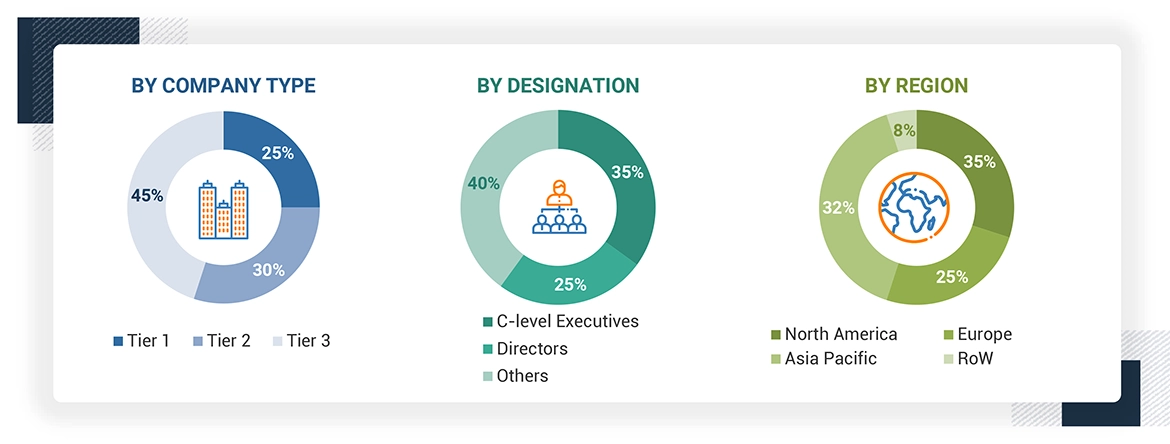
To know about the assumptions considered for the study, download the pdf brochure
Market Size Estimation
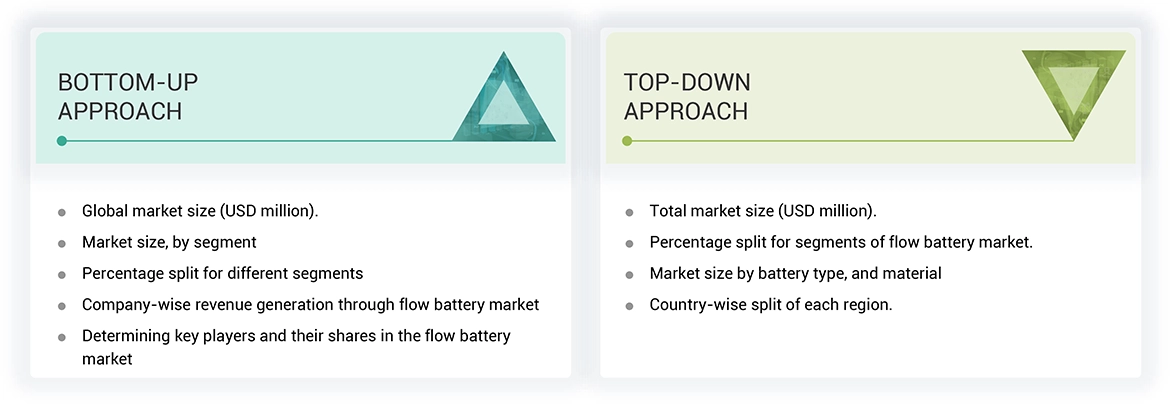
Both top-down and bottom-up approaches were used to estimate and validate the total size of the flow battery market. These methods were also used extensively to estimate the size of various subsegments in the market. The research methodology used to estimate the market size includes the following:
Flow Battery Market : Top-Down and Bottom-Up Approach
Data Triangulation
After arriving at the overall market size using the market size estimation processes as explained above, the market was split into several segments and subsegments. The data triangulation and market breakdown procedures were employed, wherever applicable, to complete the overall market engineering process and arrive at the exact statistics of each market segment and subsegment. The data was triangulated by studying various factors and trends from the demand and supply sides.
Market Definition
A flow battery is a rechargeable battery in which the electrolyte flows through various electrochemical cells from one or more tanks. The electrochemical cells used in flow batteries can be electrically connected in series or parallel, determining the overall power of a flow battery system. Flow batteries are considered safer than most commonly used lithium-ion batteries as they are resistant to high temperatures and exhibit a longer operational life, making them suitable for storing and releasing renewable energy from solar and wind sources. The scalability of flow batteries, wherein the battery’s energy storage capacity can be increased by increasing the quantity of electrolytes stored in the tanks, is another advantage driving the demand for flow batteries in large-scale energy storage applications.
Key Stakeholders
- Flow Battery Manufacturers
- Government Bodies and Policymakers
- Standards Organizations, Forums, Alliances, and Associations
- Market Research and Consulting Firms
- Raw Material Suppliers and Distributors
- Research Institutes and Organizations
- Material and Technology Providers
- Testing, Inspection, and Certification Providers
- End Users
- Distributors and System Integrators
Report Objectives
- To describe and forecast the flow battery market, in terms of value, based on battery type, storage, material, application, and vertical
- To forecast the size of the market in terms of volume
- To forecast the market size, in terms of value, for four main regions—North America, Europe, Asia Pacific, and the RoW (Rest of the World)
- To provide detailed information regarding drivers, restraints, opportunities, and challenges influencing the market growth
- To provide a detailed overview of the value chain of the flow battery ecosystem
- To strategically analyze micromarkets1 with respect to individual growth trends, prospects, and contributions to the total market
- To analyze the opportunities for stakeholders and details of the competitive landscape of the market
- To strategically profile the key players and comprehensively analyze their market positions in terms of ranking and core competencies
- To analyze the major growth strategies implemented by key market players, such as agreements, acquisitions, product launches, expansions, and partnerships
- To study the impact of AI on the market under study, along with macroeconomic outlook for each region
Available Customizations
With the given market data, MarketsandMarkets offers customizations according to the specific requirements of companies. The following customization options are available for the report:
- Detailed analysis and profiling of additional market players based on various blocks of the supply chain
Get the Full Flow Battery Market Report
Full forecast, segment splits, and company analysis for all Flow Battery Market.
- US Flow Battery Market
- Canada Flow Battery Market
- Mexico Flow Battery Market
- Germany Flow Battery Market
- UK Flow Battery Market
- France Flow Battery Market
- Italy Flow Battery Market
- Switzerland Flow Battery Market
- China Flow Battery Market
- Japan Flow Battery Market
- India Flow Battery Market
- South Korea Flow Battery Market
- Rest Of Europe Flow Battery Market
- Rest Of Asia Pacific Flow Battery Market
Need a Tailored Report?
Customize this report to your needs
Get 10% FREE Customization
Customize This Report
