
US Field-Programmable Gate Array (FPGA) Market (2025-2030)

The US Field-Programmable Gate Array (FPGA) Market was valued at $2344.7 Million in 2025 and projected to reach to $3985.1 Million by 2030, representing a compound annual growth rate of 11.2%. The US FPGA market is positioned for sustained growth through 2030, driven by accelerating digital transformation initiatives and the proliferation of AI and machine learning applications across enterprise sectors.


| Market Size in | USD 26.32 MN |
| Market Forecast in | |
| CAGR | |
| Forecast Period | |
| Units Considered | Value (USD MN) |
US Field-Programmable Gate Array (FPGA) Market Trends and Insights
- The US market is driven by increasing demand for customizable semiconductor solutions across data centers, telecommunications, and aerospace applications.
- US enterprises are investing heavily in FPGA technology to accelerate artificial intelligence workloads, edge computing, and real-time signal processing capabilities. The US FPGA market's 11.2% compound annual growth rate reflects strong adoption among technology leaders and defense contractors seeking flexible, reconfigurable hardware solutions.
- The US semiconductor ecosystem, supported by advanced manufacturing capabilities and R&D investments, positions the country as a critical hub for FPGA innovation and deployment.
- By 2030, the US market will benefit from expanded 5G infrastructure, autonomous systems development, and increased government spending on advanced computing technologies..
Key Market Statistics
- CAGR (2025-2030) 11.2% CAGR
- Market Size, 2025 ~USD 2344.7 Million
- Forecast, 2030 ~USD 3985.1 Million
- Country US
US Field-Programmable Gate Array (FPGA) Market Overview
Market Valuation Growth :
The US FPGA market is valued at $2,344.7 million in 2025 and is projected to reach $3,985.1 million by 2030, representing a robust 11.2% CAGR, outpacing the global growth rate of 10.5%.
Data Center Dominance :
US data centers are increasingly adopting FPGA technology for accelerated computing, cloud infrastructure optimization, and AI workload processing, driving significant market expansion across major tech hubs.
Aerospace & Defense Investment :
US aerospace and defense sectors are leveraging FPGA solutions for mission-critical applications, real-time signal processing, and advanced radar systems, contributing substantially to market growth.
AI Acceleration Adoption :
US enterprises are investing heavily in FPGA-based AI acceleration platforms to enhance machine learning inference, reduce latency, and optimize computational efficiency across various industries.
US Field-Programmable Gate Array (FPGA) Market Dynamics
- Major US technology companies and cloud service providers are increasingly deploying FPGA solutions to enhance data center performance and reduce operational costs.
- The telecommunications sector's 5G infrastructure expansion further amplifies demand for customizable semiconductor solutions.
- Additionally, the aerospace, defense, and automotive industries continue to adopt FPGA technology for real-time processing and safety-critical applications.
- This convergence of factors supports the projected 11.2% CAGR, positioning the US as a critical growth market within the global FPGA landscape..
Market Ecosystem
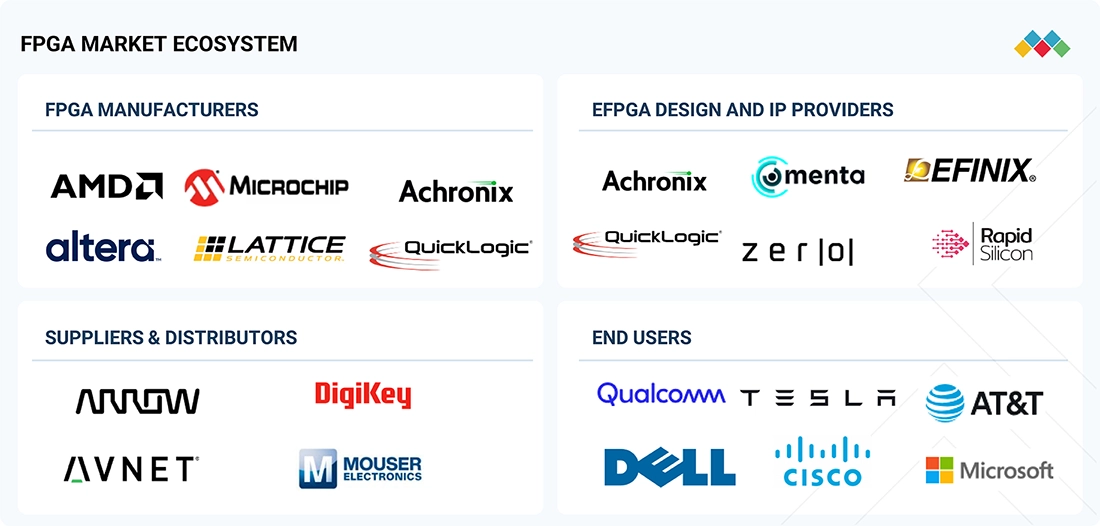
Field-Programmable Gate Array (FPGA) Market: COMMERCIAL USE CASES ACROSS INDUSTRIES
| COMPANY | USE CASE DESCRIPTION | BENEFITS |
|---|---|---|
 |
Magewell used AMD Artix UltraScale+ FPGAs to develop a 4K media capture device supporting 20 Gb/s USB 3.2 Gen 2x2 connectivity, ensuring high-speed data transmission and power efficiency. | Achieved stable 20 Gb/s USB performance, enhanced I/O efficiency, reduced development time, lower power consumption, and faster time-to-market |
 |
DigiBird integrated Xilinx Kintex-7 and Kintex UltraScale+ FPGAs to build a lossless distributed audiovisual solution, replacing lossy H.264/H.265 compression for control room and conferencing systems. | Delivered ultra-low latency, lossless video streaming, faster product deployment, and high-quality visuals for mission-critical AV systems |
|
|
Newtouch Electronics employed Xilinx Virtex UltraScale+ VU19P FPGAs in its 4th-gen PHINEDesign platform for large-scale ASIC/SoC prototyping and verification in China’s semiconductors industry. | Improved verification efficiency by 30%, reduced workload by 50%, shortened verification cycles, and accelerated chip time-to-market |
 |
TU Berlin researchers utilized Gidel’s ProcStar FPGA boards to develop a flexible Software-defined Radio (SDR) system for research, teaching, and real-time digital signal processing. | Enabled 250 MHz RF bandwidth, scalable SDR capabilities, real-time processing, and flexible system upgrades using advanced FPGA hardware |
|
|
Flex Ltd. partnered with Intel to integrate Cyclone IV FPGAs into its SMT production line for real-time analytics, predictive maintenance, and Industry 4.0 transformation. | Enhanced productivity, reduced downtime, enabled predictive maintenance, improved flexibility, and achieved intelligent, connected manufacturing |
Logos and trademarks shown above are the property of their respective owners. Their use here is for informational and illustrative purposes only.
Related Ecosystem
Cns Systems
- C-Band
- Ka-Band
- Antennas
- Unmanned Ground Vehicles (UGV)
- Rotary Wing Aircraft
- L3Harris Technologies, Inc.
- Thales group
- HONEYWELL INTERNATIONAL INC.
- Northrop Grumman Corporation
- LOCKHEED MARTIN CORPORATION
Cloud Computing
- Software as A Service (SaaS)
- Natural Language Processing (NLP)
- Platform as A Service (PaaS)
- Machine Learning
- Supply Chain Management
- International Business Machines Corporation
- MICROSOFT CORPORATION
- Oracle Corporation
- Amazon.com, Inc.
Electronics System And Components
- Sensors
- Temperature Sensors
- Pressure Sensors
- Actuators
- Image Sensors
- Lenovo
- Samsung
- Texas Instruments Incorporated
- HONEYWELL INTERNATIONAL INC.
- Teledyne Technologies Incorporated
Key Takeaways
- The US FPGA market will grow from $2,344.7M (2025) to $3,985.1M (2030), representing a 11.2% CAGR.
- US data center and cloud computing sectors are primary growth drivers for FPGA adoption and deployment.
- The US defense and aerospace industries leverage FPGAs for mission-critical applications requiring high reliability and customization.
- US technology companies are accelerating FPGA integration into AI accelerators and edge computing platforms.
Field-Programmable Gate Array (FPGA) Market Report Scope
| Report Metric | Details |
|---|---|
| Base Year | 2025 |
| Fastest Growing Segment | 5G (Type) |
| Forecast Period | 2025–2030 |
| Growth Rate | CAGR of 10.5% from 2025 to 2030 |
| Largest Segment | SRAM (Technology) |
| Market Size Base Year (Billions) | ~USD 11.74 (2025) |
| Revenue Forecast (Billions) | ~USD 19.34 (2030) |
| Segments Covered | Configuration, Node Size, Technology, Vertical, Type |
US Field-Programmable Gate Array (FPGA) Market Report Segmentation
5 segment dimensions are covered across the global market.
By Configuration
- High-End Fpga
- Low-End Fpga
- Mid-Range Fpga
By Node Size
- 20-90 Nm
- 20–90 Nm
- > 90 Nm
- >90 Nm
- = 16 Nm
- =16 Nm
By Technology
- Antifuse
- Flash
- Sram
By Vertical
- Automotive
- Broadcasting
- Consumer Electronics
- Data Center & Computing
- Healthcare
- Industrial
- Military & Aerospace
- Multimedia
- Telecommunications
- Testing, Measurement, And Emulation
By Type
- 5G
- ADAS/Sensor Fusion
- Audio Devices
- Automotive Infotainment And Driver Information Systems
- Avionics
- Backhaul & Access Network
- Broadcast Platform Designs
- Broadcasting Platform Systems
- Ct Scanners
- Electric Vehicles
- Evs
- Hardware Acceleration
- High-End Broadcast Systems
- High-End Broadcasting Systems
- High-Performance Computing
- Image Diagnostic Systems
- Imaging Diagnostic Systems
- Industrial Motor Control Devices
- Industrial Networking Solutions
- Industrial Sensors
- Machine Vision Solutions
- Missiles And Munitions
- Mri Machines
- Network Interface Control
- Network Processing
- Optical Transport Network (Otn)
- Packet-Based Networking & Switching
- Radars And Sensors
- Radio Solutions
- Robotics
- Storage Interface Control
- Ultrasound Machines
- Video Processing
- Video Surveillance Systems
- Wearable Devices
- Wired Communication
- Wired Connectivity
- Wireless Backhaul Solutions
- Wireless Baseband Solutions
- Wireless Communication
- X-Ray Machines
Target Audience
- FPGA Semiconductor Manufacturers : Need detailed US market data to optimize product portfolios, identify emerging applications in data centers and AI, and develop targeted go-to-market strategies for American enterprises.
- Data Center & Cloud Operators : Require market intelligence on FPGA adoption trends and competitive solutions to evaluate technology investments, assess vendor capabilities, and optimize infrastructure acceleration strategies.
- Aerospace & Defense Contractors : Seek comprehensive market analysis to understand FPGA technology evolution, supplier capabilities, and regulatory compliance requirements for mission-critical US defense and aviation applications.
- Technology Investment Firms : Need market sizing, growth projections, and competitive landscape data to evaluate investment opportunities in US FPGA companies, identify acquisition targets, and assess portfolio company performance.
- Enterprise IT Decision Makers : Require market trends and vendor analysis to make informed procurement decisions, evaluate FPGA solutions for AI and cloud workloads, and benchmark technology investments against industry standards.
Key Companies in the US Field-Programmable Gate Array (FPGA) Market
| Company | HQ | Ownership | Strongest segments |
|---|---|---|---|
| ARROW ELECTRONICS, INC | United States | Public Company | Semiconductor products and related services,Interconnect, passive, and electromechanical (IP&E) products,Computing and memory products, |
| ATMEL CORPORATION | United States | Private Company | Microcontroller,Nonvolatile Memory and Security,Automotive, |
| KAYNES TECHNOLOGY | India | Public Company | Automotive and Rail Electronics,Industrial and IoT Systems,Aerospace, Defence, Outer-space, and Nuclear, |
| CADENCE DESIGN SYSTEMS | United States | Public Company | Digital IC design and implementation,Custom/analog and mixed-signal design,Verification (simulation, emulation, formal), |
| AVNET | United States | Public Company | Semiconductors,Interconnect, Passive, and Electromechanical (IP&E) Components,Embedded Solutions, Boards, and Industrial Subsystems, |
| ADVANTEST CORPORATION | Japan | Public Company | SoC automated test equipment,Memory and SSD test systems,Handlers, device interface, and interconnect solutions, |
| LENOVO | China | Public Company | Commercial PCs and small form factor signage controllers,Embedded/edge systems and dedicated media players,Tablets and smart devices for interactive signage and kiosks, |
| ADVANCED MICRO DEVICES, INC. | United States | Public Company | Data Center (EPYC, Instinct, Alveo, Pensando),Client (Ryzen, Ryzen AI, Athlon, PRO),Gaming (Radeon, semi-custom SoCs), |
| MICROCHIP TECHNOLOGY INC. | United States | Public Company | 8/16/32/64-bit MCUs and MPUs,Analog, connectivity, and interface products,Memory products, |
| LATTICE SEMICONDUCTOR CORPORATION | United States | Public Company | Small FPGA Platforms (Nexus, Nexus 2, MachXO, iCE, CrossLink families),Mid-range FPGA (Lattice Avant, Avant-G, CertusPro, Certus-N2),Specialized FPGA Solutions (Avant-E, Avant-X, CrossLinkPlus, SCP), |
| QUICKLOGIC CORPORATION | United States | Public Company | Silicon FPGA products (EOS, ArcticLink, PolarPro, Eclipse families),eFPGA IP licensing and professional services,AI/ML solutions and sensor algorithms (including SaaS subscriptions), |
| RENESAS ELECTRONICS CORPORATION | Japan | Public Company | Automotive MCUs and Microprocessors,Industrial/Infrastructure/IoT MCUs and MPUs,Analog, Mixed-Signal, and Interface ICs, |
| SHANGHAI ANLOGIC INFOTECH CO., LTD. | China | Public Company | SALPHOENIX and SALEAGLE PLD series,SALELF and other entry PLDs,SALSWIFT system chips and FPSoC, |
| NANOXPLORE | Canada | Public Company | GrapheneBlack powder and graphene additives,Graphene-enhanced masterbatch pellets,Graphene-enhanced plastic and composite products, |
ARROW ELECTRONICS, INC
Arrow Electronics, Inc. is a publicly traded distributor of electronic components and computer products founded in 1935, employing 22,230 people across the United States.
ATMEL CORPORATION
Atmel Corporation is a private semiconductor company founded in 1984 with 4,700 employees, based in the United States.
KAYNES TECHNOLOGY
Kaynes Technology is a publicly traded Indian technology company founded in 1988 with 1,567 employees.
CADENCE DESIGN SYSTEMS
Cadence Design Systems is a publicly traded software and semiconductor design company founded in 1988 with 13,800 employees in the United States.
AVNET
Avnet is a publicly traded electronics distributor founded in 1921 with 14,869 employees based in the United States.
ADVANTEST CORPORATION
Advantest Corporation is a publicly traded Japanese semiconductor testing equipment manufacturer founded in 1946 with 7,241 employees.
LENOVO
Lenovo is a publicly traded Chinese technology company founded in 1984.
ADVANCED MICRO DEVICES, INC.
Advanced Micro Devices, Inc. is a publicly traded semiconductor manufacturer founded in 1969 with 31,000 employees based in the United States.
MICROCHIP TECHNOLOGY INC.
Microchip Technology Inc. is a publicly traded semiconductor company founded in 1989 with 17,900 employees based in the United States.
LATTICE SEMICONDUCTOR CORPORATION
Lattice Semiconductor Corporation is a publicly traded semiconductor company founded in 1983 with 1,174 employees based in the United States.
QUICKLOGIC CORPORATION
QuickLogic Corporation is a publicly traded semiconductor company founded in 1988 with 51 employees based in the United States.
RENESAS ELECTRONICS CORPORATION
Renesas Electronics Corporation is a publicly traded Japanese semiconductor manufacturer founded in 2002 with 21,907 employees.
SHANGHAI ANLOGIC INFOTECH CO., LTD.
Shanghai Anlogic Infotech Co., Ltd. is a publicly traded Chinese semiconductor company founded in 2011 with 505 employees.
NANOXPLORE
Nanoxplore is a publicly traded Canadian semiconductor company founded in 2011 with 390 employees.
Reasons to Buy this Report
- Strategic Market Sizing : Obtain precise US market valuation data ($2,344.7M in 2025) and 5-year forecasts to inform capital allocation decisions and competitive positioning strategies specific to the American FPGA landscape.
- Sector-Specific Insights : Gain detailed intelligence on FPGA adoption trends across US data centers, telecommunications, aerospace, and defense sectors to identify high-growth vertical opportunities and customer segments.
- Competitive Landscape Analysis : Understand the competitive dynamics, market share distribution, and key player strategies within the US FPGA market to benchmark performance and identify partnership or acquisition targets.
- Technology Trend Identification : Access comprehensive analysis of emerging FPGA applications in AI acceleration, 5G infrastructure, and edge computing within the US market to guide R&D investments and product development roadmaps.
- Investment Decision Support : Leverage market growth projections (11.2% CAGR through 2030) and demand drivers to validate investment theses, support funding proposals, and establish realistic revenue forecasts for US operations.
Frequently asked questions
What is the current size of the US FPGA market in 2025?
The US FPGA market is valued at $2,344.7 million in 2025, reflecting strong demand for reconfigurable semiconductor solutions across multiple industries.
What is the projected size of the US FPGA market by 2030?
The US FPGA market is forecast to reach $3,985.1 million by 2030, growing at an 11.2% compound annual growth rate.
Which industries are driving growth in the US FPGA market?
The US FPGA market is primarily driven by data centers, telecommunications, aerospace, defense, and artificial intelligence applications requiring customizable hardware solutions.
Why is the US FPGA market growing faster than the global average?
The US FPGA market's 11.2% CAGR exceeds the global 10.5% rate due to strong domestic demand from technology leaders, defense contractors, and advanced computing investments.
What factors will influence US FPGA market growth through 2030?
Key factors include 5G infrastructure expansion, AI and machine learning adoption, edge computing proliferation, government defense spending, and autonomous systems development in the US.
RESEARCH METHODOLOGY
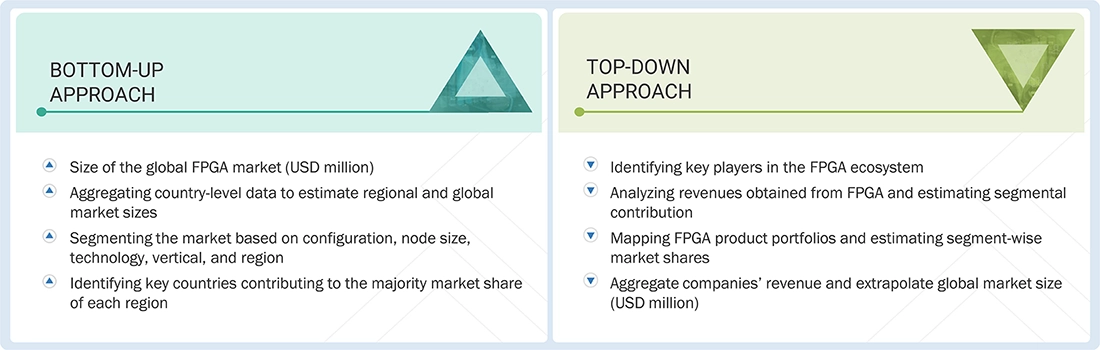
The study involved four major activities in estimating the current size of the field programmable gate array (FPGA) market. Exhaustive secondary research collected information on the market, peer, and parent markets. The next step was to validate these findings, assumptions, and sizing with industry experts across the value chain through primary research. Both top-down and bottom-up approaches were employed to estimate the complete market size. After that, market breakdown and data triangulation techniques were used to estimate the market size of segments and subsegments.
Secondary Research
The secondary research process has referred to various secondary sources to identify and collect necessary information for this study. The secondary sources include annual reports, press releases, and investor presentations of companies; white papers; journals and certified publications; and articles from recognized authors, websites, directories, and databases. Secondary research was conducted to obtain critical information about the industry’s supply chain, the market’s value chain, the total pool of key players, market segmentation according to the industry trends (to the bottom-most level), regional markets, and key developments from market- and technology-oriented perspectives. Secondary data was collected and analyzed to determine the overall market size, which was further validated through primary research.
Primary Research
Extensive primary research was conducted after gaining knowledge about the current scenario of the FPGA market through secondary research. Several primary interviews were conducted with experts from the demand and supply sides across four major regions: North America, Europe, the Asia Pacific, and the Rest of the World (RoW). This primary data was collected through questionnaires, emails, and telephone interviews.
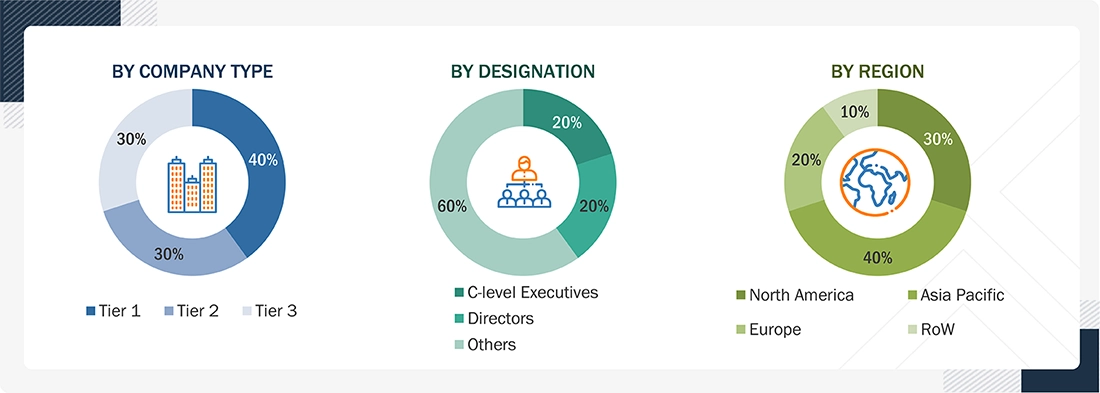
Notes: Other designations include technology heads, media analysts, sales managers, marketing managers, and product managers.
The three tiers of the companies are based on their total revenues as of 2024; Tier 1: >USD 1 billion, Tier 2: USD 500 million–1 billion, and Tier 3: USD 500 million.
To know about the assumptions considered for the study, download the pdf brochure
Market Size Estimation
In the complete market engineering process, top-down and bottom-up approaches and several data triangulation methods were used to estimate and forecast the overall market segments and subsegments listed in this report. Key players in the market were identified through secondary research, and their market shares in the respective regions were determined through primary and secondary research. This entire procedure includes the study of annual and financial reports of the top market players and extensive interviews for key insights (quantitative and qualitative) with industry experts (CEOs, VPs, directors, and marketing executives).
All percentage shares, splits, and breakdowns were determined using secondary sources and verified through primary sources. All the parameters affecting the markets covered in this research study were accounted for, viewed in detail, verified through primary research, and analyzed to obtain the final quantitative and qualitative data. This data was consolidated and supplemented with detailed inputs and analysis from MarketsandMarkets and presented in this report.
Field-Programmable Gate Array (FPGA) Market : Top-Down and Bottom-Up Approach
Data Triangulation
After arriving at the overall market size, the market was split into several segments and subsegments using the market size estimation processes explained above. Data triangulation and market breakdown procedures were employed to complete the entire market engineering process and determine the exact statistics of each market segment and subsegment. The data was triangulated by studying various factors and trends from the demand and supply sides in the FPGA market.
Market Definition
FPGAs are reconfigurable semiconductor devices that can be programmed post-manufacturing to perform specific logic functions, enabling flexible hardware customization. They are built on different technologies such as SRAM-based FPGAs for reprogrammability, Flash-based FPGAs for non-volatility and low power, and Antifuse-based FPGAs for permanent, high-security configurations. FPGAs are categorized as low-end, mid-range, and high-end devices depending on their logic density, performance, and power efficiency. They are widely used across industries, including telecommunications, data centers, automotive, industrial automation, military and aerospace, consumer electronics, healthcare, test and measurement, broadcasting, and multimedia, for applications requiring high-speed parallel processing and adaptability.
Key Stakeholders
- Original equipment manufacturers (OEMs)
- Technology solution providers
- Research institutes
- Market research and consulting firms
- Forums, alliances, and associations related to the FPGA market
- Technology investors
- Governments and financial institutions
- Analysts and strategic business planners
- Existing end users and prospective ones
- Business providers
- Professional service/solution providers
- Cloud service providers
- Software & platform providers
- Enterprise users
- Developers & researchers
- Data center operators
- Telecom & networking companies
- Regulatory bodies & industry associations
- Systems integrators
- Consulting firms
- Academic & research institutions
Report Objectives
- To describe and forecast the FPGA market based on configuration, node size, technology, FPGA and eFPGA market size, vertical, and region, in terms of value
- To describe and forecast the FPGA market for various segments across four major regions—North America, Europe, the Asia Pacific, and the Rest of World (RoW), in terms of value
- To forecast the size and market segments of the FPGA market by volume based on configuration
- To provide detailed information regarding drivers, restraints, opportunities, and challenges influencing market growth
- To provide the ecosystem analysis, case study analysis, patent analysis, technology analysis, ASP analysis, key conferences and events, key stakeholders and buying criteria, Porter’s Five Forces analysis, and regulations pertaining to the market under study
- To provide a detailed overview of the value chain of the FPGA landscape
- To strategically analyze micromarkets1 concerning individual growth trends, prospects, and contributions to the total market
- To strategically profile the key players and comprehensively analyze their market shares and core competencies2
- To analyze the opportunities in the market for stakeholders and describe the competitive landscape
- To assess the competitive developments, such as collaborations, agreements, partnerships, and product developments, in the market
- To analyze the impact of the macroeconomic outlook for each region
Customization Options
With the given market data, MarketsandMarkets offers customizations according to the specific requirements of companies. The following customization options are available for the report:
Company Information:
- Additional country-wise breakdown for North America, Europe, the Asia Pacific, and the Rest of the World
Company Information:
- Detailed analysis and profiling of additional market players (up to five)
Get the Full Field-Programmable Gate Array (FPGA) Market Report
Full forecast, segment splits, and company analysis for all Field-Programmable Gate Array (FPGA) Market.
- Canada Field-Programmable Gate Array (FPGA) Market
- Mexico Field-Programmable Gate Array (FPGA) Market
- Germany Field-Programmable Gate Array (FPGA) Market
- UK Field-Programmable Gate Array (FPGA) Market
- France Field-Programmable Gate Array (FPGA) Market
- Italy Field-Programmable Gate Array (FPGA) Market
- Rest Of Europe Field-Programmable Gate Array (FPGA) Market
Need a Tailored Report?
Customize this report to your needs
Get 10% FREE Customization
Customize This Report
