
Italy Pet Food Ingredients Market (2023-2028)

The Italy Pet Food Ingredients Market was valued at $912.5 Million in 2023 and projected to reach to $1136.1 Million by 2028, representing a compound annual growth rate of 4.5%. Italy's pet food ingredients market is positioned for steady growth through 2028, driven by the nation's deeply rooted pet ownership culture and evolving consumer preferences toward premium nutrition.


| Market Size in | USD 26.32 MN |
| Market Forecast in | |
| CAGR | |
| Forecast Period | |
| Units Considered | Value (USD MN) |
Italy Pet Food Ingredients Market Trends and Insights
- Italy's market reflects steady demand driven by the country's strong pet ownership culture and increasing consumer focus on premium, nutritionally balanced pet food formulations.
- The Italian market benefits from established distribution networks and growing awareness among pet owners regarding ingredient quality and sourcing transparency. In Italy, the pet food ingredients sector is characterized by a shift toward natural and sustainable ingredients, with local manufacturers and importers responding to consumer preferences for high-quality proteins and functional additives.
- Italy's position within the European market supports access to diverse ingredient suppliers and advanced processing technologies.
- Between 2023 and 2028, Italy is expected to see moderate but consistent growth as pet humanization trends and premiumization continue to influence purchasing decisions across the country..
Key Market Statistics
- CAGR (2023-2028) 4.5% CAGR
- Market Size, 2023 ~USD 912.5 Million
- Forecast, 2028 ~USD 1136.1 Million
- Country Italy
Italy Pet Food Ingredients Market Overview
Market Valuation :
Italy's pet food ingredients market reached USD 912.5 million in 2023, with projections to grow to USD 1,136.1 million by 2028, representing a steady 4.5% CAGR.
Premium Pet Ownership Culture :
Italy demonstrates strong pet ownership rates with consumers increasingly investing in premium, nutritionally balanced pet food formulations, driving demand for high-quality ingredients.
Growth Trajectory :
The Italian market is expanding at 4.5% CAGR, outpacing some European peers while maintaining stability compared to the global market growth rate of 6.8%.
Local Market Drivers :
Italy's pet food ingredients market benefits from established domestic pet care traditions, rising disposable incomes, and growing awareness of pet nutrition and wellness among Italian consumers.
Italy Pet Food Ingredients Market Dynamics
- Italian pet owners increasingly prioritize quality ingredients and balanced formulations, supporting demand for specialized and functional pet food components.
- The market's 4.5% CAGR reflects moderate but consistent expansion as manufacturers respond to consumer demands for transparency and nutritional excellence. The Italian market will likely benefit from regional supply chain advantages and growing collaboration between local ingredient suppliers and pet food manufacturers.
- Sustainability and natural ingredient sourcing are becoming key differentiators in Italy's competitive landscape.
- As European regulations tighten around pet food standards, Italian producers are well-positioned to capitalize on premium positioning and quality assurance, supporting continued market growth through 2028..
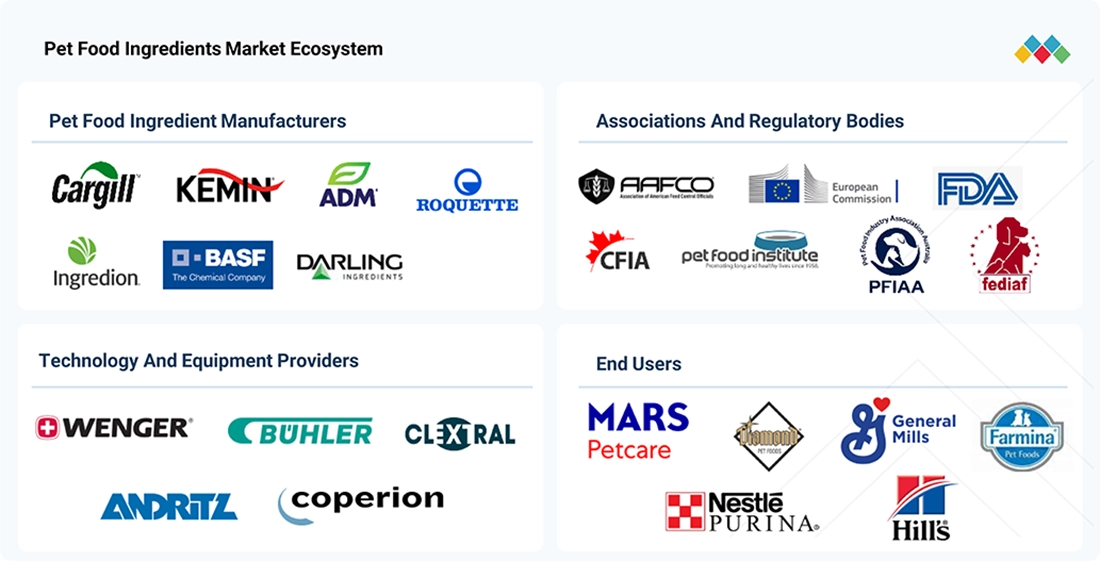
Market Ecosystem
PET FOOD INGREDIENTS MARKET: COMMERCIAL USE CASES ACROSS INDUSTRIES
| COMPANY | USE CASE DESCRIPTION | BENEFITS |
|---|---|---|
 |
Lallemand develops and manufactures microbial and yeast-derived ingredients for companion animal nutrition. Its LALPROBIOME platform includes yeast and bacterial solutions for digestive health, immune support, antioxidant support, and other pet wellness applications, while its yeast-derived ingredients are also used as pet food palatants. | Supports digestive and immune health, pet wellbeing, palatability, and development of differentiated functional pet foods, treats, and supplements. |
 |
Kemin supplies palatants such as PALASURANCE, PALTEVA, and PALIVATE for dry and wet pet food. PALIVATE is specifically designed for wet pet food and is formulated to withstand retort processing while improving palatability. | Improves taste, aroma, and food acceptance while maintaining product integrity during processing; supports consistent consumption and product differentiation. |
Logos and trademarks shown above are the property of their respective owners. Their use here is for informational and illustrative purposes only.
Related Ecosystem
Feed And Animal Nutrition
- Animal-Based Sealants
- Camera Systems
- Lactic Acid
- Tricalcium Phosphate
- Citric Acid
- AZELIS HOLDINGS SA
- NOVUS INTERNATIONAL, INC.
- Feedone Co., Ltd.
- NOSAN CORPORATION
- Mitsui & Co., Ltd.
Key Takeaways
- Italy's pet food ingredients market reached USD 912.5 million in 2023 with a projected value of USD 1,136.1 million by 2028.
- Italy is experiencing a 4.5% CAGR, reflecting steady growth driven by premiumization and pet humanization trends.
- Italian consumers increasingly demand natural, sustainable, and transparent ingredient sourcing in pet food products.
- Italy's European location provides competitive advantages in accessing diverse ingredient suppliers and advanced processing capabilities.
Pet Food Ingredients Market Report Scope
| Report Metric | Details |
|---|---|
| Base Year | 2023 |
| Fastest Growing Segment | VEGETABLES & FRUITS (Ingredient) |
| Forecast Period | 2023-2028 |
| Growth Rate | CAGR of 6.8% from 2023 to 2028 |
| Largest Segment | DRY (Form) |
| Market Size Base Year (Billions) | ~USD 34.11 (2023) |
| Revenue Forecast (Billions) | ~USD 47.4 (2028) |
| Segments Covered | Ingredient, Subtype, Type, Pet, Source, Form |
Italy Pet Food Ingredients Market Report Segmentation
6 segment dimensions are covered across the global market.
By Ingredient
- Additives
- Cereals
- Fats
- Meat & Meat Products
- Vegetables
- Vegetables & Fruits
By Subtype
- Animal Digest
- Barley
- By-Product Meal
- Carrots
- Corn & Cornmeal
- Deboned Meat
- Enzymes
- Fish Oil
- Fruits
- Lard
- Meat Meal
- Other Additives
- Other Cereals
- Pea
- Potatoes
- Poultry Fat
- Rice
- Soy & Soy Meal
- Tallow
- Vegetable Oil
- Vitamins & Minerals
- Wheat & Wheatmeal
By Type
- Barley
- Corn & Cornmeal
- Other Cereals
- Rice
- Wheat & Wheatmeal
By Pet
- Cats
- Dogs
- Fish
- Other Pets
By Source
- Animal-Based
- Bacteria
- Plant Derivatives
- Synthetic
- Yeast & Fungi
By Form
- Dry
- Wet
Target Audience
- Pet Food Manufacturers : Italian and international pet food producers need Italy-specific market data to optimize ingredient sourcing, formulation strategies, and product positioning in this premium-focused market.
- Ingredient Suppliers : Domestic and export-focused ingredient suppliers require detailed Italy market insights to identify demand trends, pricing dynamics, and partnership opportunities with local manufacturers.
- Investment & Private Equity Firms : Investors evaluating opportunities in Italy's pet care sector need validated market sizing and growth forecasts to assess investment returns and portfolio company expansion potential.
- Market Entry Strategists : Companies planning market entry into Italy require localized competitive analysis, consumer preference data, and growth projections to minimize risk and optimize go-to-market strategies.
- Business Development Executives : BD professionals in pet nutrition need Italy-specific market intelligence to identify partnership opportunities, negotiate supplier contracts, and support strategic business planning.
Reasons to Buy this Report
- Precise Italy Market Sizing : Access validated market valuation data specific to Italy (USD 912.5M in 2023), enabling accurate budgeting and investment decisions for Italian market entry or expansion.
- Competitive Positioning Intelligence : Understand Italy's 4.5% CAGR relative to global 6.8% growth, identifying market maturity levels and competitive dynamics unique to the Italian pet food ingredients sector.
- Consumer Behavior Insights : Gain detailed understanding of Italian pet owners' preferences for premium, nutritionally balanced formulations, enabling targeted product development and marketing strategies.
- 5-Year Forecast Planning : Leverage Italy-specific projections through 2028 (USD 1,136.1M) to develop long-term supply chain strategies, capacity planning, and revenue forecasting for Italian operations.
- Regional Market Differentiation : Distinguish Italy's market characteristics from broader European trends, identifying unique growth drivers and localized opportunities for ingredient suppliers and manufacturers.
Frequently asked questions
What is the current size of Italy's pet food ingredients market?
Italy's pet food ingredients market was valued at USD 912.5 million in 2023 and is expected to reach USD 1,136.1 million by 2028.
What is the growth rate for pet food ingredients in Italy?
Italy's pet food ingredients market is growing at a compound annual growth rate of 4.5% from 2023 to 2028.
What are the main drivers of growth in Italy's pet food ingredients market?
Key drivers in Italy include pet humanization trends, increasing consumer demand for premium and natural ingredients, and growing awareness of ingredient quality and sourcing transparency.
Which ingredient types are most popular in Italy's pet food market?
Italy shows strong demand for natural proteins, functional additives, and sustainable ingredients that align with consumer preferences for high-quality pet nutrition.
How does Italy's market compare to other European markets?
Italy's 4.5% CAGR reflects moderate growth typical of mature European markets, supported by established distribution networks and strong pet ownership culture.
RESEARCH METHODOLOGY
This study involved two major approaches in estimating the current size of the pet food ingredients market. Exhaustive secondary research was conducted to collect information on the source, form, ingredient, pet, nature, and regional segments of the market. The next step involved validating these findings, assumptions, and sizing with industry experts across the value chain through primary research. Both top-down and bottom-up approaches were employed to estimate the complete market size. Thereafter, data triangulation was used to estimate the market size of segments and subsegments.
Secondary Research
This research study involved the use of extensive secondary sources—directories and databases such as Bloomberg Businessweek and Factiva—to identify and collect information useful for a technical, market-oriented, and commercial market study. In the secondary research process, sources such as annual reports, press releases & investor presentations of companies, white papers, pet food journals, certified publications, articles from recognized authors, directories, and databases were referred to to identify and collect information. Secondary research was mainly used to obtain key information about the industry’s supply chain, the pool of key players, and market classification and segmentation as per the industry trends to the bottom-most level, regional markets, and key developments from market- and technology-oriented perspectives.
Primary Research
Extensive primary research was conducted after obtaining information regarding the pet food ingredients market scenario through secondary research. Several primary interviews were conducted with market experts from the demand and supply sides across major countries of North America, Europe, Asia Pacific, South America, and the Rest of the World. Primary data were collected through questionnaires, emails, and telephonic interviews. The primary sources from the supply side included various industry experts, such as chief experience officers (CXOs), vice presidents (VPs), directors from business development, marketing, research, and development teams, and related key executives from distributors and key opinion leaders. Primary interviews were conducted to gather insights such as market statistics, data on revenue collected from the products and services, market breakdowns, market size estimations, market forecasting, and data triangulation. Primary research also helped understand the various trends related to the source, form, ingredient, pet, nature, and regional segments. Stakeholders from the demand side, such as pet food manufacturers, pet food brands, contract manufacturers, veterinary diet manufacturers, pet treat manufacturers, and pet nutrition product formulators, were interviewed to understand buyers’ perspectives on pet food ingredients, ingredient specifications, formulation requirements, quality and regulatory requirements, pricing, procurement practices, supply availability, and the outlook of their businesses, which will affect the overall market.
Breakdown Of Primary Interviews
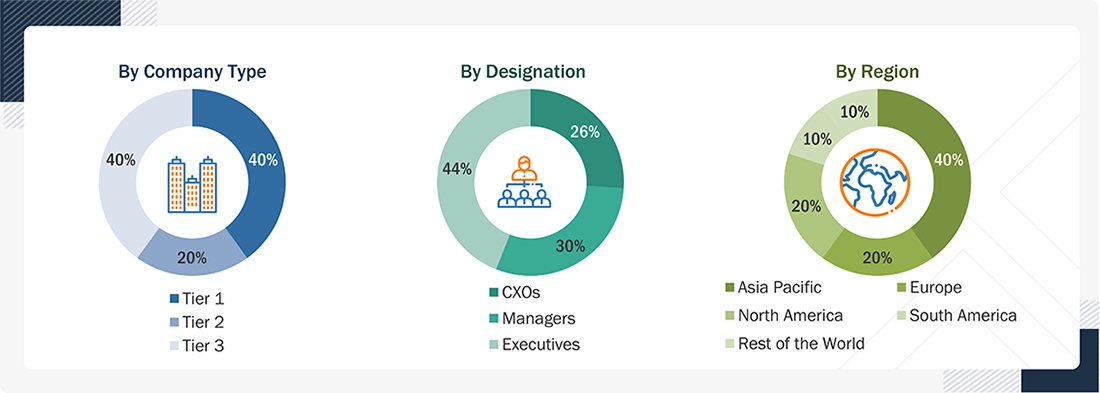
Note: The three tiers of the companies are defined based on their total revenues in 2024 or 2025, as per the availability of financial data: Tier 1: Revenue >USD 1 billion; Tier 2: USD 100 million ≤ revenue ≤ USD 1 billion; Tier 3: Revenue <USD 100 million. Rest of the World includes Africa and the Middle East.
|
COMPANY NAME |
DESIGNATION |
|
Cargill, Incorporated |
Product Development Manager |
|
dsm-firmenich |
Sales Head |
|
Kemin Industries Inc. |
Marketing Head |
|
Phileo by Lesaffre |
Sales Head |
|
Ingredion |
Senior Research Executive |
|
Lallemand Inc. |
Business Development Manager |
To know about the assumptions considered for the study, download the pdf brochure
Market Size Estimation
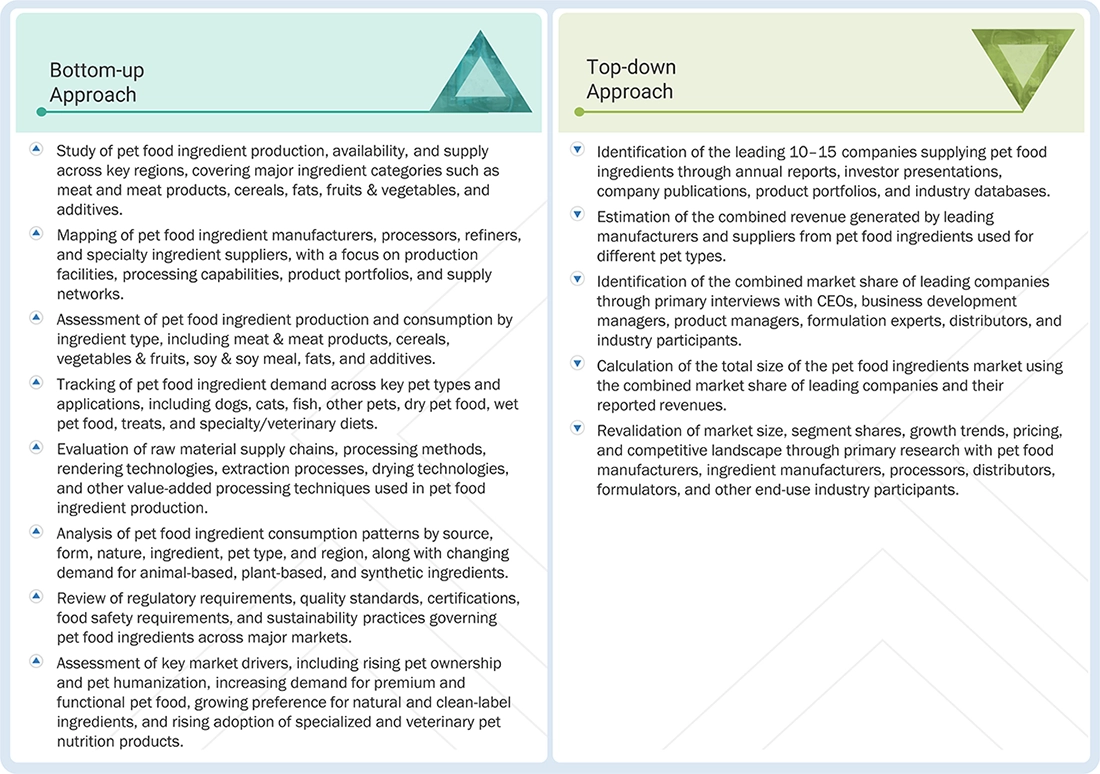
The top-down and bottom-up approaches were used to estimate and validate the total size of the pet food ingredients market. These approaches were also used extensively to determine the size of various subsegments in the market. The research methodology used to estimate the market size includes the following details:
- The key players in the industry and the overall market were identified through extensive secondary research.
- All shares, splits, and breakdowns were determined using secondary sources and verified through primary sources.
- All possible parameters that affect the market covered in this research study were accounted for, viewed in extensive detail, verified through primary research, and analyzed to obtain final quantitative and qualitative data.
- The research included the study of reports, reviews, and newsletters of top market players, along with extensive interviews for opinions from leaders, such as CEOs, directors, and marketing executives.
Pet Food Ingredients Market: Top-Down and Bottom-Up Approach
Data Triangulation
After determining the overall market size from the estimation process explained above, the total market was split into several segments and subsegments. The data triangulation procedure was employed, wherever applicable, to estimate the overall pet food ingredients market and arrive at the exact statistics for all segments and subsegments. The data were triangulated by studying various factors and trends from the demand and supply sides. The market size was also validated using both the top-down and bottom-up approaches.
Market Definition
According to the Association of American Feed Control Officials (AAFCO), a pet food manufacturer is allowed to claim its food as “complete and balanced” by meeting an AAFCO nutrient profile (dog or cat) or by passing a feeding trial. All ingredients used in pet food must be appropriate for the pet, and all pet food must be acceptable either by the AAFCO ingredients definition process or by the Food and Drug Administration–Center for Veterinary Medicine (FDA-CVM) or be self-affirmed Generally Recognized as Safe (GRAS).
Standard quality food ingredients provide the proper balance of nutrition to pets. It helps them to meet their need for a certain combination of proteins, carbohydrates, fats, vitamins, minerals, and water to function normally. A proper pet food ingredient has advantages such as improvement in muscle tone and body condition, keeping skin and haircoat healthy, enhancement in digestion, and prevention of diseases.
Key Stakeholders
- Raw material suppliers, including producers and processors of meat, animal by-products, fish, cereals, grains, vegetables, fruits, oilseeds, and other raw materials used in pet food ingredient production
- Pet food ingredient manufacturers and processors, including producers of animal-based proteins, meat meals, plant proteins, cereals, fats & oils, vitamins, minerals, enzymes, and other specialty ingredients
- Intermediate stakeholders, including ingredient distributors, traders, importers/ exporters, contract manufacturers, logistics providers, packaging suppliers, and storage providers
- Pet food manufacturers and brands, including producers of dry pet food, wet pet food, pet treats and snacks, veterinary diets, and specialty pet nutrition products
- Pet food ingredient solution providers and formulation specialists, including specialty ingredient manufacturers, premix providers, nutrition consultants, and formulation service providers
- Government organizations and regulatory authorities, responsible for pet food safety, ingredient approval, labeling, quality standards, feed safety, and regulatory compliance
- Research institutions, universities, veterinary institutions, and testing laboratories, involved in pet nutrition research, ingredient development, digestibility studies, efficacy evaluation, food safety, and quality testing
- Pet nutritionists, veterinarians, R&D scientists, formulation specialists, and quality assurance professionals, responsible for ingredient selection, formulation development, nutritional assessment, safety evaluation, and quality control
- Industry associations and certification organizations, promoting responsible sourcing, feed safety, sustainability, quality standards, and best practices across the pet food industry
-
Associations and industry bodies:
- Association of American Feed Control Officials (AAFCO)
- US Food and Drug Administration – Center for Veterinary Medicine (FDA-CVM)
- European Pet Food Industry Federation (FEDIAF)
- European Food Safety Authority (EFSA)
- US Department of Agriculture (USDA)
- Food and Agriculture Organization (FAO)
- Pet Food Institute (PFI)
- Global Alliance of Pet Food Associations (GAPFA)
- Pet Food Manufacturers' Association (PFMA), UK
- Pet Food Industry Association of Australia (PFIAA)
- International Organization for Standardization (ISO)
Report Objectives
- To determine and project the size of the pet food ingredients market based on source, form, ingredient, pet, nature, and region, over five years, ranging from 2026 to 2031
- To identify the attractive opportunities in the market by determining the largest and fastest-growing segments across regions
- To provide detailed information about the key factors influencing market growth (drivers, restraints, opportunities, and challenges)
- To analyze the opportunities in the market for stakeholders and provide details of the competitive landscape for market leaders
- To analyze the micromarkets with respect to individual growth trends, prospects, and their contribution to the total market
- To identify and profile the key players in the market
- To understand the competitive landscape and identify the major growth strategies adopted by players across the key regions
Available customizations:
With the given market data, MarketsandMarkets offers customizations according to company-specific scientific needs. The following customization options are available for the report:
Product Analysis
-
Product matrix, which gives a detailed comparison of the product portfolio of each company.
Geographic Analysis
- Further breakdown of the Rest of Europe pet food ingredients market into key countries
- Further breakdown of the Rest of Asia Pacific pet food ingredients market into key countries
- Further breakdown of the Rest of South America pet food ingredients market into key countries
Company Information
-
Detailed analyses and profiling of additional market players (up to five)
Get the Full Pet Food Ingredients Market Report
Full forecast, segment splits, and company analysis for all Pet Food Ingredients Market.
- Rest Of South America Pet Food Ingredients Market
- Canada Pet Food Ingredients Market
- Mexico Pet Food Ingredients Market
- US Pet Food Ingredients Market
- China Pet Food Ingredients Market
- Japan Pet Food Ingredients Market
- India Pet Food Ingredients Market
- Germany Pet Food Ingredients Market
- Russia Pet Food Ingredients Market
- UK Pet Food Ingredients Market
- France Pet Food Ingredients Market
- Brazil Pet Food Ingredients Market
- Argentina Pet Food Ingredients Market
- Rest Of Europe Pet Food Ingredients Market
- Rest Of Asia Pacific Pet Food Ingredients Market
Need a Tailored Report?
Customize this report to your needs
Get 10% FREE Customization
Customize This Report
