
Asia Pacific Healthcare EDI Market (2026-2031)

The Asia Pacific Healthcare EDI Market was valued at $150.2 Million in 2026 and projected to reach to $244.6 Million by 2031, representing a compound annual growth rate of 10.3%. Asia Pacific's Healthcare EDI Market is positioned for accelerated growth as healthcare systems across the region prioritize digital infrastructure investments and regulatory compliance.


| Market Size in | USD 26.32 MN |
| Market Forecast in | |
| CAGR | |
| Forecast Period | |
| Units Considered | Value (USD MN) |
Asia Pacific Healthcare EDI Market Trends and Insights
- Asia Pacific's healthcare sector is increasingly adopting Electronic Data Interchange solutions to streamline administrative processes, reduce operational costs, and improve interoperability across provider networks.
- The region's rapid digital transformation, coupled with rising healthcare expenditure and regulatory mandates for data standardization, is driving widespread EDI implementation across Asia Pacific. Asia Pacific's market expansion is fueled by growing demand for efficient claims processing, patient data management, and supply chain optimization in healthcare organizations.
- The region's diverse regulatory landscape and varying levels of healthcare IT maturity create both opportunities and challenges for EDI adoption across Asia Pacific.
- By 2031, Asia Pacific is expected to capture significant market share as healthcare providers increasingly recognize EDI's role in achieving operational excellence and regulatory compliance..
Key Market Statistics
- CAGR (2026-2031) 10.3% CAGR
- Market Size, 2026 ~USD 150.2 Million
- Forecast, 2031 ~USD 244.6 Million
- Geography Asia Pacific
Asia Pacific Healthcare EDI Market Overview
Rapid Digital Transformation :
Asia Pacific healthcare providers are accelerating EDI adoption to modernize legacy systems and enable seamless data exchange across fragmented provider networks, driven by government digital health initiatives.
Cost Optimization Focus :
Healthcare organizations across Asia Pacific are leveraging EDI solutions to reduce administrative overhead, minimize billing errors, and streamline claims processing, directly improving operational margins.
Interoperability Imperative :
Regulatory frameworks in key markets like Japan, China, and India are mandating standardized data exchange protocols, creating strong demand for compliant EDI platforms among hospitals and insurers.
Market Expansion Trajectory :
The Asia Pacific Healthcare EDI Market is projected to grow from $150.2 million in 2026 to $244.6 million by 2031, representing a 10.3% CAGR, outpacing the global average of 9.8%.
Asia Pacific Healthcare EDI Market Dynamics
- The region's large patient populations, expanding insurance coverage, and increasing healthcare spending create substantial demand for efficient data interchange solutions.
- Key markets including Japan, China, and India are implementing national health information exchange standards, compelling providers and payers to adopt EDI platforms. The forecast period through 2031 will be characterized by consolidation among EDI vendors, integration with cloud-based healthcare IT ecosystems, and expansion into emerging markets within Southeast Asia.
- Rising cybersecurity concerns and data privacy regulations will drive adoption of secure, compliant EDI solutions.
- Healthcare organizations seeking competitive advantage will increasingly view EDI as a strategic enabler of value-based care delivery and population health management across Asia Pacific..
Market Ecosystem
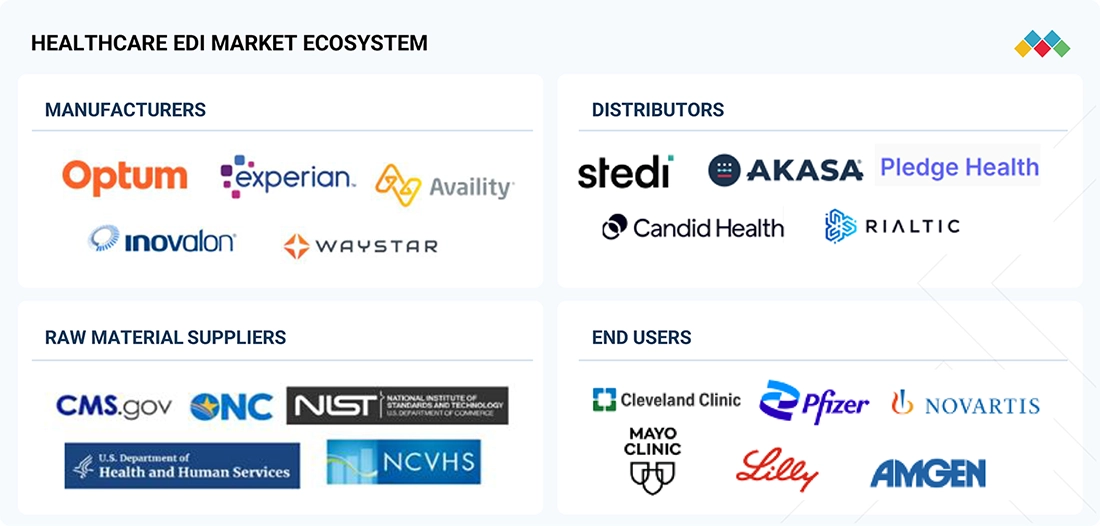
HEALTHCARE EDI MARKET: COMMERCIAL USE CASES ACROSS INDUSTRIES
| COMPANY | USE CASE DESCRIPTION | BENEFITS |
|---|---|---|
 |
Provides healthcare EDI and clearinghouse capabilities for claims submission, eligibility verification, claim status, prior authorization, remittance, and payment workflows across providers and payers | Improves payer-provider connectivity, reduces claim errors, speeds up reimbursement, and supports smoother revenue cycle operations |
 |
Offers a provider-payer network for exchanging EDI transactions such as eligibility and benefits checks, claims, authorizations, remittance, and payment-related information | Reduces manual calls and portal work, improves transaction visibility, and helps providers manage multiple payer connections through one platform |
 |
Delivers claims management, eligibility verification, authorization, denial management, payment, and clearinghouse solutions for hospitals, clinics, and billing teams | Helps reduce claim rejections, improves cash flow, automates payment posting, and gives providers better control over revenue cycle workflows |
 |
Provides healthcare EDI and revenue cycle tools for insurance eligibility, claims management, prior authorization, patient access, remittance, and payment-related workflows | Supports faster insurance checks, improves claim accuracy, reduces administrative burden, and helps providers identify payment issues earlier |
 |
Offers cloud-based healthcare data and EDI-enabled solutions for claims processing, eligibility checks, payer-provider data exchange, prior authorization, and administrative automation | Enhances data accuracy, supports real-time healthcare transactions, improves operational efficiency, and helps payers and providers manage large transaction volumes |
Logos and trademarks shown above are the property of their respective owners. Their use here is for informational and illustrative purposes only.
Related Ecosystem
Healthcare It
- Computed Tomography (CT)
- Machine Learning
- Magnetic Resonance Imaging (MRI)
- Natural Language Processing (NLP)
- Predictive Analytics
- CERNER CORPORATION
- PHILIPS HEALTHCARE
- Oracle Corporation
- GE HealthCare Technologies Inc.
- Siemens healthineers
Key Takeaways
- Asia Pacific Healthcare EDI Market is projected to grow from $150.2M (2026) to $244.6M (2031) at a 10.3% CAGR.
- Asia Pacific's digital healthcare transformation and regulatory compliance requirements are primary drivers of EDI adoption.
- Asia Pacific's diverse healthcare IT maturity levels present both growth opportunities and implementation challenges.
- By 2031, Asia Pacific will represent a significant portion of global Healthcare EDI demand driven by operational efficiency needs.
Healthcare EDI Market Report Scope
| Report Metric | Details |
|---|---|
| Base Year | 2026 |
| Fastest Growing Segment | PRIOR AUTHORIZATION & REFERRAL MANAGEMENT (Solution) |
| Forecast Period | 2026–2031 |
| Growth Rate | CAGR of 9.8% from 2026 to 2031 |
| Largest Segment | SERVICES (2024–2031) |
| Market Size Base Year (Billions) | ~USD 2.77 (2026) |
| Revenue Forecast (Billions) | ~USD 4.42 (2031) |
| Segments Covered | 2024–2031, Solution |
Asia Pacific Healthcare EDI Market Report Segmentation
2 segment dimensions are covered across the global market.
By 2024–2031
- Services
- Solutions
By Solution
- Claims Management
- Edi Clearinghouse
- Electronic Remittance & Payment Posting
- Eligibility & Benefits Verification
- Prior Authorization & Referral Management
Target Audience
- Healthcare IT Vendors & Solution Providers : EDI software vendors and healthcare IT companies need Asia Pacific market intelligence to prioritize product localization, identify high-growth markets, and develop region-specific sales strategies.
- Healthcare Providers & Hospital Networks : Hospital systems and provider organizations require market data to benchmark EDI adoption rates, evaluate vendor solutions, and justify digital transformation investments to stakeholders.
- Insurance Companies & Payers : Health insurers and payers need insights into EDI market trends to optimize claims processing, improve provider network connectivity, and reduce administrative costs across Asia Pacific operations.
- Healthcare Consultants & System Integrators : Consulting firms and SI partners require detailed market analysis to advise clients on EDI implementation strategies, vendor selection, and ROI projections specific to Asia Pacific markets.
- Investment & Private Equity Firms : Investors evaluating healthcare IT opportunities in Asia Pacific need comprehensive market data to assess growth potential, competitive dynamics, and exit opportunities in the EDI sector.
Key Companies in the Asia Pacific Healthcare EDI Market
| Company | HQ | Ownership | Strongest segments |
|---|---|---|---|
| QUALITY SYSTEMS INC | United States | Private Company | Enterprise EHR (NextGen Enterprise EHR),Enterprise PM & Financial Solutions,NextGen Office (integrated clinical + financial cloud suite), |
| GENERAL ELECTRIC | United States | Public Company | Commercial Engines & Services,Defense & Propulsion Technologies,Additive and Specialized Components Brands, |
| GE HEALTHCARE | United States | Public Company | Imaging,Advanced Visualization Solutions (AVS),Patient Care Solutions (PCS), |
| WAYSTAR HOLDING CORP. | United States | Public Company | Claims & Payer Payment Management,Financial Clearance & Eligibility,Patient Financial Care, |
| COGNIZANT | United States | Public Company | Financial Services,Health Sciences,Products and Resources, |
| MCKESSON CORPORATION | United States | Public Company | North American Pharmaceutical Distribution,Oncology & Multispecialty,Prescription Technology Solutions, |
| INOVALON HOLDINGS, INC. | United States | Private Company | Payer solutions (converged quality, risk, outreach, provider enablement, analytics, data lake),Provider solutions (registration, insurance discovery, claims, RCM intelligence, safety, workforce),Real-world data and insights (clinical trials analytics, commercial analytics, real-world data, real-time patient data), |
| VERADIGM INC. | United States | Public Company | Ambulatory EHR and Practice Management (including Veradigm EHR and Practice Fusion),Revenue Cycle and Payerpath Clearinghouse,Real-World Data, Analytics, and Registries, |
| THE SSI GROUP, LLC | Philippines | Public Company | Fast fashion & casual wear (Zara, Bershka, Pull&Bear, Stradivarius, Old Navy, Gap),Luxury & premium fashion/accessories (Hermès, Cartier, Ferragamo, Lacoste, Kate Spade, Michael Kors, Tory Burch),Footwear value & mid-market (Payless, Steve Madden, Dune), |
| IBM | United States | Public Company | Software (Hybrid Cloud and AI Platforms),Consulting,Infrastructure, |
| ORACLE | United States | Public Company | Fusion Cloud ERP/EPM/SCM/HCM,Database & Infrastructure Technologies (Oracle DB, MySQL, Autonomous DB, middleware, IaaS/PaaS),NetSuite Applications Suite, |
| NTT DATA GROUP CORPORATION | Japan | Private Company | Application and Enterprise Platforms,Cloud, Data and Intelligence, Generative AI,Consulting and Industry Solutions, |
| COMARCH S.A. | Poland | Private Company | Telecom IoT and BSS/OSS Platforms,Banking, Insurance, and Wealth Platforms,ERP, Document Management, and Office Platforms, |
| AXWAY | United States | Public Company | Amplify platform & API management,B2B integration,Managed file transfer (MFT), |
QUALITY SYSTEMS INC
QUALITY SYSTEMS INC is a private United States company founded in 1974 with 2783 employees.
GENERAL ELECTRIC
GENERAL ELECTRIC is a public United States company founded in 1892 with 57000 employees.
GE HEALTHCARE
GE HEALTHCARE is a public United States company founded in 2022 with 54000 employees.
WAYSTAR HOLDING CORP.
WAYSTAR HOLDING CORP. is a public United States company founded in 2017 with 1700 employees.
COGNIZANT
COGNIZANT is a public United States company founded in 1988 with 357600 employees.
MCKESSON CORPORATION
MCKESSON CORPORATION is a public United States company founded in 1833 with 42300 employees.
INOVALON HOLDINGS, INC.
INOVALON HOLDINGS, INC. is a private United States company founded in 1998 with 1836 employees.
VERADIGM INC.
VERADIGM INC. is a public United States company founded in 1986 with 2300 employees.
THE SSI GROUP, LLC
THE SSI GROUP, LLC is a public Philippines company founded in 1987 with 7595 employees.
IBM
IBM is a public United States company founded in 1911 with 264300 employees.
ORACLE
ORACLE is a public United States company founded in 1977 with 141000 employees.
NTT DATA GROUP CORPORATION
NTT DATA GROUP CORPORATION is a private Japan company founded in 1988 with 197777 employees.
COMARCH S.A.
COMARCH S.A. is a private Poland company founded in 1993 with 6583 employees.
AXWAY
AXWAY is a public United States company founded in 2000 with 4512 employees.
Countries within Asia Pacific - compare and drill down
| Country | 2025 size (native) |
|---|---|
| China | USD 133.5 Million |
| Japan | USD 180.4 Million |
| India | USD 119.3 Million |
| Australia | USD 35.8 Million |
| South Korea | USD 26.3 Million |
Country market size visualization
Reasons to Buy this Report
- Regional Market Sizing & Forecasts : Obtain precise market valuations for Asia Pacific and individual country-level data through 2031, enabling accurate budget allocation and investment planning specific to your target markets.
- Competitive Landscape Intelligence : Understand vendor positioning, market share dynamics, and competitive strategies unique to Asia Pacific healthcare EDI, identifying partnership and acquisition opportunities.
- Regulatory & Compliance Insights : Navigate country-specific healthcare data exchange regulations, interoperability standards, and compliance requirements across China, Japan, India, and other key Asia Pacific markets.
- Growth Driver Analysis : Identify region-specific catalysts including government digital health initiatives, insurance expansion, and provider network consolidation driving 10.3% CAGR in Asia Pacific.
- Strategic Market Entry Roadmap : Develop market entry strategies with country-level opportunity assessments, customer segmentation, and go-to-market recommendations tailored to Asia Pacific healthcare dynamics.
Frequently asked questions
What is the current size of the Healthcare EDI Market in Asia Pacific?
The Asia Pacific Healthcare EDI Market was valued at $150.2 million in 2026 and is expected to grow significantly through 2031.
What is the projected growth rate for Healthcare EDI in Asia Pacific?
Asia Pacific's Healthcare EDI Market is expected to grow at a compound annual growth rate (CAGR) of 10.3% from 2026 to 2031.
What will be the market size of Healthcare EDI in Asia Pacific by 2031?
The Asia Pacific Healthcare EDI Market is forecasted to reach $244.6 million by 2031, representing substantial expansion from 2026 levels.
What are the main drivers of Healthcare EDI adoption in Asia Pacific?
Key drivers in Asia Pacific include digital healthcare transformation, regulatory compliance mandates, operational cost reduction, and improved interoperability requirements across healthcare networks.
How does Asia Pacific's Healthcare EDI growth compare to global trends?
Asia Pacific's 10.3% CAGR slightly outpaces the global Healthcare EDI Market CAGR of 9.8%, indicating stronger regional growth momentum.
RESEARCH METHODOLOGY
The study involved five major activities to estimate the current size of the Healthcare EDI Market. Exhaustive secondary research was done to collect information on the market and its different subsegments. The next step was to validate these findings, assumptions, and sizing with industry experts across the value chain through primary research. Both top-down and bottom-up approaches were employed to estimate the complete market size. Thereafter, market breakdown and data triangulation procedures were used to estimate the market size of the segments and subsegments.
Secondary Research
In the secondary research process, various secondary sources such as annual reports, press releases & investor presentations of companies, white papers, certified publications, articles by recognized authors, gold-standard & silver-standard websites, regulatory bodies, and databases (such as D&B Hoovers, Bloomberg Business, and Factiva) were referred to identify and collect information for the study of the Healthcare EDI market. It was also used to obtain important information about the top players, market classification, and segmentation according to industry trends to the bottom-most level, geographic markets, and key developments related to the market. A database of the key industry leaders was also prepared using secondary research.
Primary Research
Extensive primary research was conducted after acquiring basic knowledge about the global Healthcare EDI market scenario through secondary research. Several primary interviews were conducted with market experts from both the demand side (Hospital directors, Hospital Vice Presidents, Department heads, and Critical care specialists ) and supply side (such as C-level and D-level executives, technology experts, product managers, marketing and sales managers, among others) across five major regions North America, Europe, the Asia Pacific, Latin America, Middle East, and Africa. This primary data was collected through questionnaires, e-mails, online surveys, personal interviews, and telephonic interviews.
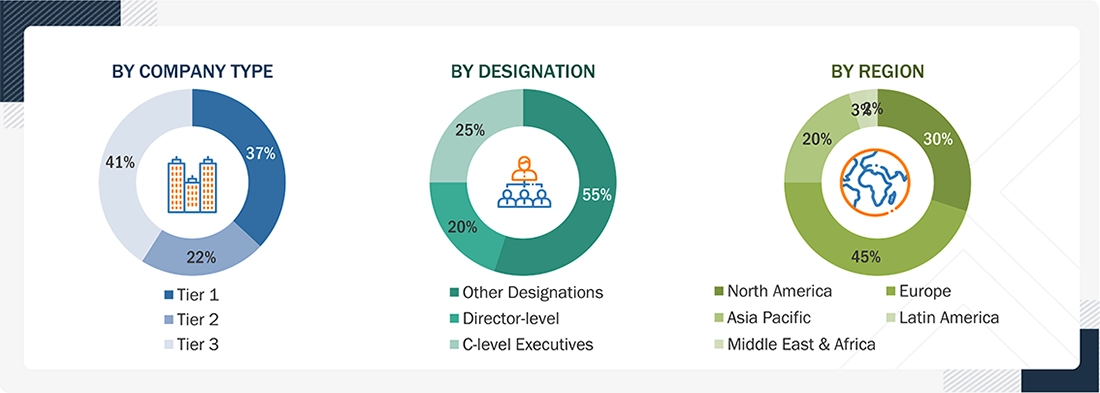
Note 1: Others include sales managers, marketing managers, and product managers.
Note 2: Tiers of companies are defined on the basis of their total revenues in 2025. Tier 1 = >USD 1 billion, Tier 2 = USD 500 million to USD 1 billion, and Tier 3 = <USD 500 million
To know about the assumptions considered for the study, download the pdf brochure
Market Size Estimation
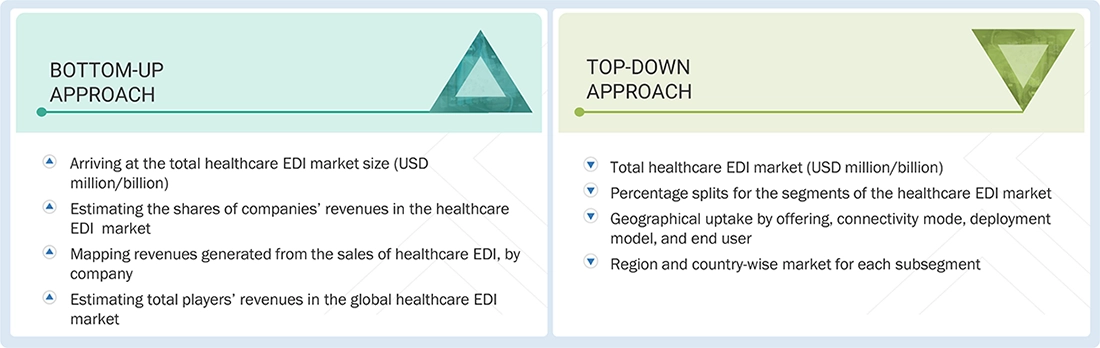
Both top-down and bottom-up approaches were used to estimate and validate the total size of the Healthcare EDI market. These methods were also used extensively to estimate the size of various subsegments in the market.
Data Triangulation
After arriving at the overall market size using the market size estimation processes, the market was split into several segments and subsegments. To complete the overall market engineering process and arrive at the exact statistics of each market segment and sub-segment, data triangulation and market breakdown procedures were employed, wherever applicable. The data was triangulated by studying various factors and trends from both the demand and supply sides in the Healthcare EDI market.
Market Definition
Healthcare electronic data interchange (EDI) is a structured method to exchange healthcare information in a standardized format between providers, payers, clearinghouses, pharmacies, suppliers, and manufacturers. Healthcare providers use EDI to send insurance claims directly to payers (insurance companies, Medicare/Medicaid) in standardized formats (e.g., X12 837 format). Healthcare EDI applies to claims, medical billing, health records, purchase orders, invoices, shipping notices, and other essential or classified healthcare-related information.
Key Stakeholders
- Healthcare EDI Software & Service Providers
- Government Agencies
- Healthcare Startups, Consultants, and Regulators
- Healthcare Providers
- Clinical/Physician Centers
- Surgeons, Physicians, and Operating Room Staff
- Health IT Service Providers
- Healthcare Associations/Institutes
- Hospitals (Public and Private)
- Ambulatory Care Centers
- Academic Medical Institutes
- Venture Capitalists
- Distributors & Resellers
- Maintenance & Support Service Providers
- Integration Service Providers
- Data Security & Privacy Experts
Report Objectives
- To define, describe, and forecast the global healthcare EDI market based on offering, connectivity mode, deployment model, end user, and region
- To provide detailed information regarding the major factors (such as drivers, restraints, opportunities, and challenges) influencing market growth
- To strategically analyze micro-markets with respect to individual growth trends, prospects, and contributions to the overall healthcare EDI market
- To analyze opportunities in the market for stakeholders and provide details of the competitive landscape for market leaders
- To strategically analyze the market structure profile of the key players of the healthcare EDI market and comprehensively analyze their core competencies
- To forecast the size of the market segments with respect to five regions: North America, Europe, Asia Pacific, Latin America, and the Middle East & Africa
- To track and analyze competitive developments such as product launches, investments, partnerships, collaborations, acquisitions, expansions, product approval, and alliances in the healthcare EDI market during the forecast period
Available customizations:
With the given market data, MarketsandMarkets offers customizations as per the company’s specific needs. The following customization options are available for the report:
- Product Analysis: Product matrix, which gives a detailed comparison of the product portfolios of each company
- Geographic Analysis: Further breakdown of Latin America, Europe, the Middle East & Africa Healthcare EDI into specific countries
Get the Full Healthcare EDI Market Report
Full forecast, segment splits, and company analysis for all Healthcare EDI Market.
- Australia Healthcare EDI Market
- Brazil Healthcare EDI Market
- Canada Healthcare EDI Market
- China Healthcare EDI Market
- France Healthcare EDI Market
- Germany Healthcare EDI Market
- India Healthcare EDI Market
- Italy Healthcare EDI Market
- Japan Healthcare EDI Market
- Mexico Healthcare EDI Market
- Saudi Arabia Healthcare EDI Market
- South Africa Healthcare EDI Market
- South Korea Healthcare EDI Market
- Spain Healthcare EDI Market
- UAE Healthcare EDI Market
- UK Healthcare EDI Market
- US Healthcare EDI Market
Need a Tailored Report?
Customize this report to your needs
Get 10% FREE Customization
Customize This Report