
Japan Healthcare EDI Market (2026-2031)

The Japan Healthcare EDI Market was valued at $39.3 Million in 2026 and projected to reach to $54.9 Million by 2031, representing a compound annual growth rate of 11.6%. Japan's Healthcare EDI market is positioned for sustained expansion driven by demographic pressures and regulatory mandates.


| Market Size in | USD 26.32 MN |
| Market Forecast in | |
| CAGR | |
| Forecast Period | |
| Units Considered | Value (USD MN) |
Japan Healthcare EDI Market Trends and Insights
- This expansion reflects Japan's increasing digitalization of healthcare operations and regulatory emphasis on interoperable health information systems.
- Japan's aging population and advanced healthcare infrastructure are driving adoption of Electronic Data Interchange solutions across hospitals, clinics, and insurance providers. The Japanese market is characterized by strong government support for healthcare IT modernization and a mature healthcare sector seeking operational efficiency.
- Japan's Healthcare EDI market growth outpaces global trends, with an 11.6% compound annual growth rate significantly exceeding the global average.
- Between 2026 and 2031, Japan will see substantial investment in EDI platforms to streamline claims processing, patient records management, and inter-provider communication. Japan's healthcare providers are increasingly recognizing EDI as essential for reducing administrative costs and improving care coordination.
- The market's trajectory reflects Japan's commitment to digital health transformation and the critical role EDI plays in modernizing Japan's healthcare delivery ecosystem..
Key Market Statistics
- CAGR (2026-2031) 11.6% CAGR
- Market Size, 2026 ~USD 39.3 Million
- Forecast, 2031 ~USD 54.9 Million
- Country Japan
Japan Healthcare EDI Market Overview
Market Valuation Growth :
Japan's Healthcare EDI market is valued at $39.3 million in 2026 and is projected to reach $54.9 million by 2031, representing a robust 11.6% CAGR, outpacing the global average of 9.8%.
Aging Population Driver :
Japan's rapidly aging demographic necessitates efficient healthcare data exchange systems. EDI solutions enable seamless coordination across hospitals, clinics, and care facilities to manage the complex needs of elderly patients.
Regulatory Digitalization Push :
Japanese healthcare regulations increasingly mandate interoperable health information systems. Government initiatives promote digital transformation, creating strong compliance drivers for EDI adoption across healthcare providers.
Advanced Infrastructure Foundation :
Japan's mature healthcare infrastructure and high technology adoption rates provide an ideal environment for EDI implementation, with existing digital systems facilitating faster integration and deployment.
Japan Healthcare EDI Market Dynamics
- The country's aging population creates urgent demand for efficient healthcare data management and interoperability solutions.
- Government policies emphasizing digital health infrastructure and standardized data exchange protocols are accelerating EDI adoption among hospitals, clinics, and insurance providers.
- Japan's advanced technological capabilities and healthcare sector maturity support rapid implementation cycles and innovation in EDI platforms tailored to local requirements. Looking ahead to 2031, the market will benefit from increased investment in healthcare IT infrastructure and growing recognition of EDI's role in improving patient outcomes and operational efficiency.
- Integration with emerging technologies such as AI-driven analytics and cloud-based systems will enhance EDI value propositions.
- Competitive pressures and consolidation among healthcare providers will further drive standardization and adoption of comprehensive EDI solutions across Japan's healthcare ecosystem..
Market Ecosystem
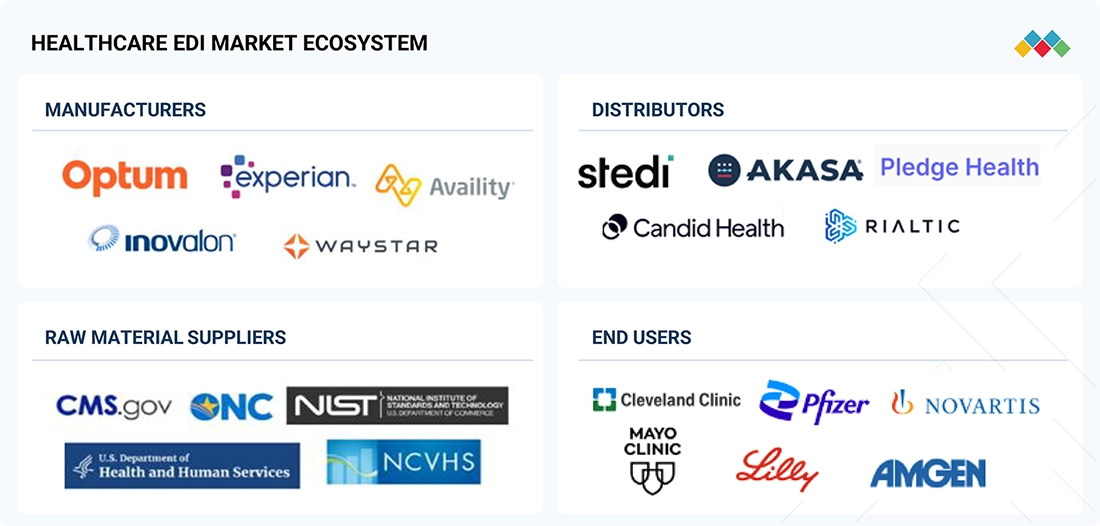
HEALTHCARE EDI MARKET: COMMERCIAL USE CASES ACROSS INDUSTRIES
| COMPANY | USE CASE DESCRIPTION | BENEFITS |
|---|---|---|
 |
Provides healthcare EDI and clearinghouse capabilities for claims submission, eligibility verification, claim status, prior authorization, remittance, and payment workflows across providers and payers | Improves payer-provider connectivity, reduces claim errors, speeds up reimbursement, and supports smoother revenue cycle operations |
 |
Offers a provider-payer network for exchanging EDI transactions such as eligibility and benefits checks, claims, authorizations, remittance, and payment-related information | Reduces manual calls and portal work, improves transaction visibility, and helps providers manage multiple payer connections through one platform |
 |
Delivers claims management, eligibility verification, authorization, denial management, payment, and clearinghouse solutions for hospitals, clinics, and billing teams | Helps reduce claim rejections, improves cash flow, automates payment posting, and gives providers better control over revenue cycle workflows |
 |
Provides healthcare EDI and revenue cycle tools for insurance eligibility, claims management, prior authorization, patient access, remittance, and payment-related workflows | Supports faster insurance checks, improves claim accuracy, reduces administrative burden, and helps providers identify payment issues earlier |
 |
Offers cloud-based healthcare data and EDI-enabled solutions for claims processing, eligibility checks, payer-provider data exchange, prior authorization, and administrative automation | Enhances data accuracy, supports real-time healthcare transactions, improves operational efficiency, and helps payers and providers manage large transaction volumes |
Logos and trademarks shown above are the property of their respective owners. Their use here is for informational and illustrative purposes only.
Related Ecosystem
Healthcare It
- Computed Tomography (CT)
- Machine Learning
- Magnetic Resonance Imaging (MRI)
- Natural Language Processing (NLP)
- Predictive Analytics
- CERNER CORPORATION
- PHILIPS HEALTHCARE
- Oracle Corporation
- GE HealthCare Technologies Inc.
- Siemens healthineers
Key Takeaways
- Japan's Healthcare EDI market will grow from $39.3M (2026) to $54.9M (2031) at an 11.6% CAGR, outpacing global growth rates.
- Japan's aging demographic and advanced healthcare infrastructure create strong demand for EDI solutions to optimize care delivery and administrative efficiency.
- Government regulatory initiatives in Japan are accelerating healthcare IT modernization and interoperability standards adoption.
- Japan's mature healthcare sector is increasingly investing in EDI platforms to reduce claims processing costs and improve provider-payer communication.
Healthcare EDI Market Report Scope
| Report Metric | Details |
|---|---|
| Base Year | 2026 |
| Fastest Growing Segment | INDIA (Deployment Model) |
| Forecast Period | 2026–2031 |
| Growth Rate | CAGR of 9.8% from 2026 to 2031 |
| Largest Segment | POINT-TO-POINT EDI (End User) |
| Market Size Base Year (Billions) | ~USD 2.77 (2026) |
| Revenue Forecast (Billions) | ~USD 4.42 (2031) |
| Segments Covered | Type, Deployment Model, Transaction Type, Transmission Type, Healthcare Provider, End User, Component, End-User |
Japan Healthcare EDI Market Report Segmentation
8 segment dimensions are covered across the global market.
By Type
- Ambulatory Surgery Centers
- Ambulatory Surgical Centers
- Claim Status
- Claim Submission
- Claims Management Services
- Claims Payment
- Eligibility Verification
- Hospitals & Clinics
- Implementation Services
- Inventory Management
- Maintenance & Support Services
- Managed Services
- Order Management
- Other Edi Claim Transactions
- Other Edi Transactions
- Other Healthcare Providers
- Other Services
- Payment Remittance
- Private Payers
- Procurement Management
- Professional Services
- Public Payers
- Referral Certification & Authorization
- Supply Management Services
By Deployment Model
- On-Premise Edi Model
- Web/Cloud-Based Edi Model
By Transaction Type
- Claims Management Software
- Supply Management Software
By Transmission Type
- Multi-Channel Edi
- Point-To-Point Edi
- Value-Added Network (Van) Edi
By Healthcare Provider
- Ambulatory Surgical Centers
- Diagnostic Centers & Laboratories
- Hospitals & Clinics
- Other Healthcare Providers
By End User
- Healthcare Payers
- Healthcare Providers
- Medical Device Companies
- Pharmaceutical & Biotechnology Companies
- Pharmacies
By Component
- Services
- Software
By End-User
- Healthcare Payers
- Healthcare Providers
- Medical Device Companies
- Pharmaceutical & Biotechnology Companies
- Pharmacies
JAPAN: HEALTHCARE EDI MARKET, BY END USER, 2024–2031
| Segment | 2024 | 2025 | 2026 | 2027 | 2028 | 2029 | 2030 | 2031 | CAGR (%) |
|---|---|---|---|---|---|---|---|---|---|
| HEALTHCARE CLEARINGHOUSES | 6.6 | 7.3 | 8 | 8.7 | 9.6 | 10.6 | 11.8 | 13 | 10.3 |
| HEALTHCARE PAYERS | 19.4 | 21.3 | 23.5 | 25.9 | 28.7 | 31.8 | 35.3 | 39.3 | 10.8 |
| HEALTHCARE PROVIDERS | 34.1 | 37.3 | 40.8 | 44.7 | 49.2 | 54.2 | 59.9 | 66.2 | 10.2 |
| OTHERS | 3.4 | 3.7 | 4 | 4.4 | 4.8 | 5.3 | 5.8 | 6.4 | 9.8 |
| PHARMACIES & PBMS | 4.3 | 4.7 | 5.1 | 5.7 | 6.3 | 6.9 | 7.7 | 8.5 | 10.6 |
| TOTAL | 67.8 | 74.2 | 81.4 | 89.4 | 98.6 | 108.9 | 120.5 | 133.5 | 10.4 |
Target Audience
- Healthcare IT Vendors : EDI software and platform providers need Japan-specific market data to develop localized solutions, understand regulatory requirements, and identify partnership opportunities with Japanese healthcare organizations.
- Hospital & Clinic Networks : Healthcare facility operators require market intelligence to evaluate EDI investment decisions, benchmark against peers, and understand how demographic trends and regulations impact their digital transformation roadmaps.
- Healthcare Insurance Providers : Insurance companies need insights into EDI adoption trends to streamline claims processing, improve interoperability with providers, and optimize operations in Japan's aging population context.
- Healthcare Consultants & Integrators : System integrators and management consultants require Japan-specific market data to advise clients on EDI implementation strategies, vendor selection, and alignment with regulatory and demographic trends.
- Government & Policy Makers : Healthcare policy officials and government agencies need market research to assess digitalization progress, evaluate policy effectiveness, and plan future healthcare IT infrastructure investments for Japan.
Key Companies in the Japan Healthcare EDI Market
| Company | HQ | Ownership | Strongest segments |
|---|---|---|---|
| QUALITY SYSTEMS INC | United States | Private Company | Enterprise EHR (NextGen Enterprise EHR),Enterprise PM & Financial Solutions,NextGen Office (integrated clinical + financial cloud suite), |
| GENERAL ELECTRIC | United States | Public Company | Commercial Engines & Services,Defense & Propulsion Technologies,Additive and Specialized Components Brands, |
| GE HEALTHCARE | United States | Public Company | Imaging,Advanced Visualization Solutions (AVS),Patient Care Solutions (PCS), |
| WAYSTAR HOLDING CORP. | United States | Public Company | Claims & Payer Payment Management,Financial Clearance & Eligibility,Patient Financial Care, |
| COGNIZANT | United States | Public Company | Financial Services,Health Sciences,Products and Resources, |
| MCKESSON CORPORATION | United States | Public Company | North American Pharmaceutical Distribution,Oncology & Multispecialty,Prescription Technology Solutions, |
| INOVALON HOLDINGS, INC. | United States | Private Company | Payer solutions (converged quality, risk, outreach, provider enablement, analytics, data lake),Provider solutions (registration, insurance discovery, claims, RCM intelligence, safety, workforce),Real-world data and insights (clinical trials analytics, commercial analytics, real-world data, real-time patient data), |
| VERADIGM INC. | United States | Public Company | Ambulatory EHR and Practice Management (including Veradigm EHR and Practice Fusion),Revenue Cycle and Payerpath Clearinghouse,Real-World Data, Analytics, and Registries, |
| THE SSI GROUP, LLC | Philippines | Public Company | Fast fashion & casual wear (Zara, Bershka, Pull&Bear, Stradivarius, Old Navy, Gap),Luxury & premium fashion/accessories (Hermès, Cartier, Ferragamo, Lacoste, Kate Spade, Michael Kors, Tory Burch),Footwear value & mid-market (Payless, Steve Madden, Dune), |
| IBM | United States | Public Company | Software (Hybrid Cloud and AI Platforms),Consulting,Infrastructure, |
| ORACLE | United States | Public Company | Fusion Cloud ERP/EPM/SCM/HCM,Database & Infrastructure Technologies (Oracle DB, MySQL, Autonomous DB, middleware, IaaS/PaaS),NetSuite Applications Suite, |
| NTT DATA GROUP CORPORATION | Japan | Private Company | Application and Enterprise Platforms,Cloud, Data and Intelligence, Generative AI,Consulting and Industry Solutions, |
| COMARCH S.A. | Poland | Private Company | Telecom IoT and BSS/OSS Platforms,Banking, Insurance, and Wealth Platforms,ERP, Document Management, and Office Platforms, |
| AXWAY | United States | Public Company | Amplify platform & API management,B2B integration,Managed file transfer (MFT), |
QUALITY SYSTEMS INC
QUALITY SYSTEMS INC is a private United States company founded in 1974 with 2783 employees.
GENERAL ELECTRIC
GENERAL ELECTRIC is a public United States company founded in 1892 with 57000 employees.
GE HEALTHCARE
GE HEALTHCARE is a public United States company founded in 2022 with 54000 employees.
WAYSTAR HOLDING CORP.
WAYSTAR HOLDING CORP. is a public United States company founded in 2017 with 1700 employees.
COGNIZANT
COGNIZANT is a public United States company founded in 1988 with 357600 employees.
MCKESSON CORPORATION
MCKESSON CORPORATION is a public United States company founded in 1833 with 42300 employees.
INOVALON HOLDINGS, INC.
INOVALON HOLDINGS, INC. is a private United States company founded in 1998 with 1836 employees.
VERADIGM INC.
VERADIGM INC. is a public United States company founded in 1986 with 2300 employees.
THE SSI GROUP, LLC
THE SSI GROUP, LLC is a public Philippines company founded in 1987 with 7595 employees.
IBM
IBM is a public United States company founded in 1911 with 264300 employees.
ORACLE
ORACLE is a public United States company founded in 1977 with 141000 employees.
NTT DATA GROUP CORPORATION
NTT DATA GROUP CORPORATION is a private Japan company founded in 1988 with 197777 employees.
COMARCH S.A.
COMARCH S.A. is a private Poland company founded in 1993 with 6583 employees.
AXWAY
AXWAY is a public United States company founded in 2000 with 4512 employees.
Reasons to Buy this Report
- Japan-Specific Market Sizing : Obtain precise valuation data for Japan's Healthcare EDI market with verified 2026 baseline ($39.3M) and 2031 forecast ($54.9M), enabling accurate budget allocation and ROI projections for Japan-focused strategies.
- Regulatory Compliance Insights : Understand Japan's unique regulatory landscape and government digitalization mandates driving EDI adoption. Identify compliance requirements and standards specific to Japanese healthcare providers to ensure market-ready solutions.
- Demographic Opportunity Analysis : Leverage insights into Japan's aging population dynamics and their impact on healthcare EDI demand. Tailor product offerings and go-to-market strategies to address the specific needs of Japan's elderly care ecosystem.
- Competitive Positioning for Japan : Benchmark your organization against Japan-specific market trends and competitor strategies. Identify white space opportunities and differentiation angles within Japan's 11.6% CAGR growth trajectory.
- Infrastructure Integration Strategy : Understand Japan's advanced healthcare IT infrastructure maturity and integration requirements. Develop implementation roadmaps that leverage existing systems while addressing local interoperability standards and preferences.
Frequently asked questions
What is the current size of Japan's Healthcare EDI market?
Japan's Healthcare EDI market was valued at $39.3 million in 2026 and is expected to reach $54.9 million by 2031.
What is the growth rate of Japan's Healthcare EDI market?
Japan's Healthcare EDI market is growing at a compound annual growth rate (CAGR) of 11.6% from 2026 to 2031.
What factors are driving growth in Japan's Healthcare EDI market?
Key drivers include Japan's aging population, government healthcare IT modernization initiatives, regulatory emphasis on interoperability, and the need for operational efficiency in healthcare delivery.
How does Japan's Healthcare EDI market growth compare to global trends?
Japan's 11.6% CAGR significantly exceeds the global Healthcare EDI market CAGR of 9.8%, indicating stronger regional growth momentum.
Which healthcare segments in Japan are adopting EDI solutions?
Hospitals, clinics, insurance providers, and healthcare networks across Japan are increasingly adopting EDI platforms for claims processing, patient records management, and inter-provider communication.
RESEARCH METHODOLOGY
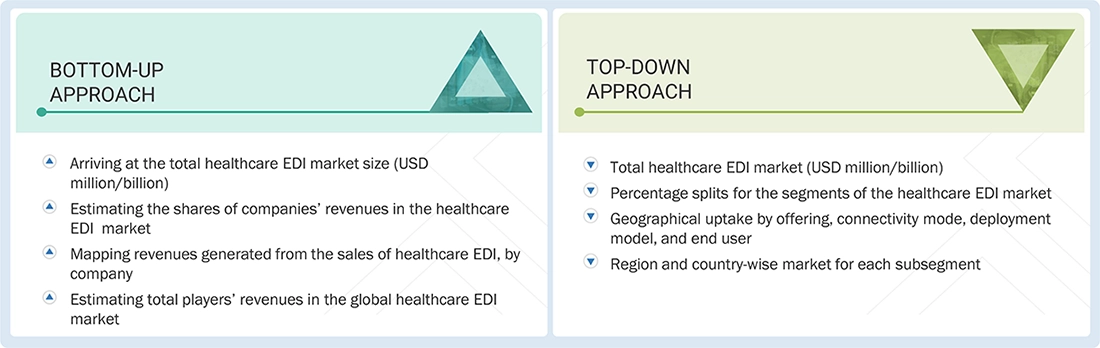
The study involved five major activities to estimate the current size of the Healthcare EDI Market. Exhaustive secondary research was done to collect information on the market and its different subsegments. The next step was to validate these findings, assumptions, and sizing with industry experts across the value chain through primary research. Both top-down and bottom-up approaches were employed to estimate the complete market size. Thereafter, market breakdown and data triangulation procedures were used to estimate the market size of the segments and subsegments.
Secondary Research
In the secondary research process, various secondary sources such as annual reports, press releases & investor presentations of companies, white papers, certified publications, articles by recognized authors, gold-standard & silver-standard websites, regulatory bodies, and databases (such as D&B Hoovers, Bloomberg Business, and Factiva) were referred to identify and collect information for the study of the Healthcare EDI market. It was also used to obtain important information about the top players, market classification, and segmentation according to industry trends to the bottom-most level, geographic markets, and key developments related to the market. A database of the key industry leaders was also prepared using secondary research.
Primary Research
Extensive primary research was conducted after acquiring basic knowledge about the global Healthcare EDI market scenario through secondary research. Several primary interviews were conducted with market experts from both the demand side (Hospital directors, Hospital Vice Presidents, Department heads, and Critical care specialists ) and supply side (such as C-level and D-level executives, technology experts, product managers, marketing and sales managers, among others) across five major regions North America, Europe, the Asia Pacific, Latin America, Middle East, and Africa. This primary data was collected through questionnaires, e-mails, online surveys, personal interviews, and telephonic interviews.
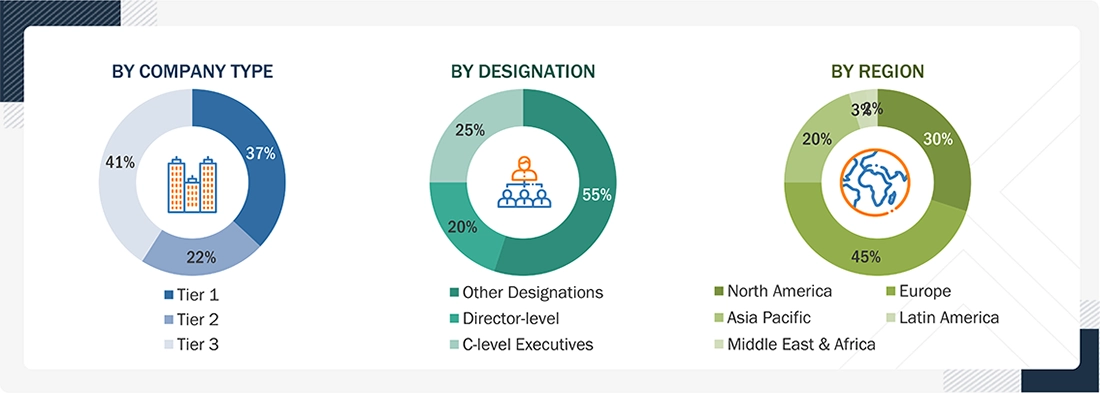
Note 1: Others include sales managers, marketing managers, and product managers.
Note 2: Tiers of companies are defined on the basis of their total revenues in 2025. Tier 1 = >USD 1 billion, Tier 2 = USD 500 million to USD 1 billion, and Tier 3 = <USD 500 million
To know about the assumptions considered for the study, download the pdf brochure
Market Size Estimation
Both top-down and bottom-up approaches were used to estimate and validate the total size of the Healthcare EDI market. These methods were also used extensively to estimate the size of various subsegments in the market.
Data Triangulation
After arriving at the overall market size using the market size estimation processes, the market was split into several segments and subsegments. To complete the overall market engineering process and arrive at the exact statistics of each market segment and sub-segment, data triangulation and market breakdown procedures were employed, wherever applicable. The data was triangulated by studying various factors and trends from both the demand and supply sides in the Healthcare EDI market.
Market Definition
Healthcare electronic data interchange (EDI) is a structured method to exchange healthcare information in a standardized format between providers, payers, clearinghouses, pharmacies, suppliers, and manufacturers. Healthcare providers use EDI to send insurance claims directly to payers (insurance companies, Medicare/Medicaid) in standardized formats (e.g., X12 837 format). Healthcare EDI applies to claims, medical billing, health records, purchase orders, invoices, shipping notices, and other essential or classified healthcare-related information.
Key Stakeholders
- Healthcare EDI Software & Service Providers
- Government Agencies
- Healthcare Startups, Consultants, and Regulators
- Healthcare Providers
- Clinical/Physician Centers
- Surgeons, Physicians, and Operating Room Staff
- Health IT Service Providers
- Healthcare Associations/Institutes
- Hospitals (Public and Private)
- Ambulatory Care Centers
- Academic Medical Institutes
- Venture Capitalists
- Distributors & Resellers
- Maintenance & Support Service Providers
- Integration Service Providers
- Data Security & Privacy Experts
Report Objectives
- To define, describe, and forecast the global healthcare EDI market based on offering, connectivity mode, deployment model, end user, and region
- To provide detailed information regarding the major factors (such as drivers, restraints, opportunities, and challenges) influencing market growth
- To strategically analyze micro-markets with respect to individual growth trends, prospects, and contributions to the overall healthcare EDI market
- To analyze opportunities in the market for stakeholders and provide details of the competitive landscape for market leaders
- To strategically analyze the market structure profile of the key players of the healthcare EDI market and comprehensively analyze their core competencies
- To forecast the size of the market segments with respect to five regions: North America, Europe, Asia Pacific, Latin America, and the Middle East & Africa
- To track and analyze competitive developments such as product launches, investments, partnerships, collaborations, acquisitions, expansions, product approval, and alliances in the healthcare EDI market during the forecast period
Available customizations:
With the given market data, MarketsandMarkets offers customizations as per the company’s specific needs. The following customization options are available for the report:
- Product Analysis: Product matrix, which gives a detailed comparison of the product portfolios of each company
- Geographic Analysis: Further breakdown of Latin America, Europe, the Middle East & Africa Healthcare EDI into specific countries
Get the Full Healthcare EDI Market Report
Full forecast, segment splits, and company analysis for all Healthcare EDI Market.
- US Healthcare EDI Market
- Canada Healthcare EDI Market
- Germany Healthcare EDI Market
- France Healthcare EDI Market
- UK Healthcare EDI Market
- Italy Healthcare EDI Market
- Spain Healthcare EDI Market
- China Healthcare EDI Market
- India Healthcare EDI Market
- Australia Healthcare EDI Market
- South Korea Healthcare EDI Market
- Brazil Healthcare EDI Market
- Mexico Healthcare EDI Market
- Saudi Arabia Healthcare EDI Market
- UAE Healthcare EDI Market
Need a Tailored Report?
Customize this report to your needs
Get 10% FREE Customization
Customize This Report
