
South Africa Healthcare EDI Market (2026-2031)

The South Africa Healthcare EDI Market was valued at $11.5 Million in 2026 and projected to reach to $17.5 Million by 2031, representing a compound annual growth rate of 8.8%. South Africa's Healthcare EDI market is experiencing steady expansion as healthcare providers recognize the critical need for digital transformation in administrative operations.


| Market Size in | USD 26.32 MN |
| Market Forecast in | |
| CAGR | |
| Forecast Period | |
| Units Considered | Value (USD MN) |
South Africa Healthcare EDI Market Trends and Insights
- South Africa's healthcare sector is increasingly adopting Electronic Data Interchange solutions to streamline administrative processes, reduce operational costs, and improve interoperability between providers, payers, and pharmaceutical distributors.
- The market growth in South Africa is driven by regulatory pressures, digital transformation initiatives, and the need for efficient claims processing and patient data management across the country's complex healthcare ecosystem. South Africa's Healthcare EDI adoption reflects broader regional trends in the Middle East Africa segment, though the country maintains unique market dynamics shaped by its healthcare infrastructure and regulatory environment.
- South Africa's healthcare providers are investing in EDI platforms to enhance supply chain visibility, reduce billing errors, and comply with emerging data governance standards.
- Between 2026 and 2031, South Africa is expected to see accelerated adoption as healthcare organizations prioritize interoperability and digital health initiatives..
Key Market Statistics
- CAGR (2026-2031) 8.8% CAGR
- Market Size, 2026 ~USD 11.5 Million
- Forecast, 2031 ~USD 17.5 Million
- Country South Africa
South Africa Healthcare EDI Market Overview
Market Valuation Growth :
South Africa's Healthcare EDI market is valued at USD 11.5 million in 2026 and is projected to reach USD 17.5 million by 2031, representing a robust 8.8% CAGR over the forecast period.
Administrative Efficiency Drivers :
South African healthcare providers are increasingly implementing EDI solutions to streamline claims processing, reduce manual data entry errors, and accelerate reimbursement cycles across the fragmented healthcare ecosystem.
Interoperability Expansion :
Growing adoption of EDI standards among South African hospitals, clinics, payers, and pharmaceutical distributors is enabling seamless data exchange and improving coordination of care delivery across public and private sectors.
Cost Reduction Imperative :
South African healthcare organizations are leveraging EDI technology to lower operational expenses, minimize billing disputes, and optimize supply chain management amid increasing pressure to improve financial sustainability.
South Africa Healthcare EDI Market Dynamics
- The country's mixed public-private healthcare landscape is driving demand for interoperable EDI solutions that can bridge communication gaps between diverse stakeholders including government health facilities, private hospitals, insurance companies, and pharmaceutical suppliers. The forecast period through 2031 will be characterized by increased regulatory emphasis on data standardization, growing investment in healthcare IT infrastructure, and rising adoption among mid-sized and smaller healthcare facilities.
- South Africa's healthcare sector will continue leveraging EDI to enhance operational efficiency, reduce costs, and improve patient care coordination, positioning the market for sustained growth at 8.8% CAGR..
Market Ecosystem
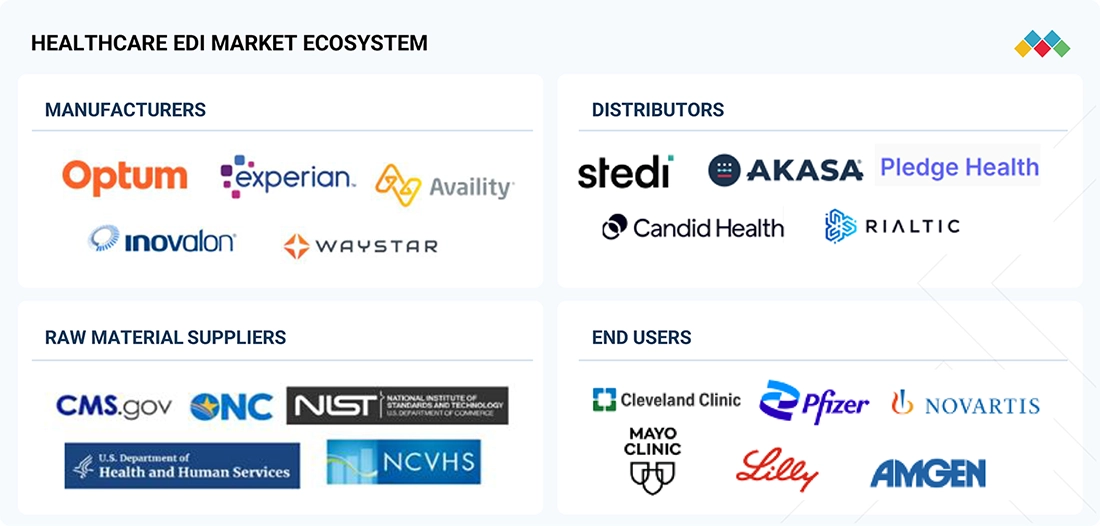
HEALTHCARE EDI MARKET: COMMERCIAL USE CASES ACROSS INDUSTRIES
| COMPANY | USE CASE DESCRIPTION | BENEFITS |
|---|---|---|
 |
Provides healthcare EDI and clearinghouse capabilities for claims submission, eligibility verification, claim status, prior authorization, remittance, and payment workflows across providers and payers | Improves payer-provider connectivity, reduces claim errors, speeds up reimbursement, and supports smoother revenue cycle operations |
 |
Offers a provider-payer network for exchanging EDI transactions such as eligibility and benefits checks, claims, authorizations, remittance, and payment-related information | Reduces manual calls and portal work, improves transaction visibility, and helps providers manage multiple payer connections through one platform |
 |
Delivers claims management, eligibility verification, authorization, denial management, payment, and clearinghouse solutions for hospitals, clinics, and billing teams | Helps reduce claim rejections, improves cash flow, automates payment posting, and gives providers better control over revenue cycle workflows |
 |
Provides healthcare EDI and revenue cycle tools for insurance eligibility, claims management, prior authorization, patient access, remittance, and payment-related workflows | Supports faster insurance checks, improves claim accuracy, reduces administrative burden, and helps providers identify payment issues earlier |
 |
Offers cloud-based healthcare data and EDI-enabled solutions for claims processing, eligibility checks, payer-provider data exchange, prior authorization, and administrative automation | Enhances data accuracy, supports real-time healthcare transactions, improves operational efficiency, and helps payers and providers manage large transaction volumes |
Logos and trademarks shown above are the property of their respective owners. Their use here is for informational and illustrative purposes only.
Related Ecosystem
Healthcare It
- Computed Tomography (CT)
- Machine Learning
- Magnetic Resonance Imaging (MRI)
- Natural Language Processing (NLP)
- Predictive Analytics
- CERNER CORPORATION
- PHILIPS HEALTHCARE
- Oracle Corporation
- GE HealthCare Technologies Inc.
- Siemens healthineers
Key Takeaways
- South Africa's Healthcare EDI market is valued at USD 11.5 million in 2026 and is forecast to reach USD 17.5 million by 2031, representing an 8.8% CAGR.
- South Africa's healthcare providers are prioritizing EDI adoption to streamline claims processing, reduce administrative burden, and improve operational efficiency.
- South Africa's regulatory environment and digital health initiatives are key drivers accelerating Healthcare EDI implementation across the country.
- South Africa's market growth is supported by increasing interoperability requirements and the need for secure, compliant data exchange in the healthcare sector.
Healthcare EDI Market Report Scope
| Report Metric | Details |
|---|---|
| Base Year | 2026 |
| Fastest Growing Segment | PRIOR AUTHORIZATION & REFERRAL MANAGEMENT (Solution) |
| Forecast Period | 2026–2031 |
| Growth Rate | CAGR of 9.8% from 2026 to 2031 |
| Largest Segment | SERVICES (2024–2031) |
| Market Size Base Year (Billions) | ~USD 2.77 (2026) |
| Revenue Forecast (Billions) | ~USD 4.42 (2031) |
| Segments Covered | 2024–2031, Solution |
South Africa Healthcare EDI Market Report Segmentation
2 segment dimensions are covered across the global market.
By 2024–2031
- Services
- Solutions
By Solution
- Claims Management
- Edi Clearinghouse
- Electronic Remittance & Payment Posting
- Eligibility & Benefits Verification
- Prior Authorization & Referral Management
Target Audience
- Healthcare IT Solution Providers : EDI software vendors and healthcare IT companies need South Africa market data to identify growth opportunities, understand local competition, and develop region-specific product strategies for healthcare providers and payers.
- Healthcare Providers & Hospital Networks : South African hospitals, clinics, and healthcare networks require market insights to evaluate EDI solution investments, benchmark operational efficiency gains, and understand adoption trends among peer institutions.
- Insurance & Payer Organizations : Health insurance companies and medical aid schemes in South Africa need EDI market intelligence to optimize claims processing, improve provider communication, and assess technology investment ROI in the local market.
- Healthcare Consultants & System Integrators : Consulting firms and IT integrators serving South African healthcare clients require detailed market data to advise on EDI implementation strategies, vendor selection, and digital transformation roadmaps.
- Pharmaceutical & Medical Supply Distributors : South African pharmaceutical companies and medical supply distributors need market insights to enhance supply chain efficiency through EDI adoption and improve coordination with healthcare providers and payers.
Key Companies in the South Africa Healthcare EDI Market
| Company | HQ | Ownership | Strongest segments |
|---|---|---|---|
| QUALITY SYSTEMS INC | United States | Private Company | Enterprise EHR (NextGen Enterprise EHR),Enterprise PM & Financial Solutions,NextGen Office (integrated clinical + financial cloud suite), |
| GENERAL ELECTRIC | United States | Public Company | Commercial Engines & Services,Defense & Propulsion Technologies,Additive and Specialized Components Brands, |
| GE HEALTHCARE | United States | Public Company | Imaging,Advanced Visualization Solutions (AVS),Patient Care Solutions (PCS), |
| WAYSTAR HOLDING CORP. | United States | Public Company | Claims & Payer Payment Management,Financial Clearance & Eligibility,Patient Financial Care, |
| COGNIZANT | United States | Public Company | Financial Services,Health Sciences,Products and Resources, |
| MCKESSON CORPORATION | United States | Public Company | North American Pharmaceutical Distribution,Oncology & Multispecialty,Prescription Technology Solutions, |
| INOVALON HOLDINGS, INC. | United States | Private Company | Payer solutions (converged quality, risk, outreach, provider enablement, analytics, data lake),Provider solutions (registration, insurance discovery, claims, RCM intelligence, safety, workforce),Real-world data and insights (clinical trials analytics, commercial analytics, real-world data, real-time patient data), |
| VERADIGM INC. | United States | Public Company | Ambulatory EHR and Practice Management (including Veradigm EHR and Practice Fusion),Revenue Cycle and Payerpath Clearinghouse,Real-World Data, Analytics, and Registries, |
| THE SSI GROUP, LLC | Philippines | Public Company | Fast fashion & casual wear (Zara, Bershka, Pull&Bear, Stradivarius, Old Navy, Gap),Luxury & premium fashion/accessories (Hermès, Cartier, Ferragamo, Lacoste, Kate Spade, Michael Kors, Tory Burch),Footwear value & mid-market (Payless, Steve Madden, Dune), |
| IBM | United States | Public Company | Software (Hybrid Cloud and AI Platforms),Consulting,Infrastructure, |
| ORACLE | United States | Public Company | Fusion Cloud ERP/EPM/SCM/HCM,Database & Infrastructure Technologies (Oracle DB, MySQL, Autonomous DB, middleware, IaaS/PaaS),NetSuite Applications Suite, |
| NTT DATA GROUP CORPORATION | Japan | Private Company | Application and Enterprise Platforms,Cloud, Data and Intelligence, Generative AI,Consulting and Industry Solutions, |
| COMARCH S.A. | Poland | Private Company | Telecom IoT and BSS/OSS Platforms,Banking, Insurance, and Wealth Platforms,ERP, Document Management, and Office Platforms, |
| AXWAY | United States | Public Company | Amplify platform & API management,B2B integration,Managed file transfer (MFT), |
QUALITY SYSTEMS INC
QUALITY SYSTEMS INC is a private United States company founded in 1974 with 2783 employees.
GENERAL ELECTRIC
GENERAL ELECTRIC is a public United States company founded in 1892 with 57000 employees.
GE HEALTHCARE
GE HEALTHCARE is a public United States company founded in 2022 with 54000 employees.
WAYSTAR HOLDING CORP.
WAYSTAR HOLDING CORP. is a public United States company founded in 2017 with 1700 employees.
COGNIZANT
COGNIZANT is a public United States company founded in 1988 with 357600 employees.
MCKESSON CORPORATION
MCKESSON CORPORATION is a public United States company founded in 1833 with 42300 employees.
INOVALON HOLDINGS, INC.
INOVALON HOLDINGS, INC. is a private United States company founded in 1998 with 1836 employees.
VERADIGM INC.
VERADIGM INC. is a public United States company founded in 1986 with 2300 employees.
THE SSI GROUP, LLC
THE SSI GROUP, LLC is a public Philippines company founded in 1987 with 7595 employees.
IBM
IBM is a public United States company founded in 1911 with 264300 employees.
ORACLE
ORACLE is a public United States company founded in 1977 with 141000 employees.
NTT DATA GROUP CORPORATION
NTT DATA GROUP CORPORATION is a private Japan company founded in 1988 with 197777 employees.
COMARCH S.A.
COMARCH S.A. is a private Poland company founded in 1993 with 6583 employees.
AXWAY
AXWAY is a public United States company founded in 2000 with 4512 employees.
Reasons to Buy this Report
- Market-Specific Growth Projections : Access detailed forecasts showing South Africa's Healthcare EDI market expanding from USD 11.5M to USD 17.5M by 2031, enabling informed investment and expansion decisions tailored to local market dynamics.
- Competitive Landscape Intelligence : Understand the competitive positioning of EDI solution providers operating in South Africa's healthcare sector, including market share analysis and strategic initiatives specific to the country's regulatory environment.
- Regulatory & Compliance Insights : Gain comprehensive understanding of South African healthcare regulations, data protection requirements, and EDI standards compliance needs that directly impact solution implementation and market adoption rates.
- Sector-Specific Opportunity Analysis : Identify high-growth segments within South Africa's healthcare EDI market, including opportunities in public health systems, private hospitals, insurance companies, and pharmaceutical distribution networks.
- Localized Implementation Strategies : Develop market entry and expansion strategies based on South Africa-specific insights into healthcare provider needs, budget constraints, technology adoption barriers, and interoperability challenges.
Frequently asked questions
What is the current size of South Africa's Healthcare EDI market?
South Africa's Healthcare EDI market is valued at USD 11.5 million in 2026 and is expected to grow to USD 17.5 million by 2031.
What is the projected growth rate for Healthcare EDI in South Africa?
South Africa's Healthcare EDI market is projected to grow at a compound annual growth rate (CAGR) of 8.8% from 2026 to 2031.
What are the main drivers of Healthcare EDI adoption in South Africa?
South Africa's Healthcare EDI adoption is driven by regulatory compliance requirements, digital transformation initiatives, the need for efficient claims processing, and improved interoperability between healthcare stakeholders.
Which healthcare organizations in South Africa are adopting EDI solutions?
South Africa's healthcare providers, payers, pharmaceutical distributors, and hospital networks are increasingly adopting EDI solutions to enhance operational efficiency and data exchange capabilities.
How does South Africa's Healthcare EDI market compare to the broader Middle East Africa region?
South Africa's Healthcare EDI market reflects unique dynamics within the Middle East Africa segment, with the country's advanced healthcare infrastructure and regulatory framework supporting faster adoption compared to some regional peers.
RESEARCH METHODOLOGY
The study involved five major activities to estimate the current size of the Healthcare EDI Market. Exhaustive secondary research was done to collect information on the market and its different subsegments. The next step was to validate these findings, assumptions, and sizing with industry experts across the value chain through primary research. Both top-down and bottom-up approaches were employed to estimate the complete market size. Thereafter, market breakdown and data triangulation procedures were used to estimate the market size of the segments and subsegments.
Secondary Research
In the secondary research process, various secondary sources such as annual reports, press releases & investor presentations of companies, white papers, certified publications, articles by recognized authors, gold-standard & silver-standard websites, regulatory bodies, and databases (such as D&B Hoovers, Bloomberg Business, and Factiva) were referred to identify and collect information for the study of the Healthcare EDI market. It was also used to obtain important information about the top players, market classification, and segmentation according to industry trends to the bottom-most level, geographic markets, and key developments related to the market. A database of the key industry leaders was also prepared using secondary research.
Primary Research
Extensive primary research was conducted after acquiring basic knowledge about the global Healthcare EDI market scenario through secondary research. Several primary interviews were conducted with market experts from both the demand side (Hospital directors, Hospital Vice Presidents, Department heads, and Critical care specialists ) and supply side (such as C-level and D-level executives, technology experts, product managers, marketing and sales managers, among others) across five major regions North America, Europe, the Asia Pacific, Latin America, Middle East, and Africa. This primary data was collected through questionnaires, e-mails, online surveys, personal interviews, and telephonic interviews.
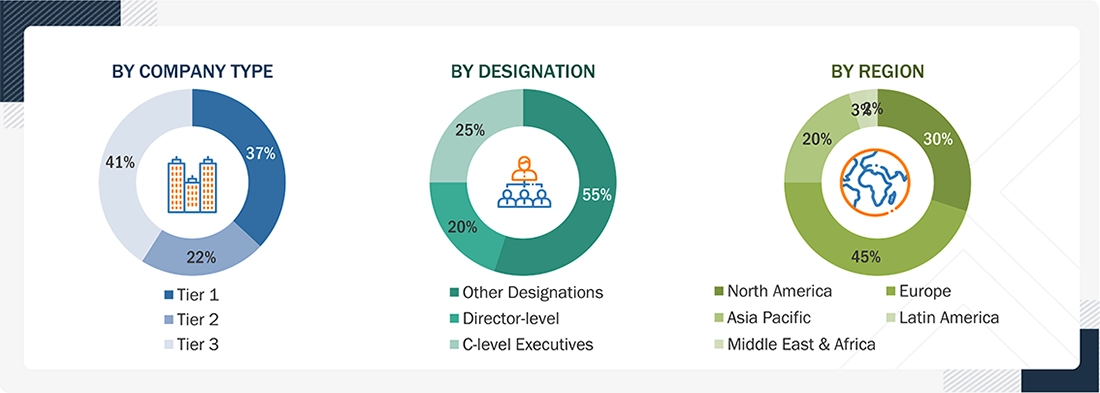
Note 1: Others include sales managers, marketing managers, and product managers.
Note 2: Tiers of companies are defined on the basis of their total revenues in 2025. Tier 1 = >USD 1 billion, Tier 2 = USD 500 million to USD 1 billion, and Tier 3 = <USD 500 million
To know about the assumptions considered for the study, download the pdf brochure
Market Size Estimation
Both top-down and bottom-up approaches were used to estimate and validate the total size of the Healthcare EDI market. These methods were also used extensively to estimate the size of various subsegments in the market.
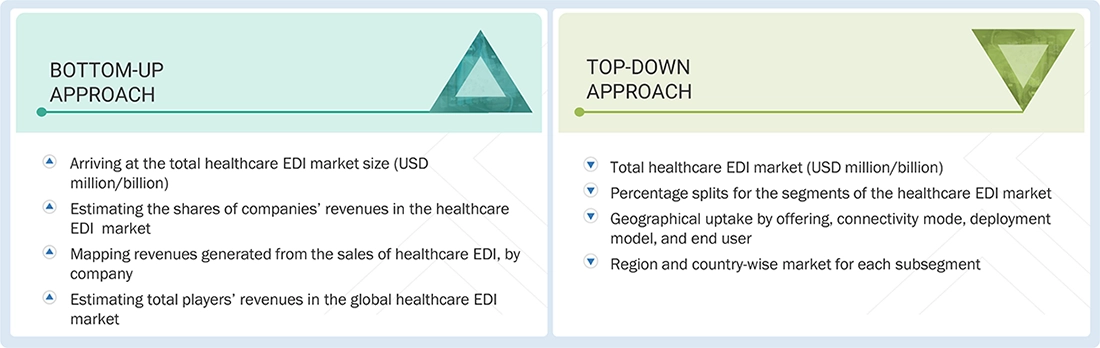
Data Triangulation
After arriving at the overall market size using the market size estimation processes, the market was split into several segments and subsegments. To complete the overall market engineering process and arrive at the exact statistics of each market segment and sub-segment, data triangulation and market breakdown procedures were employed, wherever applicable. The data was triangulated by studying various factors and trends from both the demand and supply sides in the Healthcare EDI market.
Market Definition
Healthcare electronic data interchange (EDI) is a structured method to exchange healthcare information in a standardized format between providers, payers, clearinghouses, pharmacies, suppliers, and manufacturers. Healthcare providers use EDI to send insurance claims directly to payers (insurance companies, Medicare/Medicaid) in standardized formats (e.g., X12 837 format). Healthcare EDI applies to claims, medical billing, health records, purchase orders, invoices, shipping notices, and other essential or classified healthcare-related information.
Key Stakeholders
- Healthcare EDI Software & Service Providers
- Government Agencies
- Healthcare Startups, Consultants, and Regulators
- Healthcare Providers
- Clinical/Physician Centers
- Surgeons, Physicians, and Operating Room Staff
- Health IT Service Providers
- Healthcare Associations/Institutes
- Hospitals (Public and Private)
- Ambulatory Care Centers
- Academic Medical Institutes
- Venture Capitalists
- Distributors & Resellers
- Maintenance & Support Service Providers
- Integration Service Providers
- Data Security & Privacy Experts
Report Objectives
- To define, describe, and forecast the global healthcare EDI market based on offering, connectivity mode, deployment model, end user, and region
- To provide detailed information regarding the major factors (such as drivers, restraints, opportunities, and challenges) influencing market growth
- To strategically analyze micro-markets with respect to individual growth trends, prospects, and contributions to the overall healthcare EDI market
- To analyze opportunities in the market for stakeholders and provide details of the competitive landscape for market leaders
- To strategically analyze the market structure profile of the key players of the healthcare EDI market and comprehensively analyze their core competencies
- To forecast the size of the market segments with respect to five regions: North America, Europe, Asia Pacific, Latin America, and the Middle East & Africa
- To track and analyze competitive developments such as product launches, investments, partnerships, collaborations, acquisitions, expansions, product approval, and alliances in the healthcare EDI market during the forecast period
Available customizations:
With the given market data, MarketsandMarkets offers customizations as per the company’s specific needs. The following customization options are available for the report:
- Product Analysis: Product matrix, which gives a detailed comparison of the product portfolios of each company
- Geographic Analysis: Further breakdown of Latin America, Europe, the Middle East & Africa Healthcare EDI into specific countries
Get the Full Healthcare EDI Market Report
Full forecast, segment splits, and company analysis for all Healthcare EDI Market.
- Australia Healthcare EDI Market
- Brazil Healthcare EDI Market
- Canada Healthcare EDI Market
- China Healthcare EDI Market
- France Healthcare EDI Market
- Germany Healthcare EDI Market
- India Healthcare EDI Market
- Italy Healthcare EDI Market
- Japan Healthcare EDI Market
- Mexico Healthcare EDI Market
- Saudi Arabia Healthcare EDI Market
- South Korea Healthcare EDI Market
- Spain Healthcare EDI Market
- UAE Healthcare EDI Market
- UK Healthcare EDI Market
- US Healthcare EDI Market
Need a Tailored Report?
Customize this report to your needs
Get 10% FREE Customization
Customize This Report
