
Germany Medical Simulation Market (2026-2031)

The Germany Medical Simulation Market was valued at $221.4 Million in 2026 and projected to reach to $404.8 Million by 2031, representing a compound annual growth rate of 16.4%. Germany's medical simulation market is positioned for sustained growth through 2031, driven by increasing healthcare expenditure, regulatory emphasis on clinical training standards, and widespread adoption of advanced simulation technologies across medical institutions.


| Market Size in | USD 26.32 MN |
| Market Forecast in | |
| CAGR | |
| Forecast Period | |
| Units Considered | Value (USD MN) |
Germany Medical Simulation Market Trends and Insights
- This growth trajectory reflects France's commitment to advancing healthcare education and clinical training through immersive simulation technologies.
- France is leveraging simulation platforms to enhance surgical precision, emergency response capabilities, and patient safety outcomes across its healthcare system. The French market is driven by increasing adoption of virtual reality and high-fidelity mannequins in medical schools, teaching hospitals, and professional development centers.
- France's regulatory environment and emphasis on continuous medical education are accelerating investment in simulation infrastructure.
- By 2031, France is expected to solidify its position as a leading European hub for medical simulation innovation, with growing demand from both public and private healthcare institutions. France's 16.4% compound annual growth rate outpaces the global average, underscoring the nation's strategic focus on modernizing clinical training.
- France's healthcare sector is increasingly recognizing simulation as essential for reducing medical errors and improving practitioner competency across specialties..
Key Market Statistics
- CAGR (2026-2031) 16.4% CAGR
- Market Size, 2026 ~USD 221.4 Million
- Forecast, 2031 ~USD 404.8 Million
- Country Germany
Germany Medical Simulation Market Overview
Market Valuation Growth :
Germany's medical simulation market is valued at USD 221.4 million in 2026 and is projected to reach USD 404.8 million by 2031, representing an 82.8% total growth over the forecast period.
Strong CAGR Performance :
Germany's medical simulation market is expanding at a CAGR of 16.4%, outpacing the global average of 15.3%, indicating robust regional demand and investment in healthcare training technologies.
Healthcare Education Leadership :
Germany's commitment to advancing clinical training through simulation technologies is driving adoption across medical schools, hospitals, and surgical centers, enhancing procedural precision and emergency response capabilities.
Technology Integration :
German healthcare institutions are increasingly adopting immersive simulation platforms to improve surgical outcomes, reduce training costs, and standardize clinical competency assessments across the nation.
Germany Medical Simulation Market Dynamics
- The market benefits from Germany's strong healthcare infrastructure, leading medical device manufacturers, and universities investing heavily in simulation-based education programs.
- Key growth drivers include rising demand for minimally invasive surgical training, emergency medicine simulation, and patient safety initiatives.
- The market is expected to see continued innovation in virtual reality and augmented reality applications, with healthcare providers recognizing simulation's cost-effectiveness in reducing complications and improving clinical outcomes..
Market Ecosystem
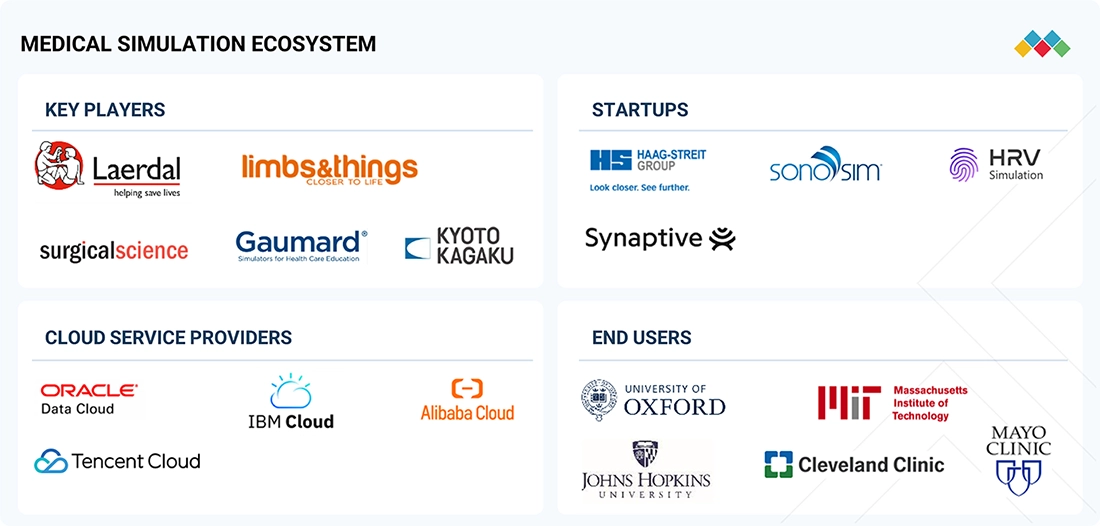
MEDICAL SIMULATION MARKET: COMMERCIAL USE CASES ACROSS INDUSTRIES
| COMPANY | USE CASE DESCRIPTION | BENEFITS |
|---|---|---|
 |
Offers high-fidelity simulators like LapSim and TraumaVR for surgical training, including robotic surgery and endovascular procedures | Provides customizable training modules through MentorLearn and iCase | Improves surgical proficiency and reduces error rates through evidence-based, proficiency-based training |
 |
Develops immersive simulation solutions, including SimMan and virtual reality training for emergency, obstetric, and neonatal care | Collaborates with Unity for scalable simulation platforms | Enhances team communication and coordination, leading to improved patient safety outcomes |
 |
Provides advanced patient simulators like HAL S5301 and robotic obstetric simulators for training across specialties, including trauma, pediatrics, and obstetrics | Facilitates safe, repeatable training scenarios, enabling learners to practice rare or high-risk events without patient risk |
 |
Manufactures anatomical models, imaging phantoms, and simulators for medical imaging and procedural training | Provides realistic, hands-on training tools that enhance understanding of anatomy and procedural techniques |
 |
Offers simulation products like the Laparoscopic Skills Trainer and AR-based trainers for catheterization and wound care | Provides augmented reality training apps to visualize internal anatomy | Improves clinical skills and team coordination, leading to better patient outcomes |
Logos and trademarks shown above are the property of their respective owners. Their use here is for informational and illustrative purposes only.
Related Ecosystem
Healthcare It
- Computed Tomography (CT)
- Machine Learning
- Magnetic Resonance Imaging (MRI)
- Natural Language Processing (NLP)
- Predictive Analytics
- CERNER CORPORATION
- PHILIPS HEALTHCARE
- Oracle Corporation
- GE HealthCare Technologies Inc.
- Siemens healthineers
Key Takeaways
- France's medical simulation market will nearly double from USD 221.4M (2026) to USD 404.8M (2031), driven by healthcare modernization initiatives.
- France's 16.4% CAGR exceeds the global average of 15.3%, reflecting strong regional demand for advanced clinical training solutions.
- France is investing heavily in VR and high-fidelity simulation technologies across medical schools, teaching hospitals, and professional development centers.
- France's regulatory emphasis on continuous medical education and patient safety is accelerating adoption of simulation platforms in both public and private healthcare sectors.
Medical Simulation Market Report Scope
| Report Metric | Details |
|---|---|
| Base Year | 2026 |
| Fastest Growing Segment | ASIA PACIFIC (End User) |
| Forecast Period | 2026–2031 |
| Growth Rate | CAGR of 15.3% from 2026 to 2031 |
| Largest Segment | HEALTHCARE SIMULATION ANATOMICAL MODELS (Offering) |
| Market Size Base Year (Billions) | ~USD 4.07 (2026) |
| Revenue Forecast (Billions) | ~USD 8.3 (2031) |
| Segments Covered | Offering, Product & Service, Type, Application, Technology, End User |
Germany Medical Simulation Market Report Segmentation
6 segment dimensions are covered across the global market.
By Offering
- Healthcare Simulation Anatomical Models
- Healthcare Simulation Software
- Simulation Training Services
- Web-Based Simulation
By Product & Service
- Healthcare Simulation Anatomical Models
- Healthcare Simulation Software
- Healthcare Simulation Training Services
- Simulation Training Services
- Web-Based Simulation
By Type
- Cardiovascular Simulators
- Custom Consulting Services
- Dental Simulators
- Educational Societies
- Endovascular Simulators
- Eye Simulators
- Gynecology Simulators
- High Fidelity
- High-Fidelity Patient Simulators
- Interventional/Surgical Simulators
- Laparoscopic Surgical Simulators
- Low Fidelity
- Low-Fidelity Patient Simulators
- Medium Fidelity
- Medium-Fidelity Patient Simulators
- Orthopedic Surgical Simulators
- Other Interventional/Surgical Simulators
- Patient Simulators
- Spine Surgical Simulators
- Task Trainers
- Ultrasound Simulators
- Vendor-Based Training
By Application
- Cardiovascular Simulators
- Endovascular Simulators
- Gynecology Simulators
- Laparoscopic Surgical Simulators
- Orthopedic Simulators
- Orthopedic Surgical Simulators
- Other Applications
- Other Patient Simulators
- Spine Surgical Simulators
By Technology
- 3D Printing
- Procedural Rehearsal Technology
- Virtual Patient Simulation
By End User
- Academic Institutes
- Hospitals
- Military Organizations
- Other End Users
GERMANY: MEDICAL SIMULATION MARKET, BY END USER, 2024–2031
| Segment | 2024 | 2025 | 2026 | 2027 | 2028 | 2029 | 2030 | 2031 | CAGR (%) |
|---|---|---|---|---|---|---|---|---|---|
| ACADEMIC INSTITUTES | 132.2 | 154.5 | 180.5 | 210.3 | 244.2 | 282.8 | 326.7 | 376.7 | 15.9 |
| HOSPITALS | 49.7 | 58.2 | 68.2 | 79.7 | 92.8 | 107.8 | 124.9 | 144.5 | 16.2 |
| MILITARY ORGANIZATIONS | 42.8 | 49.7 | 57.7 | 66.9 | 77.2 | 88.9 | 102.1 | 117.1 | 15.2 |
| OTHER END USERS | 12 | 14 | 16.4 | 19 | 22 | 25.4 | 29.3 | 33.7 | 15.6 |
| TOTAL | 236.7 | 276.4 | 322.7 | 375.9 | 436.2 | 505 | 583.1 | 672 | 15.8 |
Target Audience
- Medical Device Manufacturers : Manufacturers need Germany market data to develop localized simulation products, understand regulatory pathways, and identify distribution channels within Europe's premium healthcare market.
- Healthcare Institutions & Hospitals : German hospitals and medical centers require market insights to benchmark simulation investments, evaluate technology providers, and justify budget allocations for clinical training programs.
- Investment & Private Equity Firms : Investors targeting healthcare technology need Germany-specific market analysis to assess growth potential, identify acquisition targets, and evaluate return on investment in medical simulation ventures.
- Medical Education Providers : Universities and medical schools in Germany need market intelligence to align curriculum development with industry trends, secure funding, and implement cutting-edge simulation-based training.
- Healthcare Consultants & Analysts : Consulting firms and research analysts require detailed Germany market data to support client advisory services, competitive benchmarking, and strategic planning in the medical simulation sector.
Key Companies in the Germany Medical Simulation Market
| Company | HQ | Ownership | Strongest segments |
|---|---|---|---|
| BIOMERIEUX S.A. | France | Public Company | Clinical microbiology (culture media, VITEK, BACT/ALERT, ETEST, API),Molecular diagnostics (BIOFIRE, BIOFIRE SPOTFIRE, ARGENE, EPISEQ),Immunoassays and CLIA (VIDAS, Hybiome, severe infection markers), |
| DENTSPLY SIRONA | United States | Public Company | Connected Technology Solutions (imaging, CEREC, digital equipment),Essential Dental Solutions (endodontics, restorative, preventive consumables),Orthodontic and Implant Solutions, |
| AMBU | Denmark | Public Company | Endoscopy (single-use scopes and visualization units),Airway management and anaesthesia,Neurology (EEG/EMG and intraoperative monitoring), |
| BRAINLAB AG | Germany | Private Company | Image-guided surgery and navigation (spine, neuro, CMF, ENT, orthopedic),Radiotherapy planning and workflow software,Digital operating room and healthcare IT integration, |
| EPAM SYSTEMS, INC. | United States | Public Company | Core digital platform engineering & custom software development,Cloud, data, analytics & AI services,Customer experience, marketing & digital product design, |
| TENET HEALTHCARE CORPORATION | United States | Public Company | Hospital Operations and Services,Ambulatory Care, |
| SURGICAL SCIENCE SWEDEN AB | Sweden | Public Company | Laparoscopic and general MIS simulators (LapSim, LAP Mentor, LapSim ST/Essence/360, Simball Box),Endoscopy and bronchoscopy simulators (GI Mentor, BRONCH Mentor/Express, EndoSim, PELVIC Mentor, HYST Mentor, URO Mentor, Perc Mentor),Robotic surgery training (FlexVR, RobotiX Mentor), |
| MENTICE AB | Sweden | Public Company | Mentice VIST (VR platforms, procedural models, Angiosuite integrations),Physical Sim (flow models, silicone/3D vessels, accessories),Ankyras and software apps (decision support, cloud, mobile), |
| SIMULAIDS | United States | Private Company | ALS/BLS patient simulators and manikins,Moulage systems and trauma trainers,Medical and nursing skills trainers, |
BIOMERIEUX S.A.
bioMérieux S.A. is a French public company founded in 1963 that employs 14,894 people. The company operates in the diagnostics and life sciences sector.
DENTSPLY SIRONA
Dentsply Sirona is a United States-based public company founded in 1877 with 14,000 employees. The company is a leading manufacturer of dental and orthodontic products and technologies.
AMBU
Ambu is a Danish public company founded in 1937 with 5,200 employees. The company specializes in medical devices and equipment for emergency care and anesthesia.
BRAINLAB AG
Brainlab AG is a German private company founded in 1989 with 2,370 employees. The company develops software and hardware solutions for surgical navigation and imaging.
EPAM SYSTEMS, INC.
EPAM Systems, Inc. is a United States-based public company founded in 1993 with 62,850 employees. The company provides software engineering and digital transformation services globally.
TENET HEALTHCARE CORPORATION
Tenet Healthcare Corporation is a United States-based public company founded in 1967 with 88,500 employees. The company operates a large network of hospitals and healthcare facilities across the country.
SURGICAL SCIENCE SWEDEN AB
Surgical Science Sweden AB is a Swedish public company founded in 1997 with 317 employees. The company develops virtual reality simulation systems for surgical training and education.
MENTICE AB
Mentice AB is a Swedish public company founded in 1998 with 119 employees. The company develops virtual reality simulation systems for interventional medical procedures.
SIMULAIDS
Simulaids is a United States-based private company founded in 1963 that produces CPR training manikins and medical simulation equipment.
Reasons to Buy this Report
- Market Size & Growth Data : Access precise valuation figures for Germany's medical simulation market with detailed CAGR analysis, enabling accurate financial forecasting and investment decision-making for the 2026-2031 period.
- Competitive Landscape Intelligence : Understand Germany-specific market dynamics, key players, and competitive positioning to identify partnership opportunities and market entry strategies in Europe's largest healthcare economy.
- Regulatory & Compliance Insights : Gain comprehensive knowledge of German healthcare regulations, certification requirements, and clinical training standards that influence simulation technology adoption and procurement decisions.
- Segment & Application Analysis : Detailed breakdown of Germany's medical simulation market by surgical specialties, training modalities, and end-user institutions to identify high-growth segments and target customer profiles.
- Strategic Planning Resources : Leverage Germany-focused market intelligence for product development, go-to-market strategies, and resource allocation decisions tailored to regional healthcare priorities and investment trends.
Frequently asked questions
What is the current size of France's medical simulation market?
France's medical simulation market is valued at USD 221.4 million in 2026 and is projected to grow to USD 404.8 million by 2031.
What is the growth rate of France's medical simulation market?
France's medical simulation market is growing at a compound annual growth rate (CAGR) of 16.4% from 2026 to 2031.
What technologies are driving growth in France's medical simulation market?
Virtual reality platforms, high-fidelity mannequins, and immersive clinical training systems are the primary technologies driving market expansion in France.
Which sectors in France are adopting medical simulation solutions?
France's medical schools, teaching hospitals, professional development centers, and both public and private healthcare institutions are actively adopting simulation technologies.
How does France's market growth compare to global trends?
France's 16.4% CAGR outpaces the global medical simulation market CAGR of 15.3%, indicating stronger regional adoption and investment.
RESEARCH METHODOLOGY
The study involved five major activities to estimate the current size of the medical simulation market. Exhaustive secondary research was conducted to gather information on the market and its subsegments. The next step was to validate these findings, assumptions, and sizing with industry experts across the value chain through primary research. Both top-down and bottom-up approaches were employed to estimate the complete market size. Thereafter, market breakdown and data triangulation procedures were used to estimate the market size of the segments and subsegments.
Secondary Research
This research study used secondary sources, directories, and databases such as Dun & Bradstreet, Bloomberg Business, and Factiva; white papers, annual reports and companies’ house documents; investor presentations; and companies’ SEC filings. The market for medical simulation solutions is assessed using secondary data from both paid and free sources. This involves analyzing the product portfolios of major industry players and evaluating them based on performance and quality. Various resources were utilized in the secondary research process to gather information for this study. The sources include annual reports, press releases, investor presentations, white papers, academic journals, certified publications, articles by recognized authors, directories, and databases. The secondary research process involved consulting various sources to identify and collect information for the study. These sources included annual reports, press releases, investor presentations of medical simulation vendors, forums, certified publications, and white papers. Secondary research was used to obtain critical information on the industry’s value chain, the total pool of key players, and market classification and segmentation from market- and technology-oriented perspectives.
Primary Research
In the primary research process, various supply and demand sources were interviewed to obtain qualitative and quantitative information for this report. Primary sources are primarily industry experts from core and related industries, as well as preferred suppliers, manufacturers, distributors, technology developers, researchers, and organizations across all segments of this industry’s value chain. In-depth interviews were conducted with various primary respondents, including key industry participants, subject-matter experts (SMEs), C-level executives of key market players, and industry consultants, among other experts, to obtain and verify critical qualitative and quantitative information and assess prospects.
Primary research was conducted to identify segmentation types, industry trends, key players, and key market dynamics, including drivers, restraints, opportunities, and challenges, as well as the strategies adopted by key players.
After completing the market engineering process, which includes calculations for market statistics, market breakdown, size estimations, forecasting, and data triangulation, extensive primary research was conducted. This research aimed to gather information and verify the critical numbers obtained during the market analysis. Additionally, primary research was conducted to identify market segmentation types, analyze industry trends, evaluate the competitive landscape of medical simulation solutions offered by various players, and understand key market dynamics, including drivers, restraints, opportunities, challenges, and strategies employed by key market participants.
Throughout the complete market engineering process, the top-down and bottom-up approaches, along with several data triangulation methods, were extensively used to estimate and forecast the overall market segments and subsegments listed in this report. Extensive qualitative and quantitative analysis was performed on the complete market engineering process to list the key information/insights throughout the report.
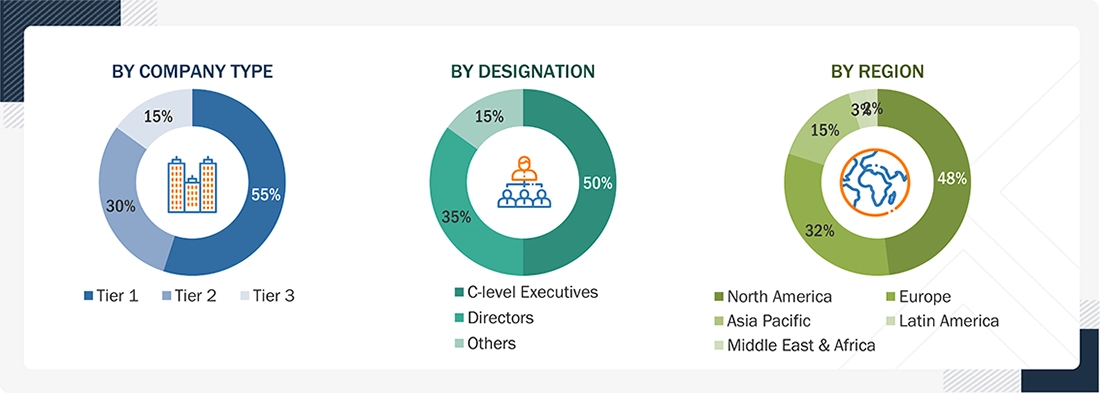
Note: Other designations include sales, marketing, and product managers.
Tiers are defined based on a company’s total revenue as of 2025: Tier 1 = >USD 1 billion, Tier 2 = USD 500 million to USD 1 billion, and Tier 3 = <USD 500 million.
To know about the assumptions considered for the study, download the pdf brochure
Market Size Estimation
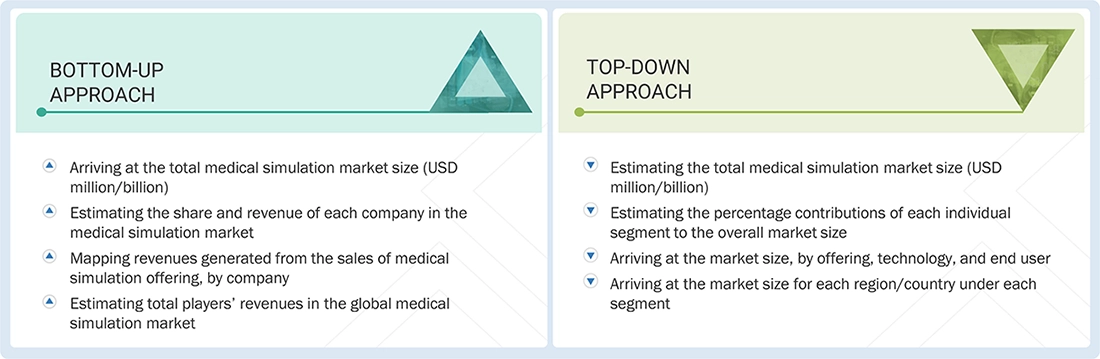
The market size estimates and forecasts provided in this study are derived through a mix of the bottom-up approach (revenue share analysis of leading players) and the top-down approach (assessment of utilization/adoption/penetration trends by offering, technology, end user, and region).
Data Triangulation
After determining the overall market size, the estimation process divided the market into several segments and subsegments. To complete the overall market engineering process and arrive at the exact statistics of each market segment and subsegment, the data triangulation and market breakdown procedures were employed, wherever applicable. The data was triangulated by studying various factors and trends from both the demand and supply sides in the medical simulation market.
Market Definition
Medical simulation uses virtual patients, mannequins, task trainers, or computer-based environments to replicate real-life clinical situations for training, education, evaluation, or system improvement without risking patient safety. It is a strategic tool that enables safe, repeatable, and immersive learning experiences, enhancing clinical performance, reducing medical errors, and improving healthcare delivery outcomes.
Key Stakeholders
- Medical simulation vendors
- Government bodies
- Healthcare service providers
- Clinical/physician centers
- Healthcare professionals
- Health IT service providers
- Healthcare associations/institutes
- Ambulatory care centers
- Venture capitalists
- Distributors and resellers
- Maintenance and support service providers
- Integration service providers
- Military organizations
- Advocacy groups
- Investors and financial institutions
- Industry associations and trade groups
Report Objectives
- To define, describe, and forecast the medical simulation market by offering, technology, end user, and region
- To provide detailed information regarding the major factors, such as drivers, restraints, opportunities, and challenges, influencing the market growth
- To analyze micromarkets with respect to individual growth trends, prospects, and contributions to the overall medical simulation market
- To assess the medical simulation market with regard to Porter’s five forces, regulatory landscape, value chain, ecosystem map, patent protection, impact of 2025 US tariff, AI/Gen AI impact on the market under study, and key stakeholders’ buying criteria
- To analyze opportunities in the market for stakeholders and provide details of the competitive landscape for market leaders
- To forecast the size of the medical simulation market with respect to five main regions, namely, North America, Europe, Asia Pacific, Latin America, and the Middle East & Africa
- To profile the key players in the medical simulation market and comprehensively analyze their core competencies and market shares
- To track and analyze competitive developments such as agreements, partnerships, acquisitions, expansions, product launches and enhancements, and R&D activities in the medical simulation market.
Available customizations:
With the given market data, MarketsandMarkets offers customizations according to your company’s specific needs. The following customization options are available for the report:
Company Information
- Detailed analysis and profiling of additional market players (up to 5)
Geographic Analysis
- Further breakdown of the medical simulation market in the Rest of Europe (Denmark, Norway, and other countries)
- Further breakdown of the medical simulation market in the Rest of Asia Pacific (Vietnam, New Zealand, the Philippines, and other countries)
Get the Full Medical Simulation Market Report
Full forecast, segment splits, and company analysis for all Medical Simulation Market.
Need a Tailored Report?
Customize this report to your needs
Get 10% FREE Customization
Customize This Report
