
Asia Pacific Medical Simulation Market (2026-2031)

The Asia Pacific Medical Simulation Market was valued at $556.3 Million in 2026 and projected to reach to $1178.1 Million by 2031, representing a compound annual growth rate of 16.2%. The Asia Pacific medical simulation market is positioned for exceptional growth through 2031, driven by escalating healthcare investments and regulatory pressures for clinical competency validation.


| Market Size in | USD 26.32 MN |
| Market Forecast in | |
| CAGR | |
| Forecast Period | |
| Units Considered | Value (USD MN) |
Asia Pacific Medical Simulation Market Trends and Insights
- Asia Pacific's accelerating adoption of simulation-based training reflects rising healthcare investments, regulatory pressures for clinical competency, and growing demand for risk-free learning environments across the region's diverse healthcare systems.
- The 16.2% compound annual growth rate underscores Asia Pacific's emergence as a critical hub for medical education innovation. Asia Pacific's market growth is driven by increasing physician shortages, expanding medical school enrollments, and government initiatives to modernize healthcare training infrastructure.
- Countries throughout Asia Pacific are integrating high-fidelity simulators, virtual reality platforms, and hybrid learning models into curricula and continuing professional development programs.
- By 2031, Asia Pacific is expected to capture a significantly larger share of global medical simulation adoption, supported by improving healthcare budgets and technological accessibility across the region..
Key Market Statistics
- CAGR (2026-2031) 16.2% CAGR
- Market Size, 2026 ~USD 556.3 Million
- Forecast, 2031 ~USD 1178.1 Million
- Geography Asia Pacific
Asia Pacific Medical Simulation Market Overview
Rapid Market Expansion :
Asia Pacific medical simulation market is projected to grow from $556.3 million in 2026 to $1,178.1 million by 2031, representing a 16.2% CAGR—outpacing the global average of 15.3%.
Regulatory Compliance Drivers :
Increasing regulatory mandates across Asia Pacific nations require clinical competency validation through simulation-based training, accelerating market adoption among healthcare institutions.
Healthcare Investment Surge :
Rising healthcare expenditures and government initiatives in emerging Asia Pacific economies are fueling infrastructure development and simulation technology adoption in medical education.
Risk-Free Learning Demand :
Growing emphasis on patient safety and clinical skill development is driving demand for immersive simulation environments across diverse healthcare systems in the Asia Pacific region.
Asia Pacific Medical Simulation Market Dynamics
- Key markets including China, Japan, and India are rapidly adopting simulation technologies to address skill gaps and enhance patient safety outcomes.
- The region's diverse healthcare landscape creates substantial opportunities for tailored simulation solutions across surgical, diagnostic, and emergency care domains. Expanding medical education infrastructure and increasing adoption of technology-enabled training methodologies will continue to propel market expansion.
- Healthcare providers across Asia Pacific are recognizing simulation's value in reducing training costs, improving clinical outcomes, and meeting international standards.
- Strategic partnerships between simulation vendors and regional healthcare institutions will further accelerate market penetration and innovation in the coming years..
Market Ecosystem
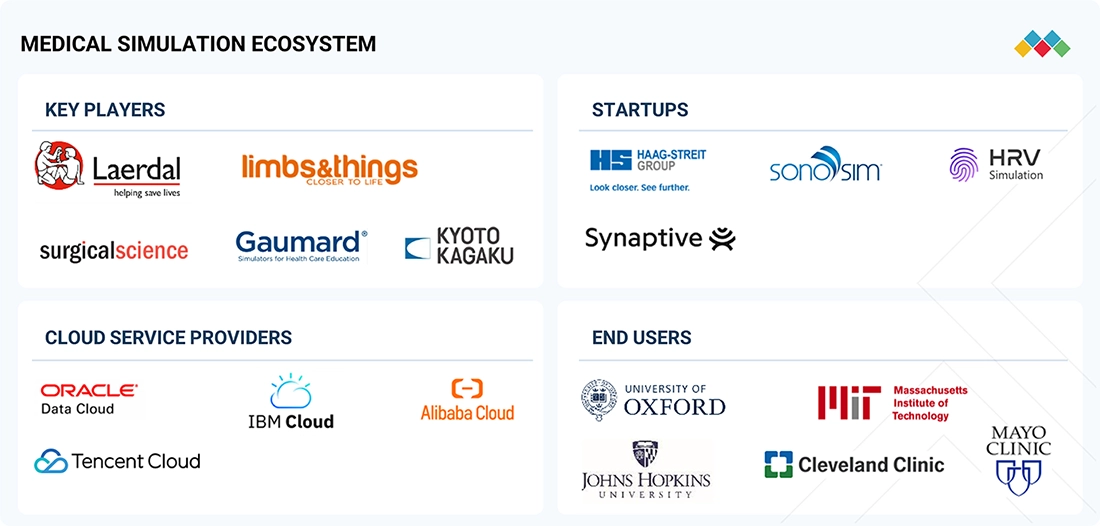
MEDICAL SIMULATION MARKET: COMMERCIAL USE CASES ACROSS INDUSTRIES
| COMPANY | USE CASE DESCRIPTION | BENEFITS |
|---|---|---|
 |
Offers high-fidelity simulators like LapSim and TraumaVR for surgical training, including robotic surgery and endovascular procedures | Provides customizable training modules through MentorLearn and iCase | Improves surgical proficiency and reduces error rates through evidence-based, proficiency-based training |
 |
Develops immersive simulation solutions, including SimMan and virtual reality training for emergency, obstetric, and neonatal care | Collaborates with Unity for scalable simulation platforms | Enhances team communication and coordination, leading to improved patient safety outcomes |
 |
Provides advanced patient simulators like HAL S5301 and robotic obstetric simulators for training across specialties, including trauma, pediatrics, and obstetrics | Facilitates safe, repeatable training scenarios, enabling learners to practice rare or high-risk events without patient risk |
 |
Manufactures anatomical models, imaging phantoms, and simulators for medical imaging and procedural training | Provides realistic, hands-on training tools that enhance understanding of anatomy and procedural techniques |
 |
Offers simulation products like the Laparoscopic Skills Trainer and AR-based trainers for catheterization and wound care | Provides augmented reality training apps to visualize internal anatomy | Improves clinical skills and team coordination, leading to better patient outcomes |
Logos and trademarks shown above are the property of their respective owners. Their use here is for informational and illustrative purposes only.
Related Ecosystem
Healthcare It
- Computed Tomography (CT)
- Machine Learning
- Magnetic Resonance Imaging (MRI)
- Natural Language Processing (NLP)
- Predictive Analytics
- CERNER CORPORATION
- PHILIPS HEALTHCARE
- Oracle Corporation
- GE HealthCare Technologies Inc.
- Siemens healthineers
Key Takeaways
- Asia Pacific medical simulation market valued at $556.3M in 2026, expanding to $1,178.1M by 2031 at 16.2% CAGR
- Asia Pacific's growth outpaces global average, driven by healthcare modernization and physician training demands
- Asia Pacific adoption of VR, high-fidelity simulators, and hybrid learning models accelerating across medical institutions
- Asia Pacific government initiatives and rising healthcare budgets supporting infrastructure investment in simulation technology
Medical Simulation Market Report Scope
| Report Metric | Details |
|---|---|
| Base Year | 2026 |
| Fastest Growing Segment | WEB-BASED SIMULATION (Offering) |
| Forecast Period | 2026–2031 |
| Growth Rate | CAGR of 15.3% from 2026 to 2031 |
| Largest Segment | HEALTHCARE SIMULATION ANATOMICAL MODELS (Offering) |
| Market Size Base Year (Billions) | ~USD 4.07 (2026) |
| Revenue Forecast (Billions) | ~USD 8.3 (2031) |
| Segments Covered | Offering, Type, Application, Technology, End User |
Asia Pacific Medical Simulation Market Report Segmentation
5 segment dimensions are covered across the global market.
By Offering
- Healthcare Simulation Anatomical Models
- Healthcare Simulation Software
- Simulation Training Services
- Web-Based Simulation
By Type
- Cardiovascular Simulators
- Cardiovascular Surgical Simulators
- Custom Consulting Services
- Dental Simulators
- Educational Societies
- Endovascular Simulators
- Endovascular Surgical Simulators
- Eye Simulators
- Gynecology Simulators
- Gynecology Surgical Simulators
- High-Fidelity Patient Simulators
- Interventional/Surgical Simulators
- Laparoscopic Surgical Simulators
- Low-Fidelity Patient Simulators
- Medium-Fidelity Patient Simulators
- Orthopedic Simulators
- Orthopedic Surgical Simulators
- Other Interventional/ Surgical Simulators
- Other Interventional/Surgical Simulators
- Patient Simulators
- Spine Surgical Simulators
- Task Trainers
- Ultrasound Simulators
- Vendor-Based Training
By Application
- Cardiovascular Simulators
- Endovascular Simulators
- Gynecology Simulators
- Laparoscopic Simulators
- Laparoscopic Surgical Simulators
- Orthopedic Simulators
- Orthopedic Surgical Simulators
- Other Patient Simulators
- Spine Simulators
- Spine Surgical Simulators
By Technology
- 3D Printing
- Procedural Rehearsal Technology
- Virtual Patient Simulation
By End User
- Academic Institutes
- Hospitals
- Military Organizations
- Other End Users
Target Audience
- Medical Device Manufacturers : Require Asia Pacific market intelligence to develop region-specific simulation products, identify distribution channels, and capitalize on the 16.2% CAGR growth opportunity.
- Healthcare Institutions & Hospitals : Need market insights to justify simulation technology investments, benchmark against regional peers, and align procurement strategies with regulatory compliance requirements.
- Medical Education Providers : Seek data on simulation adoption trends and best practices across Asia Pacific to enhance curriculum offerings and secure funding for simulation infrastructure development.
- Investment & Private Equity Firms : Require comprehensive market analysis to identify high-growth acquisition targets, assess investment returns, and evaluate expansion opportunities in Asia Pacific healthcare simulation.
- Healthcare Consultants & Advisors : Need detailed regional market data to provide strategic recommendations to clients on simulation technology adoption, market positioning, and competitive differentiation in Asia Pacific.
Key Companies in the Asia Pacific Medical Simulation Market
| Company | HQ | Ownership | Strongest segments |
|---|---|---|---|
| BIOMERIEUX S.A. | France | Public Company | Clinical microbiology (culture media, VITEK, BACT/ALERT, ETEST, API),Molecular diagnostics (BIOFIRE, BIOFIRE SPOTFIRE, ARGENE, EPISEQ),Immunoassays and CLIA (VIDAS, Hybiome, severe infection markers), |
| DENTSPLY SIRONA | United States | Public Company | Connected Technology Solutions (imaging, CEREC, digital equipment),Essential Dental Solutions (endodontics, restorative, preventive consumables),Orthodontic and Implant Solutions, |
| AMBU | Denmark | Public Company | Endoscopy (single-use scopes and visualization units),Airway management and anaesthesia,Neurology (EEG/EMG and intraoperative monitoring), |
| BRAINLAB AG | Germany | Private Company | Image-guided surgery and navigation (spine, neuro, CMF, ENT, orthopedic),Radiotherapy planning and workflow software,Digital operating room and healthcare IT integration, |
| EPAM SYSTEMS, INC. | United States | Public Company | Core digital platform engineering & custom software development,Cloud, data, analytics & AI services,Customer experience, marketing & digital product design, |
| TENET HEALTHCARE CORPORATION | United States | Public Company | Hospital Operations and Services,Ambulatory Care, |
| SURGICAL SCIENCE SWEDEN AB | Sweden | Public Company | Laparoscopic and general MIS simulators (LapSim, LAP Mentor, LapSim ST/Essence/360, Simball Box),Endoscopy and bronchoscopy simulators (GI Mentor, BRONCH Mentor/Express, EndoSim, PELVIC Mentor, HYST Mentor, URO Mentor, Perc Mentor),Robotic surgery training (FlexVR, RobotiX Mentor), |
| MENTICE AB | Sweden | Public Company | Mentice VIST (VR platforms, procedural models, Angiosuite integrations),Physical Sim (flow models, silicone/3D vessels, accessories),Ankyras and software apps (decision support, cloud, mobile), |
| SIMULAIDS | United States | Private Company | ALS/BLS patient simulators and manikins,Moulage systems and trauma trainers,Medical and nursing skills trainers, |
| ERLER-ZIMMER MEDICAL GMBH | Germany | Private | Anatomical models and charts,Clinical and procedural task trainers,Digital and blended learning aids, |
BIOMERIEUX S.A.
bioMérieux S.A. is a French public company founded in 1963 that employs 14,894 people. The company operates in the diagnostics and life sciences sector.
DENTSPLY SIRONA
Dentsply Sirona is a United States-based public company founded in 1877 with 14,000 employees. The company is a leading manufacturer of dental and orthodontic products and technologies.
AMBU
Ambu is a Danish public company founded in 1937 with 5,200 employees. The company specializes in medical devices and equipment for emergency care and anesthesia.
BRAINLAB AG
Brainlab AG is a German private company founded in 1989 with 2,370 employees. The company develops software and hardware solutions for surgical navigation and imaging.
EPAM SYSTEMS, INC.
EPAM Systems, Inc. is a United States-based public company founded in 1993 with 62,850 employees. The company provides software engineering and digital transformation services globally.
TENET HEALTHCARE CORPORATION
Tenet Healthcare Corporation is a United States-based public company founded in 1967 with 88,500 employees. The company operates a large network of hospitals and healthcare facilities across the country.
SURGICAL SCIENCE SWEDEN AB
Surgical Science Sweden AB is a Swedish public company founded in 1997 with 317 employees. The company develops virtual reality simulation systems for surgical training and education.
MENTICE AB
Mentice AB is a Swedish public company founded in 1998 with 119 employees. The company develops virtual reality simulation systems for interventional medical procedures.
SIMULAIDS
Simulaids is a United States-based private company founded in 1963 that produces CPR training manikins and medical simulation equipment.
ERLER-ZIMMER MEDICAL GMBH
Erler-Zimmer Medical GmbH is a medical equipment manufacturer that produces anatomical models and educational products.
Countries within Asia Pacific - compare and drill down
| Country | 2025 size (native) |
|---|---|
| China | USD 673.9 Million |
| Japan | USD 534.1 Million |
| India | USD 337.3 Million |
| Australia | USD 123.3 Million |
| South Korea | USD 90.1 Million |
Country market size visualization
Reasons to Buy this Report
- Regional Market Sizing & Forecasts : Detailed market valuations and growth projections specific to Asia Pacific, enabling accurate budget allocation and investment planning for the region through 2031.
- Country-Level Intelligence : Granular market data across major Asia Pacific economies including China, Japan, India, Australia, and South Korea to identify high-growth opportunities and market entry strategies.
- Competitive Landscape Analysis : Comprehensive assessment of regional and global players operating in Asia Pacific, including market positioning, partnerships, and expansion strategies tailored to local markets.
- Regulatory & Compliance Insights : In-depth analysis of healthcare regulations and clinical competency requirements driving simulation adoption across diverse Asia Pacific regulatory environments.
- Strategic Growth Opportunities : Actionable recommendations for market entry, product development, and partnership strategies specific to Asia Pacific's unique healthcare infrastructure and investment landscape.
Frequently asked questions
What is the current size of the Asia Pacific medical simulation market?
The Asia Pacific medical simulation market is valued at $556.3 million in 2026 and is projected to grow to $1,178.1 million by 2031.
What is the growth rate for medical simulation in Asia Pacific?
Asia Pacific's medical simulation market is growing at a compound annual growth rate (CAGR) of 16.2% from 2026 to 2031.
What factors are driving growth in Asia Pacific's medical simulation market?
Key drivers include physician shortages, expanding medical school enrollments, government healthcare modernization initiatives, regulatory requirements for clinical competency, and increasing adoption of VR and high-fidelity simulation technologies across Asia Pacific institutions.
Which technologies are most adopted in Asia Pacific medical simulation?
Asia Pacific institutions are increasingly adopting high-fidelity simulators, virtual reality platforms, augmented reality applications, and hybrid learning models that combine simulation with traditional and digital education methods.
How does Asia Pacific's growth compare to the global medical simulation market?
Asia Pacific's 16.2% CAGR exceeds the global average of 15.3%, positioning the region as a faster-growing market segment within the global medical simulation industry.
RESEARCH METHODOLOGY
The study involved five major activities to estimate the current size of the medical simulation market. Exhaustive secondary research was conducted to gather information on the market and its subsegments. The next step was to validate these findings, assumptions, and sizing with industry experts across the value chain through primary research. Both top-down and bottom-up approaches were employed to estimate the complete market size. Thereafter, market breakdown and data triangulation procedures were used to estimate the market size of the segments and subsegments.
Secondary Research
This research study used secondary sources, directories, and databases such as Dun & Bradstreet, Bloomberg Business, and Factiva; white papers, annual reports and companies’ house documents; investor presentations; and companies’ SEC filings. The market for medical simulation solutions is assessed using secondary data from both paid and free sources. This involves analyzing the product portfolios of major industry players and evaluating them based on performance and quality. Various resources were utilized in the secondary research process to gather information for this study. The sources include annual reports, press releases, investor presentations, white papers, academic journals, certified publications, articles by recognized authors, directories, and databases. The secondary research process involved consulting various sources to identify and collect information for the study. These sources included annual reports, press releases, investor presentations of medical simulation vendors, forums, certified publications, and white papers. Secondary research was used to obtain critical information on the industry’s value chain, the total pool of key players, and market classification and segmentation from market- and technology-oriented perspectives.
Primary Research
In the primary research process, various supply and demand sources were interviewed to obtain qualitative and quantitative information for this report. Primary sources are primarily industry experts from core and related industries, as well as preferred suppliers, manufacturers, distributors, technology developers, researchers, and organizations across all segments of this industry’s value chain. In-depth interviews were conducted with various primary respondents, including key industry participants, subject-matter experts (SMEs), C-level executives of key market players, and industry consultants, among other experts, to obtain and verify critical qualitative and quantitative information and assess prospects.
Primary research was conducted to identify segmentation types, industry trends, key players, and key market dynamics, including drivers, restraints, opportunities, and challenges, as well as the strategies adopted by key players.
After completing the market engineering process, which includes calculations for market statistics, market breakdown, size estimations, forecasting, and data triangulation, extensive primary research was conducted. This research aimed to gather information and verify the critical numbers obtained during the market analysis. Additionally, primary research was conducted to identify market segmentation types, analyze industry trends, evaluate the competitive landscape of medical simulation solutions offered by various players, and understand key market dynamics, including drivers, restraints, opportunities, challenges, and strategies employed by key market participants.
Throughout the complete market engineering process, the top-down and bottom-up approaches, along with several data triangulation methods, were extensively used to estimate and forecast the overall market segments and subsegments listed in this report. Extensive qualitative and quantitative analysis was performed on the complete market engineering process to list the key information/insights throughout the report.
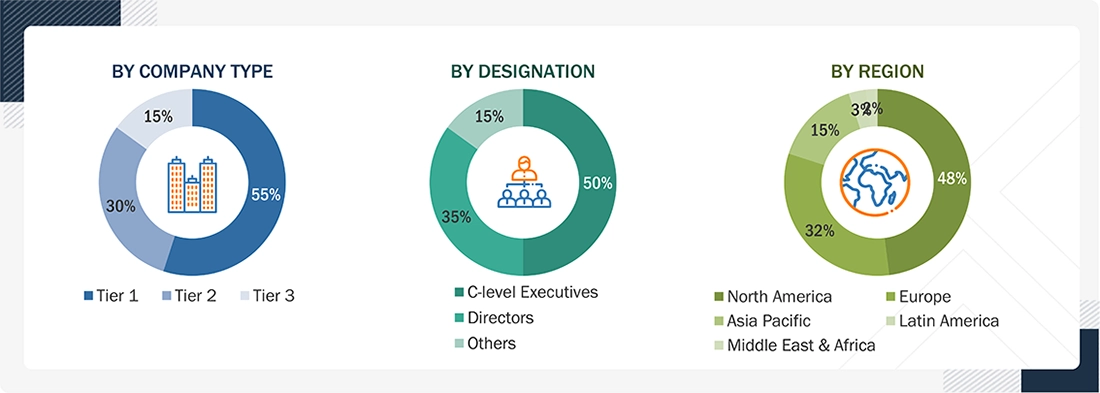
Note: Other designations include sales, marketing, and product managers.
Tiers are defined based on a company’s total revenue as of 2025: Tier 1 = >USD 1 billion, Tier 2 = USD 500 million to USD 1 billion, and Tier 3 = <USD 500 million.
To know about the assumptions considered for the study, download the pdf brochure
Market Size Estimation
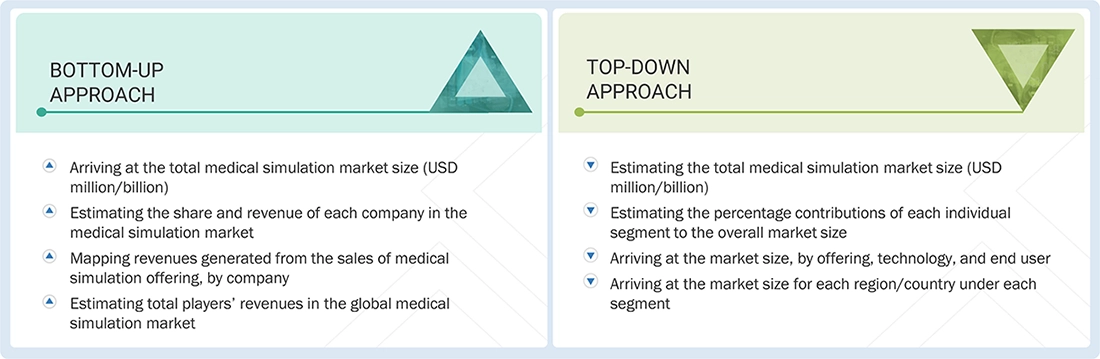
The market size estimates and forecasts provided in this study are derived through a mix of the bottom-up approach (revenue share analysis of leading players) and the top-down approach (assessment of utilization/adoption/penetration trends by offering, technology, end user, and region).
Data Triangulation
After determining the overall market size, the estimation process divided the market into several segments and subsegments. To complete the overall market engineering process and arrive at the exact statistics of each market segment and subsegment, the data triangulation and market breakdown procedures were employed, wherever applicable. The data was triangulated by studying various factors and trends from both the demand and supply sides in the medical simulation market.
Market Definition
Medical simulation uses virtual patients, mannequins, task trainers, or computer-based environments to replicate real-life clinical situations for training, education, evaluation, or system improvement without risking patient safety. It is a strategic tool that enables safe, repeatable, and immersive learning experiences, enhancing clinical performance, reducing medical errors, and improving healthcare delivery outcomes.
Key Stakeholders
- Medical simulation vendors
- Government bodies
- Healthcare service providers
- Clinical/physician centers
- Healthcare professionals
- Health IT service providers
- Healthcare associations/institutes
- Ambulatory care centers
- Venture capitalists
- Distributors and resellers
- Maintenance and support service providers
- Integration service providers
- Military organizations
- Advocacy groups
- Investors and financial institutions
- Industry associations and trade groups
Report Objectives
- To define, describe, and forecast the medical simulation market by offering, technology, end user, and region
- To provide detailed information regarding the major factors, such as drivers, restraints, opportunities, and challenges, influencing the market growth
- To analyze micromarkets with respect to individual growth trends, prospects, and contributions to the overall medical simulation market
- To assess the medical simulation market with regard to Porter’s five forces, regulatory landscape, value chain, ecosystem map, patent protection, impact of 2025 US tariff, AI/Gen AI impact on the market under study, and key stakeholders’ buying criteria
- To analyze opportunities in the market for stakeholders and provide details of the competitive landscape for market leaders
- To forecast the size of the medical simulation market with respect to five main regions, namely, North America, Europe, Asia Pacific, Latin America, and the Middle East & Africa
- To profile the key players in the medical simulation market and comprehensively analyze their core competencies and market shares
- To track and analyze competitive developments such as agreements, partnerships, acquisitions, expansions, product launches and enhancements, and R&D activities in the medical simulation market.
Available customizations:
With the given market data, MarketsandMarkets offers customizations according to your company’s specific needs. The following customization options are available for the report:
Company Information
- Detailed analysis and profiling of additional market players (up to 5)
Geographic Analysis
- Further breakdown of the medical simulation market in the Rest of Europe (Denmark, Norway, and other countries)
- Further breakdown of the medical simulation market in the Rest of Asia Pacific (Vietnam, New Zealand, the Philippines, and other countries)
Get the Full Medical Simulation Market Report
Full forecast, segment splits, and company analysis for all Medical Simulation Market.
- Australia Medical Simulation Market
- Brazil Medical Simulation Market
- Canada Medical Simulation Market
- China Medical Simulation Market
- France Medical Simulation Market
- Germany Medical Simulation Market
- India Medical Simulation Market
- Italy Medical Simulation Market
- Japan Medical Simulation Market
- Mexico Medical Simulation Market
- Rest Of Aasia Pacific Medical Simulation Market
- Rest Of Europe Medical Simulation Market
- Rest Of Latin America Medical Simulation Market
- Saudi Arabia Medical Simulation Market
- South Africa Medical Simulation Market
- South Korea Medical Simulation Market
- Spain Medical Simulation Market
- UAE Medical Simulation Market
- UK Medical Simulation Market
- US Medical Simulation Market
Need a Tailored Report?
Customize this report to your needs
Get 10% FREE Customization
Customize This Report