
South Korea Medical Simulation Market (2026-2031)

The South Korea Medical Simulation Market was valued at $45.1 Million in 2026 and projected to reach to $90.1 Million by 2031, representing a compound annual growth rate of 14.9%. South Korea's medical simulation market is poised for sustained growth through 2031, driven by the country's advanced healthcare infrastructure and commitment to clinical excellence.


| Market Size in | USD 26.32 MN |
| Market Forecast in | |
| CAGR | |
| Forecast Period | |
| Units Considered | Value (USD MN) |
South Korea Medical Simulation Market Trends and Insights
- This growth trajectory reflects South Korea's commitment to advancing healthcare education and clinical training through innovative simulation technologies.
- South Korea's healthcare sector is increasingly adopting high-fidelity simulators, virtual reality platforms, and hybrid training solutions to enhance physician competency and patient safety outcomes. The 14.9% compound annual growth rate underscores South Korea's position as a leader in medical technology adoption within the Asia Pacific region.
- South Korea's investment in medical education infrastructure, coupled with rising demand for standardized training protocols, is driving market expansion.
- By 2031, South Korea is expected to solidify its role as a key hub for medical simulation innovation, supported by government initiatives, academic partnerships, and private sector investment in healthcare workforce development..
Key Market Statistics
- CAGR (2026-2031) 14.9% CAGR
- Market Size, 2026 ~USD 45.1 Million
- Forecast, 2031 ~USD 90.1 Million
- Country South Korea
South Korea Medical Simulation Market Overview
Rapid Market Expansion :
South Korea's medical simulation market is projected to double from $45.1 million in 2026 to $90.1 million by 2031, demonstrating a strong 14.9% CAGR driven by healthcare modernization initiatives and increased investment in clinical training infrastructure.
High-Fidelity Technology Adoption :
South Korean healthcare institutions are increasingly deploying advanced high-fidelity simulators and virtual reality platforms to enhance surgical training, patient safety protocols, and medical education standards across teaching hospitals and medical schools.
Government Support & Healthcare Investment :
South Korea's government-backed healthcare policies and substantial funding for medical education technology are accelerating the adoption of simulation-based training, positioning the country as a regional leader in healthcare innovation.
Clinical Training Standardization :
Medical simulation is becoming integral to South Korea's standardized clinical training protocols, with hospitals and educational institutions prioritizing simulation-based competency assessments to improve patient outcomes and reduce medical errors.
South Korea Medical Simulation Market Dynamics
- The adoption of cutting-edge simulation technologies across major teaching hospitals and medical institutions reflects South Korea's strategic focus on improving healthcare professional competency and patient safety outcomes.
- Government initiatives supporting medical education modernization and increasing healthcare expenditure will continue to fuel market expansion.
- Additionally, the integration of artificial intelligence and immersive technologies into simulation platforms is expected to create new growth opportunities.
- South Korea's position as a technology innovator positions it favorably to lead regional adoption of next-generation medical simulation solutions, with particular emphasis on minimally invasive surgical training and emergency medicine preparedness..
Market Ecosystem
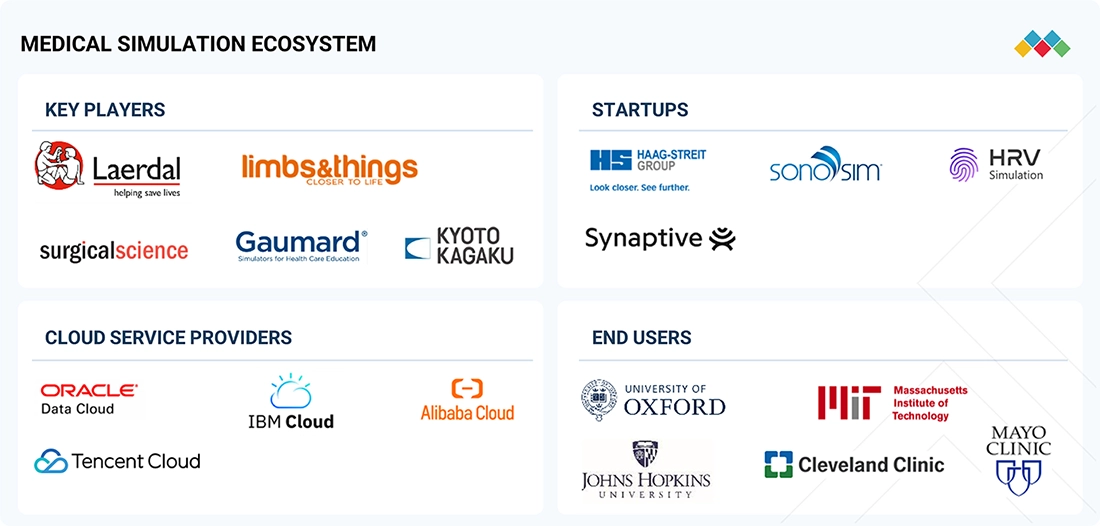
MEDICAL SIMULATION MARKET: COMMERCIAL USE CASES ACROSS INDUSTRIES
| COMPANY | USE CASE DESCRIPTION | BENEFITS |
|---|---|---|
 |
Offers high-fidelity simulators like LapSim and TraumaVR for surgical training, including robotic surgery and endovascular procedures | Provides customizable training modules through MentorLearn and iCase | Improves surgical proficiency and reduces error rates through evidence-based, proficiency-based training |
 |
Develops immersive simulation solutions, including SimMan and virtual reality training for emergency, obstetric, and neonatal care | Collaborates with Unity for scalable simulation platforms | Enhances team communication and coordination, leading to improved patient safety outcomes |
 |
Provides advanced patient simulators like HAL S5301 and robotic obstetric simulators for training across specialties, including trauma, pediatrics, and obstetrics | Facilitates safe, repeatable training scenarios, enabling learners to practice rare or high-risk events without patient risk |
 |
Manufactures anatomical models, imaging phantoms, and simulators for medical imaging and procedural training | Provides realistic, hands-on training tools that enhance understanding of anatomy and procedural techniques |
 |
Offers simulation products like the Laparoscopic Skills Trainer and AR-based trainers for catheterization and wound care | Provides augmented reality training apps to visualize internal anatomy | Improves clinical skills and team coordination, leading to better patient outcomes |
Logos and trademarks shown above are the property of their respective owners. Their use here is for informational and illustrative purposes only.
Related Ecosystem
Healthcare It
- Computed Tomography (CT)
- Machine Learning
- Magnetic Resonance Imaging (MRI)
- Natural Language Processing (NLP)
- Predictive Analytics
- CERNER CORPORATION
- PHILIPS HEALTHCARE
- Oracle Corporation
- GE HealthCare Technologies Inc.
- Siemens healthineers
Key Takeaways
- South Korea's medical simulation market is valued at $45.1 million in 2026 and will nearly double to $90.1 million by 2031.
- South Korea is experiencing a 14.9% CAGR, reflecting strong adoption of simulation-based training in healthcare education.
- South Korea's healthcare institutions are increasingly integrating VR, AR, and high-fidelity simulators into clinical training programs.
- South Korea's government support and academic partnerships are accelerating market growth and innovation in medical simulation technologies.
Medical Simulation Market Report Scope
| Report Metric | Details |
|---|---|
| Base Year | 2026 |
| Fastest Growing Segment | WEB-BASED SIMULATION (Offering) |
| Forecast Period | 2026–2031 |
| Growth Rate | CAGR of 15.3% from 2026 to 2031 |
| Largest Segment | HEALTHCARE SIMULATION ANATOMICAL MODELS (Offering) |
| Market Size Base Year (Billions) | ~USD 4.07 (2026) |
| Revenue Forecast (Billions) | ~USD 8.3 (2031) |
| Segments Covered | Offering, Type, Application, Technology, End User |
South Korea Medical Simulation Market Report Segmentation
5 segment dimensions are covered across the global market.
By Offering
- Healthcare Simulation Anatomical Models
- Healthcare Simulation Software
- Simulation Training Services
- Web-Based Simulation
By Type
- Cardiovascular Simulators
- Cardiovascular Surgical Simulators
- Custom Consulting Services
- Dental Simulators
- Educational Societies
- Endovascular Simulators
- Endovascular Surgical Simulators
- Eye Simulators
- Gynecology Simulators
- Gynecology Surgical Simulators
- High-Fidelity Patient Simulators
- Interventional/Surgical Simulators
- Laparoscopic Surgical Simulators
- Low-Fidelity Patient Simulators
- Medium-Fidelity Patient Simulators
- Orthopedic Simulators
- Orthopedic Surgical Simulators
- Other Interventional/ Surgical Simulators
- Other Interventional/Surgical Simulators
- Patient Simulators
- Spine Surgical Simulators
- Task Trainers
- Ultrasound Simulators
- Vendor-Based Training
By Application
- Cardiovascular Simulators
- Endovascular Simulators
- Gynecology Simulators
- Laparoscopic Simulators
- Laparoscopic Surgical Simulators
- Orthopedic Simulators
- Orthopedic Surgical Simulators
- Other Patient Simulators
- Spine Simulators
- Spine Surgical Simulators
By Technology
- 3D Printing
- Procedural Rehearsal Technology
- Virtual Patient Simulation
By End User
- Academic Institutes
- Hospitals
- Military Organizations
- Other End Users
Target Audience
- Medical Device Manufacturers : Manufacturers of simulation equipment and high-fidelity simulators need South Korea-specific market data to identify growth opportunities, understand local regulatory requirements, and develop region-appropriate product strategies for the expanding Korean healthcare market.
- Healthcare Institution Administrators : Hospital directors, medical school deans, and clinical training program leaders require market insights to justify simulation technology investments, benchmark against peer institutions, and make informed procurement decisions aligned with South Korea's healthcare standards.
- Investment & Private Equity Firms : Investors evaluating opportunities in South Korea's healthcare technology sector need detailed market analysis, growth projections, and competitive landscape data to assess investment viability and identify acquisition targets in the medical simulation space.
- Healthcare Technology Consultants : Consulting firms advising Korean healthcare organizations on digital transformation and clinical training modernization require comprehensive market data to develop evidence-based recommendations and validate technology adoption strategies.
- Medical Education & Training Organizations : Educational institutions and professional training bodies in South Korea need market intelligence to understand simulation technology trends, identify best-in-class solutions, and develop curriculum strategies incorporating advanced simulation-based learning methodologies.
Key Companies in the South Korea Medical Simulation Market
| Company | HQ | Ownership | Strongest segments |
|---|---|---|---|
| BIOMERIEUX S.A. | France | Public Company | Clinical microbiology (culture media, VITEK, BACT/ALERT, ETEST, API),Molecular diagnostics (BIOFIRE, BIOFIRE SPOTFIRE, ARGENE, EPISEQ),Immunoassays and CLIA (VIDAS, Hybiome, severe infection markers), |
| DENTSPLY SIRONA | United States | Public Company | Connected Technology Solutions (imaging, CEREC, digital equipment),Essential Dental Solutions (endodontics, restorative, preventive consumables),Orthodontic and Implant Solutions, |
| AMBU | Denmark | Public Company | Endoscopy (single-use scopes and visualization units),Airway management and anaesthesia,Neurology (EEG/EMG and intraoperative monitoring), |
| BRAINLAB AG | Germany | Private Company | Image-guided surgery and navigation (spine, neuro, CMF, ENT, orthopedic),Radiotherapy planning and workflow software,Digital operating room and healthcare IT integration, |
| EPAM SYSTEMS, INC. | United States | Public Company | Core digital platform engineering & custom software development,Cloud, data, analytics & AI services,Customer experience, marketing & digital product design, |
| TENET HEALTHCARE CORPORATION | United States | Public Company | Hospital Operations and Services,Ambulatory Care, |
| SURGICAL SCIENCE SWEDEN AB | Sweden | Public Company | Laparoscopic and general MIS simulators (LapSim, LAP Mentor, LapSim ST/Essence/360, Simball Box),Endoscopy and bronchoscopy simulators (GI Mentor, BRONCH Mentor/Express, EndoSim, PELVIC Mentor, HYST Mentor, URO Mentor, Perc Mentor),Robotic surgery training (FlexVR, RobotiX Mentor), |
| MENTICE AB | Sweden | Public Company | Mentice VIST (VR platforms, procedural models, Angiosuite integrations),Physical Sim (flow models, silicone/3D vessels, accessories),Ankyras and software apps (decision support, cloud, mobile), |
| SIMULAIDS | United States | Private Company | ALS/BLS patient simulators and manikins,Moulage systems and trauma trainers,Medical and nursing skills trainers, |
| ERLER-ZIMMER MEDICAL GMBH | Germany | Private | Anatomical models and charts,Clinical and procedural task trainers,Digital and blended learning aids, |
BIOMERIEUX S.A.
bioMérieux S.A. is a French public company founded in 1963 that employs 14,894 people. The company operates in the diagnostics and life sciences sector.
DENTSPLY SIRONA
Dentsply Sirona is a United States-based public company founded in 1877 with 14,000 employees. The company is a leading manufacturer of dental and orthodontic products and technologies.
AMBU
Ambu is a Danish public company founded in 1937 with 5,200 employees. The company specializes in medical devices and equipment for emergency care and anesthesia.
BRAINLAB AG
Brainlab AG is a German private company founded in 1989 with 2,370 employees. The company develops software and hardware solutions for surgical navigation and imaging.
EPAM SYSTEMS, INC.
EPAM Systems, Inc. is a United States-based public company founded in 1993 with 62,850 employees. The company provides software engineering and digital transformation services globally.
TENET HEALTHCARE CORPORATION
Tenet Healthcare Corporation is a United States-based public company founded in 1967 with 88,500 employees. The company operates a large network of hospitals and healthcare facilities across the country.
SURGICAL SCIENCE SWEDEN AB
Surgical Science Sweden AB is a Swedish public company founded in 1997 with 317 employees. The company develops virtual reality simulation systems for surgical training and education.
MENTICE AB
Mentice AB is a Swedish public company founded in 1998 with 119 employees. The company develops virtual reality simulation systems for interventional medical procedures.
SIMULAIDS
Simulaids is a United States-based private company founded in 1963 that produces CPR training manikins and medical simulation equipment.
ERLER-ZIMMER MEDICAL GMBH
Erler-Zimmer Medical GmbH is a medical equipment manufacturer that produces anatomical models and educational products.
Reasons to Buy this Report
- Market Size & Growth Validation : Obtain precise market valuation data for South Korea ($45.1M in 2026) with verified 14.9% CAGR projections through 2031, enabling accurate investment decisions and competitive positioning in this high-growth healthcare segment.
- Regional Competitive Intelligence : Understand South Korea's unique market dynamics, technology adoption patterns, and institutional preferences compared to global benchmarks, providing strategic advantages for market entry and product localization strategies.
- Healthcare Institution Insights : Access detailed analysis of South Korean teaching hospitals, medical schools, and clinical training centers driving simulation adoption, identifying key decision-makers and procurement opportunities within the healthcare ecosystem.
- Technology Trend Analysis : Gain comprehensive understanding of high-fidelity simulator preferences, VR/AR integration trends, and emerging technologies being adopted by South Korean healthcare providers to align product development and marketing strategies.
- Investment & Expansion Planning : Leverage South Korea-specific market forecasts and growth drivers to develop targeted expansion strategies, identify partnership opportunities with local healthcare institutions, and optimize resource allocation for market penetration.
Frequently asked questions
What is the current size of South Korea's medical simulation market?
South Korea's medical simulation market is valued at $45.1 million in 2026 and is projected to grow to $90.1 million by 2031.
What is the growth rate of South Korea's medical simulation market?
South Korea's medical simulation market is growing at a compound annual growth rate (CAGR) of 14.9% from 2026 to 2031.
What technologies are driving growth in South Korea's medical simulation market?
South Korea's market growth is driven by adoption of high-fidelity simulators, virtual reality platforms, augmented reality applications, and hybrid training solutions in healthcare education.
Which sectors in South Korea are investing most in medical simulation?
South Korea's medical schools, teaching hospitals, healthcare training centers, and private medical institutions are the primary investors in simulation-based training technologies.
How does South Korea's medical simulation market compare to the global market?
South Korea's 14.9% CAGR is slightly below the global average of 15.3%, but South Korea's market demonstrates strong regional leadership within Asia Pacific.
RESEARCH METHODOLOGY
The study involved five major activities to estimate the current size of the medical simulation market. Exhaustive secondary research was conducted to gather information on the market and its subsegments. The next step was to validate these findings, assumptions, and sizing with industry experts across the value chain through primary research. Both top-down and bottom-up approaches were employed to estimate the complete market size. Thereafter, market breakdown and data triangulation procedures were used to estimate the market size of the segments and subsegments.
Secondary Research
This research study used secondary sources, directories, and databases such as Dun & Bradstreet, Bloomberg Business, and Factiva; white papers, annual reports and companies’ house documents; investor presentations; and companies’ SEC filings. The market for medical simulation solutions is assessed using secondary data from both paid and free sources. This involves analyzing the product portfolios of major industry players and evaluating them based on performance and quality. Various resources were utilized in the secondary research process to gather information for this study. The sources include annual reports, press releases, investor presentations, white papers, academic journals, certified publications, articles by recognized authors, directories, and databases. The secondary research process involved consulting various sources to identify and collect information for the study. These sources included annual reports, press releases, investor presentations of medical simulation vendors, forums, certified publications, and white papers. Secondary research was used to obtain critical information on the industry’s value chain, the total pool of key players, and market classification and segmentation from market- and technology-oriented perspectives.
Primary Research
In the primary research process, various supply and demand sources were interviewed to obtain qualitative and quantitative information for this report. Primary sources are primarily industry experts from core and related industries, as well as preferred suppliers, manufacturers, distributors, technology developers, researchers, and organizations across all segments of this industry’s value chain. In-depth interviews were conducted with various primary respondents, including key industry participants, subject-matter experts (SMEs), C-level executives of key market players, and industry consultants, among other experts, to obtain and verify critical qualitative and quantitative information and assess prospects.
Primary research was conducted to identify segmentation types, industry trends, key players, and key market dynamics, including drivers, restraints, opportunities, and challenges, as well as the strategies adopted by key players.
After completing the market engineering process, which includes calculations for market statistics, market breakdown, size estimations, forecasting, and data triangulation, extensive primary research was conducted. This research aimed to gather information and verify the critical numbers obtained during the market analysis. Additionally, primary research was conducted to identify market segmentation types, analyze industry trends, evaluate the competitive landscape of medical simulation solutions offered by various players, and understand key market dynamics, including drivers, restraints, opportunities, challenges, and strategies employed by key market participants.
Throughout the complete market engineering process, the top-down and bottom-up approaches, along with several data triangulation methods, were extensively used to estimate and forecast the overall market segments and subsegments listed in this report. Extensive qualitative and quantitative analysis was performed on the complete market engineering process to list the key information/insights throughout the report.
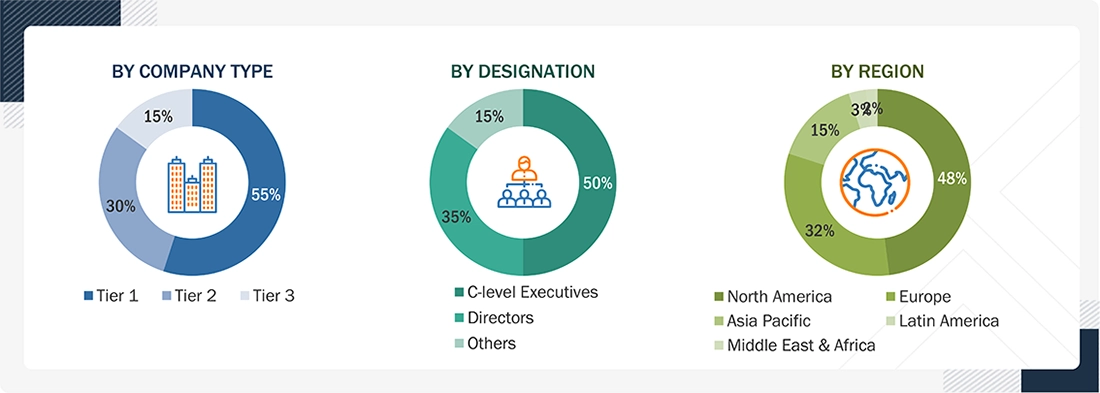
Note: Other designations include sales, marketing, and product managers.
Tiers are defined based on a company’s total revenue as of 2025: Tier 1 = >USD 1 billion, Tier 2 = USD 500 million to USD 1 billion, and Tier 3 = <USD 500 million.
To know about the assumptions considered for the study, download the pdf brochure
Market Size Estimation
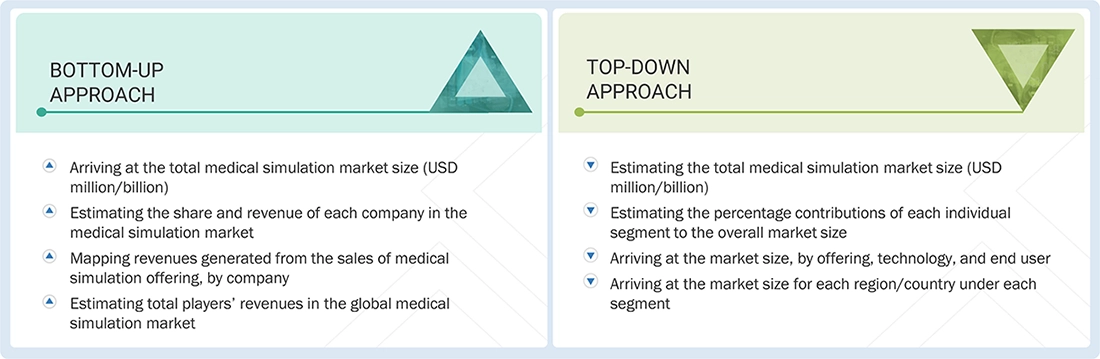
The market size estimates and forecasts provided in this study are derived through a mix of the bottom-up approach (revenue share analysis of leading players) and the top-down approach (assessment of utilization/adoption/penetration trends by offering, technology, end user, and region).
Data Triangulation
After determining the overall market size, the estimation process divided the market into several segments and subsegments. To complete the overall market engineering process and arrive at the exact statistics of each market segment and subsegment, the data triangulation and market breakdown procedures were employed, wherever applicable. The data was triangulated by studying various factors and trends from both the demand and supply sides in the medical simulation market.
Market Definition
Medical simulation uses virtual patients, mannequins, task trainers, or computer-based environments to replicate real-life clinical situations for training, education, evaluation, or system improvement without risking patient safety. It is a strategic tool that enables safe, repeatable, and immersive learning experiences, enhancing clinical performance, reducing medical errors, and improving healthcare delivery outcomes.
Key Stakeholders
- Medical simulation vendors
- Government bodies
- Healthcare service providers
- Clinical/physician centers
- Healthcare professionals
- Health IT service providers
- Healthcare associations/institutes
- Ambulatory care centers
- Venture capitalists
- Distributors and resellers
- Maintenance and support service providers
- Integration service providers
- Military organizations
- Advocacy groups
- Investors and financial institutions
- Industry associations and trade groups
Report Objectives
- To define, describe, and forecast the medical simulation market by offering, technology, end user, and region
- To provide detailed information regarding the major factors, such as drivers, restraints, opportunities, and challenges, influencing the market growth
- To analyze micromarkets with respect to individual growth trends, prospects, and contributions to the overall medical simulation market
- To assess the medical simulation market with regard to Porter’s five forces, regulatory landscape, value chain, ecosystem map, patent protection, impact of 2025 US tariff, AI/Gen AI impact on the market under study, and key stakeholders’ buying criteria
- To analyze opportunities in the market for stakeholders and provide details of the competitive landscape for market leaders
- To forecast the size of the medical simulation market with respect to five main regions, namely, North America, Europe, Asia Pacific, Latin America, and the Middle East & Africa
- To profile the key players in the medical simulation market and comprehensively analyze their core competencies and market shares
- To track and analyze competitive developments such as agreements, partnerships, acquisitions, expansions, product launches and enhancements, and R&D activities in the medical simulation market.
Available customizations:
With the given market data, MarketsandMarkets offers customizations according to your company’s specific needs. The following customization options are available for the report:
Company Information
- Detailed analysis and profiling of additional market players (up to 5)
Geographic Analysis
- Further breakdown of the medical simulation market in the Rest of Europe (Denmark, Norway, and other countries)
- Further breakdown of the medical simulation market in the Rest of Asia Pacific (Vietnam, New Zealand, the Philippines, and other countries)
Get the Full Medical Simulation Market Report
Full forecast, segment splits, and company analysis for all Medical Simulation Market.
- Australia Medical Simulation Market
- Brazil Medical Simulation Market
- Canada Medical Simulation Market
- China Medical Simulation Market
- France Medical Simulation Market
- Germany Medical Simulation Market
- India Medical Simulation Market
- Italy Medical Simulation Market
- Japan Medical Simulation Market
- Mexico Medical Simulation Market
- Rest Of Aasia Pacific Medical Simulation Market
- Rest Of Europe Medical Simulation Market
- Rest Of Latin America Medical Simulation Market
- Saudi Arabia Medical Simulation Market
- South Africa Medical Simulation Market
- Spain Medical Simulation Market
- UAE Medical Simulation Market
- UK Medical Simulation Market
- US Medical Simulation Market
Need a Tailored Report?
Customize this report to your needs
Get 10% FREE Customization
Customize This Report
