
UK HVAC Filters Market (2026-2031)

The UK HVAC Filters Market was valued at $187.8 Million in 2026 and projected to reach to $233.7 Million by 2031, representing a compound annual growth rate of 4.5%. The UK HVAC filters market is positioned for steady expansion through 2031, supported by stringent building standards, net-zero carbon commitments, and heightened awareness of indoor environmental quality.


| Market Size in | USD 26.32 MN |
| Market Forecast in | |
| CAGR | |
| Forecast Period | |
| Units Considered | Value (USD MN) |
UK HVAC Filters Market Trends and Insights
- The UK market reflects steady demand driven by regulatory compliance, building standards enforcement, and increased focus on indoor air quality across residential and commercial sectors.
- The UK's mature HVAC infrastructure and stringent environmental regulations continue to support consistent filter replacement cycles and product innovation. Growth in the UK HVAC filters market is underpinned by rising awareness of air quality standards, retrofit activities in aging building stock, and the transition toward energy-efficient HVAC systems.
- The UK's commitment to net-zero emissions and building performance standards has accelerated investment in ventilation upgrades, directly benefiting the filters segment.
- Between 2026 and 2031, the UK market will experience moderate but stable expansion as commercial facilities, healthcare institutions, and residential properties prioritize air filtration quality and system maintenance..
Key Market Statistics
- CAGR (2026-2031) 4.5% CAGR
- Market Size, 2026 ~USD 187.8 Million
- Forecast, 2031 ~USD 233.7 Million
- Country UK
UK HVAC Filters Market Overview
Market Size & Growth :
The UK HVAC filters market is valued at £187.8 million in 2026 and is projected to reach £233.7 million by 2031, with a steady CAGR of 4.5%, outpacing broader economic growth.
Regulatory Drivers :
UK building regulations and energy efficiency standards are key growth catalysts, with mandatory compliance requirements pushing adoption of high-performance HVAC filtration systems across commercial and residential properties.
Indoor Air Quality Focus :
Post-pandemic awareness and workplace wellness initiatives have elevated indoor air quality priorities in UK offices, hospitals, and educational institutions, driving demand for premium filtration solutions.
Mature Infrastructure Base :
The UK's established HVAC infrastructure and retrofit market present sustained replacement and upgrade opportunities, supporting consistent demand for filter products across aging building stock.
UK HVAC Filters Market Dynamics
- Commercial sectors including healthcare, hospitality, and office spaces are driving significant filter demand as businesses invest in ventilation upgrades to meet regulatory requirements and employee wellness expectations.
- Residential demand remains stable, underpinned by renovation activities and growing consumer consciousness around air quality.
- The market's 4.5% CAGR reflects a mature, regulated environment with consistent replacement cycles and incremental innovation in filter efficiency and sustainability..
Market Ecosystem
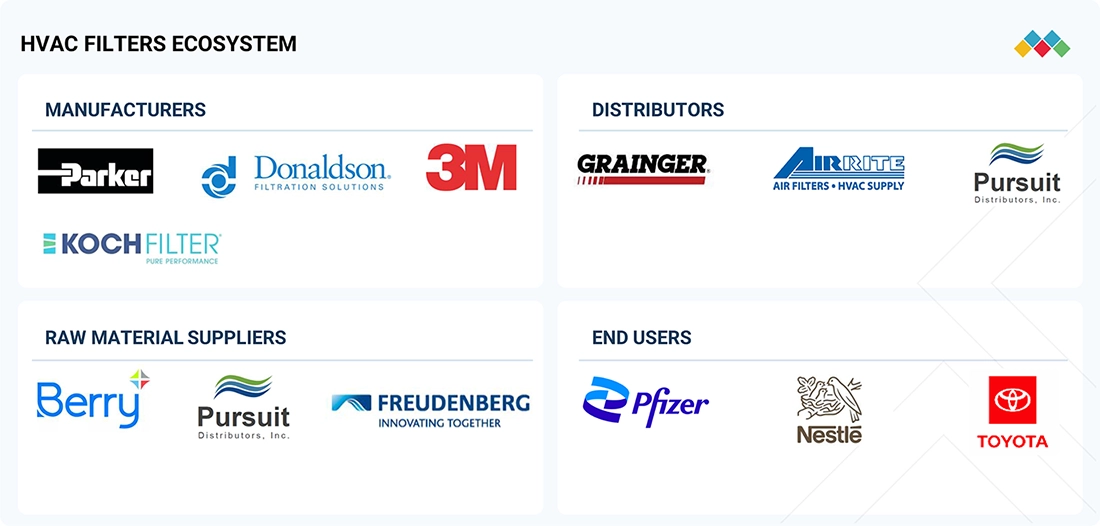
HVAC FILTERS MARKET: COMMERCIAL USE CASES ACROSS INDUSTRIES
| COMPANY | USE CASE DESCRIPTION | BENEFITS |
|---|---|---|
 |
Designs and manufactures a broad range of HVAC filtration solutions, including panel, pleated, bag, rigid, HEPA, and molecular filters for commercial buildings, healthcare facilities, data centers, pharmaceuticals, and industrial applications; Focuses on improving indoor air quality, energy efficiency, and system protection through advanced filtration media and innovative filter designs | High filtration efficiency, improved indoor air quality, extended HVAC equipment life, reduced energy consumption, and strong expertise in contaminant control across diverse applications |
 |
Provides HVAC filtration products through its filtration business, offering air filters for commercial, industrial, healthcare, and cleanroom environments; Emphasizes advanced filtration technologies, energy-efficient performance, and compliance with stringent indoor air quality standards | Enhanced airborne particle removal, energy-efficient operation, regulatory compliance support, reliable system performance, and comprehensive filtration solutions for critical environments |
 |
Develops high-performance HVAC filtration solutions utilizing proprietary nonwoven and electrostatic filtration technologies; Serves residential, commercial, healthcare, and institutional facilities with products designed to capture fine particulates while maintaining airflow efficiency | Superior particulate capture, lower pressure drop, improved airflow, enhanced occupant health and comfort, and reduced operating costs through energy-efficient filtration performance |
 |
Manufactures a comprehensive portfolio of HVAC air filtration products, including prefilters, rigid filters, pocket filters, HEPA filters, and gas-phase filtration systems; Serves commercial buildings, healthcare facilities, industrial plants, and specialized clean-air applications | Broad product portfolio, high indoor air quality performance, protection of HVAC equipment, support for sustainability initiatives, and effective filtration for demanding environments |
 |
Offers a wide range of HVAC filtration solutions through multiple brands, including panel, pleated, bag, rigid, HEPA, ULPA, and molecular filters; Serves commercial, industrial, healthcare, pharmaceutical, and data center markets with a focus on clean air, energy efficiency, and sustainability | Comprehensive filtration expertise, strong contaminant removal capabilities, customized solutions, improved energy efficiency, and reliable performance in critical air quality applications |
Logos and trademarks shown above are the property of their respective owners. Their use here is for informational and illustrative purposes only.
Related Ecosystem
Equipment Machine And Tooling
- Wastewater Treatment
- Air Cooled Heat Exchangers
- Diaphragm Pumps
- Fiberglass
- HVAC System
- Alfa Laval Corporate AB
- Johnson Controls International plc
- Daikin Industries,Ltd.
- Veolia
- Carrier Global Corporation
Key Takeaways
- The UK HVAC filters market is valued at £187.8 million in 2026 and will reach £233.7 million by 2031, growing at a 4.5% CAGR.
- UK regulatory frameworks and building standards drive consistent demand for high-performance air filtration products.
- The UK market benefits from retrofit activity and energy efficiency initiatives aligned with net-zero commitments.
- Steady growth in the UK reflects mature market dynamics with emphasis on air quality, maintenance cycles, and commercial sector investment.
HVAC Filters Market Report Scope
| Report Metric | Details |
|---|---|
| Base Year | 2026 |
| Fastest Growing Segment | -PP (Material) |
| Forecast Period | 2026-2031 |
| Growth Rate | CAGR of 5.9% from 2026 to 2031 |
| Largest Segment | MEDIA-BASED (Technology) |
| Market Size Base Year (Billions) | ~USD 4.66 (2026) |
| Revenue Forecast (Billions) | ~USD 6.21 (2031) |
| Segments Covered | Design Type, Material, Technology 2022-2025, Technology, Systems, End-Use Industry 2022-2025, End-Use Industry, Material Type |
UK HVAC Filters Market Report Segmentation
8 segment dimensions are covered across the global market.
By Design Type
- Box Filters
- Cartridge Filters
- Other Filters
- Pleated Filters
- Pocket Filters
By Material
- Adsorbent Material
- Fiberglass
- Metal
- Nanofiber Polymers
- Other Materials
- Synthetic Polymer
- -Activated Carbon
- -Other Adsorbent Material
- -Other Nanofiber Polymers
- -Others
- -Pa
- -Pan
- -Pet
- -Pp
- -Ptfe
- -Pvdf
- -Pvdf Nanofiber
- -Zeolite
By Technology 2022-2025
- Adsorbent/Reactant Material-Based
- Media-Based
- Other Technologies
- Systems-Based
By Technology
- Adsorbent/Reactant Material-Based
- Media-Based
- Other Technologies
- Systems-Based
By Systems
- Air Handling Units
- Clean Room Systems
- Ductless Systems
- Other Systems
- Residential Units
- Split Systems
- -Indoor Hvac Units
- -Rooftop Hvac Units
By End-Use Industry 2022-2025
- Commercial
- Industrial
- Residential
- -Apartments
- -Automotive
- -Corporate Institutions
- -Data Centers
- -Educational Facilities
- -Electrical & Electronics
- -Food & Beverages
- -Healthcare Facilities
- -Individual Houses
- -Malls & Shopping Complex
- -Other Commercial End-Use Industries
- -Other End-Use Industries
- -Pharmaceuticals
By End-Use Industry
- Commercial
- Industrial
- Residential
- -Apartments
- -Automotive
- -Corporate Institutions
- -Data Centers
- -Educational Facilities
- -Electrical & Electronics
- -Food & Beverages
- -Healthcare Facilities
- -Individual Houses
- -Malls & Shopping Complex
- -Other Commercial End-Use Industries
- -Other End-Use Industries
- -Pharmaceuticals
By Material Type
- Adsorbent Material
- Fiberglass
- Metal
- Nanofiber Polymers
- Other Materials
- Synthetic Polymer
- -Activated Carbon
- -Other Adsorbent Material
- -Other Adsorbent Materials
- -Other Nanofiber Polymers
- -Others
- -Pa
- -Pan
- -Pet
- -Pp
- -Ptfe
- -Pvdf
- -Pvdf Nanofiber
- -Zeolite
Target Audience
- HVAC Equipment Manufacturers : Need UK-specific market data to inform product development roadmaps, supply chain planning, and sales forecasting for integrated HVAC systems and filter components.
- Filter & Component Suppliers : Require detailed UK market insights to identify distribution opportunities, assess competitive positioning, and develop targeted strategies for residential and commercial customer segments.
- Building & Facilities Managers : Seek market intelligence on filter specifications, compliance requirements, and cost-benefit analyses to optimize procurement decisions and maintenance budgets for UK properties.
- Investors & Private Equity : Need comprehensive UK market analysis to evaluate investment opportunities, assess growth potential, and identify acquisition targets within the HVAC filtration supply chain.
- Consultants & System Integrators : Require UK market data and regulatory insights to advise clients on HVAC system upgrades, filter selection, and compliance strategies aligned with building standards and sustainability goals.
Reasons to Buy this Report
- Regulatory Compliance Intelligence : Understand UK-specific building standards, energy efficiency directives, and mandatory filter specifications to ensure product alignment with evolving regulatory requirements and avoid market access barriers.
- Competitive Market Positioning : Identify market gaps, competitor strategies, and customer preferences specific to the UK to develop targeted go-to-market approaches and differentiation strategies for residential and commercial segments.
- Growth Opportunity Mapping : Pinpoint high-growth sectors within the UK market—healthcare, education, hospitality—and understand their unique filtration needs to prioritize sales efforts and product development investments.
- Investment & Expansion Planning : Leverage accurate market sizing and forecasts to support business case development, capital allocation decisions, and expansion strategies for UK operations or partnerships.
- Customer Insights & Demand Drivers : Gain deep understanding of UK customer motivations—wellness, sustainability, cost efficiency—to refine messaging, pricing strategies, and product bundling for maximum market penetration.
Frequently asked questions
What is the current size of the UK HVAC filters market?
The UK HVAC filters market is estimated at £187.8 million in 2026 and is expected to grow to £233.7 million by 2031.
What is the growth rate of the UK HVAC filters market?
The UK HVAC filters market is projected to grow at a compound annual growth rate (CAGR) of 4.5% from 2026 to 2031.
What factors are driving growth in the UK HVAC filters market?
Key drivers include UK regulatory compliance, building standards enforcement, increased indoor air quality awareness, retrofit activities in aging buildings, and the UK's net-zero emissions commitments.
Which sectors are the primary consumers of HVAC filters in the UK?
The UK HVAC filters market serves residential properties, commercial facilities, healthcare institutions, and industrial applications requiring air filtration and system maintenance.
How does the UK market compare to global HVAC filters trends?
The UK market grows at 4.5% CAGR, slightly below the global average of 5.9%, reflecting a mature market with stable, regulated demand and established infrastructure.
RESEARCH METHODOLOGY
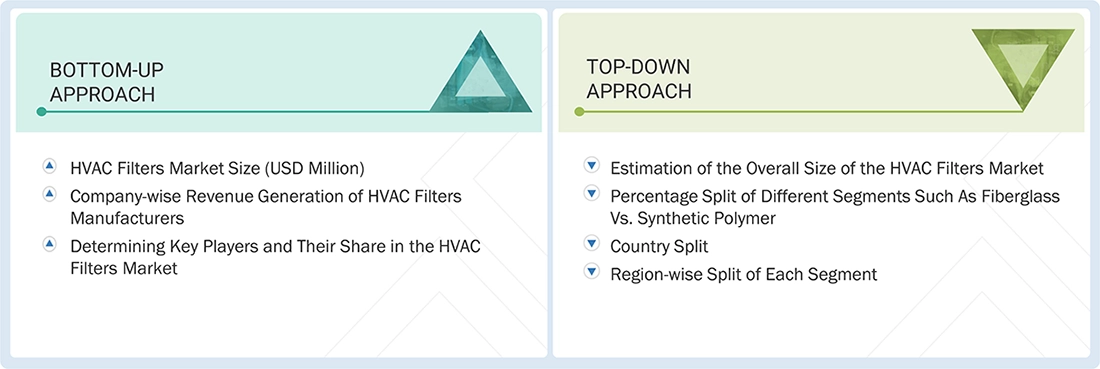
The study involves two major activities in estimating the current market size for the HVAC filters market. Exhaustive secondary research was done to collect information on the market, peer market, and parent market. The next step was to validate these findings, assumptions, and sizing with industry experts across the value chain through primary research. Both top-down and bottom-up approaches were employed to estimate the complete market size. After that, market breakdown and data triangulation were used to estimate the market size of segments and subsegments.
Secondary Research
Secondary sources referred to for this research study include financial statements of companies offering HVAC filters and information from various trade, business, and professional associations. Secondary research has been used to obtain critical information about the industry’s value chain, the total pool of key players, market classification, and segmentation according to industry trends to the bottom-most level and regional markets. The secondary data was collected and analyzed to arrive at the overall size of the HVAC filters market, which was validated by primary respondents.
Primary Research
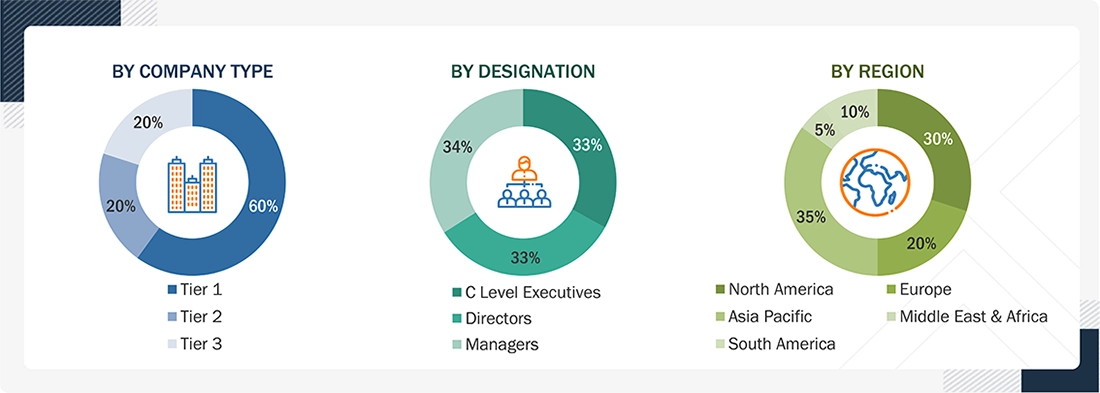
Extensive primary research was conducted after obtaining information regarding the HVAC filters market scenario through secondary research. Several primary interviews were conducted with market experts from both the demand and supply sides across major countries of North America, Europe, Asia Pacific, the Middle East & Africa, and South America. Primary data was collected through questionnaires, emails, and telephonic interviews. The primary sources from the supply side included various industry experts, such as chief executive officers (CXOs), vice presidents (VPs), directors from business development, marketing, product development/innovation teams, and related key executives from HVAC filters industry vendors; material providers; distributors; and key opinion leaders. Primary interviews were conducted to gather insights into market statistics, revenue from products and services, market breakdowns, market size estimates, market forecasting, and data triangulation. Primary research also helped in understanding the various trends related to process, capacity, application, system, end-use industry, and region. Stakeholders from the demand side, such as CIOs, CTOs, CSOs, and installation teams of the customer/end users who are seeking HVAC filters, were interviewed to understand the buyer’s perspective on the suppliers, products, and their current usage of HVAC filters and future outlook of their business, which will affect the overall market.
To know about the assumptions considered for the study, download the pdf brochure
Market Size Estimation
The research methodology used to estimate the size of the HVAC filters market includes the following details. The market sizing of the market was undertaken from the demand side. The market was upsized based on the demand for HVAC filters in different end-use industries at a regional level. Such procurements provide information on the demand aspects of the HVAC filters industry for each end-use industry. For each end-use, all possible segments of the HVAC filters market were integrated and mapped.
Data Triangulation
After arriving at the overall size from the market size estimation process explained above, the total market was split into several segments and subsegments. The data triangulation and market breakdown procedures explained below were implemented, wherever applicable, to complete the overall market engineering process and arrive at the exact statistics for various market segments and subsegments. The data was triangulated by studying various factors and trends from the demand and supply sides. Along with this, the market size was validated using both the top-down and bottom-up approaches.
Market Definition
The HVAC filters market consists of filter media and technologies that are employed in HVAC systems to filter out airborne particles, dust, allergens, microorganisms, odor, and other contaminants from the air. These filters help improve indoor air quality, protect HVAC systems, increase energy efficiency, and comply with air quality regulations. The HVAC filters market is made up of different materials, technologies, and filter efficiencies that cater to the various environmental needs.
Key Stakeholders
- HVAC filter manufacturers
- HVAC filter distributors and suppliers
- End-use industries
- Universities, governments, and research organizations
- Associations and industrial bodies
- R&D institutes
- Environmental support agencies
- Investment banks and private equity firms
- Research and consulting firms
Report Objectives
- To define, describe, and forecast the HVAC filters market size in terms of volume and value
- To provide detailed information regarding the key factors, such as drivers, restraints, opportunities, and challenges influencing market growth
- To analyze and forecast the market by system, material, technology, end-use industry, and region
- To forecast the market size concerning five main regions (along with country-level data), namely, North America, Europe, Asia Pacific, the Middle East & Africa, and South America, and analyze the significant region-specific trends
- To strategically analyze micromarkets with respect to individual growth trends, prospects, and contributions of the submarkets to the overall market
- To analyze the market opportunities and the competitive landscape for stakeholders and market leaders
- To assess recent market developments and competitive strategies, such as agreements, contracts, acquisitions, partnerships & collaboration, and product developments/product launches, to draw the competitive landscape
- To strategically profile the key market players and comprehensively analyze their core competencies
Available customizations:
MarketsandMarkets offers the following customizations for this market report:
- Additional country-level analysis of the HVAC Filters market
Product Analysis
- Product matrix, which provides a detailed comparison of the product portfolio of each company’s market
Get the Full HVAC Filters Market Report
Full forecast, segment splits, and company analysis for all HVAC Filters Market.
- US HVAC Filters Market
- Canada HVAC Filters Market
- Mexico HVAC Filters Market
- Germany HVAC Filters Market
- France HVAC Filters Market
- Italy HVAC Filters Market
- Spain HVAC Filters Market
- China HVAC Filters Market
- India HVAC Filters Market
- Japan HVAC Filters Market
- South Korea HVAC Filters Market
- South Africa HVAC Filters Market
- Brazil HVAC Filters Market
- Argentina HVAC Filters Market
- Rest Of Europe HVAC Filters Market
- Rest Of Asia Pacific HVAC Filters Market
- GCC Countries HVAC Filters Market
- -Rest Of GCC HVAC Filters Market
- Rest Of South America HVAC Filters Market
Need a Tailored Report?
Customize this report to your needs
Get 10% FREE Customization
Customize This Report
