
Thailand Ion Exchange Resins Market (2024-2029)

The Thailand Ion Exchange Resins Market was valued at $9740 Million in 2024 and projected to reach to $12274 Million by 2029, representing a compound annual growth rate of CAGR 3.9%. Thailand's ion exchange resins market is poised for consistent growth through 2029, driven by increasing industrialization and stringent water quality regulations.


| Market Size in | USD 26.32 MN |
| Market Forecast in | |
| CAGR | |
| Forecast Period | |
| Units Considered | Value (USD MN) |
Thailand Ion Exchange Resins Market Trends and Insights
- Thailand's market growth is driven by increasing demand from water treatment, chemical processing, and pharmaceutical industries, which rely on ion exchange resins for purification and separation applications.
- The country's expanding industrial base and rising environmental regulations are accelerating adoption of advanced resin technologies across manufacturing sectors. In 2024, Thailand's ion exchange resins market reflects strong regional positioning within Asia Pacific, supported by the nation's robust chemical and material processing infrastructure.
- By 2029, Thailand is expected to capture greater market share as industrial water treatment becomes mandatory and pharmaceutical production scales up.
- The forecast period demonstrates Thailand's commitment to sustainable industrial practices and technological modernization, positioning the country as a key growth hub for ion exchange resin applications in Southeast Asia..
Key Market Statistics
- CAGR (2024-2029) CAGR 3.9%
- Market Size, 2024 ~USD 9740 Million
- Forecast, 2029 ~USD 12274 Million
- Country Thailand
Thailand Ion Exchange Resins Market Overview
Market Size & Growth :
Thailand's ion exchange resins market is valued at USD 9,740 million in 2024, with projected growth to USD 12,274 million by 2029, representing a steady CAGR of 3.9% over the forecast period.
Water Treatment Demand :
Thailand's expanding water treatment sector drives significant demand for ion exchange resins, particularly for municipal water purification and industrial wastewater management applications across the country.
Industrial Processing Growth :
Chemical processing and pharmaceutical manufacturing industries in Thailand increasingly adopt ion exchange resins for purification, separation, and quality enhancement processes, supporting market expansion.
Regional Market Position :
Thailand's ion exchange resins market grows at 3.9% CAGR, slightly below the global average of 4.8%, reflecting steady domestic demand but indicating opportunities for accelerated growth through market penetration.
Thailand Ion Exchange Resins Market Dynamics
- The water treatment sector remains the primary growth engine, supported by rising investments in municipal infrastructure and industrial wastewater management.
- Pharmaceutical and chemical processing industries continue to expand their operations in Thailand, creating sustained demand for high-quality ion exchange resins for purification applications.
- Government initiatives promoting environmental sustainability and industrial modernization further support market development.
- The market's 3.9% CAGR reflects Thailand's position as a growing hub for chemical and pharmaceutical manufacturing in Southeast Asia, with opportunities for market acceleration through technological adoption and capacity expansion..
Market Ecosystem
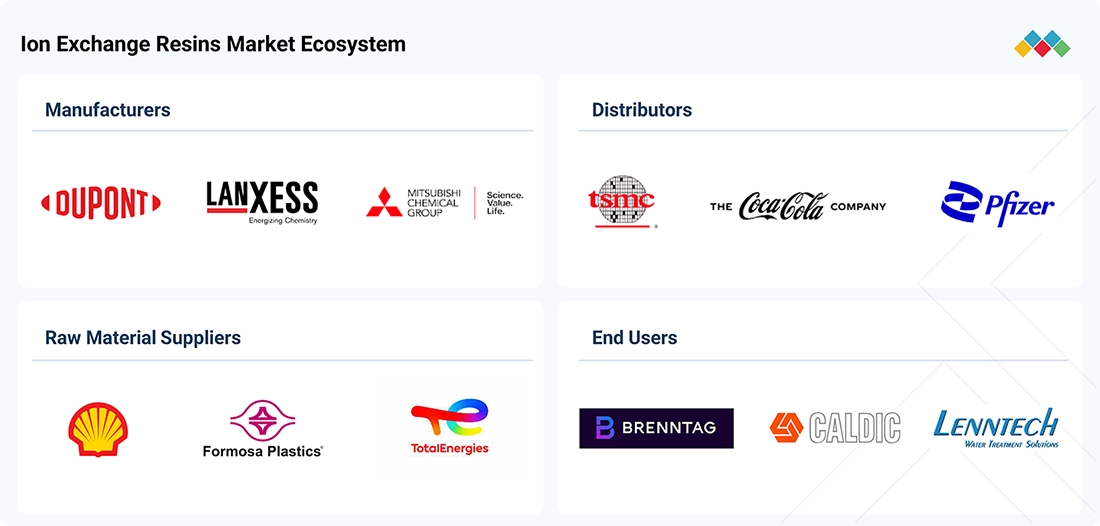
ION EXCHANGE RESINS MARKET: COMMERCIAL USE CASES ACROSS INDUSTRIES
| COMPANY | USE CASE DESCRIPTION | BENEFITS |
|---|---|---|
 |
Ion exchange resins purify industrial, nuclear, drinking, and electrolyzer process water | High-purity water, contaminant removal, and improved process efficiency |
 |
Lewatit resins treat water and liquids across power, pharmaceutical, chemical, mining, and semiconductor applications | Selective ion removal, purification, and resource recovery |
 |
DIAION resins support water purification, wastewater treatment, pharmaceutical, food, and semiconductor applications | Efficient purification, selective separation, and high-purity water |
 |
TRILITE resins enable water treatment and separation across pharmaceutical, semiconductor, and catalyst applications | Ultrapure water, contaminant removal, and efficient purification |
Logos and trademarks shown above are the property of their respective owners. Their use here is for informational and illustrative purposes only.
Related Ecosystem
Resins And Polymers
- Polycarbonate
- Acrylonitrile Butadiene Styrene (ABS)
- Epoxy Resin
- Light Commercial Vehicles (LCVs)
- Polypropylene (PP)
- Basf se
- DOW CHEMICAL COMPANY
- Solvay sa
- Saudi arabia basic industries corporation (sabic)
- DuPont de Nemours, Inc.
Water Purification
- Corrosion Inhibitors
- Cartridge Filters
- Fiberglass
- Reverse Osmosis
- Acetone
- Veolia
- Basf se
- CALGON CARBON CORPORATION
- SOLENIS
- Kemira oyj
Fandb Additives
- Dairy Products
- Bakery Products
- Polyglycerol Esters
- Microorganism
- Carbohydrates
- AZELIS HOLDINGS SA
- Archer-Daniels-Midland Company
- Amway
- UNILEVER PLC
- DuPont de Nemours, Inc.
Key Takeaways
- Thailand's ion exchange resins market is valued at USD 9,740 million in 2024 and will reach USD 12,274 million by 2029.
- Thailand is experiencing a 3.9% CAGR, driven by water treatment, pharmaceutical, and chemical processing industries.
- Stricter environmental regulations in Thailand are accelerating demand for advanced ion exchange resin technologies.
- Thailand's industrial expansion and infrastructure development position it as a critical growth market within the Asia Pacific region.
Ion Exchange Resins Market Report Scope
| Report Metric | Details |
|---|---|
| Base Year | 2024 |
| Fastest Growing Segment | ELECTRICAL & ELECTRONICS (End-Use Industry) |
| Forecast Period | 2024-2029 |
| Growth Rate | CAGR of 4.8% from 2024 to 2029 |
| Largest Segment | WATER (Application) |
| Market Size Base Year (Billions) | ~USD 2.11 (2024) |
| Revenue Forecast (Billions) | ~USD 2.67 (2029) |
| Segments Covered | Type, Application, End-Use Industry |
Thailand Ion Exchange Resins Market Report Segmentation
3 segment dimensions are covered across the global market.
By Type
- Anionic Resins
- Cationic Resins
- Other Types
By Application
- -Industrial
- -Municipal
- -Others
- Non-Water
- Water
- -Industrial
- -Municipal
- -Others
By End-Use Industry
- Chemicals & Petrochemicals
- Electrical & Electronics
- Food & Beverage
- Metal & Mining
- Other End-Use Industries
- Pharmaceuticals
- Power
THAILAND: ION EXCHANGE RESINS MARKET, BY END-USE INDUSTRY, 2024–2030
| Segment | 2024 | 2025 | 2026 | 2027 | 2028 | 2029 | 2030 | CAGR (%) |
|---|---|---|---|---|---|---|---|---|
| CHEMICALS & PETROCHEMICALS | 9.8 | 10.3 | 10.7 | 11.3 | 11.8 | 12.4 | 13 | 4.8 |
| ELECTRICAL & ELECTRONICS | 2.4 | 2.6 | 2.7 | 2.9 | 3 | 3.2 | 3.4 | 5.8 |
| FOOD & BEVERAGE | 3.1 | 3.3 | 3.5 | 3.7 | 3.9 | 4.2 | 4.4 | 5.8 |
| METAL & MINING | 0.3 | 0.3 | 0.3 | 0.4 | 0.4 | 0.4 | 0.4 | 4.2 |
| OTHERS | 3.6 | 3.8 | 4 | 4.2 | 4.4 | 4.6 | 4.9 | 5.2 |
| PHARMACEUTICALS | 1 | 1.1 | 1.1 | 1.2 | 1.3 | 1.4 | 1.4 | 5.5 |
| POWER | 6.6 | 7 | 7.3 | 7.7 | 8.2 | 8.6 | 9.1 | 5.4 |
| TOTAL | 26.9 | 28.3 | 29.8 | 31.3 | 33 | 34.7 | 36.6 | 5.2 |
Target Audience
- Chemical & Resin Manufacturers : Manufacturers need Thailand-specific market data to assess production capacity requirements, identify distribution opportunities, and develop localized product strategies for the growing Thai market.
- Water Treatment Companies : Water treatment operators require detailed market insights to understand demand trends, plan infrastructure investments, and source ion exchange resins efficiently across Thailand's expanding municipal and industrial sectors.
- Pharmaceutical & Chemical Processors : End-user industries need market intelligence to forecast resin procurement needs, evaluate supplier options, and optimize purification processes aligned with Thailand's industrial growth trajectory.
- Investment & Private Equity Firms : Investors require comprehensive Thailand market data to evaluate acquisition targets, assess growth potential, and make informed capital allocation decisions in the ion exchange resins sector.
- Government & Regulatory Bodies : Policy makers and regulatory agencies need market insights to develop environmental standards, plan infrastructure investments, and support industrial development initiatives in Thailand's water and chemical sectors.
Reasons to Buy this Report
- Market Size & Forecast Data : Access precise market valuation for Thailand at USD 9,740M (2024) and USD 12,274M (2029), enabling accurate financial planning and investment decisions specific to the Thai market.
- Industry-Specific Insights : Understand demand drivers across Thailand's water treatment, chemical processing, and pharmaceutical sectors, identifying high-growth application areas and customer segments within the country.
- Competitive Positioning : Benchmark Thailand's 3.9% CAGR against the global 4.8% rate to identify market gaps, competitive advantages, and opportunities for market share expansion in the region.
- Strategic Market Entry : Develop informed market entry strategies for Thailand with detailed insights into local demand patterns, regulatory environment, and industrial growth trajectories specific to the ion exchange resins sector.
- Investment & Growth Planning : Make data-driven decisions on capacity expansion, product development, and resource allocation in Thailand based on comprehensive market forecasts and industry-specific growth projections.
Frequently asked questions
What is the current market size of ion exchange resins in Thailand?
Thailand's ion exchange resins market is estimated at USD 9,740 million in 2024.
What is the projected market size for ion exchange resins in Thailand by 2029?
Thailand's ion exchange resins market is projected to reach USD 12,274 million by 2029.
What is the CAGR for Thailand's ion exchange resins market?
Thailand's ion exchange resins market is growing at a CAGR of 3.9% from 2024 to 2029.
Which industries drive demand for ion exchange resins in Thailand?
Water treatment, pharmaceutical manufacturing, chemical processing, and industrial purification sectors are the primary drivers of ion exchange resin demand in Thailand.
What factors are accelerating growth in Thailand's ion exchange resins market?
Environmental regulations, industrial expansion, pharmaceutical production scaling, and mandatory water treatment standards are key growth factors in Thailand's market.
RESEARCH METHODOLOGY
The study involved four major activities to estimate the current size of the global ion exchange resins market. Exhaustive secondary research was conducted to collect information on the ion exchange resins market, the peer product market, and the parent product group market. The next step was to validate these findings, assumptions, and sizes with industry experts across the ion exchange resins value chain through primary research. Both the top-down and bottom-up approaches were employed to estimate the overall size of the ion exchange resins market. After that, market breakdown and data triangulation were used to determine the sizes of different market segments and subsegments.
Secondary Research
For the secondary research, sources such as D&B Hoovers, Factiva, Bloomberg Businessweek, and Dun & Bradstreet were used to identify and collect information for this study of the ion exchange resins market. These sources included annual reports, press releases, and investor presentations from companies; white papers; certified publications; databases; articles by recognized authors; regulatory bodies; and trade directories.
Primary Research
The ion exchange resins market involves various stakeholders along the supply chain, such as raw material suppliers, distributors, end-product manufacturers, buyers, and regulatory bodies. Qualitative and quantitative data were collected through interviews with primary sources from both the supply and demand sides. On the demand side, key participants include opinion leaders, company executives, vice presidents, and CEOs in the market. On the supply side, primary sources consist of associations, institutions, influential opinion leaders, and processing companies involved in the market.
Breakdown of Primary Profiles
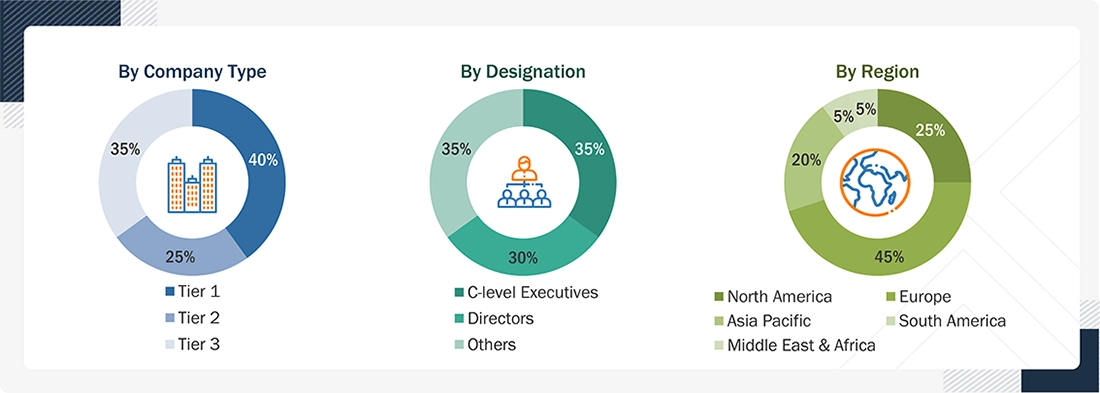
To know about the assumptions considered for the study, download the pdf brochure
Market Size Estimation
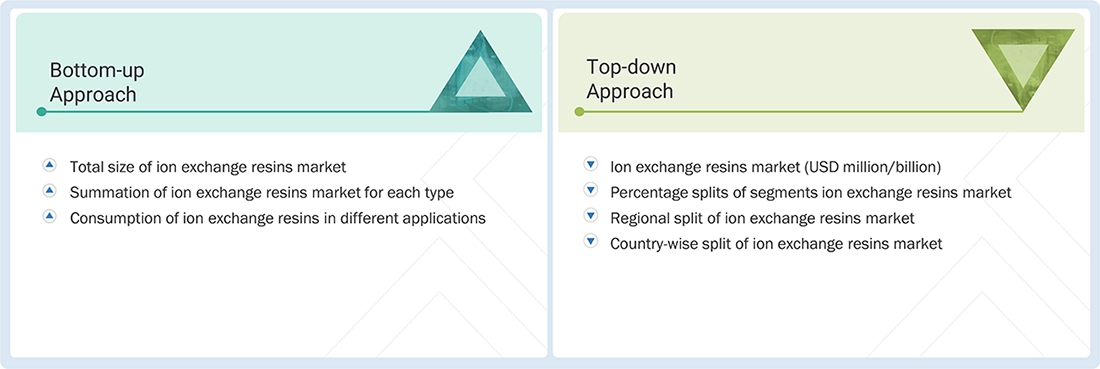
The bottom-up and top-down approaches were used to estimate the ion exchange resins market by type, application, end-use industry, and region. The research methodology used to calculate the market size includes the following steps:
- The key players in the industry and markets were identified through extensive secondary research.
- In terms of value, the industry’s supply chain and market size were determined through primary and secondary research processes.
- All percentage shares, splits, and breakdowns were determined using secondary sources and verified through primary sources.
- All parameters that affect the markets covered in this research study were accounted for, examined in detail, verified through primary research, and analyzed to obtain the final quantitative and qualitative data.
- The research included reviewing reports, reviews, and newsletters from top market players, as well as extensive interviews with leaders, such as directors and marketing executives, to gather opinions.
The following figure illustrates the overall market size estimation process employed for this study.
Data Triangulation
After estimating the total size of the ion exchange resins market, the market was divided into multiple segments and subsegments. Data triangulation and breakdown methods were used, where relevant, to refine the overall market analysis and determine precise statistics for all segments. The data was cross-checked by examining factors and trends from both demand and supply perspectives. Additionally, market size validation was performed using top-down and bottom-up approaches.
Market Definition
Ion exchange resins are insoluble polymers prepared by cross-linking polystyrenes that contain various functional groups. They act as a medium for ion exchange reactions and consist of a polymer matrix to which ion exchange sites are attached. These sites carry charged functional groups that attract and exchange ions of the opposite charge. Ion exchange resins are typically available as porous yellow microbeads, membranes, or granular material, although other forms, such as sheets, are also used. Ion exchange resins fall into two categories: cation exchange resins, which attract positive ions, and anion exchange resins, which attract negative ions. Ion exchange resins are used across various industries, such as power, chemical and petrochemical, food and beverage, pharmaceutical, electrical and electronics, metal and mining, and other industrial applications to improve system efficiency, reduce energy consumption, and extend equipment life.
Key Stakeholders
- Ion exchange resin manufacturers
- Raw material suppliers
- Regulatory bodies and government agencies
- Distributors and suppliers
- End-use industries
- Associations and industrial bodies
- Market research and consulting firms
Report Objectives
- To define, describe, and forecast the size of the ion exchange resins market in terms of value and volume
- To provide detailed information regarding the key factors influencing the growth of the market (drivers, restraints, opportunities, and challenges)
- To forecast the market size based on type, application, end-use industry, and region
- To forecast the market size for the five main regions—North America, Europe, Asia Pacific, South America, and Middle East & Africa—along with their key countries
- To strategically analyze micromarkets with respect to individual growth trends, prospects, and contributions to the total market
- To analyze opportunities in the market for stakeholders and provide details of the competitive landscape for market leaders
- To strategically profile leading players and comprehensively analyze their key developments, such as product launches, expansions, and deals in the ion exchange resins market
- To comprehensively analyze the market share and core competencies of key players
- To study the impact of AI/generative AI on the market under study, along with the macroeconomic outlook
Available customizations:
With the given market data, MarketsandMarkets offers customizations tailored to the specific needs of companies.
The following customization options are available for the report:
PRODUCT ANALYSIS
- Product matrix, which provides a detailed comparison of the market for different sources of ion exchange resins
REGIONAL ANALYSIS
- Further country-level breakdown of the ion exchange resins market
COMPANY INFORMATION
- Detailed analysis and profiling of additional market players
Get the Full Ion Exchange Resins Market Report
Full forecast, segment splits, and company analysis for all Ion Exchange Resins Market.
- Rest Of South America Ion Exchange Resins Market
- US Ion Exchange Resins Market
- Canada Ion Exchange Resins Market
- Mexico Ion Exchange Resins Market
- Germany Ion Exchange Resins Market
- France Ion Exchange Resins Market
- Italy Ion Exchange Resins Market
- UK Ion Exchange Resins Market
- Spain Ion Exchange Resins Market
- Russia Ion Exchange Resins Market
- Netherlands Ion Exchange Resins Market
- China Ion Exchange Resins Market
- India Ion Exchange Resins Market
- Japan Ion Exchange Resins Market
- South Korea Ion Exchange Resins Market
- Indonesia Ion Exchange Resins Market
- Taiwan Ion Exchange Resins Market
- South Africa Ion Exchange Resins Market
- Brazil Ion Exchange Resins Market
- Argentina Ion Exchange Resins Market
- Rest Of Europe Ion Exchange Resins Market
- Rest Of Asia Pacific Ion Exchange Resins Market
- GCC Ion Exchange Resins Market
- Türkiye Ion Exchange Resins Market
- -Rest Of GCC Ion Exchange Resins Market
- -Saudi Arabia Ion Exchange Resins Market
Need a Tailored Report?
Customize this report to your needs
Get 10% FREE Customization
Customize This Report
