
Europe Agriculture IoT Market (2025-2030)

The Europe Agriculture IoT Market was valued at $2607.4 Million in 2025 and projected to reach to $3666 Million by 2030, representing a compound annual growth rate of 7.1%. Europe's Agriculture IoT market is positioned for sustained growth, expanding from $2,607.4 million in 2025 to $3,666.0 million by 2030 at a 7.1% CAGR.


| Market Size in | USD 26.32 MN |
| Market Forecast in | |
| CAGR | |
| Forecast Period | |
| Units Considered | Value (USD MN) |
Europe Agriculture IoT Market Trends and Insights
- This 7.1% compound annual growth rate reflects Europe's commitment to precision farming and sustainable agricultural practices.
- Europe is leveraging advanced sensor technologies, data analytics, and connectivity solutions to optimize crop yields and resource management across diverse farming landscapes. The European Agriculture IoT market is driven by regulatory support for sustainable farming, increasing labor costs, and the region's strong technology infrastructure.
- Europe's focus on digital transformation in agriculture is supported by EU funding initiatives and green farming mandates that encourage IoT adoption.
- Between 2025 and 2030, Europe is expected to see accelerated deployment of connected devices, automated irrigation systems, and real-time crop monitoring solutions across major agricultural regions. Europe's competitive advantage lies in its integration of IoT with environmental compliance frameworks and precision agriculture standards.
- The region's mature semiconductor and electronics ecosystem enables rapid innovation in agricultural sensors and edge computing devices.
- Europe's market growth is underpinned by farmer adoption of data-driven decision-making and the region's emphasis on reducing carbon footprints through intelligent farming technologies..
Key Market Statistics
- CAGR (2025-2030) 7.1% CAGR
- Market Size, 2025 ~USD 2607.4 Million
- Forecast, 2030 ~USD 3666 Million
- Geography Europe
Europe Agriculture IoT Market Overview
Germany Leads European Market :
Germany dominates Europe's Agriculture IoT market with $991.7 million in market size, driven by advanced farming infrastructure, strong industrial automation expertise, and significant investment in precision agriculture technologies across its extensive agricultural sector.
Precision Farming Adoption :
European farmers are increasingly adopting IoT-enabled precision farming solutions to optimize resource utilization, reduce environmental impact, and enhance crop yields. This aligns with the EU's sustainability and digital agriculture initiatives.
Regulatory Support & Green Policies :
EU regulations promoting sustainable farming practices and digital transformation in agriculture create favorable conditions for IoT adoption. The Common Agricultural Policy (CAP) incentivizes technology-driven efficiency improvements across member states.
Strong Technology Infrastructure :
Europe's robust connectivity networks, advanced sensor manufacturing capabilities, and data analytics expertise provide a solid foundation for Agriculture IoT deployment, supporting the region's 7.1% CAGR through 2030.
Europe Agriculture IoT Market Dynamics
- This growth is underpinned by increasing digitalization of farming operations, stringent environmental regulations driving efficiency demands, and significant investments in smart agriculture infrastructure across EU member states. Key drivers include the adoption of advanced sensor networks, real-time data analytics platforms, and precision irrigation systems.
- European farmers are prioritizing sustainability and resource optimization, creating strong demand for IoT solutions.
- Germany, France, and the UK lead market expansion, while emerging Eastern European markets present additional growth opportunities as agricultural modernization accelerates across the continent..
Market Ecosystem
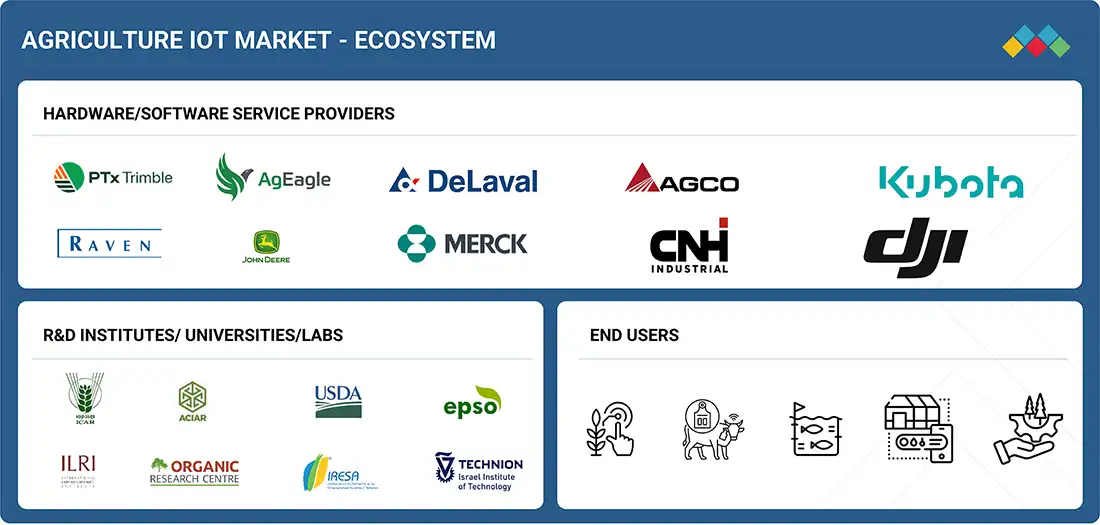
Agriculture IoT Market Growth: COMMERCIAL USE CASES ACROSS INDUSTRIES
| COMPANY | USE CASE DESCRIPTION | BENEFITS |
|---|---|---|
 |
Precision farming with high-resolution satellite imagery via Planet Labs partnership, integrated into the Cropwise digital agriculture platform | Enables early anomaly detection, improved decision-making, reduced input costs, higher yields, and sustainable farming practices |
 |
IoT-powered sensors with multi-network SIM cards for monitoring fruit size in real-time and uploading data to the cloud | Enhances forecasting and inventory management, reduces food waste, aligns fruit yield with market demand, and improves grower profitability |
 |
Drone-based remote sensing and satellite analytics to monitor crop health, water usage, and pest activity in California’s agriculture sector | Enabled early detection of stress, reduced water and chemical usage, optimized inputs, increased yields, lowered operational costs, and improved sustainability |
 |
Precision farming solutions for cotton farmers in Parbhani, Maharashtra, through a digital platform delivering real-time insights on crop management, soil health, and weather | Improved cotton yields, better pest and disease control, optimized resource utilization, enhanced crop quality, and increased farmer profitability |
 |
Precision herbicide spraying in sugarcane plantations of Paraná, Brazil, using DJI Agras T40 drones with mapping support from DJI Mavic 3M for optimized chemical application | Treated 4,000+ hectares with reduced chemical costs, lower environmental impact, improved weed control, healthier crops, enhanced efficiency, and greater operational agility. |
Logos and trademarks shown above are the property of their respective owners. Their use here is for informational and illustrative purposes only.
Related Ecosystem
Electronics System And Components
- Sensors
- Temperature Sensors
- Pressure Sensors
- Actuators
- Image Sensors
- Lenovo
- Samsung
- Texas Instruments Incorporated
- HONEYWELL INTERNATIONAL INC.
- Teledyne Technologies Incorporated
Internet Of Things And M2M
- Sensors
- Cellular Network
- Digital Signal Processor (DSP)
- Global Positioning System (GPS)
- Image Sensors
- MITSUI ELECTRONICS INC
- MICROSOFT CORPORATION
- INTEL CORPORATION
- Amazon.com, Inc.
- Cisco Systems, Inc.
Key Takeaways
- Europe's Agriculture IoT market will grow from $2,607.4M (2025) to $3,666.0M (2030) at a 7.1% CAGR, driven by precision farming adoption and EU sustainability mandates.
- Europe leads in integrating IoT with environmental compliance, leveraging regulatory frameworks to accelerate smart farming technology deployment across the region.
- Europe's mature semiconductor and electronics infrastructure enables rapid innovation in agricultural sensors, edge computing, and real-time crop monitoring solutions.
- Between 2025 and 2030, Europe expects increased farmer adoption of data-driven decision-making and automated irrigation systems to reduce resource consumption and carbon footprints.
Agriculture IoT Market Report Scope
| Report Metric | Details |
|---|---|
| Base Year | 2025 |
| Fastest Growing Segment | GPS TRACKERS (Type) |
| Forecast Period | 2025-2030 |
| Growth Rate | CAGR of 7.3% from 2025 to 2030 |
| Largest Segment | PRECISION FARMING HARDWARE (Hardware) |
| Market Size Base Year (Billions) | ~USD 8.87 (2025) |
| Revenue Forecast (Billions) | ~USD 12.61 (2030) |
| Segments Covered | Hardware, Type, Drones/Uavs, Application, Farm Production Planning, Farm Size |
Europe Agriculture IoT Market Report Segmentation
6 segment dimensions are covered across the global market.
By Hardware
- Livestock Monitoring Hardware
- Monitoring Hardware
- Other Hardware
- Precision Aquaculture Hardware
- Precision Farming Hardware
- Precision Forestry Hardware
- Smart Greenhouse Hardware
By Type
- Automation & Control Systems
- Camera Systems
- Cameras
- Climate Sensors
- Control Systems
- Drones/Uavs
- Gps Trackers
- Gps/Gnss Trackers
- Guidance & Steering
- Harvester & Forwarder
- Hvac Systems
- Irrigation Controllers
- Irrigation Systems
- Led Grow Lights
- Other Automation & Control Systems
- Other Precision Aquaculture Hardware
- Other Precision Forestry Hardware
- Rfid Sensors
- Rfid Tags & Readers
- Sensing & Monitoring Devices
- Sensors
- Sensors & Cameras
- Soil Sensors
- Uavs/Drones
- Variable Rate Controllers
- Water Sensors
- Yield Monitors
By Drones/Uavs
- Drones/Uavs
By Application
- Livestock Monitoring
- Other Applications
- Precision Aquaculture
- Precision Farming
- Precision Forestry
- Smart Greenhouse
By Farm Production Planning
- Post-Production
- Pre-Production
- Production
- Production Planning
By Farm Size
- Large
- Medium
- Small
REST OF EUROPE: AGRICULTURE IOT MARKET, BY APPLICATION, 2025–2030
| Segment | 2025 | 2026 | 2027 | 2028 | 2029 | 2030 | CAGR (%) |
|---|---|---|---|---|---|---|---|
| LIVESTOCK MONITORING | 13.3 | 13.4 | 17.5 | 17.8 | 18 | 18.2 | 6.5 |
| OTHER APPLICATIONS | 2.6 | 2.9 | 3.1 | 3.4 | 3.7 | 4.1 | 9.9 |
| PRECISION AQUACULTURE | 21.4 | 22.6 | 26.2 | 29.8 | 33.4 | 37.7 | 11.9 |
| PRECISION FARMING | 104.3 | 106.1 | 108.2 | 108.9 | 109.5 | 111.5 | 1.3 |
| PRECISION FORESTRY | 37.9 | 40.4 | 42.6 | 42.8 | 44.5 | 47.1 | 4.5 |
| SMART GREENHOUSE | 29.9 | 31.7 | 33.1 | 33.2 | 33.4 | 33.4 | 2.2 |
| TOTAL | 209.4 | 217.1 | 230.7 | 235.9 | 242.6 | 251.9 | 3.8 |
Target Audience
- IoT Solution Providers : Companies developing agricultural IoT platforms, sensors, and connectivity solutions need Europe-specific market data to identify growth opportunities, prioritize country expansion, and tailor offerings to regional regulatory requirements.
- Agricultural Equipment Manufacturers : Farm equipment and machinery producers require insights into IoT integration trends and smart farming adoption rates across European markets to develop connected products and enhance competitive positioning.
- Investment & Private Equity Firms : Investors evaluating opportunities in European agritech need detailed market sizing, growth forecasts, and regional dynamics to make informed funding decisions and identify high-potential acquisition targets.
- Agricultural Cooperatives & Farmers : European farming organizations and large-scale agricultural operations need market intelligence on available IoT solutions, cost-benefit analyses, and adoption best practices to optimize operations and sustainability.
- Government & Policy Makers : EU and national agricultural authorities require market research to inform digital agriculture policies, subsidy programs, and sustainability initiatives that support IoT adoption and rural economic development.
Countries within Europe - compare and drill down
| Country | 2025 size (native) |
|---|---|
| Germany | USD 991.7 Million |
| UK | USD 310.5 Million |
| France | USD 360.4 Million |
| Italy | USD 192.2 Million |
| Netherlands | USD 166.4 Million |
| Poland | USD 110.9 Million |
| Nordics | USD 78.9 Million |
| Rest Of Europe | USD 111.5 Million |
Country market size visualization
Reasons to Buy this Report
- Regional Market Segmentation : Gain detailed insights into Europe's Agriculture IoT market broken down by key countries including Germany, France, UK, Italy, Netherlands, and Poland, enabling targeted market entry and expansion strategies.
- Growth Trajectory Analysis : Understand the 7.1% CAGR growth dynamics specific to Europe through 2030, with forecasts and trend analysis to support investment decisions and business planning in the region.
- Competitive Landscape Intelligence : Identify leading IoT solution providers, sensor manufacturers, and technology integrators operating across European agricultural markets to benchmark competitive positioning and partnership opportunities.
- Regulatory & Policy Insights : Access comprehensive analysis of EU agricultural policies, sustainability mandates, and digital transformation initiatives that drive IoT adoption and create market opportunities across member states.
- Technology Adoption Trends : Discover which IoT technologies (sensors, connectivity, analytics platforms) are gaining traction in European agriculture, helping stakeholders align product development with regional market demands.
Frequently asked questions
What is the current size of Europe's Agriculture IoT market in 2025?
Europe's Agriculture IoT market is valued at $2,607.4 million in 2025, representing a significant segment of the global market driven by precision farming initiatives and EU sustainability regulations.
What is the projected size of Europe's Agriculture IoT market by 2030?
Europe's Agriculture IoT market is projected to reach $3,666.0 million by 2030, reflecting a 7.1% compound annual growth rate over the forecast period.
What factors are driving growth in Europe's Agriculture IoT market?
Europe's Agriculture IoT growth is driven by EU green farming mandates, increasing labor costs, strong technology infrastructure, regulatory support for sustainability, and farmer adoption of data-driven precision agriculture practices.
How does Europe's Agriculture IoT market compare to global growth rates?
Europe's Agriculture IoT market is growing at 7.1% CAGR, slightly below the global average of 7.3%, reflecting the region's mature market status and focus on sustainable, compliance-driven adoption.
What technologies are most prevalent in Europe's Agriculture IoT ecosystem?
Europe's Agriculture IoT ecosystem emphasizes advanced sensors, real-time crop monitoring solutions, automated irrigation systems, edge computing devices, and data analytics platforms integrated with environmental compliance frameworks.
RESEARCH METHODOLOGY
The research study involved four major steps in estimating the size of the agriculture IoT market. Exhaustive secondary research has been done to collect important information about the market and peer markets. The next step has been to validate these findings and assumptions and size them with the help of primary research with industry experts across the value chain. Both top-down and bottom-up approaches have been used to estimate the market size. After this, the market breakdown and data triangulation approaches have been adopted to estimate the market sizes of segments and subsegments.
Secondary Research
Various secondary sources have been referred to in the secondary research process to identify and collect important information for this study. The secondary sources include annual reports, press releases, and investor presentations of companies; white papers; journals and certified publications; and articles from recognized authors, websites, directories, and databases. Secondary research has been conducted to obtain key information about the industry's supply chain, the market's value chain, the total pool of key players, market segmentation according to the industry trends (to the bottom-most level), regional markets, and key developments from market- and technology-oriented perspectives. The secondary data has been collected and analyzed to determine the overall market size, further validated by primary research.
Primary Research
Extensive primary research has been conducted after understanding the agriculture IoT market scenario through secondary research. Several primary interviews have been conducted with key opinion leaders from demand- and supply-side vendors across major regions— North America, Europe, Asia Pacific, RoW. This primary data has been collected mainly through telephonic interviews, which consist of 80% of the total primary interviews; questionnaires, and emails:
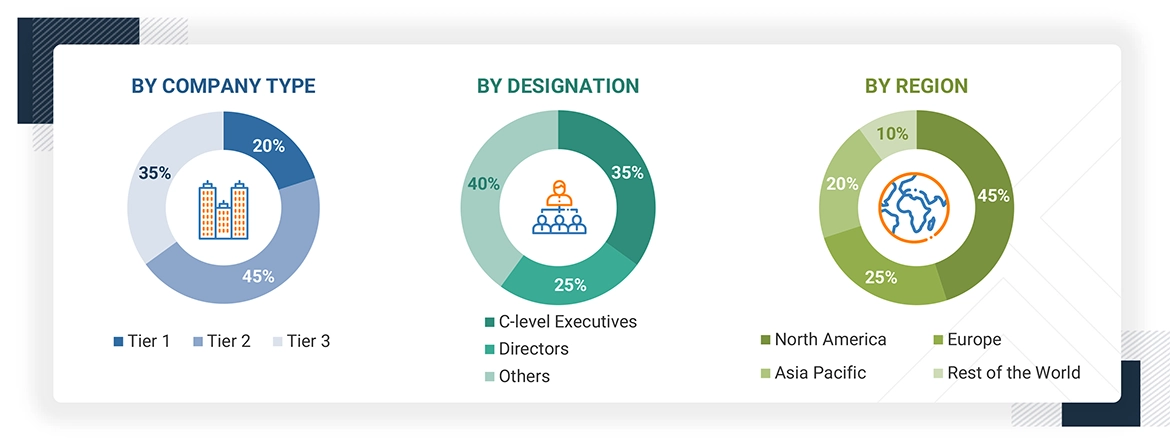
Note: Others include sales, marketing, and product managers.
To know about the assumptions considered for the study, download the pdf brochure
Market Size Estimation
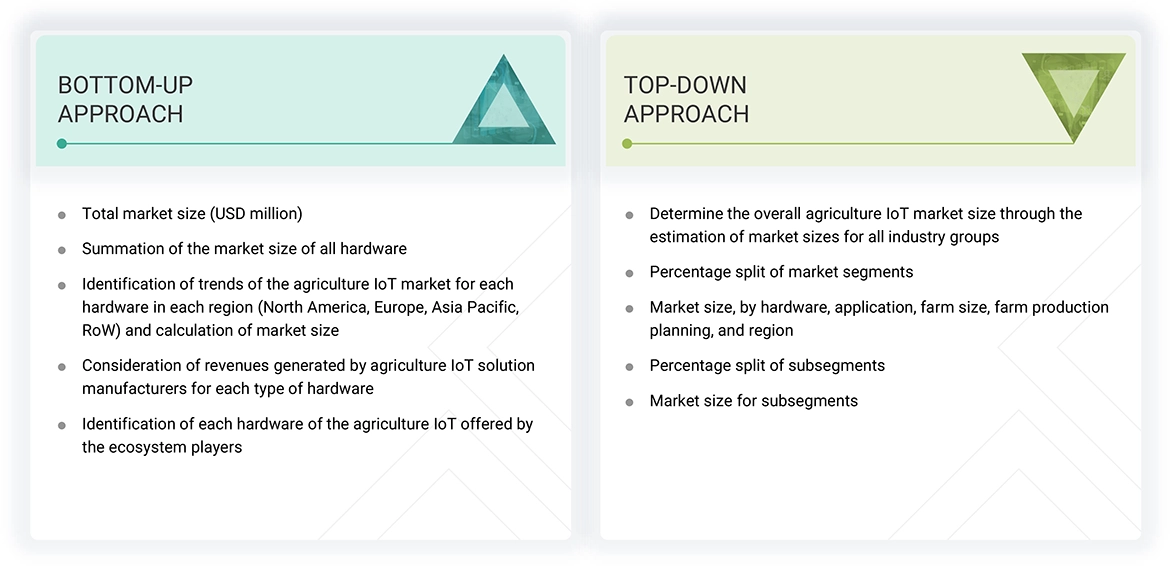
In the market engineering process, both top-down and bottom-up approaches and data triangulation methods have been used to estimate and validate the size of the agriculture IoT and other dependent submarkets. The research methodology used to estimate the market sizes includes the following:
- Identifying the players in the agriculture IoT market, along with their offerings
- Analyzing major manufacturers of agriculture IoT Solutions, studying their portfolios, and understanding several types of products based on their features and functions
- Tracking ongoing and upcoming developments in the market, such as investments made, R&D activities, product launches, acquisitions, partnerships, and forecasting the market based on these developments and other critical parameters
- Identification of each hardware of the agriculture IoT offered by the ecosystem players
- Consideration of revenues generated by agriculture IoT solution manufacturers for each type of hardware
- Identification of trends of the agriculture IoT market for each hardware in each region (North America, Europe, Asia Pacific, Rest of the World) and calculation of market size
- Summation of the market size of all hardware and deriving the total market size (USD million)
- Conducting multiple discussions with key opinion leaders to understand different agriculture IoT hardware, applications, and current trends in the market, thereby analyzing the breakup of the scope of work carried out by major manufacturing companies
- Arriving at the market estimates by analyzing the revenues of these companies generated from different types of products, and then combining the same to get the market estimate by region
- The pricing of various product types is calculated separately to analyze the shipment of the precision farming hardware category.
- Verifying and cross-checking the estimates at every level by discussing with key opinion leaders, such as CXOs, directors, and operations managers, and finally with the domain experts in MarketsandMarkets
- Studying various paid and unpaid sources of information, such as annual reports, press releases, white papers, and databases
Agriculture IoT Market : Top-Down and Bottom-Up Approach
Data Triangulation
After arriving at the overall market size, using the market size estimation processes as explained above, the market has been split into several segments and subsegments. Data triangulation and market breakdown procedures have been employed to complete the entire market engineering process and arrive at each market segment's and subsegment's exact statistics. The data has been triangulated by studying various factors and trends from the demand and supply sides in the agriculture IoT market.
Market Definition
The Agriculture IoT Market encompasses solutions that assess and track the quality, performance, and health of Agriculture IoT refers to the application of Internet of Things (IoT) technologies in agriculture, where interconnected devices such as sensors, monitors, cameras, controllers, and connectivity technologies are used in farming operations to collect and exchange real-time data. This integration enables monitoring, analysis, and optimization of agricultural activities, facilitating precision farming, efficient resource utilization (such as water, fertilizers, and energy), enhanced crop and livestock management, and data-driven decision-making to improve productivity, sustainability, and operational efficiency.
Key Stakeholders
- Agriculture IoT component providers
- Product manufacturers
- Agriculture IoT-related associations, organizations, forums, and alliances
- Government and corporate bodies
- Research institutes and organizations
- Venture capitalists, private equity firms, and start-ups
- Distributors and traders
- End users
- Market research and consulting firms
- Agri-food buyers
- Agriculture technology providers
Report Objectives
- To describe and forecast the size of the agriculture IoT market by hardware, farm size, farm production planning, application, and region in terms of value
- To estimate the market size of various segments across four key regions, North America, Europe, Asia Pacific, and RoW, in terms of value
- To forecast the size of the agriculture IoT market by automation & control systems, in terms of volume
- To provide detailed information regarding the drivers, restraints, opportunities, and challenges influencing the growth of the agriculture IoT market
- To evaluate the agriculture IoT value chain and ecosystem, along with the average selling price of drones/UVAs
- To strategically analyze the regulatory landscape, tariffs, standards, patents, Porter's five forces, import and export scenarios, AI/Gen AI impact, trade values, the 2025 US Tariff, and case studies pertaining to the market under study
- To understand micromarkets with regard to individual growth trends, prospects, and contributions to the overall market
- To study opportunities in the market for stakeholders by identifying high-growth segments
- To provide details of the competitive landscape for market leaders
- To offer details of the macroeconomic outlook for regions
- To analyze strategies such as product launches, contracts, collaborations, and acquisitions adopted by players in the agriculture IoT market
- To profile key players in the agriculture IoT market and comprehensively analyze their market ranking based on their revenue, market share, and core competencies
Available Customizations:
With the given market data, MarketsandMarkets offers customizations according to the specific requirements of companies. The following customization options are available for the report:
- Detailed analysis and profiling of additional market players based on various blocks of the supply chain
Get the Full Agriculture IoT Market Report
Full forecast, segment splits, and company analysis for all Agriculture IoT Market.
- US Agriculture IoT Market
- Canada Agriculture IoT Market
- Mexico Agriculture IoT Market
- Germany Agriculture IoT Market
- UK Agriculture IoT Market
- Italy Agriculture IoT Market
- Netherlands Agriculture IoT Market
- Poland Agriculture IoT Market
- China Agriculture IoT Market
- Japan Agriculture IoT Market
- Australia Agriculture IoT Market
- India Agriculture IoT Market
- South Korea Agriculture IoT Market
- Indonesia Agriculture IoT Market
- Malaysia Agriculture IoT Market
- Thailand Agriculture IoT Market
- Vietnam Agriculture IoT Market
- France Agriculture IoT Market
- Nordics Agriculture IoT Market
- Rest Of Europe Agriculture IoT Market
- Rest Of Asia Pacific Agriculture IoT Market
- Africa Agriculture IoT Market
- Middle East Agriculture IoT Market
- South America Agriculture IoT Market
- Argentina Agriculture IoT Market
- Brazil Agriculture IoT Market
- Rest Of South America Agriculture IoT Market
- Bahrain Agriculture IoT Market
- Kuwait Agriculture IoT Market
- Oman Agriculture IoT Market
- Qatar Agriculture IoT Market
- Rest Of Middle East Agriculture IoT Market
- Saudi Arabia Agriculture IoT Market
- UAE Agriculture IoT Market
- Rest Of Africa Agriculture IoT Market
- South Africa Agriculture IoT Market
Need a Tailored Report?
Customize this report to your needs
Get 10% FREE Customization
Customize This Report
