
Australia Laboratory Equipment Services Market (2025-2030)

The Australia Laboratory Equipment Services Market was valued at $190.1 Million in 2025 and projected to reach to $408.3 Million by 2030, representing a compound annual growth rate of CAGR 13.6%. Australia's laboratory equipment services market is positioned for substantial expansion through 2030, driven by modernization of healthcare facilities and increased diagnostic testing demand.


| Market Size in | USD 26.32 MN |
| Market Forecast in | |
| CAGR | |
| Forecast Period | |
| Units Considered | Value (USD MN) |
Australia Laboratory Equipment Services Market Trends and Insights
- This represents a compound annual growth rate of 13.6%, reflecting strong demand across Australia's healthcare and research sectors.
- Australia's market expansion is driven by increasing investments in diagnostic infrastructure, rising adoption of advanced laboratory technologies, and growing emphasis on preventive healthcare throughout the country. The laboratory equipment services sector in Australia encompasses maintenance, calibration, repair, and technical support services essential for healthcare facilities, research institutions, and diagnostic laboratories.
- Australia's healthcare modernization initiatives and regulatory compliance requirements are accelerating the adoption of specialized equipment services.
- Between 2025 and 2030, Australia is expected to see significant growth in service demand as laboratories upgrade aging equipment and expand capacity to meet rising patient volumes and research needs..
Key Market Statistics
- CAGR (2025-2030) CAGR 13.6%
- Market Size, 2025 ~USD 190.1 Million
- Forecast, 2030 ~USD 408.3 Million
- Country Australia
Australia Laboratory Equipment Services Market Overview
Market Valuation Growth :
Australia's laboratory equipment services market is valued at USD 190.1 million in 2025, with projections reaching USD 408.3 million by 2030, demonstrating a strong 13.6% CAGR over the forecast period.
Healthcare Infrastructure Investment :
Increasing government and private sector investments in Australia's diagnostic infrastructure are driving demand for advanced laboratory equipment services across hospitals, pathology labs, and research institutions.
Research Sector Expansion :
Australia's growing research and development activities, particularly in biotechnology and pharmaceutical sectors, are creating sustained demand for specialized laboratory equipment maintenance and support services.
Outpacing Global Growth :
Australia's market CAGR of 13.6% is slightly below the global average of 15%, indicating competitive positioning while maintaining steady regional growth momentum through 2030.
Australia Laboratory Equipment Services Market Dynamics
- The country's strong healthcare system and investment in research infrastructure create favorable conditions for service providers.
- Rising adoption of automated laboratory systems and preventive maintenance programs further supports market growth.
- Additionally, Australia's focus on precision medicine and advanced diagnostics strengthens the need for specialized equipment services.
- The market's 13.6% CAGR reflects confidence in sustained healthcare spending and research funding, with opportunities emerging across metropolitan and regional healthcare networks..
Market Ecosystem
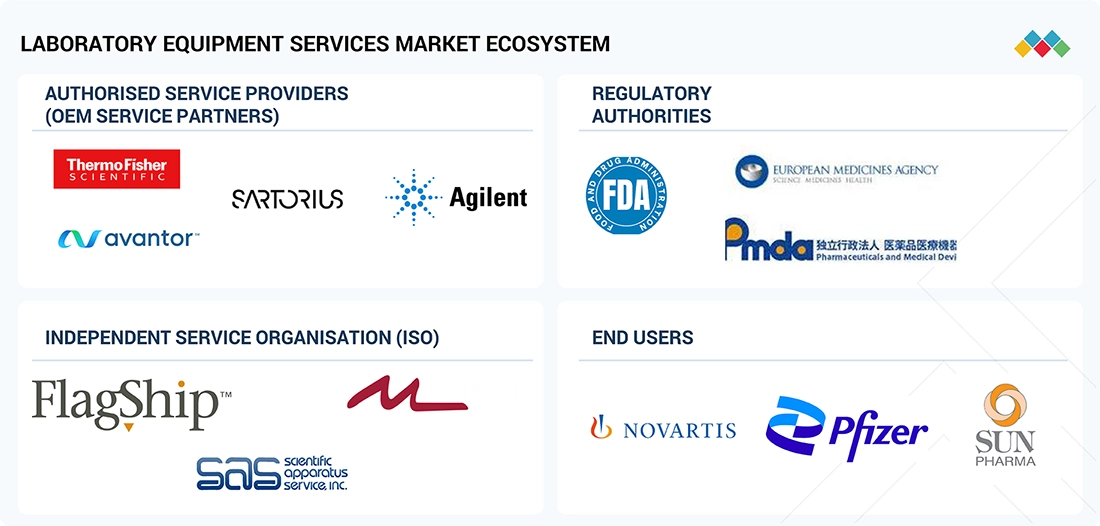
LABORATORY EQUIPMENT SERVICES MARKET: COMMERCIAL USE CASES ACROSS INDUSTRIES
| COMPANY | USE CASE DESCRIPTION | BENEFITS |
|---|---|---|
 |
Maintenance & repair services, preventive maintenance plans, calibration & instrument qualification (IQ/OQ/PQ), compliance services, remote diagnostics, multi-instrument service plans | Maximizes equipment uptime | Ensures regulatory compliance | Reduces operational disruption | Offers wide instrument coverage for simplified vendor management | Supports high-throughput labs |
 |
Calibration, maintenance & repair for analytical instruments (chromatography, spectroscopy, MS systems), equipment performance verification, compliance services, service contracts, spare-parts support | High-reliability servicing for complex analytical instruments | Ensures precision & data accuracy | Supports regulatory compliance | Extends equipment lifespan | Trusted by pharma & biotech labs |
 |
Full life-cycle services, including installation, commissioning, qualification (IQ/OQ), preventive maintenance & service contracts, accredited calibration (pipettes, balances, liquid handling), repairs, spare-part support | Ensures high accuracy and reproducibility | Supports GMP/GLP compliance | Minimizes downtime | Provides traceable, ISO-compliant calibration | Predictable maintenance costs with contract plans |
 |
Installation, validation & qualification (IQ/OQ/PQ), calibration, preventive maintenance, repair, pipette calibration, multi-vendor equipment servicing, equipment relocation, asset & inventory management | Vendor-agnostic service simplifies lab operations | Improves compliance and traceability | Reduces downtime | Supports cost-effective lifecycle management | Ideal for multi-vendor laboratories |
Logos and trademarks shown above are the property of their respective owners. Their use here is for informational and illustrative purposes only.
Related Ecosystem
Analytical And Scientific Instrumentation
- Environmental Testing
- Gas Chromatography
- Polymerase Chain Reaction (PCR)
- Automated Liquid Handling Systems
- Flow Cytometry
- Thermo Fisher Scientific Inc.
- Danaher Corporation
- Agilent Technologies, Inc.
- Merck KGaA
- Shimadzu Corporation
Key Takeaways
- Australia's laboratory equipment services market will more than double from USD 190.1M (2025) to USD 408.3M (2030), driven by healthcare infrastructure expansion.
- The 13.6% CAGR in Australia reflects strong demand for maintenance and technical support services across diagnostic and research laboratories.
- Australia's regulatory compliance requirements and equipment modernization initiatives are key growth catalysts for specialized laboratory services.
- Australia's aging laboratory infrastructure and rising diagnostic volumes create sustained demand for equipment servicing and support solutions through 2030.
Laboratory Equipment Services Market Report Scope
| Report Metric | Details |
|---|---|
| Base Year | 2025 |
| Fastest Growing Segment | INSTALLATION, REPAIR, BREAKDOWN, AND MAINTENANCE SERVICES (Service Type) |
| Forecast Period | 2025–2030 |
| Growth Rate | CAGR of 15% from 2025 to 2030 |
| Largest Segment | OEMS (Service Provider) |
| Market Size Base Year (Billions) | ~USD 23.56 (2025) |
| Revenue Forecast (Billions) | ~USD 47.39 (2030) |
| Segments Covered | Service Type, Service Provider, Type, Equipment Type, Contract Type, Type 2024–2031 |
Australia Laboratory Equipment Services Market Report Segmentation
6 segment dimensions are covered across the global market.
By Service Type
- Calibration Services
- Contract/Managed Services
- Installation, Repair, Breakdown, And Maintenance Services
- Other Services
- Preventive Maintenance Services
- Qualification & Validation Services
- Training, Education, And Certification Services
By Service Provider
- Distributor-Led Service Providers
- Oems
- Third-Party Service Providers
By Type
- Multi-Brand OEM Services
- OEM-Affiliated Services
By Equipment Type
- Analytical Equipment
- General Equipment
- Specialty Equipment
- Support Equipment
By Contract Type
- Customized Support Plans
- Gold Support Plans
- Other Support Plans
- Platinum Support Plans
- Silver Support Plans
By Type 2024–2031
- Multi-Brand OEM Services
- OEM-Affiliated Services
Target Audience
- Laboratory Equipment Service Providers : Service companies need Australia-specific market data to understand demand trends, competitive landscape, and growth opportunities to optimize service offerings and expand operations across the country.
- Healthcare Facility Administrators : Hospital and pathology lab managers require market insights to budget for equipment services, evaluate vendor options, and plan infrastructure investments aligned with market growth trends.
- Medical Device Manufacturers : Equipment manufacturers need Australia market analysis to identify service revenue opportunities, develop regional support strategies, and understand aftermarket service demand drivers.
- Investment & Private Equity Firms : Investors evaluating opportunities in Australia's healthcare sector need market sizing and growth forecasts to assess acquisition targets, portfolio companies, and regional expansion potential.
- Research & Academic Institutions : University and research center procurement teams need market data to understand equipment service trends, budget planning, and vendor selection criteria for laboratory infrastructure investments.
Key Companies in the Australia Laboratory Equipment Services Market
| Company | HQ | Ownership | Strongest segments |
|---|---|---|---|
| STANDEX INTERNATIONAL CORPORATION | United States | Public Company | Installation, Repair, Breakdown, and Maintenance,Preventive Maintenance Services,Calibration, |
| UNILABS | Switzerland | Private Company | Installation, Repair, Breakdown, and Maintenance,Calibration,Qualification & Validation, |
| THERMO FISHER SCIENTIFIC INC. | United States | Public Company | Installation, Repair, Breakdown, and Maintenance Services,Calibration Services,Qualification & Validation Services, |
| AGILENT TECHNOLOGIES | United States | Public Company | Installation, Repair, Breakdown, and Maintenance,Calibration,Qualification & Validation, |
| DANAHER CORPORATION | United States | Public Company | Analytical Equipment Services,Specialty Equipment Services,General Equipment Services, |
| MERCK KGAA | United States | ||
| BRUKER | United States | Public Company | Installation, Repair, Breakdown, and Maintenance,Calibration Services,Qualification & Validation Services, |
| EPPENDORF SE | Germany | Private Company | Installation, Repair, Breakdown, and Maintenance,Calibration,Preventive Maintenance Services, |
| BIO-RAD LABORATORIES, INC. | United States | Public Company | Installation, Repair, Breakdown, and Maintenance,Calibration; Qualification & Validation,Preventive Maintenance Services, |
| SIEMENS HEALTHINEERS | Germany |
STANDEX INTERNATIONAL CORPORATION
Standex International Corporation is a publicly traded United States company founded in 1955 with 4,100 employees.
UNILABS
Unilabs is a Swiss private company established in 1987 with 1,897 employees providing laboratory services.
THERMO FISHER SCIENTIFIC INC.
Thermo Fisher Scientific Inc. is a publicly traded United States company founded in 1956 with 125,000 employees, operating as a major life sciences and diagnostics provider.
AGILENT TECHNOLOGIES
Agilent Technologies is a publicly traded United States company founded in 1999 with 18,000 employees specializing in life sciences and diagnostics instrumentation.
DANAHER CORPORATION
Danaher Corporation is a publicly traded United States company founded in 1969 with 59,000 employees operating across diversified industrial and life sciences sectors.
MERCK KGAA
Insufficient data available to generate a business description for Merck KGaA.
BRUKER
Bruker is a publicly traded United States company founded in 1960 with 11,085 employees specializing in scientific instruments and analytical equipment.
EPPENDORF SE
Eppendorf SE is a German private company founded in 1945 with 4,358 employees manufacturing laboratory equipment and supplies.
BIO-RAD LABORATORIES, INC.
Bio-Rad Laboratories, Inc. is a publicly traded United States company founded in 1952 with 7,450 employees providing life science research and clinical diagnostics products.
SIEMENS HEALTHINEERS
Insufficient data available to generate a business description for Siemens Healthineers.
Reasons to Buy this Report
- Market Size & Growth Validation : Obtain precise valuation data for Australia's laboratory equipment services market (USD 190.1M in 2025) with verified 13.6% CAGR forecasts through 2030 to support investment and expansion decisions.
- Competitive Positioning Intelligence : Benchmark your organization against Australia-specific market dynamics and identify growth opportunities within the country's healthcare and research sectors relative to global trends.
- Strategic Market Entry Planning : Access detailed Australia market analysis to develop targeted go-to-market strategies, understand regional demand drivers, and allocate resources effectively for market penetration.
- Investment Decision Support : Leverage comprehensive Australia market forecasts and growth projections to justify capital investments, secure funding, and make informed decisions about service expansion in the region.
- Stakeholder Communication : Present credible, Australia-specific market data to investors, board members, and partners to demonstrate market opportunity, validate business plans, and build confidence in regional growth strategies.
Frequently asked questions
What is the current size of Australia's laboratory equipment services market?
Australia's laboratory equipment services market is valued at USD 190.1 million in 2025 and is projected to grow to USD 408.3 million by 2030.
What is the expected growth rate for Australia's laboratory equipment services market?
Australia's laboratory equipment services market is expected to grow at a compound annual growth rate (CAGR) of 13.6% from 2025 to 2030.
What services are included in Australia's laboratory equipment services market?
Australia's market includes maintenance, calibration, repair, technical support, and equipment lifecycle management services for diagnostic and research laboratories.
What are the primary drivers of growth in Australia's laboratory equipment services market?
Key drivers in Australia include healthcare infrastructure modernization, regulatory compliance requirements, aging equipment replacement, and increased diagnostic demand.
Which sectors are the largest consumers of laboratory equipment services in Australia?
Australia's primary consumers include public and private hospitals, diagnostic laboratories, research institutions, and pathology centers requiring specialized equipment support.
RESEARCH METHODOLOGY
The size of the laboratory equipment services market was determined based on primary studies to ensure precision. Initial data for the market and related niches were collected from 3 to 5 secondary sources. This information was then validated through primary research to confirm assumptions and overall market size. Both top-down and bottom-up methods were used to estimate the total market, which was then broken down into segment and subsegment sizes. Finally, data triangulation was performed to verify the accuracy of the data findings.
Secondary Research
Secondary research sources included directories, Factiva, white papers, Bloomberg Business, annual reports, SEC filings, business filings, and investor presentations. These sources provided valuable insights into market leaders, sector divisions, and technological differences within various segments of the laboratory equipment services industry.
Primary Research
Primary research involved both quantitative and qualitative insights collected through interviews with key stakeholders. On the demand side, participants included researchers, department heads, and staff from diagnostic centers, clinical research organizations, and research institutes. On the supply side, interviews were held with CEOs, area sales managers, territory and regional sales managers, and other top executives from relevant companies. These direct conversations helped verify the secondary research findings and provided an opportunity to directly ask questions and confirm details and assumptions.
A breakdown of the primary respondents is provided below:
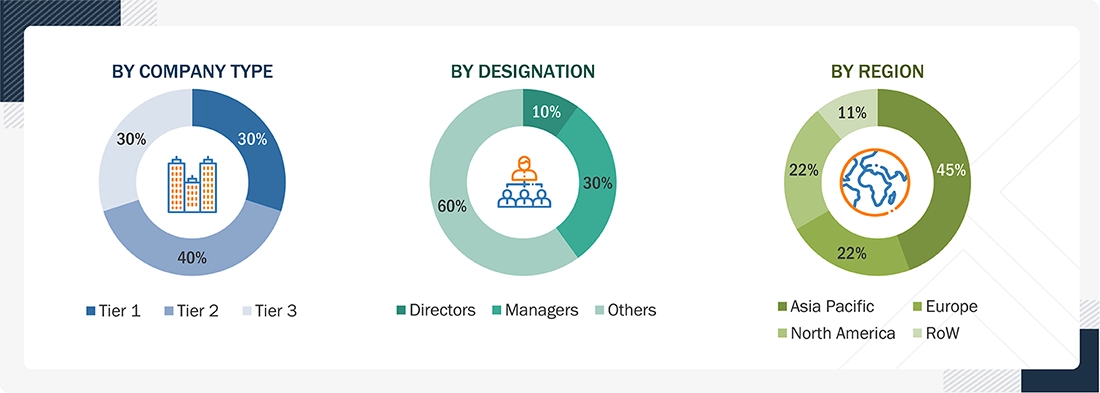
Note 1: Others include sales managers, marketing managers, business development managers, product managers, distributors, and suppliers
Note 2: Companies are classified into tiers based on their total revenue. As of 2024, Tier 1 = >USD 1 billion, Tier 2 = <USD 500 million, and Tier 3 = <USD 100 million
To know about the assumptions considered for the study, download the pdf brochure
Market Size Estimation
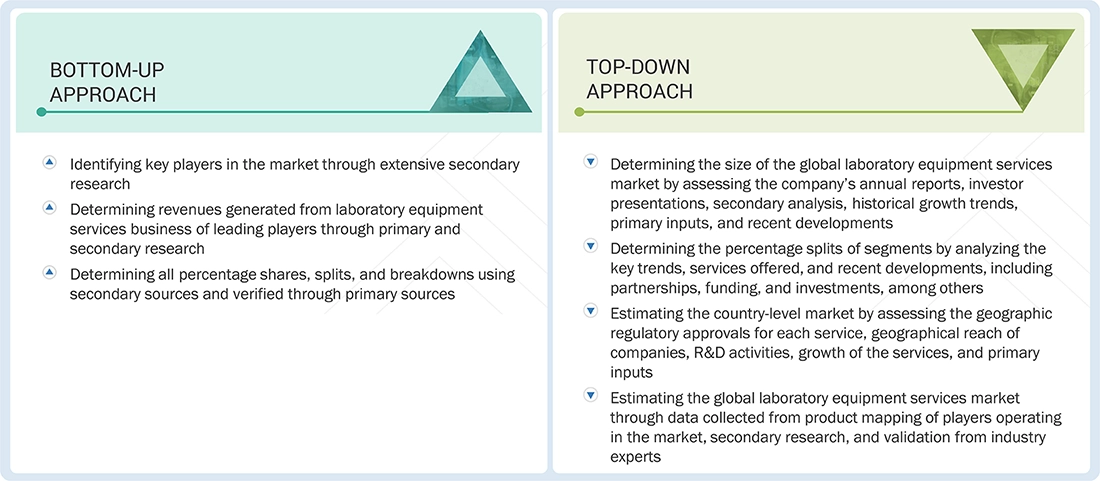
This report used the revenue share analysis of major companies to assess the size of the global laboratory equipment services market. This analysis involved identifying key market players and calculating their revenue from laboratory equipment services using data collected during both primary and secondary research phases. One part of the secondary research included reviewing the annual and financial reports of leading market companies. In contrast, primary research consisted of detailed interviews with influential thought leaders, including directors, CEOs, and key marketing executives.
To determine the overall market value, the segmental revenue was calculated by mapping the revenue of the leading solution and service providers. The process involved several steps.
- Making a list of leading international companies in the laboratory equipment service industry
- Charting annual profits made by leading companies in the laboratory equipment services sector (or the closest stated business unit/product category)
- 2024 revenue mapping of leading companies to cover a significant portion of the global market
- Calculating the global value of the laboratory equipment services industry
Laboratory Equipment Services Market: Bottom-up and Top-down Approach
Market Definition
Laboratory equipment maintenance services provide the professional support your laboratory equipment needs to operate correctly, safely, and efficiently throughout its lifecycle. Laboratory equipment services are activities related to the installation, calibration, maintenance, repair, testing and management of laboratory equipment used in research, clinical diagnostics, biotechnology, pharmaceutical and industrial testing. These services ensure that your equipment operates accurately, meets regulatory standards, and remains reliable in everyday use. This market includes services provided by OEMs, third-party service providers, and in-house technology teams that strive to reduce equipment downtime, extend equipment life, and support high-quality laboratory operations.
Data Triangulation
To ensure accurate data, the laboratory equipment services market was divided into various segments and subsegments. A data triangulation process that used both top-down and bottom-up approaches was applied. This involved analyzing factors and trends from both the demand and supply sides to validate the findings for each segment. The combination of this segmentation with the triangulation process helps ensure that the market data is both accurate and reliable.
Key Stakeholders
- Service providers of laboratory equipment’s
- Researchers such as clinical research organizations, research institutes, diagnostic laboratories
- Research professionals, including scientists, pathologist
- Regulatory bodies overseeing product standards and safety
Objectives of the Study
- To define, describe, and forecast the laboratory equipment services market based on service type, service provider, equipment type, contract type, and region
- To provide detailed information regarding the major factors influencing the growth of the market (drivers, restraints, opportunities, and industry-specific challenges)
- To strategically analyze micromarkets with respect to individual growth trends, prospects, and contributions to the total market
- To analyze opportunities in the market for stakeholders and provide details of the competitive landscape for market leaders
- To forecast the revenue of the market segments with respect to five regions: North America, Europe, the Asia Pacific, Latin America, and the Middle East & Africa
- To profile the key players and comprehensively analyze their market ranking and core competencies
- To benchmark players within the market using a proprietary Company Evaluation Matrix framework, which analyzes market players on various parameters within the broad categories of business strategy excellence and strength of product portfolio
- To analyze competitive developments such as product launches, agreements, expansions, collaborations, and acquisitions in the CT Simulators market
Customization Options
Using market data, MarketsandMarkets offers customization according to your company's requirements. Here are the available customization options for the global laboratory equipment services market.
Service Analysis
- Service matrix, which gives a detailed comparison of the service portfolios of the top fifteen companies.
Company Information
- Detailed analysis and profiling of additional market players (up to 15)
Geographic Analysis
- Further breakdown of the Rest of European laboratory equipment services market into Russia, Belgium, the Netherlands, Switzerland, Austria, Finland, Sweden, Poland, and Portugal, among others
- Further breakdown of the Rest of Asia Pacific laboratory equipment services market into Singapore, Taiwan, New Zealand, the Philippines, Malaysia, and other Asia Pacific countries
Get the Full Laboratory Equipment Services Market Report
Full forecast, segment splits, and company analysis for all Laboratory Equipment Services Market.
- US Laboratory Equipment Services Market
- Canada Laboratory Equipment Services Market
- Germany Laboratory Equipment Services Market
- UK Laboratory Equipment Services Market
- France Laboratory Equipment Services Market
- Italy Laboratory Equipment Services Market
- Spain Laboratory Equipment Services Market
- China Laboratory Equipment Services Market
- Japan Laboratory Equipment Services Market
- India Laboratory Equipment Services Market
- South Korea Laboratory Equipment Services Market
- Rest Of Europe Laboratory Equipment Services Market
- Rest Of Asia Pacific Laboratory Equipment Services Market
Need a Tailored Report?
Customize this report to your needs
Get 10% FREE Customization
Customize This Report
