
Japan Lubricants Market (2025-2030)

The Japan Lubricants Market was valued at $8234.4 Million in 2025 and projected to reach to $9296 Million by 2030, representing a compound annual growth rate of CAGR 2.45%. Japan's lubricants market is positioned for steady, predictable growth driven by its mature industrial base and advanced automotive sector.


| Market Size in | USD 26.32 MN |
| Market Forecast in | |
| CAGR | |
| Forecast Period | |
| Units Considered | Value (USD MN) |
Japan Lubricants Market Trends and Insights
- Japan maintains a mature and stable lubricants sector, driven by its advanced automotive and industrial manufacturing base.
- The market in Japan reflects steady demand from both the automotive aftermarket and industrial applications, supported by the country's commitment to equipment maintenance and operational efficiency standards. Growth in Japan's lubricants market is underpinned by technological advancements in synthetic and bio-based formulations, as well as regulatory compliance with stringent environmental standards.
- Japan's focus on sustainability and energy efficiency continues to shape product innovation, with manufacturers in Japan increasingly developing high-performance lubricants that reduce friction and extend equipment life.
- Between 2025 and 2030, Japan's market expansion will be supported by ongoing industrial activity and the replacement cycle of automotive and machinery fleets across the region..
Key Market Statistics
- CAGR (2025-2030) CAGR 2.45%
- Market Size, 2025 ~USD 8234.4 Million
- Forecast, 2030 ~USD 9296 Million
- Country Japan
Japan Lubricants Market Overview
Mature Market Stability :
Japan's lubricants market demonstrates steady growth at 2.45% CAGR, reflecting a mature and well-established sector with consistent demand from automotive and industrial sectors.
Advanced Manufacturing Base :
Japan's world-class automotive and precision manufacturing industries drive sustained lubricant consumption, with OEM specifications and high-performance requirements supporting premium product demand.
Market Valuation Growth :
The market is valued at USD 8,234.4 million in 2025 and projected to reach USD 9,296.0 million by 2030, representing approximately USD 1,061.6 million in incremental value creation.
Aftermarket Strength :
Japan's robust automotive aftermarket and industrial maintenance sectors provide consistent revenue streams, supported by aging vehicle fleets and continuous industrial equipment servicing needs.
Japan Lubricants Market Dynamics
- The 2.45% CAGR reflects a stable market with consistent demand from both OEM and aftermarket channels, supported by Japan's reputation for manufacturing excellence and stringent quality standards.
- The market benefits from continuous equipment maintenance cycles and replacement demand across automotive, machinery, and industrial applications. Looking ahead to 2030, Japan's lubricants market will continue to expand moderately as manufacturers adopt advanced formulations for improved efficiency and environmental compliance.
- Growth will be tempered by market maturity and saturation, but supported by technological innovations in synthetic lubricants, industrial automation expansion, and sustained demand from Japan's export-oriented manufacturing sector..
Market Ecosystem
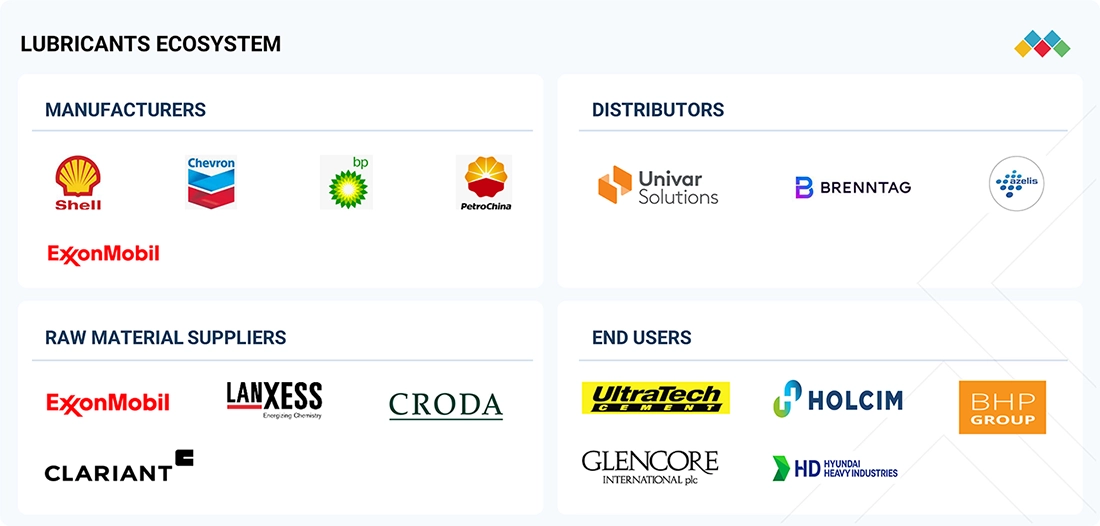
LUBRICANTS MARKET: COMMERCIAL USE CASES ACROSS INDUSTRIES
| COMPANY | USE CASE DESCRIPTION | BENEFITS |
|---|---|---|
 |
Heavy-duty engine and hydraulic system lubrication for construction and mining equipment | Ensures smooth operation under high loads, reduces wear and tear, improves equipment lifespan |
 |
Turbine and generator lubrication in power plants | Enhances thermal stability, reduces friction, and maintains consistent performance in high-temperature operations |
 |
Aircraft engine and component lubrication | Improves fuel efficiency, reduces mechanical wear, and ensures safe, reliable operations under extreme conditions |
 |
Rolling mill and steel processing machinery lubrication | Provides corrosion protection, reduces downtime, and maintains consistent machinery performance in high-stress industrial environments |
Logos and trademarks shown above are the property of their respective owners. Their use here is for informational and illustrative purposes only.
Related Ecosystem
Defence Platforms And Systems
- Sensors
- Unmanned Ground Vehicles (UGV)
- Fighter Aircraft
- Special Mission Aircraft
- Antennas
- BAE Systems plc
- Thales group
- LOCKHEED MARTIN CORPORATION
- Northrop Grumman Corporation
- L3Harris Technologies, Inc.
Farm Equipment And Irrigation
- Sensors
- Hydroponics
- Aeroponics
- Camera Systems
- Global Positioning System (GPS)
- MSK FARM MACHINERY CORPORATION
- MITSUBISHI AGRICULTURAL MACHINERY
- MITSUBISHI CHEMICAL AGRI DREAM
- RIVULIS IRRIGATION
- Deere & Company
Automotive Electronics And Electrical Equipment
- Battery Electric Vehicle (BEV)
- Light Commercial Vehicles (LCVs)
- Fuel Cell Electric Vehicle (FCEV)
- Sensors
- Hybrid Electric Vehicle (HEV)
- BOSCH LIMITED
- DENSO Corporation
- Continental ag
- Panasonic Holdings Corporation
- Texas Instruments Incorporated
Key Takeaways
- Japan's lubricants market is valued at USD 8,234.4 million in 2025 with a projected value of USD 9,296.0 million by 2030.
- Japan's market grows at a CAGR of 2.45%, reflecting steady demand from mature automotive and industrial sectors.
- Japan's regulatory environment and sustainability focus drive innovation in synthetic and environmentally friendly lubricant formulations.
- Japan's market growth is supported by equipment replacement cycles and the country's advanced manufacturing infrastructure.
Lubricants Market Report Scope
| Report Metric | Details |
|---|---|
| Base Year | 2025 |
| Fastest Growing Segment | –FOOD PROCESSING (End-Use Industry) |
| Forecast Period | 2025–2030 |
| Growth Rate | CAGR of 2.8% from 2025 to 2030 |
| Largest Segment | MINERAL OIL LUBRICANTS (Base Oil) |
| Market Size Base Year (Billions) | ~USD 177.78 (2025) |
| Revenue Forecast (Billions) | ~USD 204.1 (2030) |
| Segments Covered | Base Oil, Product Type, End-Use Industry, Vehicle Type |
Japan Lubricants Market Report Segmentation
4 segment dimensions are covered across the global market.
By Base Oil
- Bio-Based Lubricants
- Mineral Oil Lubricants
- Synthetic Lubricants
By Product Type
- Compressor Oil
- Engine Oil
- Gear Oil
- Grease
- Hydraulic Oil
- Metalworking Fluid
- Other Product Types
- Turbine Oil
By End-Use Industry
- Industrial
- Transportation
- – Others
- –Automobile Manufacturing
- –Aviation
- –Cement Production
- –Chemical
- –Commercial Vehicle
- –Construction
- –Food Processing
- –Marine
- –Metal & Mining
- –Oil & Gas
- –Others
- –Passenger Vehicle
- –Power Generation
- –Railways
- –Textile
By Vehicle Type
- 2-Wheeler Vehicle
- 4-Wheeler Vehicle
JAPAN: LUBRICANTS MARKET, BY END-USE INDUSTRY, 2025–2030
| Segment | 2025 | 2026 | 2027 | 2028 | 2029 | 2030 | CAGR (%) |
|---|---|---|---|---|---|---|---|
| INDUSTRIAL | 2560.4 | 2627.3 | 2696.6 | 2768.3 | 2842.5 | 2919.3 | 2.66 |
| TRANSPORTATION | 5674 | 5805.7 | 5941.6 | 6081.9 | 6226.9 | 6376.7 | 2.36 |
| –AVIATION | 405.8 | 413.4 | 421.2 | 429.3 | 437.6 | 446.1 | 1.91 |
| –COMMERCIAL VEHICLE | 1885.3 | 1946.4 | 2009.6 | 2075.2 | 2143.2 | 2213.7 | 3.26 |
| –MARINE | 218.2 | 226.4 | 234.9 | 243.8 | 252.9 | 262.5 | 3.76 |
| –PASSENGER VEHICLE | 3107.6 | 3161.2 | 3216.2 | 3272.8 | 3331 | 3390.8 | 1.76 |
| –RAILWAYS | 57.1 | 58.3 | 59.6 | 60.9 | 62.3 | 63.7 | 2.23 |
| TOTAL | 8234.4 | 8433 | 8638.2 | 8850.2 | 9069.4 | 9296 | 2.45 |
Target Audience
- Lubricant Manufacturers & Suppliers : Need Japan-specific market data to assess market share, identify growth opportunities in automotive aftermarket and industrial segments, and develop localized product strategies.
- Automotive OEMs & Tier-1 Suppliers : Require detailed market intelligence on lubricant demand trends, aftermarket dynamics, and competitive landscape to optimize supply chain decisions and specification requirements for Japanese operations.
- Industrial Equipment Manufacturers : Depend on Japan market forecasts to understand lubricant consumption patterns, maintenance cycles, and industrial sector growth to inform equipment design and service offerings.
- Investment & Private Equity Firms : Need validated market sizing and growth projections for Japan to evaluate acquisition targets, assess portfolio company performance, and identify consolidation opportunities in the lubricants sector.
- Distribution & Retail Partners : Require market outlook data to plan inventory levels, channel expansion, and product mix decisions aligned with Japan's stable growth trajectory and mature market characteristics.
Key Companies in the Japan Lubricants Market
| Company | HQ | Ownership | Strongest segments |
|---|---|---|---|
| QATAR PETROLEUM | Qatar | Private Company | LNG & Natural Gas Liquids,Crude Oil & Condensate,Refined Products & Jet Fuel, |
| CALUMET SPECIALTY PRODUCTS PARTNERS | United States | Public Company | Specialty Products and Solutions,Montana/Renewables,Performance Brands, |
| EXXON MOBIL CORPORATION | United States | Public Company | Upstream (crude oil and natural gas),Energy Products (fuels, aromatics, catalysts, licensing),Chemical Products (olefins, polyolefins, intermediates), |
| TOTALENERGIES SE | France | Public Company | Crude oil and refined products,Natural gas and LNG,Power, renewables, and electricity, |
| SHELL PLC | United Kingdom | Public Company | Integrated Gas (LNG and GTL),Upstream (oil, gas, NGLs),Chemicals and Products, |
| CHEVRON CORPORATION | United States | Public Company | Upstream (crude oil and natural gas, LNG, gas-to-liquids, CCS),Downstream refining and marketing (fuels, lubricants, renewable fuels),Petrochemicals, plastics, and additives, |
| BP P.L.C. | United Kingdom | Public Company | Crude oil production & upstream gas,Refining, trading & midstream,Customers & products (retail fuel, convenience, B2B), |
| PETROCHINA COMPANY LIMITED | China | Public Company | Oil, Gas and New Energy,Refining, Chemicals and New Materials,Sales (Refined and Non-oil Products, Trading), |
| CHINA PETROLEUM & CHEMICAL CORPORATION | China | Public Company | Refining and petroleum products (gasoline, diesel, jet, fuel oil),Chemicals and petrochemicals (resins, fibers, rubbers, fertilizers),Exploration and production (crude oil and natural gas), |
| ENEOS HOLDINGS, INC. | Japan | Public Company | Petroleum product refining and sales,Petrochemicals and functional materials,Lubricants, |
| IDEMITSU KOSAN CO., LTD. | Japan | Public Company | Fuel Oil (incl. sustainable and synthetic fuels),Basic Chemicals (olefins, aromatics),Functional Materials (lubricants, chemicals, electronic materials, bitumen, agri-bio), |
QATAR PETROLEUM
QATAR PETROLEUM is a private Qatari petroleum company founded in 1974 with 8,270 employees.
CALUMET SPECIALTY PRODUCTS PARTNERS
CALUMET SPECIALTY PRODUCTS PARTNERS is a publicly traded United States company founded in 1919 with 1,540 employees.
EXXON MOBIL CORPORATION
EXXON MOBIL CORPORATION is a publicly traded United States energy company founded in 1870 with 57,900 employees.
TOTALENERGIES SE
TOTALENERGIES SE is a publicly traded French energy company founded in 1924 with 94,847 employees.
SHELL PLC
SHELL PLC is a publicly traded United Kingdom energy company founded in 1897 with 84,000 employees.
CHEVRON CORPORATION
CHEVRON CORPORATION is a publicly traded United States energy company founded in 1879 with 43,039 employees.
BP P.L.C.
BP P.L.C. is a publicly traded United Kingdom energy company founded in 1908 with 93,700 employees.
PETROCHINA COMPANY LIMITED
PETROCHINA COMPANY LIMITED is a publicly traded Chinese petroleum company founded in 1999 with 367,173 employees.
CHINA PETROLEUM & CHEMICAL CORPORATION
CHINA PETROLEUM & CHEMICAL CORPORATION is a publicly traded Chinese petroleum company founded in 2000 with 351,104 employees.
ENEOS HOLDINGS, INC.
ENEOS HOLDINGS, INC. is a publicly traded Japanese energy company founded in 1888 with 34,099 employees.
IDEMITSU KOSAN CO., LTD.
IDEMITSU KOSAN CO., LTD. is a publicly traded Japanese petroleum company founded in 1911 with 14,392 employees.
Reasons to Buy this Report
- Precise Market Sizing for Japan : Access validated market valuations specific to Japan (USD 8,234.4M in 2025), enabling accurate budgeting, investment decisions, and competitive positioning within this mature market segment.
- 5-Year Forecast Accuracy : Leverage detailed projections through 2030 with Japan-specific CAGR of 2.45%, supporting strategic planning for market entry, expansion, or portfolio optimization in this stable economy.
- Automotive & Industrial Insights : Understand Japan's dual-driver market dynamics from both OEM automotive requirements and industrial manufacturing demand, critical for product development and channel strategy.
- Competitive Benchmarking : Compare your performance against Japan's market growth trajectory and identify opportunities in a mature, quality-focused market with high barriers to entry and premium positioning potential.
- Regulatory & Quality Standards : Gain insights into Japan's stringent quality requirements and manufacturing standards that influence product specifications, helping align offerings with local market expectations and compliance needs.
Frequently asked questions
What is the current size of Japan's lubricants market?
Japan's lubricants market is estimated at USD 8,234.4 million in 2025.
What is the projected size of Japan's lubricants market by 2030?
Japan's lubricants market is forecast to reach USD 9,296.0 million by 2030.
What is the CAGR for Japan's lubricants market?
Japan's lubricants market is expected to grow at a CAGR of 2.45% from 2025 to 2030.
What are the main drivers of growth in Japan's lubricants market?
Growth in Japan's lubricants market is driven by technological advancements in synthetic formulations, regulatory compliance, sustainability initiatives, and steady demand from automotive and industrial sectors.
How does Japan's lubricants market compare to other Asia Pacific countries?
Japan maintains a mature and stable lubricants market with advanced manufacturing standards, reflecting higher per-capita consumption and stricter environmental regulations compared to emerging Asia Pacific economies.
RESEARCH METHODOLOGY
The study involved four major activities in estimating the lubricants market size. Exhaustive secondary research was done to collect information on the market, the peer market, and the parent market. The next step was to validate these findings, assumptions, and sizing with industry experts across the value chain through primary research. Both top-down and bottom-up approaches were employed to estimate the complete market size. After that, the market breakdown and data triangulation procedures were used to estimate the market size of the segments and subsegments.
Secondary Research
Secondary sources used in this study included annual reports, press releases, and investor presentations of companies; white papers; certified publications; articles from recognized authors; and gold standard & silver standard websites such as Factiva, ICIS, Bloomberg, and others. The findings of this study were verified through primary research by conducting extensive interviews with key officials such as CEOs, VPs, directors, and other executives. The breakdown of profiles of the primary interviewees is illustrated in the figure below.
Primary Research
The lubricants market comprises several stakeholders, such as raw material suppliers, end-product manufacturers, and regulatory organizations in the supply chain. The demand side of this market is characterized by engine oil, turbine oil, gear oil, grease, hydraulic oil, compressor oil, metalworking fluid, and others. Advancements in technology and diverse application industries characterize the supply side. Various primary sources from the supply and demand sides of the market were interviewed to obtain qualitative and quantitative information.
Breakdown Of Primary Participants
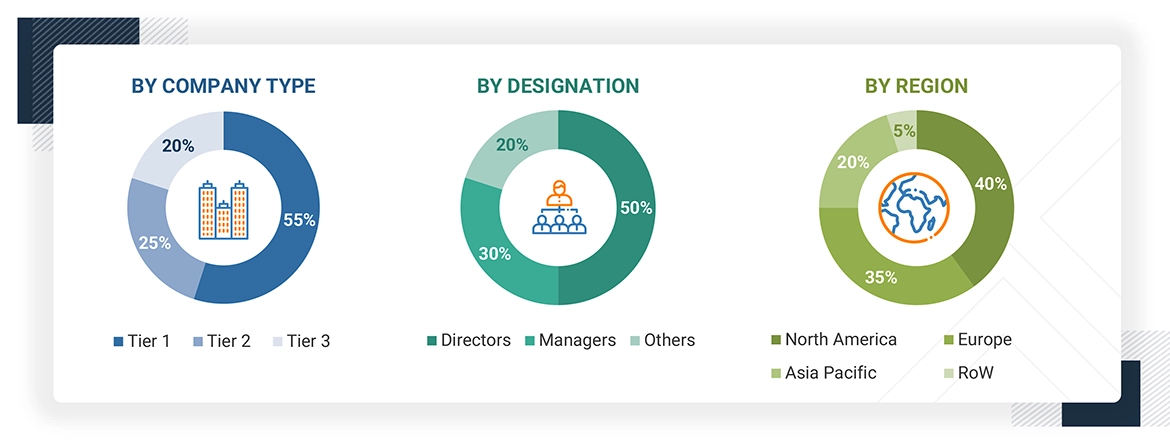
Note: Tier 1, Tier 2, and Tier 3 companies are classified based on their market revenue in 2023, available in the public domain, product portfolios, and geographical presence.
Other designations include consultants and sales, marketing, and procurement managers.
To know about the assumptions considered for the study, download the pdf brochure
| COMPANY NAME | DESIGNATION | |
|---|---|---|
| Exxon Mobil Corporation | Senior Manager | |
| Shell plc | Innovation Manager | |
| Indian Oil Corporation Limited | Vice-president | |
| BP p.l.c. | Production Supervisor | |
| Chevron Corporation | Sales Manager | |
Market Size Estimation
Top-down and bottom-up approaches were used to estimate and validate the total size of the lubricants market. These methods were also used extensively to estimate the size of various subsegments in the market. The research methodology used to estimate the market size includes the following parameters:
- The key players in the industry have been identified through extensive secondary research.
- The supply chain of the industry has been determined through primary and secondary research.
- All percentage shares, splits, and breakdowns have been determined using secondary sources and verified through primary sources.
- All possible parameters that affect the markets covered in this research study have been accounted for, viewed in extensive detail, verified through primary research, and analyzed to obtain the final quantitative and qualitative data.
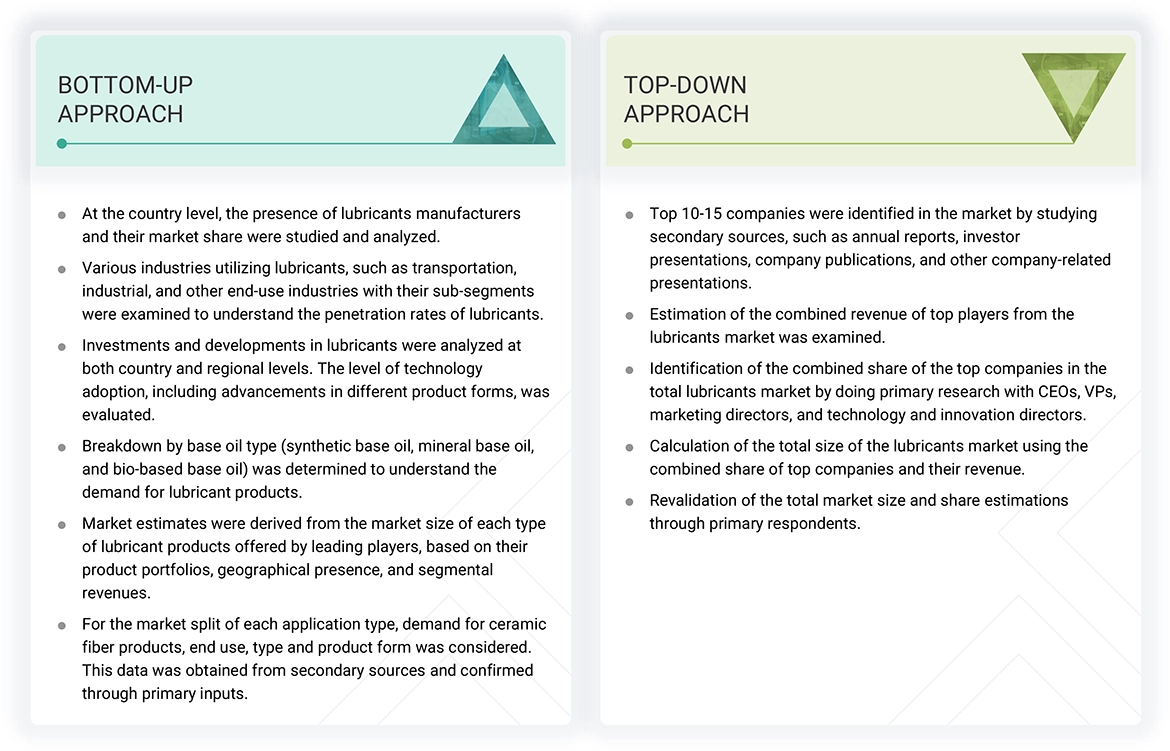
Data Triangulation
After arriving at the overall market size—using the market size estimation processes as explained above—the market was split into several segments and subsegments. Data triangulation and market breakdown procedures were employed to complete the overall market engineering process and arrive at the exact statistics of each market segment and subsegment, wherever applicable. The data was triangulated by studying various factors and trends from both the demand and supply sides in the lubricants industry.
Market Definition
The lubricants market encompasses a range of substances engineered to diminish friction between surfaces, thereby reducing heat generation and facilitating the transmission of forces during movement. These substances also serve to transport foreign particles and regulate surface temperatures. Employed across diverse applications, from industrial machinery and cooking to bioapplications such as artificial joints, medical procedures, and intimate relations, lubricants are pivotal in mitigating friction, wear, heat generation, noise, and vibrations within mechanical systems.
Stakeholders
- Lubricants manufacturers
- Lubricants suppliers
- Raw material suppliers
- Service providers
- Application sector companies
- Government bodies
Report Objectives
- To define, describe, and forecast the lubricants market in terms of value and volume
- To provide detailed information regarding the drivers, opportunities, restraints, and challenges influencing market growth
- To estimate and forecast the market size by base oil type, product type, end-use industry, and region
- To forecast the size of the market for five main regions: Asia Pacific, Europe, North America, South America, and the Middle East & Africa, along with their key countries
- To strategically analyze micromarkets1 with respect to their growth trends, prospects, and contribution to the overall market
- To analyze opportunities in the market for stakeholders and provide a competitive landscape for market leaders
- To analyze competitive developments, such as deals and expansions, in the market
- To analyze the impact of the recession on the market
- To strategically profile key players and comprehensively analyze their growth strategies
Get the Full Lubricants Market Report
Full forecast, segment splits, and company analysis for all Lubricants Market.
- India Lubricants Market
- South Korea Lubricants Market
- Indonesia Lubricants Market
- Thailand Lubricants Market
- Germany Lubricants Market
- Russia Lubricants Market
- Italy Lubricants Market
- France Lubricants Market
- Spain Lubricants Market
- UK Lubricants Market
- Turkey Lubricants Market
- Canada Lubricants Market
- Mexico Lubricants Market
- US Lubricants Market
- Saudi Arabia Lubricants Market
- Iran Lubricants Market
- South Africa Lubricants Market
- Brazil Lubricants Market
- Argentina Lubricants Market
- GCC Countries Lubricants Market
- –Rest Of GCC Countries Lubricants Market
- Rest Of South America Lubricants Market
- China Lubricants Market
- Rest Of Europe Lubricants Market
- Australia And New Zealand Lubricants Market
- Rest Of Asia Pacific Lubricants Market
Need a Tailored Report?
Customize this report to your needs
Get 10% FREE Customization
Customize This Report
