
South Korea Nutraceutical Excipients Market (2025-2030)

The South Korea Nutraceutical Excipients Market was valued at $148.1 Million in 2025 and projected to reach to $217.3 Million by 2030, representing a compound annual growth rate of 8.0%. South Korea's nutraceutical excipients market is positioned for sustained growth through 2030, supported by the nation's advanced regulatory framework and manufacturing excellence.


| Market Size in | USD 26.32 MN |
| Market Forecast in | |
| CAGR | |
| Forecast Period | |
| Units Considered | Value (USD MN) |
South Korea Nutraceutical Excipients Market Trends and Insights
- South Korea's health-conscious consumer base and advanced pharmaceutical manufacturing infrastructure are driving demand for high-quality excipients used in dietary supplements and functional foods.
- The market in South Korea is benefiting from increasing regulatory support for nutraceutical products and rising consumer awareness of preventive health solutions. South Korea's nutraceutical excipients sector is expanding at an 8.0% compound annual growth rate, outpacing global averages and reflecting strong domestic demand.
- South Korea's position as a leading biotechnology hub in Asia Pacific is attracting investment in excipient innovation and production capacity.
- The forecast period through 2030 indicates sustained momentum in South Korea, driven by aging demographics, premium product positioning, and export opportunities to neighboring Asian markets..
Key Market Statistics
- CAGR (2025-2030) 8.0% CAGR
- Market Size, 2025 ~USD 148.1 Million
- Forecast, 2030 ~USD 217.3 Million
- Country South Korea
South Korea Nutraceutical Excipients Market Overview
Market Valuation Growth :
South Korea's nutraceutical excipients market is valued at USD 148.1 million in 2025, with a projected CAGR of 8% through 2030, reaching USD 217.3 million. This outpaces the global CAGR of 7.4%, indicating stronger regional momentum.
Health-Conscious Consumer Base :
South Korea's population demonstrates exceptionally high health awareness and spending on wellness products. This cultural emphasis on preventive health and longevity drives consistent demand for premium nutraceutical formulations and specialized excipients.
Advanced Pharmaceutical Infrastructure :
South Korea possesses world-class pharmaceutical manufacturing capabilities and stringent quality standards. This infrastructure supports the production of high-purity excipients for dietary supplements and functional foods, attracting both domestic and international manufacturers.
Functional Foods & Supplements Boom :
The South Korean market for functional foods and dietary supplements is experiencing rapid expansion, driven by aging demographics and increased consumer spending on health optimization. This directly fuels demand for specialized excipients in formulation development.
South Korea Nutraceutical Excipients Market Dynamics
- The country's aging population and rising disposable incomes are accelerating adoption of premium dietary supplements and functional food products, creating consistent demand for high-quality excipients.
- Local manufacturers are increasingly investing in R&D to develop innovative excipient solutions tailored to Asian consumer preferences. The market will benefit from South Korea's strong export capabilities and integration into global nutraceutical supply chains.
- Government initiatives promoting health and wellness, combined with growing e-commerce penetration for health products, will further expand market opportunities.
- Strategic partnerships between local pharmaceutical companies and international nutraceutical brands are expected to drive market expansion and technological advancement in excipient formulation..
Market Ecosystem
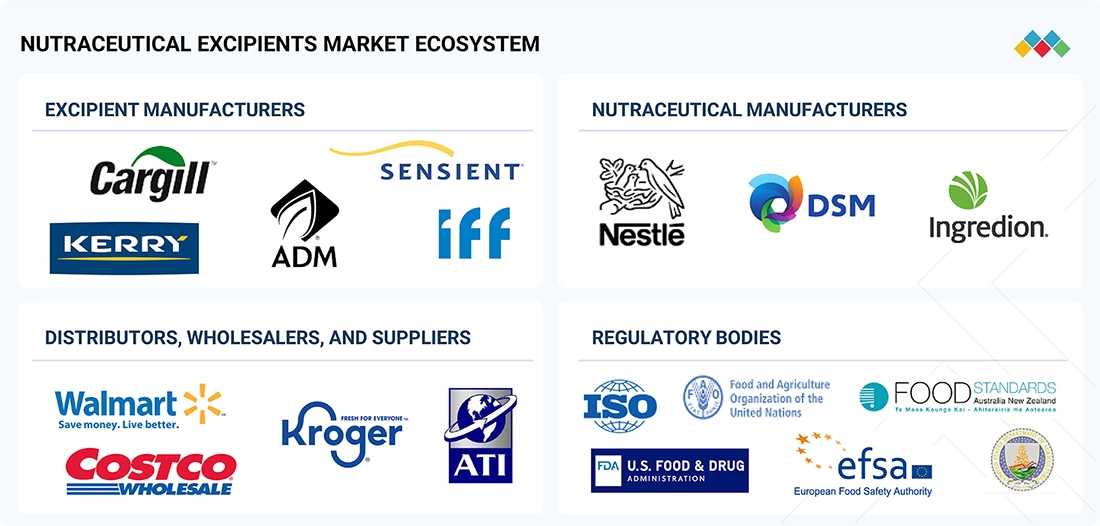
Nutraceutical Excipients Market: COMMERCIAL USE CASES ACROSS INDUSTRIES
| COMPANY | USE CASE DESCRIPTION | BENEFITS |
|---|---|---|
 |
Advanced coating systems, controlled-release polymers, and film-forming excipients for nutraceutical tablets and capsules | Improved product stability, enhanced swallowing experience, uniform appearance, and better release control for active ingredients |
 |
Taste-masking excipients, functional binders, and delivery matrix systems for powders, gummies, and functional beverages | Superior palatability, consistent texture, improved consumer acceptance, and enhanced dispersion in liquid formats |
 |
Pharma-grade binders, disintegrants, and solubilizers for high-potency nutraceutical formulations | Enhanced bioavailability, faster disintegration, improved shelf-life, and reliable performance in complex formulations |
 |
Plant-based excipients such as pea starches, polyols, and natural binders for a clean-label nutraceutical product | Clean-label positioning, improved compressibility, better formulation flexibility, and strong alignment with vegan and natural trends |
Logos and trademarks shown above are the property of their respective owners. Their use here is for informational and illustrative purposes only.
Related Ecosystem
Fandb Ingredients
- Dairy Products
- Bakery Products
- Microorganism
- Polydextrose
- Carbohydrates
- AZELIS HOLDINGS SA
- Archer-Daniels-Midland Company
- Kerry Group plc
- Amway
- DSM FIRMMENICH
Nutraceuticals And Dietary Supplements
- Dairy Products
- Animal-Based Sealants
- Carbohydrates
- Porcine
- Acrylic Polymers
- AZELIS HOLDINGS SA
- Amway
- Nestle s.a
- Kerry Group plc
- Basf se
Key Takeaways
- South Korea's nutraceutical excipients market is valued at USD 148.1 million in 2025 and will reach USD 217.3 million by 2030, representing 46.7% growth over five years.
- South Korea's market is growing at 8.0% CAGR, exceeding the global growth rate of 7.4%, indicating strong regional momentum and competitive advantage.
- South Korea's advanced biotech infrastructure and regulatory framework position the country as a premium excipient producer and exporter in Asia Pacific.
- South Korea's aging population and rising health consciousness are key drivers fueling demand for nutraceutical products and their supporting excipient materials.
Nutraceutical Excipients Market Report Scope
| Report Metric | Details |
|---|---|
| Base Year | 2025 |
| Fastest Growing Segment | METAL STEARATES (Subtype) |
| Forecast Period | 2025–2030 |
| Growth Rate | CAGR of 7.4% from 2025 to 2030 |
| Largest Segment | ORGANIC CHEMICALS (Source) |
| Market Size Base Year (Billions) | ~USD 4.98 (2025) |
| Revenue Forecast (Billions) | ~USD 7.12 (2030) |
| Segments Covered | Material, Source, Type, Subtype, Functionality Application, Formulation, Dry Formulation, Functionality, End Product |
South Korea Nutraceutical Excipients Market Report Segmentation
9 segment dimensions are covered across the global market.
By Material
- Minerals
- Omega-3 Fatty Acids
- Other End Products
- Prebiotics
- Probiotics
- Protein & Amino Acids
- Vitamins
By Source
- Inorganic Chemicals
- Organic Chemicals
- Other Chemicals
By Type
- Carbohydrates
- Oleochemicals
- Other Organic Chemicals
- Petrochemicals
- Proteins
By Subtype
- Acrylic Polymers
- Actual Sugars
- Artificial Sweeteners
- Calcium Carbonate
- Calcium Phosphate
- Calcium Sulphate
- Cellulose
- Cellulose Esters
- Cellulose Ethers
- Cmc And Croscarmellose Sodium
- Converted Starch
- Dried Starch
- Fatty Alcohols
- Glycerin
- Glycols
- Halite
- Metal Oxides
- Metal Stearates
- Microcrystalline Cellulose
- Mineral Hydrocarbons
- Modified Starch
- Other Inorganic Chemicals
- Other Oleochemicals
- Other Petroleum Excipients
- Povidones
- Starches
- Sugar Alcohols
- Sugars
By Functionality Application
- Modified Release
- Other Functionality Applications
- Solubility & Bioavailability Enhancement
- Stabilizers
- Taste Masking
By Formulation
- Dry
- Liquid
- Other Formulations
By Dry Formulation
- Capsules
- Tablets
By Functionality
- Binders
- Coating Agents
- Colorants
- Disintegrants
- Emulsifying Agents
- Fillers & Diluents
- Flavoring Agents & Sweeteners
- Lubricants & Glidants
- Other Functionalities
- Preservatives
- Suspending & Viscosity Agents
By End Product
- Minerals
- Omega-3 Fatty Acids
- Other End Products
- Prebiotics
- Probiotics
- Protein & Amino Acids
- Vitamins
Target Audience
- Excipient Manufacturers & Suppliers : Manufacturers seeking to expand into South Korea's high-growth nutraceutical market need detailed market sizing, competitive analysis, and regulatory requirements to establish local production or distribution partnerships effectively.
- Dietary Supplement & Functional Food Companies : South Korean and international supplement brands require insights into excipient demand trends, consumer preferences, and sourcing options to optimize formulations and maintain competitive advantage in this health-conscious market.
- Pharmaceutical & Nutraceutical Investors : Investment firms evaluating opportunities in South Korea's wellness sector need comprehensive market data, growth projections, and competitive dynamics to make informed capital allocation and M&A decisions.
- Contract Manufacturers & Formulators : CMOs and contract formulators operating in South Korea need market intelligence on excipient specifications, supplier landscapes, and regulatory compliance to serve local and regional nutraceutical clients effectively.
- Market Research & Strategy Consultants : Consulting firms advising clients on South Korea market expansion require detailed, country-specific data on market size, growth drivers, and competitive positioning to develop credible strategic recommendations.
Key Companies in the South Korea Nutraceutical Excipients Market
| Company | HQ | Ownership | Strongest segments |
|---|---|---|---|
| AMWAY | Malaysia | Public Company | Nutrition & Weight Management (NUTRILITE, bodykey, XS),Beauty & Personal Care (ARTISTRY, G&H, GLISTER, SATINIQUE),Home Living Systems (eSpring, ATMOSPHERE, Amway Home), |
| KERRY GROUP PLC | Ireland | Public Company | Taste solutions (flavours, extracts, taste modulation),Nutrition solutions (enzymes, proteins, lipids, fibre, wellness),Functional ingredients and food solutions, |
| INGREDION | United States | Public Company | Bulk sweeteners (HFCS, glucose syrups, dextrose, polyols),Food starches and texture systems,Industrial starches and biomaterial solutions, |
| BASF SE | Germany | Public Company | Chemicals,Materials,Industrial Solutions, |
| ASSOCIATED BRITISH FOODS PLC | United Kingdom | Public Company | Retail (Primark & Penneys),Grocery,Ingredients, |
| SENSIENT TECHNOLOGIES CORPORATION | United States | Public Company | Flavors & Extracts,Color,Asia Pacific (cross-category), |
| CARGILL, INCORPORATED | United States | Private Company | Grains and oilseeds origination, trading, and processing,Animal nutrition and protein (livestock, aquaculture, meat, and poultry),Food and beverage products, foodservice, and retail solutions, |
| AZELIS | Belgium | Public Company | Life sciences (personal care, home care, pharma, healthcare, food & nutrition, animal nutrition, agro, flavours, nutraceuticals),Industrial chemicals (CASE, advanced materials, lubricants, metalworking, electronics, essential & fine chemicals, textiles, leather, paper), |
| ASHLAND | United States | Public Company | Life Sciences (pharma, nutrition, ag, diagnostics, fine chemicals),Personal Care,Specialty Additives, |
| IMCD | Netherlands | Public Company | Industrial specialties (adhesives, thermoplastics, elastomers, additives, solvents, stabilizers),Personal care and cosmetics (actives, UV filters, rheology modifiers, emollients, fragrances),Food, nutrition, and taste (taste, texture, nutrition and function ingredients), |
AMWAY
Amway is a public company based in Malaysia, founded in 1976, with 308 employees. The company operates in the direct selling and consumer goods industry.
KERRY GROUP PLC
Kerry Group PLC is an Irish public company founded in 1972, employing 19,284 people. The company is a global leader in taste and nutrition solutions for the food and beverage industry.
INGREDION
Ingredion is a United States-based public company founded in 1906 with 11,200 employees. The company produces ingredient solutions for the food, beverage, and industrial sectors.
BASF SE
BASF SE is a German public company established in 1865, employing 94,910 people. As one of the world's largest chemical manufacturers, BASF produces a wide range of chemicals, plastics, and performance products.
ASSOCIATED BRITISH FOODS PLC
Associated British Foods PLC is a British public company founded in 1934 with 138,000 employees. The company operates across multiple sectors including retail, food, ingredients, and logistics.
SENSIENT TECHNOLOGIES CORPORATION
Sensient Technologies Corporation is a United States-based public company founded in 1882 with 4,070 employees. The company manufactures colors, flavors, and fragrances for food, beverage, and industrial applications.
CARGILL, INCORPORATED
Cargill, Incorporated is a privately held United States company founded in 1865, employing 155,000 people. The company is a major global producer and distributor of agricultural products, food ingredients, and animal nutrition.
AZELIS
Azelis is a Belgian public company founded in 1996 with 4,000 employees. The company specializes in specialty chemicals and ingredients for personal care, home care, and industrial applications.
ASHLAND
Ashland is a United States-based public company founded in 1924 with 2,900 employees. The company provides specialty chemicals and additives for various industries including coatings, adhesives, and personal care.
IMCD
IMCD is a Netherlands-based public company founded in 1995 with 5,237 employees. The company is a global distributor of specialty chemicals and ingredients for various industries.
Reasons to Buy this Report
- Market-Specific Growth Projections : Access detailed forecasts showing South Korea's nutraceutical excipients market expanding from USD 148.1M to USD 217.3M by 2030. Understand regional growth drivers that outpace global averages, enabling precise investment and expansion planning.
- Competitive Landscape Intelligence : Identify key local and international players operating in South Korea's market. Analyze their market positioning, product portfolios, and strategic initiatives to benchmark your competitive standing and identify partnership opportunities.
- Consumer Behavior & Demand Insights : Understand South Korea's health-conscious consumer preferences, purchasing patterns, and willingness to pay for premium excipients. Leverage demographic and psychographic data to tailor product development and marketing strategies.
- Regulatory & Manufacturing Standards : Navigate South Korea's stringent pharmaceutical and food safety regulations with detailed compliance requirements. Learn about local manufacturing standards and quality certifications necessary for market entry and product approval.
- Strategic Market Entry Roadmap : Develop informed go-to-market strategies with actionable insights on distribution channels, key stakeholders, and market entry barriers specific to South Korea. Reduce risk and accelerate time-to-market for new excipient products.
Frequently asked questions
What is the current size of South Korea's nutraceutical excipients market?
South Korea's nutraceutical excipients market is valued at USD 148.1 million in 2025 and is expected to grow to USD 217.3 million by 2030.
What is the growth rate for South Korea's nutraceutical excipients market?
South Korea's nutraceutical excipients market is growing at a compound annual growth rate (CAGR) of 8.0% from 2025 to 2030.
Why is South Korea's nutraceutical excipients market growing faster than the global average?
South Korea's market growth of 8.0% CAGR exceeds the global rate of 7.4% due to strong domestic demand, advanced biotech infrastructure, regulatory support, and an aging health-conscious population.
What are the main drivers of growth in South Korea's nutraceutical excipients market?
Key drivers include South Korea's aging demographics, rising consumer health awareness, premium product positioning, advanced pharmaceutical manufacturing capabilities, and export opportunities across Asia Pacific.
How much will South Korea's nutraceutical excipients market grow by 2030?
South Korea's market will grow by USD 69.2 million from 2025 to 2030, representing a 46.7% increase in total market value over the five-year forecast period.
RESEARCH METHODOLOGY
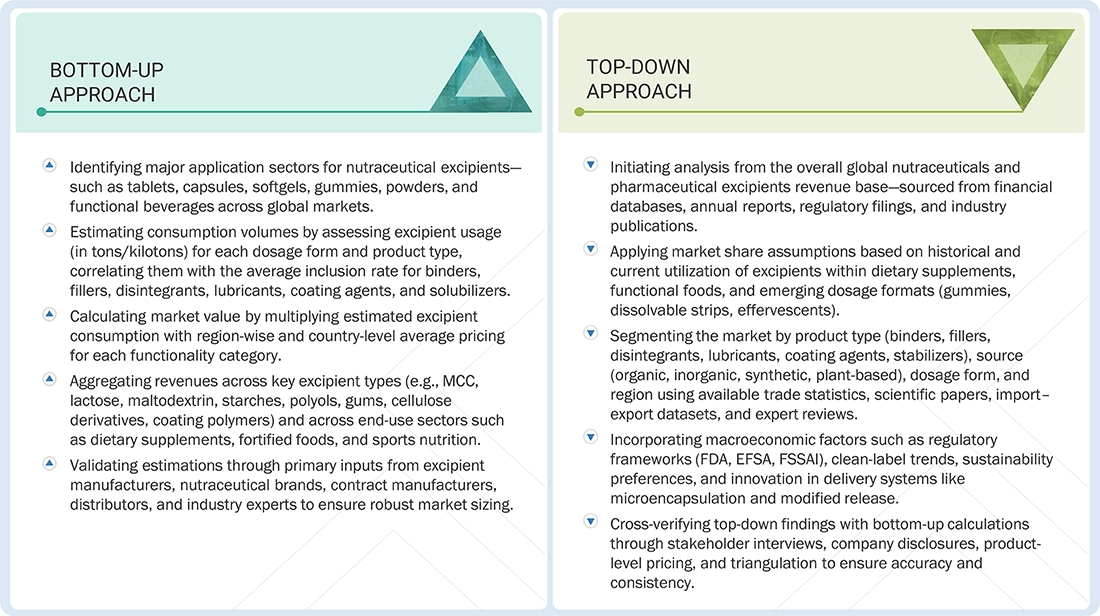
The study employed two primary approaches to estimate the current size of the nutraceutical excipients market. Exhaustive secondary research was conducted to gather information on the market, peer markets, and parent markets. The next step was to validate these findings, assumptions, and sizing with industry experts across the value chain through primary research. Both top-down and bottom-up approaches were employed to estimate the complete market size. After that, market breakdown and data triangulation were used to estimate the market size of segments and subsegments.
Secondary Research
This research study involved the extensive use of secondary sources, directories, and databases such as Bloomberg Businessweek and Factiva, to identify and collect information useful for a technical, market-oriented, and commercial study of the market.
In the secondary research process, various sources such as annual reports, press releases & investor presentations of companies, white papers, food journals, certified publications, articles from recognized authors, directories, and databases were referred to to identify and collect information.
Secondary research was mainly used to obtain key information about the industry’s supply chain, the total pool of key players, and market classification and segmentation as per the industry trends to the bottom-most level, regional markets, and key developments from both market- and technology-oriented perspectives.
Primary Research
Extensive primary research was conducted after obtaining information regarding the nutraceutical excipients market scenario through secondary research. Several primary interviews were conducted with market experts from both the demand and supply sides across major countries of North America, Europe, Asia Pacific, South America, the Middle East, and Africa. Primary data was collected through questionnaires, emails, and telephonic interviews. The primary sources from the supply side included various industry experts, such as Chief X Officers (CXOs), Vice Presidents (VPs), Directors from business development, marketing, research, and development teams, and key opinion leaders. Primary interviews were conducted to gather insights such as market statistics, data on revenue collected from the products and services, market breakdowns, market size estimations, market forecasting, and data triangulation. Primary research also helped in understanding the various trends related to source, end product, functionality, functionality application, formulation, and technology. Stakeholders from the demand side, such as research institutions and universities, and third-party vendors, were interviewed to understand the buyer’s perspective on the service, and their current usage of nutraceutical excipients and the outlook of their business, which will affect the overall market.
Breakdown of Primary Interviews
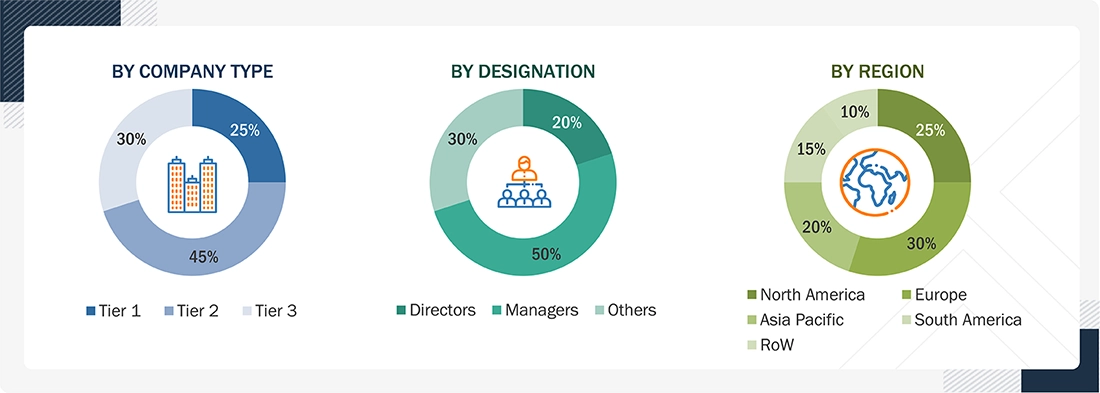
Note: The three tiers of the companies are defined based on their total revenues in 2023 or 2024, as per the availability of financial data: Tier 1: Revenue >USD 1 billion; Tier 2: USD 100 million ≤ Revenue ≤ USD 1 billion; Tier 3: Revenue < USD 100 million.
To know about the assumptions considered for the study, download the pdf brochure
| COMPANY NAME | DESIGNATION | |
|---|---|---|
| BASF SE (Germany) | R&D Expert | |
| Cargill, Incorporated (US | Sales Manager | |
| ADM (US) | Manager | |
| Corbion (Netherlands) | Sales Manager | |
| Eastman Chemical Company (US) | Marketing Manager | |
Market Size Estimation
Both the top-down and bottom-up approaches were used to estimate and validate the total size of the nutraceutical excipients market. These approaches were also used extensively to determine the size of various subsegments in the market. The research methodology used to estimate the market size includes the following details:
- The key players in the industry and the overall markets were identified through extensive secondary research.
- All shares, splits, and breakdowns were determined using secondary sources and verified through primary sources.
- All possible parameters that affect the market covered in this research study were accounted for, viewed in extensive detail, verified through primary research, and analyzed to obtain final quantitative and qualitative data.
- The research included the study of reports, reviews, and newsletters of top market players, along with extensive interviews for opinions from leaders, such as CEOs, directors, and marketing executives.
Nutraceutical Excipients Market: Bottom-up & Top-down Approaches
Data Triangulation
After arriving at the overall market size from the estimation process explained above, the total market was split into several segments and subsegments. The data triangulation and market breakdown procedures were employed, wherever applicable, to estimate the overall nutraceutical excipients market and arrive at the exact statistics for all segments and subsegments. The data was triangulated by studying various factors and trends from the demand and supply sides. The market size was also validated using both the top-down and bottom-up approaches.
Market Definition
Nutraceutical excipients are inactive ingredients that are added to nutraceutical formulations. These excipients help to improve the effectiveness of active ingredients in the final product. Nutraceutical active ingredients are functional components that support the nutrition and health of the human body. They are often used to supplement the nutrients that we get from our regular diet. Excipients play an important role in delivering nutraceutical components accurately and on time. They also maintain the optimum levels of active ingredients in the nutraceutical products, such as vitamins and minerals.
Stakeholders
- Raw material supplier
- Commercial R&D institutions
- Manufacturers, dealers, and suppliers in the nutraceutical excipients market
- Government bodies
- Food & beverage manufacturers
- Nutraceutical manufacturers
- Cosmetic & skincare product manufacturers
- Food importers and exporters
- Associations and NGOs
- Logistics providers & transporters
- Regulatory bodies & institutions
- US Food and Drug Administration (US FDA)
- European Food Safety Authority (EFSA)
- Food Safety and Standards Authority of India (FSSAI)
- Food Safety Law of the People’s Republic of China
- Food Safety Commission of Japan
Report Objectives
- To determine, define, and project the size of the nutraceutical excipients market, with respect to source, end product, functionality, functionality application, formulation, technology, and regional markets, over five years, ranging from 2025 to 2030
- To identify the attractive opportunities in the market by determining the largest and fastest-growing segments across regions
- To provide detailed information about the key factors influencing the growth of the market (drivers, restraints, opportunities, and challenges)
- To analyze the micro markets with respect to individual growth trends, prospects, and their contribution to the total market
- To strategically profile key market players and comprehensively analyze their core competencies in each segment
- To track and analyze competitive developments, such as alliances, joint ventures, new product developments, mergers, and acquisitions, in the nutraceutical excipients market
Get the Full Nutraceutical Excipients Market Report
Full forecast, segment splits, and company analysis for all Nutraceutical Excipients Market.
- US Nutraceutical Excipients Market
- Canada Nutraceutical Excipients Market
- Mexico Nutraceutical Excipients Market
- Germany Nutraceutical Excipients Market
- France Nutraceutical Excipients Market
- UK Nutraceutical Excipients Market
- Italy Nutraceutical Excipients Market
- Spain Nutraceutical Excipients Market
- China Nutraceutical Excipients Market
- Japan Nutraceutical Excipients Market
- India Nutraceutical Excipients Market
- Brazil Nutraceutical Excipients Market
- Argentina Nutraceutical Excipients Market
- Rest Of Europe Nutraceutical Excipients Market
- Rest Of Asia Pacific Nutraceutical Excipients Market
Need a Tailored Report?
Customize this report to your needs
Get 10% FREE Customization
Customize This Report
