
India Nutraceutical Ingredients Market (2024-2029)

The India Nutraceutical Ingredients Market was valued at $5757.01 Million in 2024 and projected to reach to $8254.9 Million by 2029, representing a compound annual growth rate of 7.47%. India's nutraceutical ingredients market is positioned for sustained expansion, driven by demographic shifts, increasing health consciousness, and government initiatives promoting wellness.


| Market Size in | USD 26.32 MN |
| Market Forecast in | |
| CAGR | |
| Forecast Period | |
| Units Considered | Value (USD MN) |
India Nutraceutical Ingredients Market Trends and Insights
- This expansion in India reflects rising consumer awareness of preventive healthcare, increasing disposable incomes, and a growing preference for plant-based and functional food products across urban and semi-urban populations.
- India's traditional wellness heritage, combined with modern scientific validation, positions the country as a key hub for nutraceutical ingredient production and consumption in the Asia Pacific region. The nutraceutical ingredients market in India is driven by demographic shifts, with a younger population increasingly adopting health-conscious lifestyles and dietary supplements.
- India's regulatory framework and manufacturing capabilities have strengthened the country's position as both a consumer market and a global supplier of nutraceutical ingredients.
- Between 2024 and 2029, India is expected to witness accelerated adoption of vitamins, minerals, amino acids, and botanical extracts across dietary supplements, functional foods, and beverages, supported by e-commerce penetration and direct-to-consumer brand growth..
Key Market Statistics
- CAGR (2024-2029) 7.47% CAGR
- Market Size, 2024 ~USD 5757.01 Million
- Forecast, 2029 ~USD 8254.9 Million
- Country India
India Nutraceutical Ingredients Market Overview
Strong CAGR Outpacing Global Growth :
India's nutraceutical ingredients market is growing at 7.47% CAGR, significantly exceeding the global average of 5.3%, driven by rapid urbanization and health consciousness among Indian consumers.
Rising Preventive Healthcare Adoption :
Increasing consumer awareness of preventive healthcare in India is fueling demand for nutraceutical ingredients, as middle-class populations prioritize wellness and nutritional supplementation over traditional reactive healthcare.
Plant-Based and Functional Food Preference :
Indian consumers show strong preference for plant-based and functional food products, leveraging India's rich heritage of Ayurvedic ingredients and traditional wellness practices in modern nutraceutical formulations.
Expanding Disposable Income Driving Market Growth :
Growing disposable incomes across Indian urban and semi-urban areas are enabling consumers to invest in premium nutraceutical products, supporting market expansion from USD 5,757.01 million in 2024 to USD 8,254.90 million by 2029.
India Nutraceutical Ingredients Market Dynamics
- The market's 7.47% CAGR reflects strong consumer demand for preventive health solutions and functional foods tailored to Indian dietary preferences and traditional wellness systems.
- Rising e-commerce penetration and direct-to-consumer brands are democratizing access to premium nutraceutical products across tier-2 and tier-3 cities. The forecast growth to USD 8,254.90 million by 2029 is supported by regulatory clarity, growing investment in R&D for indigenous ingredients, and collaborations between international and domestic players.
- Key opportunities exist in developing region-specific formulations, leveraging Ayurvedic and traditional ingredients, and addressing India's specific nutritional deficiencies through targeted nutraceutical solutions..
Market Ecosystem
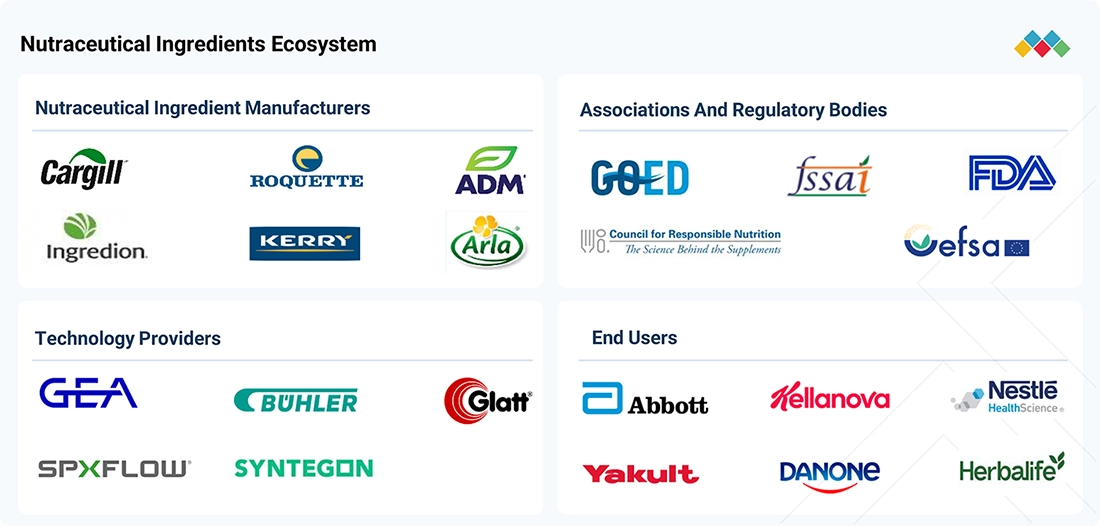
NUTRACEUTICAL INGREDIENTS MARKET: COMMERCIAL USE CASES ACROSS INDUSTRIES
| COMPANY | USE CASE DESCRIPTION | BENEFITS |
|---|---|---|
 |
Uses Cargill’s EpiCor postbiotic in BloomDays, a plant-based, sugar-free postbiotic gummy providing 500 mg of EpiCor per two-gummy serving | Enables incorporation of a stable postbiotic ingredient into a convenient gummy format for immune- and gut-health positioning |
 |
Uses Kerry’s Wellmune beta-glucan in its Mushroom Immune with Beta Glucans dietary supplement; the product contains 250 mg of Wellmune, a highly purified beta-1,3/1,6-glucan derived from baker’s yeast, alongside shiitake, maitake, and chaga mushroom powders | Supports a balanced and healthy immune response; life Extension selected Wellmune based on its clinical support for immune-health applications and uses it to provide a clinically studied dose of yeast-derived beta-glucan in a once-daily capsule |
 |
Uses PeptoPro, a peptide-based protein ingredient developed by dsm-firmenich, in its BORN RECOVERY+ recovery drink; the product contains 10 g of PeptoPro per serving and is formulated for consumption within 30 minutes after exercise | Provides a rapidly absorbed protein source to support muscle recovery and muscle building after endurance exercise, while enabling a convenient recovery-drink format |
Logos and trademarks shown above are the property of their respective owners. Their use here is for informational and illustrative purposes only.
Related Ecosystem
Fandb Ingredients
- Dairy Products
- Bakery Products
- Microorganism
- Polydextrose
- Carbohydrates
- AZELIS HOLDINGS SA
- Archer-Daniels-Midland Company
- Kerry Group plc
- Amway
- DSM FIRMMENICH
Nutraceuticals And Dietary Supplements
- Dairy Products
- Animal-Based Sealants
- Carbohydrates
- Porcine
- Acrylic Polymers
- AZELIS HOLDINGS SA
- Amway
- Nestle s.a
- Kerry Group plc
- Basf se
Key Takeaways
- India's nutraceutical ingredients market is valued at USD 5,757.01 million in 2024 and is forecast to reach USD 8,254.90 million by 2029, growing at a 7.47% CAGR.
- India's market growth outpaces the global average of 5.3% CAGR, driven by rising health consciousness and preventive healthcare adoption among Indian consumers.
- India's traditional Ayurvedic and herbal ingredient base combined with modern manufacturing capabilities positions the country as a leading regional producer and exporter.
- E-commerce expansion and direct-to-consumer brands are accelerating nutraceutical ingredient adoption across India's urban and emerging middle-class segments.
Nutraceutical Ingredients Market Report Scope
| Report Metric | Details |
|---|---|
| Base Year | 2024 |
| Fastest Growing Segment | MICROBIAL-BASED (Source) |
| Forecast Period | 2024-2029 |
| Growth Rate | CAGR of 5.3% from 2024 to 2029 |
| Largest Segment | DRY (Form) |
| Market Size Base Year (Billions) | ~USD 105.13 (2024) |
| Revenue Forecast (Billions) | ~USD 136.1 (2029) |
| Segments Covered | Type, Amino Acid Type, Sub-Type, Functional Fats & Oils Type, Vitamin Type, Carotenoid Type, Application, Form, Branched Chain Amino Acid Type, Polyunsaturated Fatty Acids, Target Consumer, Source |
India Nutraceutical Ingredients Market Report Segmentation
12 segment dimensions are covered across the global market.
By Type
- Amino Acids
- Carotenoids
- Fibers & Specialty Carbohydrates
- Functional Fats & Oils
- Minerals
- Other Types
- Phytochemicals & Plant Extracts
- Prebiotics
- Probiotics
- Proteins
- Vitamins
By Amino Acid Type
- Branched Chain Amino Acids
- Glutamic Acid
- Lysine
- Methionine
- Other Amino Acid Types
- Phenylalanine
- Threonine
- Tryptophan
By Sub-Type
- Conjugated Linoleic Acid
- Isoleucine
- Leucine
- Omega-3 Fatty Acids
- Omega-6 Fatty Acids
- Valine
By Functional Fats & Oils Type
- Medium Chain Triglycerides
- Omega-9 Fatty Acids
- Other Functional Fats & Oils
- Polyunsaturated Fatty Acids (Pufas)
By Vitamin Type
- Vitamin A
- Vitamin B
- Vitamin C
- Vitamin D
- Vitamin E
- Vitamin K
By Carotenoid Type
- Astaxanthin
- B- Carotene
- B-Carotene
- Lutein
- Lycopene
- Other Carotenoids
- Zeaxanthin
By Application
- Animal Nutrition
- Beverages
- Dietary Supplements
- Food
- Food For Special Medical Purposes (Fsmp)
By Form
- Dry
- Liquid
By Branched Chain Amino Acid Type
- Isoleucine
- Leucine
- Valine
By Polyunsaturated Fatty Acids
- Conjugated Linoleic Acid
- Omega-3 Fatty Acids
- Omega-6 Fatty Acids
By Target Consumer
- Adults
- Children
- Elderly
- Infants
- Pregnant Women
By Source
- Animal-Based
- Microbial-Based
- Others (Synthetic)
- Plant-Based
INDIA: NUTRACEUTICAL INGREDIENTS MARKET, BY APPLICATION, 2024–2029
| Segment | 2024 | 2025 | 2026 | 2027 | 2028 | 2029 | CAGR (%) |
|---|---|---|---|---|---|---|---|
| ANIMAL NUTRITION | 802.03 | 867.33 | 937.13 | 1000.98 | 1071.1 | 1147.92 | 7.43 |
| BEVERAGES | 933.97 | 1028.67 | 1131.64 | 1230.32 | 1339.61 | 1460.48 | 9.35 |
| DIETARY SUPPLEMENTS | 1298.25 | 1407.78 | 1525.22 | 1633.57 | 1752.75 | 1883.57 | 7.73 |
| FOOD | 2623.85 | 2816.32 | 3020.1 | 3201.42 | 3399.49 | 3615.25 | 6.62 |
| FOOD FOR SPECIAL MEDICAL PURPOSES (FSMP) | 98.91 | 107.88 | 117.56 | 126.64 | 136.66 | 147.68 | 8.35 |
| TOTAL | 5757.01 | 6227.98 | 6731.65 | 7192.93 | 7699.6 | 8254.9 | 7.47 |
Target Audience
- Nutraceutical Manufacturers & Ingredient Suppliers : Manufacturers and suppliers need India-specific market data to develop localized product portfolios, optimize supply chains, and capitalize on the 7.47% CAGR growth opportunity in this high-potential market.
- Food & Beverage Companies : F&B companies expanding into functional foods and fortified products require detailed insights into India's consumer preferences, regulatory requirements, and ingredient sourcing to launch successful nutraceutical product lines.
- Private Equity & Investment Firms : Investors evaluating opportunities in India's wellness sector need comprehensive market sizing, growth projections, and competitive dynamics to make informed investment decisions in nutraceutical ingredient companies.
- Retail & Distribution Networks : Retailers and distributors need India market intelligence to understand demand patterns, identify high-growth product categories, and optimize inventory management across urban and emerging tier-2/tier-3 markets.
- Government & Policy Bodies : Government agencies and policy makers require market data to develop supportive regulations, incentivize domestic ingredient production, and align nutraceutical industry growth with national health and wellness objectives.
Reasons to Buy this Report
- India-Specific Market Sizing & Forecasts : Access precise valuation data for India's nutraceutical ingredients market (USD 5,757.01M in 2024, USD 8,254.90M by 2029) with country-level CAGR of 7.47%, enabling accurate business planning and investment decisions.
- Competitive Landscape & Regional Dynamics : Understand India's unique market drivers including rising disposable incomes, preventive healthcare adoption, and consumer preference for plant-based products to identify competitive advantages and market entry strategies.
- Growth Opportunity Identification : Identify high-potential segments within India's market such as Ayurvedic ingredients, functional foods, and wellness supplements, with insights into tier-2/tier-3 city expansion and e-commerce distribution channels.
- Regulatory & Consumer Insights : Gain India-specific intelligence on regulatory frameworks, consumer preferences, traditional wellness integration, and demographic trends shaping the nutraceutical ingredients landscape for compliant market entry.
- Strategic Partnership & Investment Guidance : Leverage detailed India market analysis to identify partnership opportunities, acquisition targets, and investment hotspots within the rapidly growing nutraceutical ingredients sector outpacing global growth rates.
Frequently asked questions
What is the current size of India's nutraceutical ingredients market?
India's nutraceutical ingredients market was valued at USD 5,757.01 million in 2024 and is projected to grow to USD 8,254.90 million by 2029.
What is the expected growth rate for India's nutraceutical ingredients market?
India's nutraceutical ingredients market is expected to grow at a compound annual growth rate (CAGR) of 7.47% from 2024 to 2029.
What are the primary drivers of growth in India's nutraceutical ingredients market?
Key growth drivers in India include rising consumer health awareness, increasing disposable incomes, growing preference for plant-based products, e-commerce expansion, and India's strong traditional wellness heritage combined with modern manufacturing capabilities.
How does India's nutraceutical ingredients market growth compare to global trends?
India's market is growing at 7.47% CAGR, which significantly outpaces the global average of 5.3% CAGR, reflecting stronger regional demand and market dynamics.
Which nutraceutical ingredient categories are most prominent in India?
India's market is dominated by vitamins, minerals, amino acids, and botanical extracts, with strong demand across dietary supplements, functional foods, and fortified beverages.
RESEARCH METHODOLOGY
This study employed two primary approaches to estimate the current size of the nutraceutical ingredients market. Exhaustive secondary research was carried out to collect information on ingredient type, source, application, and regions for the market. The next step involved validating these findings, assumptions, and sizing with industry experts across the value chain through primary research. The top-down and bottom-up approaches were employed to estimate the complete market size. Thereafter, data triangulation was used to estimate the market size of segments and subsegments.
Secondary Research
This research study used extensive secondary sources—directories and databases such as Bloomberg Businessweek and Factiva—to identify and collect information for a technical, market-oriented, and commercial market study. In the secondary research process, sources such as annual reports, press releases, and investor presentations of companies, white papers, nutraceutical ingredients-related journals, certified publications, articles from recognized authors, directories, and databases were referred to identify and collect information. Secondary research was mainly used to obtain key information about the industry’s supply chain, the pool of key players, and market classification and segmentation based on industry trends to the bottom-most level, regional markets, and key developments from market- and technology-oriented perspectives.
Primary Research
Extensive primary research was conducted after obtaining the nutraceutical ingredients market scenario through secondary research. Several primary interviews were conducted with market experts from the demand and supply sides. Primary data was collected through questionnaires, emails, and telephonic interviews. The primary sources from the supply side included various industry experts, such as chief experience officers (CXOs); vice presidents (VPs); directors from business development, marketing, research, and development teams; and related key executives from distributors and key opinion leaders.
Primary interviews were conducted to gather insights, including market statistics, revenue data from products and services, market breakdowns, market size estimations, market forecasting, and data triangulation. Primary research helped understand various trends related to ingredient type, source, application, and regions.
Stakeholders from the demand side, including dietary supplement manufacturers, functional food and beverage manufacturers, medical and specialized nutrition companies, and infant and early-life nutrition manufacturers, were interviewed to understand buyers’ perspectives on nutraceutical ingredient suppliers, purchasing trends, formulation requirements, and the outlook for the market.
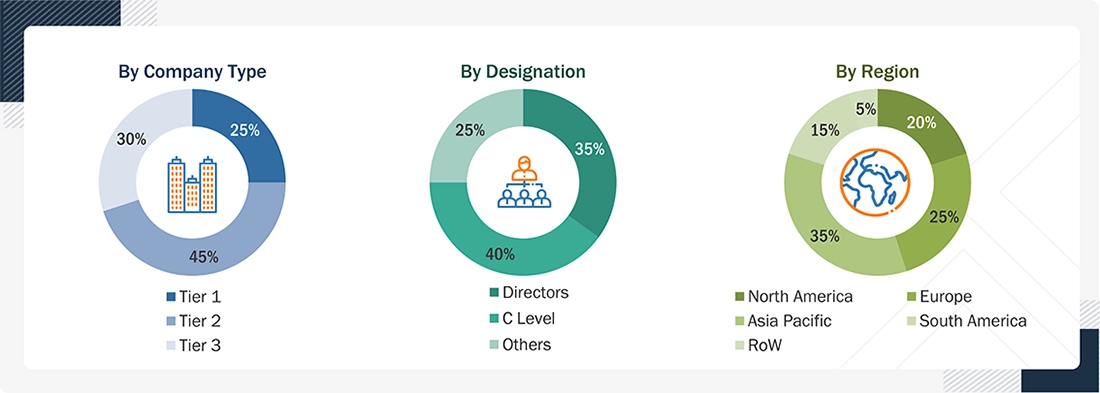
Notes:
- The three tiers of the companies are defined based on their total revenues in 2025, based on the availability of financial data.
- Tier 1: Revenue > USD 1 billion; Tier 2: USD 100 million ≤ Revenue ≤ USD 1 billion; Tier 3: Revenue < USD 100 million
- Others include product managers, R&D managers, technical managers, production managers, procurement managers, sales and marketing managers, business development managers, application specialists, and quality assurance managers.
|
COMPANY |
DESIGNATION |
|
ADM (US) |
Senior Scientist, Ingredient Delivery |
|
Roquette Frères (France) |
Nutraceutical R&D Manager |
|
Cargill, Incorporated (US) |
Protein Business Development |
|
Glanbia PLC (Ireland) |
Product Innovation Manager |
|
International Flavors & Fragrances Inc. (US) |
Beverage Application Specialist |
To know about the assumptions considered for the study, download the pdf brochure
Market Size Estimation
The top-down and bottom-up approaches were used to estimate and validate the total size of the nutraceutical ingredients market. These approaches were also used extensively to determine the size of various subsegments in the market.
The research methodology used to estimate the market size includes the following details:
- The key players in the industry and the overall markets were identified through extensive secondary research.
- All shares, splits, and breakdowns were determined using secondary sources and verified through primary sources.
- All possible parameters that affect the market covered in this research study were accounted for, viewed in extensive detail, verified through primary research, and analyzed to obtain final quantitative and qualitative data.
- The research included the study of reports, reviews, and newsletters of top market players, along with extensive interviews for opinions from leaders, such as CEOs, directors, and marketing executives.
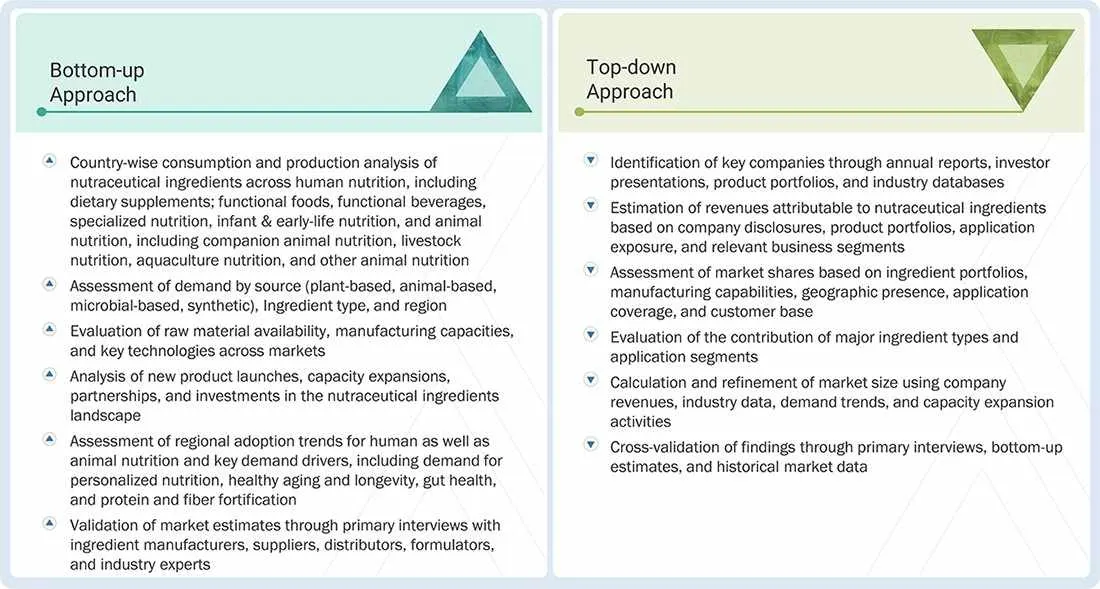
Data Triangulation
After determining the overall market size from the estimation process explained above, the total market was split into several segments and subsegments. The data triangulation procedure was employed, wherever applicable, to estimate the overall nutraceutical ingredients market and obtain precise statistics for all segments and subsegments. The data was triangulated by studying various factors and trends from the demand and supply sides. The market size was also validated using the top-down and bottom-up approaches.
Market Definition
There is no standard definition for nutraceutical ingredients globally, and the definition of ‘nutraceuticals’ differs according to region and industrial application. Therefore, for the purpose of this study, nutraceutical ingredients are defined as nutritional, bioactive, or functional ingredients used to provide nutritional value or health-related benefits in human and animal nutrition products. The scope includes ingredients derived from plant, animal, microbial, mineral, and synthetic sources and covers applications such as dietary supplements, functional foods, functional beverages, medical and specialized nutrition, infant and early-life nutrition, companion animal nutrition, livestock nutrition, and aquaculture.
The term “nutraceutical” was coined by Stephen L. DeFelice in 1989 by combining the terms “nutrition” and “pharmaceutical.” DeFelice defined a nutraceutical as a food or part of a food that provides medical or health benefits, including the prevention and treatment of disease.
Key Stakeholders
- Nutraceutical ingredient manufacturers
- Vitamin and mineral ingredient manufacturers
- Amino acid and functional protein manufacturers
- Omega-3 fatty acid manufacturers
- Probiotic, prebiotic, and fiber ingredient manufacturers
- Specialty bioactive ingredient manufacturers
- Botanical extract and enzyme manufacturers
- Nucleotide and specialty lipid manufacturers
- Plant-based, animal-based, microbial-based, and synthetic ingredient suppliers
- Animal feed ingredient and feed additive manufacturers
- Dietary supplement manufacturers
- Functional food manufacturers
- Functional beverage manufacturers
- Medical and specialized nutrition manufacturers
- Infant and early-life nutrition manufacturers
- Pet food manufacturers
- Livestock feed manufacturers
- Aquaculture feed manufacturers
- Contract manufacturers and formulation service providers
- Ingredient distributors, importers, and exporters
- Food, beverage, and dietary supplement brands
- Animal nutrition and feed brands
- Research institutes and universities
-
Government and regulatory authorities
- US Food and Drug Administration (FDA)
- European Food Safety Authority (EFSA)
- Food Safety and Standards Authority of India (FSSAI)
- Health Canada
- Food Standards Australia New Zealand (FSANZ)
- Codex Alimentarius Commission (CAC)
-
Industry and trade associations
- Council for Responsible Nutrition (CRN)
- International Alliance of Dietary/Food Supplement Associations (IADSA)
- International Probiotics Association (IPA)
- International Scientific Association for Probiotics and Prebiotics (ISAPP)
- International Food Information Council (IFIC)
- International Feed Industry Federation (IFIF)
- Animal Nutrition Society of India (ANSI)
-
Certification, testing, and standards organizations
- NSF
- USP
- ISO
Report Objectives
- To determine and project the size of the nutraceutical ingredients market based on ingredient type, source, application, and region over the forecast period
- To identify key growth opportunities by analyzing the largest and fastest-growing segments across regions
- To provide detailed insights on factors influencing market growth, including drivers, restraints, opportunities, and challenges
- To evaluate market opportunities for stakeholders and present the competitive landscape of leading players
- To analyze micromarkets with respect to individual growth trends, future potential, and their contribution to the overall market
- To identify and profile key companies operating in the nutraceutical ingredients market
- To assess the competitive environment and highlight key strategies adopted by major players across regions.
Available customizations:
With the given market data, MarketsandMarkets offers customizations according to company-specific scientific needs. The following customization options are available for the report:
PRODUCT ANALYSIS
- Product matrix, which gives a detailed comparison of the product portfolio of each company.
GEOGRAPHIC ANALYSIS
With the given market data, MarketsandMarkets offers customizations according to company-specific scientific needs.
- Further breakdown of Rest of Europe nutraceutical ingredients by key countries
- Further breakdown of Rest of Asia Pacific nutraceutical ingredients by key countries
- Further breakdown of Rest of South America nutraceutical ingredients by key countries
COMPANY INFORMATION
- Detailed analyses and profiling of additional market players (up to five)
Get the Full Nutraceutical Ingredients Market Report
Full forecast, segment splits, and company analysis for all Nutraceutical Ingredients Market.
- Canada Nutraceutical Ingredients Market
- Mexico Nutraceutical Ingredients Market
- US Nutraceutical Ingredients Market
- Germany Nutraceutical Ingredients Market
- UK Nutraceutical Ingredients Market
- France Nutraceutical Ingredients Market
- Italy Nutraceutical Ingredients Market
- Spain Nutraceutical Ingredients Market
- China Nutraceutical Ingredients Market
- Japan Nutraceutical Ingredients Market
- Brazil Nutraceutical Ingredients Market
- Argentina Nutraceutical Ingredients Market
- Rest Of Europe Nutraceutical Ingredients Market
- Rest Of Asia Pacific Nutraceutical Ingredients Market
- Rest Of South America Nutraceutical Ingredients Market
Need a Tailored Report?
Customize this report to your needs
Get 10% FREE Customization
Customize This Report
