
Canada Pea Starch Market (2024-2029)

The Canada Pea Starch Market was valued at $12.01 Million in 2024 and projected to reach to $19.94 Million by 2029, representing a compound annual growth rate of 10.7%. Canada's pea starch market is poised for sustained expansion through 2029, driven by the country's strong commitment to plant-based food innovation and sustainability initiatives.


| Market Size in | USD 26.32 MN |
| Market Forecast in | |
| CAGR | |
| Forecast Period | |
| Units Considered | Value (USD MN) |
Canada Pea Starch Market Trends and Insights
- This 10.7% compound annual growth rate reflects Canada's increasing adoption of plant-based ingredients across food manufacturing and industrial applications.
- Canada's position within North America positions it as a key player in the sustainable starch segment, driven by consumer demand for clean-label and non-GMO products. The Canadian pea starch market benefits from the country's strong agricultural heritage and growing investment in plant-based food innovation.
- Between 2024 and 2029, Canada is expected to see accelerated market penetration in bakery, snack, and meat alternative sectors.
- Canada's regulatory environment and consumer preference for locally-sourced, sustainable ingredients further support market expansion during this forecast period..
Key Market Statistics
- CAGR (2024-2029) 10.7% CAGR
- Market Size, 2024 ~USD 12.01 Million
- Forecast, 2029 ~USD 19.94 Million
- Country Canada
Canada Pea Starch Market Overview
Market Valuation Growth :
Canada's pea starch market reached $12.01 million in 2024 and is projected to grow to $19.94 million by 2029, representing a robust 10.7% CAGR that outpaces the global average of 9.5%.
Plant-Based Ingredient Adoption :
Canadian food manufacturers are increasingly incorporating pea starch into formulations, driven by consumer demand for plant-based and sustainable alternatives to traditional starches.
North American Leadership Position :
Canada's strategic location within North America and established food processing infrastructure position it as a key hub for sustainable starch innovation and distribution across the region.
Industrial Applications Expansion :
Beyond food manufacturing, Canadian industries are exploring pea starch applications in biodegradable packaging, pharmaceuticals, and cosmetics, diversifying market opportunities.
Canada Pea Starch Market Dynamics
- The 10.7% CAGR reflects growing demand from major Canadian food processors seeking clean-label ingredients and plant-derived alternatives.
- Regulatory support for sustainable agriculture and increasing consumer preference for non-GMO, allergen-friendly starches further accelerate market penetration across food and beverage sectors. The Canadian market benefits from proximity to major agricultural regions producing peas and established supply chain networks.
- Investment in food technology and R&D by Canadian companies is fostering product innovation in functional starches and specialty applications.
- As global sustainability trends intensify, Canada's pea starch market is expected to attract both domestic manufacturers and international players seeking North American production and distribution hubs..
Market Ecosystem
Related Ecosystem
Fandb Ingredients
- Dairy Products
- Bakery Products
- Microorganism
- Polydextrose
- Carbohydrates
- AZELIS HOLDINGS SA
- Archer-Daniels-Midland Company
- Kerry Group plc
- Amway
- DSM FIRMMENICH
Key Takeaways
- Canada's pea starch market is valued at $12.01 million in 2024 and will reach $19.94 million by 2029, representing a 10.7% CAGR.
- Canada's plant-based food sector is driving demand for pea starch as a clean-label, non-GMO ingredient across multiple food categories.
- Canada's agricultural capabilities and sustainable sourcing practices position the country as a competitive hub for pea starch production and innovation.
- Between 2024 and 2029, Canada will see significant growth in bakery, snack foods, and meat alternative applications leveraging pea starch.
Pea Starch Market Report Scope
| Report Metric | Details |
|---|---|
| Base Year | 2024 |
| Fastest Growing Segment | YELLOW PEAS (Organic Nature) |
| Forecast Period | 2024-2029 |
| Growth Rate | CAGR of 9.5% from 2024 to 2029 |
| Largest Segment | YELLOW PEAS (Source) |
| Market Size Base Year (Billions) | ~USD 0.43 (2024) |
| Revenue Forecast (Billions) | ~USD 0.67 (2029) |
| Segments Covered | Application, Food & Beverage Application, Feed Application, Pet Food Application, Industrial Application, Form, Function, Grade, Nature, Organic Nature, Conventional Nature, Product Type, Native Starch Sub-Type, Modified Starch Sub-Type, Chemically Modified Starch Sub-Type, Source, Technology, Function 2024-2029 |
Canada Pea Starch Market Report Segmentation
18 segment dimensions are covered across the global market.
By Application
- Feed
- Food & Beverages
- Industrial
- Pet Food
By Food & Beverage Application
- Bakery Products
- Confectionery Products
- Dairy Products
- Glass Noodles
- Meat & Poultry Products
- Other Food & Beverage Applications
- Snacks & Savories
- Snacks & Savory Products
- Soups & Sauces
By Feed Application
- Other Feed Applications
- Poultry Feed
- Ruminant Feed
- Swine Feed
By Pet Food Application
- Cat Food
- Dog Food
- Ornamental Bird & Fish Food
- Other Pet Food Applications
By Industrial Application
- Cosmetics
- Other Industrial Applications
- Paper & Board
- Pharmaceuticals
- Textiles
By Form
- Liquid
- Powder
By Function
- Binding & Thickening
- Film Forming
- Gelling
- Other Functions
- Texturizing
By Grade
- Feed
- Food
- Industrial
By Nature
- Conventional
- Organic
By Organic Nature
- Field Peas
- Green Peas
- Marrowfat Peas
- Yellow Peas
By Conventional Nature
- Field Peas
- Green Peas
- Marrowfat Peas
- Yellow Peas
By Product Type
- Modified Starch
- Native Starch
By Native Starch Sub-Type
- Pea Starch (Wet Separation)
- Pea Starch Concentrate (Dry Fractionation)
By Modified Starch Sub-Type
- Chemically Modified
- Other Modified Starches
- Physically Modified
By Chemically Modified Starch Sub-Type
- Cationic Starch
- Maltodextrin
By Source
- Field Peas
- Green Peas
- Marrowfat Peas
- Other Sources
- Yellow Peas
By Technology
- Centrifugation
- Decantation And Filtration
- Dry Milling
- Enzymatic Treatment
- Membrane Filtration (Ultrafiltration)
- Other Technologies
- Wet Milling
By Function 2024-2029
- Binding & Thickening
- Film Forming
- Gelling
- Other Functions
- Texturizing
CANADA: PEA STARCH MARKET, BY APPLICATION, 2024–2029
| Segment | 2024 | 2025 | 2026 | 2027 | 2028 | 2029 | CAGR (%) |
|---|---|---|---|---|---|---|---|
| FEED | 3.16 | 3.45 | 3.78 | 4.15 | 4.56 | 5.02 | 9.7 |
| FOOD & BEVERAGES | 2.3 | 2.56 | 2.85 | 3.18 | 3.55 | 3.97 | 11.5 |
| INDUSTRIAL | 0.42 | 0.46 | 0.51 | 0.56 | 0.63 | 0.69 | 10.5 |
| PET FOOD | 6.13 | 6.78 | 7.5 | 8.31 | 9.23 | 10.26 | 10.8 |
| TOTAL | 12.01 | 13.25 | 14.64 | 16.21 | 17.96 | 19.94 | 10.7 |
Target Audience
- Canadian Food Manufacturers : Require detailed market intelligence on pea starch sourcing, pricing trends, and competitive formulation strategies to optimize product development and supply chain decisions.
- International Ingredient Suppliers : Need Canada-specific market entry strategies, regulatory requirements, and distribution channel analysis to successfully penetrate and expand within the Canadian market.
- Investment & Private Equity Firms : Seek comprehensive market valuation, growth trajectory, and investment opportunity analysis to evaluate acquisition targets and funding decisions in Canada's plant-based sector.
- Agricultural & Commodity Traders : Require demand forecasting, pricing intelligence, and market trend analysis specific to Canadian pea production and starch processing to optimize trading and procurement strategies.
- Food Technology & Innovation Companies : Need insights into emerging applications, consumer preferences, and R&D opportunities within Canada's sustainable starch market to guide product innovation initiatives.
Reasons to Buy this Report
- Market-Specific Growth Data : Access Canada-exclusive market sizing, CAGR analysis, and 5-year forecasts to benchmark competitive positioning and identify expansion opportunities within the Canadian pea starch segment.
- Regional Supply Chain Insights : Understand Canada's unique agricultural advantages, processing capabilities, and distribution networks that differentiate the market from other North American regions.
- Regulatory & Compliance Framework : Navigate Canadian food safety standards, labeling requirements, and sustainability certifications specific to pea starch products and plant-based ingredient regulations.
- Competitive Landscape Analysis : Identify key Canadian manufacturers, importers, and distributors operating in the pea starch market with detailed market share and strategic positioning data.
- Investment & Partnership Opportunities : Discover high-growth segments, emerging applications, and strategic partnership prospects within Canada's expanding plant-based and sustainable food ingredient ecosystem.
Frequently asked questions
What is the current size of Canada's pea starch market?
Canada's pea starch market was valued at $12.01 million in 2024 and is expected to grow to $19.94 million by 2029.
What is the growth rate of pea starch in Canada?
Canada's pea starch market is growing at a compound annual growth rate (CAGR) of 10.7% from 2024 to 2029.
Which industries in Canada are driving pea starch demand?
Canada's bakery, snack food, meat alternative, and plant-based beverage sectors are primary drivers of pea starch demand.
Why is pea starch gaining popularity in Canada?
Canada's consumers increasingly prefer clean-label, non-GMO, and sustainably-sourced ingredients, making pea starch an attractive option for food manufacturers.
What factors support pea starch market growth in Canada?
Canada's strong agricultural base, regulatory support for plant-based foods, and consumer demand for sustainable ingredients support robust market expansion.
RESEARCH METHODOLOGY
The study involved two major approaches in estimating the current size of the pea starch market. Exhaustive secondary research was done to collect information on the market, peer, and parent markets. The next step was to validate these findings, assumptions, and sizing with industry experts across the value chain through primary research. Both top-down and bottom-up approaches were employed to estimate the complete market size. After that, market breakdown and data triangulation were used to estimate the market size of segments and subsegments.
Secondary Research
This research study involved the extensive use of secondary sources—directories and databases such as Bloomberg Businessweek and Factiva—to identify and collect information useful for a technical, market-oriented, and commercial study of the market.
In the secondary research process, various sources such as annual reports, press releases & investor presentations of companies, white papers, food journals, certified publications, articles from recognized authors, directories, and databases were referred to identify and collect information.
Secondary research was mainly used to obtain key information about the industry’s supply chain, the total pool of key players, and market classification and segmentation as per the industry trends to the bottom-most level, regional markets, and key developments from both market- and technology-oriented perspectives.
Primary Research
Extensive primary research was conducted after obtaining information regarding the pea starch market scenario through secondary research. Several primary interviews were conducted with market experts from both the demand and supply sides across major countries of North America, Europe, Asia Pacific, South America, and the Rest of the World. Primary data was collected through questionnaires, emails, and telephonic interviews. The primary sources from the supply side included various industry experts, such as Chief X Officers (CXOs), Vice Presidents (VPs), Directors from business development, marketing, research, and development teams, and related key executives from distributors and key opinion leaders. Primary interviews were conducted to gather insights such as market statistics, data on revenue collected from the products and services, market breakdowns, market size estimations, market forecasting, and data triangulation. Primary research also helped in understanding the various trends related to pea starch source, nature, grade, product type, application, technology type, function, form, and region. Stakeholders from the demand side, such as food associations, dealers, distributors, and government agencies, were interviewed to understand the demand side perspective on the suppliers, products, and their current usage of pea starch and the outlook of their business, which will affect the overall market.
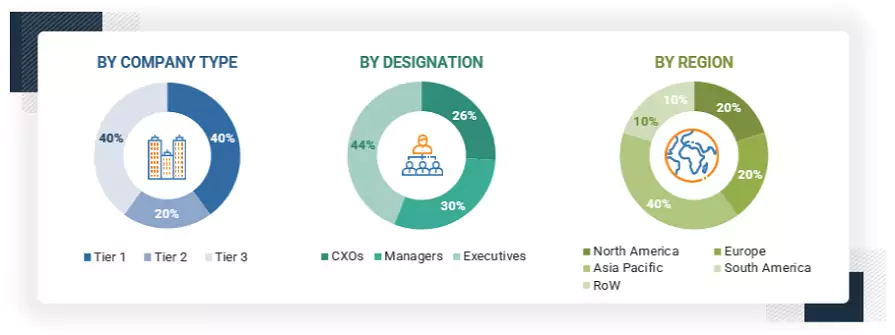
Note: The three tiers of the companies are defined based on their total revenues in 2022 or 2023, as per
the availability of financial data: Tier 1: Revenue > USD 1 billion; Tier 2: USD 100 million = Revenue = USD
1 billion; Tier 3: Revenue < USD 100 million.
To know about the assumptions considered for the study, download the pdf brochure
|
COMPANY NAME |
DESIGNATION |
|
Ingredion |
Regional Sales Manager |
|
Cosucra |
Senior Vice President |
|
Puris |
General Manager |
|
The Scoular Company |
Director of Business Development |
|
Yantai Shuangta Food Co., Ltd. |
Product Specialist |
|
Nutri-Pea |
Product R&D |
Market Size Estimation
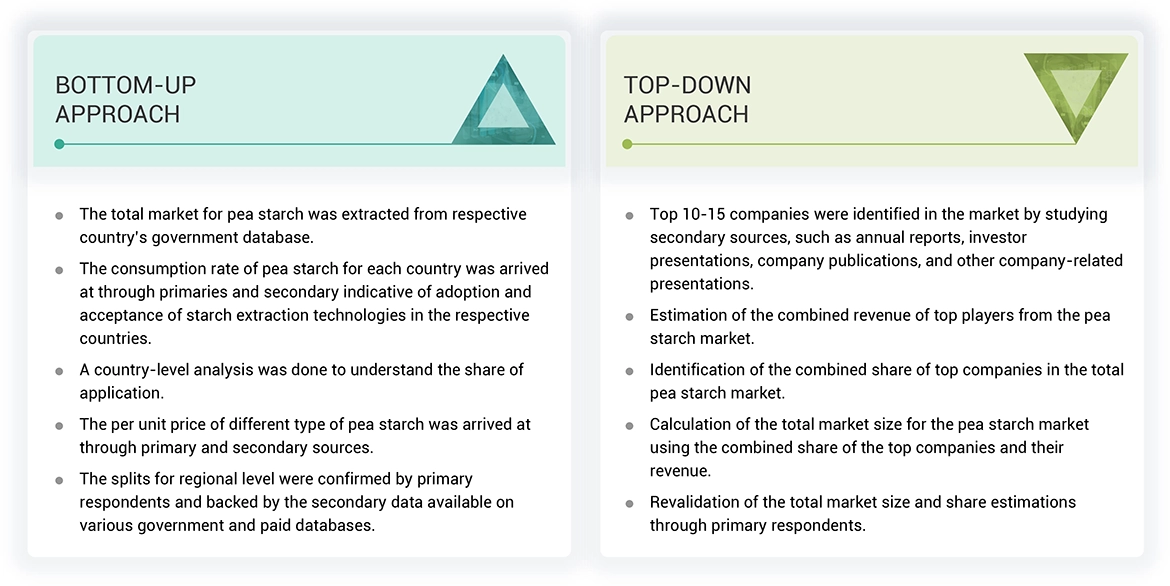
Both the top-down and bottom-up approaches were used to estimate and validate the total size of the pea starch market. These approaches were also used extensively to determine the size of various subsegments in the market. The research methodology used to estimate the market size includes the following details:
- The key players in the industry and the overall markets were identified through extensive secondary research.
- All shares, splits, and breakdowns were determined using secondary sources and verified through primary sources.
- All possible parameters that affect the market covered in this research study were accounted for, viewed in extensive detail, verified through primary research, and analyzed to obtain final quantitative and qualitative data.
- The research included the study of reports, reviews, and newsletters of top market players, along with extensive interviews for opinions from leaders, such as CXOs, directors, and marketing executives.
Pea Starch Market : Top-Down and Bottom-Up Approach
Data Triangulation
After arriving at the overall market size from the estimation process explained above, the total market was split into several segments and subsegments. Data triangulation and market breakdown procedures were employed, wherever applicable, to estimate the overall pea starch market and arrive at the exact statistics for all segments and subsegments. The data was triangulated by studying various factors and trends from the demand and supply sides. Along with this, the market size was validated using both the top-down and bottom-up approaches.
Market Definition
Pea starch is a plant-based carbohydrate extracted from peas. It is used in several applications due to a variety of functional properties, such as gluten-free, and non-GMO. It can thicken, stabilize, and emulsify products. Pea starch is commonly used in food and beverages (soups, sauces, dairy-free products, and gluten-free bakery goods), and pharmaceutical, cosmetic, and textile industries. In addition to its nutritional value, pea starch is considered environmentally friendly as peas have a lower environmental impact compared with other major starch crops.
Stakeholders
- Supply side: Raw material suppliers, pea starch manufacturers, distributors, end users
- Demand side: Food & beverages manufacturers, feed manufacturers, industrial product manufacturers, and pet food manufacturing companies that are actively involved in the R&D phase to develop gluten-free and allergen-free products.
- Regulatory side: Concerned government authorities, commercial research & development (R&D) institutions, and other regulatory bodies.
- Associations and industry bodies such as the United States Department of Agriculture (USDA), Food and Drug Administration (FDA), European Food Safety Authority (EFSA), the Food Safety and Standards Authority of India (FSSAI)
Report Objectives
-
MARKET INTELLIGENCE
- Determining and projecting the size of the pea starch market based on source, nature, grade, product type, application, technology type, function, form, and region from 2024 to 2029
- Identifying the attractive opportunities in the market by determining the largest and fastest-growing segments across the key regions
- Analyzing the demand-side factors based on the following:
- Impact of macro and microeconomic factors on the market
- Shifts in demand patterns across different subsegments and regions
This research report categorizes the pea starch market based on source, nature, grade, product type, application, technology type, function, form, and region.
Available Customizations
With the given market data, MarketsandMarkets offers customizations according to company-specific scientific needs.
The following customization options are available for the report:
Product Analysis
- Product Matrix, which gives a detailed comparison of the product portfolio of each company.
Geographic Analysis as per Feasibility
With the given market data, MarketsandMarkets offers customizations according to company-specific scientific needs.
- Further breakdown of the Rest of Europe pea starch market into key countries.
- Further breakdown of the Rest of Asia Pacific pea starch market into key countries.
- Further breakdown of the Rest of South America pea starch market into key countries.
Company Information
- Detailed analyses and profiling of additional market players (up to five)
Get the Full Pea Starch Market Report
Full forecast, segment splits, and company analysis for all Pea Starch Market.
- US Pea Starch Market
- Mexico Pea Starch Market
- Germany Pea Starch Market
- UK Pea Starch Market
- France Pea Starch Market
- Italy Pea Starch Market
- Spain Pea Starch Market
- China Pea Starch Market
- India Pea Starch Market
- Japan Pea Starch Market
- Brazil Pea Starch Market
- Argentina Pea Starch Market
- Rest Of Europe Pea Starch Market
Need a Tailored Report?
Customize this report to your needs
Get 10% FREE Customization
Customize This Report
