
South Africa Personal Care Ingredients Market (2025-2030)

The South Africa Personal Care Ingredients Market was valued at $31.8 Million in 2025 and projected to reach to $43.2 Million by 2030, representing a compound annual growth rate of 6.36%. South Africa's personal care ingredients market is positioned for sustained expansion through 2030, driven by demographic shifts toward higher-income consumers and increased beauty consciousness.


| Market Size in | USD 26.32 MN |
| Market Forecast in | |
| CAGR | |
| Forecast Period | |
| Units Considered | Value (USD MN) |
South Africa Personal Care Ingredients Market Trends and Insights
- This expansion reflects South Africa's increasing demand for premium cosmetics, skincare formulations, and natural beauty products driven by rising consumer awareness and disposable incomes.
- South Africa's market growth outpaces the global average of 4.4% CAGR, positioning the country as a key growth hub within the Middle East Africa region. The personal care ingredients sector in South Africa is benefiting from growing investment in local manufacturing capabilities and a shift toward sustainable, plant-based formulations.
- South Africa's cosmetics industry is increasingly adopting advanced ingredients such as botanical extracts, peptides, and specialty polymers to meet evolving consumer preferences.
- Between 2025 and 2030, South Africa is expected to see heightened competition among ingredient suppliers and increased collaboration between local manufacturers and international brands seeking to establish regional distribution networks..
Key Market Statistics
- CAGR (2025-2030) 6.36% CAGR
- Market Size, 2025 ~USD 31.8 Million
- Forecast, 2030 ~USD 43.2 Million
- Country South Africa
South Africa Personal Care Ingredients Market Overview
Market Valuation Growth :
South Africa's personal care ingredients market is valued at USD 31.8 million in 2025, with a projected CAGR of 6.36% through 2030, reaching USD 43.2 million. This growth rate significantly outpaces the global CAGR of 4.4%, indicating strong regional momentum.
Premium Product Demand :
Rising consumer awareness and increasing disposable incomes in South Africa are driving demand for premium cosmetics, advanced skincare formulations, and natural beauty products. This shift reflects evolving consumer preferences toward quality and efficacy.
Natural Ingredients Trend :
South African consumers show strong preference for natural and organic personal care ingredients, aligning with global wellness trends. Local suppliers are capitalizing on indigenous botanical ingredients and sustainable sourcing practices.
Regional Market Dynamics :
South Africa serves as a key hub for personal care ingredient distribution across sub-Saharan Africa. The market benefits from established manufacturing infrastructure and growing investment in cosmetic formulation capabilities.
South Africa Personal Care Ingredients Market Dynamics
- The market's 6.36% CAGR reflects strong domestic demand coupled with regional export opportunities across African markets.
- Rising urbanization and digital commerce penetration are enabling broader product accessibility and consumer engagement. Key growth catalysts include the proliferation of local beauty brands, increased R&D investments in cosmetic formulations, and growing consumer preference for clean-label and naturally-derived ingredients.
- South African manufacturers are increasingly focusing on innovation in skincare actives and functional ingredients.
- Strategic partnerships between local suppliers and international cosmetic companies are expected to accelerate market development and enhance competitive positioning..
Market Ecosystem
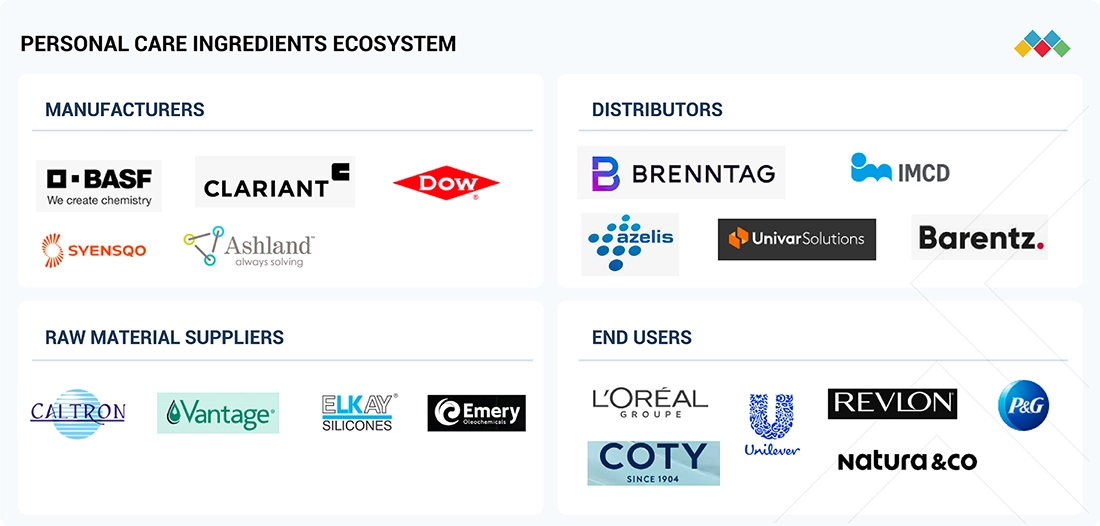
Personal Care Ingredients Market: COMMERCIAL USE CASES ACROSS INDUSTRIES
| COMPANY | USE CASE DESCRIPTION | BENEFITS |
|---|---|---|
 |
Sulfate-free shampoos and body washes using extra-mild, sugar-based surfactants for gentle yet effective cleansing | Extra mild to skin and hair with rich, creamy foam and enhanced sensorial profile |
 |
Conditioning and deposition polymers for shampoos and conditioners to enhance detangling and active delivery | Better wet/dry combing, softness, foam sensorials, and efficient deposition of actives onto hair |
 |
Emollient systems to elevate moisturization and sensorial feel in skin care and topical formats | Non-irritating emollients that support barrier repair and provide appealing skin sensory properties |
 |
Mild secondary surfactants for shampoos, body washes, and liquid soaps that boost foam and viscosity | Improved mildness with cost-efficient thickening from concentrated CAPB grades and RSPO-certified feedstocks |
Logos and trademarks shown above are the property of their respective owners. Their use here is for informational and illustrative purposes only.
Related Ecosystem
Speciality Chemicals
- Corrosion Inhibitors
- Polyetheretherketone (PEEK)
- Acrylonitrile Butadiene Styrene (ABS)
- Epoxy Resin
- Polycarbonate
- Basf se
- DOW CHEMICAL COMPANY
- Evonik industries ag
- Clariant ag.
- Solvay sa
Key Takeaways
- South Africa's personal care ingredients market will grow from USD 31.8M (2025) to USD 43.2M (2030) at a 6.36% CAGR, outpacing global growth.
- South Africa is experiencing strong demand for natural and sustainable ingredients, driving innovation in botanical and plant-based formulations.
- South Africa's market is attracting increased investment from international suppliers and local manufacturers expanding regional distribution capabilities.
- South Africa's cosmetics industry is shifting toward premium, specialized ingredients including peptides, botanical extracts, and advanced polymers.
Personal Care Ingredients Market Report Scope
| Report Metric | Details |
|---|---|
| Base Year | 2025 |
| Fastest Growing Segment | RHEOLOGY MODIFIERS (Ingredient Type) |
| Forecast Period | 2025-2030 |
| Growth Rate | CAGR of 4.4% from 2025 to 2030 |
| Largest Segment | SKIN CARE (Application) |
| Market Size Base Year (Billions) | ~USD 13.71 (2025) |
| Revenue Forecast (Billions) | ~USD 17 (2030) |
| Segments Covered | Ingredient Type, Application |
South Africa Personal Care Ingredients Market Report Segmentation
2 segment dimensions are covered across the global market.
By Ingredient Type
- Conditioning Polymers
- Emollients
- Emulsifiers
- Other Ingredient Types
- Rheology Modifiers
- Surfactants
By Application
- Hair Care
- Make-Up
- Oral Care
- Other Applications
- Skin Care
Target Audience
- Cosmetic Manufacturers & Formulators : South African and international cosmetic companies need detailed market data to optimize ingredient sourcing, develop region-specific formulations, and identify local supplier partnerships for competitive advantage in the growing South African beauty market.
- Personal Care Ingredient Suppliers : Raw material suppliers and ingredient distributors require market intelligence to identify growth opportunities, assess demand for specific ingredient categories, and develop targeted sales strategies for South African cosmetic manufacturers and brands.
- Investment & Private Equity Firms : Investors evaluating opportunities in South Africa's beauty and personal care sector need validated market sizing, growth projections, and competitive dynamics to make informed funding decisions and portfolio allocation choices.
- Beauty Brand Entrepreneurs & Retailers : Local and emerging beauty brands in South Africa require market insights to understand ingredient trends, consumer preferences, and competitive positioning. Data supports product development, sourcing decisions, and go-to-market strategies.
- Market Research & Strategy Consultants : Consulting firms advising clients on South African market expansion need comprehensive, region-specific data to develop strategic recommendations, competitive analyses, and market entry plans for personal care ingredient businesses.
Reasons to Buy this Report
- Market Size & Growth Validation : Obtain precise market valuation data for South Africa (USD 31.8M in 2025) with verified CAGR of 6.36% through 2030. Validate investment decisions and revenue projections with credible market intelligence specific to the South African region.
- Competitive Landscape Intelligence : Understand South Africa's unique market dynamics, local competitor positioning, and regional supply chain structures. Identify gaps and opportunities within the South African personal care ingredients sector before competitors.
- Consumer Trend Analysis : Access detailed insights into South African consumer preferences for premium, natural, and sustainable personal care ingredients. Align product development and marketing strategies with documented regional demand patterns and emerging beauty trends.
- Strategic Market Entry Planning : Leverage comprehensive South Africa-specific data to develop targeted market entry strategies, distribution partnerships, and localization approaches. Reduce market entry risks with validated regional insights and growth forecasts.
- Investment & Expansion Decisions : Support capital allocation decisions with reliable South African market projections through 2030. Evaluate expansion opportunities, facility investments, and partnership development with confidence in regional growth trajectories.
Frequently asked questions
What is the current market size of personal care ingredients in South Africa?
South Africa's personal care ingredients market is valued at USD 31.8 million in 2025 and is projected to reach USD 43.2 million by 2030.
What is the growth rate for personal care ingredients in South Africa?
South Africa's personal care ingredients market is growing at a CAGR of 6.36% from 2025 to 2030, which exceeds the global average of 4.4%.
What types of ingredients are driving growth in South Africa's market?
South Africa's market is driven by demand for natural and sustainable ingredients, including botanical extracts, peptides, specialty polymers, and plant-based formulations.
Why is South Africa's personal care ingredients market growing faster than the global average?
South Africa's market growth is fueled by rising consumer awareness, increasing disposable incomes, growing investment in local manufacturing, and demand for premium cosmetics and skincare products.
What competitive trends are shaping South Africa's personal care ingredients market?
South Africa's market is characterized by increased competition among ingredient suppliers, growing collaboration between local manufacturers and international brands, and expansion of regional distribution networks.
RESEARCH METHODOLOGY
The study involved four major activities in estimating the personal care ingredients market. Exhaustive secondary research was done to collect information on the market, peer, and parent markets. The next step was to validate these findings, assumptions, and sizing with industry experts across the value chain through primary research. Both top-down and bottom-up approaches were employed to estimate the complete market size. After that, the market breakdown and data triangulation procedures were used to estimate the market size of the segments and subsegments.
Secondary Research
Secondary sources used in this study included annual reports, press releases, and investor presentations of companies; white papers; certified publications; articles from recognized authors; and gold standard & silver standard websites such as Factiva, ICIS, Bloomberg, and others. The findings of this study were verified through primary research by conducting extensive interviews with key officials such as CEOs, VPs, directors, and other executives.
Primary Research
The personal care ingredients market comprises several stakeholders, such as raw material suppliers, end-product manufacturers, and regulatory organizations in the supply chain. Key opinion leaders in various applications for the personal care ingredients market characterize the demand side of this market. Advancements in technology and diverse application industries characterize the supply side. Various primary sources from the supply and demand sides of the market were interviewed to obtain qualitative and quantitative information.
Breakdown of Primary Participants
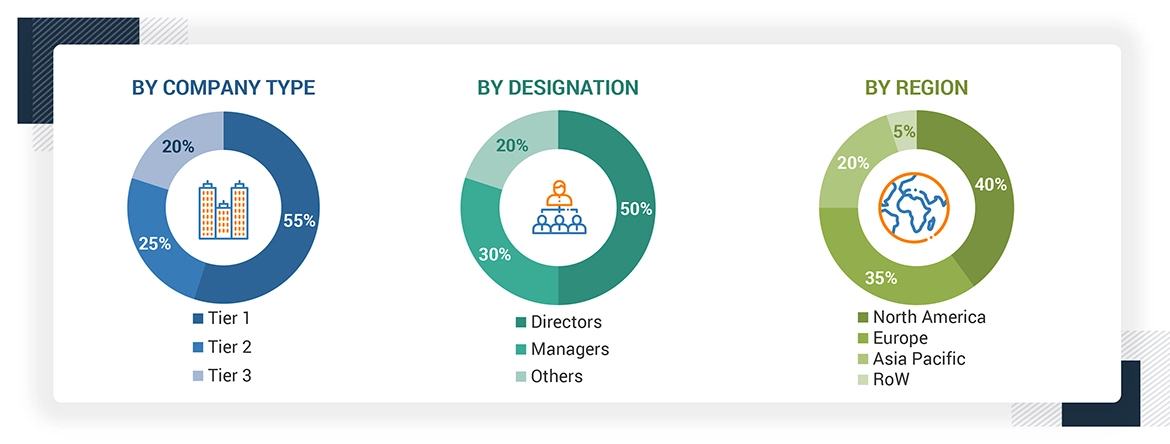
Note: Tier 1, Tier 2, and Tier 3 companies are classified based on their market revenue in 2023/2024, available in the public domain, product portfolios, and geographical presence.
Other designations include consultants and sales, marketing, and procurement managers.
To know about the assumptions considered for the study, download the pdf brochure
| COMPANY NAME | DESIGNATION | |
|---|---|---|
| BASF SE | Senior Manager | |
| Dow Inc. | Innovation Manager | |
| Syensqo SA/NV | Vice-President | |
| Clariant AG | Production Supervisor | |
| Ashland Inc. | Sales Manager | |
Market Size Estimation
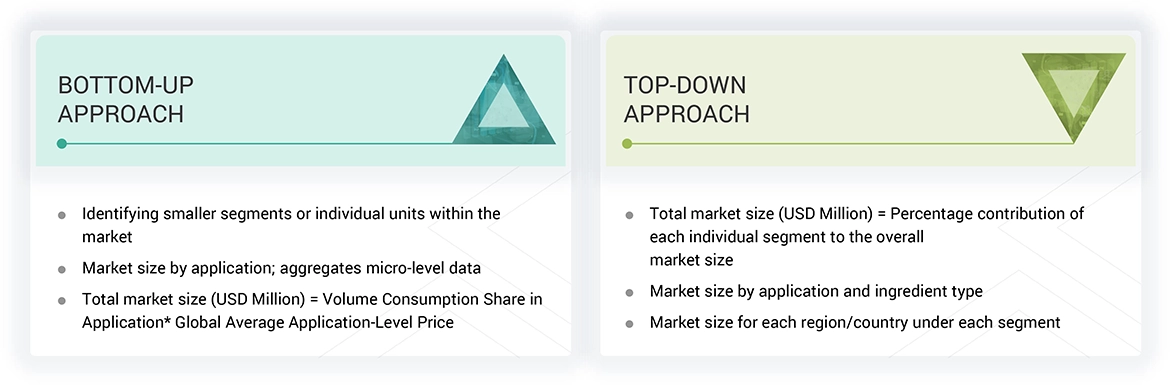
Both top-down and bottom-up approaches were used to estimate and validate the total size of the personal care ingredients market. These methods were also used extensively to estimate the size of various subsegments in the market. The research methodology used to estimate the market size includes the following
- The key players in the industry have been identified through extensive secondary research.
- The supply chain of the industry has been determined through primary and secondary research.
- All percentage shares, splits, and breakdowns have been determined using secondary sources and verified through primary sources.
- All possible parameters that affect the markets covered in this research study have been accounted for, viewed in extensive detail, verified through primary research, and analyzed to obtain the final quantitative and qualitative data.
Data Triangulation
The market was split into several segments and subsegments after arriving at the overall market size—using the market size estimation processes as explained above. Data triangulation and market breakdown procedures were employed to complete the overall market engineering process and arrive at the exact statistics of each market segment and subsegment, wherever applicable. The data was triangulated by studying various factors and trends from the demand and supply sides of the personal care ingredients industry.
Market Definition
The Personal Care Products Council (PCPC) and the Natural Products Association define personal care ingredients as ingredients that come from or are made from a renewable resource found in nature (flora, fauna, mineral) and petroleum compounds sources. For each ingredient, the substance must be listed as Generally Recognized as Safe (GRAS) by the FDA when used in accordance with Good Manufacturing Practices (GMP).
Personal care ingredients are constituents used for manufacturing consumer care products. These ingredients are used in various end-use applications such as skin care, hair care, oral care, and make-up. They provide cleansing, toning, moisturizing, hydrating, exfoliating, conditioning, anti-dandruff, antiperspirants, neutralizing, coloring, perfuming, and styling functionalities to personal care products.
Personal care ingredients include ingredients such as conditioning polymers, emollients, surfactants, rheology modifiers, emulsifiers, hair fixative polymers, antimicrobials, UV absorbers, skin-lightening agents, anti-aging agents, and opacifiers.
Stakeholders
- Personal care ingredient manufacturers
- Personal care ingredient distributors
- Raw material suppliers
- Service providers
- Government and research organizations
Report Objectives
- To analyze and forecast the market size of personal care ingredients in terms of volume and value
- To provide detailed information regarding the major factors (drivers, restraints, opportunities, and challenges) influencing the growth of the market
- To define, describe, and forecast the personal care ingredients market by ingredient type, application, and region
- To forecast the market size, in terms of value, based on regions, namely, Europe, North America, Asia Pacific, South America, and the Middle East & Africa
- To strategically analyze the market with respect to growth trends, prospects, and their contribution to the overall market
- To analyze the opportunities in the market for stakeholders and provide a competitive landscape for market leaders
- To analyze competitive developments, such as expansions, new product launches/ innovations, agreements, mergers & acquisitions, partnerships, and joint ventures, in the personal care ingredients market
- To strategically profile key players and comprehensively analyze their core competencies
Get the Full Personal Care Ingredients Market Report
Full forecast, segment splits, and company analysis for all Personal Care Ingredients Market.
- Mexico Personal Care Ingredients Market
- Canada Personal Care Ingredients Market
- US Personal Care Ingredients Market
- Brazil Personal Care Ingredients Market
- Turkey Personal Care Ingredients Market
- Iran Personal Care Ingredients Market
- Saudi Arabia Personal Care Ingredients Market
- Rest Of Europe Personal Care Ingredients Market
- Rest Of Asia Pacific Personal Care Ingredients Market
- Rest Of South America Personal Care Ingredients Market
- Germany Personal Care Ingredients Market
- France Personal Care Ingredients Market
- UK Personal Care Ingredients Market
- Italy Personal Care Ingredients Market
- Spain Personal Care Ingredients Market
- Poland Personal Care Ingredients Market
- China Personal Care Ingredients Market
- Japan Personal Care Ingredients Market
- South Korea Personal Care Ingredients Market
- India Personal Care Ingredients Market
Need a Tailored Report?
Customize this report to your needs
Get 10% FREE Customization
Customize This Report
