
North America Ring Main Unit Market (2024-2029)

The North America Ring Main Unit Market was valued at $489 Million in 2024 and projected to reach to $641.1 Million by 2029, representing a compound annual growth rate of 5.6%. The North America Ring Main Unit market is positioned for steady growth through 2029, driven by critical infrastructure modernization needs and the transition toward cleaner energy systems.


| Market Size in | USD 26.32 MN |
| Market Forecast in | |
| CAGR | |
| Forecast Period | |
| Units Considered | Value (USD MN) |
North America Ring Main Unit Market Trends and Insights
- North America's Ring Main Unit market is driven by aging electrical infrastructure, increased demand for reliable power distribution, and modernization initiatives across utilities and industrial sectors.
- The region's focus on grid resilience and renewable energy integration is accelerating adoption of advanced Ring Main Unit technologies throughout 2024-2029. North America's market growth reflects substantial investments in smart grid infrastructure and distribution automation.
- Key drivers include regulatory compliance requirements, the transition toward decentralized energy systems, and heightened demand from data centers and manufacturing facilities.
- North America continues to lead in technology adoption, with utilities prioritizing equipment upgrades to enhance operational efficiency and reduce downtime. North America's competitive landscape features both established manufacturers and emerging innovators focused on digital integration and sustainability.
- The forecast period through 2029 indicates sustained momentum as North America balances infrastructure renewal with the integration of renewable sources and grid modernization objectives..
Key Market Statistics
- CAGR (2024-2029) 5.6% CAGR
- Market Size, 2024 ~USD 489 Million
- Forecast, 2029 ~USD 641.1 Million
- Geography North America
North America Ring Main Unit Market Overview
Infrastructure Modernization Drive :
North America's aging electrical grid is spurring significant investment in Ring Main Unit upgrades. Utilities across the US and Canada are prioritizing infrastructure renewal to enhance reliability and reduce outages, creating sustained demand for advanced RMU solutions.
Smart Grid Integration :
The region is witnessing accelerated adoption of smart grid technologies and digital substations. Ring Main Units with integrated monitoring and automation capabilities are increasingly preferred by North American utilities seeking real-time operational visibility and improved asset management.
Renewable Energy Expansion :
Growing renewable energy integration across North America requires flexible and reliable distribution infrastructure. RMUs are critical for managing distributed generation and ensuring stable power flow from wind and solar installations to the grid.
Regulatory Compliance Requirements :
Stringent safety and environmental regulations in the US, Canada, and Mexico are driving utilities to replace legacy equipment with compliant, modern Ring Main Units that meet current standards and reduce operational risks.
North America Ring Main Unit Market Dynamics
- The US dominates the regional market, accounting for the largest share, while Canada and Mexico present emerging opportunities as utilities invest in grid reliability and renewable energy integration.
- Increasing focus on digitalization and predictive maintenance technologies will further accelerate RMU adoption across the region. Key growth catalysts include aging infrastructure replacement cycles, regulatory mandates for grid modernization, and the need for enhanced distribution system flexibility.
- North American utilities are increasingly investing in smart RMU solutions that offer remote monitoring, fault detection, and automated switching capabilities.
- This trend, combined with rising electricity demand and renewable energy targets, positions the region for sustained market expansion at a 5.6% CAGR through 2029..
Market Ecosystem
Related Ecosystem
Power Infrastructure
- Geographical Information System (GIS)
- Cogeneration
- Battery Electric Vehicle (BEV)
- Cellular Network
- Fuel Cell
- ABB India Limited
- Siemens ag
- SCHNEIDER ELECTRIC SE
- General Electric Company
- Eaton Corporation plc
Key Takeaways
- North America's Ring Main Unit market will grow from $489.0M (2024) to $641.1M (2029) at a 5.6% CAGR.
- North America's aging grid infrastructure and modernization mandates are primary growth catalysts for Ring Main Unit adoption.
- North America is prioritizing smart grid and distribution automation investments to enhance grid resilience and renewable integration.
- North America's market is characterized by strong competition between legacy manufacturers and technology-focused innovators through 2029.
Ring Main Unit Market Report Scope
| Report Metric | Details |
|---|---|
| Base Year | 2024 |
| Fastest Growing Segment | AIR-INSULATED (Insulation Type) |
| Forecast Period | 2024-2029 |
| Growth Rate | CAGR of 5.7% from 2024 to 2029 |
| Largest Segment | NON-EXTENSIBLE (Structure) |
| Market Size Base Year (Billions) | ~USD 2.58 (2024) |
| Revenue Forecast (Billions) | ~USD 3.4 (2029) |
| Segments Covered | Position, Insulation Type, Installation, Voltage Rating, Structure, End User |
North America Ring Main Unit Market Report Segmentation
6 segment dimensions are covered across the global market.
By Position
- 3-Position
- 6-Position
By Insulation Type
- Air-Insulated
- Gas-Insulated
- Oil-Insulated
- Solid Dielectric
By Installation
- Indoor
- Outdoor
By Voltage Rating
- 16-25 Kv
- Above 25 Kv
- Up To 15 Kv
By Structure
- Extensible
- Non-Extensible
By End User
- Commercial Buildings
- Distribution Utilities
- Industrial
- Industrial Application
- Industrial Plants
- Transportation Infrastructure
Target Audience
- Utility Companies & Grid Operators : Utilities across North America need market intelligence to plan infrastructure investments, evaluate RMU technology options, and benchmark modernization strategies against regional peers. This data supports capital allocation decisions and grid reliability initiatives.
- RMU Manufacturers & Suppliers : Equipment manufacturers require detailed market sizing and growth forecasts to optimize production capacity, identify distribution channels, and develop region-specific product variants. Country-level data enables targeted sales and marketing strategies.
- Electrical Equipment Distributors : Distributors need comprehensive market data to assess demand trends, manage inventory across North America, and identify growth opportunities in emerging segments. Regional insights support partnership development with utilities and contractors.
- Infrastructure Investment Firms : Private equity and infrastructure investors use market forecasts to evaluate investment opportunities in grid modernization projects and RMU-related businesses. Regional data supports due diligence and portfolio strategy development.
- Consulting & Engineering Firms : Consultants advising utilities and government agencies on grid modernization require credible market data to support recommendations and feasibility studies. Regional market intelligence strengthens client proposals and strategic planning engagements.
Countries within North America - compare and drill down
| Country | 2025 size (native) |
|---|---|
| US | USD 531.9 Million |
| Canada | USD 73.6 Million |
| Mexico | USD 35.5 Million |
Country market size visualization
Reasons to Buy this Report
- Market Size & Growth Trajectory : Access precise valuation data for the North America RMU market ($489.0M in 2024) with detailed forecasts through 2029. Understand regional growth dynamics at 5.6% CAGR to benchmark against global trends and identify expansion opportunities.
- Country-Level Insights : Gain granular market intelligence for the US, Canada, and Mexico with individual market sizing and growth projections. Tailor strategies to each country's unique regulatory environment, infrastructure maturity, and investment priorities.
- Infrastructure Modernization Trends : Identify key drivers reshaping North America's electrical grid, including aging infrastructure replacement, smart grid adoption, and renewable energy integration. Align product development and go-to-market strategies with regional modernization priorities.
- Competitive Positioning : Benchmark your market position against regional competitors and understand the competitive landscape across North America. Identify white space opportunities and assess market consolidation trends specific to the region.
- Strategic Investment Decisions : Make informed decisions on market entry, expansion, or M&A activities in North America with comprehensive market data. Evaluate risk-return profiles by country and identify high-growth segments within the RMU market.
Frequently asked questions
What is the current size of the Ring Main Unit market in North America?
The North America Ring Main Unit market is valued at $489.0 million in 2024 and is expected to reach $641.1 million by 2029.
What is the projected growth rate for Ring Main Units in North America?
North America's Ring Main Unit market is projected to grow at a compound annual growth rate (CAGR) of 5.6% from 2024 to 2029.
What factors are driving Ring Main Unit demand in North America?
North America's Ring Main Unit demand is driven by aging infrastructure renewal, smart grid modernization, renewable energy integration, regulatory compliance, and increased reliability requirements from utilities and industrial users.
Which sectors are the primary consumers of Ring Main Units in North America?
North America's primary Ring Main Unit consumers include utility companies, data centers, manufacturing facilities, and industrial operations requiring reliable medium-voltage power distribution.
How is North America's Ring Main Unit market expected to evolve by 2029?
North America's Ring Main Unit market is expected to evolve toward greater digitalization, enhanced monitoring capabilities, and increased integration with renewable energy systems and smart grid infrastructure by 2029.
RESEARCH METHODOLOGY
This study employed a comprehensive approach to determine the current size of the ring main unitmarket. The process began with an in-depth phase of secondary research, gathering extensive data from the market, related sectors, and the broader industry context. This initial data collection was then rigorously validated through primary research, involving discussions with industry experts across the value chain. Subsequently, market size assessments were performed for each country through tailored analyses, resulting in a detailed market breakdown. These analyses were cross-verified to estimate the sizes of various segments and sub-segments accurately. By integrating both secondary and primary research methods, the study ensures that its findings are accurate and reliable.
Secondary Research
In this research study, a wide array of secondary sources was employed to gather crucial data for a detailed analysis of the global ring main unitmarket. These sources included directories, databases, and reputable references such as Hoover's, Bloomberg BusinessWeek, Factiva, the World Bank, the US Department of Energy (DOE), and the International Energy Agency (IEA). These resources were instrumental in covering technical, market-oriented, and commercial aspects of the market, significantly enriching the study's depth and scope. Additional sources utilized in the research comprised annual reports, press releases, investor presentations, white papers, authoritative publications, articles by esteemed experts, information from industry associations, trade directories, and various database resources. The extensive and diverse secondary sources provided a robust and comprehensive foundation for the research study.
Primary Research
The ring main unit (RMU) market involves a diverse range of stakeholders, including RMU manufacturers, boiler manufacturers, subcomponent manufacturers, manufacturing technology providers, and technology support providers within the supply chain. On the demand side, the market is driven by the increasing need for RMUs in electrical distribution networks. On the supply side, the market is characterized by a growing demand for contracts from distribution utilities, as well as mergers and acquisitions among major industry players. To gather both qualitative and quantitative data, numerous primary sources from both the supply and demand sides of the market were interviewed. Below is a breakdown of the primary respondents:
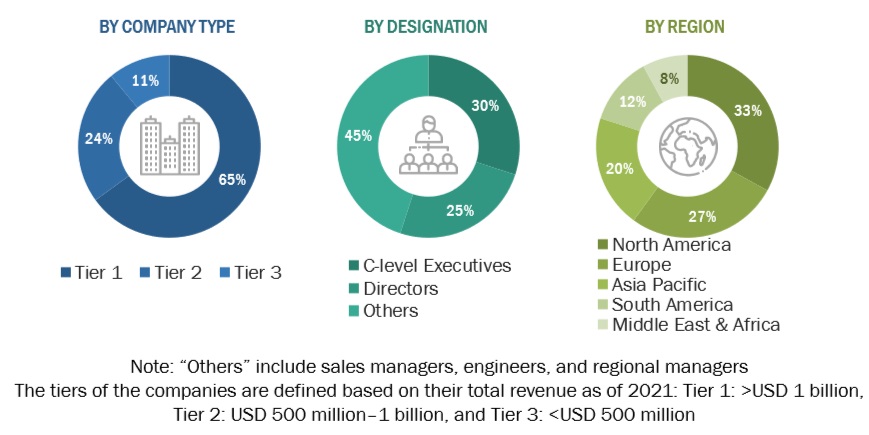
To know about the assumptions considered for the study, download the pdf brochure
Market Size Estimation
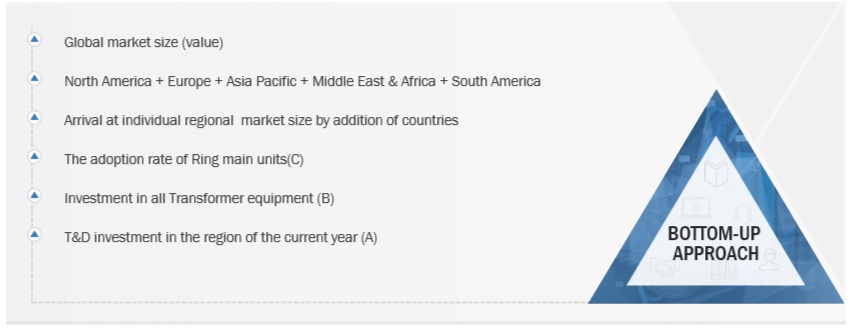
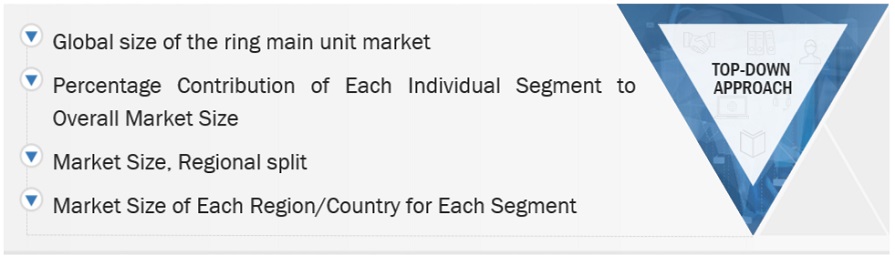
The ring main unit market size has been meticulously estimated and verified through the application of both bottom-up and top-down methodology. Numerous market subsegments were estimated using this method in great detail. The research process includes the following important stages.
- This approach has looked at regional and national manufacturing data for all kinds of ring main units.
- A substantial amount of primary and secondary research has been carried out in order to completely comprehend the state of the global market for different types of ring main units.
- Several primary interviews have been conducted with eminent ring main unit system development specialists, including major OEMs and Tier I suppliers.
- Qualitative aspects like market drivers, constraints, opportunities, and challenges have been considered when assessing and projecting the market size.
Global Ring Main Unit Market Size: Bottom-Up Approach
To know about the assumptions considered for the study, Request for Free Sample Report
Global Ring Main Unit Market Size: Top-Down Approach
Data Triangulation
To determine the overall market size, the study divided the market into various segments and subsegments. Techniques such as data triangulation and market segmentation were used to finalize the comprehensive market analysis and obtain precise statistics for each segment and subsegment. Data triangulation involved a detailed analysis of various factors and trends from both the demand and supply sides within the ring main unit market ecosystem.
Market Definition
A ring main unit (RMU) serves as a vital component in the transmission and distribution of electrical energy, tasked with adjusting voltage levels between circuits within the power grid. Its principal role involves either increasing (stepping up) or decreasing (stepping down) voltage as electricity traverses from power generation plants to end-users, ensuring efficient transmission over extended distances while minimizing energy loss. Power transformers play a pivotal role in linking disparate power networks and upholding the stability and reliability of the electrical supply system. Comprising a magnetic core typically crafted from materials like silicon steel and insulated wire coils or windings, power transformers operate through electromagnetic induction. As alternating current flows through the primary winding, it generates a magnetic field that induces voltage in the secondary winding. The magnitude of the induced voltage is contingent upon the turns ratio between the primary and secondary windings. For example, if the secondary winding has fewer turns than the primary, the resultant output voltage will be lower, thus functioning as a step-down transformer.
Key Stakeholders
- Government Utility Providers
- Independent Power Producers
- Transformer manufacturers
- Power equipment and garden tool manufacturers
- Consulting companies in the energy & power sector
- Distribution utilities
- Government and research organizations
- Organizations, forums, and associations
- Raw material suppliers
- State and national regulatory authorities
- RMU manufacturers, distributors, and suppliers
- RMU original equipment manufacturers (OEMs)
Objectives of the Study
- Based on variables including insulation type, installation, voltage rating, structure, application, the ring main unit market will be defined, categorized, segmented, and projected.
- To estimate market sizes for the major nations in each of these five regions, along with those for Africa, the Middle East, Asia Pacific, North America, and South America.
- To offer comprehensive examinations of the factors influencing market dynamics, as well as industry-specific prospects, limitations, and challenges.
- To methodically evaluate each subsegment's market share, growth patterns, and future prospects.
- To assess market prospects for interested parties and the competitive environment facing industry leaders.
- To develop strategic profiles of the leading companies by carefully analyzing their market shares and key differentiators.
- To keep an eye on and evaluate developments pertaining to competition in the ring main unit market, including partnerships, agreements, sales contracts, joint ventures, product launches, contracts, expansions, and investments.
- This study provides an analysis of the market for ring main units.
Available Customization
With the given market data, MarketsandMarkets offers customizations based on the company’s specific needs. The following customization options are available for the report:
Product Analysis
- Product Matrix, which provides a detailed comparison of the product portfolio of each company
Company Information
- Detailed analyses and profiling of additional market players (up to 5)
Get the Full Ring Main Unit Market Report
Full forecast, segment splits, and company analysis for all Ring Main Unit Market.
- China Ring Main Unit Market
- India Ring Main Unit Market
- Japan Ring Main Unit Market
- Malaysia Ring Main Unit Market
- South Korea Ring Main Unit Market
- Germany Ring Main Unit Market
- France Ring Main Unit Market
- UK Ring Main Unit Market
- Canada Ring Main Unit Market
- Mexico Ring Main Unit Market
- US Ring Main Unit Market
- Saudi Arabia Ring Main Unit Market
- UAE Ring Main Unit Market
- Egypt Ring Main Unit Market
- South Africa Ring Main Unit Market
- Brazil Ring Main Unit Market
- Argentina Ring Main Unit Market
- Rest Of Europe Ring Main Unit Market
- Rest Of Asia Pacific Ring Main Unit Market
- GCC Ring Main Unit Market
- Kuwait Ring Main Unit Market
- Qatar Ring Main Unit Market
- Rest Of GCC Ring Main Unit Market
- Rest Of South America Ring Main Unit Market
Need a Tailored Report?
Customize this report to your needs
Get 10% FREE Customization
Customize This Report
